What is Channapatna Lacquered Toys?
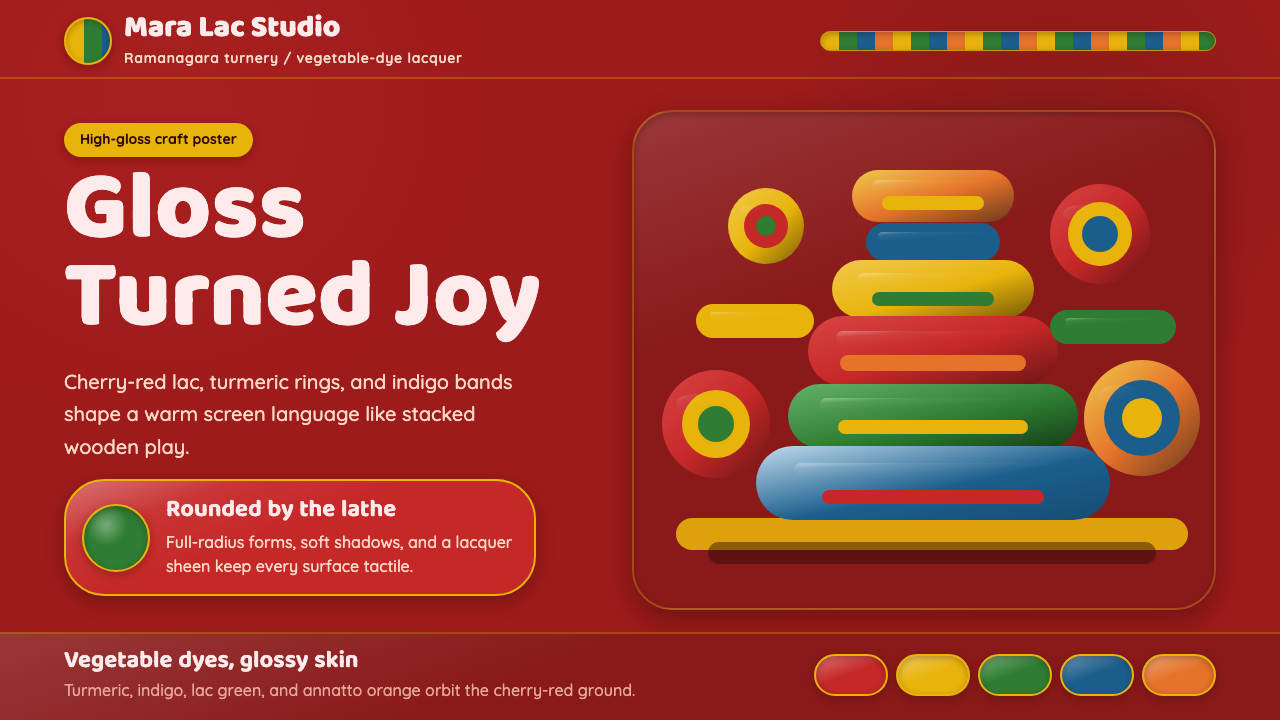
Channapatna toys get their color from friction, not paint — a stick of dyed lac pressed against a spinning lathe melts straight into the wood grain.
Channapatna Lacquered Toys in brief
Channapatna lacquered toys are a Geographical Indication–protected wood-turning craft centered on Channapatna, a small town in Ramanagara district, Karnataka, in southern India, popularly called the 'toy town' of the country. The objects themselves are humble — spinning tops, rattles, stacking rings, chess pieces, fruit and vegetable sets, small figurines and dolls — but every one of them is turned on a lathe from a single block of soft local wood and colored entirely with natural, food-grade lac dye rather than painted.
The defining technique is called lac-turnery. A kharadi artisan — a member of the traditional wood-turning community that has practiced the craft for generations — mounts a roughed-out wood blank on a manually or foot-powered lathe and spins it at speed. Instead of applying pigment with a brush, the artisan presses a solid stick of colored lac resin directly against the spinning surface. Friction generates enough heat to soften the lac, which melts and spreads itself evenly around the turning form; a final pass with a leaf, traditionally screw-pine, burnishes the surface to a hard, glassy shine as it cools. The color is not a surface layer sitting on top of the wood — it is fused into the outer skin of the object itself.
Because the dye and the shaping happen on the same spinning axis, Channapatna work has a distinctive visual signature: color arrives in continuous concentric bands, following the turned contours of the object rather than any drawn or printed pattern. Every silhouette is a lathe silhouette — built from rounded bulges, tapered necks and blunt curved ends, because a lathe simply cannot produce a hard corner. The palette is drawn from a short list of plant and mineral dyes, so even elaborate multicolor pieces read as a small, disciplined set of hues repeating in bands, rather than an open palette.
Where does Channapatna Lacquered Toys come from?
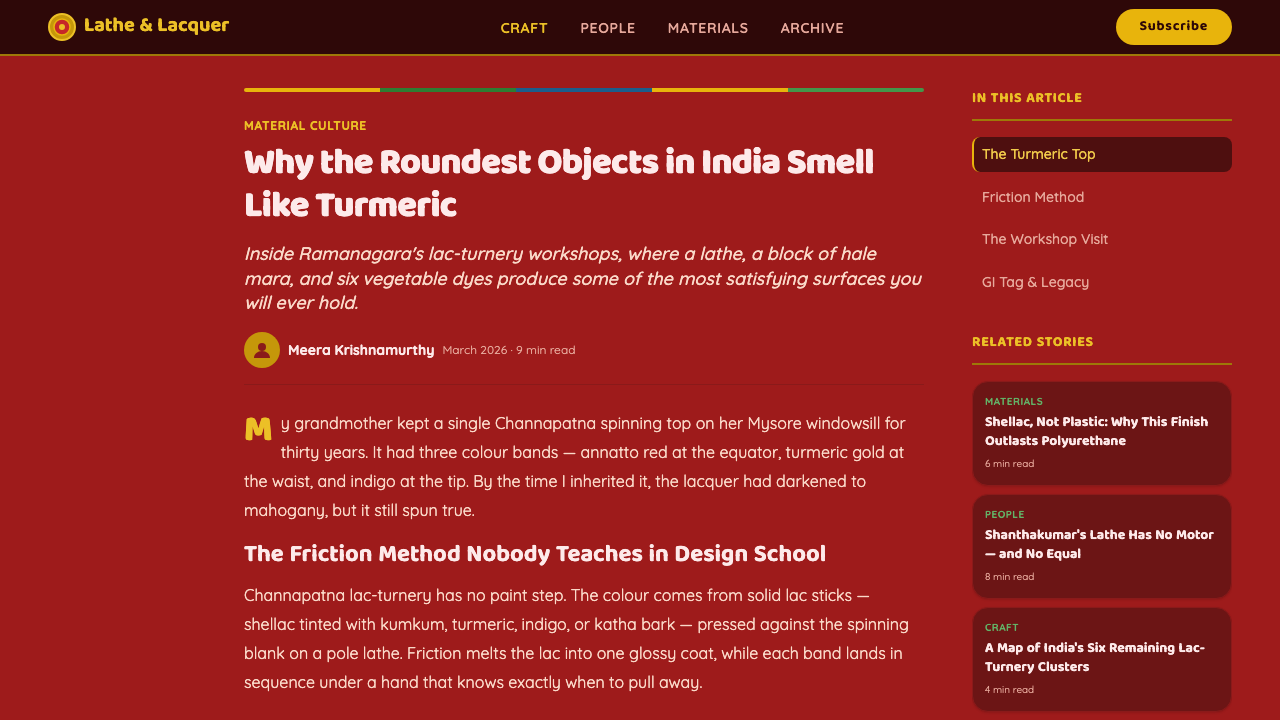
Local tradition in Channapatna credits the craft's introduction to the late eighteenth century and to Tipu Sultan, the ruler of the Kingdom of Mysore, who is remembered locally as having invited Persian craftsmen skilled in lacquer and wood-turning to train artisans in the region. As with many craft-origin stories passed down inside a workshop tradition rather than recorded in contemporary documents, the precise names and dates have blurred into local lore over two centuries; what is well attested is that by the nineteenth century Channapatna had a settled community of kharadi wood-turners producing lacquered wares for regional trade, and that the technique — friction-melted lac dye on a lathe-turned form — is distinctive enough to that stretch of Karnataka that it carries the town's name today.
The wood itself shaped the craft as much as any imported technique. Turners favored a local tree known in Kannada as aale mara — ivory wood, botanically Wrightia tinctoria — prized for being lightweight, close-grained, nearly white, and soft enough to turn cleanly at speed while still holding fine detail. Ivory wood's pale, receptive surface also takes dye far more evenly than a darker or coarser timber would, which is part of why Channapatna colors read as so saturated and clean rather than muddy. As demand grew and the surrounding forest thinned, sourcing sustainable ivory wood became one of the craft's persistent supply pressures, and cooperative plantations and alternate softwoods have been introduced over recent decades to ease it.
The craft's dyes are entirely plant- and mineral-derived: turmeric for yellow, indigo for blue, annatto seed for a red-orange, and katha — extracted from the heartwood of the khair acacia tree, the same catechu used in betel preparations — for brown. These were not chosen for symbolism so much as availability and safety: all four were kitchen and medicine-cabinet materials in the region long before they were toy dyes, which meant they were inexpensive, locally sourced, and, crucially, non-toxic enough to put in a child's mouth. That safety record became a marketing asset in the twenty-first century, when Channapatna's natural-dye toys were repositioned against a wave of imported lead-painted plastic toys as a certified non-toxic, artisan-made alternative.
Formal recognition followed slowly. The Karnataka state government and craft-development bodies organized kharadi turners into cooperative societies through the later twentieth century to stabilize incomes and collective purchasing of wood and lac, and in 2006 Channapatna lacquerware received a Geographical Indication tag from the Government of India, legally restricting the name to toys made by the traditional method in the district. The GI tag did not change the technique, which is still hand-lathe work passed within kharadi families, but it gave the town's toy-makers a protected identity to market against cheaper, mechanized imitations made elsewhere with printed or sprayed color rather than friction-fused lac.
What defines the Channapatna Lacquered Toys look?
Color
The palette is a short, disciplined list of plant-derived hues — a warm turmeric yellow, a deep indigo blue, an annatto red-orange, and a brown drawn from acacia heartwood — set against lac grounds that range from a deep glossy cherry red to near-black. Because every color is fused rather than layered, hues read as dense and saturated rather than pastel, and a finished piece rarely uses more than three or four of them at once, keeping the palette legible instead of decorative.
Form
Every silhouette begins on a lathe, so every silhouette is built from turned curves: rounded bulges, tapered waists, blunt domed caps, no flat planes and no sharp corners anywhere. This gives the whole visual language an inherently soft, toy-like geometry — full, generous radii rather than the crisp right angles of printed or cut design work.
Banding
Because the dye stick is held against a spinning surface, color arrives as continuous rings running around the object's circumference rather than as a drawn or printed pattern. The bands follow the object's turned contours exactly, so a wider band sits on a wider part of the form and a narrow band on a narrow neck — pattern and shape are locked to the same physical process.
Surface and Gloss
The friction-melted lac cools into a hard, glassy, high-gloss finish, close in feel to a lacquered or shellacked surface rather than a matte painted one. Light catches on the curved turned forms as a bright, rolling highlight rather than a flat sheen, which is part of what reads as 'handmade' rather than manufactured.
Composition
Pieces are typically presented singly or in small stacked or nested sets — rings threaded on a dowel, a stack of graduated beads, a family of fruit shapes — so composition tends toward simple repetition of one turned form at different sizes, rather than an assembled scene of varied objects.
Typography (as translated into a digital system)
Carried into a digital system, the craft's warmth and roundness push toward a friendly, generously rounded display letterform with soft terminals rather than sharp serifs or a rigid geometric sans — type that echoes the same lathe-turned fullness as the toys themselves, paired with full, toy-radius corners on interface shapes.
Who shaped Channapatna Lacquered Toys?
Local tradition in Channapatna attributes the craft's introduction to the late eighteenth-century court of Tipu Sultan, ruler of Mysore, who is remembered as having brought in Persian artisans skilled in lacquer and wood-turning to train the region's turners. The specifics have blurred into oral history over two centuries and are treated locally as founding lore rather than documented record, but the account is the one most consistently repeated as the craft's origin story.
The kharadi are the traditional caste of wood-turners who have practiced the lathe trade in and around Channapatna for generations, typically working from small family workshops where the skills of turning, dyeing, and lac application pass from parent to child rather than through formal training. They remain the craft's living carriers today.
Through the later twentieth century, kharadi turners organized into cooperative societies to pool wood and lac purchasing and stabilize incomes; these cooperatives led the push that won the craft its 2006 Geographical Indication tag, which legally reserves the Channapatna name for toys made by the traditional lathe-and-lac method in the district.
Channapatna sits within a broader regional tradition of lac-turned wooden ware across Karnataka, in which friction-fused vegetable dye on a spinning lathe is used not only for toys but for bangles, kitchenware, and small decorative objects — Channapatna is simply the tradition's most concentrated and best-known center.
The broader practice of coloring turned wooden toys exclusively with plant- and mineral-derived lac dyes — rather than painted pigment — is what gives Channapatna work its reputation for being naturally non-toxic, a quality that became central to how the toys are marketed today.
How do you use Channapatna Lacquered Toys today?
Channapatna's visual logic is built entirely from a manufacturing constraint turned into style — a lathe cannot cut a corner, and dye cannot be printed, only fused in rings — so applying it well means preserving that discipline rather than just borrowing the color palette. The strongest results keep forms rounded throughout, keep color arriving in bands rather than gradients, and keep the palette to three or four saturated hues at most.
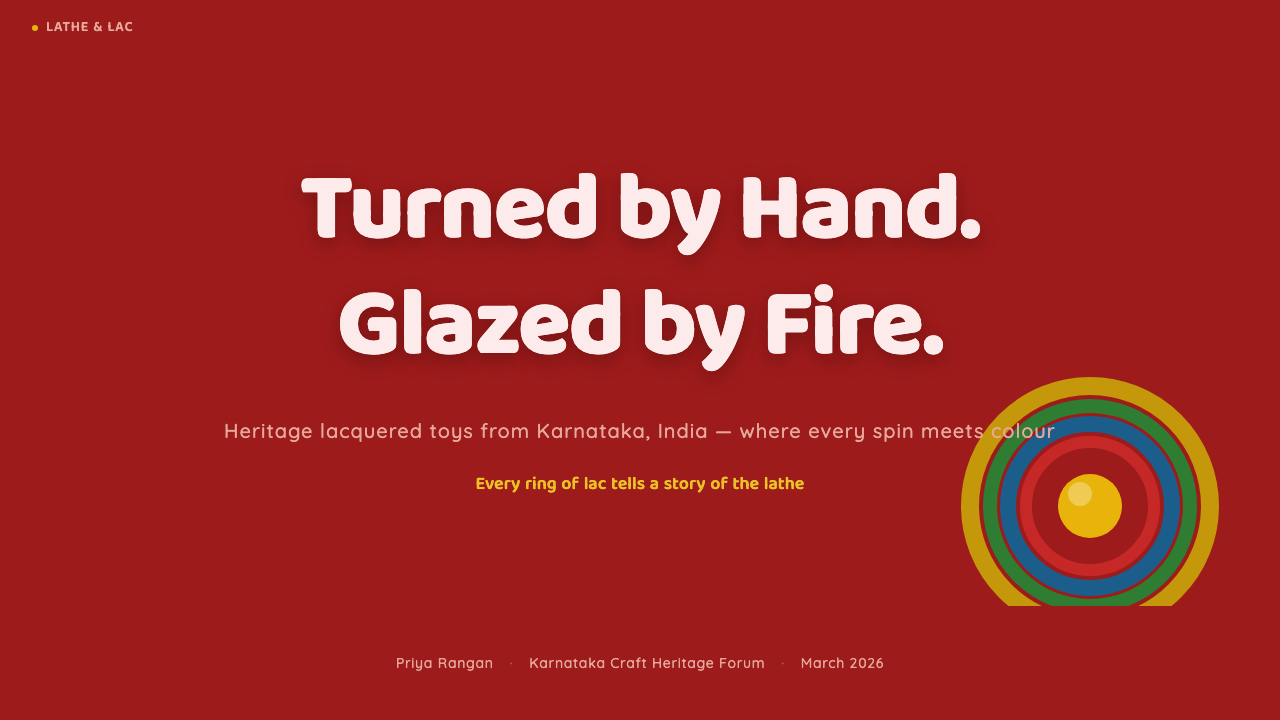
On presentation slides, the style suits a cover built around one dominant lac-ground color with a single toy-like rounded shape anchoring a corner, title type set in the same warm rounded letterform the system carries. Content slides work best organized around one clear rounded 'frame' element repeated across the deck — think of it as the digital equivalent of the stacked toy set — with body text kept short and set at a comfortable, generous size rather than dense. Data slides can borrow the banding idea directly: bar and ring charts rendered as concentric or stacked bands in the turmeric-indigo-red palette read as native to the system rather than bolted on.
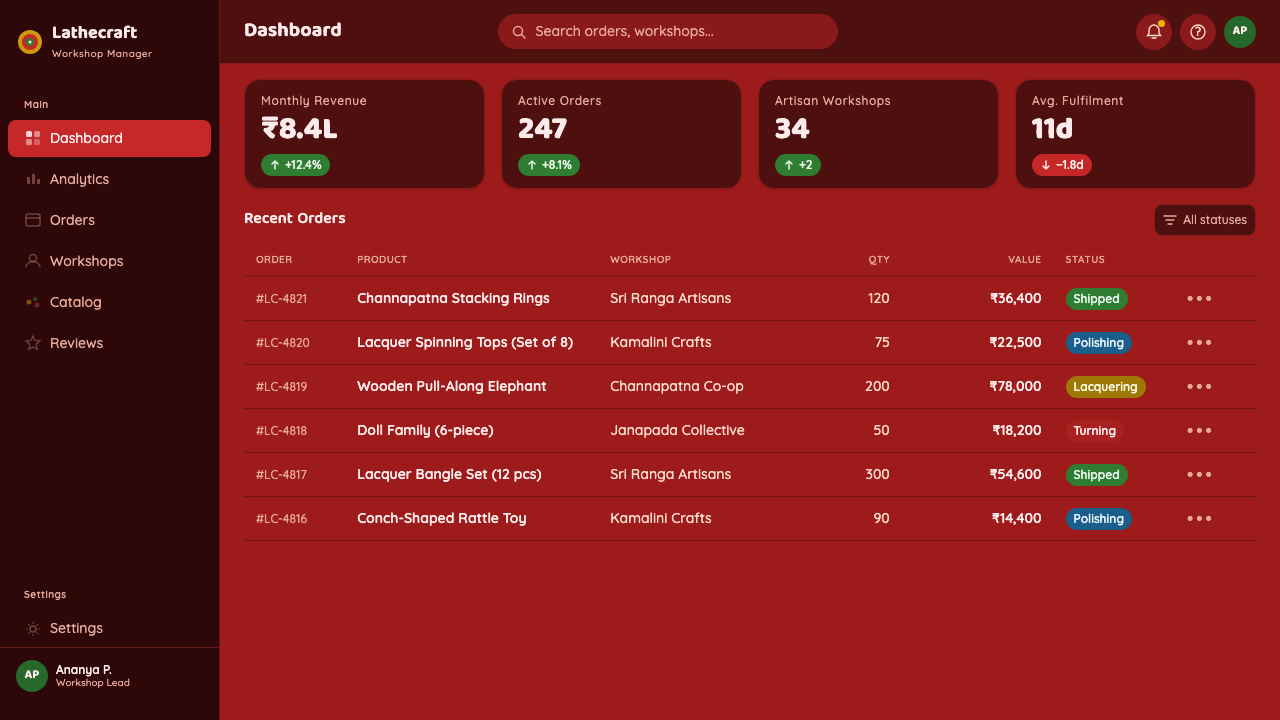
For web interfaces, the style's warmth and roundness suit consumer, education, and children's-product dashboards more naturally than enterprise software — anywhere a friendly, tactile, handmade feeling is an asset rather than a distraction. Buttons and cards should carry generous, toy-like rounded corners rather than a light corner radius, and hover or active states can borrow the banding motif as a colored ring or underline rather than a flat highlight. Pricing pages benefit from treating each tier as a distinct 'turned object' — a rounded card in one dominant hue — rather than a uniform grid of identical boxes.
In editorial and marketing contexts, the style photographs and illustrates well around craft, sustainability, and handmade-goods narratives — gift guides, maker-economy features, children's product marketing, cultural-heritage storytelling. Layouts that give a single rounded shape or product photograph room to breathe against a deep lac-colored ground, with banded color used as a section divider instead of a straight rule, carry the tactile feeling furthest. Marketing pages work well with warm, saturated field colors used the way the toy's lac ground is used — as the dominant color of the whole composition, not a background afterthought.
The most common mistake is treating this as a generic 'bright folk-color' palette and pairing it with sharp corners, straight dividers, or a cool geometric sans — any hard-edged element breaks the illusion immediately, because the entire visual logic of Channapatna work comes from the fact that nothing in it could have been cut with a straight edge. A second frequent error is scattering many hues evenly across a layout; authentic pieces stay disciplined, usually leading with one dominant lac ground and letting the turmeric and indigo bands function as accents rather than equal partners.
Channapatna Lacquered Toys — FAQ
Is Channapatna lacquerware painted or dyed?
Neither, exactly — it is dyed, but not with a brush or a spray. A stick of solid lac resin, pre-colored with a vegetable dye, is pressed against the wood while it spins on a lathe; friction heat melts the lac and spreads it around the surface, where it cools into a hard, glossy, fused coating. Because the color fuses into the outer layer of the wood rather than sitting on top of it as a paint film, it does not flake or chip the way painted toys do.
Why does the craft use only a handful of colors?
Because every color has to come from a natural, food-safe source that can be worked into a solid lac stick — turmeric, indigo, annatto, and acacia-derived katha cover yellow, blue, red-orange, and brown, and combinations of these produce the rest of the range. The limitation is partly practical (these were the safe, available dyes) and partly what gives the craft its visual discipline: a small palette repeated in confident bands reads as more controlled than an open one.
Why are all the shapes so rounded?
Because every object is shaped on a lathe, which removes material by spinning it against a fixed cutting tool — a process that is physically suited to curves, tapers, and radii, and simply cannot produce a flat plane or a sharp corner. The rounded, bulbous silhouette associated with Channapatna toys isn't a stylistic choice layered on afterward; it's a direct consequence of how the object was made.
What is the wood, and why does it matter?
Most traditional Channapatna work uses a local tree known in Kannada as aale mara, or ivory wood (Wrightia tinctoria) — a soft, fine-grained, pale timber that turns cleanly at speed and absorbs dye far more evenly than a darker or coarser wood would. That even absorption is part of why the colors look so clean and saturated rather than blotchy, and it's one reason the craft is tied so specifically to its home region, where the tree traditionally grew.
Is 'Channapatna' a protected name?
Yes. Since 2006 it has carried a Geographical Indication tag from the Government of India, which legally restricts the name to toys made in Ramanagara district by the traditional lac-turnery method. The tag was pursued partly to distinguish genuine hand-lathe, natural-dye toys from cheaper, mass-produced imitations using printed or sprayed color.
Related design styles
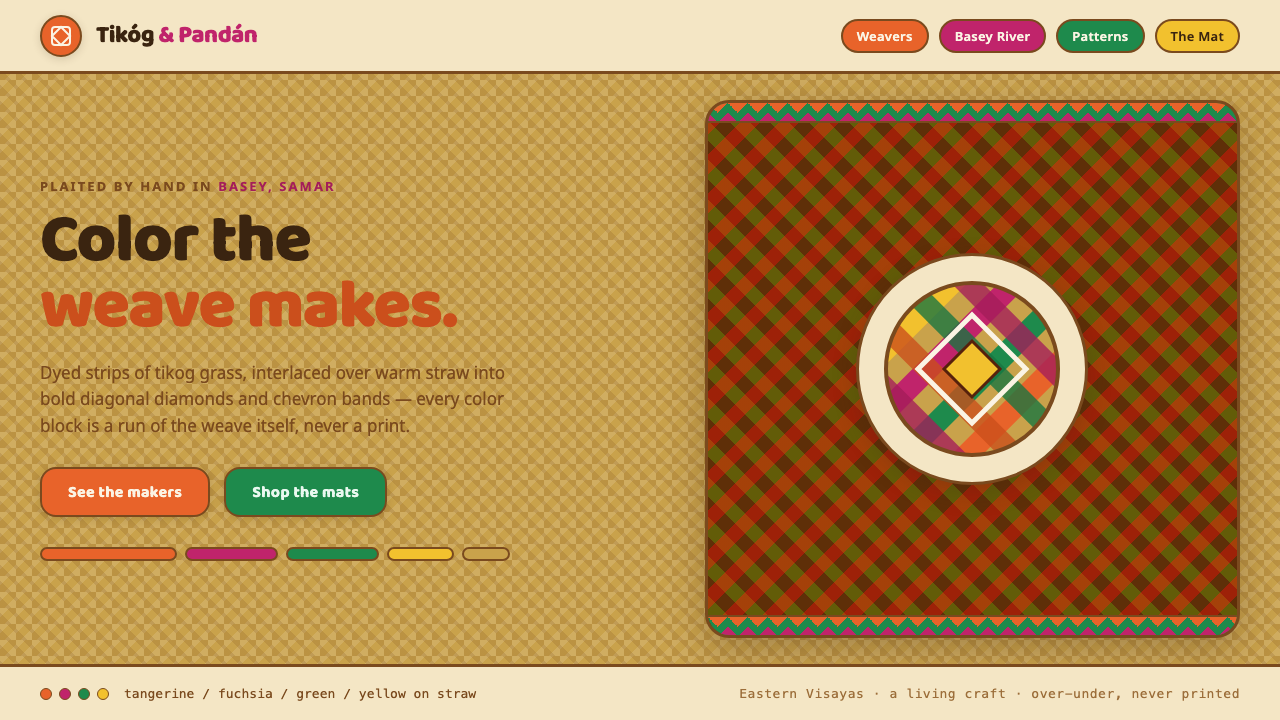 Banig Pandan MatHandwoven Filipino joy. Tangerine, fuchsia and green strips plaited into diag…
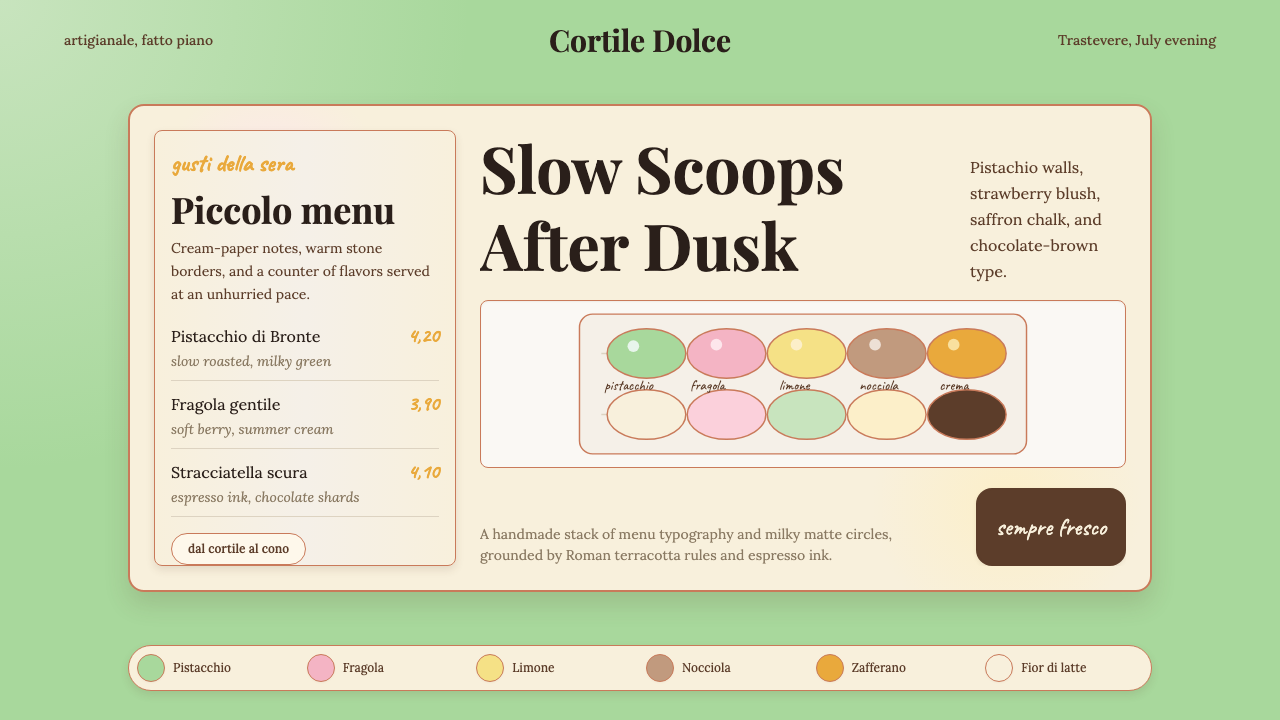 Italian Gelato ShopWarmth is hand-scooped. Pistachio green, cream panels, high-contrast serif, c…
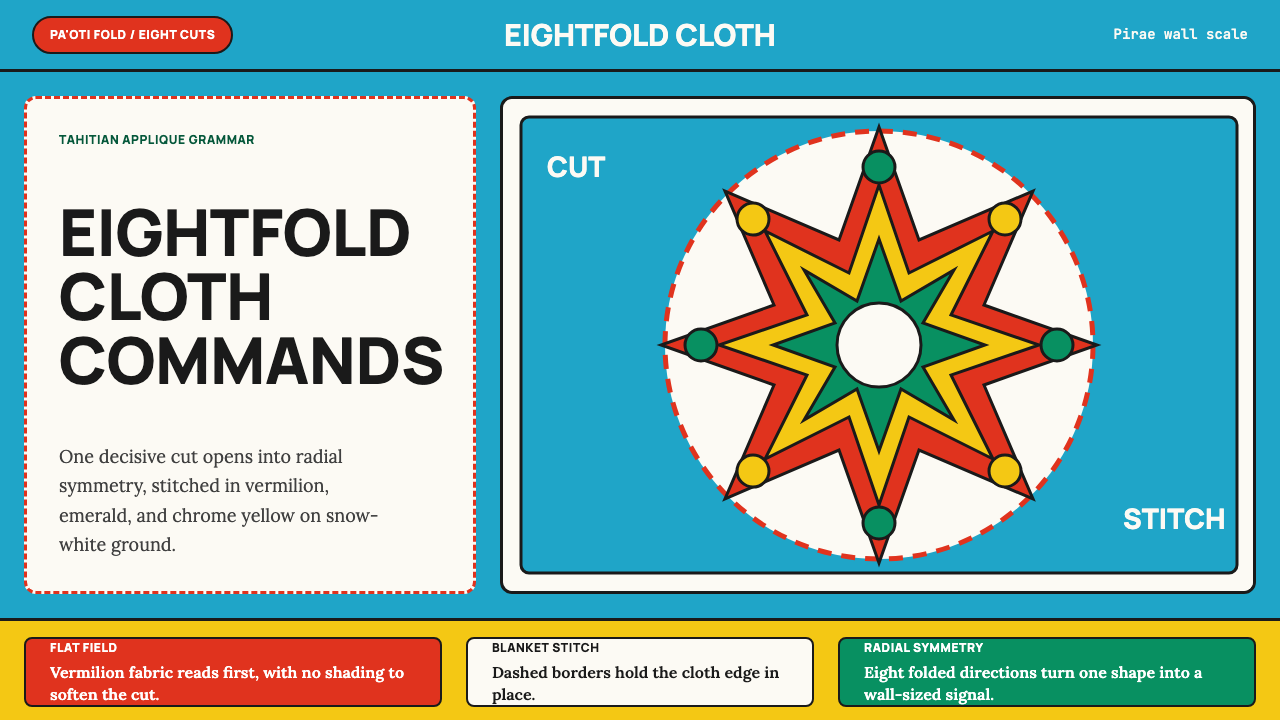 Tahitian Tifaifai (Appliqué Quilt)Flat fields command the room. Vermilion radial applique sits on Pacific cyan…
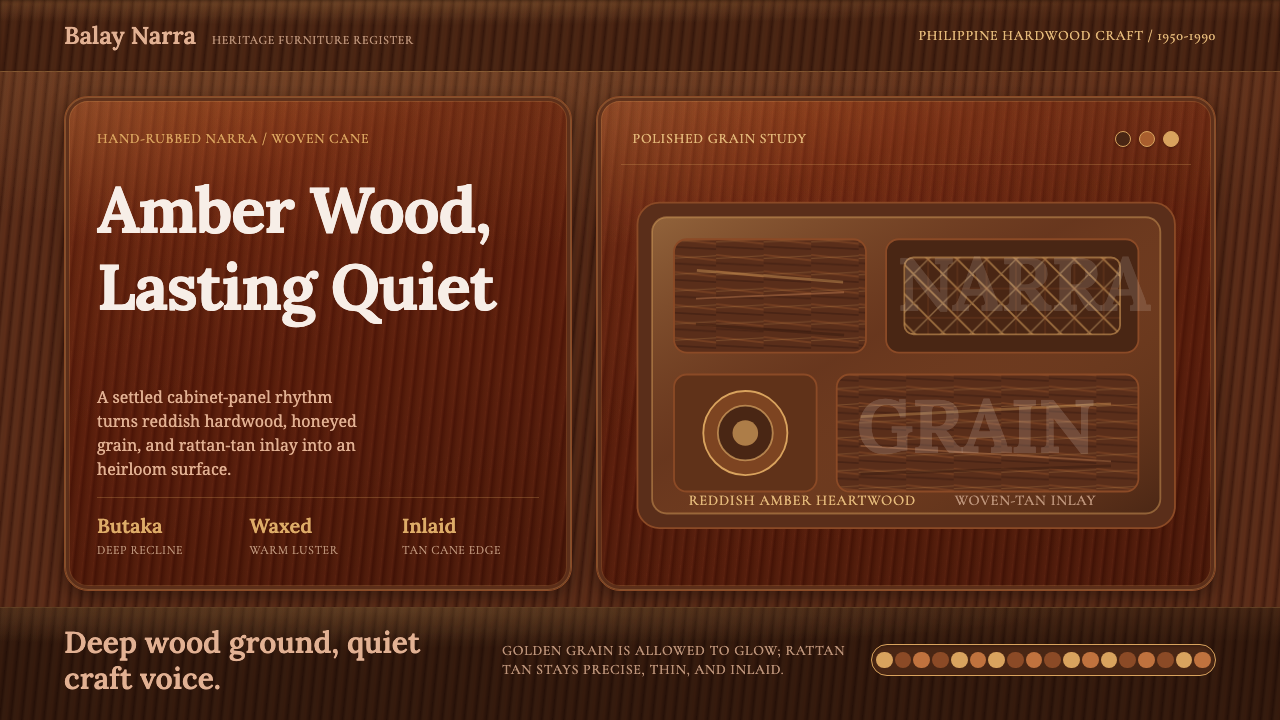 Filipino Narra HardwoodPolished heritage, held in shadow. Reddish hardwood grain meets thin rattan-t…
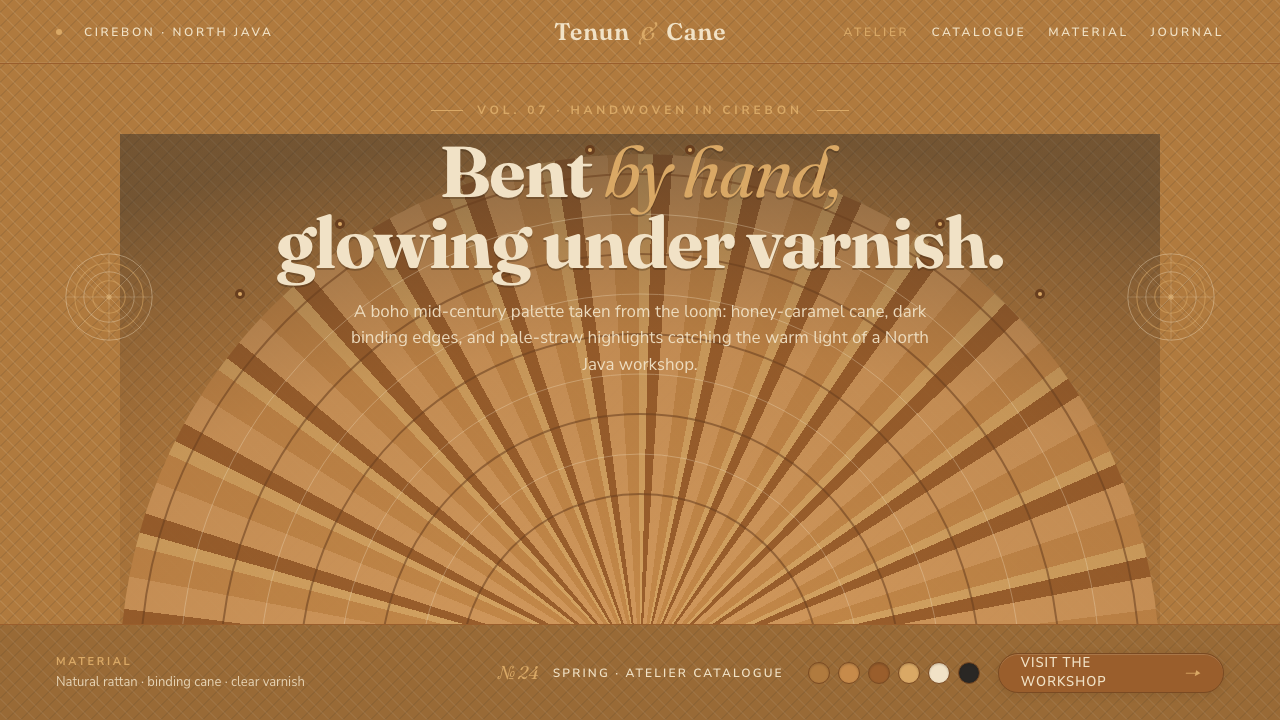 Indonesian Rattan WeaveBent by hand, varnished warm. Honey-caramel cane and dark binding edges over…
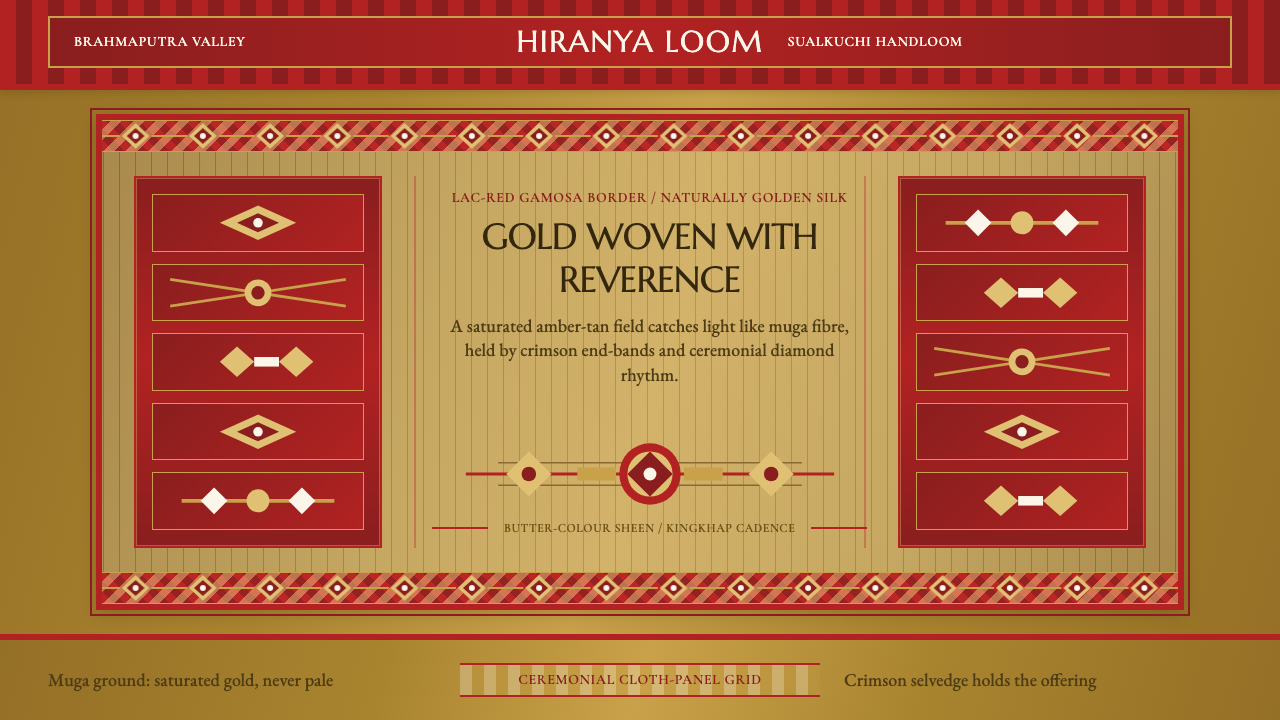 Assam Muga Silk & GamosaWarm ceremony in silk. Muga gold sheen meets crimson borders and woven diamon…