What is Busójárás Mask?
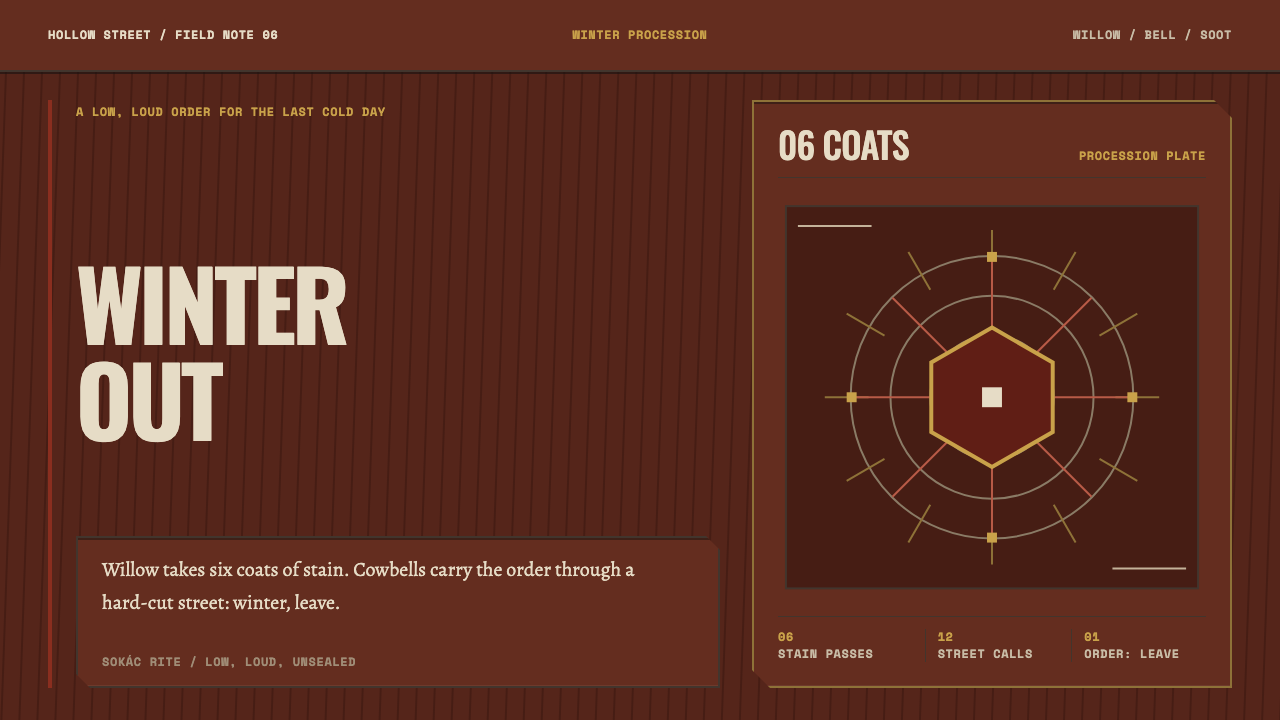
Busójárás turns the end of winter into something you can see and shout at — a willow mask darkened with pig's blood, real horns, and a surface that is never polished and never symmetrical.
Busójárás Mask in brief
Busójárás is the end-of-winter carnival of Mohács, a town on the Danube in southern Hungary, held in the days before Lent. Men dressed as busós pull on inside-out sheepskin, strap a cowbell to the belt and put on a mask carved from willow, then march through the town making as much noise as possible to drive the cold season out. The name pairs the masked figure, the busó, with the Hungarian word for a walk or procession.
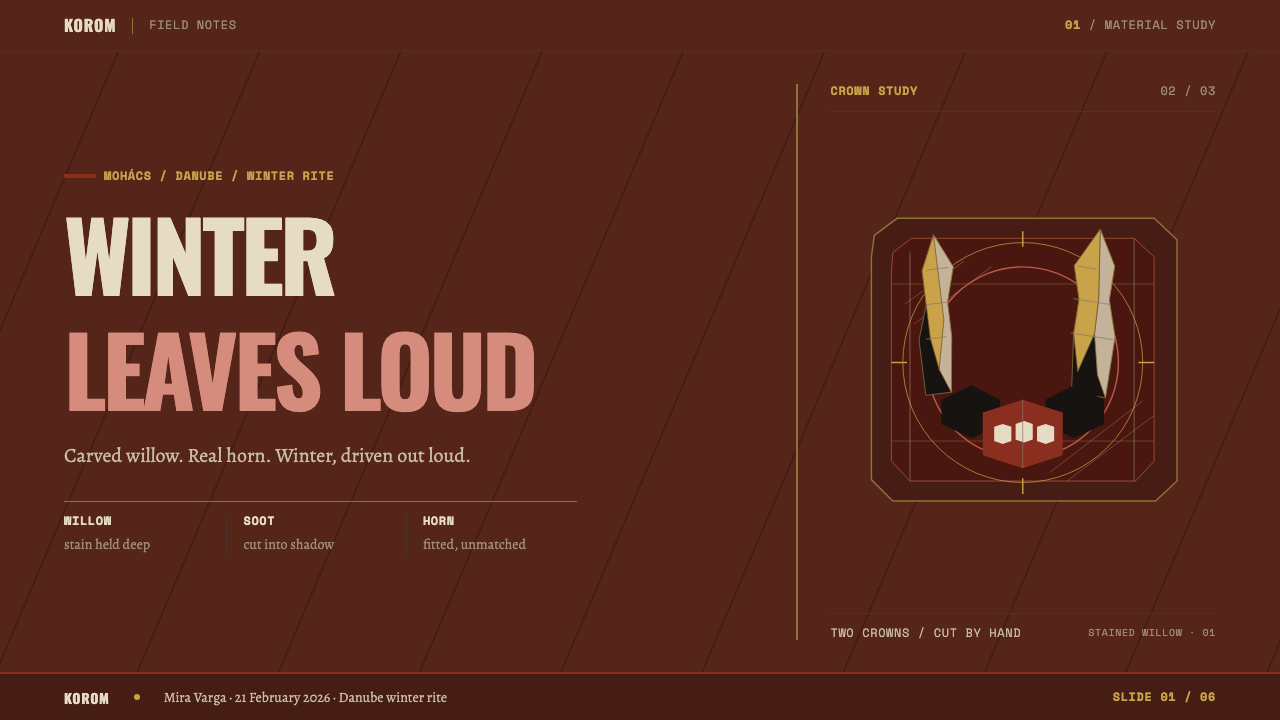
The mask is the centre of the image. A face is carved from willow and coated again and again in pig's blood, five or six times, until the wood goes a matte, dark oxblood. The eye sockets and beard are smoked black with soot, the teeth are left white, and the horns on top are real: ram, Racka sheep, goat. No two crowns match, and no mask is symmetrical. These are not devils. They are a ritual force sent out to banish winter.
As a design language, the style takes that surface literally. The ground is stained wood, not black. Every edge is a gouge cut, never a rounded fillet. Type is condensed and shouted, proportions are heavy and low, and nothing is sealed, polished or symmetrical. Wood grain, soot, greasy wool curls and straw supply the material vocabulary, and the colour comes down to oxblood, soot-black, bone-white teeth and the pale warmth of unwashed fleece. It is a dark style whose darkness has texture and a reason.
Where does Busójárás Mask come from?
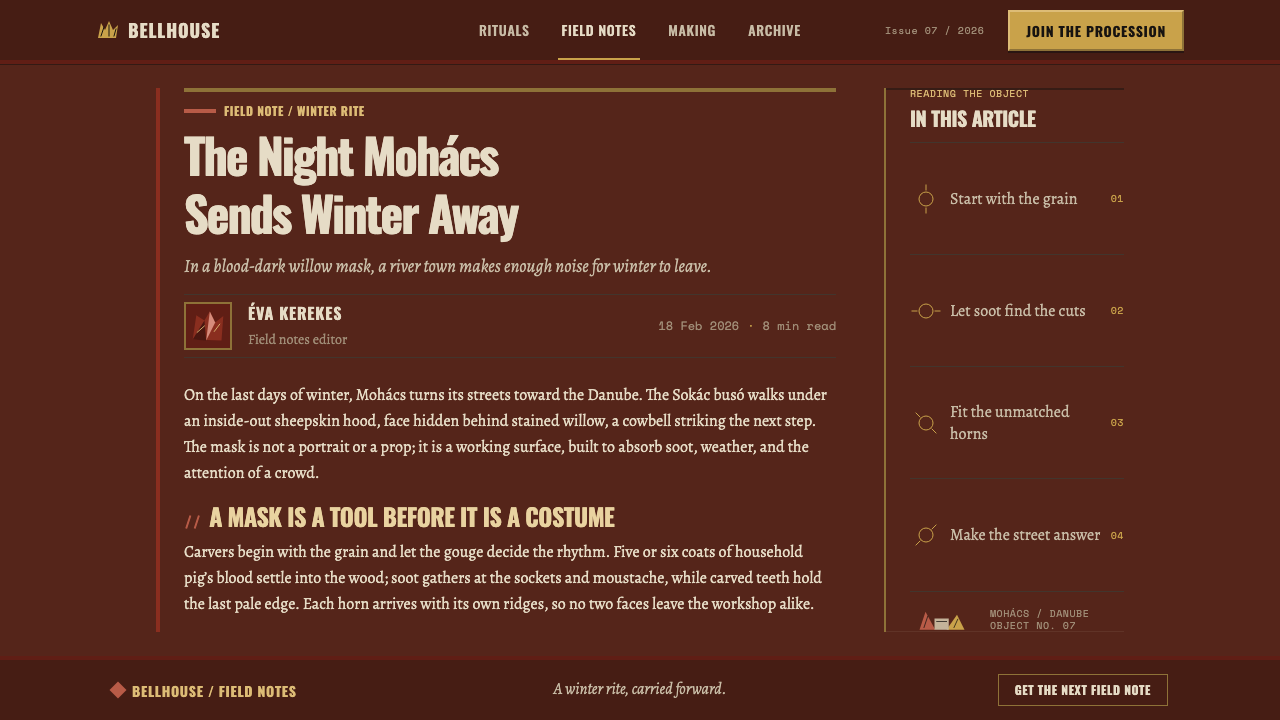
Busójárás is a folk custom older than 1900 that has continued without a break to the present day. It belongs to the Sokác community of Mohács, a South Slavic community on the Danube, and it sits within a wider family of Central European masked winter-banishing rites, in which loud and frightening figures are sent through a village to drive out the cold. A popular local legend says the first busós were villagers who scared off invaders with fearsome masks. Whatever its historical truth, the story explains why the faces are built to alarm rather than to charm.
The calendar fixes the shape of the event. The carnival opens six days before Lent, and the busós move through the town in groups, their cowbells rolling together into a sound that matters to the custom as much as the masks matter to the eye. The sheepskin coat is worn with the wool turned outward, so the whole body becomes a mass of fleece, and the black-rimmed eyes, white teeth and curved horns of the mask sit on top of it. The custom marks the turn out of the winter season, and its energy is rowdy and celebratory rather than sinister.
Making the mask is a craft with its own discipline. Willow is cut with gouges and chisels, so the planes of the face stay faceted and tool-marked. Blood is built up in coat after coat, which is why the finish is dark, dull and absorbent rather than lacquered. Soot defines eyes and beard, the teeth are left as pale wood, and the horns come from real animals, so the crown of every mask is a different asymmetrical object. Heilmann János, Pákovics Péter, Baráth Gábor and Prókai György are the names tied to the Mohács tradition, part of the line of makers and keepers who have kept that craft alive.
In recent years the custom has gained formal recognition. UNESCO placed Busójárás on its Representative List of the Intangible Cultural Heritage of Humanity in 2009, and Hungary named it a Hungarikum, a national treasure, in 2013. The masks have become emblems of Mohács and of Hungarian folk culture. For designers, those honours carry a responsibility: the mask belongs to a living community and a living ritual, not to generic horror or fantasy imagery, and the most respectful way to borrow from it is to take its surface logic seriously.
What defines the Busójárás Mask look?
Stained Wood Ground
The ground is not black. It is the colour of willow soaked in blood: a dark, matte oxblood brown that absorbs light instead of reflecting it. Dark surfaces in this style carry warmth and a faint red-brown cast, and they look like wood that has been handled, not like a screen that has been switched off. Large areas stay quiet so that pale elements stand out sharply against them.
Palette of Blood, Soot and Bone
Colour is limited to what the mask and costume are made of: oxblood for the wood, soot-black for the eye sockets and beard, bone-white for the teeth, the warm cream of unwashed wool and the dull gold of straw. Contrast is high but never glossy; the strongest relationship is dark against bone-white, the way teeth flash in a darkened face. Nothing is neon and nothing is pastel.
Gouge-Cut Edges
Edges are cut, not rounded. Each shape looks as if a gouge removed it in a few decisive strokes, leaving flat facets and slightly irregular corners. Rounded corners and soft pill shapes do not belong here. Where the style needs a corner, it uses a chamfer or a notch; where it needs a divider, it uses a rough scored line.
Shouted Condensed Type
Headlines are set in tall, narrow, heavy letters, usually capitals, packed tightly so they read like a yell rather than a statement. Body copy stays plain and legible, but the display voice is loud and compressed. Titles are allowed to be big and to crowd the space; the contrast between a shouted title and quiet supporting text is the typographic structure of the whole system.
Heavy, Low Proportions
Forms are wide and squat, closer to straw-stuffed trousers than to a slender figure. Blocks of content sit low and broad, with generous padding and short, stocky shapes. Vertical stretch is avoided; mass sits near the ground, and the weight of the composition falls toward the bottom.
Unsealed Materials
Wood grain, soot smudges, greasy wool curls and straw are the textures, and none of them is sealed, varnished or polished. Surfaces are matte and slightly absorbent. Highlights, glass effects, soft shadows and glossy reflections all contradict the material logic. When texture is used at all, it should look like something real that has been touched, not like a filter laid on top.
Deliberate Asymmetry
No two horns match and no mask is mirrored. In layout terms, asymmetry is a rule, not an accident: columns of unequal width, elements offset from the centre line, one oversized block balanced by a cluster of smaller ones. Perfect mirroring and rigid symmetry make the style feel manufactured; the irregularity is what keeps it feeling carved.

Who shaped Busójárás Mask?
Heilmann János is one of the names tied to the Mohács mask tradition. The Hungarian convention puts the family name first, and this name appears among those connected with the craft of the Busójárás mask. Whatever the individual biography, the work this lineage of makers repeats year after year is the same set of decisions that define the style: how deep to cut a brow, when to stop the gouge, how many coats of blood the wood will take.
Pákovics Péter is another name recorded among the key figures of the Busójárás tradition. What a maker in this line demonstrates is a mask built from specific, found materials: willow for the face, soot for the sockets, real horns for the crown. The result is a face whose power comes from the material itself rather than from an imitation of it, which is the principle a design system should follow when it claims the same look.
Baráth Gábor is also counted among the figures of the tradition. The lesson of the lineage he belongs to is that the mask and coat are built to be worn through a loud, physical, crowded week. They are heavy, rugged and readable at a distance. In design terms that means robust, large-scale shapes and clear silhouettes, not delicate detail that disappears when the crowd moves.
Prókai György completes the group of names usually cited with the Mohács tradition. The point his lineage makes is continuity: the mask is not a museum object but something worn every year, so makers renew the same forms while letting every crown differ. In a design system this is the principle of a fixed vocabulary with real variation: keep the rules, vary the individual pieces.
How do you use Busójárás Mask today?
Busójárás is among the most distinctive dark styles in the library, because its darkness is made of a specific material rather than of a generic night mode. To apply it correctly, think of an interface as carved and stained wood: heavy, matte, tool-marked and loud.
For presentation slides, a cover works with a stained-wood ground, a title in tall condensed capitals set large and tight, and one bone-white block or notch cut into a corner. Content slides can be built from broad, low blocks of unequal width, with one shouted heading and quiet supporting text. Data slides suit thick bars with squared-off, cut ends and no rounded caps, a single bone-white or straw accent for the series that matters, and coarse scored lines in place of delicate gridlines.
For web interfaces, the style suits festival and event sites, craft and heritage brands, music and nightlife, game and community products, and dashboards that want a heavy, tactile identity. Use the stained-wood tone for backgrounds, keep corners chamfered rather than rounded, and replace soft card shadows with flat, heavy edges. Buttons should be blunt blocks with condensed capital labels, and pricing tiers can be three planks of unequal height. Avoid glass, blur and gradients; they break the material logic.
For editorial and marketing work, the style gives folklore features, regional festival coverage, craft brands and food-and-drink campaigns a strong, earthy voice. Headlines can shout, pull quotes can be set in oversized condensed capitals, and photography works best when it is grainy, high-contrast and unretouched. Long-form pieces should keep body text calm and readable so the loud display type has something to contrast with.
The most common mistake is to read the style as horror or Halloween. The busó is not a demon; it is a ritual figure that chases winter out of town, and the mood is rowdy and celebratory rather than sinister. A second mistake is using pure black as the ground, which erases the warm stained-wood character, or adding glossy highlights and soft shadows, which make the wood look lacquered. Do not mirror the layout either; symmetry is the one thing a hand-carved mask never offers. And treat the origin with care: credit Mohács, and avoid caricature.
Busójárás Mask — FAQ
Is Busójárás a Halloween or horror style?
No. The masks are frightening in a ritual sense, built to scare winter away, but the festival is a communal, noisy, celebratory event. The busó is not a demon. A faithful design treatment keeps the weight, the roughness and the volume, and leaves out the horror clichés: dripping red, glowing eyes, cobwebs and gore.
Why use stained wood instead of black for the dark theme?
Because the darkness of the mask is a surface, not an absence. Willow coated in blood goes a matte, warm oxblood, and soot adds black only where it is needed, around the eyes and beard. A pure black ground reads as a switched-off screen and flattens everything placed on it. A stained-wood ground gives pale elements something warm and material to stand against, and keeps the style from sliding into generic dark mode.
Can the style work on a light background?
The library's version is dark, but the material palette allows a light variant: a pale, unbleached wool or straw-cream ground, with oxblood and soot as the ink, and the same chiselled shapes and shouted type. The test is whether surfaces stay matte and edges stay cut. If a light version starts to look glossy, rounded or symmetrical, it has left the style behind.
How rough is too rough for readability?
Roughness belongs in shapes, edges and surfaces, not in the text people have to read. Keep body copy plain, adequately sized and high in contrast against the stained ground, and let the condensed display type do the shouting only in short headings. Texture overlays should sit behind content, never through it. If a paragraph needs effort to decipher, the roughness has gone too far.
What does the name refer to, and how should it be credited?
Busójárás is the name of the Mohács end-of-winter carnival, and a busó is one of its masked participants. It is a living custom of the Sokác community, recognised by UNESCO in 2009. Use the name accurately, credit Mohács where the context allows, and avoid turning the mask into a generic monster or costume motif. Borrowing the surface logic of the craft is welcome; reducing a community ritual to a theme is not.
Related design styles
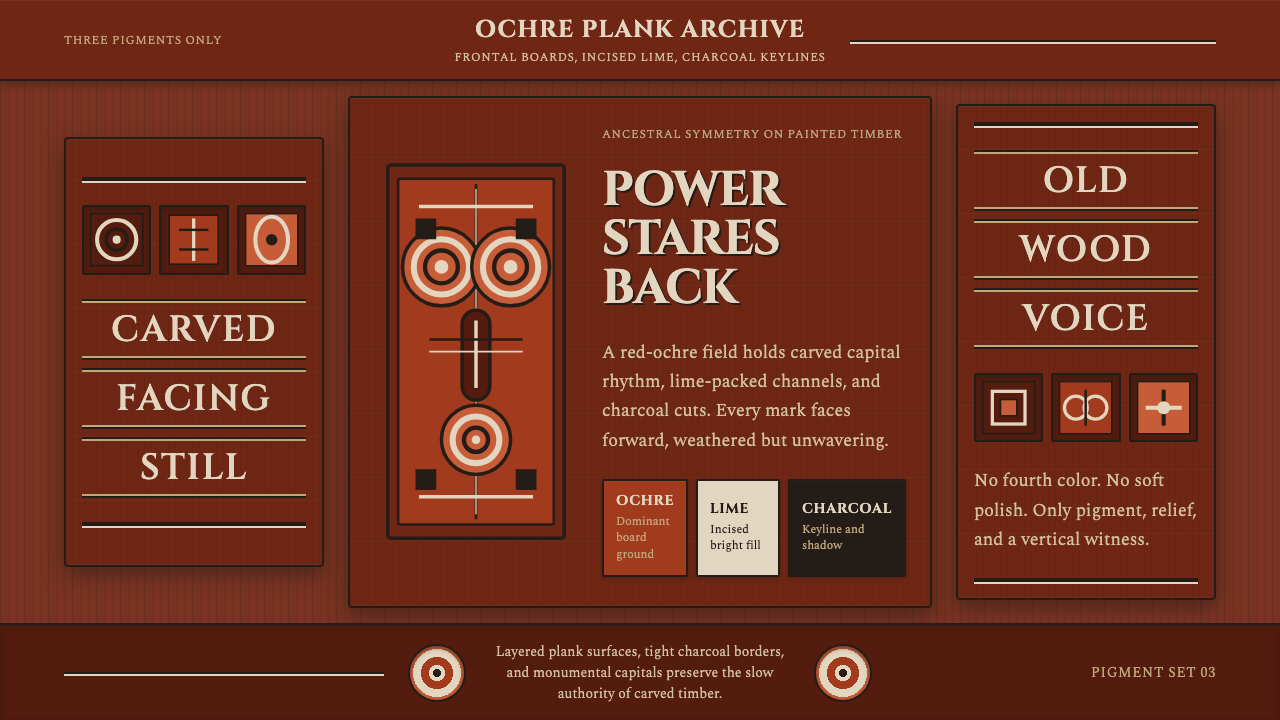 Sepik Spirit BoardThree-pigment power. Ochre, lime, and charcoal lock into frontal carved symme…
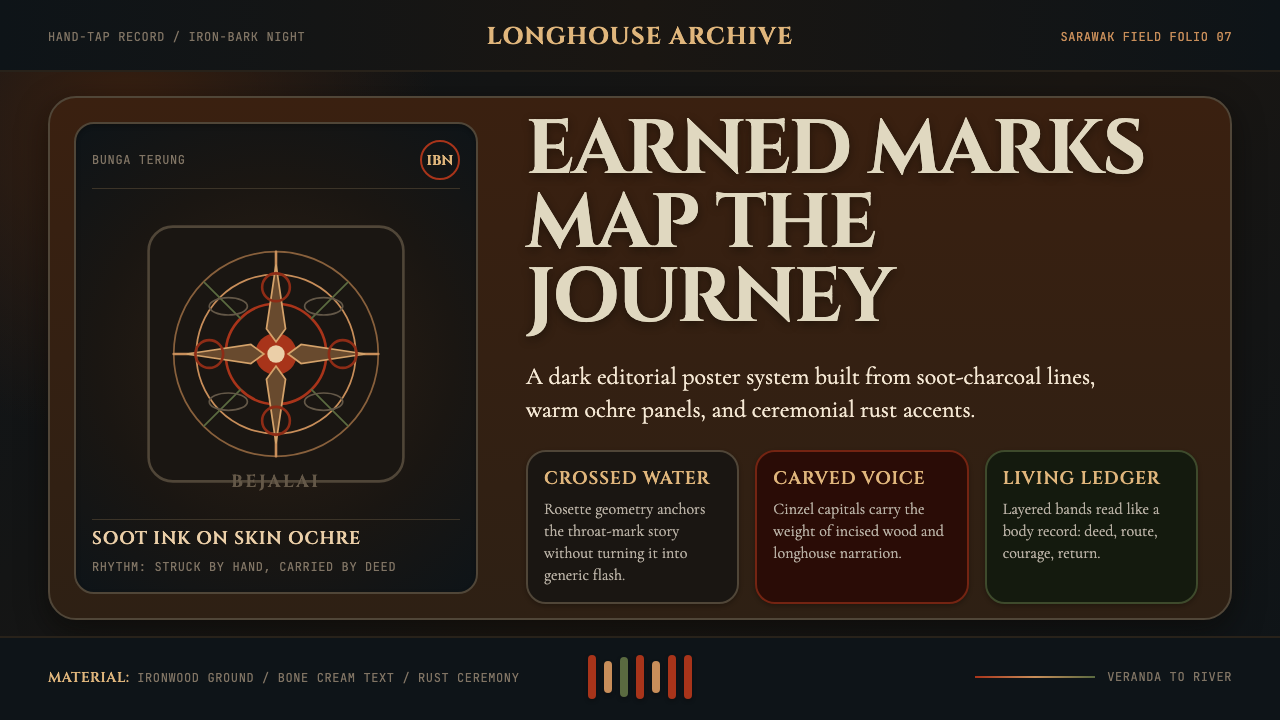 Dayak Borneo Tattoo (Iban)A living journey ledger. Soot lines, ochre panels, and rust rosettes feel han…
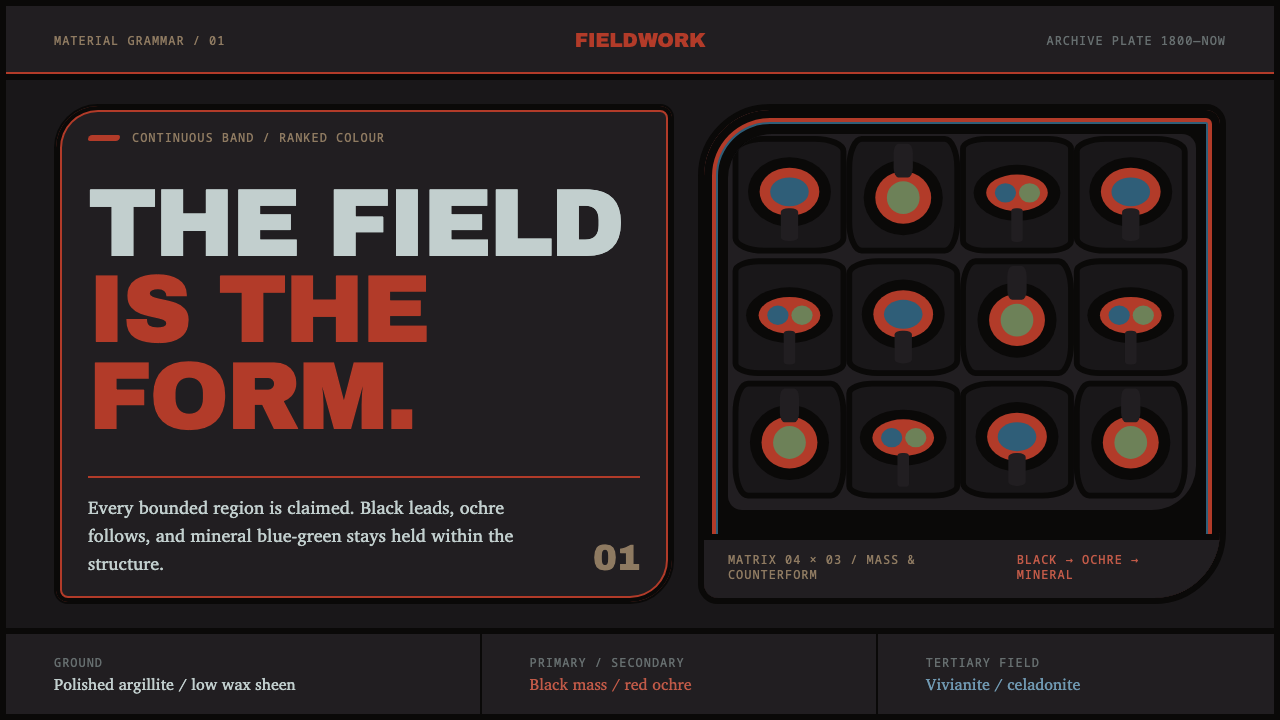 Haida FormlineEvery field is claimed. Black bands lead ochre and mineral blue-green through…
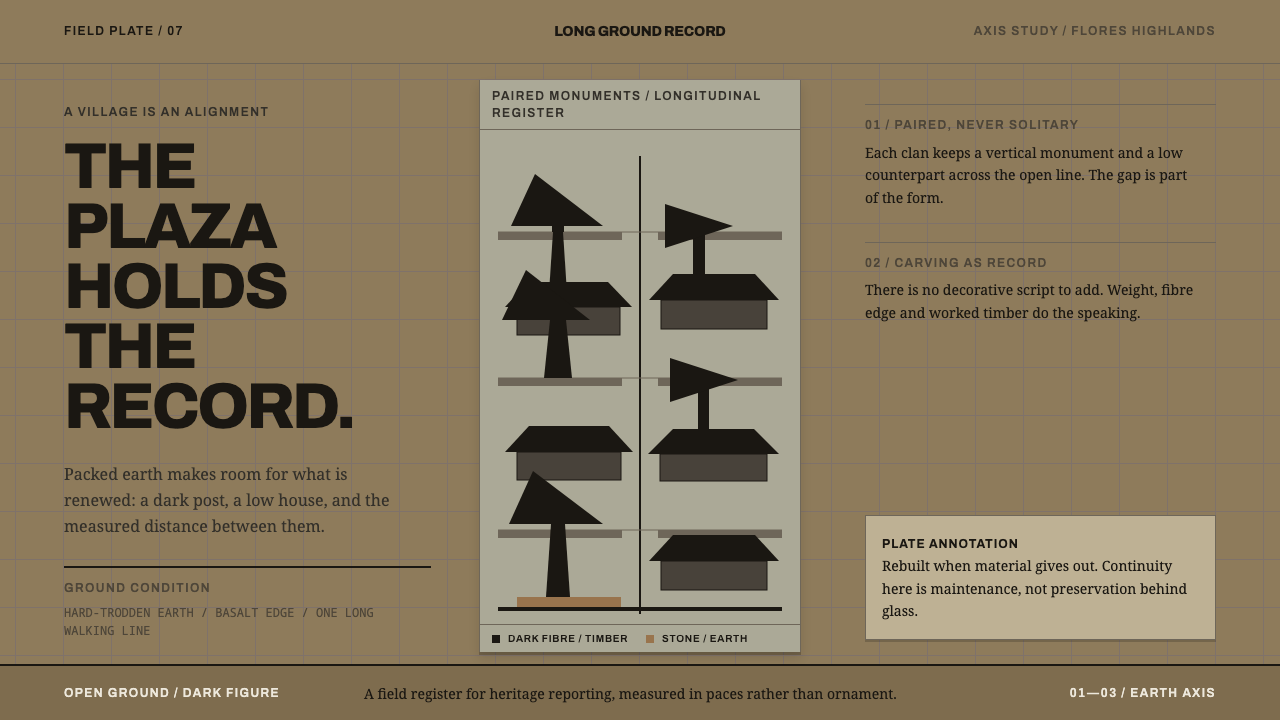 Ngada Ancestor PostsThe plaza is the record. Ijuk-black pairs stand on packed earth along one mea…
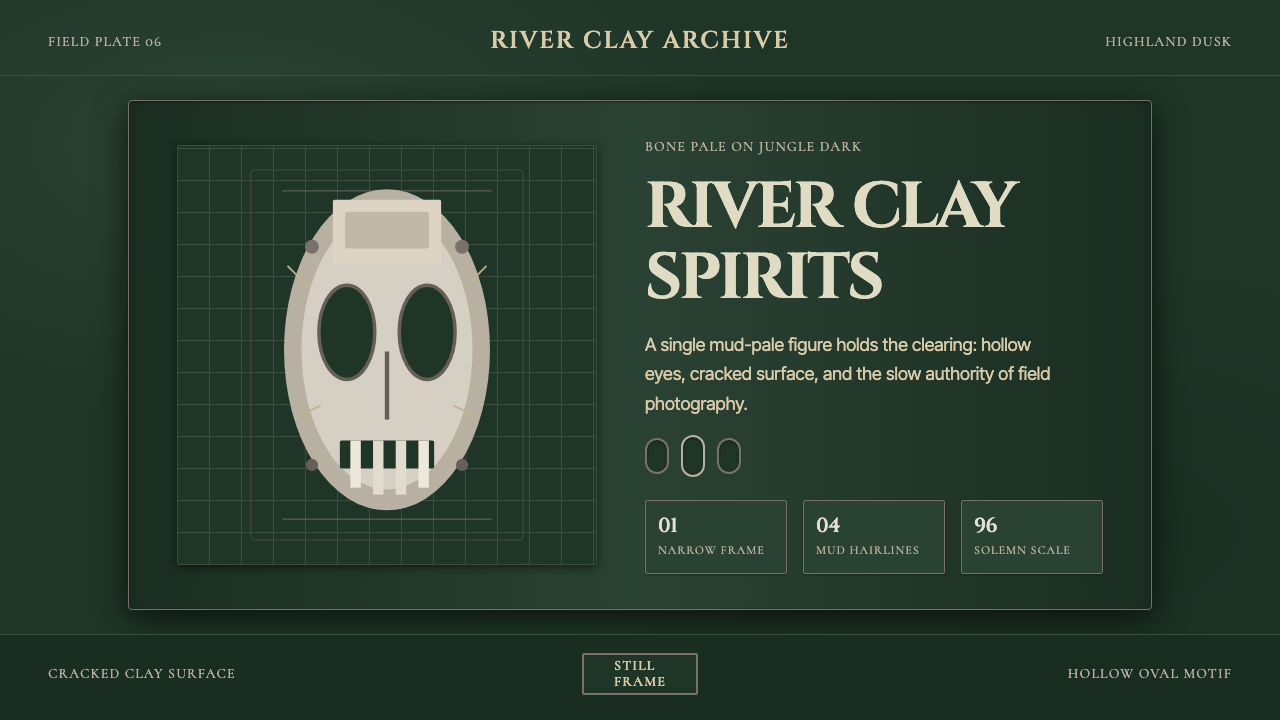 Papuan Asaro MudmenRitual stillness commands the frame. Bone-pale Cinzel rises against jungle-da…
 Georgian Qvevri Supra FeastHospitality made earthen. Terracotta ground, amber wine, Georgian serif curve…