What is Ngada Ancestor Posts?
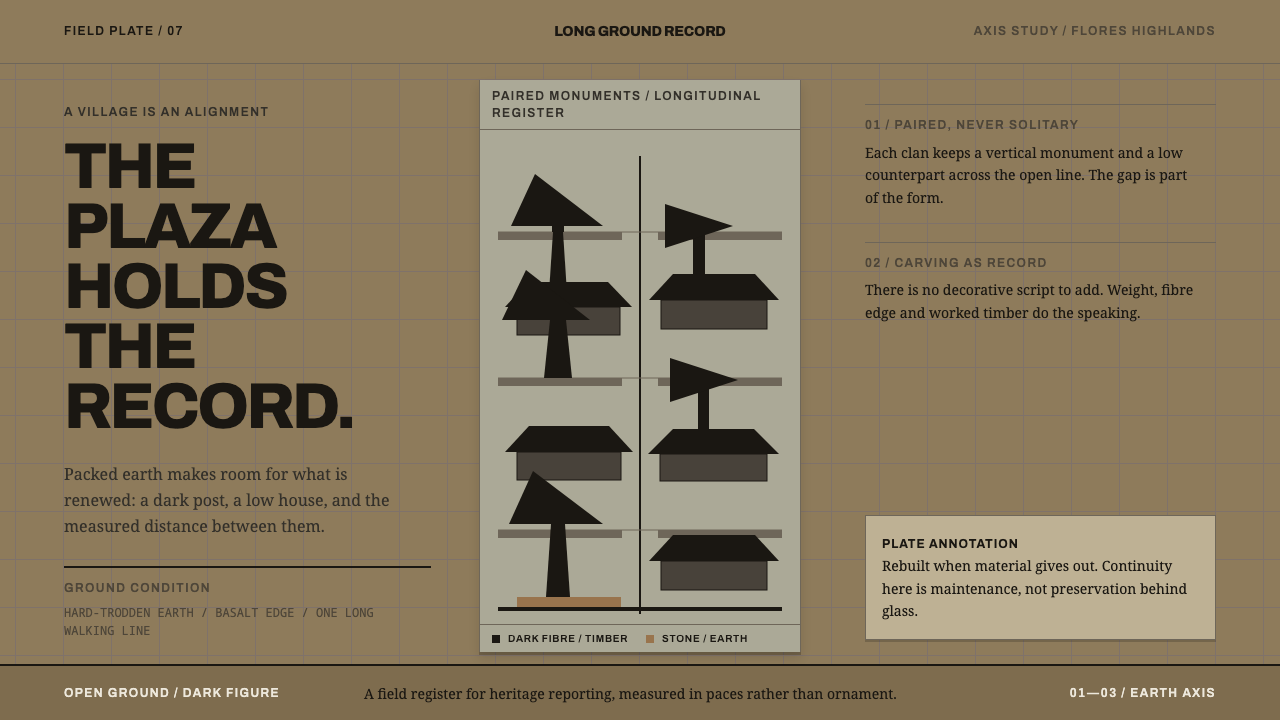
In the Ngada villages of central Flores the plaza is the design — paired dark monuments standing on packed earth along one measured axis, with the carving itself serving as the record.
Ngada Ancestor Posts in brief
Ngada Ancestor Posts is a design style drawn from the traditional villages of the Ngada people in central Flores, Indonesia, where the organizing idea is not a single building but the open plaza. Packed grey-tan earth, ringed with lichen-covered basalt slabs, carries paired clan monuments down one long axis, while two rows of houses face each other across it. The resulting visual language is dark figures on an open ground: heavy silhouettes, a great deal of unfilled space, and a refusal to invent pattern where none is needed.
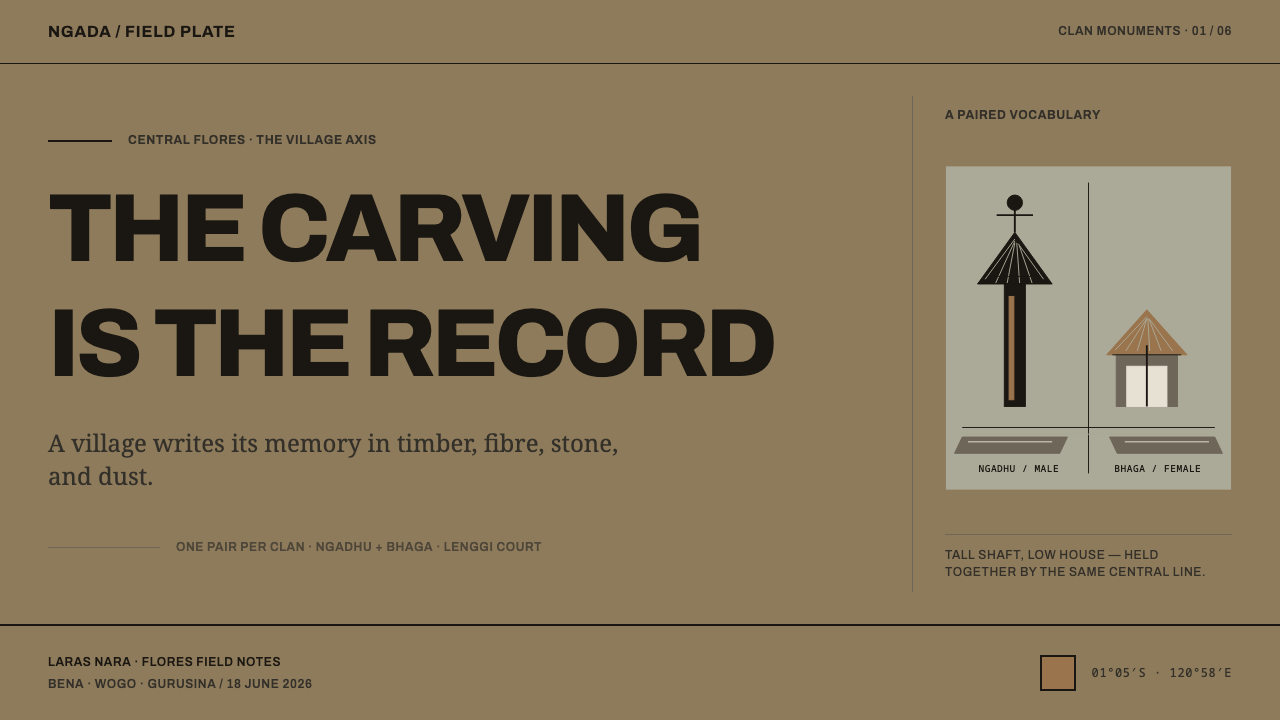
At its core are two paired monuments. The ngadhu is male: a carved hardwood shaft planted upright and capped by a cone of black sugar-palm fibre called ijuk. The bhaga is female: a miniature thatched house standing close beside it. Each clan keeps one pair, and a pair is never left alone. As a design principle this gives the style its grammar — two unequal but inseparable forms, stationed on a shared line and answering each other across empty ground.
Because the Ngada have no script of their own, the carving carries the record. A warrior is adzed into the top of the post, holding his sau sword and bhuja spear; buffalo horns are fixed at doorways; flat lenggi slabs mark the places where the clan sits in council. This system keeps that logic. It is a style about weight, placement and silence, in which what is left out is as deliberate as what is carved.
Where does Ngada Ancestor Posts come from?
The Ngada people live in the highlands of central Flores, in Nusa Tenggara Timur province, Indonesia. The best-known of their traditional settlements — Bena, Wogo and Gurusina, all within reach of the market town of Bajawa — are organized the other way round from most villages: the open plaza is laid out first, and the houses line up along it. The tradition has roots well before 1900, yet it is not a museum survival. The monuments are rebuilt and maintained today, which is why this style is better described as a living practice than as a historical period.
The plan belongs to a wider family of Austronesian megalithic village traditions, in which upright stones, terraced ground and ancestor posts mark the meeting point of a community's living and dead. Among the Ngada the arrangement is bound up with adat, the body of customary law and obligation that governs land, marriage, feasting and ritual. A clan house, called a sa'o, is not simply a family dwelling but the seat of a lineage, and the houses of a village face one another in two rows across the central axis. Clan elders are the custodians of this arrangement: they decide when a monument is renewed and how the ceremonies around it are held.
The two paired monuments carry the symbolic structure. The ngadhu is generally understood as standing for the male founding ancestor of a clan, the bhaga for the female. One is a post and the other a house; one is vertical and carved, the other low and thatched. They are not ornamental extras but the clan's ritual centre, and the animal sacrifices and feasts that fill the ceremonial calendar take place around them. Buffalo horns and jawbones fixed at doorways and on posts usually work as a tally of those feasts, which is why the carved and hung elements read as records rather than decoration.
Beyond Flores, the plazas became widely known through photography. Dutch ethnographic photographers documented the villages, and their images, held today by the Tropenmuseum, fix the way many outsiders picture them: pale earth, dark roofs, strong diagonals of post and thatch. This style draws on both inheritances — the lived adat of villages such as Bena and Wogo, and the photographic view of them — while keeping the discipline of the original: nothing is invented to fill the silence.
What defines the Ngada Ancestor Posts look?
The Plaza as Ground
The primary compositional element is the empty ground. Packed grey-tan earth fills most of the field, and everything else is placed on it rather than competing with it. In design terms the background is not a neutral wrapper but the subject: it should feel firm, dry and slightly warm, with enough room around each object that the eye reads distance as meaning.
One Measured Axis
Monuments are stationed down a single long axis, with houses facing across it. Layouts in this style favour one dominant line over a scattered grid. Elements are set at deliberate intervals along it, and balance is read in terms of facing rows rather than mirrored halves. The axis gives the page a direction of travel without arrows or decoration.
Paired Forms
Every clan has one ngadhu and one bhaga: a vertical carved shaft and a low thatched house, unequal in form but inseparable. The visual grammar is the pairing itself — tall with low, carved with plain, dark with open. Two related objects set side by side say more than one object doubled, and neither appears alone.
Ijuk-Black Mass
The darkest values belong to the figures: the black fibre cone of the ngadhu, the dark hardwood, the weathered roofline. The shapes are heavy and silhouette-driven, with edges that read as cut rather than rendered. Colour is held back so value does the work — near-black form against pale earth is the main event.
Carving as Record
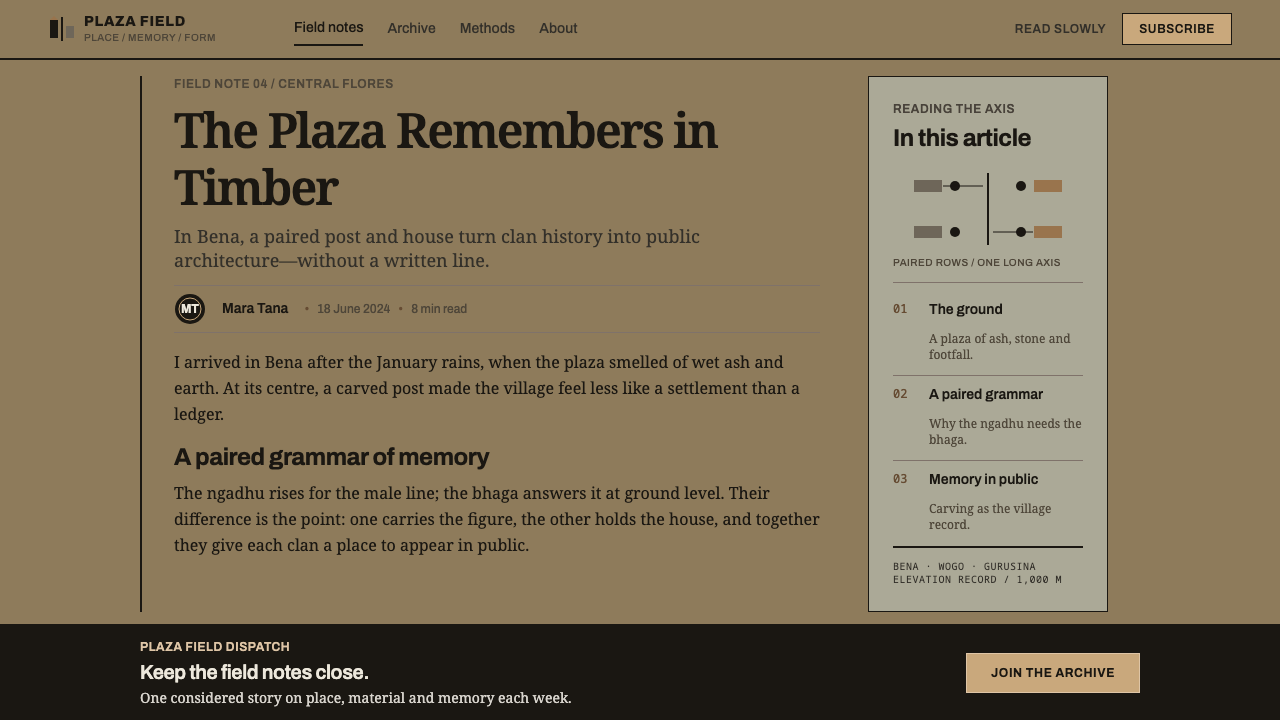
Without a script, the clan's history is written in wood and stone: a warrior with sword and spear adzed into the post, buffalo horns at the threshold, flat slabs where councils meet. Ornament in this style is therefore always informational. Marks are few, they stand for something, and they sit exactly where their meaning is needed.
Earth, Stone and Fibre Palette
The palette is taken entirely from the materials: grey-tan earth, basalt dusted with pale lichen, the black of palm fibre, the weathered brown of hardwood, the straw tone of thatch. There are no saturated accent colours. If a highlight is needed it comes from bone, horn or lichen — pale and slightly warm — never from a bright hue.
Silence Held Open
The most characteristic quality is restraint of a particular kind: nothing is invented to fill the silence. Large areas stay empty. No pattern is generated to cover the ground, no texture is added for richness. This is not minimalism as taste but a view about honesty — a space left open is still saying something.
Who shaped Ngada Ancestor Posts?
The elders of each sa'o, or clan house, are the working authorities behind the plaza. They determine when posts are renewed, how buffalo feasts are staged and how the carved record is added to. For a designer, the lesson they embody is custodianship: the form is maintained by repeated, deliberate acts rather than invented once and left alone.
Village-level adat councils coordinate the clans that share a plaza in settlements such as Bena and Wogo, keeping the layout, the monuments and the ritual calendar in step. Their role explains why the plazas stay coherent although they are built across generations: the axis, the facing rows and the paired monuments are agreed conventions, not individual inventions.
The Dutch ethnographic photographers whose images are held by the Tropenmuseum gave the villages their wide visual afterlife. Their pictures fix the compositional features this style takes up — pale ground, dark silhouettes, long axis — and they are a reminder that the style reaches us through two lenses: the community's own practice and an outsider's frame.
How do you use Ngada Ancestor Posts today?
This style is most useful when a design needs weight, calm and an unmistakable sense of place without resorting to decoration. Its structure — dark figures, an open ground, one axis — transfers readily to screens and slides, but it only works if the empty space is treated as part of the composition rather than as room waiting to be filled.
On presentation slides, a cover can be little more than a pale earth-toned field with a single heavy dark form set off to one side and the title beneath it, aligned to the same axis. Content slides work as a line of objects on that axis: a heading, a short run of text and one supporting image or figure, spaced at generous intervals. For data slides, treat each series as a standing figure rather than a coloured bar — dark, solid and unembellished — and leave the ground blank instead of gridding it.
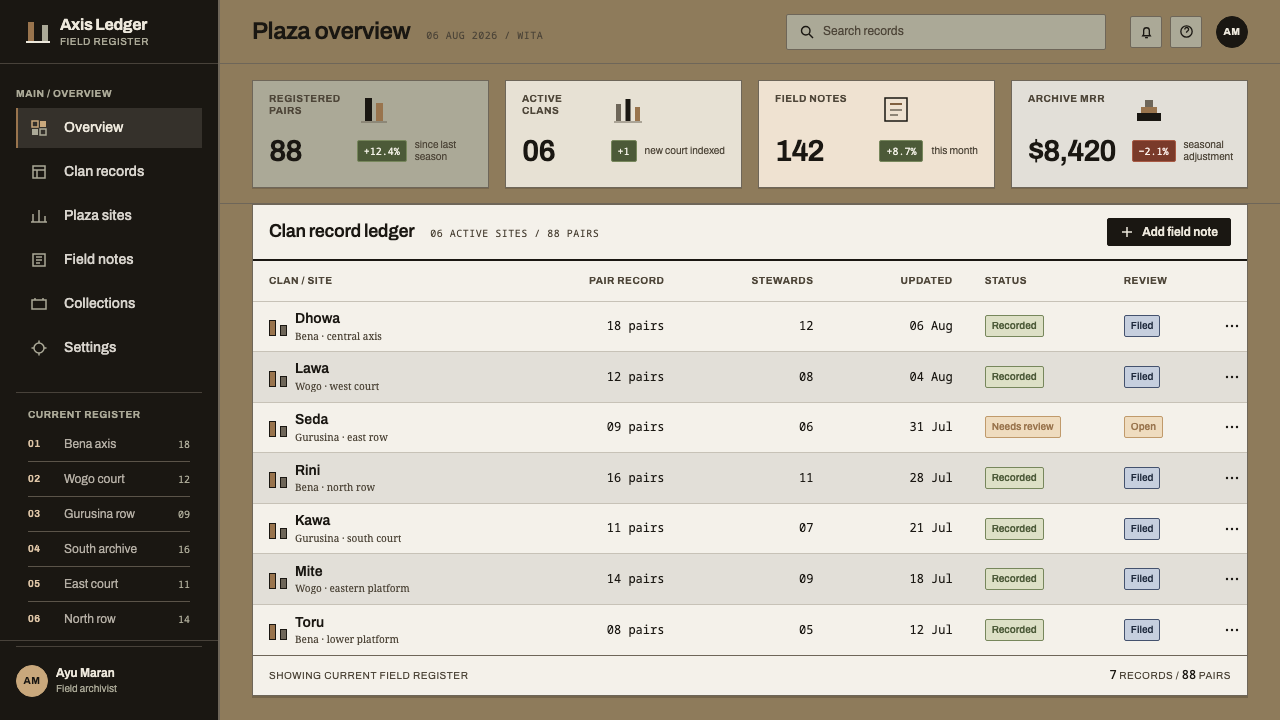
In web interfaces, the style suits dashboards and product pages that benefit from strong hierarchy and few moving parts. Use the pale ground as the page and keep cards, panels and inputs as dark, flat shapes with crisp edges rather than soft-shadowed layers. Pricing pages can lean on the pairing principle: two plans side by side, one tall and one low, instead of a row of equal tiles. Navigation should be plain text with generous spacing, and imagery should be silhouette-like and high in contrast.
For editorial and marketing work, the style gives a measured, documentary tone. Long-form layouts benefit from a single column that follows the axis, with captions set like inscriptions and pull quotes isolated in open space. It suits cultural institutions, heritage and craft brands, architecture and travel journals, and any subject that wants to be taken seriously without looking austere. Photographs should be chosen for silhouette and weather, not for saturation.
The common mistake is treating the style as a source of motifs. Carved figures, horns and thatch silhouettes lifted out of context and scattered as pattern or icon decoration produce exactly the invented filler the tradition refuses, and they flatten a living cultural practice into a theme. Take the logic rather than the artefacts: the open ground, the pairing, the single axis, the heavy dark forms. If a motif is needed at all, use it once, with purpose, and credit its source.
Ngada Ancestor Posts — FAQ
What are the ngadhu and the bhaga, and do I need to understand them to use the style?
The ngadhu is a carved hardwood post capped by a cone of black sugar-palm fibre; the bhaga is a small thatched house. They are the male and female monuments of a clan and stand together as a pair on the plaza. You do not need the ritual detail to apply the style's structure, but you should know they are living, maintained ritual objects. That is the reason to borrow the logic of the plaza instead of reproducing the objects as decoration.
Is it appropriate to use a living tradition as a design reference?
It is, with care. The style borrows organizational logic — open ground, paired forms, one axis, restraint — and credits the source. It avoids copying clan-specific or sacred carvings, avoids using them as logos, mascots or wallpaper, and does not present the result as Ngada work. When a project is specifically about Flores or Indonesian heritage, working with community sources is far better than working from a style description.
Why does the style use dark figures on a light ground, and can it be inverted?
The tradition is lit by tropical daylight: dark fibre, wood and thatch stand against pale packed earth and basalt. That is why the system has a light ground and dark forms. A fully inverted dark mode loses the reference, because the dark figures would disappear. If a dark interface is unavoidable, keep the pale earth as a contained stage — a panel or card — and put the dark figures on it, rather than flipping everything.
How is this different from other tribal or ethnic pattern styles?
Most ethnic pattern styles are built from repeating ornament, such as geometric borders or woven motifs. This one is built from absence: its rule is that nothing is invented to fill the silence. It has no repeat pattern, no border system and no textile-style fills. The interest comes from silhouette, placement and the relationship between a few dark carved objects and a great deal of open ground.
Can the style carry data-heavy interfaces?
Yes, within limits. The axis and pairing logic organize tables, comparisons and timelines well, and the open ground helps legibility. But the style does not supply a rich palette for multi-series charts. Use value — dark against pale — and position rather than a rainbow, and use weight and spacing to separate categories. For very dense dashboards a second neutral may be needed, but it should stay within the earth and stone range.
Related design styles
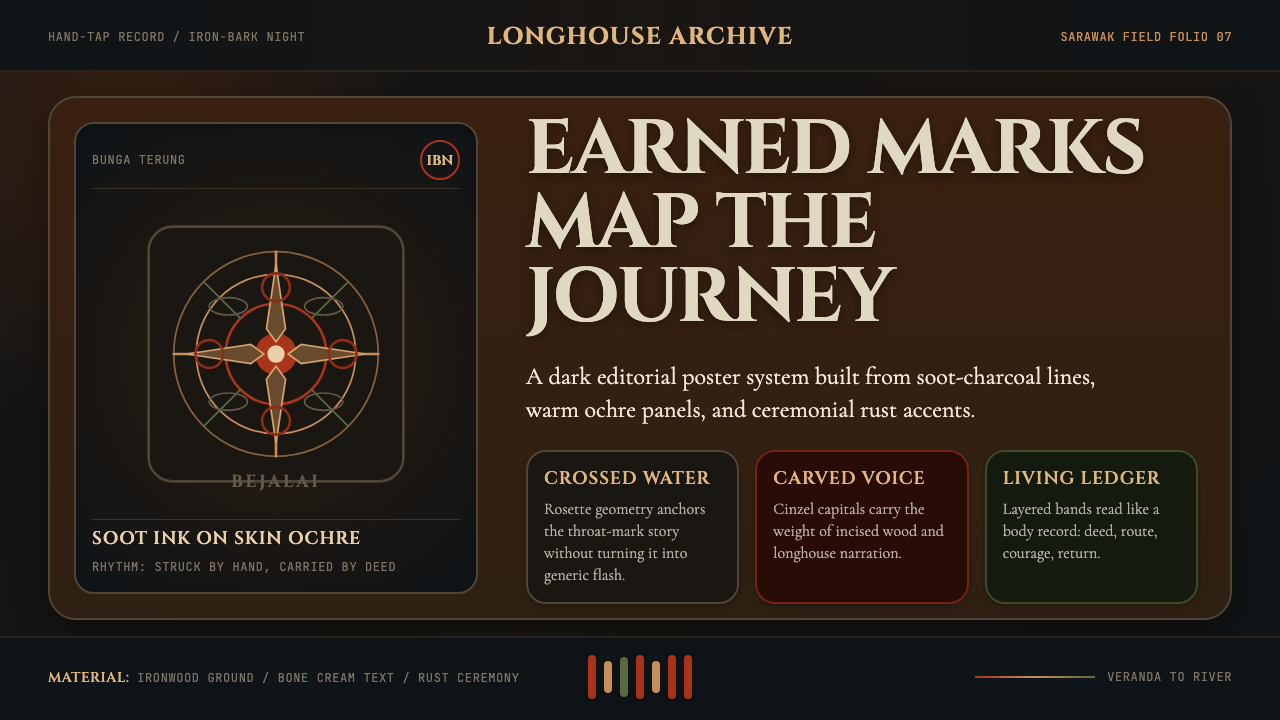 Dayak Borneo Tattoo (Iban)A living journey ledger. Soot lines, ochre panels, and rust rosettes feel han…
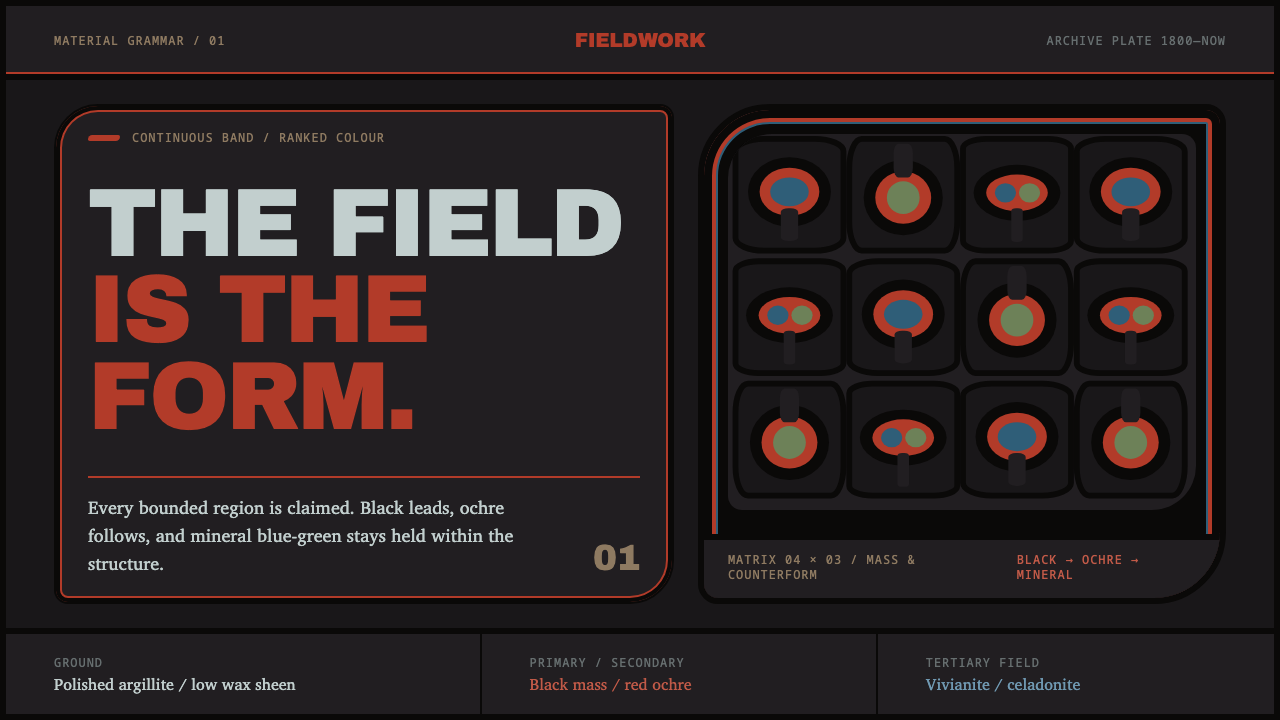 Haida FormlineEvery field is claimed. Black bands lead ochre and mineral blue-green through…
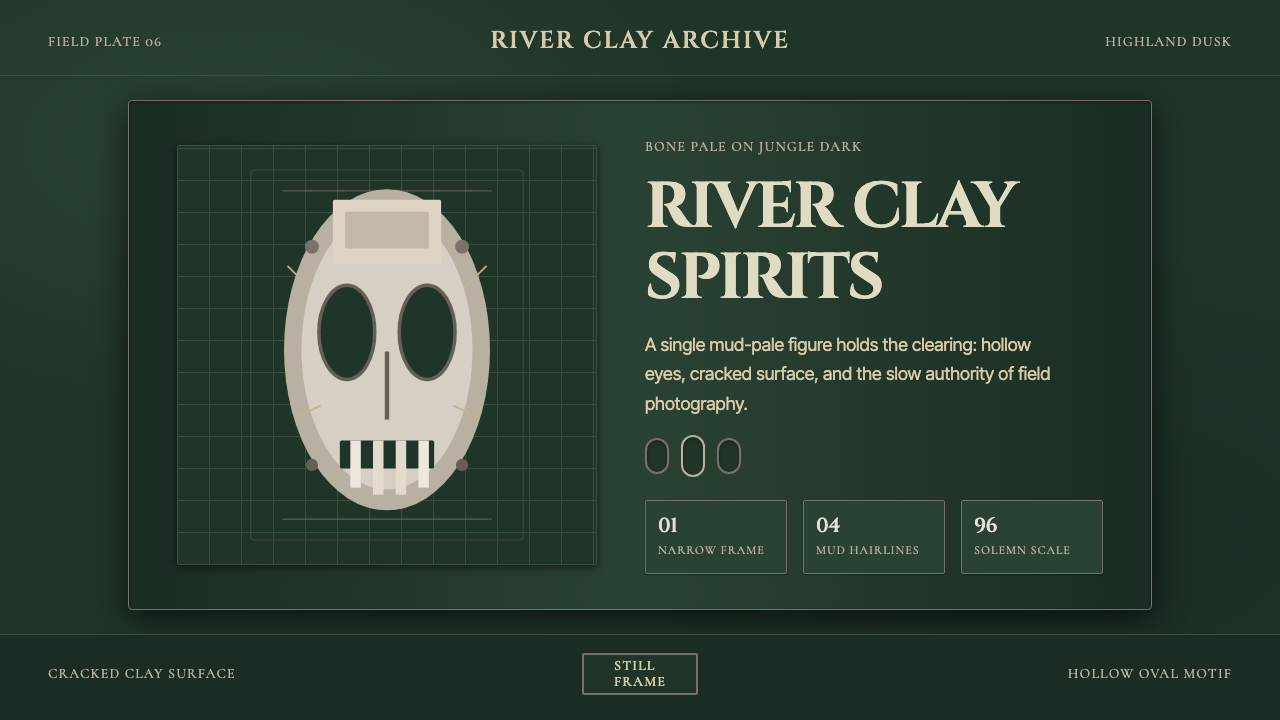 Papuan Asaro MudmenRitual stillness commands the frame. Bone-pale Cinzel rises against jungle-da…
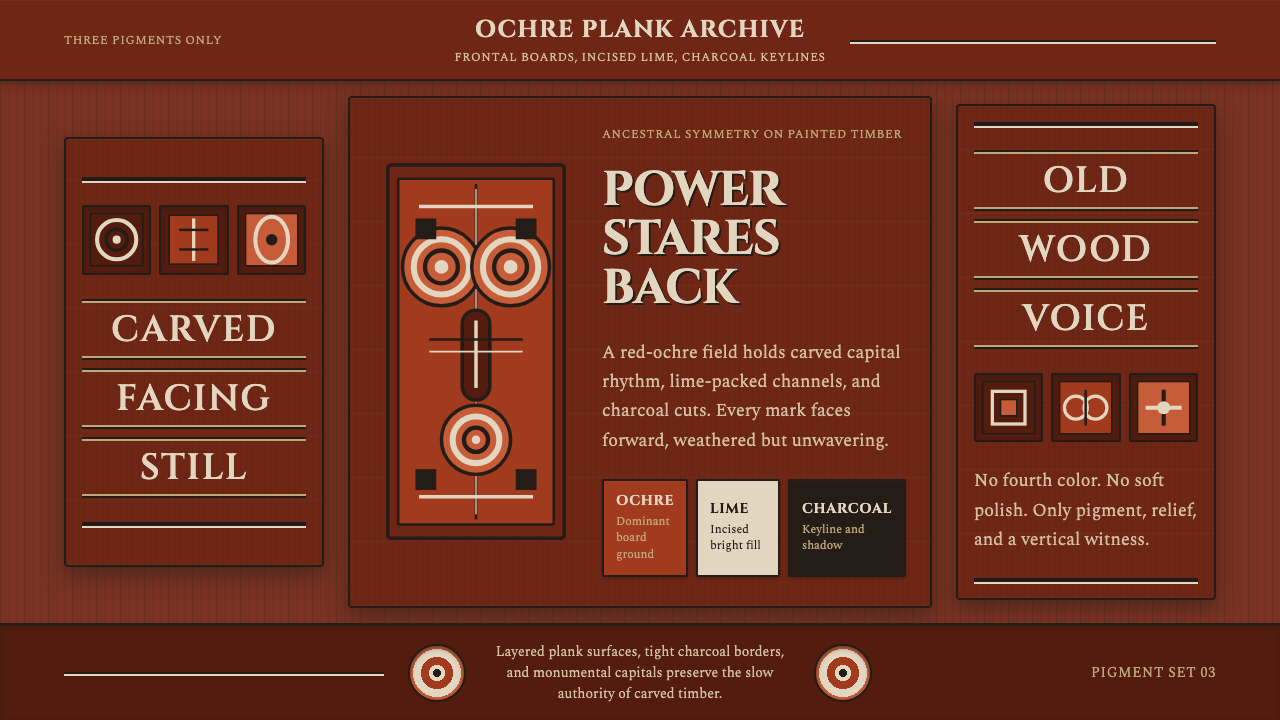 Sepik Spirit BoardThree-pigment power. Ochre, lime, and charcoal lock into frontal carved symme…
 Cham My Son TowersWall before ornament. Greyed brick bays recede around cut shadows and sandsto…
 Hindu Widow White SariRestraint carries the weight. Ash-toned khadi, quiet serif type, and vertical…