What is Pathein Parasol?
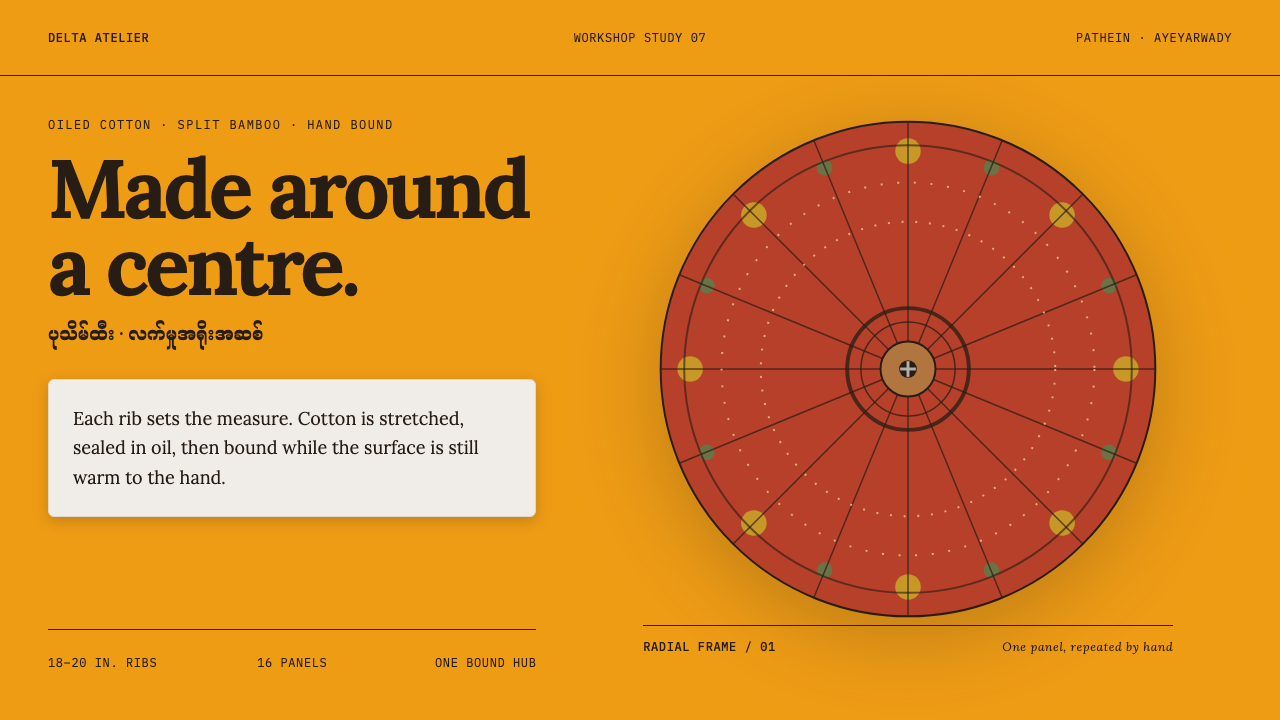
The Pathein parasol is craft built from the centre outward — bamboo ribs for structure, sunlit saffron cotton for colour, and lacquer red with hand-painted petals for rhythm.
Pathein Parasol in brief
The Pathein Parasol is a design system drawn from the hand-made parasols of Pathein, a town in the Irrawaddy delta of Myanmar that makes the parasols the rest of the country buys. Its starting point is the object itself: a ring of split-cane ribs radiating from a turned wooden handle, covered with cotton or paper stretched tight and sealed with coats of oil or lacquer. The system borrows that anatomy and treats the frame as layout, the canopy as colour, and the painter's brush as the source of every edge.
Two registers share the same frame, and the system holds both. The plain register is the saffron canopy carried by monks and nuns, with the nuns' parasols painted red — quiet, unadorned, almost entirely colour. The market register is the hand-painted parasol sold to everyone else, covered in lotus, peacock and flowering vines, one motif to a panel, repeated around the circle. The design system lets the plain register supply the ground and the principal colour, and lets the painted register supply detail and rhythm.
Visually it is warm, radiant and slightly irregular. Saffron sits underneath as a light-struck ground, a monastic red gives the main weight, and bamboo yellow and leaf green appear in small touches on petals. Compositions open from a centre, repeated forms circle around it, and wherever a shape is drawn it keeps the start and lift of a brushstroke rather than the even edge of a vector pattern.
Where does Pathein Parasol come from?
Pathein, also spelled Bassein, lies in the Ayeyarwady Region where the great river fans out into its delta, and its workshops are the source of the parasols the rest of Myanmar buys. The system's era is given as the nineteenth-century Pathein workshops through the present-day cottage industry, and the tradition is described in the source as delta cottage manufacture: not factories, but family-scale workshops, each holding a place in a chain of small skilled operations from cane to canopy.
The making is a sequence of specific materials and gestures. Cane of two kinds, Tin-wah and Thara Khu, is split into slender strips that become the ribs. A handle of Ma Tu Shwe Wa wood is turned on a lathe. Cotton or paper is stretched across the frame, and coats of oil or lacquer seal it so that it sheds rain and turns sunlight into glowing colour. Almost every step has to be done at the right moment, with the canopy pulled tight, the ribs lashed and the finish applied before it dries, which is why the work has stayed in the hand rather than moving to a machine.
Alongside the object runs a web of cultural connections. The source places the Pathein parasol among Burmese lacquerware, the traditional group of handicrafts known as pan se, and the wider world of delta cottage manufacture. Lacquer is the thread: the same material that finishes bowls and boxes gives the canopy its water resistance and its warm sheen. Monks and nuns carrying plain saffron and red canopies tie the craft to daily religious life, while the lotus, peacock and flowering vines of the market parasol tie it to the pleasure of ornament and the picture-making of the town's painters.
Named workshops carry the tradition into the present, among them the Shwe Sar Umbrella Workshop and the many Pathein family parasol workshops. For a designer the lesson of this lineage is twofold. First, the parasol is a structural object before it is a decorative one: the ribs decide everything about how the surface is divided. Second, colour is secondary to light: saffron, red, yellow and green are what you see when sun passes through oil-sealed cotton, not pigments laid over an opaque ground. This system takes its structure from the frame and its colour from the canopy.
What defines the Pathein Parasol look?
Structure from the frame
Layouts radiate or divide as the ribs do. A composition has a centre, and panels fan out from it as wedges or evenly spaced segments. The rhythm of those divisions, not a grid of boxes, sets the pace of reading. Even when a page must be rectangular, the eye should sense a middle from which things grow.
Saffron ground
Saffron cotton is the underlying colour, a warm yellow-orange that behaves like light seen through a canopy rather than paint laid on a wall. Large areas sit on it comfortably. Text on this ground is best set in deep, warm darks rather than a hard pure black, so the whole surface feels lit from the same sun.
Monastic red
Red is the principal colour, a lacquer or monastic red drawn from the nuns' parasols. It gives titles, key shapes and the strongest accents their weight. It is rich and a little deep rather than bright, and it works as a large area as well as a small one, which is what lets it hold the centre of a composition.
Bamboo yellow and leaf green
The two supporting colours appear only as small touches, the way they would dot a painted petal: a bamboo yellow on a stamen, a leaf green on a vine. Their job is to enliven the red and the saffron, not to compete with them. If either grows into a large field, the balance of the canopy is lost.
One motif per panel
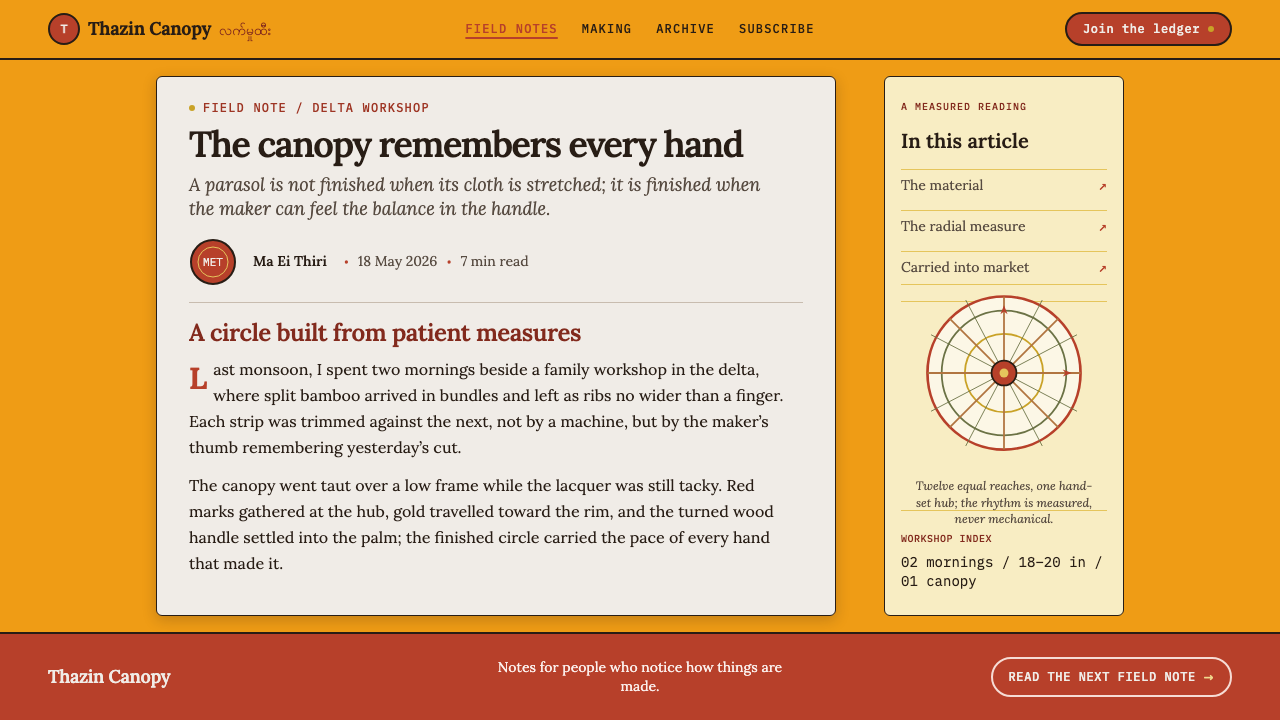
Lotus, peacock and flowering vine are painted as a single motif per panel and repeated around the circle. In layout this means each section or card carries one idea and one illustration, and the repetition across sections creates the pattern. Variation lives in the hand that drew each one, not in adding more motifs to a panel.
Brush-stroke edges
Shapes keep the start, press and lift of a brush. Strokes taper, petals overlap slightly, and curves are not mathematically even. This is the system's guard against looking like a vector pattern: edges should feel placed by a hand, with the small irregularities that signal real people painted each panel.
Oil-sealed glow
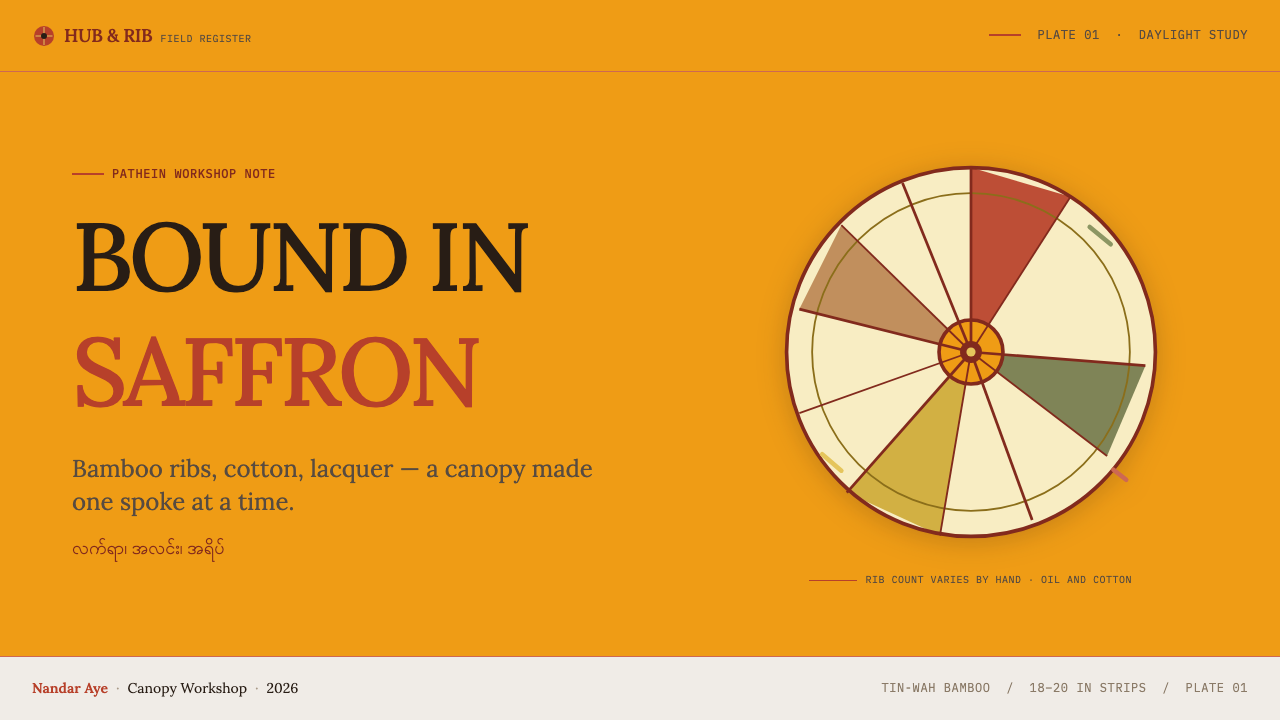
The canopy is sealed with oil or lacquer and lit by daylight from behind, so its surface has a faint translucency and a warm centre. Gentle radial warmth, a soft sheen on the main colour and an absence of cold greys keep the page feeling lit from within rather than flat. The effect is subtle; it should be felt more than seen.
Who shaped Pathein Parasol?
The Shwe Sar Umbrella Workshop is one of the named workshops the source ties to the Pathein tradition. It stands for the full chain of making in one place: cane split into ribs, a handle turned on a lathe, cotton or paper stretched over the frame, protective coats of oil or lacquer, and hand-painted panels. For a designer it is a reminder that the system describes a made object with a real maker, not an abstract pattern.
Beyond any single name, the tradition lives in the family workshops of Pathein, which the source places in the long run of delta cottage manufacture from the nineteenth century to today. Their importance is collective: the same few materials, the same frame and the same painted motifs recur from workshop to workshop, with small differences of hand. That combination of strict method and personal variation is exactly what the design system tries to hold.
The painters who decorate the market parasol are not named in the source, and the tradition does not centre on individual signatures. What the source does record is their method: lotus, peacock and flowering vines, one motif to a panel, repeated around the circle. They are included here because the system's brushstroke edges and its one-motif-per-panel rule are, in effect, a description of how these anonymous hands work.
How do you use Pathein Parasol today?
The Pathein Parasol suits work that wants to feel warm, handmade and centred. It rewards compositions that grow from the middle, colour that behaves like transmitted light, and shapes that look as though a brush made them. It is a system for craft, hospitality, culture and wellbeing rather than for cold precision.
On slides, let the cover open from a centre: a large circular or fan-shaped form in monastic red on a saffron ground, with the title set in deep warm dark beside or beneath it. Content slides can divide into evenly spaced segments, each with one idea and a single small painted motif. Data slides suit radial and pie-style charts, which echo the canopy naturally, with red as the principal segment, saffron as the ground and bamboo yellow and leaf green reserved for the smallest slices or highlights.
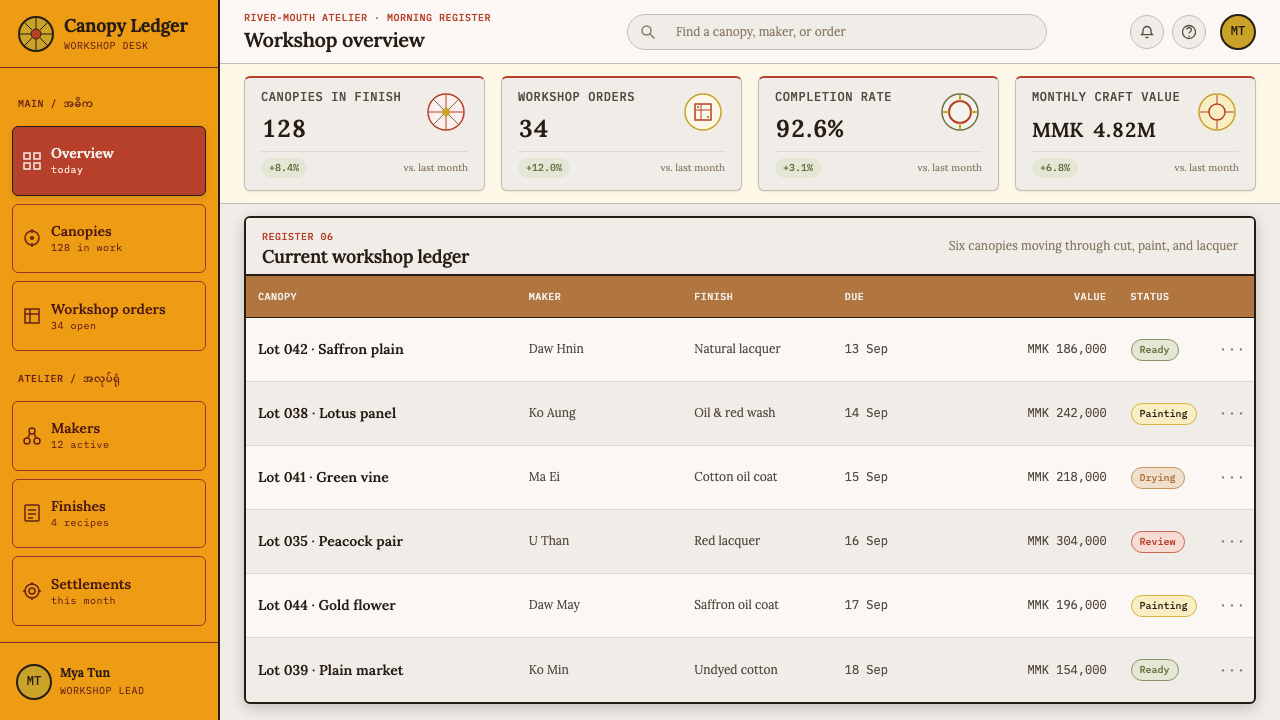
In web interfaces, the system works well for booking, craft commerce, cultural institutions and community products. Use a saffron ground with red for primary actions and key headings, and keep supporting colours to dots and indicators. Cards can carry a single motif each, repeated across a row to create pattern. Dashboards should avoid rigid tables of identical boxes; radial gauges, grouped segments and gently rounded forms preserve the parasol logic without sacrificing clarity.
For editorial and marketing work, the style supports storytelling about places, makers and materials. Long-form pages can use a single illustrative motif per section as a recurring marker, and photography of hands, cane, lacquer and daylight fits naturally. Packaging, event materials and campaign pages benefit from the saffron and red pairing, which is instantly warm. Keep the lettering quiet so that the canopy does the talking.
The most common mistake is making the edges too perfect. A perfectly smooth vector petal, symmetrical to the pixel, destroys the idea that a person painted it. The second is spreading all four colours at equal weight, which turns the canopy into confetti; red and saffron lead, yellow and green only punctuate. The third is treating saffron and red as pure decoration, when both are associated with monastic life, so use them with respect and avoid contexts that would feel trivialising.
Pathein Parasol — FAQ
Why does this system use saffron and red together?
Because they are the two plain registers of the same object. Monks and nuns carry a saffron canopy, and nuns' parasols are painted red, so the pairing comes straight from the working life of the parasol. In the system saffron acts as the ground, like cotton lit by the sun, and red acts as the principal colour, like lacquer. The combination is warm without needing any other hue, and the supporting yellow and green only enrich it.
What does 'one motif per panel' mean for page design?
On a parasol, each wedge of the canopy carries one painted subject, such as a lotus, a peacock or a flowering vine, and the same subject repeats around the circle. On a page, each section or card should carry one idea and one picture, and similar sections should echo one another so that a rhythm builds across the layout. It is a discipline against clutter: if a panel feels crowded, it is carrying too many ideas.
How hand-drawn should the edges look?
Enough that a viewer senses a brush, but not so much that the page looks messy. Strokes should taper at their ends, petals can overlap slightly, and curves should have a little natural variation. The aim is to avoid the mechanical evenness of a vector pattern while keeping the layout orderly. A good test is whether two repeated motifs look related but not identical.
Is the system only for light backgrounds?
It is built for a light, warm ground because its central image is a canopy lit by daylight. A dark inversion loses the translucency that makes saffron and red glow. If a dark variant is unavoidable, use a deep, warm brown rather than neutral black, let saffron appear as a lit centre, and keep the red as a rich accent. Expect a quieter, more lantern-like mood than the original.
Where does the system fit, and where does it not?
It fits craft and cultural subjects, hospitality and travel, gifts and packaging, wellbeing, education about heritage, and any product where warmth and a human touch are part of the promise. It struggles with cold, technical or high-density products such as trading terminals or developer tooling, where the radial composition and hand-painted softness would work against fast scanning. It also needs care in contexts that could trivialise the monastic associations of its colours.
Related design styles
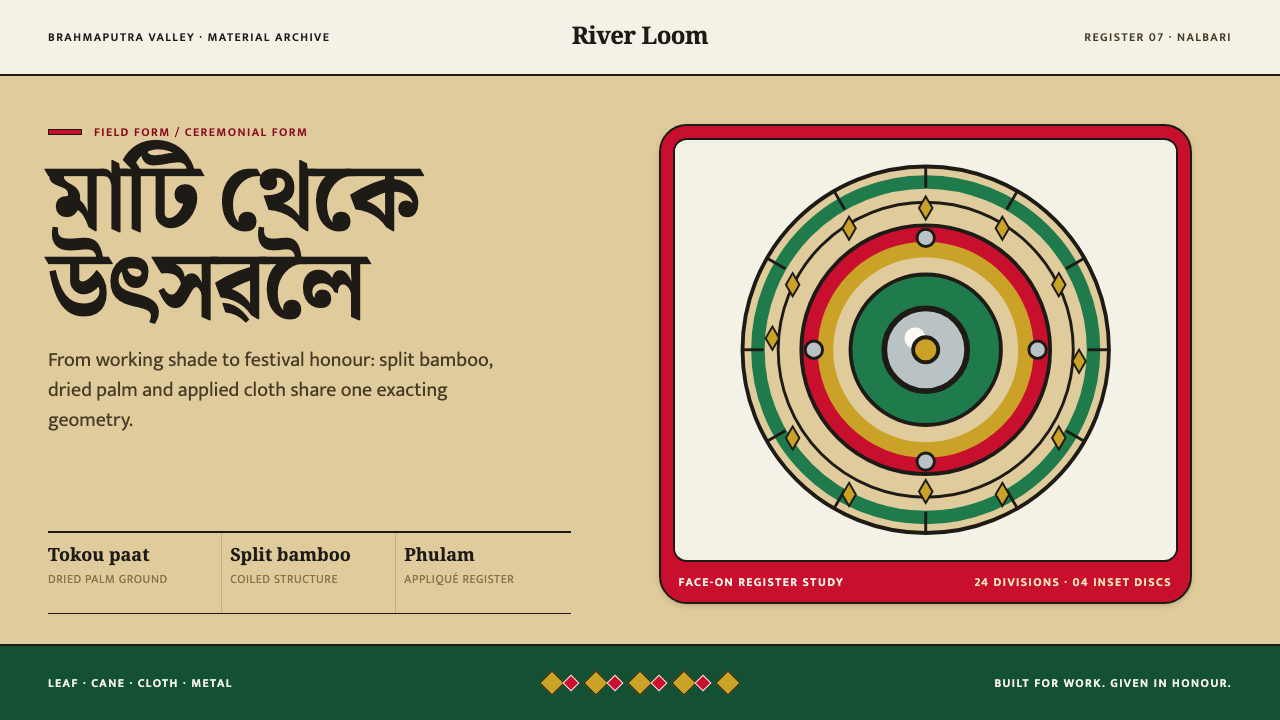 Assamese JapiWork becomes ceremony. Straw-gold rings carry green appliqué, festival red an…
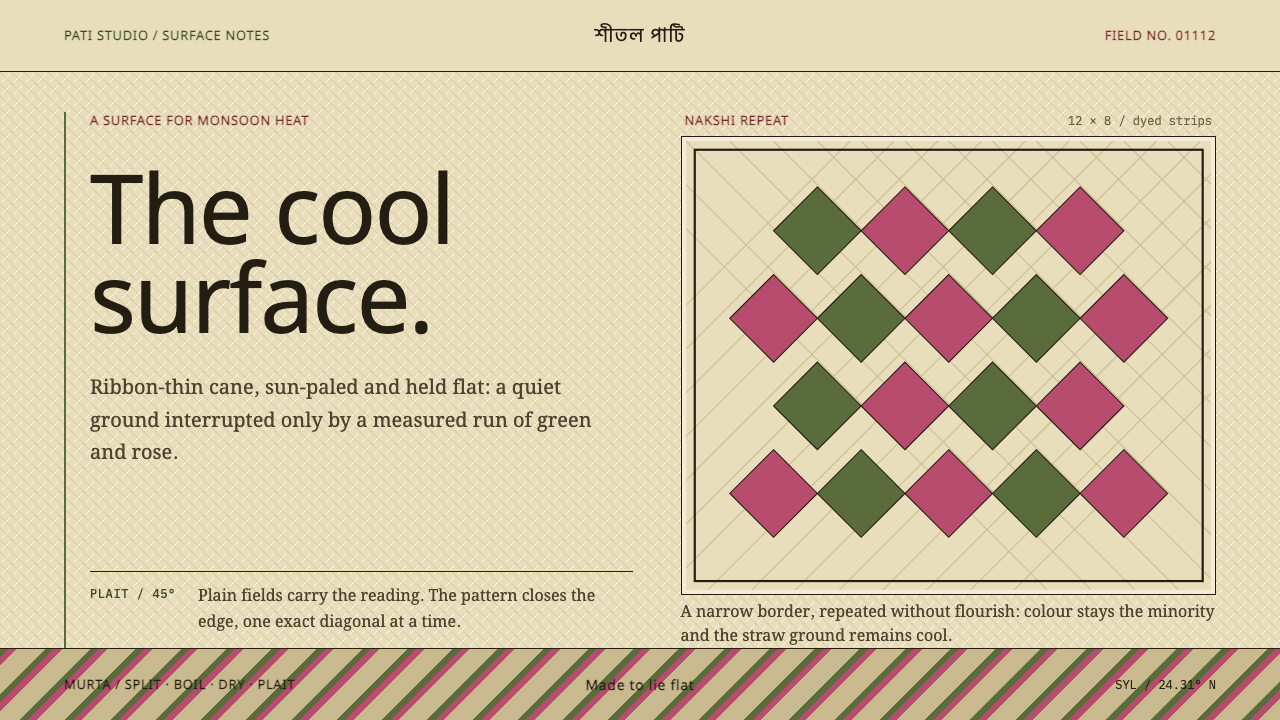 Sylheti Shital PatiCoolness lies flat. Pale straw fields hold cane-green and rose diamond repeat…
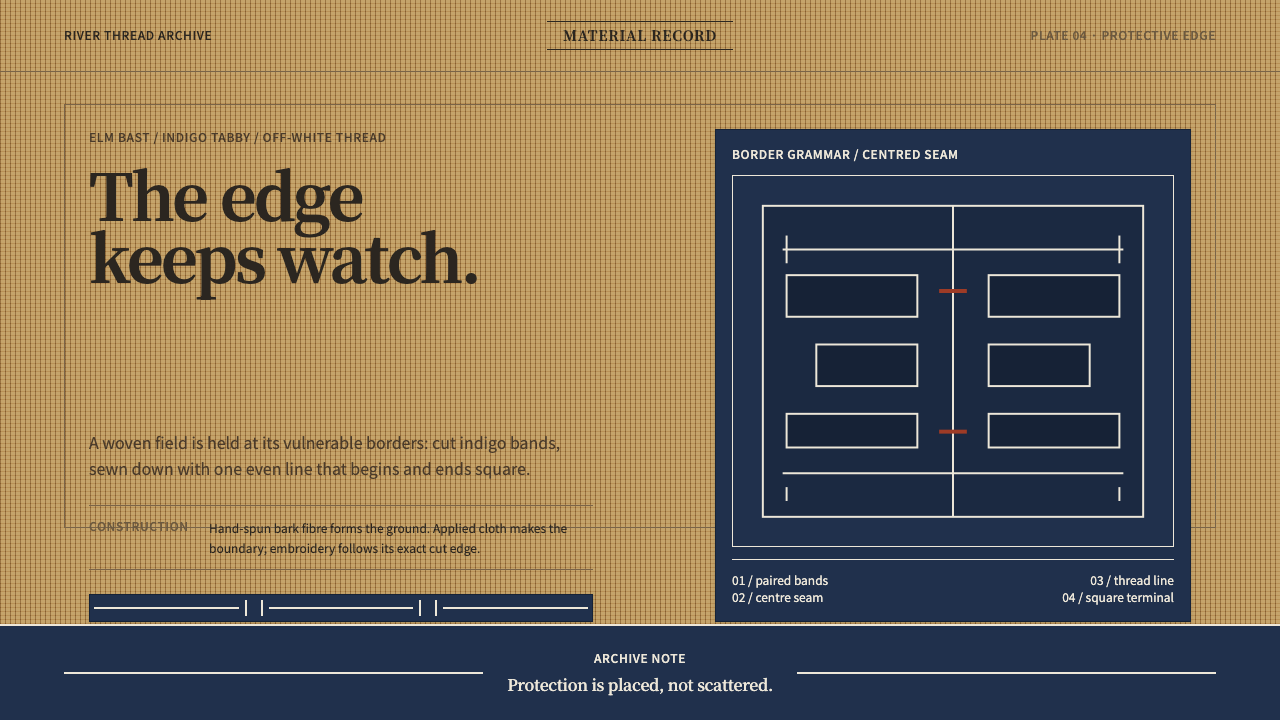 Ainu Attus RobeProtection is cut, not painted. Indigo bands and square-ended thread hold elm…
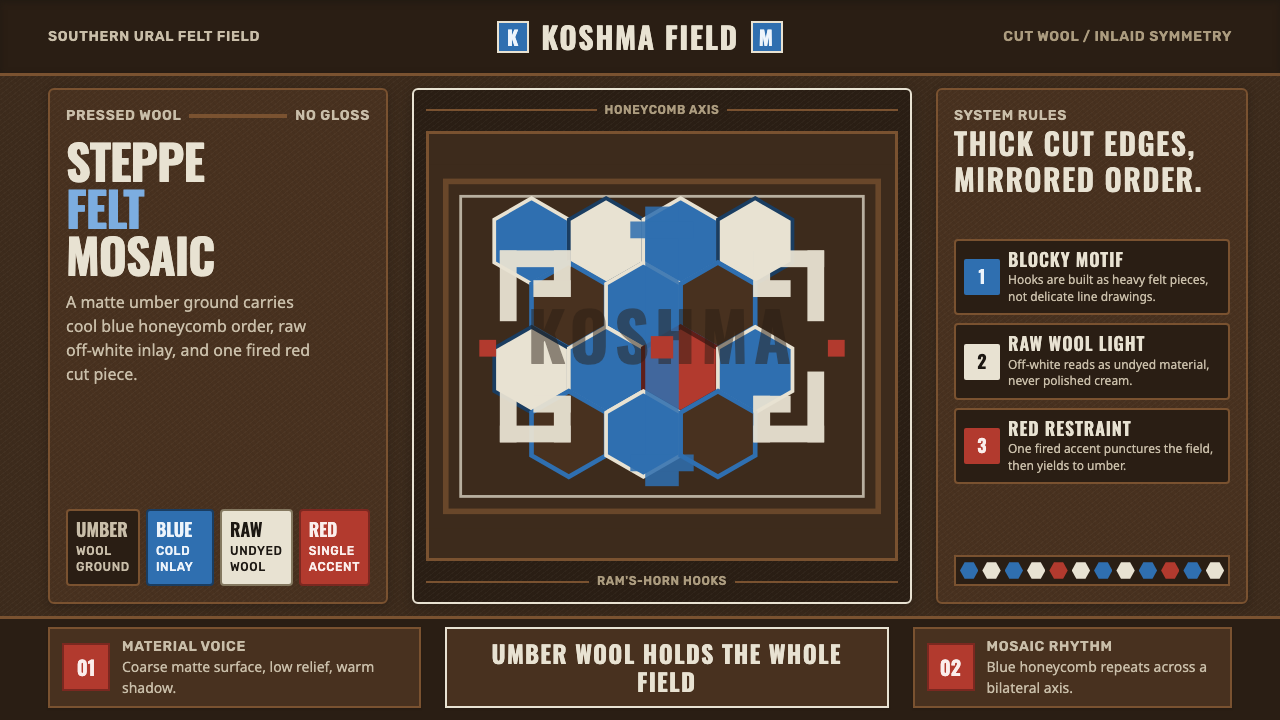 Bashkir Honeycomb Felt OrnamentSteppe craft feels weighty. Umber felt holds blue honeycomb and raw-wool hook…
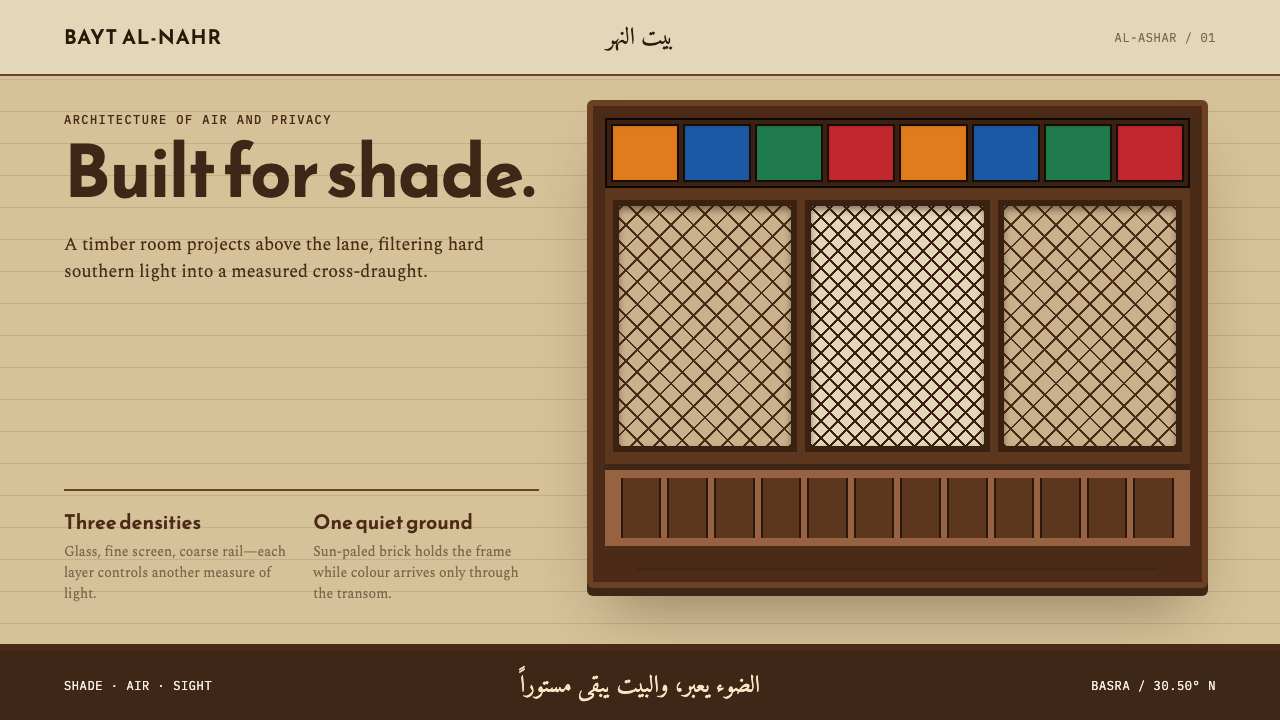 Basra ShanasheelClimate craft becomes ornament. Dark timber lattice projects over sun-paled I…
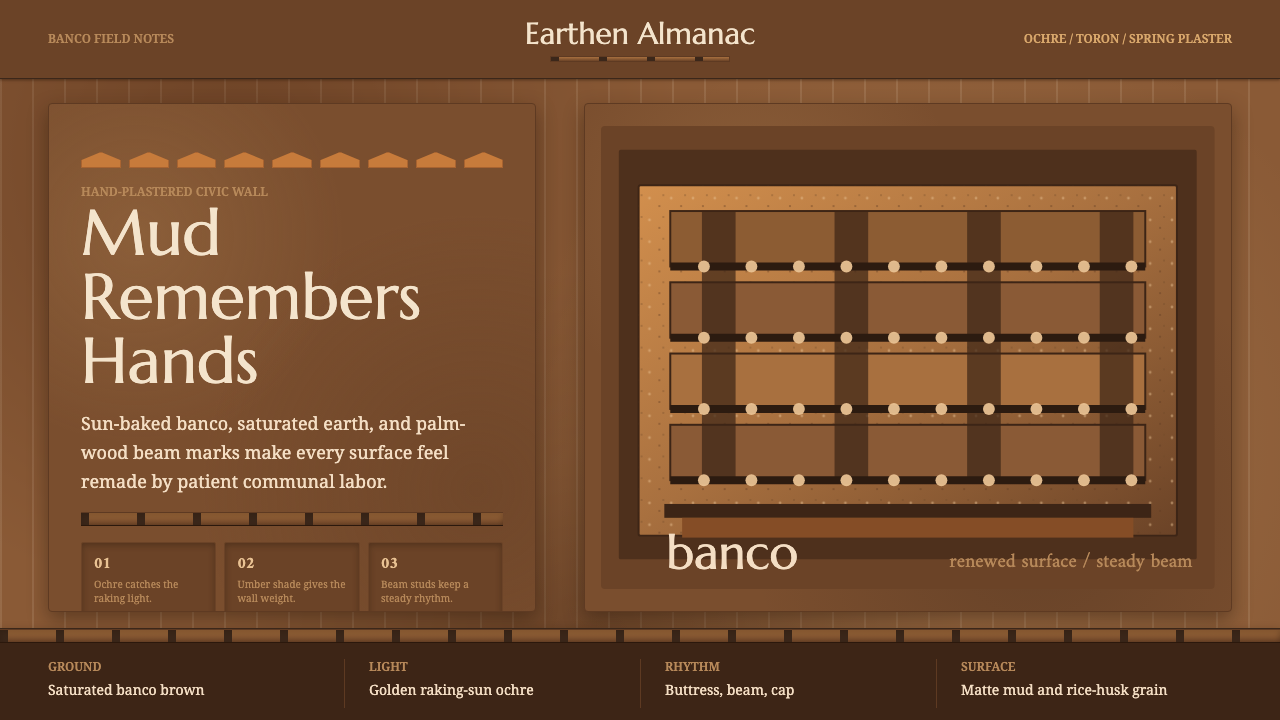 Djenné Mud MosqueBuilt from renewal. Banco brown, ochre caps, and toron grids feel hand-plaste…