What is Bulgarian Kukeri Mummers?
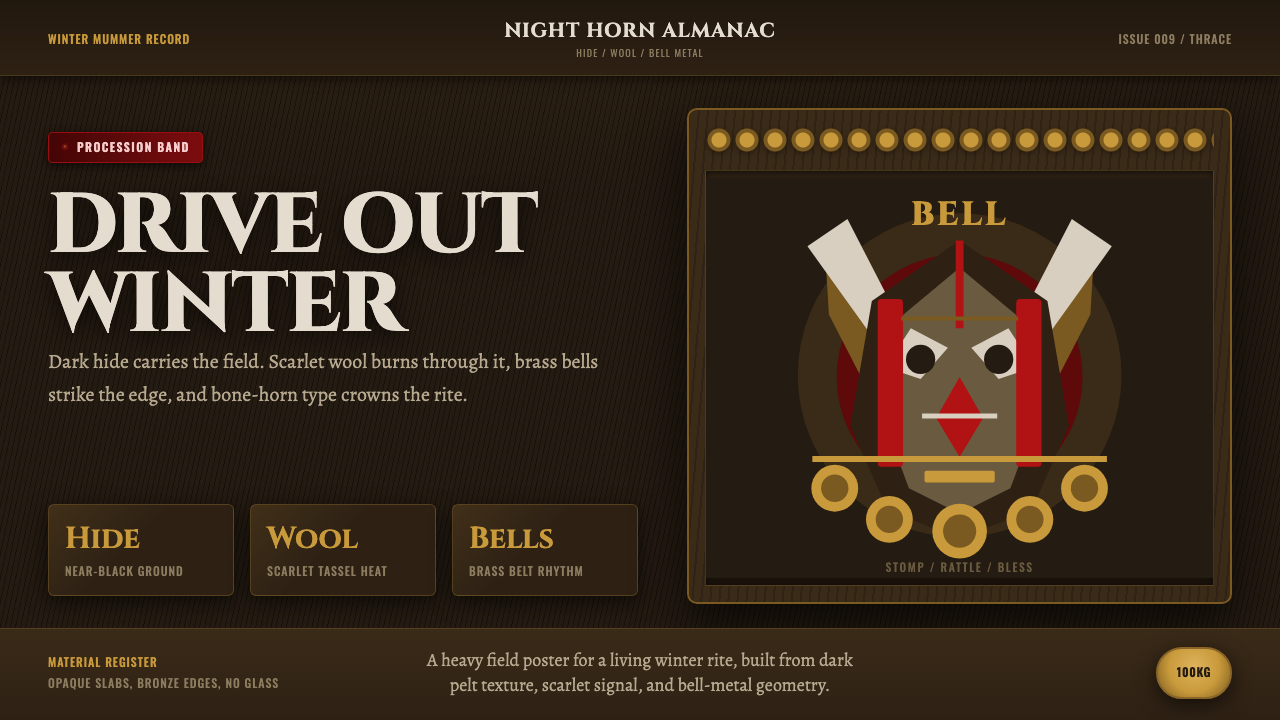
Kukeri masking turns a Bulgarian winter rite into a design language: shaggy dark hide, blood-scarlet wool, and clanging bronze bells built to frighten winter itself into retreat.
Bulgarian Kukeri Mummers in brief
Kukeri (in some regions called survakari) are the costumed mummers of Bulgaria's winter masquerade tradition — men, and in some villages now women, who wrap themselves in the raw hides of goats and sheep, crown themselves with tall carved wooden masks bearing horns, and hang enormous bronze or copper bells from their waists and backs. Troupes assemble in the days around the New Year and move from house to house and through village streets, stamping and leaping so the bells roar, driving out the evil spirits of the old year and clearing the ground for a fertile one.
The visual world this produces has nothing in common with the tidy, pastel version of 'folk craft' that design references often default to. It is dark, heavy, and percussive. The base tone is the near-black or deep umber of cured hide, not the cream or beige most folk traditions lean on. Cutting through that darkness are two hot accents: the scarlet of wool tassels and hand-woven kerchiefs, and the warm brass-bronze glint of hammered bell metal, worn dull and irregular rather than polished. Bone and horn — the raw material of the masks themselves — supply the only pale note, closer to old ivory than white.
Because kukeri is a worn, moving costume rather than a printed or painted object, the aesthetic reads as tactile and handmade at every scale: matted fur, hand-forged bell clappers, chiseled wood grain on the masks, coarse-woven wool. Nothing in it is smooth, clean, or corporate. A design system drawn from kukeri inherits that friction — it should feel closer to a costume you could touch than a screen you could tap.
Where does Bulgarian Kukeri Mummers come from?
Kukeri belongs to a family of winter masking rituals found across the Balkans, and scholars generally trace its roots to pre-Christian, likely pagan agrarian rites rather than to any single documented founder — this is folk practice, transmitted village to village and generation to generation rather than authored. The Thracian peoples who inhabited the region in antiquity are frequently cited as an ancestral layer, their seasonal fertility and sun-worship rites absorbed and reshaped over centuries by Slavic settlement and later folded, uneasily, into the Christian calendar around the New Year and the feast of Epiphany.
The ritual mechanics are consistent across most surviving village traditions even where costume details vary. A troupe, sometimes called a cheta, is organized around a core of costumed kukeri along with supporting characters — a 'bride,' a 'bear,' a 'doctor,' or other stock figures depending on the region — who together perform a loose narrative of death and rebirth as they move through the village. The masks themselves are carved by hand from wood, often by a designated village craftsman whose skill is passed down informally rather than through any academy, and the bells are commissioned from local coppersmiths and prized for the specific tone and volume of their peal, believed to be what actually frightens the spirits away.
Regional variation is part of the tradition's texture rather than a flaw in it: costume silhouettes, mask horn shapes, and the exact timing of the processions differ from village to village and are the subject of ongoing folklore documentation rather than settled record — where sources disagree on precise dates or attributions, that reflects the oral, decentralized nature of the practice itself rather than any gap to be filled in.
The ritual survived industrialization, war, and decades of state atheism under Bulgaria's socialist government, in part by being reframed as folk heritage rather than religious practice. In 2009 UNESCO inscribed the Surova folk feast associated with kukeri-type masquerades in the Pernik region onto its Representative List of the Intangible Cultural Heritage of Humanity, and the Surva International Festival of Masquerade Games, held in Pernik, has since become the largest annual gathering of masking traditions in the region, drawing troupes from across Bulgaria and neighboring countries and turning a village rite into both a national identity marker and a tourism institution.
What defines the Bulgarian Kukeri Mummers look?
Ground Tone
The dominant surface is a near-black to deep umber, the color of cured, unbleached hide rather than dyed leather. It behaves as a light-absorbing field rather than a reflective one — nothing in the palette shines. This is what separates a genuine kukeri-derived system from generic 'dark mode': the darkness here is animal and organic, closer to shadow inside a barn than to a screen's flat black.
Scarlet Accent
Red is used the way the mummers themselves use it: as a kerchief, a tassel, a single hot band against the dark hide, never as a field of its own. It should read as woven wool rather than printed color — a saturated, slightly matte red rather than a glossy or candy tone — and it appears sparingly, reserved for the elements that most need to seize attention.
Bell Metal
The bronze and brass of hammered bell metal supplies the system's only warm shine, and even that shine is dull and worn rather than mirror-polished — the surface of a bell that has been struck against itself for generations, not a freshly cast fitting. Metal accents should feel forged and slightly irregular, never sleek or machine-uniform.
Mask and Horn
Bone- and horn-colored off-white is the palette's only pale note, and it is architectural rather than airy — carved masks tower over the wearer's head with sculptural, sometimes exaggerated horn silhouettes. Where a pale surface appears, it should feel carved and dimensional, like a raised relief, rather than flat or paperlike.
Handmade Texture
Every surface in the source material carries the mark of a hand or a tool: matted and uneven fur, coarsely woven wool with visible slubs, chiseled wood grain on the mask faces, hammer marks on the bell metal. A system honoring kukeri resists anything that reads as smooth, vector-perfect, or mass-produced; texture is not decoration here, it is the whole point.
Rhythm and Weight
The ritual is built around stamping feet and swinging bells, and that percussive, deliberate rhythm should carry into how a kukeri-derived interface moves. Transitions should feel weighted and decisive rather than light or bouncy — closer to a boot striking frozen ground than to a soft fade. Stillness between beats matters as much as the beats themselves.
Who shaped Bulgarian Kukeri Mummers?
The chetas — organized bands of costumed kukeri, typically all men from a single village, joined by supporting stock characters like the 'bride' or the 'bear' — are the tradition's true authors. There is no single choreographer or designer; each troupe inherits and slightly reinterprets its costume and route year over year, which is why regional variation is treated as authentic rather than as deviation from a canon.
In most villages a single craftsman, often self-taught and locally renowned rather than formally trained, carves the troupe's wooden masks from a block, shaping the horns and facial features by hand and by eye. The role is usually informal and unpaid, carried as a form of village service and prestige rather than as a commercial craft.
The heavy copper-bronze bells worn by kukeri are commissioned from village or regional coppersmiths, and their craft is judged almost entirely by ear: the specific tone, resonance, and volume of a set of bells is what is believed to actually banish the winter's evil spirits, making sound as much a design material here as hide or wool.
Founded to gather masking traditions from across Bulgaria and neighboring countries into one annual event, the Pernik festival — and the 2009 UNESCO inscription of the related Surova folk feast — is the closest thing kukeri has to an institutional custodian, codifying and publicizing a tradition that otherwise survives purely through village transmission.
How do you use Bulgarian Kukeri Mummers today?
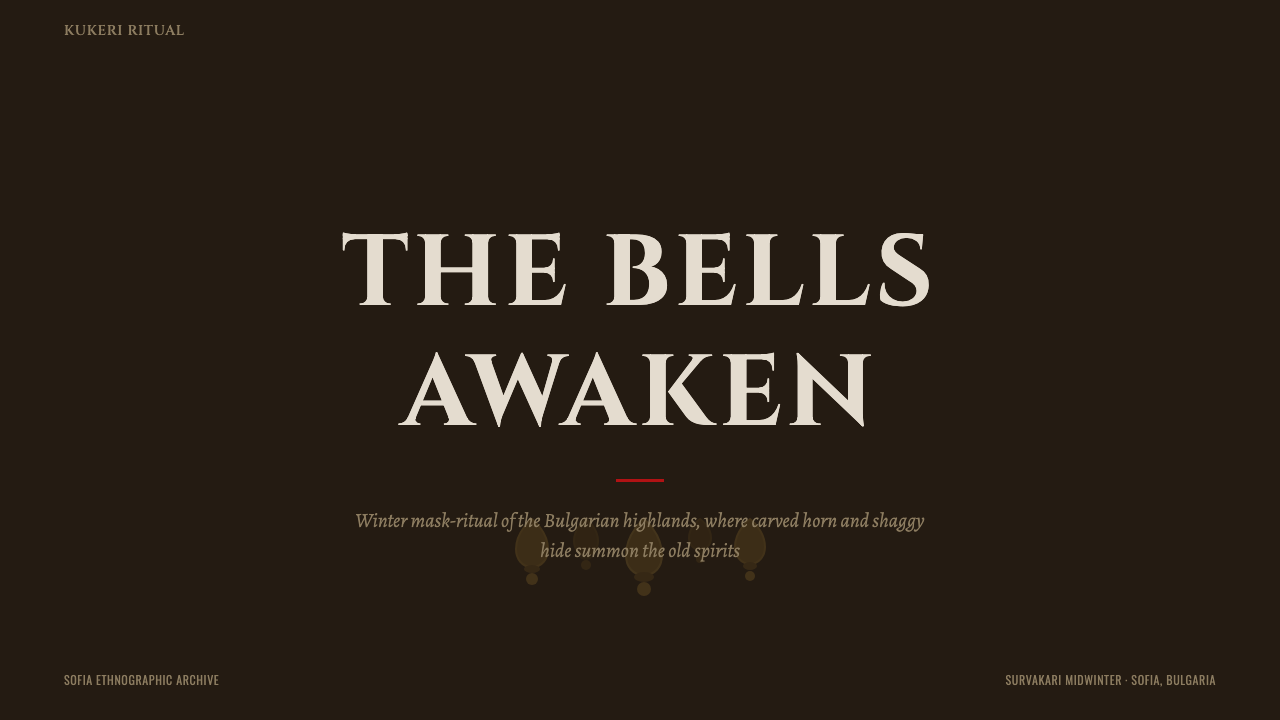
Kukeri makes an unusually strong presentation cover: a near-black ground with a single scarlet accent and a hint of worn brass reads as confident and a little dangerous, which suits any deck that wants to announce itself rather than blend in — product launches, brand relaunches, anything positioned as bold or disruptive rather than safe. The cover should resist symmetry the way the ritual itself resists tidiness; let one strong shape or mark sit off-center, the way a single bell or mask dominates a frame.
Content slides should keep the dark ground and let scarlet do the work of hierarchy — headlines or key numbers in red against the near-black field, body copy in the pale bone tone rather than pure white, so nothing reads as sterile. Data slides benefit from treating charts and figures the way the tradition treats bells: a few bold, heavy marks rather than many thin ones, high contrast rather than a gradient of grays.
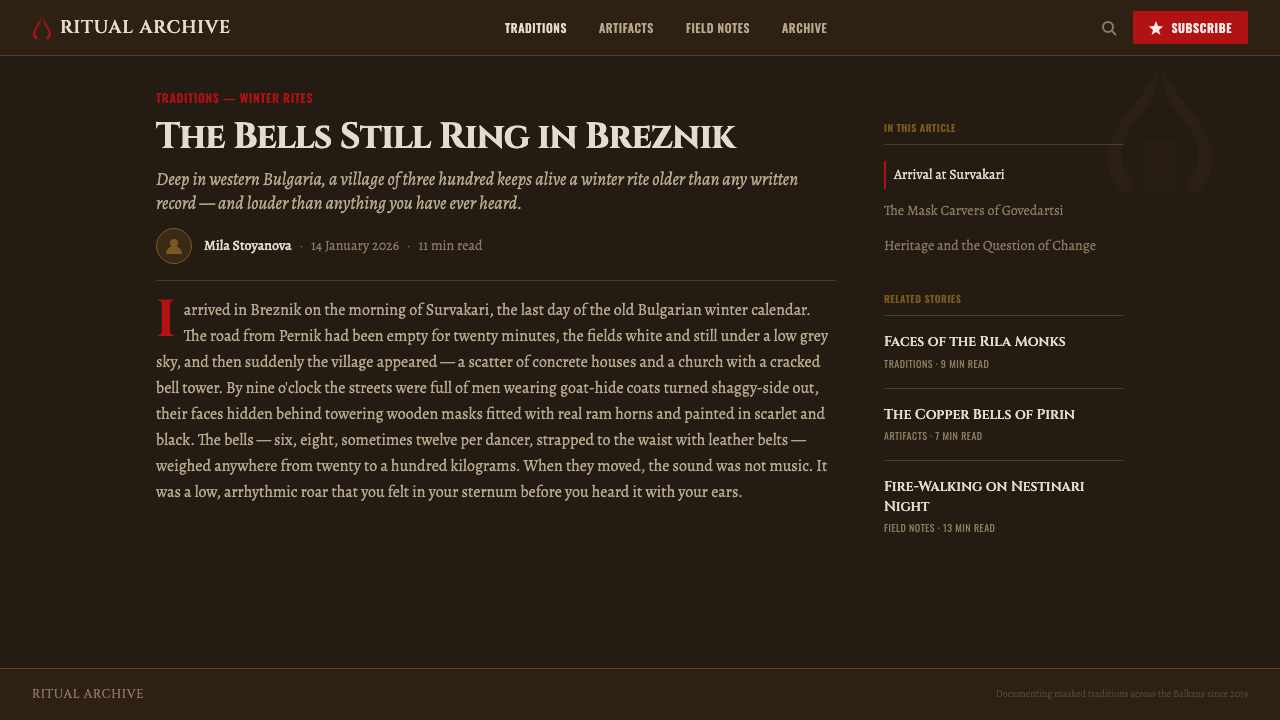
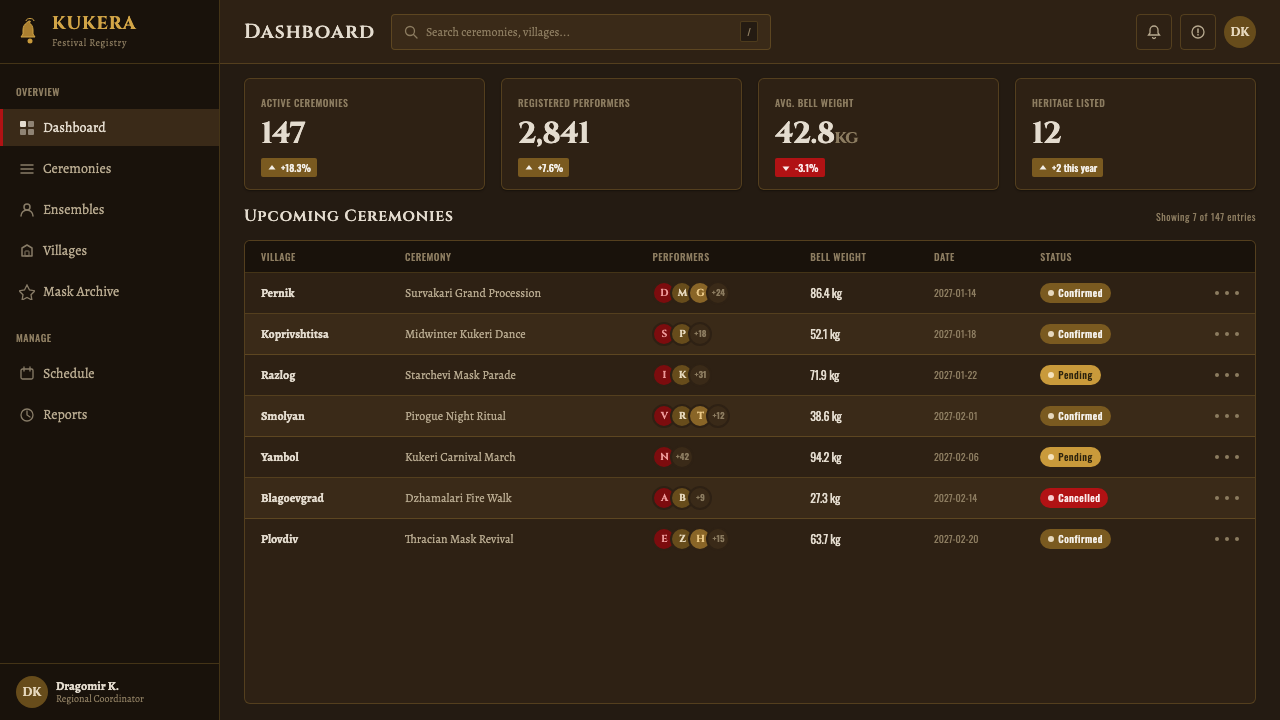
In web interfaces the aesthetic is well suited to dashboards and admin tools that want to feel serious and slightly intense rather than friendly — security products, ritual or ceremony-adjacent brands, anything in entertainment or gaming that wants darkness with genuine weight behind it rather than generic 'dark theme' styling. Pricing tiers can borrow the tradition's use of a single hot accent to mark the recommended plan against an otherwise restrained dark field, echoing how one scarlet kerchief stands out against a field of hide.
For editorial and marketing work, the style rewards long-form storytelling — travel writing, cultural features, documentary-style brand content — where a dark, tactile ground gives photography and video room to be the star, with red used only for pull quotes, calls to action, or section markers. Marketing pages should avoid decorating every element; the ritual itself is sparing with its accents, using them only where attention is genuinely earned.
The most common mistake is treating this as a generic 'dark, rustic folk' template and reaching for warm browns and creams instead of true near-black, or scattering red evenly across a layout instead of concentrating it the way a kerchief or tassel concentrates it on the body. The other frequent error is smoothing everything out — rounded corners, soft gradients, gentle drop shadows — which erases the raw, handmade, slightly frightening quality that makes kukeri distinct from generic 'boho' or 'folk' aesthetics in the first place.
Bulgarian Kukeri Mummers — FAQ
Is kukeri the same tradition across Bulgaria, or does it vary by region?
It varies significantly. Costume silhouettes, mask horn shapes, the exact timing of processions, and even the name used (kukeri in some regions, survakari in others) differ from village to village. This variation is documented by folklorists as an authentic feature of a decentralized oral tradition rather than as inconsistency to be resolved, so a design system drawn from it should be read as one interpretation among many living variants, not a single fixed canon.
Why is the palette so dark instead of using bright, festive colors typical of 'folk' design?
Because the ritual is not festive in the pastel sense — it is a rite meant to be a little frightening, aimed at scaring off malevolent spirits and the old year itself. The costumes are built from unbleached animal hide, which is naturally dark, with color reserved for a few deliberately hot accents rather than spread evenly across a bright palette. Leaning into that darkness is what keeps a kukeri-derived system distinct from generic cheerful 'folk craft' references.
Does a kukeri-inspired design require literal masks or bells as imagery?
No, and leaning too heavily on literal mask or bell illustrations tends to read as costume-party kitsch rather than as a genuine design language. The stronger approach borrows the underlying logic — near-black grounds, a single hot accent used sparingly, forged rather than polished metal tones, heavy and deliberate motion — and lets those structural choices carry the reference rather than relying on literal iconography.
Is this style appropriate for a lighthearted consumer brand?
It works best for brands that want to signal intensity, seriousness, or a touch of danger — security products, entertainment with dark themes, cultural or documentary content, bold rebrands. It tends to overwhelm contexts that need to feel light, playful, or reassuring, such as children's products or casual lifestyle apps, where the weight and darkness of the palette will read as intimidating rather than inviting.
How does kukeri differ from other dark folk-craft design references, like Bulgarian Orthodox icon gold leaf?
The difference is in what generates the darkness and what interrupts it. Kukeri's darkness comes from unbleached organic hide and is interrupted by scarlet wool and forged bell metal; it is a worn, moving, percussive costume tradition. Icon-derived systems, by contrast, get their intensity from burnished metallic leaf and painted pigment on a static wooden panel — a devotional, stilled aesthetic rather than a ritual, kinetic one. Both read as dark and Bulgarian, but the underlying material logic, and the mood it produces, are very different.
Related design styles
 Samoan Tatau (Pe'a)Gravitas without softness. Soot-black geometry locks into warm skin-tone gutt…
 Sámi Gákti & DuodjiIdentity lives at the edge. Ordered red, yellow and green bands speak against…
 Acehnese Rencong MotifA blade that reads as a word. Flat kerawang red, white, green and yellow lock…
 Bogolanfini MudclothAbsence becomes language. Warm iron-black bands hold uneven bleached-cotton s…
 Bulgarian Shevitsa Folk EmbroideryVillage-bright code. Deep indigo carries shevitsa red crosses and gold-cord b…
 Dayak Borneo Tattoo (Iban)A living journey ledger. Soot lines, ochre panels, and rust rosettes feel han…