What is Marajoara Amazon Ceramic?
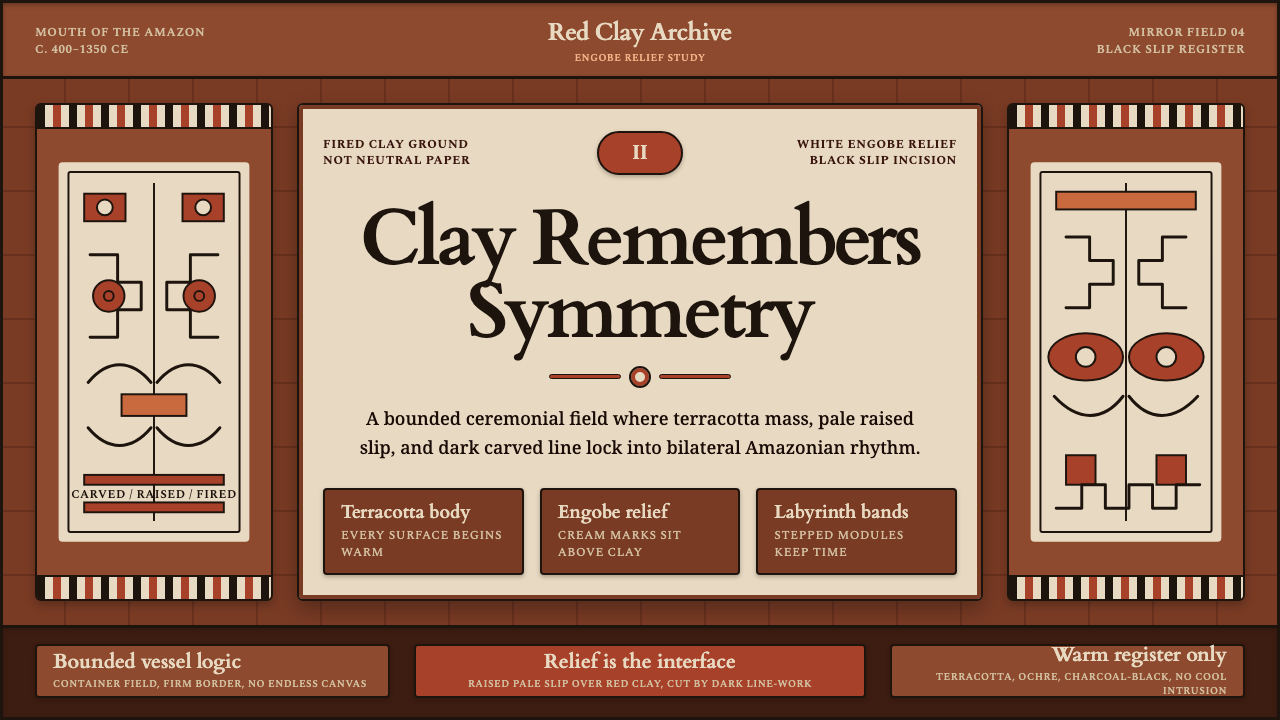
Clay holds memory: terracotta becomes the ground, pale engobe rises as relief, and black slip turns symmetry into a living system.
Marajoara Amazon Ceramic in brief
Marajoara Amazon Ceramic refers to the visual language of Marajó Island pottery, produced by Indigenous potters in the Amazonian world before European contact. Its defining image is not a neutral field decorated with motifs, but a fired red-brown clay body carrying every other decision. Dense terracotta, pale engobe, black slip, incised surfaces, raised relief, and strict bilateral symmetry work together as a single material vocabulary.
The system is built around contrast between earth and surface. Terracotta supplies warmth, weight, and permanence; pale engobe creates a light plane for carved or raised forms; black slip concentrates the drawing into decisive lines. The result is dark, tactile, and graphic without becoming sleek or technological. Surfaces feel made rather than rendered, as though every interface element has been shaped, coated, and fired.
Its motifs are immediately legible but never casual: coiled serpents, staring disembodied eyes, whisker-like scrolls, and stepped labyrinth bands repeat across funerary urns, ritual vessels, and figurines. Symmetry provides order, while repetition and relief create visual intensity. The aesthetic is therefore both controlled and uncanny, combining disciplined structure with forms that seem to watch, coil, or move across the vessel.

Where does Marajoara Amazon Ceramic come from?
Marajoara culture developed on Marajó Island at the mouth of the Amazon River in Brazil, a landmass described as comparable in size to Switzerland. The culture is dated to approximately 400–1350 CE, placing its ceramic production within the long history of pre-Columbian Amazonian ceramics. The island’s position where river and Atlantic meet is part of the style’s identity: these objects belong to an Amazonian material world, not to a generalized idea of ancient pottery.
The ceramics were made from dense terracotta clay and then given a pale engobe, a surface layer that created a contrasting ground for further work. Potters carved and painted the coated vessels with intense bilateral symmetry. This sequence matters to the design language. The pale surface is not an independent color field, and the dark drawing is not floating decoration; both remain visibly attached to the red-brown body beneath them.
Marajoara objects included funerary urns, ritual vessels, and figurines. Their surfaces combine incised marks, painted passages, raised relief, and black slip line-work. The visual system therefore emerges from the relationship between object, coating, incision, and pattern rather than from a separate graphic program applied afterward. A digital adaptation should preserve that sense of layered making: the ground remains present, and every mark appears to have a physical reason for being there.
The source attributes the tradition at culture level to Marajoara Indigenous potters and to the Amazonian mound-builder lineages of Marajó. It also places the work within the movements described as Pre-Columbian Amazonian ceramics and incised and painted relief pottery. Because no individual artist is named, authorship is understood collectively. The design system respects that collective origin by treating repetition, craft discipline, and material continuity as more important than a signature style.
What defines the Marajoara Amazon Ceramic look?
Terracotta Ground
The background is never neutral white or empty black. It is the warm red-brown of fired terracotta, treated as the physical mass beneath the entire composition. This ground gives the system density and age before any pattern appears. Dark panels can deepen the mood, but they should remain subordinate to the idea that the surface began as clay.
Engobe Relief
Pale engobe functions as a raised or coated layer rather than a flat digital fill. It should feel deposited onto the clay, then carved, interrupted, or allowed to stand proud of the ground. Its lightness is valuable because it reveals form through contrast, not because it creates a clean modern canvas.
Black Slip Linework
Black slip supplies the sharpest graphic register. It outlines eyes, serpentine coils, whisker-like scrolls, and stepped bands with a line quality that feels painted and incised at once. Use it to clarify structure, establish rhythm, and make symmetry readable. It should not become a generic outline treatment detached from the vessel-like surface.
Bilateral Symmetry
Symmetry is the organizing force, not a decorative afterthought. Forms should answer one another across an implied central axis, with repeated eyes, coils, or stepped marks held in visual tension. The result should feel intentional and ceremonial, yet not mechanically sterile. Small irregularities may remain as evidence of making, while the overall structure stays firmly balanced.
Serpents, Eyes, and Labyrinths
The motif vocabulary is compact but powerful. Coiled serpents introduce movement, staring disembodied eyes create presence, whisker-like scrolls soften the transition between forms, and stepped labyrinth bands establish containment. These motifs should be repeated, mirrored, and interlocked so that the surface reads as a continuous field rather than a collection of isolated icons.
Made Surface
The style depends on the sense that every mark belongs to a made object. Relief, coating, incision, and slip should remain visually distinguishable, even when translated into interface components. Avoid polished effects that erase the difference between material layers. Depth comes from overlap and edge, while atmosphere comes from the warmth of clay and the density of the pattern.

Who shaped Marajoara Amazon Ceramic?
The central makers of the tradition were Indigenous potters of Marajó, whose funerary urns, ritual vessels, and figurines demonstrate exceptional technical and artistic sophistication within the pre-Columbian Americas. Their collective authorship is expressed through dense terracotta construction, pale engobe, carved and painted surfaces, relief, black slip, and disciplined bilateral symmetry rather than through an individual signature.
This lineage-level attribution identifies the wider cultural setting in which Marajoara ceramics were made. It keeps the work connected to Marajó as a place and to Amazonian history as a living material context. In design terms, it supports a system based on continuity, repetition, and collective craft rather than on the mythology of a solitary genius.
The tradition itself functions as a collective figure: a recognizable body of vessels and figurines unified by terracotta, engobe, slip, relief, and symmetry. Its importance lies in how consistently material process and visual language reinforce one another. The tradition is therefore best represented through systems of making and pattern, not through a single portrait or named biography.
How do you use Marajoara Amazon Ceramic today?
For presentation covers, let terracotta carry the field and place a single pale engobe form or black slip motif where it can establish the composition immediately. A mirrored serpent, solitary eye, or stepped band can frame the title without behaving like a decorative border. Cover pages should feel like the face of a vessel: concentrated, tactile, and quietly confrontational. Content slides should open the pattern into readable zones, keeping the material ground visible around headings, diagrams, and supporting text.
On content and data slides, use bilateral structure to organize information. A central axis can divide a comparison, while mirrored relief forms can mark paired concepts. Charts should feel incised or assembled from coated clay rather than imported from a generic software palette. Use pale engobe for the primary reading layer, black slip for labels and structural marks, and terracotta for context, continuity, and visual rest. The strongest compositions let the data remain clear while the material language controls its rhythm.
For web interfaces, the style suits dashboards and pricing pages that need authority, hierarchy, and a memorable sense of place. Terracotta can form the persistent page ground; pale surfaces can contain cards or panels; black slip can define navigation, dividers, selected states, and key labels. Use relief-like edges or layered surfaces to distinguish active areas, but keep the interaction model straightforward. The pattern should support scanning, not compete with prices, status, filters, or operational decisions.
Editorial and marketing layouts can treat the page as an elongated vessel. A strong title may sit within a pale coated field, while side notes, captions, or calls to action are contained by stepped bands and serpentine transitions. Campaign pages benefit from the tension between warm clay and near-black structure, especially when a single eye or coiled form becomes a recurring anchor. The result should feel culturally grounded and materially specific, not like a generic earthy theme.
The common mistake is to imitate the palette while discarding the craft logic. Terracotta, cream, and black alone do not create Marajoara Amazon Ceramic if the layout is glossy, asymmetrical in a casual way, or filled with unrelated icons. Another mistake is to use every motif at once, turning the surface into noise. Choose a dominant pattern family, preserve a clear axis, and let the relief, coating, and slip remain visually distinct. The system becomes convincing when restraint makes the making process legible.

Marajoara Amazon Ceramic — FAQ
Why must terracotta remain visible as the ground?
Because the identity of the style begins with fired clay, not with a color palette. The red-brown body supplies the material memory that makes the pale engobe and black slip meaningful. If it is replaced by a neutral page, the surface becomes a modern graphic layout wearing historical colors. Keeping terracotta visible preserves the relationship between body, coating, incision, and relief that defines the tradition.
Is this simply an earthy dark theme?
No. Its darkness comes from dense material, black slip, and concentrated pattern rather than from a generic dark interface treatment. The pale engobe must remain an active surface layer, and the terracotta ground must retain warmth. Without relief, bilateral structure, and the specific motif vocabulary of serpents, eyes, scrolls, and stepped bands, the result loses the Marajoara reference and becomes only an earthy color scheme.
How should engobe and slip be distinguished in a digital interface?
Treat pale engobe as the light coated or raised plane and black slip as the darker linear register drawn over or into that plane. Engobe can hold a card, title field, or major content area; slip can define labels, contours, separators, and pattern rhythm. The distinction should be visible through contrast, layering, and edge behavior, not through arbitrary effects that make the interface look glossy or synthetic.
Can the style use asymmetry?
It can, but asymmetry should not weaken the tradition’s central discipline. A page may allow an irregular crop, an offset panel, or a partial motif, yet the main pattern should still answer to an implied axis or mirrored rhythm. The goal is not perfect mechanical duplication; it is a strong sense that forms belong together. Hand-made variation can coexist with structural balance.
Which imagery belongs in a Marajoara-inspired layout?
The strongest imagery is already contained in the source vocabulary: terracotta bodies, pale engobe surfaces, black slip marks, coiled serpents, staring eyes, whisker-like scrolls, stepped labyrinth bands, funerary urns, ritual vessels, and figurines. Use these as structural references rather than as a pile of decorative stickers. The style works best when imagery explains the material system and reinforces symmetry, relief, and continuity.
Related design styles
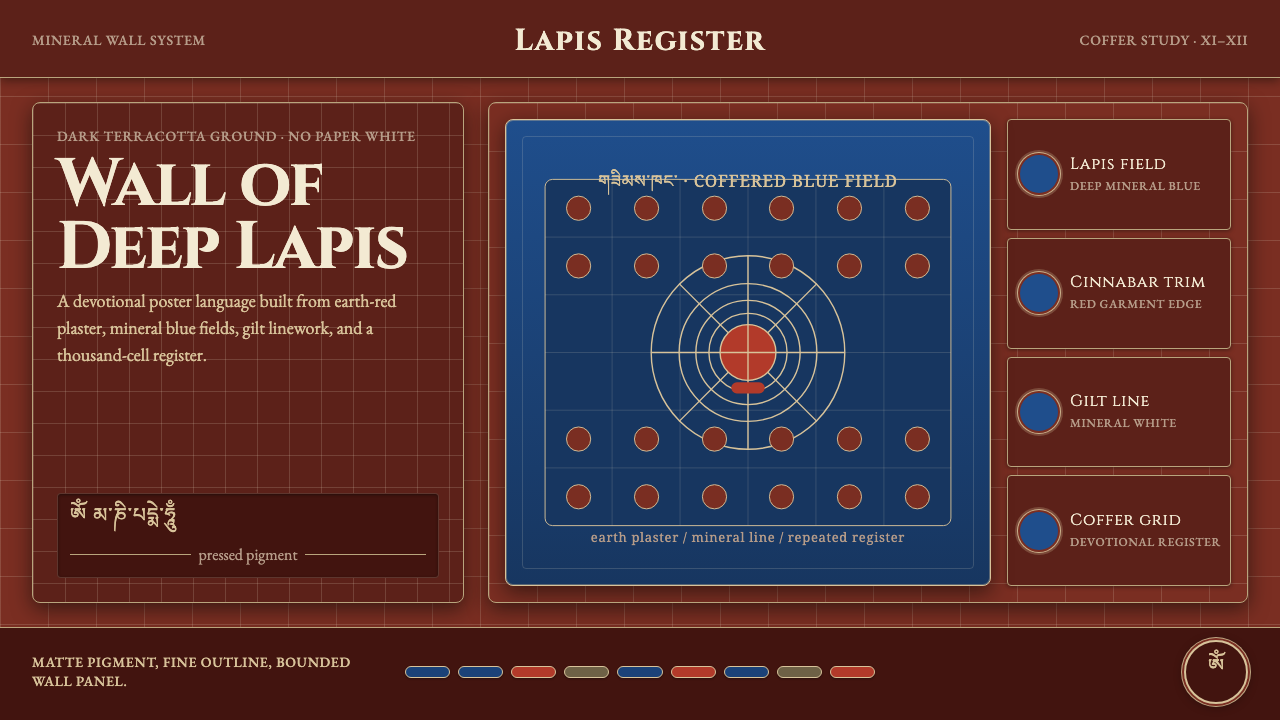 Alchi Monastery MuralDevotional depth. Lapis fields and coffered grids glow on terracotta plaster.
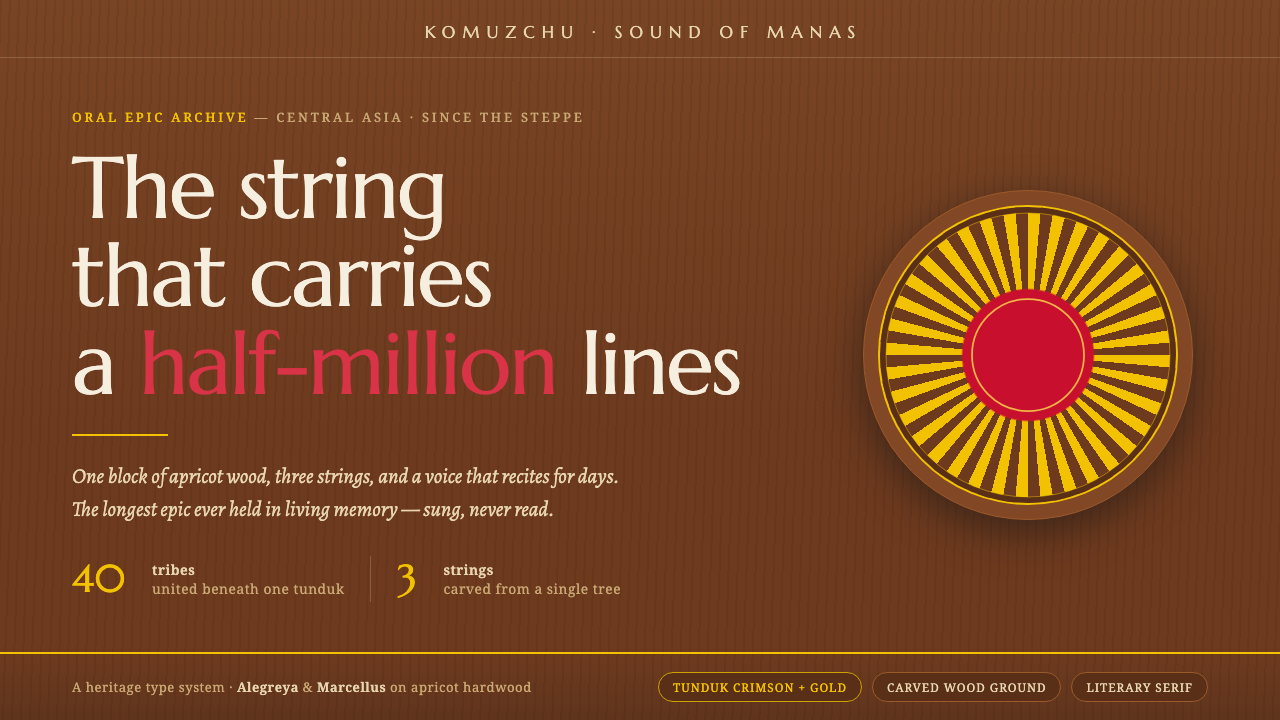 Kyrgyz Komuz & Manas EpicWarmth carved from apricot wood. Crimson-and-gold tunduk sun-rays on dark gra…
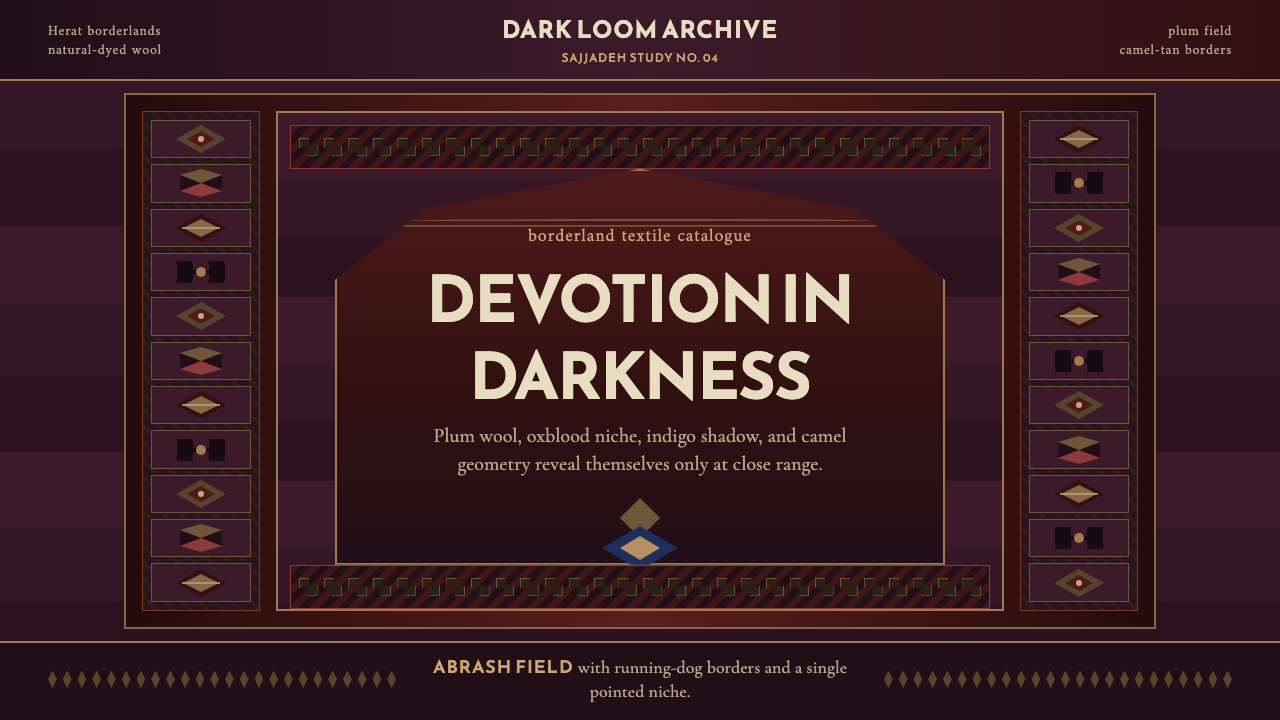 Afghan Baluchi Prayer RugDevotional darkness glows. Plum field, oxblood mihrab, and camel borders surf…
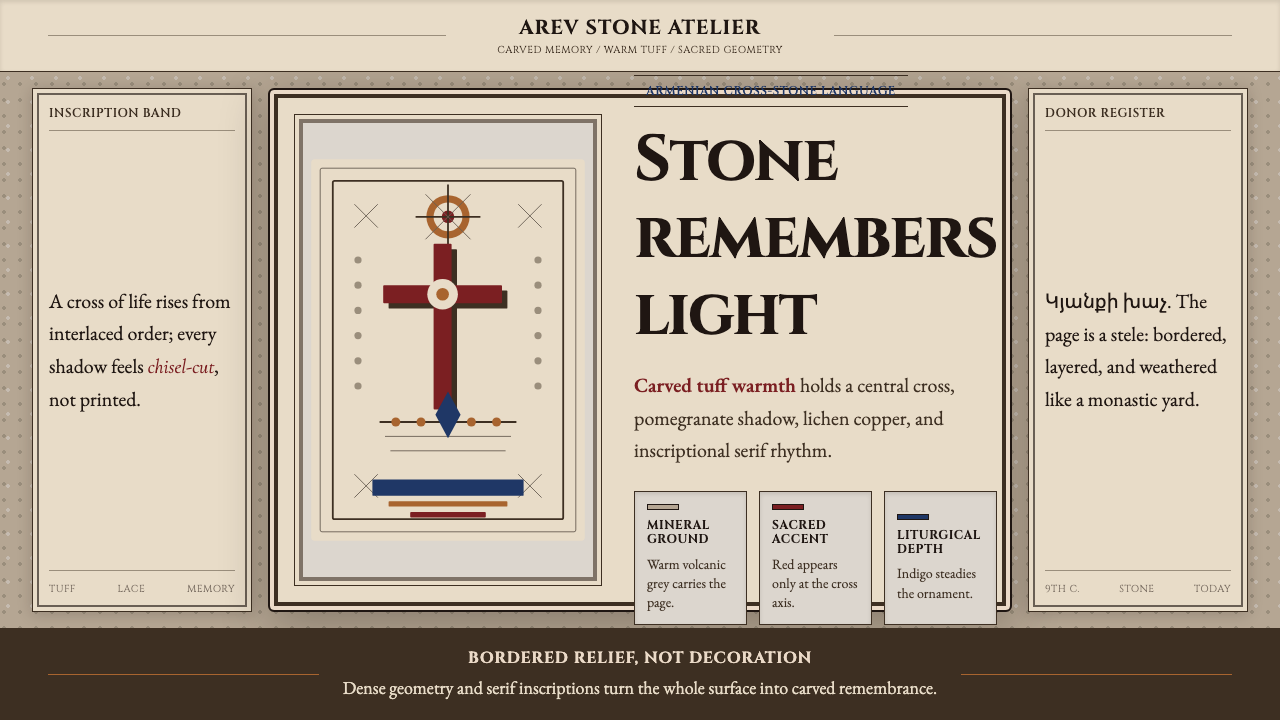 Armenian Khachkar Cross-StoneStone becomes memory. Tuff grey, pomegranate red, and carved borders hold the…
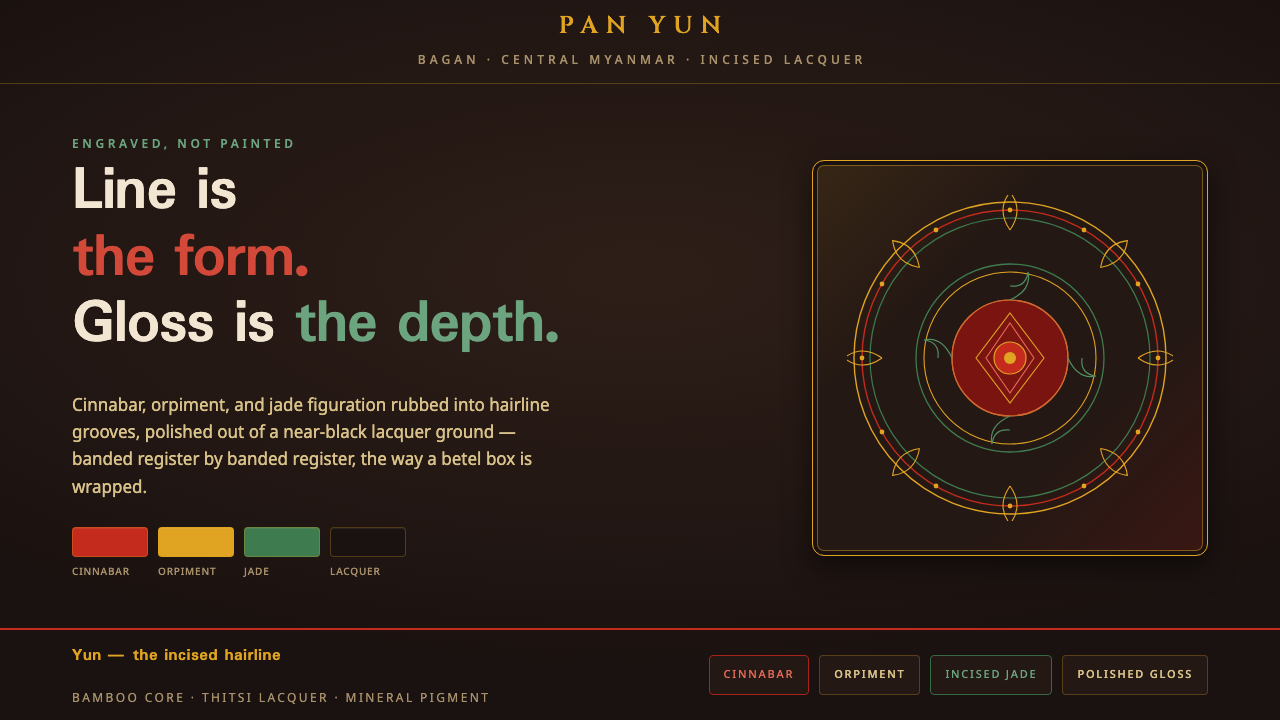 Bagan Yun LacquerwareEngraved, not painted. Cinnabar, orpiment and jade hairlines polished from ne…
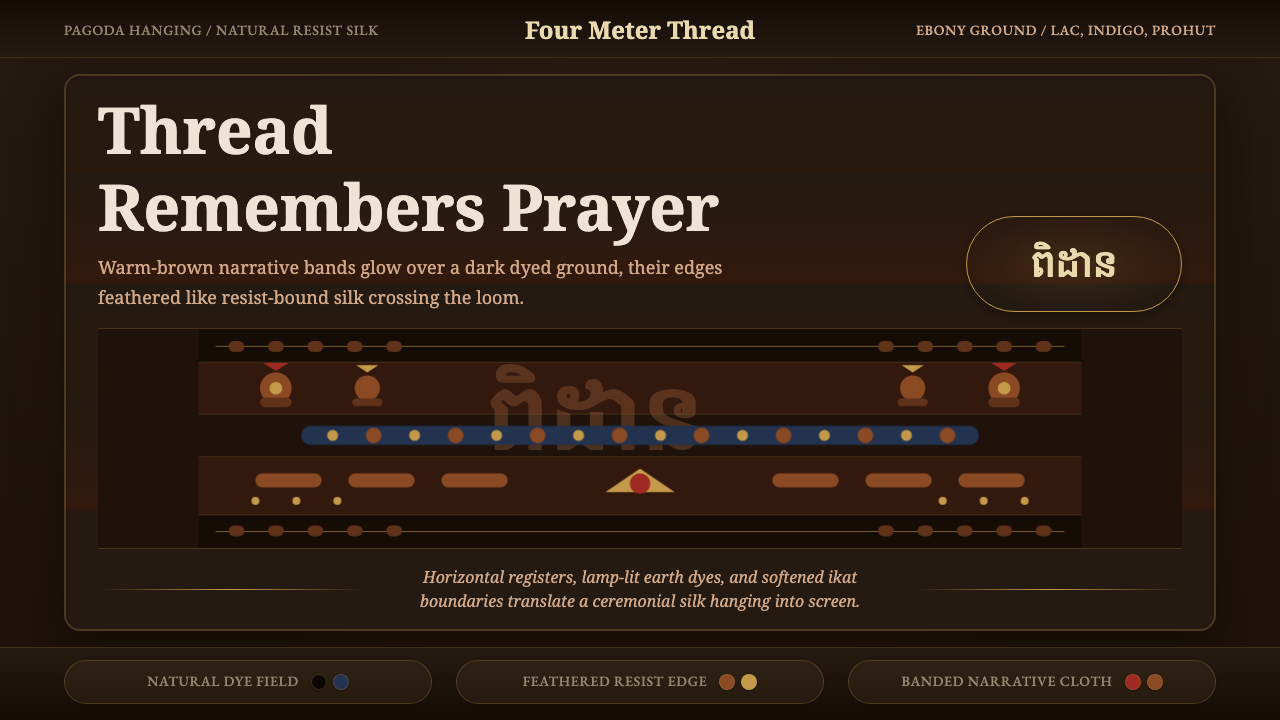 Cambodian Pidan IkatSacred cloth glows. Ebony-indigo bands carry warm-brown ikat figures with fea…