What is Diablada de Oruro?
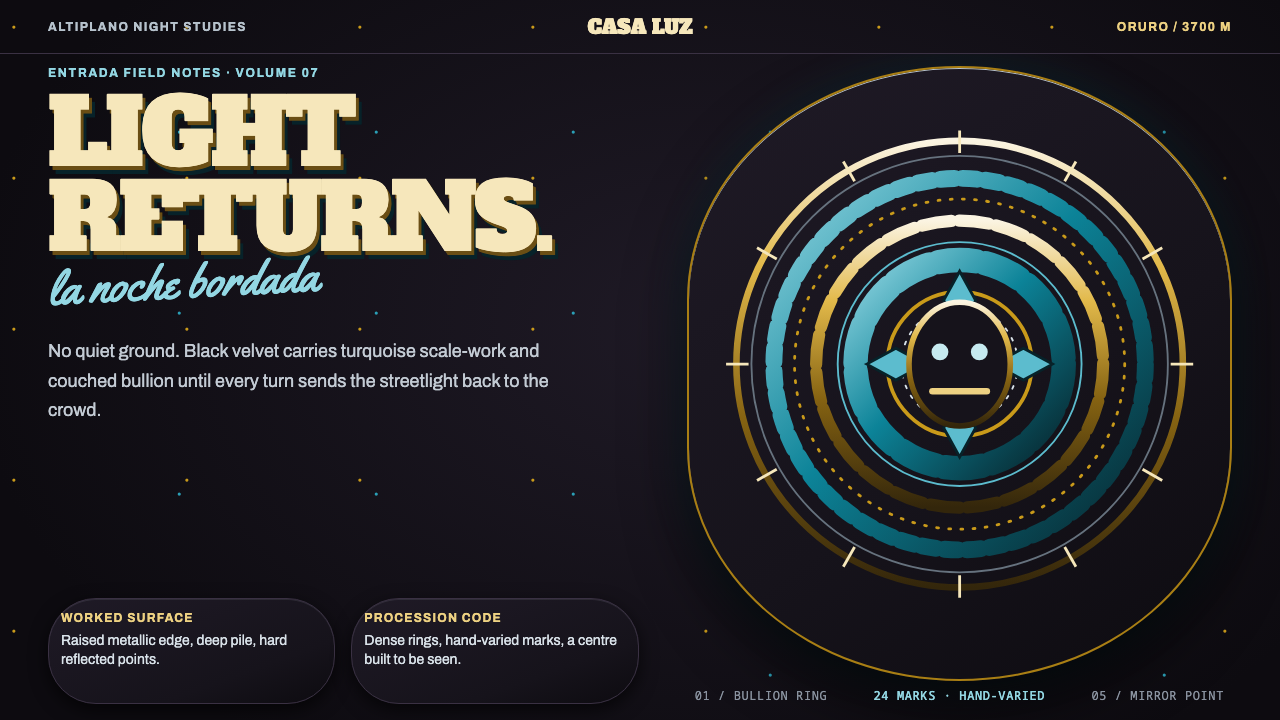
The Diablada turns a dancer into a moving mirror: black velvet, turquoise scale-work and bullion that throws every light on the route back at the crowd.
Diablada de Oruro in brief
The Diablada de Oruro is the devil dance that opens the Carnival of Oruro, in the Bolivian altiplano. Over three days at 3,700 metres above sea level, fraternities of dancers move through the city in an entrada, the long ceremonial procession that forms the backbone of the carnival. The visual language it produces is among the densest of any dance tradition: capes of black velvet worked so heavily in silver and gold bullion that the ground barely shows, and masks of moulded plaster and tin with convex glass eyes, mirror inlay, and dragons and serpents crowding the brow.
The governing idea is that density is the content. Nothing on a Diablada costume is a quiet field. Every surface is either carrying embroidery, catching light, or growing into a creature, and the whole costume is engineered to return the lights along the route to the people watching it pass. It does not merely reflect; it throws brightness back, which is why the effect is closer to theatre than to ordinary decoration.
As a design language this becomes a near-black ground, turquoise scale-work, metallics that read through highlight and shadow rather than flat fill, and containers shaped like medallions instead of rectangles. It is dark, maximal and ceremonial, the opposite of the airy minimalism that dominates interface design. Its discipline lies not in emptiness but in organisation: the densest surface is held together by a small, consistent set of materials and motifs.
Where does Diablada de Oruro come from?
The Diablada belongs to the Carnival of Oruro, held in a high-altitude mining city whose religious life has long been bound up with the mines. The carnival's devotional centre is the Virgen del Socavón, the Virgin of the mineshaft, and the entrada is at once a festival and an act of devotion. The tradition runs back through colonial devotion to the Candelaria, and it is usually described as syncretic: a ritual in which Uru and Catholic strands are woven together rather than one replacing the other. UNESCO inscribed the Carnival of Oruro on its list of Intangible Cultural Heritage in 2001.
The fraternity form danced today took shape in the first half of the twentieth century, roughly 1900 to 1950, although the entrada itself is older. Troupes are organised as fraternities with their own names and identities. Two that stand as reference points are the Gran Tradicional Auténtica Diablada Oruro, whose very name claims the authentic local form, and the Diablada Ferroviaria, whose name points to the railway. Across the border in Puno, in Peru, the related Diablada Puneña shows that the devil dance is a shared Andean carnival practice rather than the property of a single town, and that each place carries its own accent.
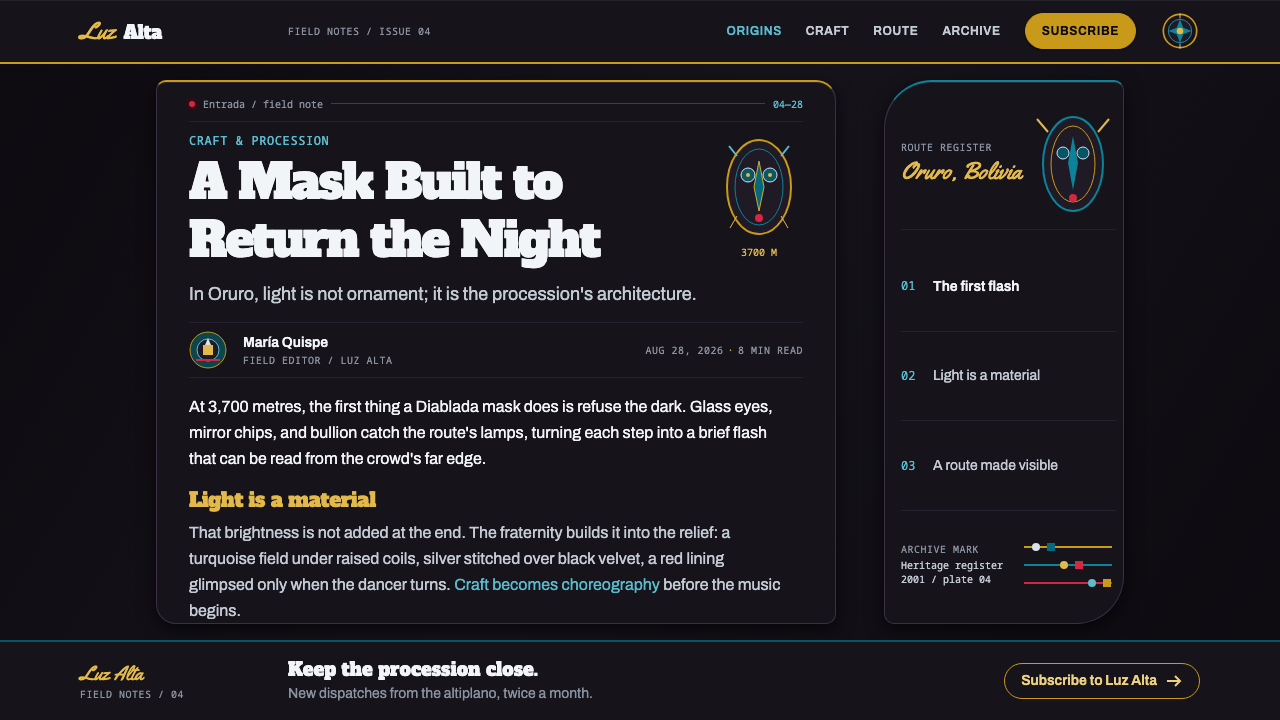
Two craft trades make the look what it is. The careteros, the mask-makers associated with Calle La Paz in Oruro, mould plaster and tin into the horned, serpent-crowned faces. The bordadores, the embroiderers of Oruro, build bullion onto velvet until the cloth disappears. Both are crafts of accumulation: glass, mirror, thread and metal are added one piece at a time, and the finished surface is the sum of thousands of small decisions. This is why the style is so surface-driven. It was authored by workshops, not by a single named designer.
For designers, the lesson is a specific logic rather than a costume to copy. Devotion is expressed as brilliance; community identity is expressed through shared materials; and a dark ground is treated as the thing that makes light legible. Because this is a living ceremonial tradition, it deserves respectful handling: name the Diablada and Oruro when you draw on it, and avoid reducing it to a generic devil motif.
What defines the Diablada de Oruro look?
Black velvet ground
The ground is near-black and behaves like velvet: it absorbs light so that everything set on it appears to glow. It is not a flat void or a neutral dark mode. It is a deep, slightly textured field whose only job is to make the metallic and turquoise elements above it read as luminous. Keeping the ground genuinely dark, rather than mid-grey, is what allows the rest of the system to work.
Turquoise scale-work
The signature colour is a lake-blue turquoise drawn from the scales of the dragons and serpents that crowd the masks. It appears as overlapping scale-work, a repeating rhythm of small curved plates, rather than as a flat block of colour. Turquoise is the cool voice against the warm metals, and the scale rhythm gives large areas a surface without needing an image.
Metal read by light
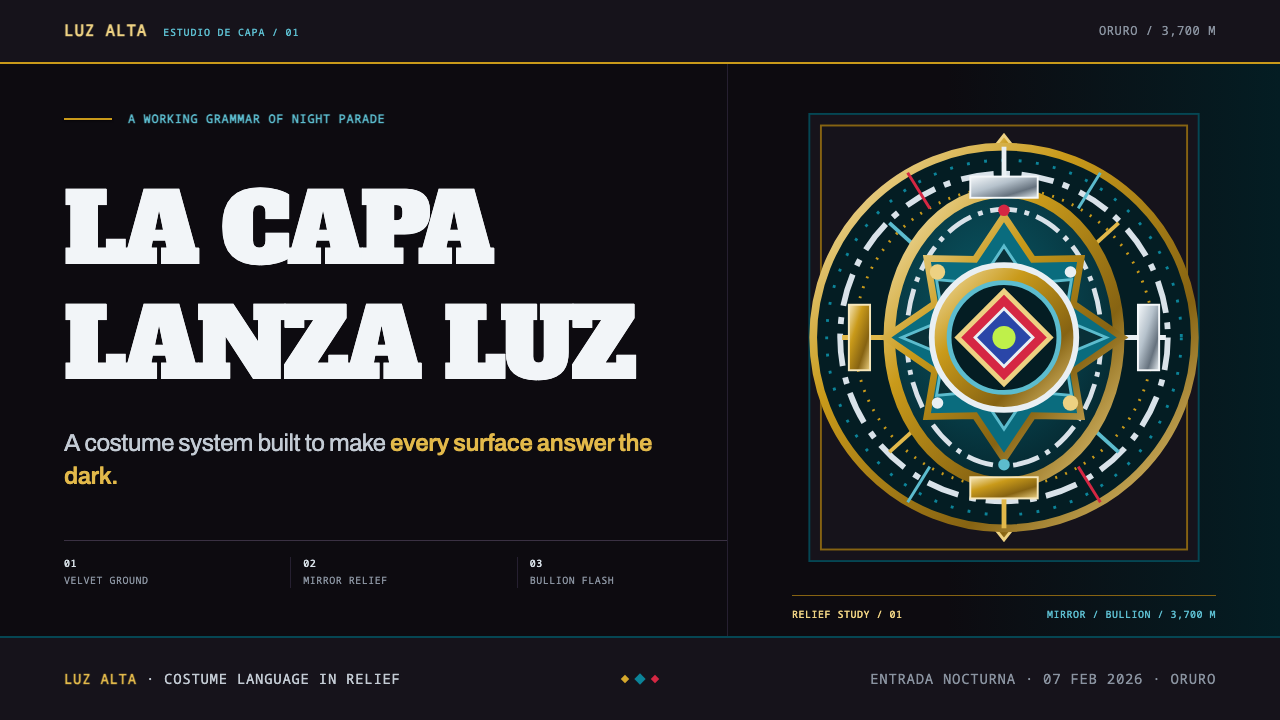
Silver and gold arrive as bullion: rings, coils and cord worked onto the cloth. They are rendered through highlight and shadow, a bright edge and a darker underside, never as a single flat fill. A flat yellow reads as paint and a flat grey as concrete; only a surface that lights up on one side and falls away on the other reads as metal. That distinction is the whole difference between richness and cheapness here.
Medallion containers
Containers are shaped as ovals and medallions instead of rectangles. Cards, badges, avatars and call-outs take on the rounded, framed look of an inlaid jewel. The shape echoes the convex glass eyes and mirror inlay on the masks, and it signals at a glance that the interface belongs to a ceremonial rather than a corporate world.
Density as content
There is no quiet field to rest in. Where most design systems treat empty space as the main device for hierarchy, this one fills the surface and builds hierarchy through material: which element is brightest, which is most layered, which is closest to a jewel. The eye is kept moving across a continuous, crowded field, much as it would along a line of costumed dancers.
Dragons and serpents
Ornament is figurative and emblematic. Dragons and serpents crowd the brow of the masks, and their forms supply the motifs: crests, coils, scales and heads. Even when abstracted, the decorative vocabulary stays tied to creatures rather than to pure geometry, which gives the style a mythic, slightly menacing character.
Glass and mirror glints
Convex glass eyes and mirror inlay supply small, sharp points of brightness scattered over dark fields. In an interface these become glints: tiny highlights on badges, rings and borders. Used with discipline they keep the dark ground alive; scattered everywhere they turn into noise, so they work best attached to the most important elements.

Who shaped Diablada de Oruro?
A dance fraternity of Oruro whose name, Great Traditional Authentic Diablada, states its claim to carry the local form of the dance. It stands as one of the principal reference points for the Oruro entrada and for the look of the fraternity costume danced today.
Another fraternity named in the tradition, whose name points to the railway. It is a reminder that the Diablada is organised around communities and associations, and that the costume is a shared identity as much as an individual outfit.
The mask-makers associated with Calle La Paz in Oruro. They mould plaster and tin into the convex-eyed, serpent-crowned masks, and their craft is the origin of the style's sculptural, high-relief character.
The embroiderers who work silver and gold bullion onto black velvet until the cloth barely shows. Their labour-intensive method is the practical basis of the style's density, and the reason metal in this system is built up in layers rather than painted on.
How do you use Diablada de Oruro today?
The Diablada system suits subjects that want theatre, celebration or craft heritage: festivals, nightlife, music, fashion, jewellery, hospitality and cultural storytelling. It is a poor fit for work whose value depends on quiet, such as tax software or medical records. The style is powerful because it is concentrated, so it should be applied in settings that can carry that intensity.
For slides, a cover works best as a black field with the title set inside a single medallion frame, a band of turquoise scale-work along one edge, and one metallic rule beneath. Content slides keep the dark ground and place each key point in its own medallion, with metallic lines separating sections. On data slides, charts sit on black with bars and lines drawn in lit metal and turquoise; give the most important number the brightest metallic, and keep scale-work out of the plot area so the data stays readable.
For web interfaces, the style translates into a dark theme in which badges, avatars and plan emblems become medallions. On a pricing page, tiers can each be a medallion, with the recommended tier given the strongest highlight. Dashboards should keep body text on solid dark panels with strong contrast, and reserve ornament for headers, borders and empty-state illustrations rather than placing it behind figures or form fields.
For editorial and marketing work, the style gives event pages and cultural features an immediate sense of occasion. Let the hero area carry the full density of scale-work, bullion and glints, then calm the layout for the article body, where ordinary dark panels and clear type should take over. Density belongs to the chrome and the headlines, not to paragraphs people have to read.
The most common mistake is to treat density as noise. Sprinkling sparkle over everything, putting pattern behind body text, or filling metallic areas with flat yellow all break the logic that makes the style work. A second mistake is drifting into a generic Halloween devil, with horns and pitchfork cartoons. This costume belongs to a devotional carnival, and the result should read as ceremonial and crafted, not as a joke.
Diablada de Oruro — FAQ
What is the Diablada de Oruro?
It is the devil dance that opens the Carnival of Oruro in the Bolivian altiplano. Fraternities of costumed dancers process through the city in a three-day entrada, wearing velvet capes covered in silver and gold bullion and masks of moulded plaster and tin. The carnival is tied to devotion to the Virgen del Socavón and was inscribed by UNESCO as Intangible Cultural Heritage in 2001. As a design style, it stands for dense, light-reflecting, ceremonial richness.
Does the style work on a light background?
It is built around a near-black velvet ground, and that is not incidental. Metallics read as lit because they sit against dark, and turquoise gains its glow the same way. On a pale ground the highlight-and-shadow logic loses its contrast, and the whole look drifts toward ordinary decoration. If you need a light surface, keep it for small reading areas and let the dark ground frame them.
How do I make metallic gold and silver without a flat yellow or grey?
Build metal from light rather than from a single colour. Give each metallic element a bright edge where light would strike it and a darker underside where it would fall into shadow, and shape it as a ring, coil or cord instead of a rectangle. The result should read as worked bullion with depth. Avoid uniform fills, because a flat colour tells the eye it is paint, not metal.
Why use medallions instead of rectangular cards?
Medallions come from the shape language of the costume itself: convex glass eyes, mirror inlay and ringed ornaments that catch light. A rectangle belongs to documents and grids, whereas an oval frame reads as a jewel set into cloth. Swapping the container shape is the cheapest way to move an interface from corporate to ceremonial without redrawing its structure.
Is it respectful to use a sacred carnival costume as a visual style?
It can be, if you treat it as a reference with a source. The Diablada is a living devotional and communal tradition, so name it and its home in Oruro, draw on its craft logic of density, reflection and handwork, and avoid caricature. Keep the work focused on materials and structure instead of imitating specific sacred figures, and credit the tradition where the context allows.
Related design styles
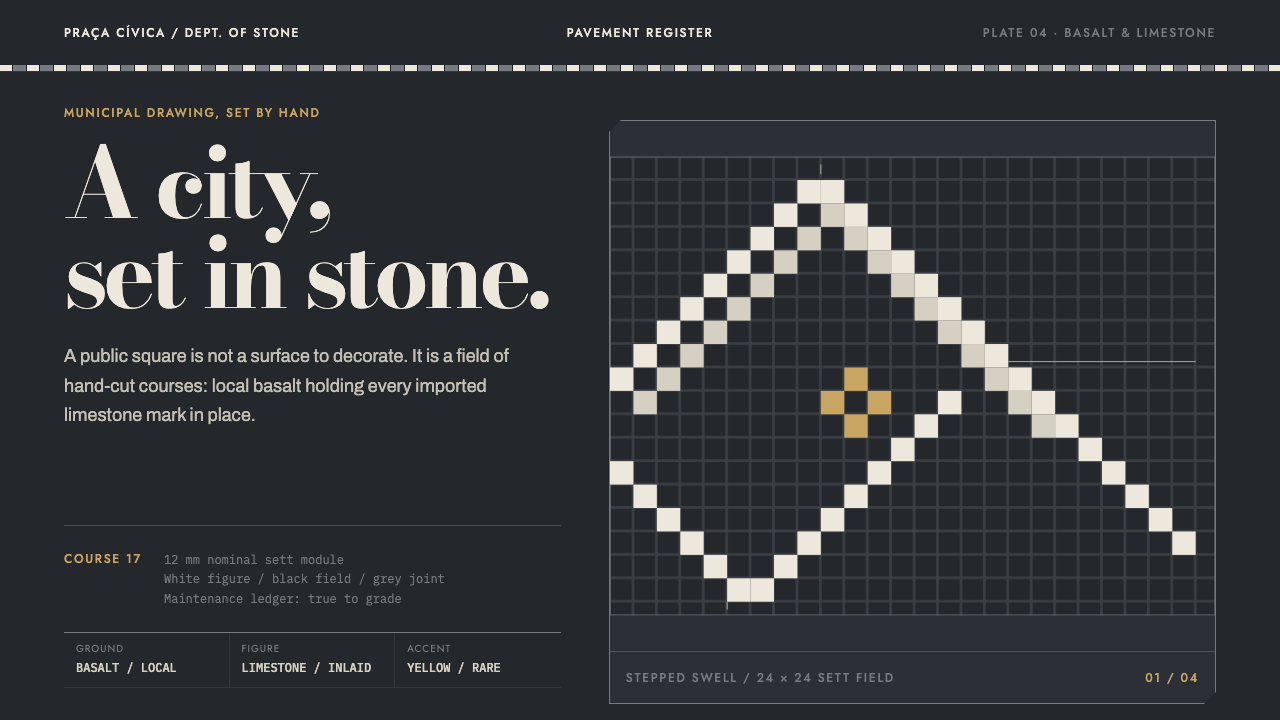 Calçada PortuguesaA city drawn in stone. Stepped limestone courses cut across a basalt grid.
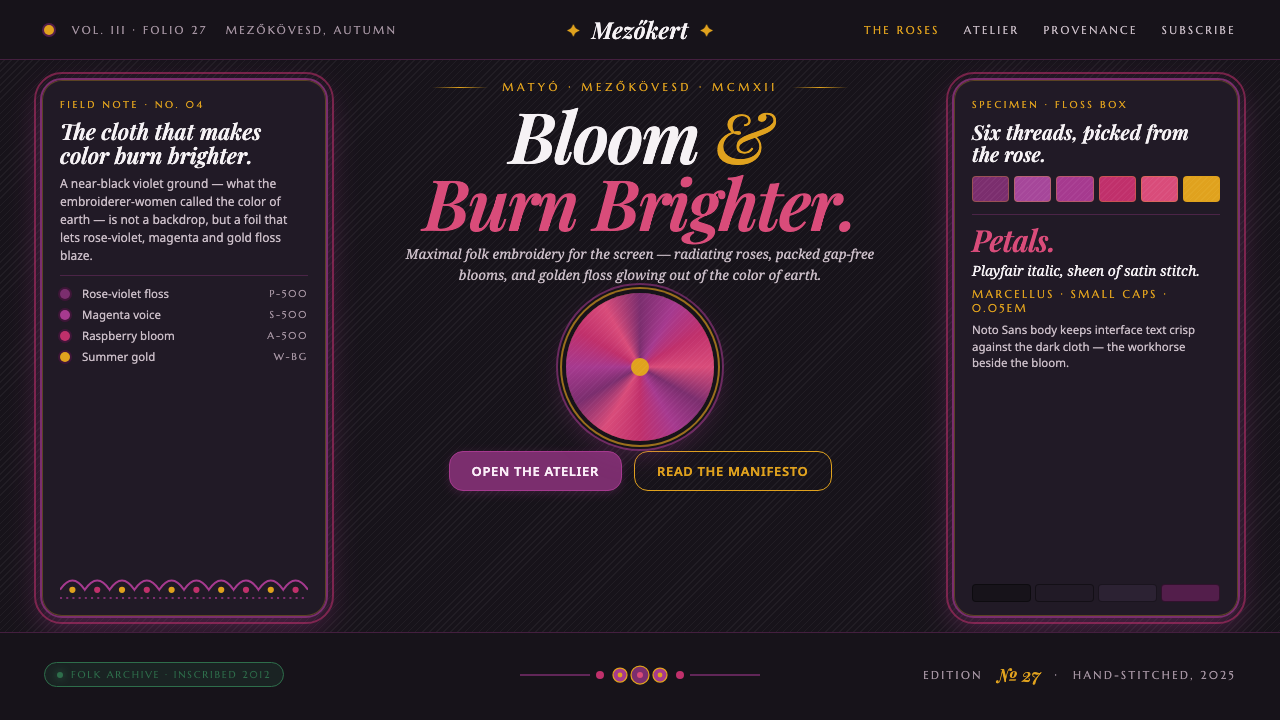 Hungarian Matyó VioletFolk embroidery, maximal. Rose-violet and gold blooms blaze gap-free on near-…
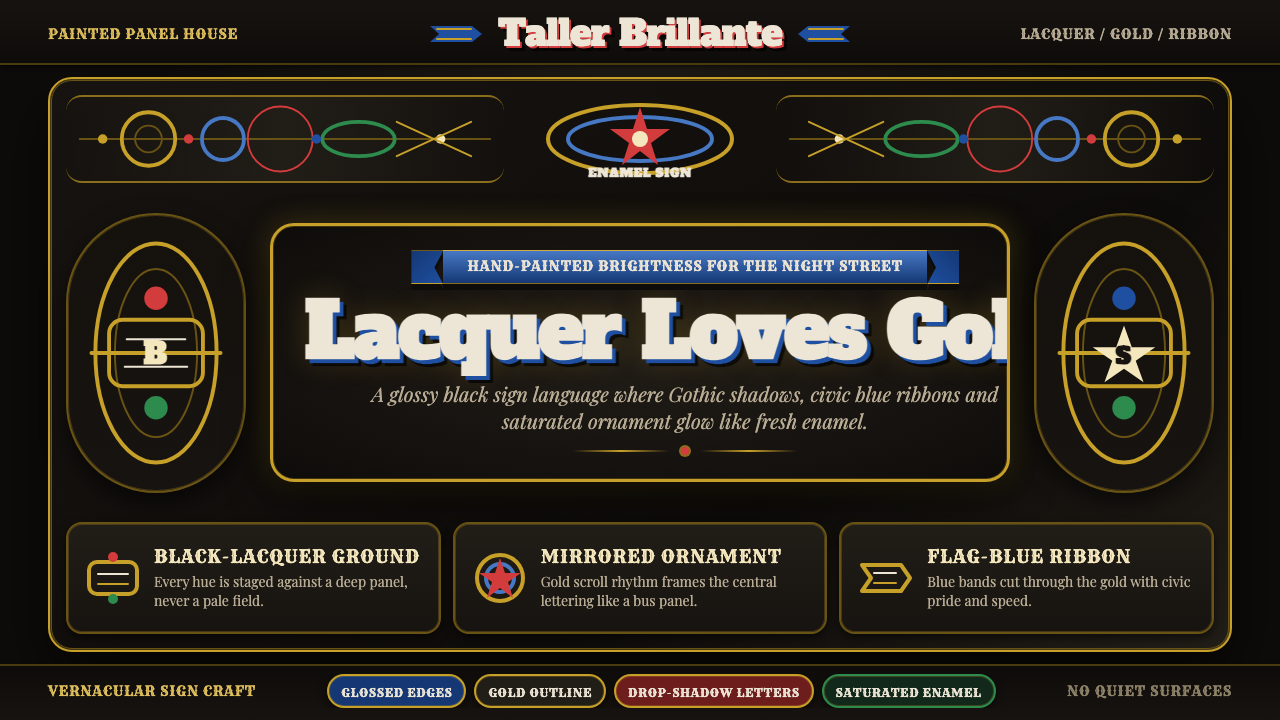 Fileteado Porteño Sign ArtBlack lacquer turns maximal. Gold scrolls, blue ribbons and Gothic shadows gl…
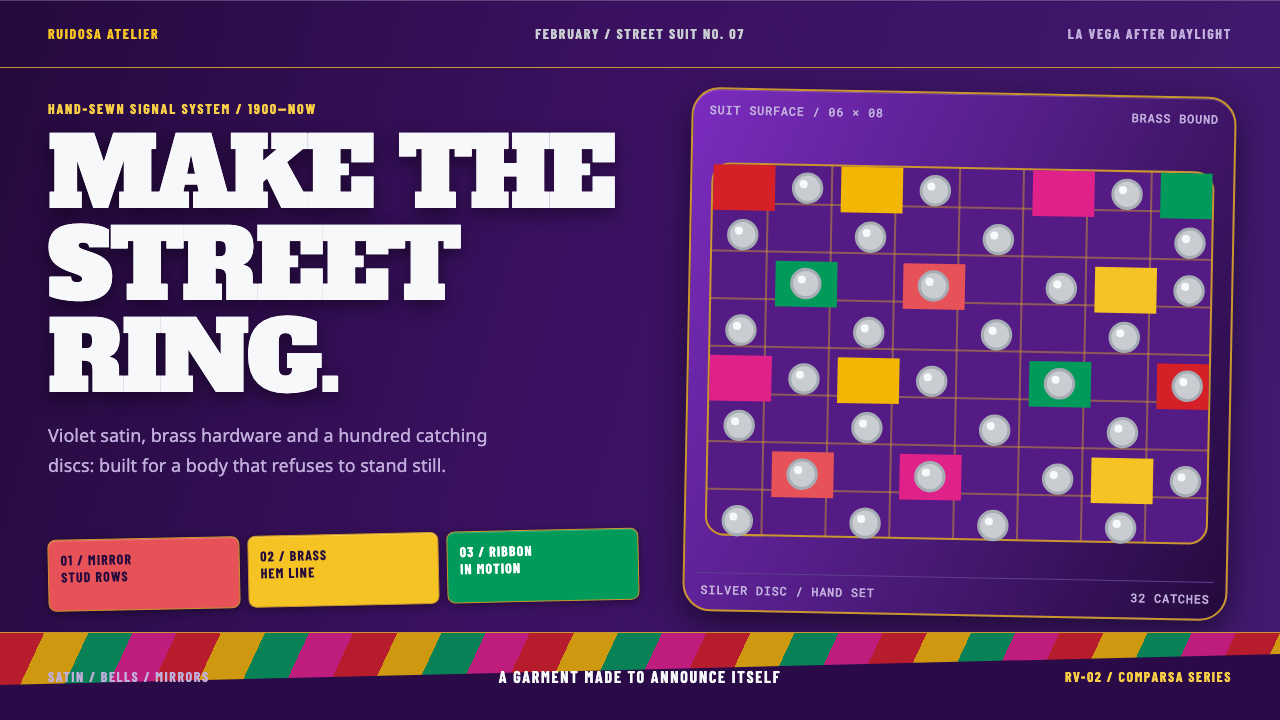 Diablo Cojuelo CostumeBuilt to be seen moving. Violet satin, brass edges, and mirror-disc grids mak…
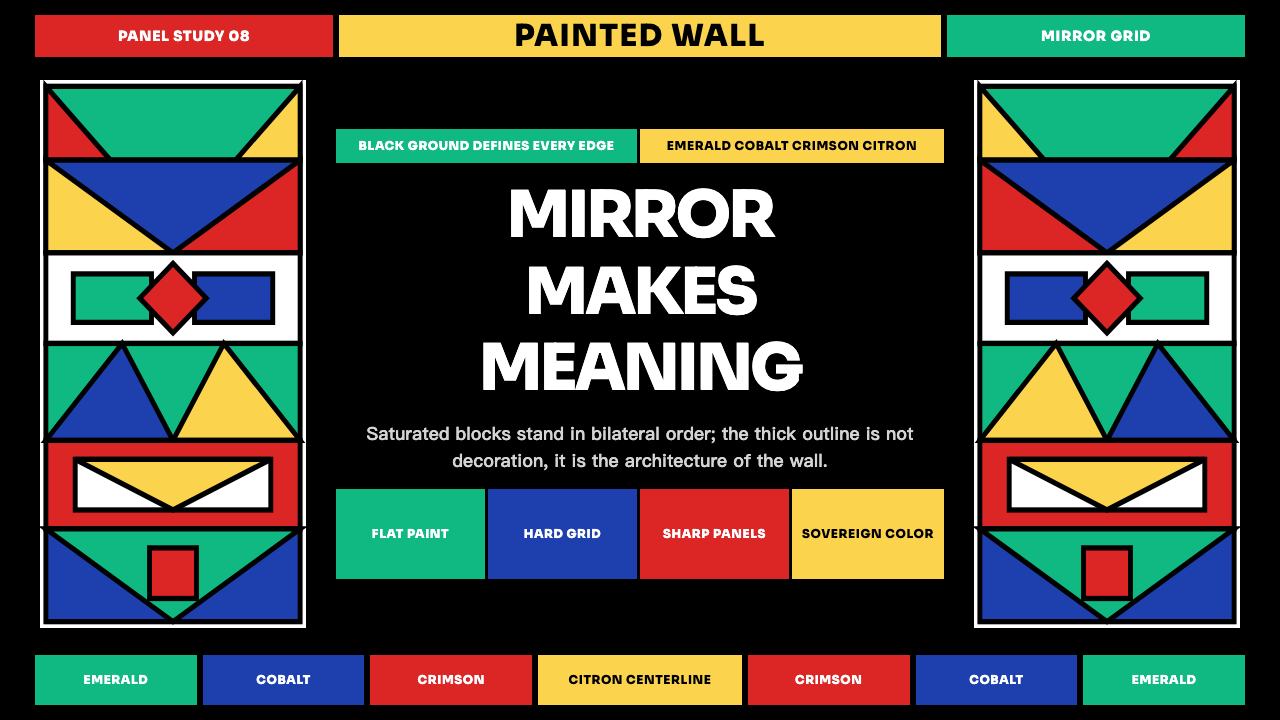 Ndebele Geometric MuralSymmetry declares presence. Emerald, cobalt, crimson and citron lock into bla…
 Russian KhokhlomaOrnament is the message. Antique gold curls and crimson dots crowd a black la…