What is Diablo Cojuelo Costume?
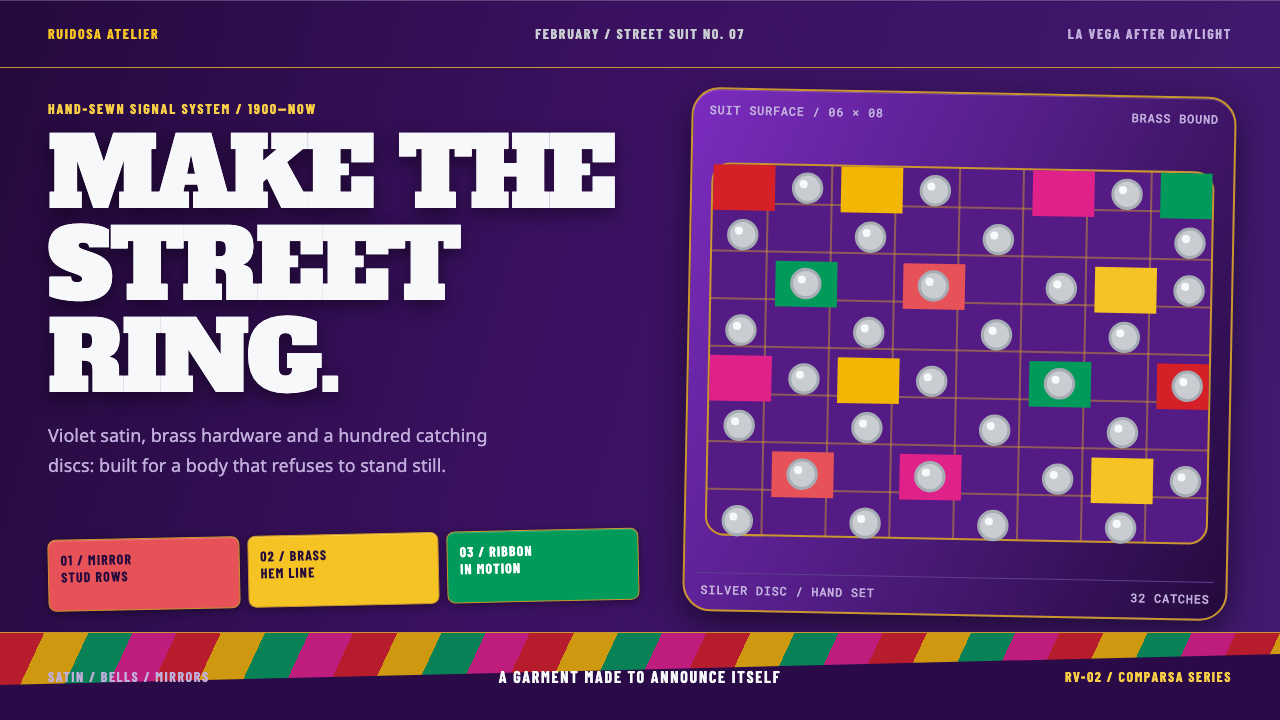
The diablo cojuelo is not a mask but a garment: a satin suit sewn by hand over a year and hung with mirrors and brass bells, built to be seen moving down a February street.
Diablo Cojuelo Costume in brief
Diablo Cojuelo Costume is a design style drawn from the carnival suit of the diablo cojuelo, the 'limping devil' of Dominican carnival, as it is made in La Vega and Santiago de los Caballeros. The costume is a full-body satin suit sewn by hand over about a year, carrying hundreds of small mirrors, brass cowbells and strips of ribbon, and topped with a horned papier-mâché head whose surface sprouts coral-like growths. It can cost a month's wages or more, and it is made to be seen in motion.
That last fact defines the whole visual system. Nothing about the suit is meant to be looked at while standing still. Colour arrives in hard blocks set directly against each other, with no blending between them. Mirrors become small bright discs that flash as the wearer moves, brass runs around the edge of every panel, and the whole surface is tuned to catch daylight and throw it back. The page in this style is not paper and not a wall. It is a piece of violet satin.
As a design system it is dark, saturated and tactile: a deep violet ground, abrupt colour fields, a repeating grid of mirror-like points, metallic edges and a composition that sits slightly off axis. It aims at the feeling of a street procession arriving in front of you, loud, rhythmic, a little unstable and entirely deliberate.
Where does Diablo Cojuelo Costume come from?
The costume belongs to Dominican carnival, and in particular to the towns of La Vega and Santiago de los Caballeros, where devil masquerades are a central figure of the street parade. The modern La Vega comparsa suit is placed in the first half of the twentieth century, between 1900 and 1950. A comparsa is the organised troupe that parades together, and the suit is the troupe's visible identity. Carnival falls in February, which is why the style keeps insisting on daylight: these costumes are built for the sun, not for a stage.
The name is older than the suit. Diablo cojuelo descends from a 1641 novel by Luis Vélez de Guevara. What reached the street was the name; the satin, the mirrors and the bells are the work of makers and comparsas, not of any text. The costume has a literary ancestor and a craft practice of its own, and the second is far larger than the first.
Three strands feed the look, according to its lineage: Dominican carnival itself, the Iberian devil-masquerade tradition, and Afro-Caribbean masquerade. One reading is that the Iberian line supplies the devil, the horns and the idea of the street as the stage for a disguised figure, while the Afro-Caribbean line supplies the emphasis on sound, rhythm and the whole body in motion. The brass bells and the ribbon strips that swing and rattle make the suit an instrument as much as a garment. Neither line explains the satin and mirror-work by itself; the Dominican suit is what the combination looks like.
The economics matter to the aesthetic. A suit that takes a year of hand-sewing and costs a month's wages is not a costume in the casual sense; it is a possession, and its extravagance is the point. Hundreds of mirrors and bells are not subtle, and the design system keeps that spirit: density is celebrated, repetition is a material, and surfaces are allowed to be worked over in a way that most contemporary interface styles would call excess.
What defines the Diablo Cojuelo Costume look?
Violet satin ground
The base is violet satin, deep and faintly sheened, seen in February daylight rather than under gallery lighting. The ground is a fabric, not a wall: it has body and drape and a soft sheen that shifts with the viewer's angle. Against it, everything else reads as applied by hand.
Hard colour blocks
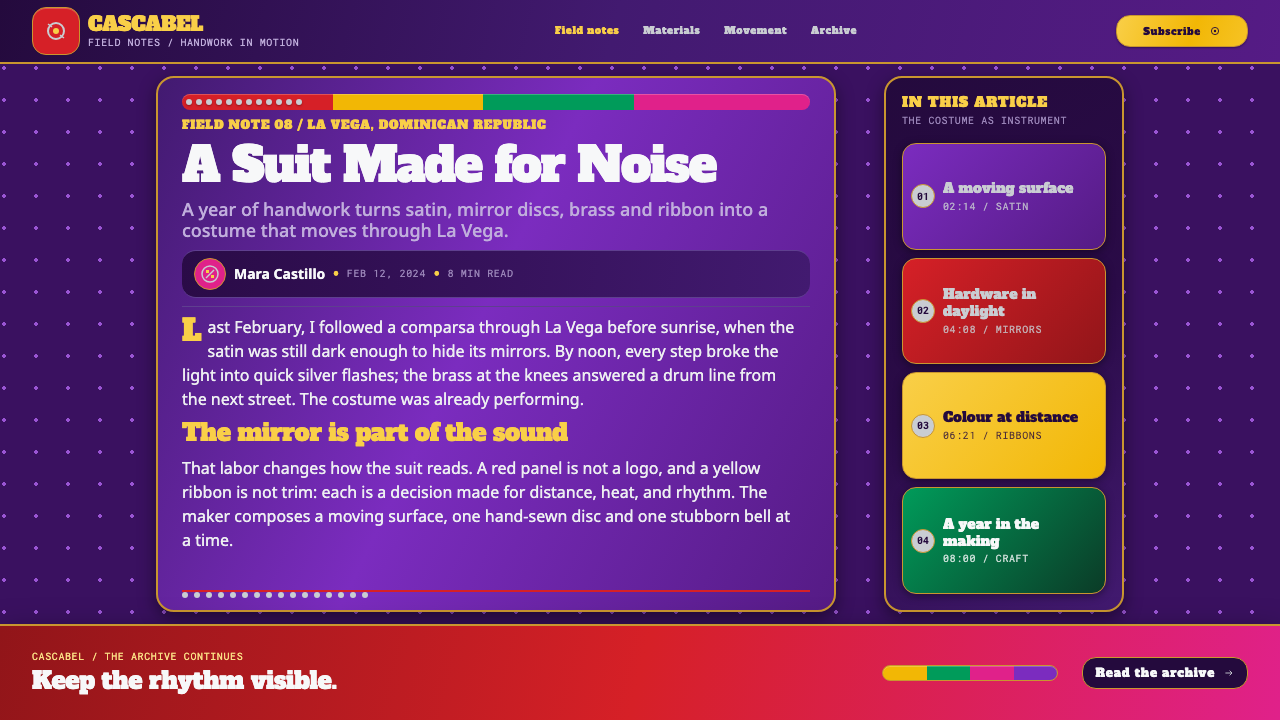
Colours sit in abrupt blocks, edge to edge, with no gradient or blend between them. Transitions are cut lines, like panels of cloth stitched together. The effect is loud and graphic, and the contrast between neighbouring fields does the work that soft shading does in other styles.
Mirror-disc grids
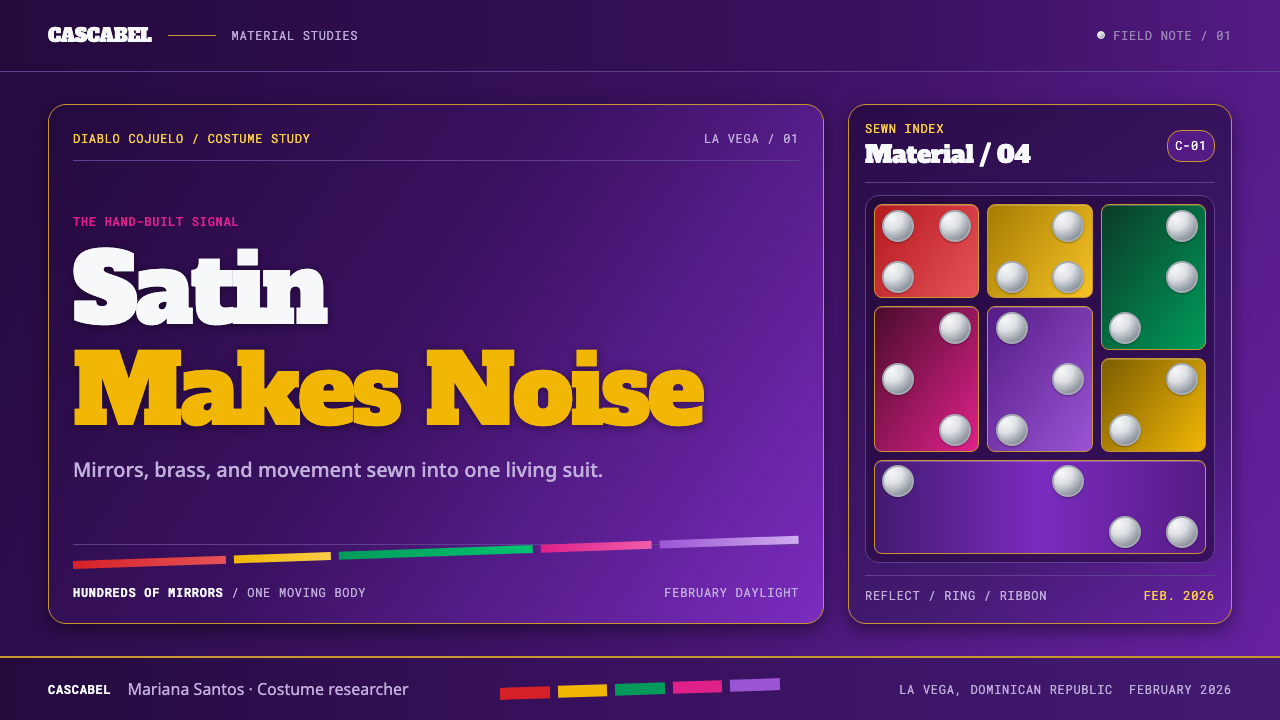
Hundreds of small mirrors catch light as bright discs set in regular grids. The look is a repeated field of small circular points, crisp, round and evenly spaced, so that a surface reads as dotted glass and metal rather than as flat colour. Repetition is the texture, and the glints are what make the surface feel alive.
Brass edging
Brass runs along the edge of every panel, and brass cowbells hang from the suit. In design terms each block of colour is bordered with a warm metallic line. These borders are not neutral hairlines but golden outlines that frame and ring, and their warm yellow contrasts with the cool grey of silver in other traditions.
Doubled stage-light shadows
Under each panel sits a doubled shadow, like stage light striking the cloth from behind, a layered offset that lifts the block off the ground. It gives panels the feeling of being separate stitched pieces rather than painted areas, and it adds to the sense of a surface that is built, not drawn.
Off-axis composition
Nothing sits quite square. A comparsa moves sideways down the street and never faces the viewer in a tidy row, so the composition leans accordingly: slightly skewed, tilted, rhythmic, as if caught mid-step. The tilt is small. It reads as energy, not as collapse.
Ribbon strips and the horned head
Strips of ribbon hang and flutter from the suit, and the papier-mâché head is horned and covered in coral-like growths. These supply the vocabulary of accent: pointed, branching, protruding shapes at the top of a composition, ribbon-like vertical streamers beneath. The silhouette is spiky and layered rather than smooth.
Who shaped Diablo Cojuelo Costume?
The Spanish author of the 1641 novel from which the character's name descends. What survives in the street is chiefly the title and the limping devil it names. He is the literary ancestor of the figure, not of the costume: the satin suit, the mirrors and the bells belong to carnival makers.
The organised troupes of La Vega who parade together in the modern suit. The comparsa is the unit that gives the costume its meaning: a single suit is striking, but a troupe of them moving sideways down a street produces the rhythm, the sound and the colour-blocking that the design style takes as its model.
The makers who spend about a year sewing a single suit by hand, setting mirrors, hanging bells and shaping the horned papier-mâché head. Their labour explains the density of the look. Every disc, edge and strip is a deliberate act, which is why the style treats surface richness as a material rather than as decoration.
Alongside La Vega, Santiago de los Caballeros is the other home of the tradition named in the style's lineage. Its carnival keeps the devil masquerade in the middle of the street parade and shares in the wider Dominican practice that this design system draws on.
How do you use Diablo Cojuelo Costume today?
Diablo Cojuelo Costume is a maximalist style, and it is most useful when a project needs energy, rhythm and a sense of festival rather than calm. It works on dark grounds, rewards density, and wants the layout to feel handmade even when it is rigorously built.
For slides, a cover can take a full violet field with a hard-edged cut of a second saturated colour, a brass-coloured outline around the title block and a grid of small bright circles along one margin. Content slides should treat each block as a stitched panel: a hard colour field, a brass edge and a doubled shadow, with a slight tilt applied sparingly to one or two elements and never to body text. Data slides turn into festival bunting, with bars in blocked saturated colours outlined in brass and small circular markers for data points.
For web interfaces, the style belongs to entertainment, events, music, nightlife, festival ticketing and consumer brands that want to be loud. Cards behave like panels with brass borders and a doubled shadow, grids of small circles can serve as dividers or backgrounds, and hover states should answer with a visible flash or shift, the way a mirror catches the sun. It is a poor fit for data-heavy dashboards and long reading screens, where density and tilt cost legibility. If it must appear there, confine it to headers and marketing sections and keep the working screens quiet.
In editorial and marketing work it excels at event posters, line-up announcements, campaign launches and packaging. Colour fields can be stacked like cut cloth, a single focal photograph can be framed by brass edging, and type should be bold and legible enough to hold its own against the surface. Motion design suits it well: repeated flashes, swings and sideways slides rather than fades.
The usual mistake is to keep the look but lose the structure: scattering random sparkles, putting soft gradients between the colour blocks, or tilting everything at once. The suit works because each element is hard-edged and deliberately placed, and a blurred glow undoes the cloth. Tilt only a few elements, keep text upright and readable, and keep the brass edging consistent. Another mistake is to treat the diablo cojuelo as a generic devil motif and push it towards horror or Halloween imagery. It is a festive carnival figure, and the mood of the style is celebration, not menace.
Diablo Cojuelo Costume — FAQ
Is Diablo Cojuelo Costume a dark theme?
Yes, in the sense that its ground is deep violet satin, and it behaves as a dark, saturated style. But it is not a moody dark theme. The darkness is the colour of cloth in daylight, and everything on it is bright, metallic and loud. If your dark theme is meant to feel hushed, this is not it.
What does 'diablo cojuelo' mean, and does it matter for the design?
It is usually rendered as the limping devil. The name descends from a 1641 novel by Luis Vélez de Guevara, but the design does not illustrate the book. What matters for design is that this is a carnival figure, a garment built for parade, so the style is about movement, sound and festival, not about menace or the supernatural.
Why mirrors and brass instead of gradients and glow?
Because the suit is made of physical things that catch daylight: small mirrors, brass bells, satin. Each one produces a crisp flash, not a haze. Translating that faithfully means hard-edged discs, firm metallic outlines and clean colour blocks. Soft gradients and glows imitate a screen, not a satin suit, and they flatten the very contrast the style depends on.
Can it work for a serious business product?
In small, controlled doses, yes. A brass edge, a violet field or a single mirror-disc motif can lift a hero section or an event page. As a full system for a finance or operations tool, it will fight the content. The style is built to be seen moving down a street, and professional workflows rarely want that much attention from the interface.
How do I use the tilt without making the layout look broken?
Keep the tilt small and local. Tilt panels, badges or decorative blocks, and keep body text, navigation and data tables upright. Use one consistent direction so the lean reads as movement down a street, not as random disorder. The surrounding grid should stay stable, because the tilt only reads as energy when something firm is there for it to deviate from.
Related design styles
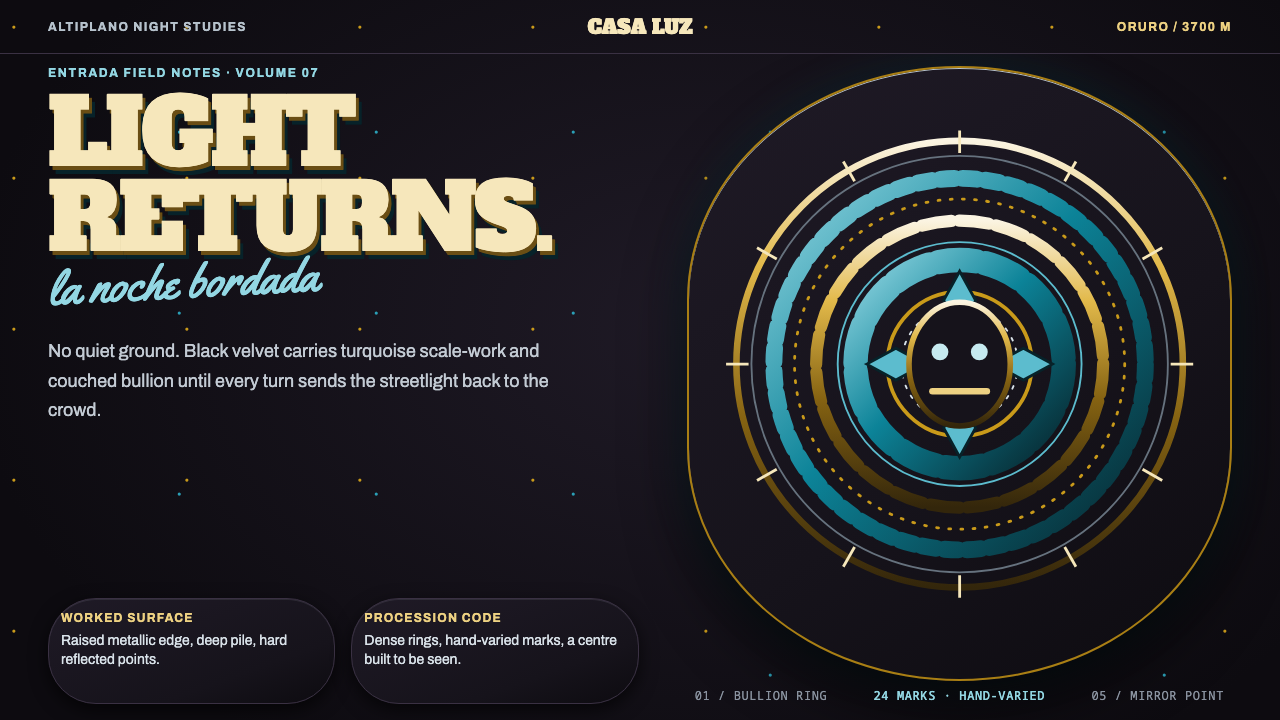 Diablada de OruroDensity throws light back. Turquoise scale-work and bullion rings electrify b…
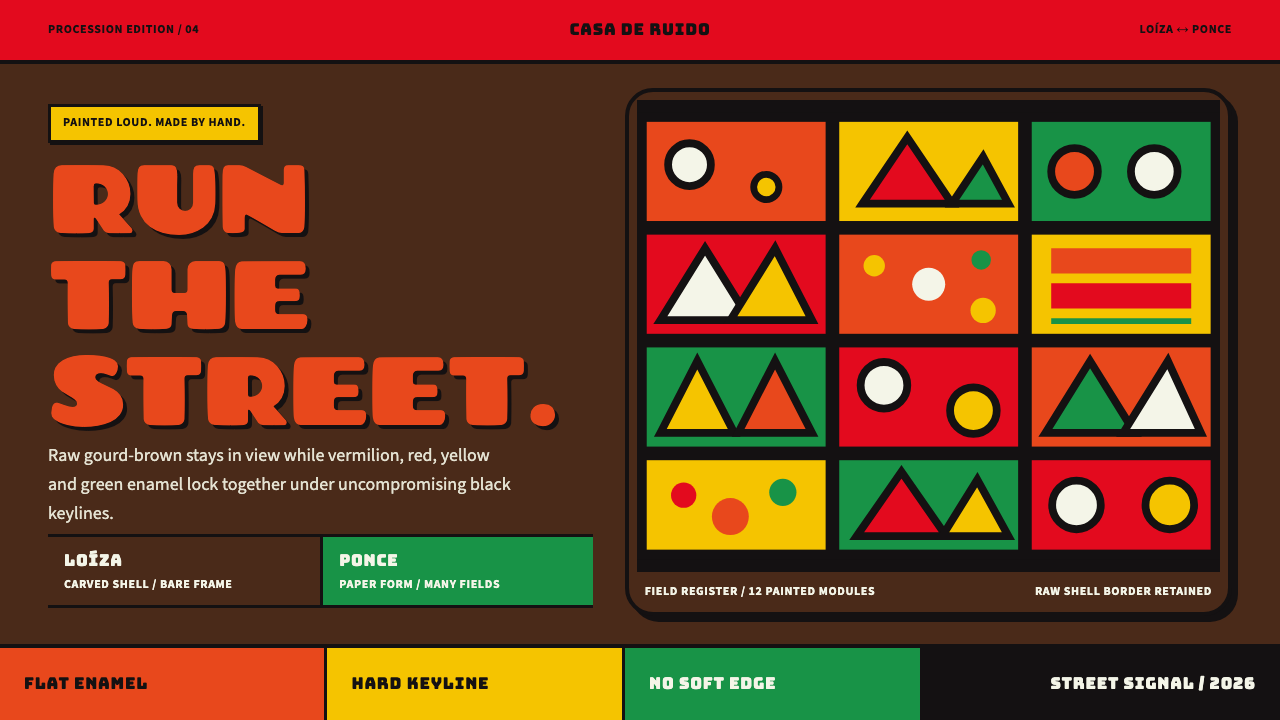 Vejigante MaskCarnival paint refuses polish. Flat red, yellow and green enamel meet in hard…
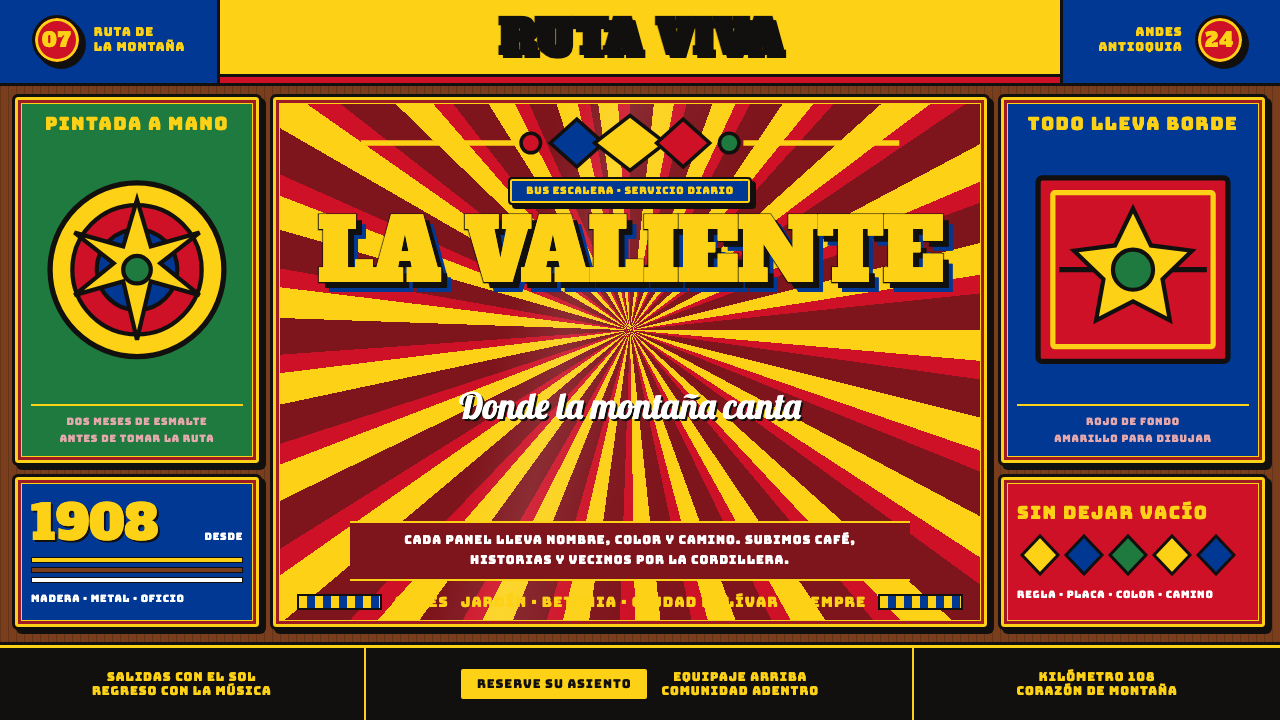 Colombian Chiva BusNothing is left unpainted. Flag-yellow rules, slab lettering and black keylin…
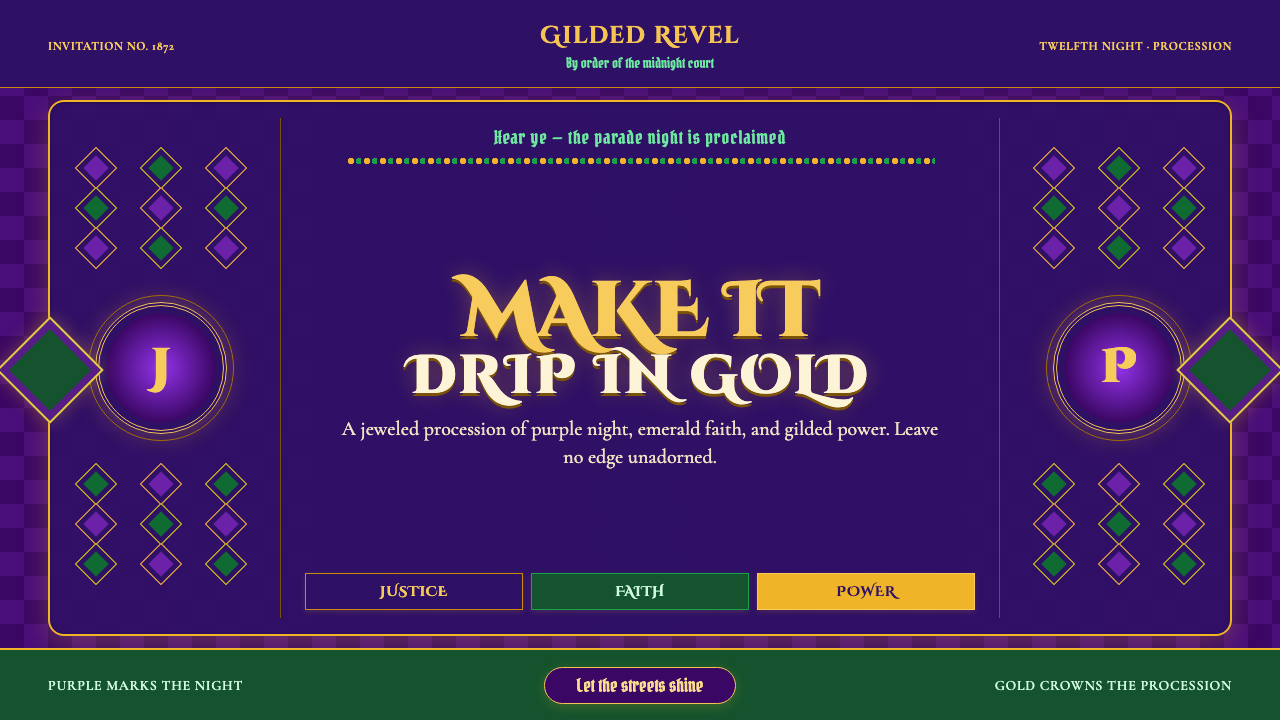 Mardi Gras New OrleansJoyfully excessive. Gilded type, jewel purple, emerald, and bead-strand borde…
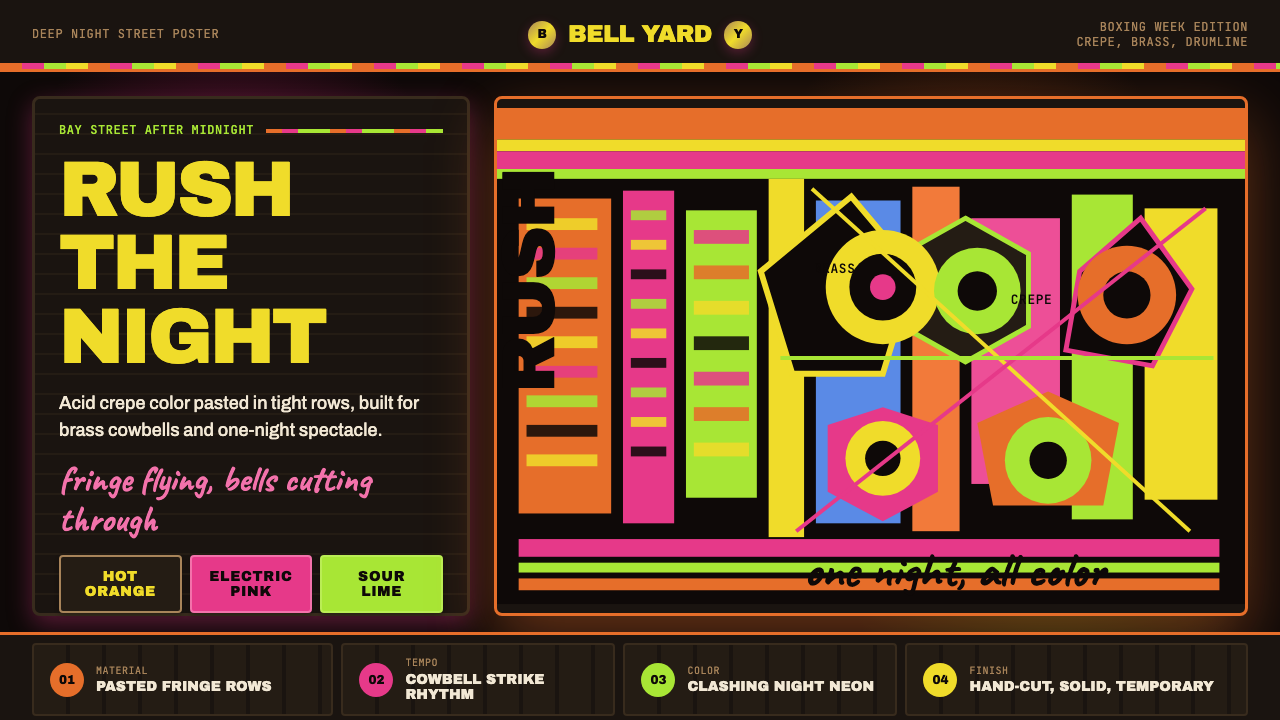 Bahamian Junkanoo CowbellNight refuses silence. Acid crepe stripes and block type collide like cowbell…
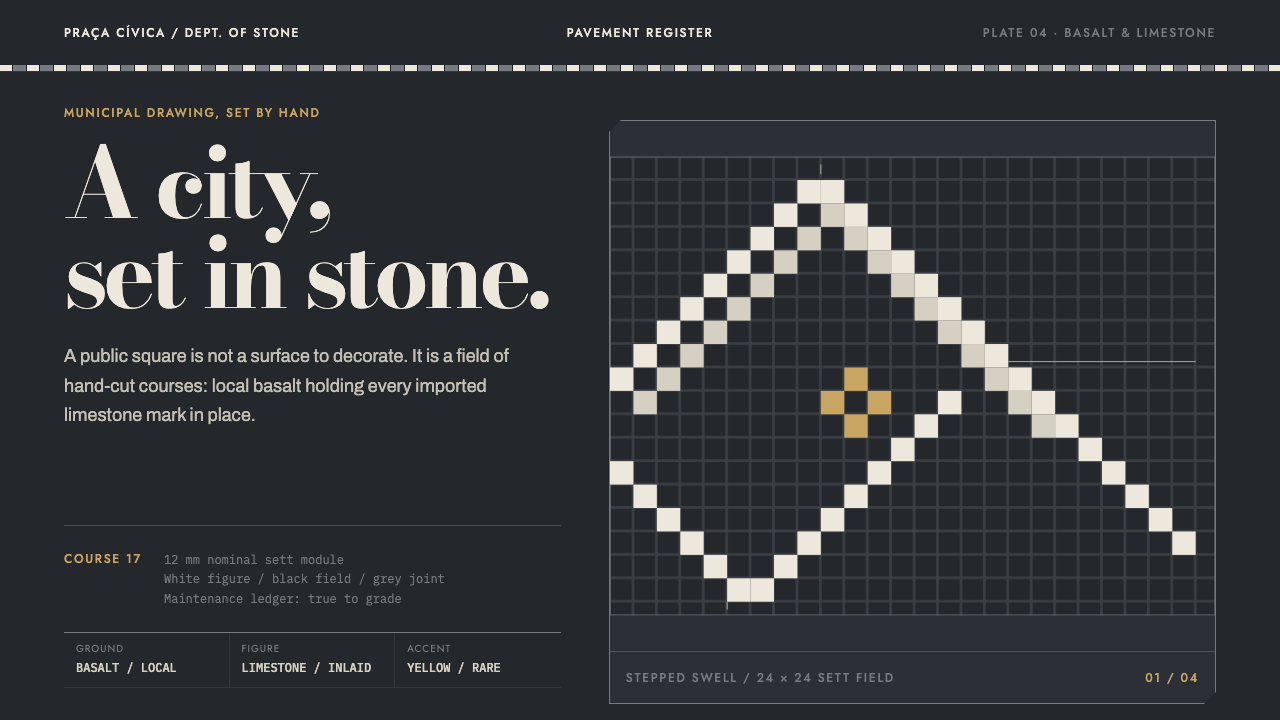 Calçada PortuguesaA city drawn in stone. Stepped limestone courses cut across a basalt grid.