What is Bolga Basket?
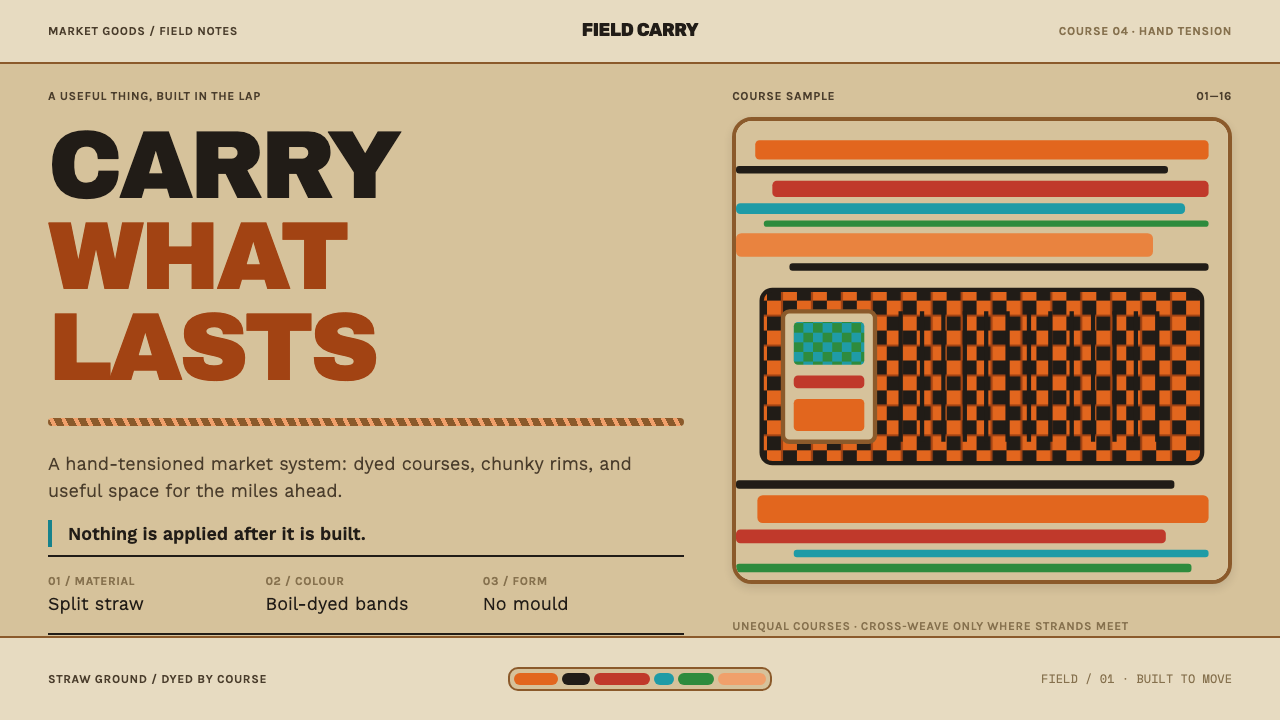
A Bolga basket has no decoration at all — every band, check and edge is simply the weaving itself, which is exactly why it looks so alive.
Bolga Basket in brief
The Bolga basket is the hand-woven basketry of Bolgatanga, in the Upper East Region of northern Ghana. Gurune weavers, also known as Frafra, split veta vera elephant grass, twist it into a two-ply strand, dye it, and then build the basket in the lap without any mould or frame. What emerges is a sturdy, round-bellied vessel with a straw-coloured body, bands of vivid colour and a handle designed to be carried every day.
Its central idea is that structure is the ornament. Nothing on a Bolga basket is painted, printed or stuck on afterward. The stripes are the places where dyed strands run; the checks appear where two colours cross; the spokes fan out from the base because that is how the basket begins. Take the weave away and no pattern is left, because the pattern was never a separate layer. Colour, form and function are the same act performed once.
Curio's interpretation makes this logic literal. Colour arrives as bands of unequal width stacked across a pale straw ground. Orange, red and turquoise tones dominate, and pattern appears only where two dyed lines cross. Edges are chunky because a two-ply strand is chunky. Small misalignments are kept, because hand tension means no row ever lines up exactly with the next. It is a style for things that are used, not things that sit on a shelf.
Where does Bolga Basket come from?
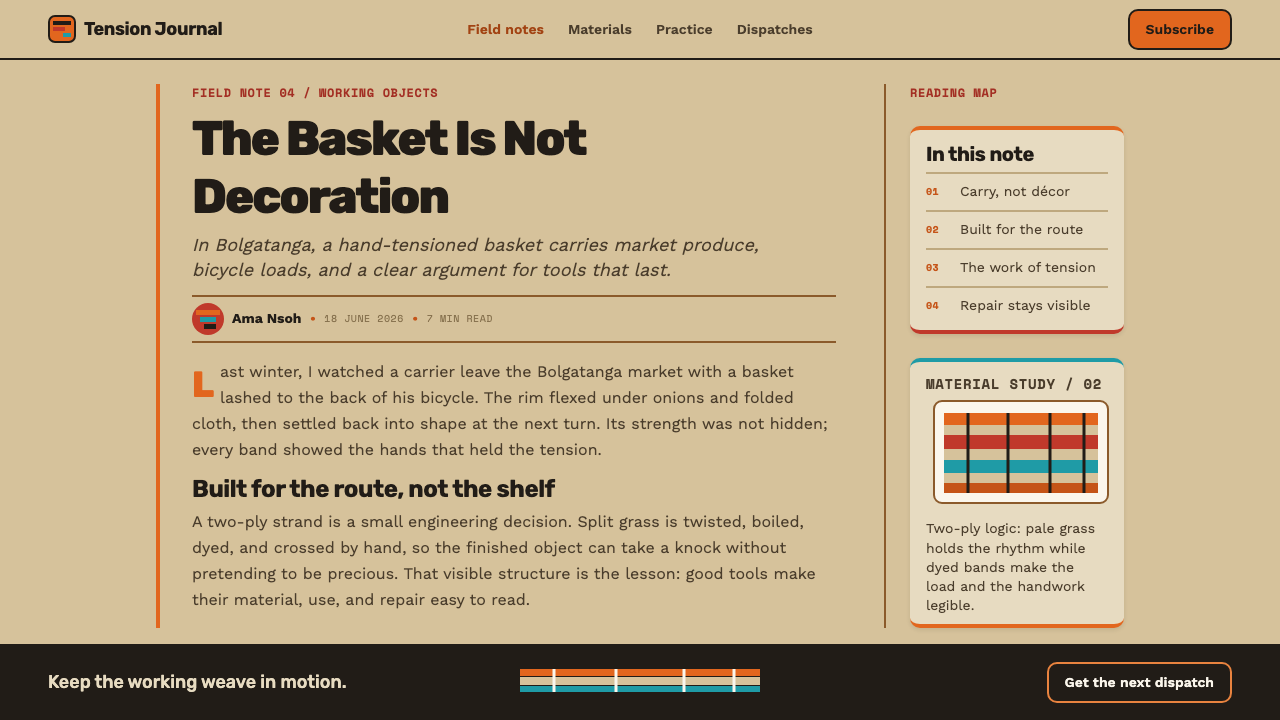
Basketry in this part of northern Ghana is older than the colonial period. It began as village craft: containers for grain, produce and water, made from the grasses that grow around Bolgatanga. The source plant, veta vera elephant grass, is tall, tough and fibrous. Weavers split the stalks, twist them into a two-ply strand that is thicker and stronger than a single thread of grass, and then use that strand as the basic building unit. The thickness of the strand is the origin of the basket's chunky character; nothing delicate can be woven from it.
Colour enters through dyeing, in a two-stage process. The strand is first boiled in a dye bath to turn it yellow, then dyed again to produce warmer tones of orange and red. Turquoise and other bands are added in the same way, so the colour belongs to the material rather than sitting on top of it. The baskets themselves are built in the lap, starting from a spread of radiating spokes at the base and rising in coils, with each weaver controlling tension by feel. This is why every basket is slightly different: nothing is cut from a template, and nothing is forced into a mould.
The craft is carried by Gurune women. The Gurune, also called Frafra, are the people of this region, and the weavers are the community from which the style comes. Village weaving cooperatives have grown up around the craft, linking households that work independently into a shared trade. From the middle of the twentieth century the baskets moved beyond local markets into export on a larger scale, which is how the form became known abroad. The market shopper and the U-shopper, a deeper basket with a distinctive U-shaped body, are among the forms that travelled furthest.
Three overlapping traditions lie behind the design language: West African utilitarian basketry, village craft with no ornamental pretensions; the fair-trade craft export movement, which carried the baskets into international markets; and the working forms of market baskets themselves. What unites them is use. These are things carried to market, loaded onto a bicycle, filled with produce. The design logic is the logic of a tool, and the beauty is a by-product of doing a job honestly. A Curio system built on this heritage should feel practical and warm rather than precious.
What defines the Bolga Basket look?
Color
The base is a pale straw tone, the natural colour of the grass, and everything else is dye laid over it. Warm yellow, orange and red lead, with turquoise or green-blue bands cutting across them as a cool counterweight. Hues are saturated and slightly uneven, as boil-dyed fibre never takes colour in a perfectly flat way. The overall feeling is bright and sunlit without turning neon or synthetic.
Unequal Bands
Colour arrives as horizontal bands that are never the same width. A thick band of red may sit above a thin line of orange and a medium stripe of turquoise, with straw showing between them. The unevenness is rhythmic rather than random, like a stack of woven courses. Layouts should avoid uniform stripe widths: they should read as stacked layers of different weights, each one a decision.
Pattern at the Crossing
Where two dyed strands cross, small checks or stepped marks appear. They are never drawn; they are what happens when one colour passes over another. In design, pattern should therefore emerge from overlap and intersection rather than from a separate ornamental layer. Squares, notches and woven checkerboards are the vocabulary, and they should appear only where lines actually meet.
Chunky Edges
A two-ply strand is thick, so every edge is thick. Corners are rounded by the material, outlines are bold, and nothing is thin or fine. Components such as buttons, cards and rules should carry real weight, with generous thickness and substantial rounded forms. Hairlines belong to another world. Here, the line is a rope.
Radiating Structure
A Bolga basket begins with spokes that spread outward from the centre of the base, and the weave coils around them. That origin gives the form a radial logic: lines run from a centre, concentric rings climb upward, and the whole object holds together by tension. Circular compositions, concentric bands and layouts that seem to grow from a single point suit the style well.
Hand Tension
Because every course is pulled by hand, no row lines up perfectly. Bands wobble slightly, spacing shifts and tension varies. That small error is a feature and should be kept. Nothing should be snapped to an exact grid; allow a little drift in alignment so that the layout feels woven rather than machined. A page that looks too exact has lost the evidence of a human making it.
Nothing Applied
The deepest rule of the style is that nothing is added afterward. No shadows applied for drama, no gradients laid on for richness, no ornaments pasted onto a finished surface. Everything visible has a structural reason, and the surface is flat, matte and fibrous in feel. If an element could be removed without changing how the object is built, it probably does not belong.
Who shaped Bolga Basket?
The Gurune women of the Bolgatanga area are the makers and keepers of the craft. They gather and split the grass, twist the strand, boil and over-dye it, and weave each basket in the lap without a mould. Their knowledge is embodied in the hands: how tightly to pull, when to change colour, how to shape a handle that will bear weight. Every quality of the design system, from chunky edges to unequal bands, is a record of their method.
Village weaving cooperatives organise households that weave independently into a shared trade, helping baskets reach wider markets. They sit at the point where a domestic craft becomes a livelihood and an export. Their significance for the style is that they show it can grow without losing its basic logic. The baskets that travel abroad are still woven by hand, in the lap, from dyed grass strands.
These are not people but the working shapes that carried the craft furthest: the market shopper and the deeper U-shopper, with its distinctive U-shaped body. They matter because they show the style is made for use. A design system inspired by them should feel like it could be hung on a handlebar, loaded with produce and taken through a crowd without complaint.
How do you use Bolga Basket today?
Bolga basket is a strong choice for products that are practical, human and unpretentious: markets and marketplaces, grocery and food, craft and fair-trade brands, community platforms, mobility and delivery apps, and anything where a hand-made feeling is worth more than polish. It is a light-ground system that rewards confident colour and thick, honest shapes.
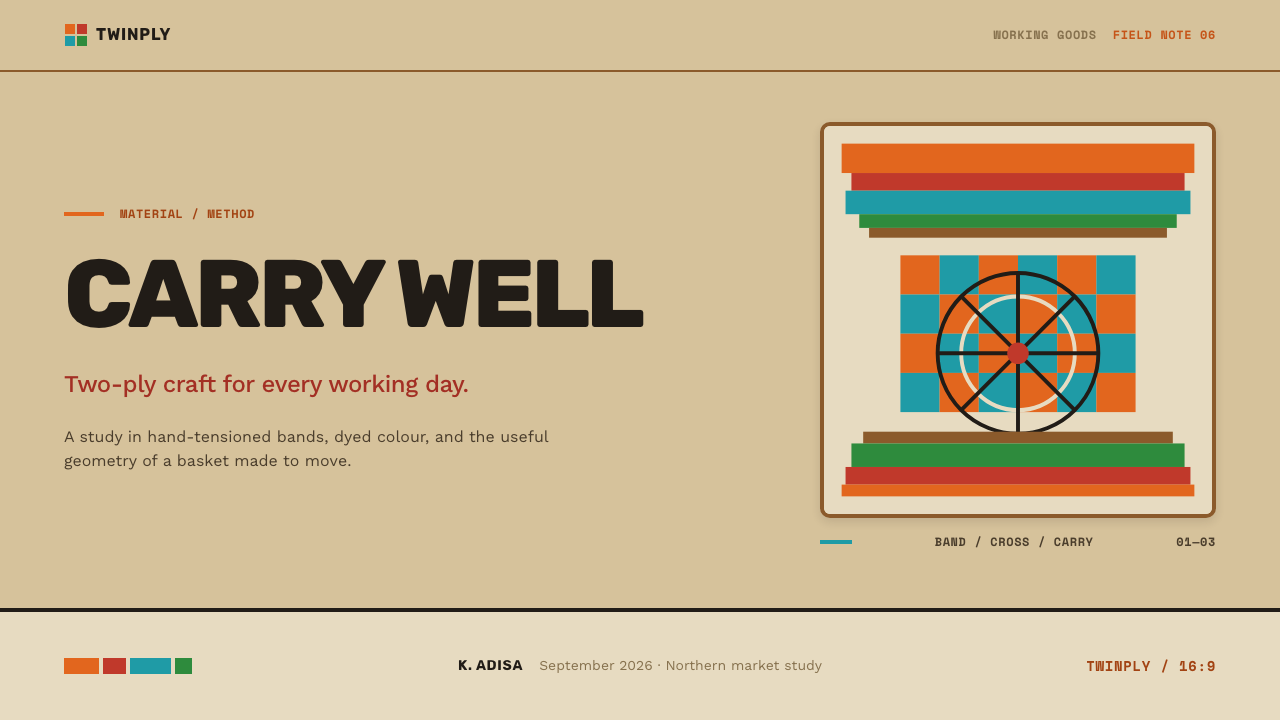
For presentation slides, a cover can be built from three or four stacked bands of unequal width in orange, red and turquoise over a pale straw field, with the title set large in a dark, warm tone. Content slides can reuse the band logic as section headers, one thick band per topic. Data slides suit horizontal bar charts and stacked bars, because bands are the natural unit of the style; make the bars thick and let their lengths vary honestly.
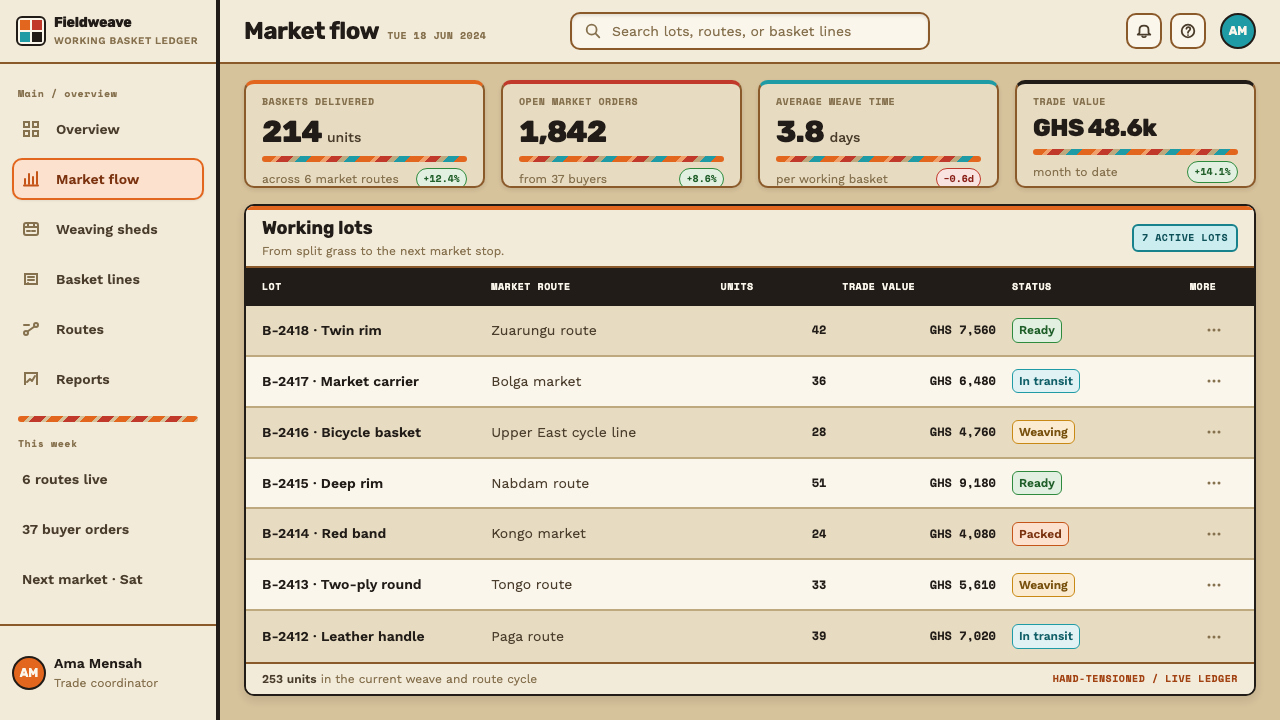
For web interfaces, start with a straw-toned page and use thick, rounded components. Buttons can be solid and weighty, borders substantial, and cards separated by wide bands of colour rather than hairline rules. Navigation can sit as a stack of two or three bands. Use crossing colours for emphasis states, so that a selected item appears where two colours meet, echoing the woven check. Avoid soft shadows and gradients entirely.
For editorial and marketing work, the style gives you a robust, friendly voice. Section breaks can be stripes of unequal width, pull quotes can sit inside a thick band, and photography of people, produce and hands will sit naturally within it. Copy should be plain and direct. The visual language is already warm, so words do not need to shout.
The most common mistake is treating the bands as stripes of equal width, which turns the style into a generic striped theme. Another is adding polish: thin lines, soft shadows, gradients or glossy buttons all contradict the material logic. A third is using the accent colours in tiny, nervous amounts. The baskets are bold; the colours should commit. Finally, never pin everything to a perfect grid, because the hand-made drift is part of the style.
Bolga Basket — FAQ
What is a Bolga basket made from?
It is made from veta vera elephant grass, a tall tough grass that grows around Bolgatanga in northern Ghana. Weavers split the stalks and twist them into a two-ply strand, which is boiled in dye to give it colour, and then woven by hand without any mould. The strand's natural thickness and fibre are why the finished basket looks so sturdy. In design terms, the material determines every visual quality: bold bands, chunky edges and a matte, fibrous surface.
What does 'structure is the ornament' mean?
It means that every visible mark on the basket is a consequence of how it is built, and nothing is added purely for looks. Stripes occur where dyed strands run, checks appear where two colours cross, and spokes radiate because that is how weaving starts. In a layout, it translates to a rule: any pattern you use should come from overlap, intersection or repetition of the page's own elements, never from a decorative layer applied afterward.
Why are the colour bands different widths?
Because they are made by weavers deciding, course by course, which dyed strand to use and for how long. There is no template and no repeat length, so bands naturally vary in thickness. The unevenness is also what gives the basket its rhythm: it reads like a layered, hand-built stack rather than a mechanical stripe. In design, use unequal widths deliberately, and avoid repeating the same width twice in a row.
Is the style suitable for a dark theme?
It is built on a pale straw ground, because the basket is a natural-fibre object seen in daylight. A dark version would remove the straw colour that every band is measured against, and the dyes would stop reading as colours laid over fibre. If you need dark mode, keep a warm earthy dark rather than a cold black, keep the bands thick and unequal, and treat it as an adaptation rather than the core form of the style.
How does this style handle imperfection?
It treats it as evidence. Because the baskets are woven in the lap and tension is controlled by feel, no row is perfectly aligned with the next, and that small error is left in. A layout should do the same: allow slight irregularities in alignment, spacing or band thickness so that the page looks made rather than generated. The goal is not sloppiness but an honest record of the hand, which is the quality people value in a basket.
Related design styles
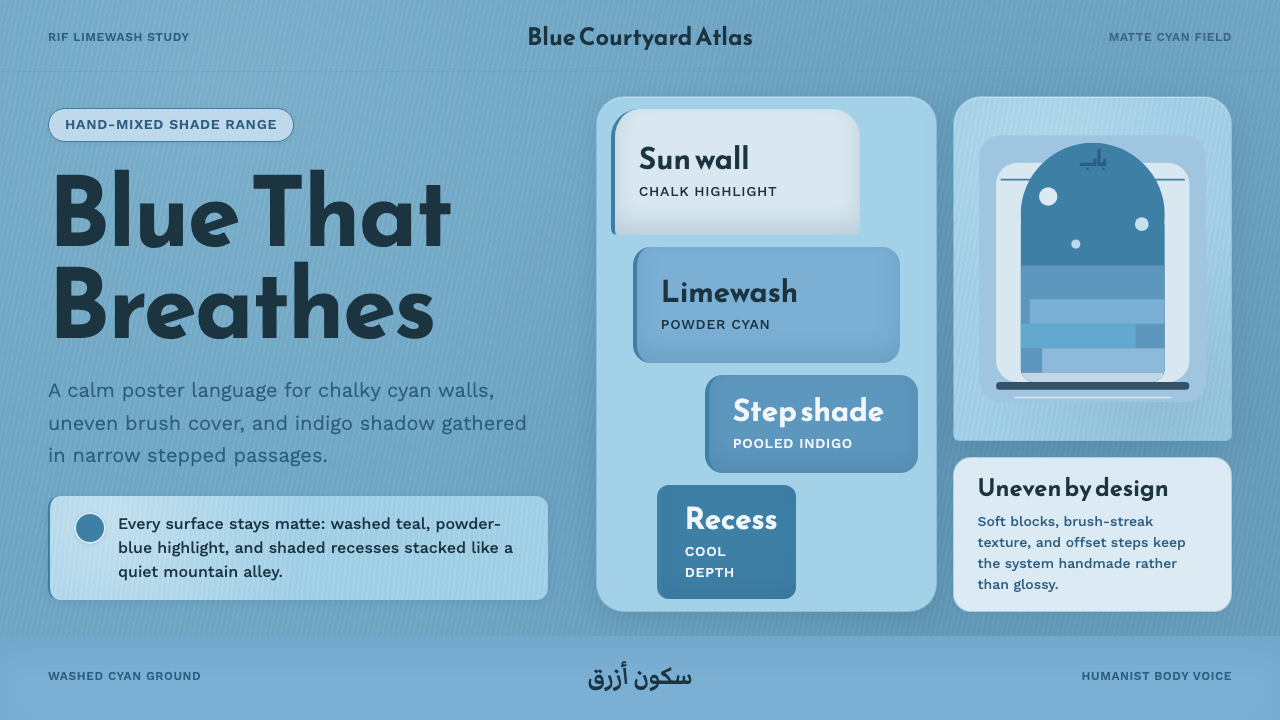 Chefchaouen Blue MedinaCalm becomes architecture. Chalky cyan, Reem Kufi type, and offset steps hold…
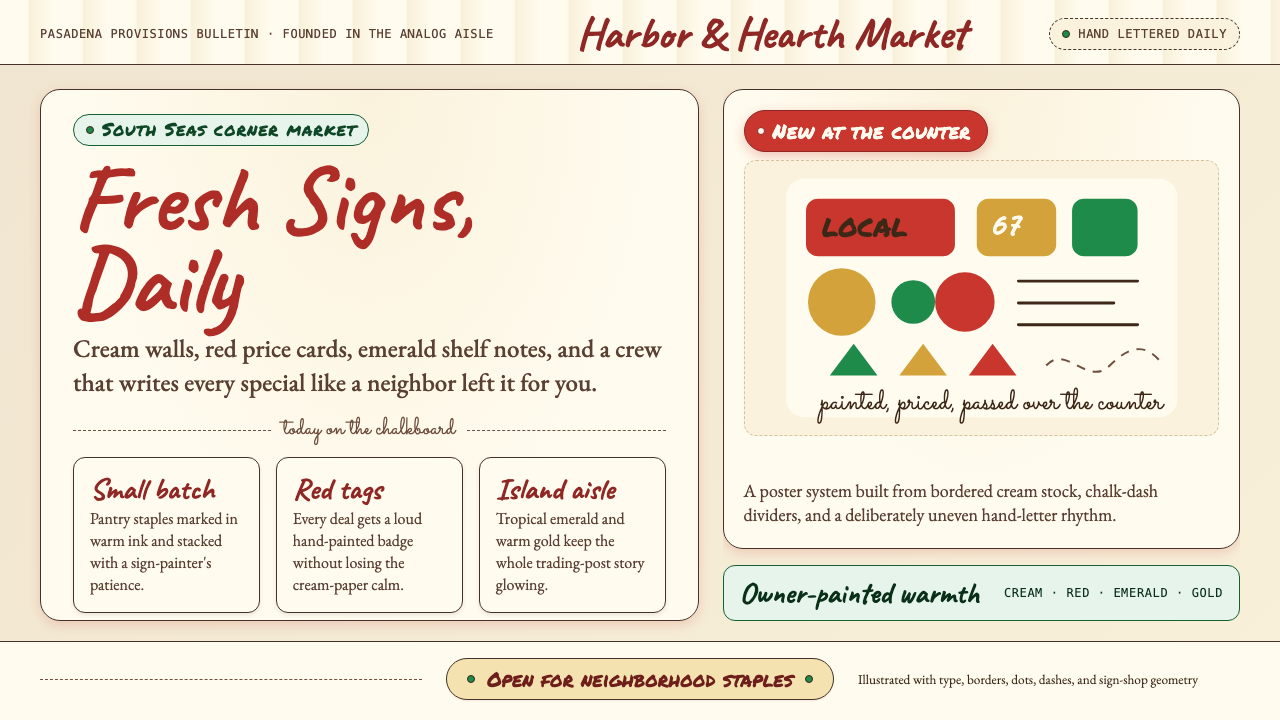 Trader Joe's Hand-LetteredHandmade grocery warmth. Cream chalkboards, red price tags, emerald accents.
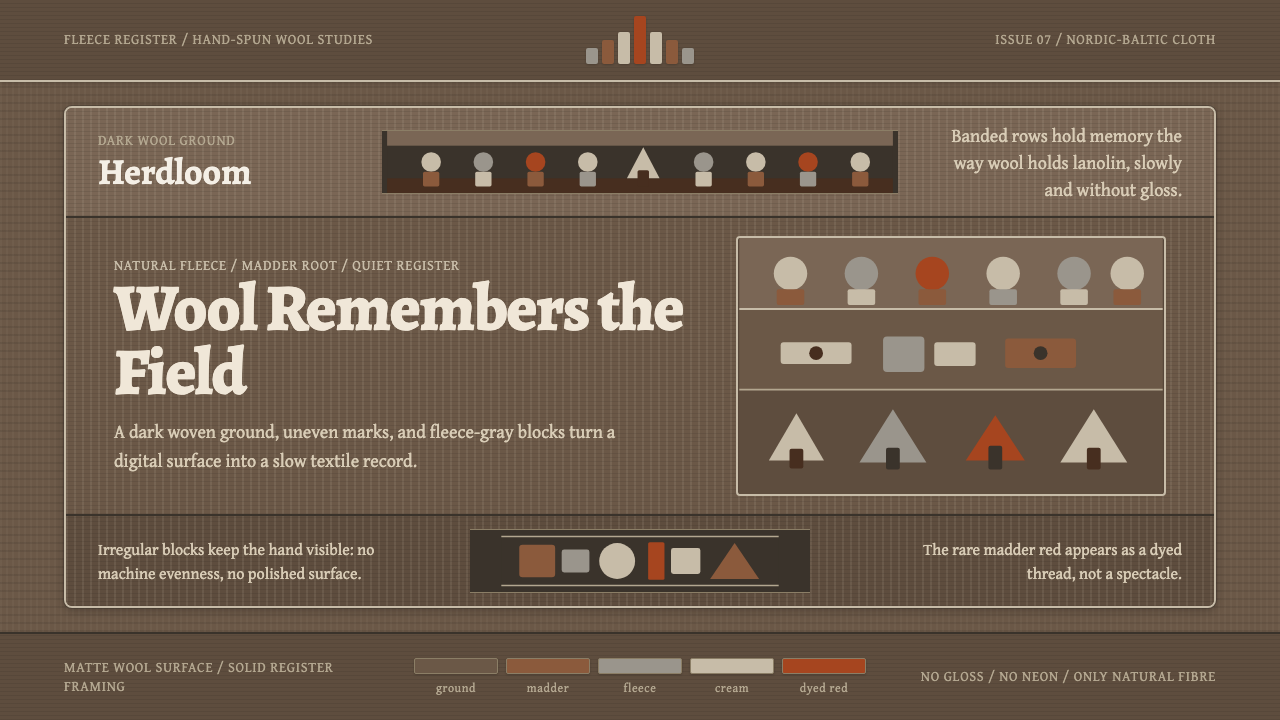 Estonian Folk Tapestry (Anu Raud)Quiet wool carries memory. Banded fleece browns and Alegreya type move like a…
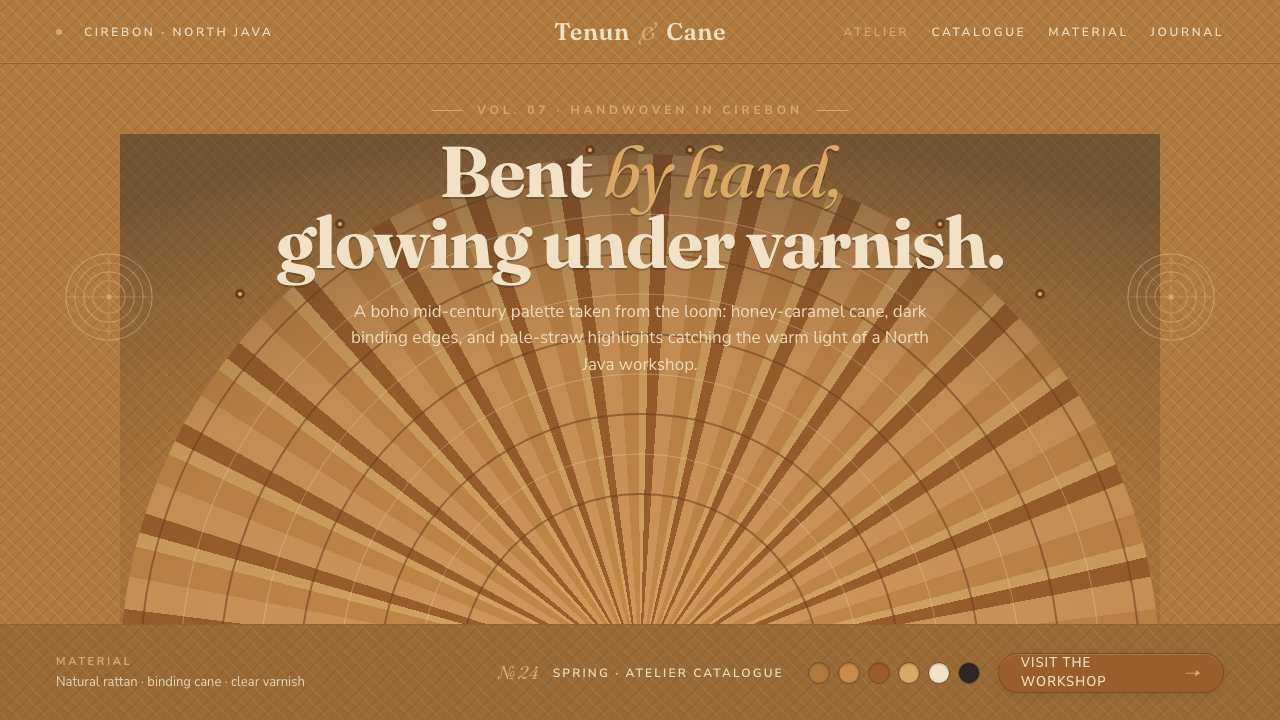 Indonesian Rattan WeaveBent by hand, varnished warm. Honey-caramel cane and dark binding edges over…
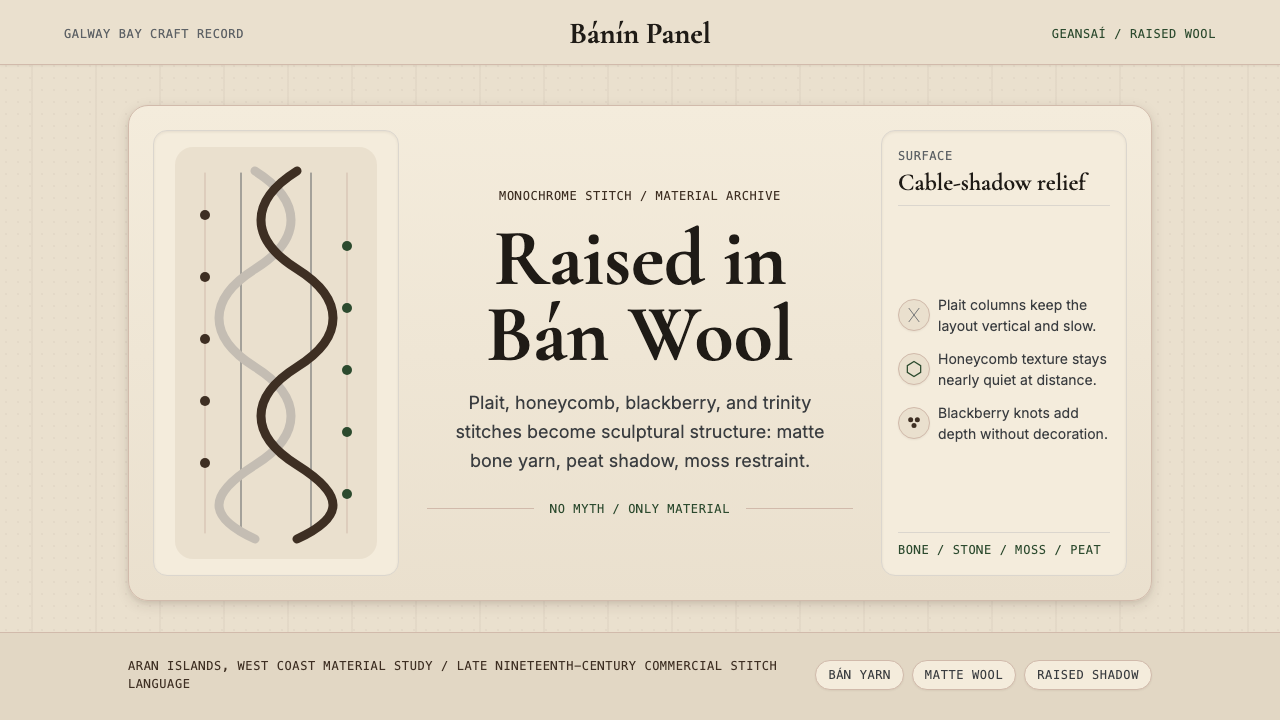 Irish Aran Island Cable KnitMaterial honesty raised in wool. Bone ground, moss ink, and cable columns cas…
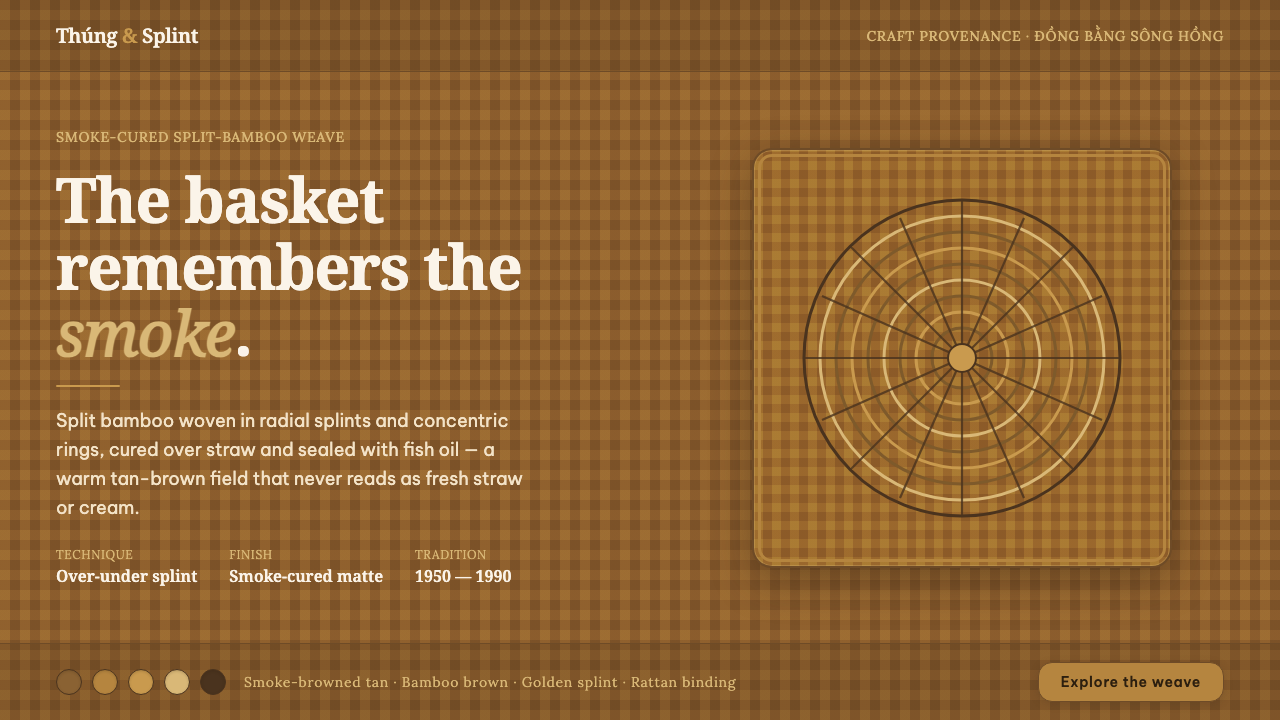 Vietnamese Bamboo BasketryThe basket remembers the smoke. Tan-brown woven ground, concentric splint rin…