What is Bengali Rickshaw Art?
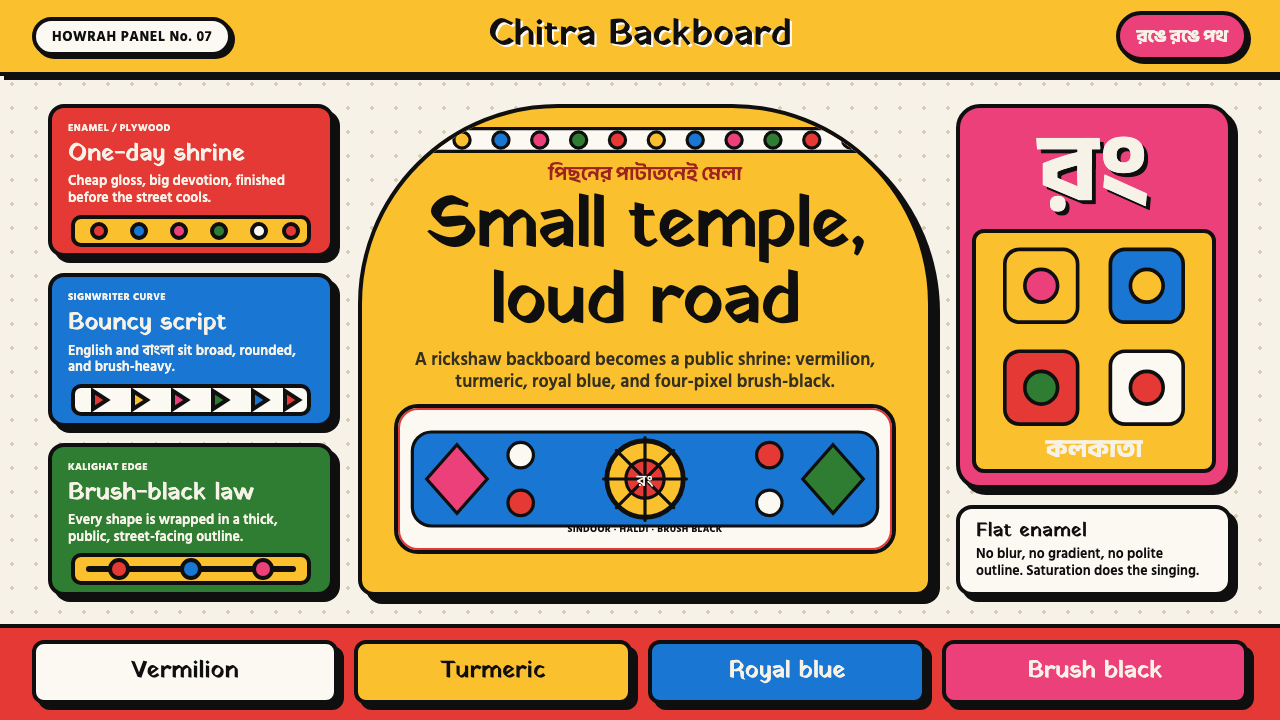
On the backstreets of Kolkata, cycle-rickshaw painters turned every plywood panel into a small roadside temple — blazing with vermilion, turmeric yellow, and brush-black outlines that trace back through two centuries of Bengali folk devotion.
Bengali Rickshaw Art in brief
Bengali Rickshaw Art is the hand-painted visual tradition applied to the rear backboards of cycle-rickshaws in West Bengal, India, and particularly in the dense workshops of Kolkata and its sister city Howrah. Each panel is a self-contained world: a goddess mid-battle, a tiger in a jungle saturated to the point of hallucination, a Bollywood heroine escorted by peacocks, a verse from Tagore lettered in flowing Bengali script. The style is emphatically public — facing the street, speaking to everyone who follows on foot or on wheel.
The tradition belongs to the broader family of South Asian folk painting, but it carries a visual signature all its own. Vermilion and turmeric yellow form the foundational chord, supported by deep cobalt blue, vivid leaf green, and warm rose pink for complexions. Thick brush-black outlines — drawn with broad, confident strokes — wrap every figure and every shape, a practice inherited directly from Kalighat patua painting. Against these saturated fields, a primed bone-white ground breathes through the composition, preventing the palette from collapsing into mud.
Crucially, the work is anonymous and artisanal. The painters are not fine artists seeking individual recognition; they are hereditary craftspeople — often from patua communities — working fast, working cheap, and working in quantity. A finished backboard takes roughly a day. The materials are inexpensive synthetic enamel and household brushes, yet the results carry an authority that has drawn the attention of ethnographers, folk-art collectors, and contemporary designers worldwide.

Where does Bengali Rickshaw Art come from?
The visual roots of Bengali Rickshaw Art run back to the Kalighat patua tradition, which flourished in the bazaars surrounding the Kalighat temple in Kolkata from the early nineteenth century onward. Patua painters — scroll painters from hereditary artisan castes — migrated to Kalighat to sell devotional images to pilgrims. Under commercial pressure to work quickly, they developed a bold, simplified style: fluid brush lines that describe a figure in three or four decisive strokes, color laid in flat washes, no modeling, no perspective. The thick black outline that defines Bengali Rickshaw Art descends directly from this Kalighat shorthand.
A second ancestor is the Battala woodblock printing industry that flourished in North Kolkata from the late eighteenth century through the mid-twentieth. Battala publishers produced cheap, widely distributed illustrated books, pamphlets, and broadsheets — mythological tales, comic narratives, devotional calendars — using woodblock prints that shared Kalighat's appetite for flat color, heavy outline, and densely populated compositions. The poster-like flatness of rickshaw backboards is partly a Battala inheritance: images meant to be read at a glance, in motion, from a distance.
The third major tributary is the Bombay calendar god-poster industry, which emerged in the late nineteenth century after painter Raja Ravi Varma began producing lithographic prints of Hindu deities rendered in a hybrid Western academic and Indian iconographic style. By the mid-twentieth century, these mass-produced god-posters had reached every corner of the subcontinent and set a popular visual standard for what a deity should look like: luminous complexion, elaborate jewelry, rich textile pattern, saturated background. Rickshaw painters absorbed this calendar-art vocabulary — the jeweled border, the floral backdrop, the softly idealized face — and filtered it through Kalighat's bold linework.
Cycle-rickshaws became common in Kolkata and Howrah from the 1940s onward, and the practice of decorating their rear panels developed alongside the vehicle itself. By the 1960s and 1970s, a Howrah workshop economy had coalesced around this demand, with specialist painters producing backboards to order — a customer might specify a religious subject, a film star, a landscape, or a tiger, and receive a finished panel within a day or two. The tradition reached its quantitative peak in the 1980s and 1990s, when tens of thousands of cycle-rickshaws plied Kolkata's streets, and has since contracted as battery-assisted and motorized vehicles have displaced the traditional pedal-rickshaw. Yet the aesthetic vocabulary it created — the fierce goddess, the jeweled border, the turmeric-and-vermilion chord, the Kalighat outline — has been taken up by contemporary Bengali graphic designers, textile printers, and muralists, giving the tradition a second life beyond the backboard.
What defines the Bengali Rickshaw Art look?
Color Palette
The palette is anchored by two foundational hues that appear in almost every panel: vermilion, the auspicious red associated with sindoor and the goddess's presence, and turmeric yellow, warm and ceremonial. These two set the emotional temperature of the whole composition. Deep cobalt blue fills sky and water; vivid leaf green fills jungle and foliage; rose pink and warm ochre model faces and skin. Black is not a background but a structural element — the heavy outline that holds every other color in place. Bone white, the primed ground, surfaces through these layers as the composition's breath. The overall effect is unmistakably high-saturation folk festivity, closer in feel to a marigold garland than to any European palette.
The Kalighat Outline
The single most distinctive mark in Bengali Rickshaw Art is the broad, confident brush-black outline that circumscribes every form. Inherited from the Kalighat patua painters of the nineteenth century, this outline is not a cautious drawing-in-advance but a fluid calligraphic act: it varies in width along its length, swells at corners, tapers at extremities, and carries the energy of a single uninterrupted stroke even when it is not. The outline both contains color and generates form — without it, the composition would dissolve. It also guarantees legibility at the distances and speeds of street-level viewing.
Subject Matter and Iconography
Subject matter falls into several repeating categories. Religious images dominate: Durga slaying the buffalo demon Mahishasura is the single most common motif, followed by Kali, Saraswati, and Ganesha. Natural subjects — tigers, peacocks, elephants, lotuses — appear constantly, often within jungle panoramas of impossible richness. Popular culture contributes images of film stars and cricketers, rendered with the same reverent attention given to the deities. Landscape and architectural backdrops, often combining a recognizable monument with a fantastic sky, serve as generic backdrops. Text appears as decorative calligraphy — a Tagore verse, a dedication, a name — integrated into the compositional field rather than separated from the image.
Jeweled Borders and Decorative Frames
The perimeter of a rickshaw backboard is typically treated as a distinct zone: a decorative border of floral motifs, geometric interlace, or pearl-and-jewel patterns frames the central image. This border convention comes directly from the calendar god-poster tradition and, more distantly, from the illuminated borders of Mughal manuscript painting. The border does two things: it defines the panel as a sacred or celebratory object rather than mere painted plywood, and it provides a transitional zone between the high-energy central composition and the raw edge of the board.
Flat Planes and Compressed Space
Bengali Rickshaw Art has no interest in Western-style perspectival recession or tonal modeling. Space is compressed rather than deep: foreground and background occupy the same picture plane, figures overlap without diminishing in scale, distant hills are the same height as nearby ones. Color is applied in even, flat washes; there is no blending, no gradation from light to shadow. This flatness is not a limitation of skill — Kalighat painters deliberately abandoned earlier modeling conventions in favor of this more immediate, more legible, more poster-like approach. The compressed space maximizes the visual intensity of the image within a small format.
Expressive Figuration
Human and divine figures in Bengali Rickshaw Art are not anatomically faithful but expressively heightened. Eyes are enlarged and elongated — a convention shared with Kalighat painting and Indian classical sculpture alike — to convey supernatural awareness. Bodies are proportionally generous, weighted downward. Hands in ritual gesture (mudra) are rendered with their symbolic form emphasized over their physical accuracy. The emotional register is always elevated: deities do not merely stand, they preside; animals do not merely exist, they embody force. This expressive exaggeration is deliberate — the image is not a record but an invocation.
Material Modesty, Festive Spirit
The support material is ordinary exterior-grade plywood, the paints are cheap synthetic enamel, and the tools are common household brushes. There is no preparatory drawing in pencil; experienced painters work directly in paint, correcting as they go. This material modesty is not a compromise but an ethic: the festive spirit, the devotional intensity, and the visual splendor are achieved despite and through the humbleness of the materials. The tradition insists that a backboard, however cheap its substrate, deserves to be treated as a small temple — paint it accordingly.

Who shaped Bengali Rickshaw Art?
The backbone of the tradition is a community of unnamed painters who worked — and in some cases still work — in the cramped lane workshops of Howrah, the industrial twin city across the Hooghly River from Kolkata. Operating without individual signatures, these painters sustained a visual vocabulary across generations by passing technique from senior to apprentice within family and caste networks. Their anonymity is structural rather than accidental: the tradition valorizes the image and its devotional function over personal authorship. Ethnographers and folk-art researchers have documented the workshops since the 1970s, but the painters themselves rarely sought public recognition.
In the Pingla district of West Bengal, the village of Naya has become an important living node of the patua scroll-painting tradition that underlies Bengali Rickshaw Art. Naya's patua painters — many of them women — have in recent decades adapted their hereditary scroll-painting skills to respond to contemporary audiences, producing works that address ecological themes, health awareness campaigns, and current events alongside traditional mythological subjects. Their work represents a direct living link between the nineteenth-century Kalighat visual language and present-day Bengali folk art practice, and several Naya artists have been recognized with national crafts awards.
Raja Ravi Varma (1848–1906) was a Kerala-born painter who synthesized Indian iconographic conventions with the oil-painting and academic realism he absorbed from European artists working in India. His lithographic prints of Hindu deities — produced at his own press in Bombay from the 1890s — were distributed at an unprecedented scale and established the visual standard for popular religious imagery across India. For Bengali Rickshaw Art, Ravi Varma's calendar-god aesthetic provided the template for how a deity's jewelry, clothing, complexion, and heavenly backdrop should be rendered. His influence on the tradition is indirect but pervasive: you see it in every jeweled border and idealized face on a Howrah backboard.
The Kalighat bazaar painters of the nineteenth and early twentieth centuries are the direct stylistic ancestors of Bengali Rickshaw Art. Working in the market streets outside the Kalighat Kali temple in Kolkata, they painted rapidly on mill-produced paper, selling images of deities and, from around the 1870s onward, wickedly satirical scenes of contemporary social life — corrupt lawyers, henpecked husbands, fashionable women. Their formal innovations — the thick fluid outline, the flat wash of color, the compressed figural space, the bold reduction of a subject to its expressive minimum — are all present in rickshaw painting, transmitted through oral training and visual imitation over more than a century.
How do you use Bengali Rickshaw Art today?
Bengali Rickshaw Art is a high-energy, devotionally charged aesthetic, and translating it into contemporary design contexts requires understanding its structural logic rather than simply sampling its surface. The style works through a specific combination of forces: saturated warm-dominant color chords, bold flat outline, compressed pictorial space, and subject matter that carries cultural weight. Apply all four and the result has coherence; cherry-pick only the colors and you get tropical noise.
For presentation slides, the style is best suited to cover pages and section-opening slides rather than dense data pages. A cover built in this register works with a large central figure or motif — a goddess silhouette, a peacock, a tiger — set against a vermilion or deep turmeric ground, framed by a simplified border of repeating geometric or floral units. Title text should sit in bold, high-contrast type — ideally in a script that echoes the calligraphic quality of Bengali lettering — against a contrasting ground. Data slides are better treated with restraint: bring in the palette through color-coded chart elements and section rules, but keep the compositions clean and uncluttered to avoid competing with the visual intensity the style naturally generates.
For web interfaces, the tradition adapts well to landing pages, cultural institution sites, editorial platforms, and product pages aimed at audiences with an affinity for South Asian craft and visual culture. Apply a warm off-white or parchment ground as the base; use vermilion and turmeric for primary call-to-action elements and active states; reserve deep cobalt or black for body text and structural lines. Decorative border elements — simplified floral interlace or geometric bands — can mark section transitions without overwhelming the layout. Avoid applying the full high-saturation palette to UI components that require extended reading; the visual intensity that works on a backboard panel becomes fatiguing at dashboard scale.
For editorial and marketing work, the style supports bold single-image spreads, event posters, packaging, and cultural campaign materials with strong visual authority. A poster in this register leads with one dominant motif, uses the jeweled border convention to frame the composition, and delivers text in a calligraphic or display face that echoes the hand-lettering tradition. Marketing campaigns that draw on this aesthetic work best when they commit to the cultural specificity rather than using it as generic tropical decoration: the reference should be legible as South Asian and Bengali in particular, not merely colorful.
A common mistake when working with this style is equating it with generic 'vibrant folk art' and mixing it indiscriminately with motifs from unrelated traditions — Rajasthani block print, Mexican Otomi, Southeast Asian batik — under a vague multicultural-craft banner. Bengali Rickshaw Art has a precise iconographic and stylistic provenance; its authority comes from that specificity. Another frequent error is eliminating the bone-white ground entirely in favor of saturated color from edge to edge, which destroys the breathing room the tradition's own painters always preserved. Let the ground show.

Bengali Rickshaw Art — FAQ
Is Bengali Rickshaw Art the same as Kalighat painting?
They are closely related but distinct in context and function. Kalighat painting was produced from the early nineteenth century in the bazaars near the Kalighat temple, primarily on paper, and sold to pilgrims as devotional souvenirs. Bengali Rickshaw Art applies the Kalighat visual vocabulary — especially its bold brush-black outline and flat color washes — to plywood backboards in a utilitarian, street-facing context. Rickshaw painting also incorporates elements from the Battala woodblock tradition and the Bombay calendar god-poster aesthetic that Kalighat painting predates or developed in parallel with. Think of rickshaw art as Kalighat's visual language migrating from the bazaar shop to the back of a moving vehicle, picking up additional influences along the way.
Can this style work on a light, minimal background rather than a fully saturated ground?
Yes, and the tradition actually supports this. Rickshaw painters always primed their boards with a bone-white ground before laying in color, and the white shows through in compositional gaps — it is a structural part of the visual system, not an oversight. In contemporary design applications, a warm off-white or parchment background can function as this ground: it gives the saturated vermilion and turmeric the contrast surface they need to read as vivid rather than garish. The key is to ensure the bold black outline is still present to hold compositions together. A full-saturation ground from edge to edge is actually the less historically accurate approach.
How does this style handle typography — especially for non-Bengali scripts?
In the original tradition, Bengali script is treated as an integral visual element rather than a subordinate caption: it curves, swells, and flows with the same calligraphic energy as the outlines around figures. For contemporary Latin-script typography, the closest equivalent is a bold, brush-influenced display face with visible stroke variation — something that echoes handmade mark-making rather than the geometric precision of a sans-serif. Body text is better set in a quieter, legible face that does not compete with the illustrative elements. Avoid using overly refined or geometric type as a headline; it will sit uneasily against the organic energy of the visual system.
What kinds of projects or brands should avoid this style?
Bengali Rickshaw Art is not culturally neutral. Because its iconography is rooted in Hindu devotional imagery and specifically Bengali folk practice, brands or projects that appropriate it without genuine cultural connection risk appearing exploitative rather than inspired. Beyond cultural fit, the style also struggles in contexts that call for calm and clinical authority — medical platforms, legal or financial services, minimalist luxury goods — where its festive exuberance reads as misaligned. It also requires a compositional richness that works poorly on very small-format applications like mobile app icons or business cards, where the detail collapses. The style's ideal is the poster, the mural, the exhibition panel — large formats where its visual energy has room to expand.
How does Bengali Rickshaw Art differ from other South Asian folk painting traditions like Madhubani or Warli?
The three traditions are geographically and aesthetically distinct despite all being described as South Asian folk painting. Madhubani (Bihar) uses fine line-work, intricate geometric fill patterns, and a palette that tends toward earth reds, black, and vivid supplementary colors; its compositions are symmetrical and allover-patterned. Warli (Maharashtra) uses white chalk or rice-paste on a dark earthen ground to draw schematic stick-human figures in hunting, dancing, and agricultural scenes; it is geometric and narrative without being devotional in the same register as Bengali work. Bengali Rickshaw Art is the most painterly of the three: it uses broad, fluid brushwork rather than fine linework, a palette dominated by warm saturated hues, bold figural subject matter drawn from popular devotional culture, and the compressed representational space of the Kalighat tradition. Each tradition is specific to its region, its material support, and its social function — they should not be treated as interchangeable.
Related design styles
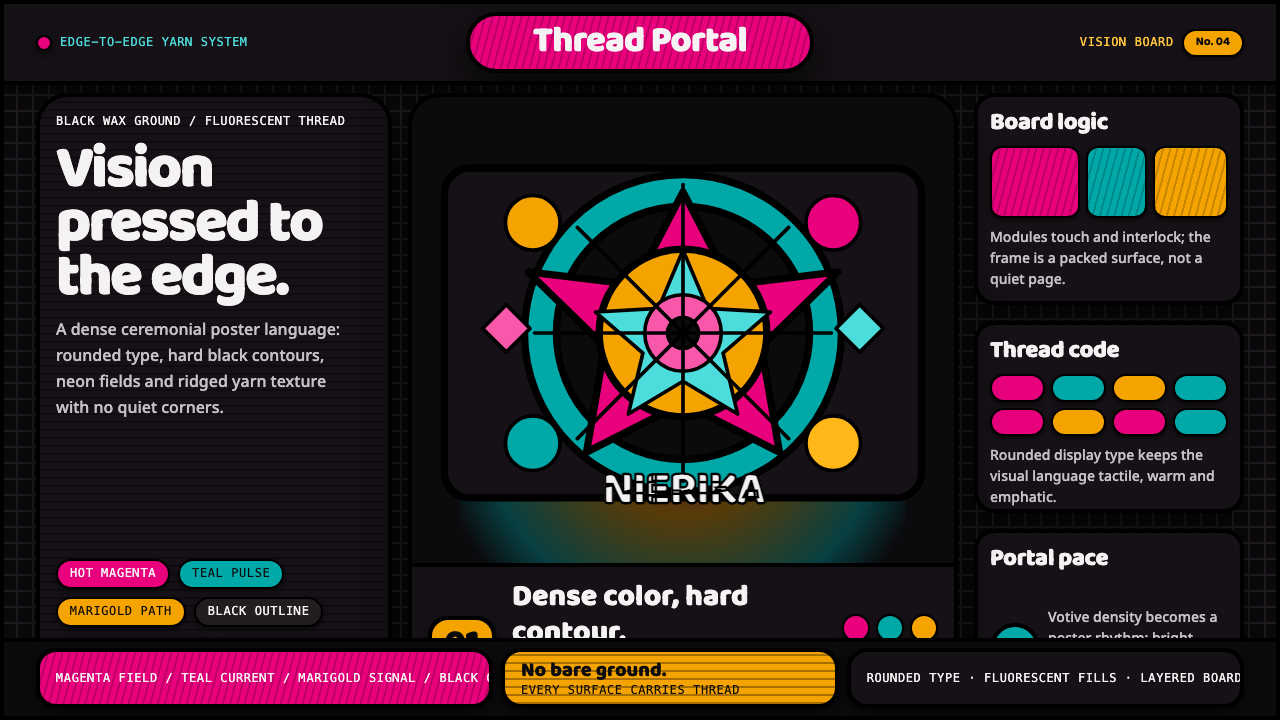 Huichol Yarn NierikaCeremonial density glows. Neon yarn colors lock into black-contoured, edge-to…
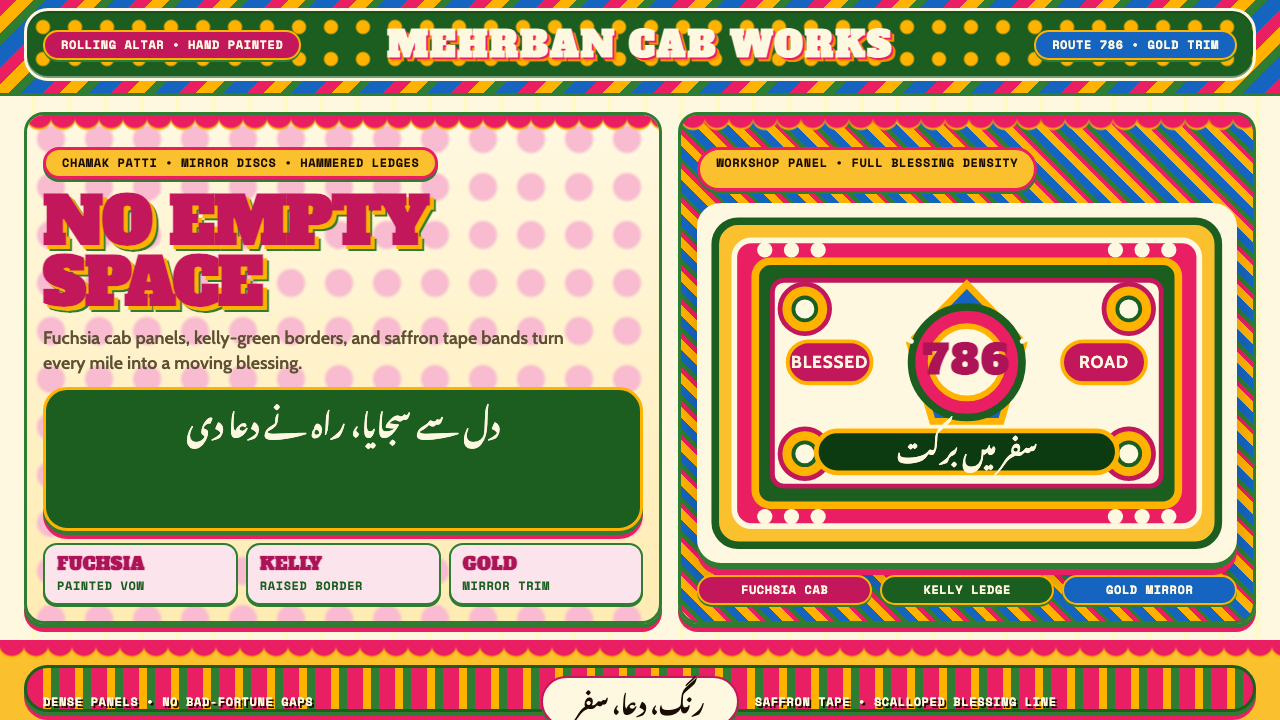 Pakistani Truck ArtBlessing crowds every inch. Fuchsia, kelly green, and gold stack into scallop…
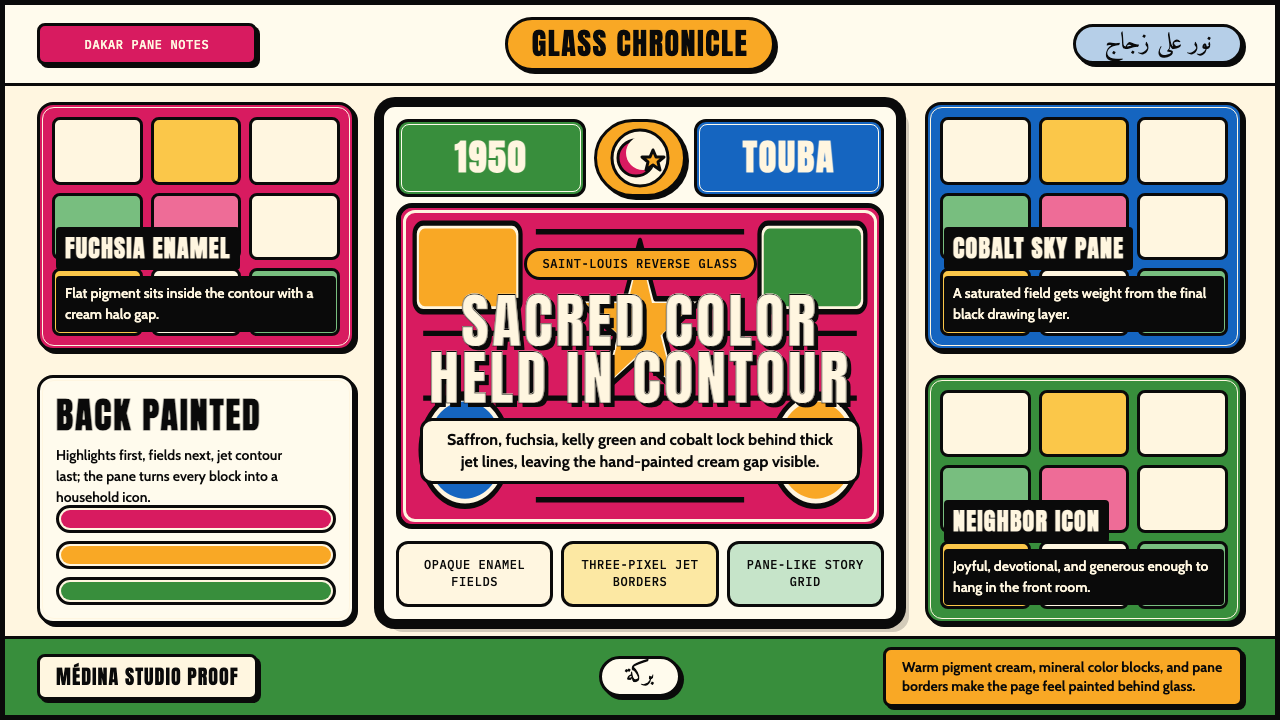 Senegalese Sous-VerreSacred joy in enamel. Fuchsia and saffron panes lock behind thick jet contour…
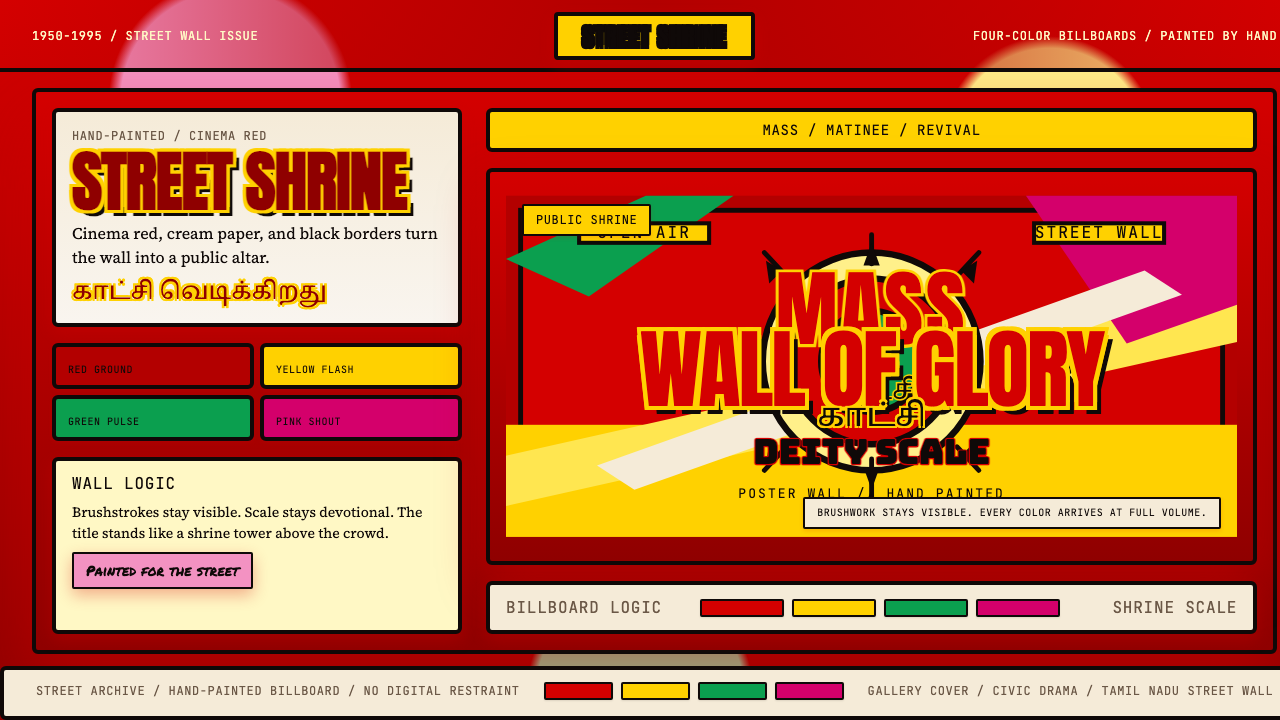 Tamil Cinema Poster (MGR era)The wall becomes a shrine. Red, yellow, green, and pink crash into cream pane…
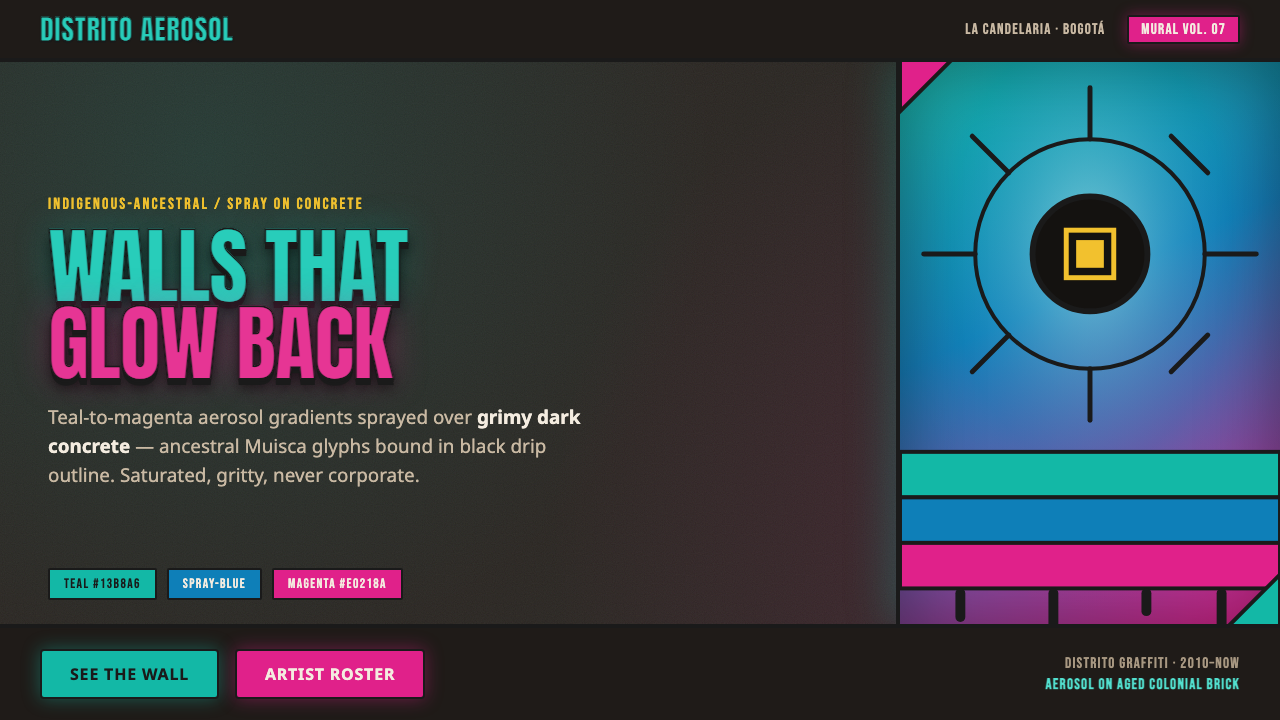 Bogotá Street MuralismNeon spray glowing off the wall. Teal-to-magenta aerosol on grimy concrete, i…
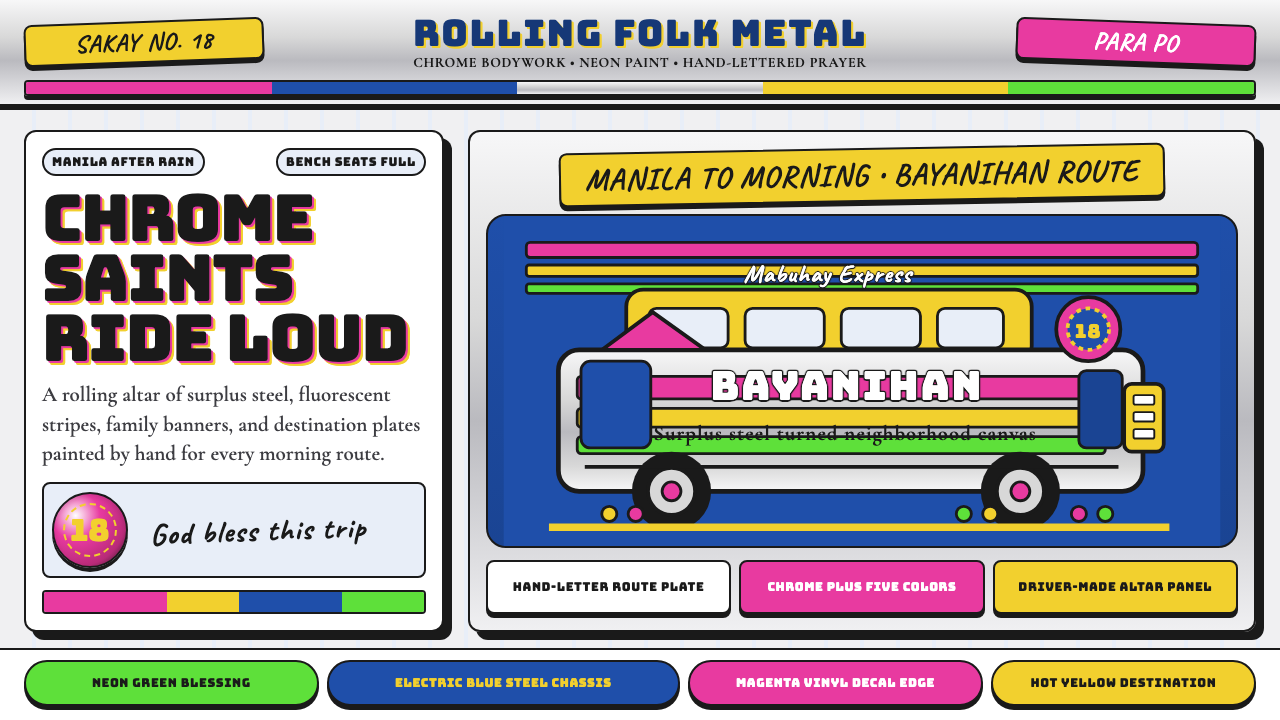 Filipino JeepneyLoud steel, made personal. Chrome gradients carry neon stripes and hand-lette…