What is Bangladeshi Nakshi Pitha Motifs?
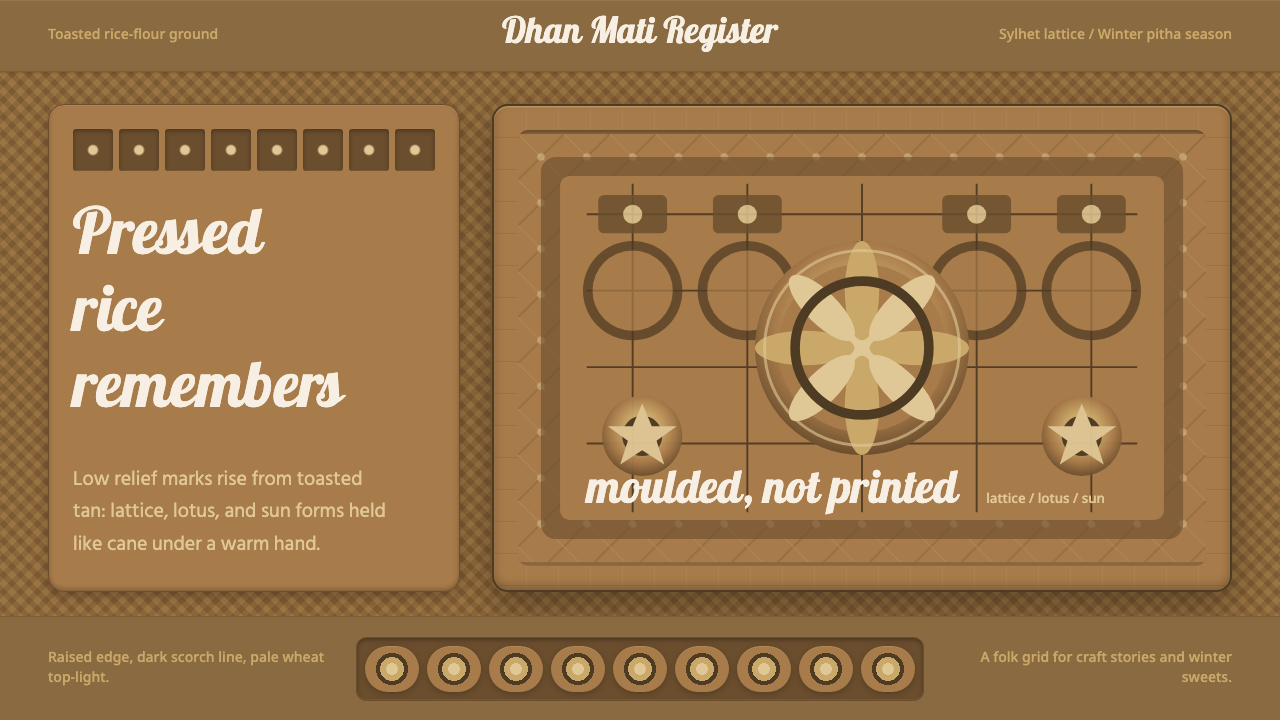
Nakshi pitha presses the pattern into the food itself — rice flour pushed into a carved wooden mould until sun and lotus motifs rise in warm relief across a toasted-tan surface.
Bangladeshi Nakshi Pitha Motifs in brief
Nakshi pitha are the patterned rice cakes of rural Bengal, made by pressing cooked rice-flour dough into carved wooden moulds so that a design — most often a lotus, a sunburst, or a repeating lattice — rises in low relief across the toasted surface once the cake is cooked. The word nakshi comes from naksha, meaning pattern or design, and the same root gives its name to nakshi kantha, the celebrated embroidered quilts of the same region; pitha simply names the cake. What the two crafts share is a working method: pattern is not printed onto a surface, it is built into the material, so that light and shadow do work that color alone cannot.
Alongside the pitha tradition sits shitalpati, the fine mat weaving of the Sylhet region, made from strips of murta cane split so thin they take on a silk-like sheen. Woven mats in interlaced lattice patterns, golden-brown when new and deepening with handling, cover floors, serve as sleeping surfaces in the region's humid climate, and appear as ceremonial gifts. Shitalpati's precision — every strip the same width, every crossing exact — gives the craft a structural regularity that pairs naturally with the pitha mould's geometric repeats.
This design system reads both crafts as one visual language: a deep, toasted-tan ground standing in for the baked cake surface; motifs embossed rather than printed, so edges catch soft directional light instead of sitting flat; and a lattice grid borrowed from shitalpati weaving used to organize structure the way a formal grid organizes a printed page. Nothing here is bright or graphic in the poster sense — the palette and the relief technique both come from cooked rice and dried cane, materials that are warm, matte, and slightly imperfect by nature.
Where does Bangladeshi Nakshi Pitha Motifs come from?
Pitha-making is a home craft, not a workshop or guild tradition — carried almost entirely by women in rural Bengali households, passed from mother to daughter, and concentrated around specific calendar moments rather than produced year-round. The heaviest pitha season falls around Poush Sankranti in mid-January, the winter harvest festival, when new rice and date-palm jaggery come into season together and households compete, informally, to produce the most elaborately patterned cakes for family and neighbors.
The moulds themselves — carved from wood, sometimes from clay — are a craft in their own right, cut by hand with the same repertoire of motifs recurring across villages and generations: lotus flowers, radiating suns, fish (a recurring auspicious motif in Bengali delta culture), and abstract lattice fields that fill in background space around a central figure. Because the mould is reused for years, its wear becomes part of a household's identity — a slightly softened motif edge is a record of use, not a flaw to be corrected.
Shitalpati weaving is concentrated in and around Sylhet, in Bangladesh's northeast, where the murta plant grows in the wetlands. Weavers split the cane into fine strips, dry and polish them, then interlace them by hand into mats whose patterning comes entirely from the weave structure itself — over-under sequences that shift to create lattice, herringbone, or diamond fields. In 2017, shitalpati weaving was inscribed on UNESCO's Representative List of the Intangible Cultural Heritage of Humanity, a recognition that named the craft as a fragile, transmission-dependent tradition worth active protection rather than a static museum piece.
Both crafts sit inside a broader Bengali folk-art vocabulary that treats domestic, everyday objects — a cake, a floor mat, a quilt — as legitimate surfaces for elaborate pattern-making, without the aesthetic ever being separated out into fine art reserved for galleries. The patterns exist because they are made by hand, for use, inside the rhythm of a household year, which is part of why they read as warm and lived-in rather than designed from a brief.
What defines the Bangladeshi Nakshi Pitha Motifs look?
Relief, not print
The defining technique across both source crafts is that pattern is pressed into the material rather than applied on top of it. A pitha's lotus motif rises from the cake's own surface; a shitalpati mat's diamond field comes from the weave structure, not a dye. Translated to screen, this shows up as embossed, dimensional treatment for motifs rather than flat iconography — edges that catch light as if physically raised, never a simple silhouette laid over a solid ground.
Toasted, earthen palette
Color follows the material rather than a designer's whim: the warm tan and gold-brown of a rice cake fresh from the mould, the deepening amber of aged murta cane, the near-black of a well-used wooden mould's grain. Nothing in this palette is bright or synthetic — every hue reads as something that came from an oven, a plant, or a hand tool, giving the system a consistently warm, low-saturation, evening-light temperature.
Lotus and sunburst motifs
The recurring figures are drawn from the same small repertoire village carvers have used for generations — a radiating lotus, a sunburst with even petal-like rays, and occasionally a stylized fish. These motifs are always symmetrical around a central point, reflecting the fact that a mould is carved once and reused identically every time, so the design has to be resolved and balanced rather than sketched freehand.
Lattice grid structure
Where the pitha motifs supply a focal center, shitalpati weaving supplies the field around it — an interlaced lattice built from strips crossing at a consistent angle, filling background space the way a woven mat fills a floor. This lattice becomes the system's structural grid: a repeating, evenly spaced under-pattern that organizes content the way a printed grid would, but with a handwoven irregularity that keeps it from feeling mechanical.
Directional soft shadow
Because the source material is physically embossed, light in this system is always treated as coming from one consistent direction, casting a soft, warm-toned shadow along one edge of each raised motif. This is not a hard graphic drop shadow — it is closer to the gentle shading you would see running a thumb across a real pressed rice cake, present but never heavy-handed.
Handmade imperfection
Because moulds wear down and cane strips are split by hand, no two impressions are perfectly identical — a repeated motif has slight variation in depth or spacing from one instance to the next. The system preserves this quality deliberately: repetition is never mechanically uniform, and a faint asymmetry in otherwise mirrored motifs signals craft rather than a production flaw.
Border framing
Both pitha cakes and shitalpati mats are typically bounded by a distinct border pattern that differs from the interior field — a simpler repeating band containing a more elaborate central motif. This nested structure — border, then field, then focal motif — gives the system a natural way to frame content: an outer band that signals containment, with the visual weight concentrated toward the center.
Who shaped Bangladeshi Nakshi Pitha Motifs?
The tradition's actual authorship belongs to generations of women in rural Bengali households who carve, maintain, and pass down pitha moulds and recipes as domestic knowledge rather than signed design work. Skill is transmitted directly, mother to daughter, and a household's pitha patterns often function as a quiet marker of family identity during festival seasons.
Concentrated in the wetlands around Sylhet in Bangladesh's northeast, weaver families work the murta cane crop through a full seasonal cycle — cutting, splitting, drying, and interlacing — to produce mats whose lattice patterning is a direct byproduct of weave structure. Their craft was formally recognized by UNESCO in 2017 as a tradition requiring active safeguarding.
By inscribing shitalpati weaving onto its Representative List in 2017, UNESCO's ICH programme reframed the craft as a living tradition at risk of disappearing rather than a settled folk curiosity — a designation that has since supported documentation and transmission efforts inside Bangladesh.
The wooden pitha moulds used across generations of households are themselves the work of specialist carvers, who cut the recurring repertoire of lotus, sun, and lattice motifs by hand into blocks that will be reused for years. A mould's slow wear over repeated use becomes part of the visual record it leaves behind.
Sharing the naksha (pattern) root with nakshi pitha, the nakshi kantha quilt-embroidery tradition of the same region works the identical vocabulary of lotus, sun, and lattice motifs into stitched cloth rather than pressed rice flour, underscoring that this is a regional design language that moves fluidly across craft materials.
How do you use Bangladeshi Nakshi Pitha Motifs today?
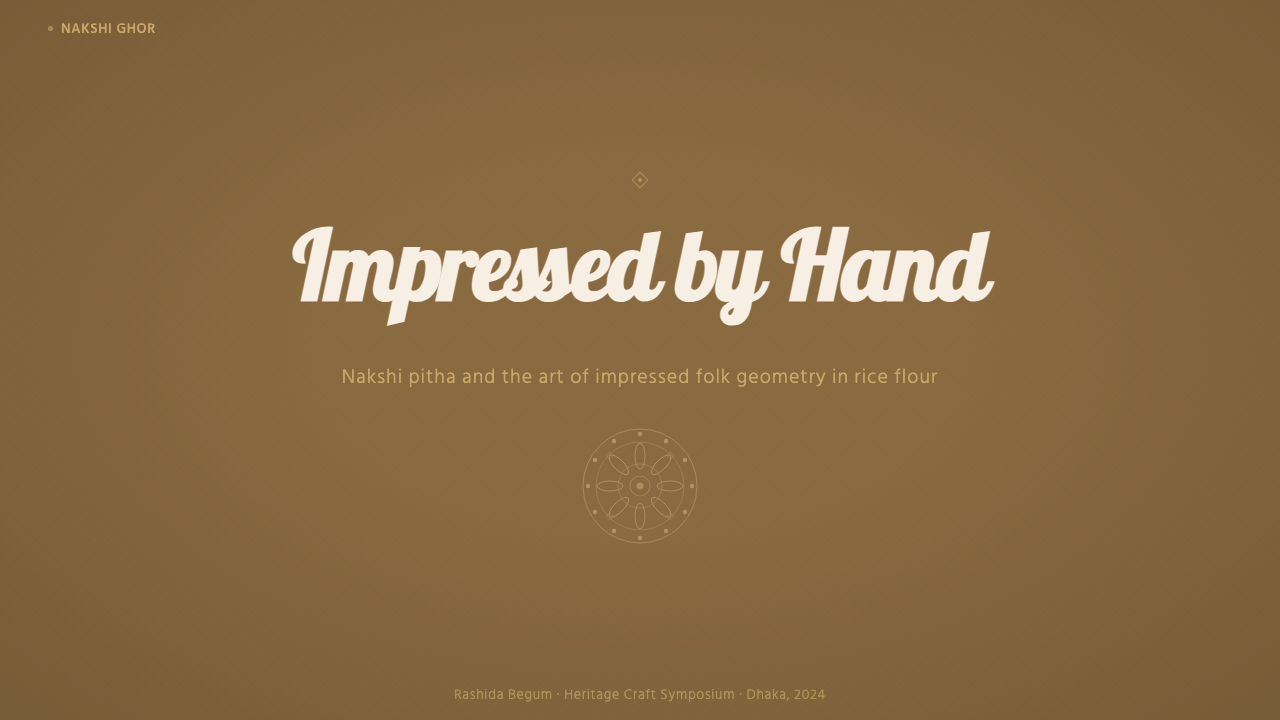
For presentation slides, this system's warm, tactile quality suits decks that want to feel handmade and human rather than corporate — cultural reports, heritage and travel proposals, food and craft brand pitches. A cover slide works well built around one large embossed motif — a lotus or sunburst treated with the soft directional shadow — centered or offset against the toasted-tan ground, with the title set in restrained type so the motif carries the visual weight. Content slides should keep the lattice pattern to margins or section dividers rather than filling the whole background, which would compete with body text; data should be presented in warm, muted tones rather than a bright analytical palette, since the source material has no precedent for high-contrast charting.
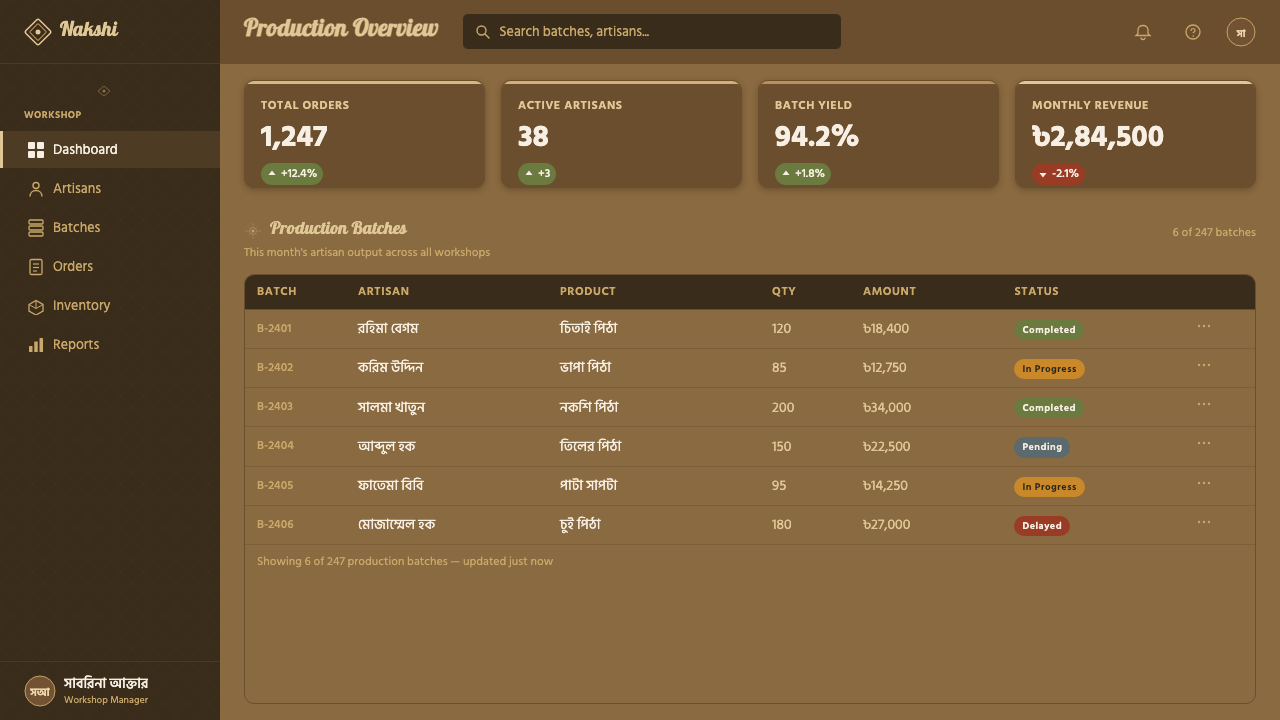
For web interfaces, the system's earthen palette and relief motifs suit editorial storytelling more naturally than transactional dashboards — a food culture site, a crafts marketplace, a museum or heritage microsite. Dashboards and pricing pages are a harder fit: the embossed, low-contrast motif treatment does not read cleanly at small interactive sizes, and the system has no native vocabulary for the sharp state changes — hover, active, error — that transactional UI depends on. Where it is used for UI, it works best confined to hero sections and content cards, with functional interface chrome kept plain.
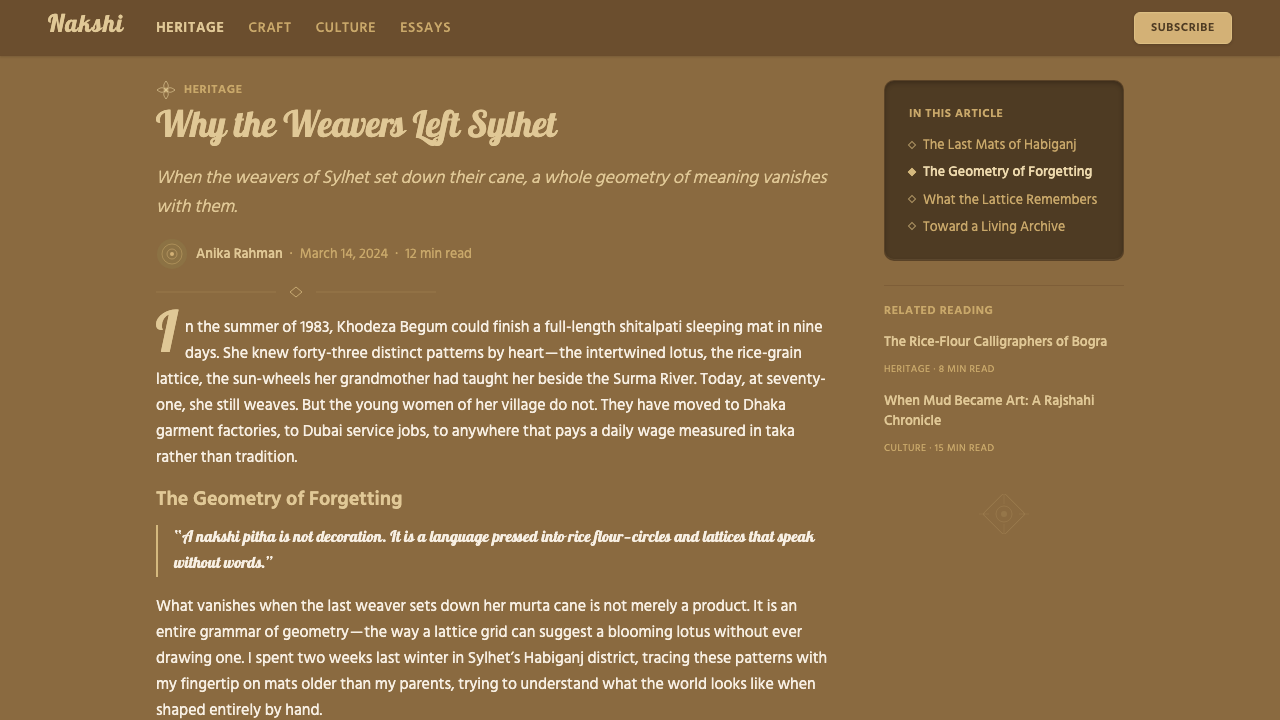
For editorial and marketing work, this is where the system is strongest. A long-form article on Bengali craft, food heritage, or South Asian design can use the lattice pattern as a running margin motif and the embossed lotus or sunburst as section-break ornaments, echoing the physical experience of turning a patterned pitha or a woven mat over in hand. Marketing material for food, hospitality, or cultural-tourism brands benefits from the same warmth — a menu cover, a packaging wrap, or a festival announcement all sit naturally on the toasted-tan ground with a single embossed centerpiece motif.
The most common misapplication is treating this as a generic ethnic pattern and printing the lattice flat, in full saturation, across an entire background. That erases the one thing that makes the source material distinctive — pattern that is pressed into a surface, catching real light, rather than printed onto it. A second frequent error is over-brightening the palette to make it pop on screen; the tradition's warmth comes specifically from muted, oven- and cane-derived tones, and pushing saturation up turns a handmade craft language into a generic tropical or festival cliché.
Bangladeshi Nakshi Pitha Motifs — FAQ
What does "nakshi" mean, and how is nakshi pitha related to nakshi kantha embroidery?
Nakshi comes from the Bengali word naksha, meaning pattern or design. Nakshi pitha are patterned rice cakes; nakshi kantha are patterned, hand-embroidered quilts from the same Bengali cultural region. The two crafts share a design vocabulary — the same lotus, sun, and lattice motifs recur in both — but differ entirely in material and technique: one is pressed relief in cooked rice flour, the other is stitched thread on layered cloth. Understanding this shared root helps explain why the design system treats motif and lattice as a coherent regional language rather than two unrelated patterns.
Why is shitalpati weaving recognized by UNESCO, and does that affect how the pattern is used here?
Shitalpati was inscribed on UNESCO's Representative List of the Intangible Cultural Heritage of Humanity in 2017, in recognition of its skill-intensive, hand-transmitted weaving process and its vulnerability to declining practice. That recognition does not restrict how the visual pattern can be referenced in design work, but it does underscore that the lattice motif borrowed here comes from a living craft actively at risk, not a settled historical style — a reason to treat the reference with some care rather than as decorative shorthand for South Asian pattern generally.
Why does this system favor embossed, dimensional motifs instead of flat printed icons?
Because both source crafts are physically dimensional — a pitha's design rises from pressed dough, a shitalpati mat's pattern comes from the weave's over-under structure — flatness would misrepresent the actual material experience the tradition is built on. Rendering motifs with soft directional shadow instead of flat fill is what keeps the system honest to its source rather than reducing it to a generic ethnic surface pattern.
Is this style suitable for a modern tech product, or is it strictly for cultural and food content?
It leans strongly toward cultural, food, editorial, and hospitality contexts, where its warmth and handmade quality are assets. It is a poor fit for dense transactional interfaces — dashboards, checkout flows, anything requiring sharp state changes — because the embossed, low-contrast motif language does not hold up at small interactive scale and has no native vocabulary for functional UI states. Used sparingly, as hero imagery or section ornament within an otherwise plain interface, it can still work in a broader product context.
Why is the color palette so restrained compared to other festive South Asian design references?
Because the palette is derived directly from the physical materials — toasted rice cake, dried and polished cane, aged wood — rather than from festival textiles or dyed cloth, which tend toward much higher saturation. Keeping the palette earthen and warm rather than bright is what distinguishes this system from generic colorful-Bengal clichés and keeps it tied to the specific, quieter materiality of pitha-making and mat weaving.
Related design styles
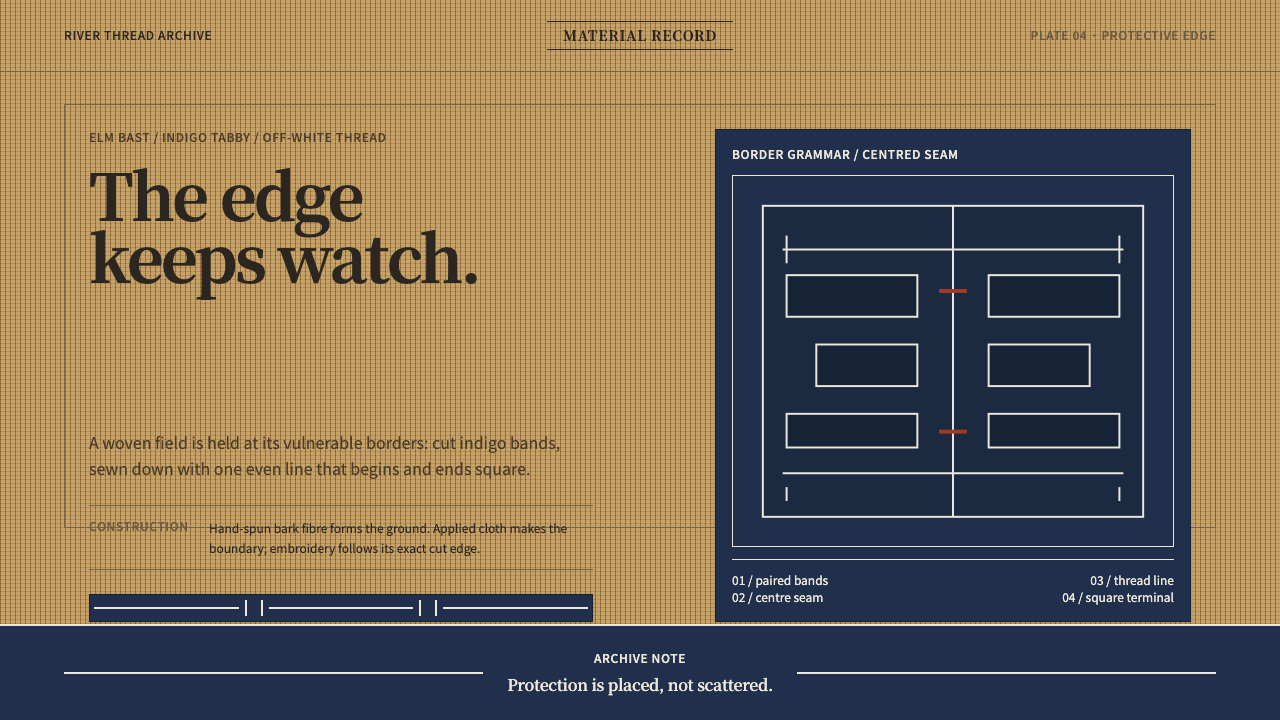 Ainu Attus RobeProtection is cut, not painted. Indigo bands and square-ended thread hold elm…
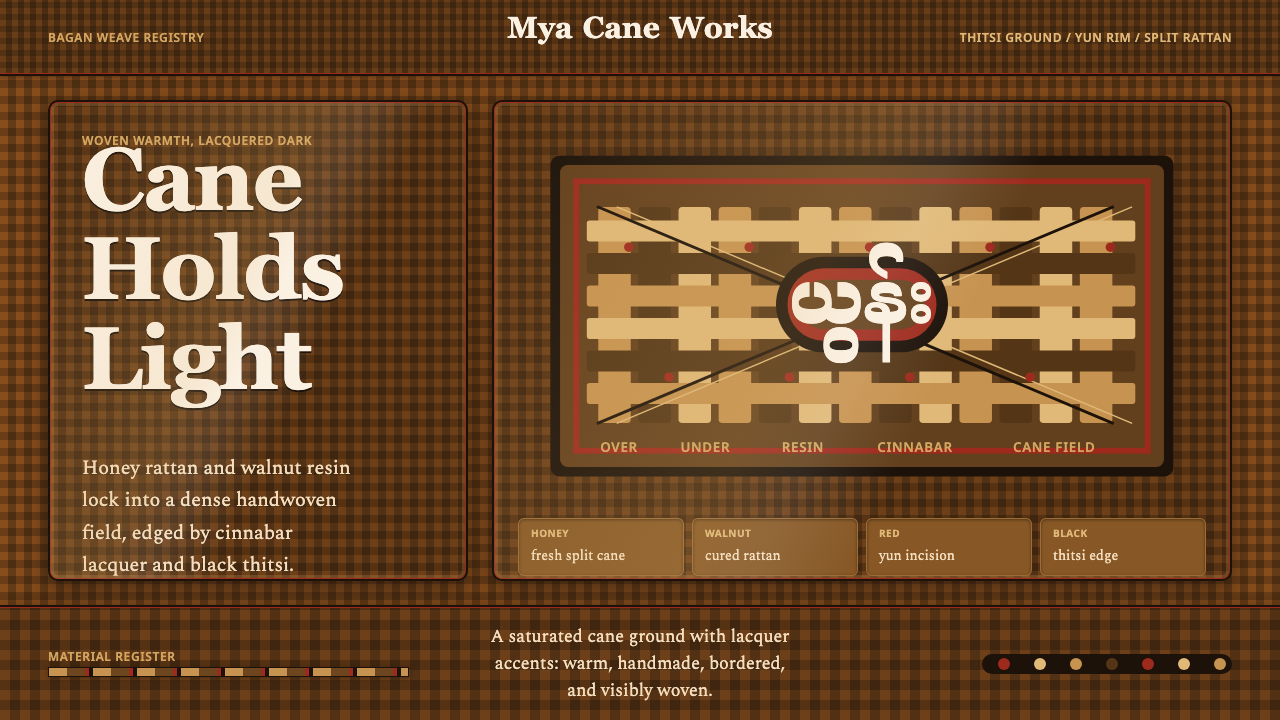 Burmese Cane RattanWoven warmth holds the page. Walnut cane lattice glows with cinnabar rim line…
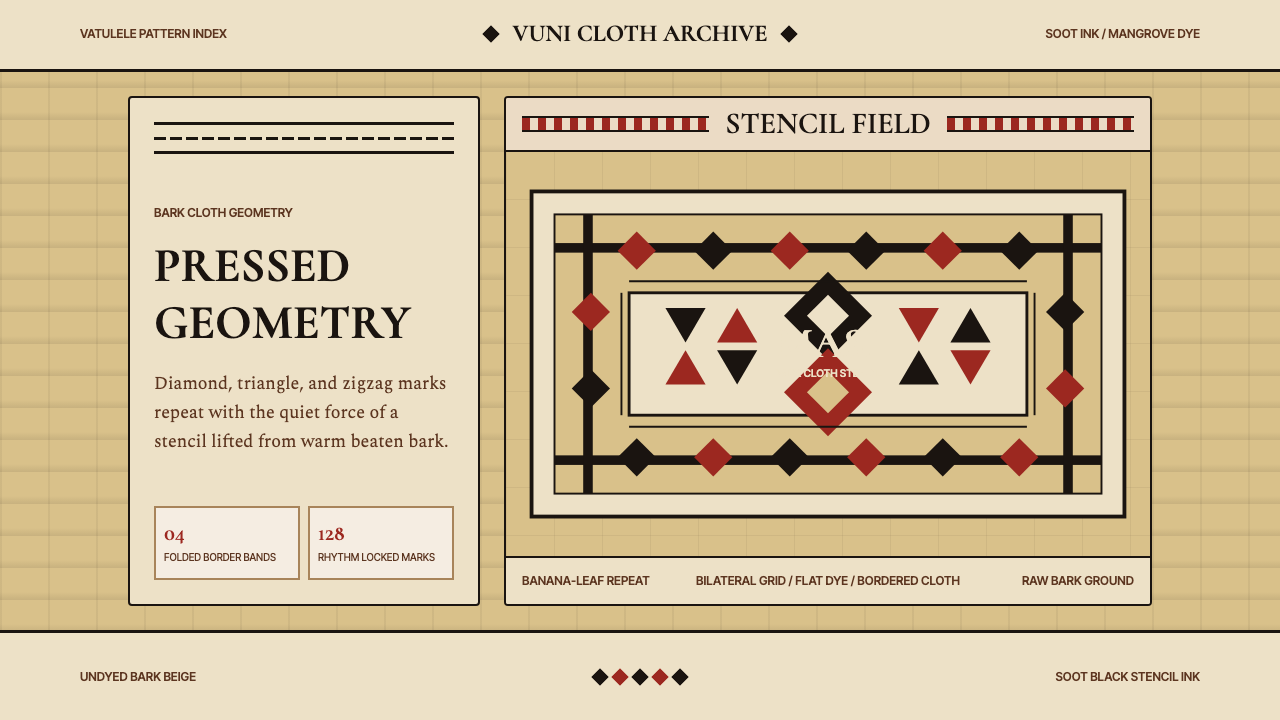 Fijian Masi Tapa StencilGeometry keeps ceremony. Soot-black diamonds repeat on bark beige with rust-r…
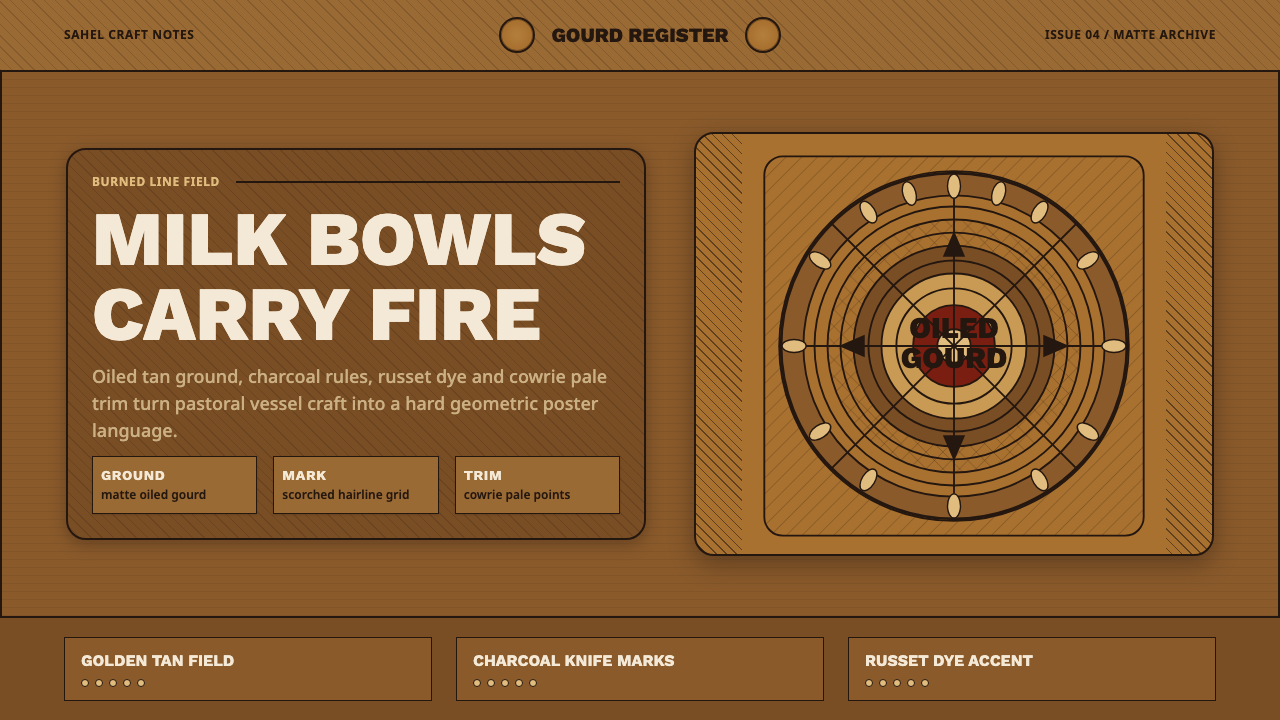 Fulani Milk CalabashMatte craft burns bright. Oiled gourd tan meets charred concentric linework.
 Harakeke Raranga WeavingStructure carries care. Honey-straw grids expose each green, bark and fibre s…
 Kabyle PotteryBuilt band by band. Resin-warm kaolin carries manganese rules and iron-red ge…