What is Banarasi Brocade Saree?
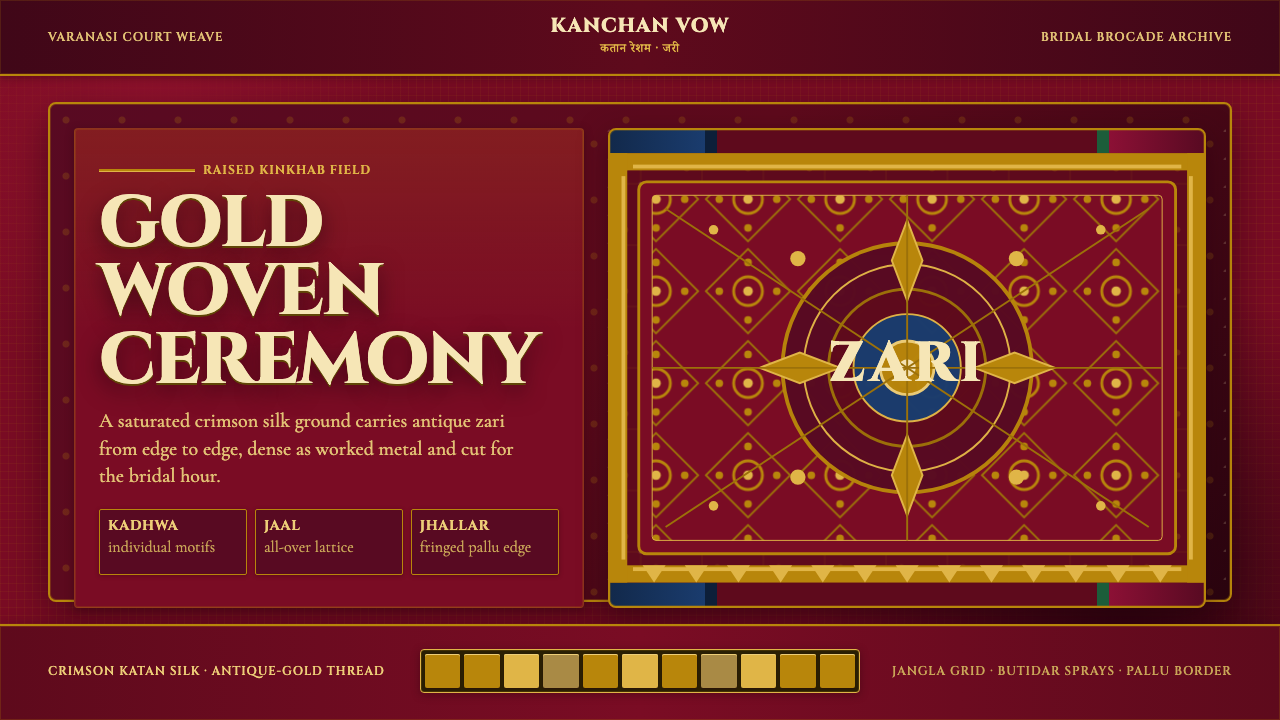
The Banarasi saree is Varanasi's dense bridal brocade — deep silk grounds overlaid edge to edge with raised metallic gold thread, woven to catch light like worked jewelry rather than printed cloth.
Banarasi Brocade Saree in brief
The Banarasi saree is a heavy brocade textile woven in Varanasi (historically Benaras), one of India's oldest continuously inhabited cities and its most storied weaving center. What distinguishes a Banarasi from other Indian silk sarees is the sheer density and metallic weight of its ornamentation: a saturated silk ground, most iconically a deep crimson, is covered almost edge to edge with zari — thread wrapped or coated in fine gold (or silver) — woven directly into the fabric's structure rather than embroidered or printed on top of it afterward.
This is maximalism as a technical achievement, not merely a visual choice. The gold-thread motifs are raised and textured against the silk ground through weaving techniques passed down through generations of Varanasi's master weaver families, so that the ornament has physical dimension — you can feel the pattern as much as see it, and it catches and scatters light the way hammered or worked metal does, unlike a flat printed pattern that only reflects light uniformly.
The motifs themselves are drawn from a specific ornamental vocabulary rooted in Mughal court art: dense, continuous floral scrollwork known as jangla, and scattered small floral sprays called butidar, both descended from Persian-influenced Mughal textile design that took root in Varanasi's workshops centuries ago and has been refined there ever since. A finished Banarasi saree reads as continuous, all-over richness rather than a pattern with breathing room — there is essentially no undecorated ground left visible once a piece is complete.
Where does Banarasi Brocade Saree come from?
Varanasi's silk weaving tradition draws deeply on Mughal patronage, which reshaped Indian textile production from the sixteenth century onward. Mughal emperors and their courts imported Persian textile aesthetics and craftsmen, and Persian-derived ornamental vocabularies — dense floral scrollwork, repeating botanical medallions, formal symmetrical garden motifs — were absorbed into Indian weaving centers including Varanasi, merging with existing local silk-weaving skill to produce something distinctly Indo-Persian rather than a direct copy of either tradition.
The technique most associated with Banarasi's raised, sculptural gold ornament is kadhwa — a weaving method in which each individual motif is woven separately into the fabric using small shuttles, rather than being carried across the entire width of the loom in a single pass. This is significantly more labor-intensive than continuous brocade weaving, since each motif is essentially built up on its own, but it produces the saree's signature effect: motifs that sit slightly raised and sculptural against the silk ground, with sharply defined edges rather than a softer, flatter woven-through look.
This weaving knowledge is held and transmitted by Varanasi's karigars — master weaver families whose skill passes down through direct apprenticeship rather than formal schooling, much like other hereditary craft traditions across India. A single elaborate Banarasi saree, particularly one using dense kadhwa work throughout, can represent weeks or months of a karigar's labor, which is central to why the finished cloth carries such value and status: it is understood, culturally, as a record of sustained, expert human labor rather than a mass-producible textile.
By the early twentieth century, Banarasi brocade had become firmly established as the definitive Indian bridal textile, its density and gold weight read directly as a display of wealth, status, and auspiciousness at weddings and major ceremonial occasions. The saree's association with Mughal-court-derived ornament also gave it an inherited sense of royal or aristocratic prestige, a connotation that has persisted into its role as the premier ceremonial textile across much of North India well into the present.
What defines the Banarasi Brocade Saree look?
Saturated Jewel-Tone Ground
The base silk field is deeply saturated rather than pastel or muted — deep crimson is the most iconic choice, but emerald green and royal blue grounds are equally traditional. Whichever hue is used, it functions as a solid, jewel-toned field meant to contrast maximally against the gold ornament layered over it, never as a soft or neutral backdrop.
All-Over Density
Ornament covers the field edge to edge with essentially no undecorated ground left visible — this is a maximalist logic in which restraint is not a value. The visual goal is continuous richness rather than a pattern set against open space, closer to how a jeweled surface or an illuminated manuscript page fills its entire field than to a pattern with generous negative space.
Raised Metallic Ornament
The zari gold thread is woven to sit physically raised above the silk ground, giving the ornament real texture and dimensionality rather than a flat printed appearance. This raised quality is what allows the pattern to catch and scatter light unevenly, the way worked or hammered metal does, producing shimmer and depth that a flat gold color could never replicate.
Jangla and Butidar Motifs
The dominant motif vocabulary consists of jangla — dense, continuous floral scrollwork that winds across the entire field like an unbroken vine — and butidar, smaller individual floral sprays scattered at regular intervals. Both are Mughal-derived botanical forms, formal and symmetrical rather than loose or naturalistic, reflecting their origin in court-commissioned rather than folk textile design.
Kadhwa Relief Technique
Because kadhwa weaving builds each motif individually rather than carrying thread continuously across the loom, motifs woven this way have sharply defined edges and a slightly sculptural, built-up presence distinct from a flatter, more continuous brocade weave. This technique is what gives premium Banarasi work its most tactile, dimensional quality.
Jhallar Fringe Borders
Borders are frequently finished with jhallar, a decorative fringe treatment that frames the dense central field with its own textured, tasseled edge. This border treatment reinforces the sense of a fully composed, edge-to-edge ceremonial object rather than a plain rectangular length of cloth with an incidental boundary.
Ornate Display Typography
In digital or print translations of this style, typography leans toward ornate, court-influenced serif letterforms for display purposes, echoing the formal, ceremonial register of the textile itself. This is a style built for occasions of significance and status display, and its typographic register should match that weight rather than defaulting to a neutral, utilitarian sans-serif.
Who shaped Banarasi Brocade Saree?
The karigars are the hereditary weaver families of Varanasi who hold and transmit the technical knowledge behind Banarasi brocade — including kadhwa relief weaving, motif design, and zari handling — through direct apprenticeship across generations rather than formal institutional training. A single dense, high-quality Banarasi saree can represent weeks to months of sustained work by a karigar, which is central to the textile's cultural understanding as a record of expert human labor rather than a mass-produced good.
The court workshops of the Mughal era introduced Persian-derived textile aesthetics and imperial patronage systems into Indian weaving centers, establishing the formal, dense, floral ornamental language that Varanasi's weavers absorbed and made their own. These ateliers were responsible for elevating brocade weaving from a regional craft into an imperially sanctioned art form with standardized, highly refined motif vocabularies.
Within Varanasi's broader weaving community, specific karigar lineages became especially known for kadhwa expertise — the demanding, motif-by-motif weaving method that produces Banarasi brocade's signature raised, sculptural gold ornament. Because kadhwa work is so labor-intensive compared to continuous brocade weaving, mastery of the technique has historically marked the most skilled tier of Varanasi's weaving families, and pieces produced this way command particular recognition for their sharply defined, dimensional motifs.
How do you use Banarasi Brocade Saree today?
Banarasi's core transferable principle is disciplined maximalism: density and ornament used with technical precision rather than randomness, always organized around a jewel-toned ground and a single metallic accent system rather than a scattershot mix of colors and textures. Applying it well means committing fully to richness rather than diluting it with restraint borrowed from a different design tradition.
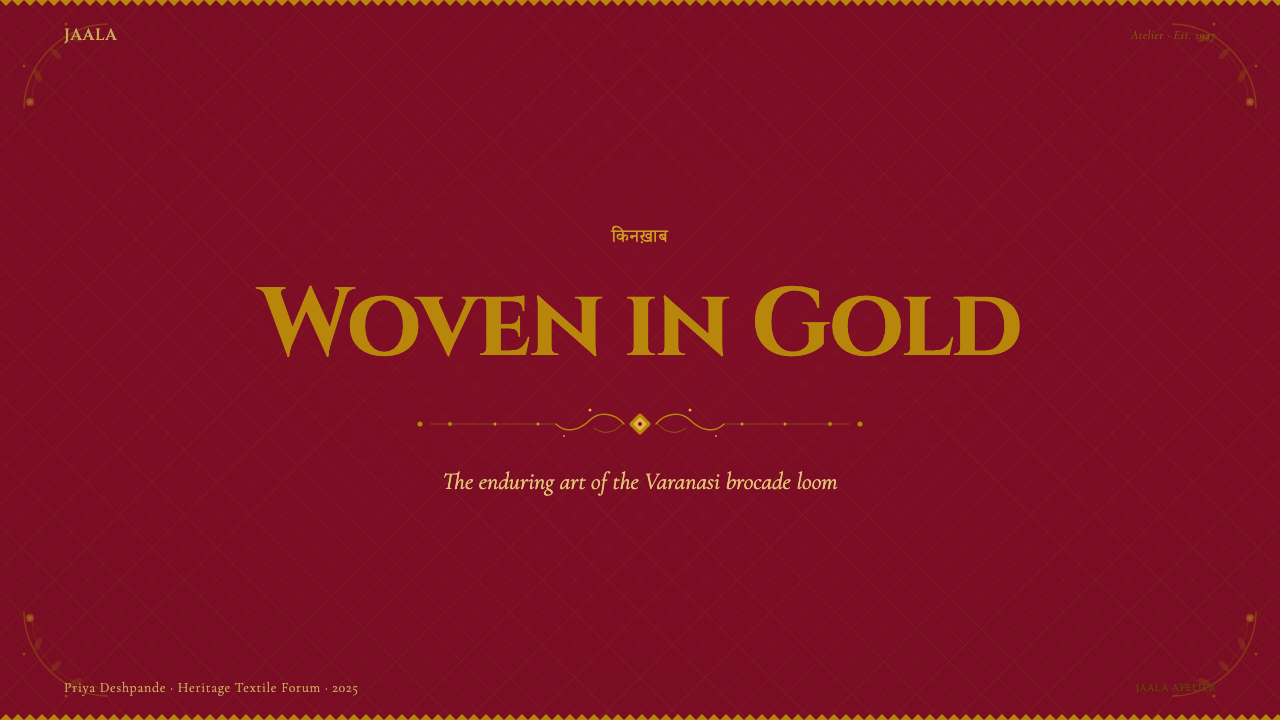
For presentation slides, the style suits cover pages and section dividers that want to signal premium, celebratory, or high-status occasions — a deep jewel-tone ground with a border treatment echoing jhallar fringe, and a single gold accent system used for the most important title or number. Content slides should use gold sparingly, reserved for emphasis rather than applied throughout, since the source material's density lives on physical cloth in a way that becomes visually overwhelming at the scale and reading distance of a slide; translate the density principle into rich, layered borders and section markers rather than dense all-over background pattern behind body text.
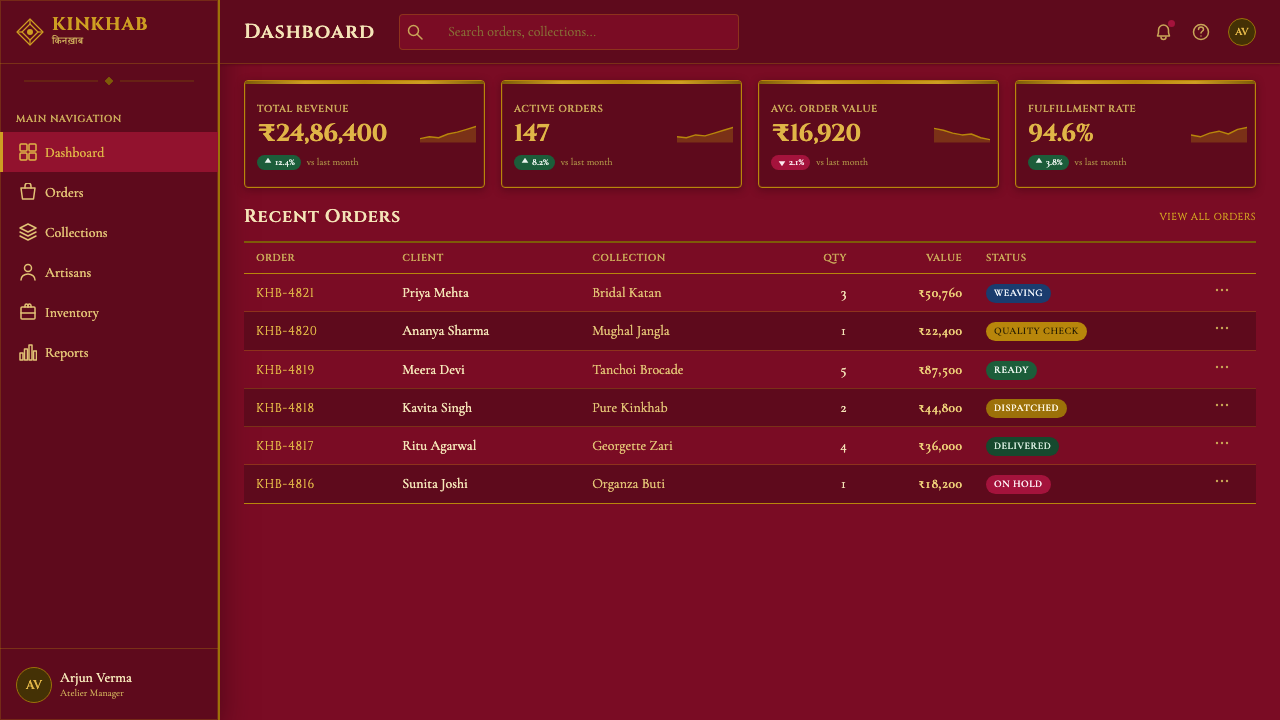
For web interfaces, this style is best suited to premium, ceremonial, or luxury-positioned products — invitation platforms, high-end e-commerce, cultural or heritage brands — rather than everyday utility tools. A jewel-tone ground used for hero sections or premium tier indicators, paired with a restrained gold accent for key actions or badges, can carry the style's status-signaling weight without requiring the literal all-over density of the textile itself, which rarely translates well to functional screen real estate.
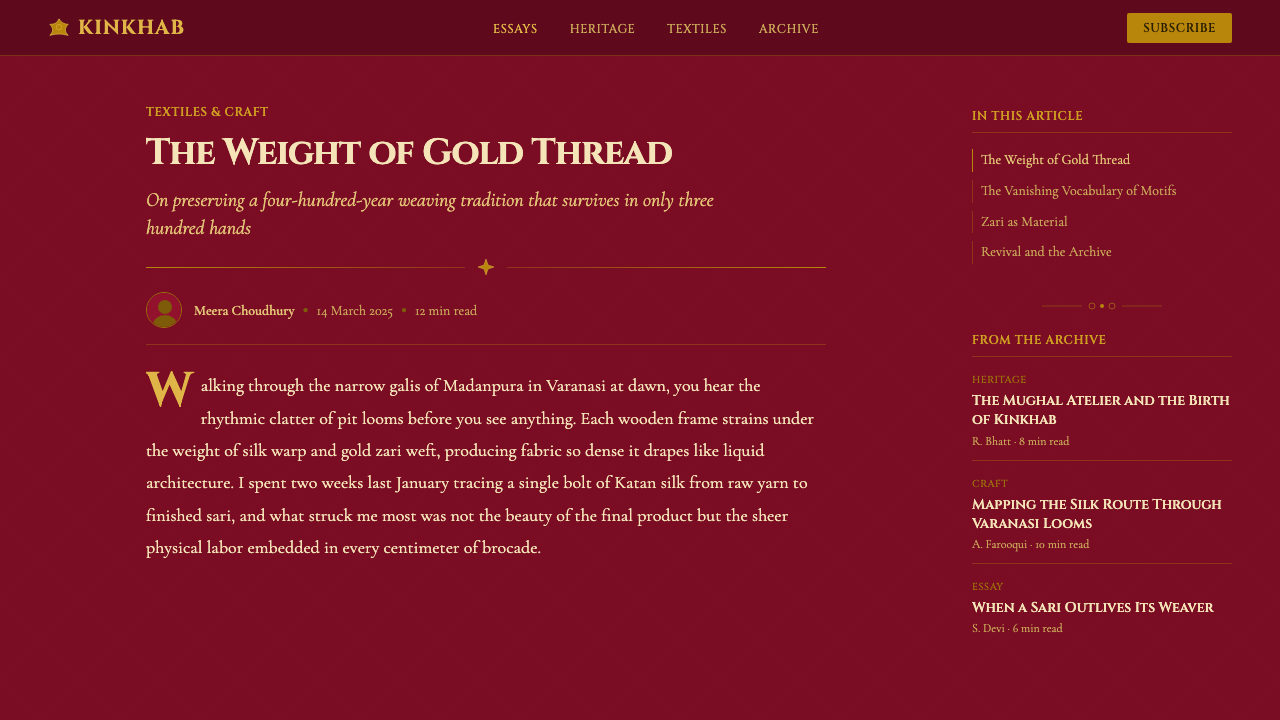
For editorial and marketing work, the style is a strong match for content about weddings, heritage craft, luxury goods, or cultural celebration — a feature article can use a deep jewel-tone section background with an ornate bordered frame around a pull quote, echoing the saree's border-and-field structure. Marketing pages promoting premium tiers or exclusive offerings can use the gold-accent-on-jewel-tone formula as a consistent visual shorthand for prestige.
A common mistake when applying this style is treating it as 'add gold color' without the underlying density and craft-precision logic — a thin gold line or a single gold icon does not evoke Banarasi; the style's identity depends on richly worked, edge-to-edge ornament against a saturated ground. Equally common is using gold as one of several competing bright accent colors rather than as the singular metallic signal against a jewel-tone field, which flattens the hierarchy that makes the original textile read as luxurious rather than simply busy.
Banarasi Brocade Saree — FAQ
What makes a Banarasi saree different from other Indian silk sarees?
The defining difference is the density and technique of its gold ornamentation: Banarasi work uses zari thread woven directly into the fabric's structure, often via the labor-intensive kadhwa method that builds each motif individually for a raised, sculptural effect, and covers the silk ground almost entirely edge to edge. Many other regional Indian sarees use lighter ornamentation, different weaving techniques, or motifs drawn from different cultural sources, so the sheer metallic density and Mughal-derived floral vocabulary are what specifically identify a piece as Banarasi.
What is kadhwa weaving, and why does it matter?
Kadhwa is a weaving technique in which each individual motif is woven separately into the cloth using small shuttles, rather than a single continuous thread carried across the entire loom width. It is significantly more time- and labor-intensive than continuous weaving, but it produces motifs with sharply defined edges and a slightly raised, sculptural texture — the visual and tactile signature most associated with premium Banarasi work.
Why is deep crimson the most iconic ground color for a Banarasi saree?
Deep crimson silk provides maximum contrast against the gold zari thread while also carrying strong cultural association with auspiciousness and bridal ceremony across much of India, which is why it remains the single most iconic ground color for the style even though emerald green and royal blue are equally traditional alternatives. The choice of ground color is always a saturated, jewel-toned hue rather than a pastel or neutral one, regardless of which specific color is selected.
What are jangla and butidar motifs?
Jangla refers to dense, continuous floral scrollwork that winds across the entire field of the fabric like an unbroken vine, while butidar refers to smaller individual floral sprays scattered at regular intervals across the ground. Both motif types descend from Mughal-court-influenced ornamental design and are formal and symmetrical rather than loose or freehand, reflecting their origins in courtly rather than folk textile traditions.
How much of this style translates well to digital screens versus staying purely physical?
The jewel-tone ground, restrained gold-accent logic, ornate border treatments, and display typography translate well to digital and print contexts as tools for signaling premium status and celebration. The literal edge-to-edge physical density of the original textile, however, is harder to replicate faithfully at screen scale without becoming visually overwhelming, so digital applications generally borrow the style's richness principle and apply it selectively — to borders, hero sections, and accent details — rather than attempting to cover an entire interface in dense ornament the way the physical cloth does.
Related design styles
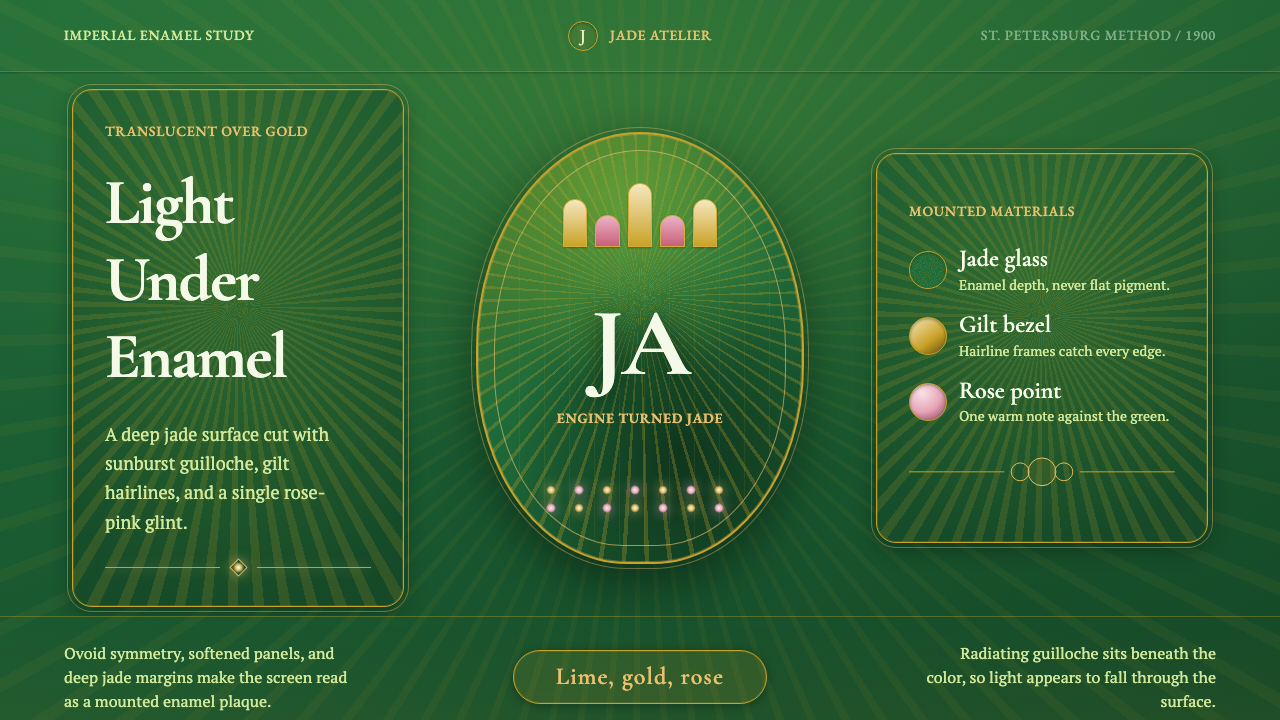 Faberge Guilloche EnamelImperial enamel glows. Jade guilloche, gilt hairlines, rose-pink points.
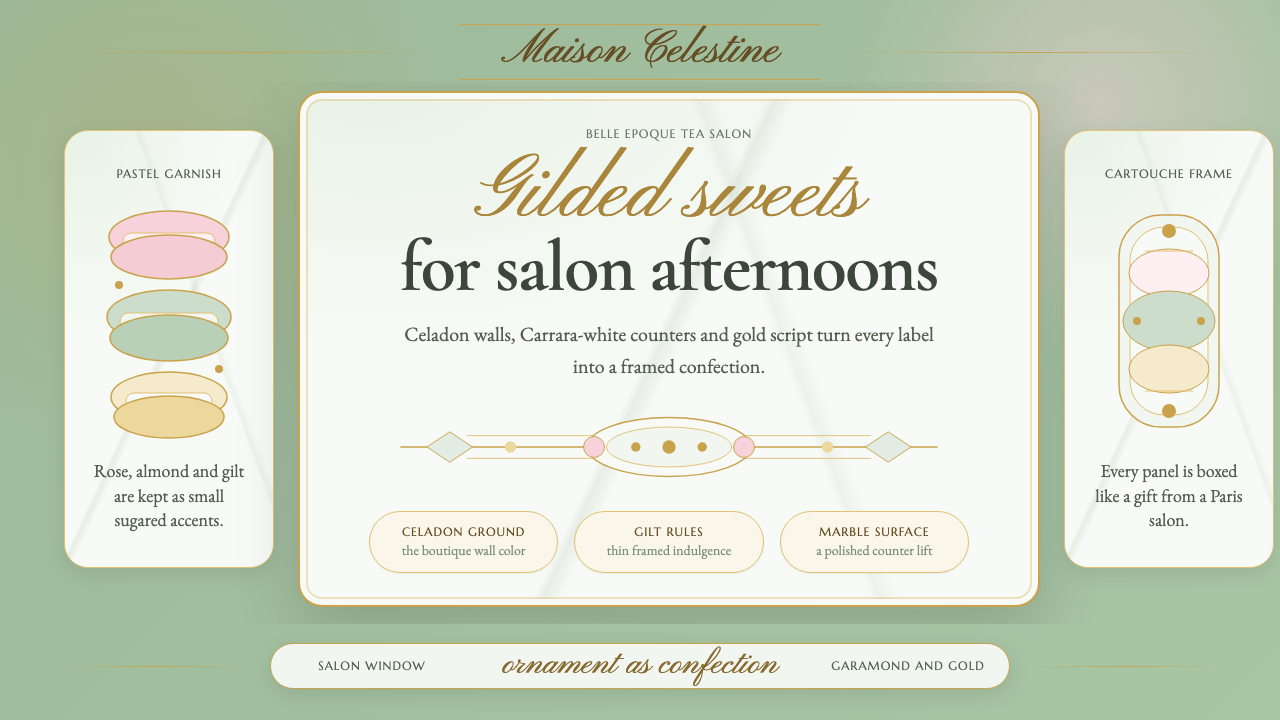 French PâtisserieOrnament is the luxury. Celadon ground, gilt cartouches, Garamond and script…
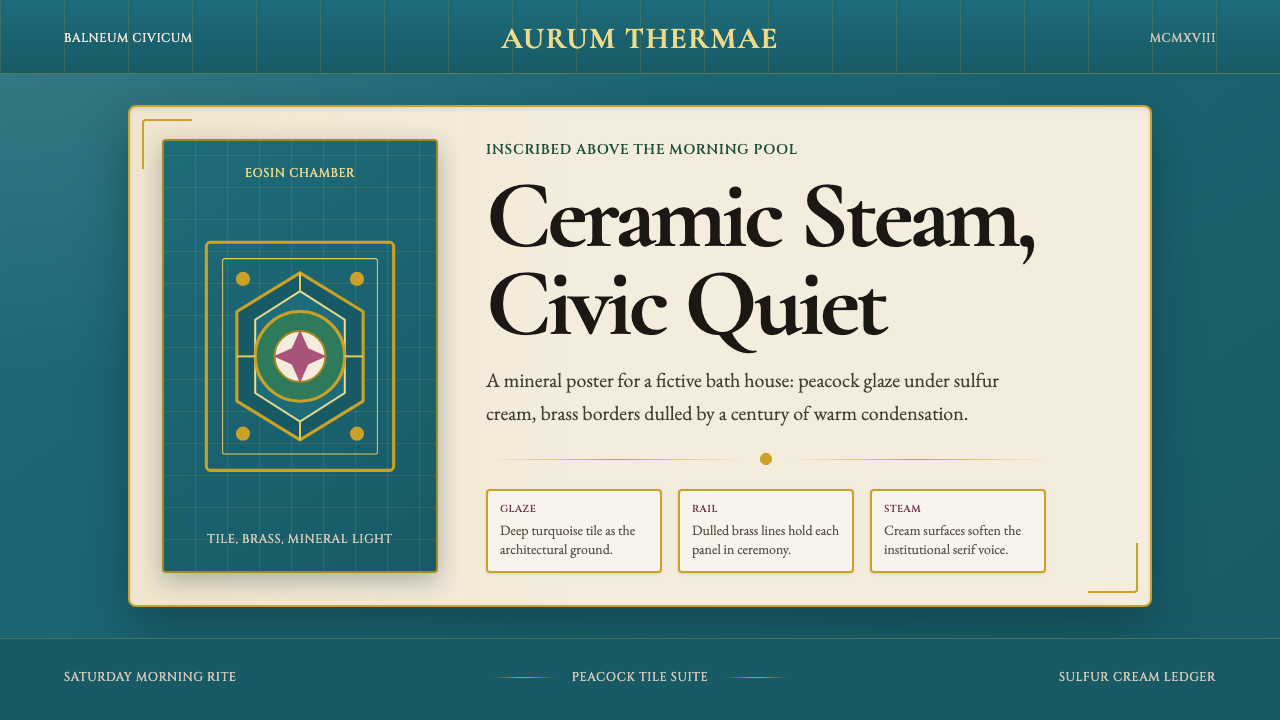 Budapest Thermal Bath Art DecoCivic steam, made ceremonial. Peacock turquoise, brass borders, and Garamond…
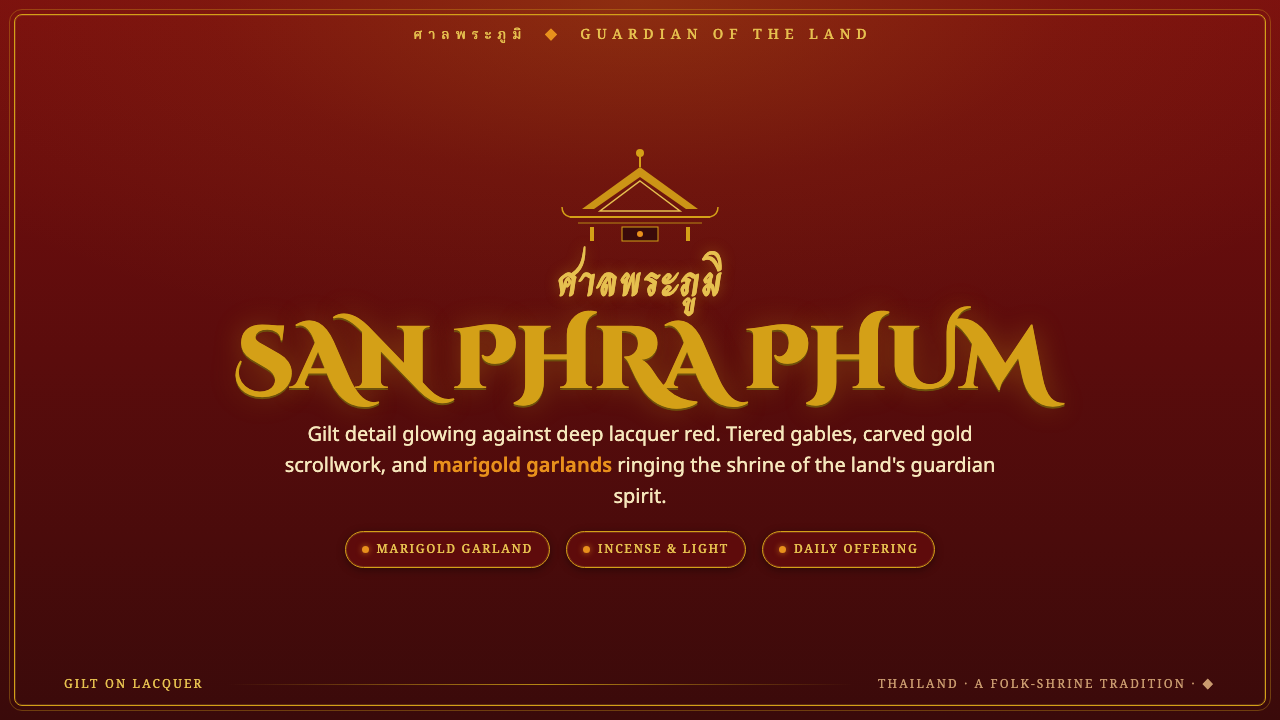 Thai Spirit HouseDevotion in gilt and lacquer. Gold scrollwork and tiered gables glowing on a…
 Arabian Oud Attar BottleResinous luxury, gilded. Chocolate oud lacquer frames Cinzel caps and ruby-am…
 Burmese Shan Lacquer BrownDark lacquer leads. Cinnabar bands and shwe hairlines cut across a warm umber…