What is Baluchari Saree?
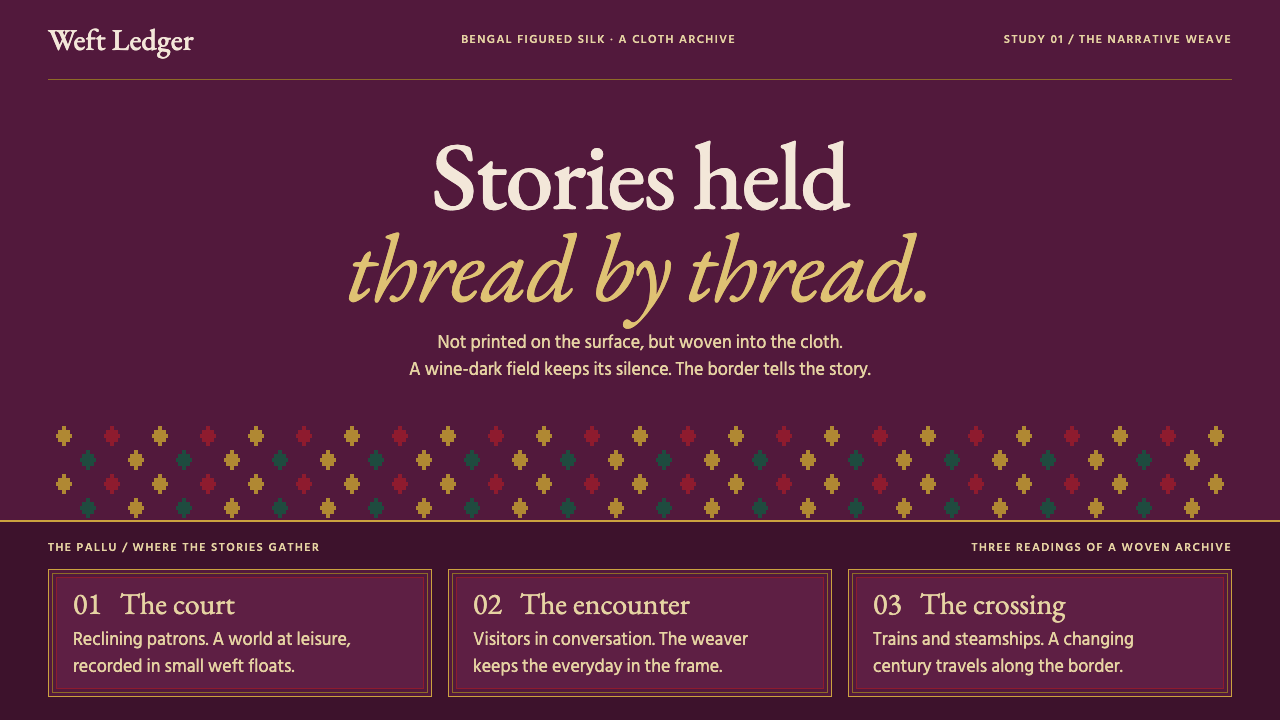
The Baluchari is a figured silk sari from Bengal in which the story is woven rather than printed — a dark wine field, small motifs marching in diagonal rows, and every narrative held inside a framed panel.
Baluchari Saree in brief
The Baluchari saree is a figured silk sari from Bengal, and its defining claim is in the construction: the storytelling is woven, never printed. As a design style, Baluchari means a dark, wine-coloured field scattered with small repeating motifs, a wide decorative end band that carries all the narrative, and an unusual discipline about edges, which are never smoothed, only stepped.
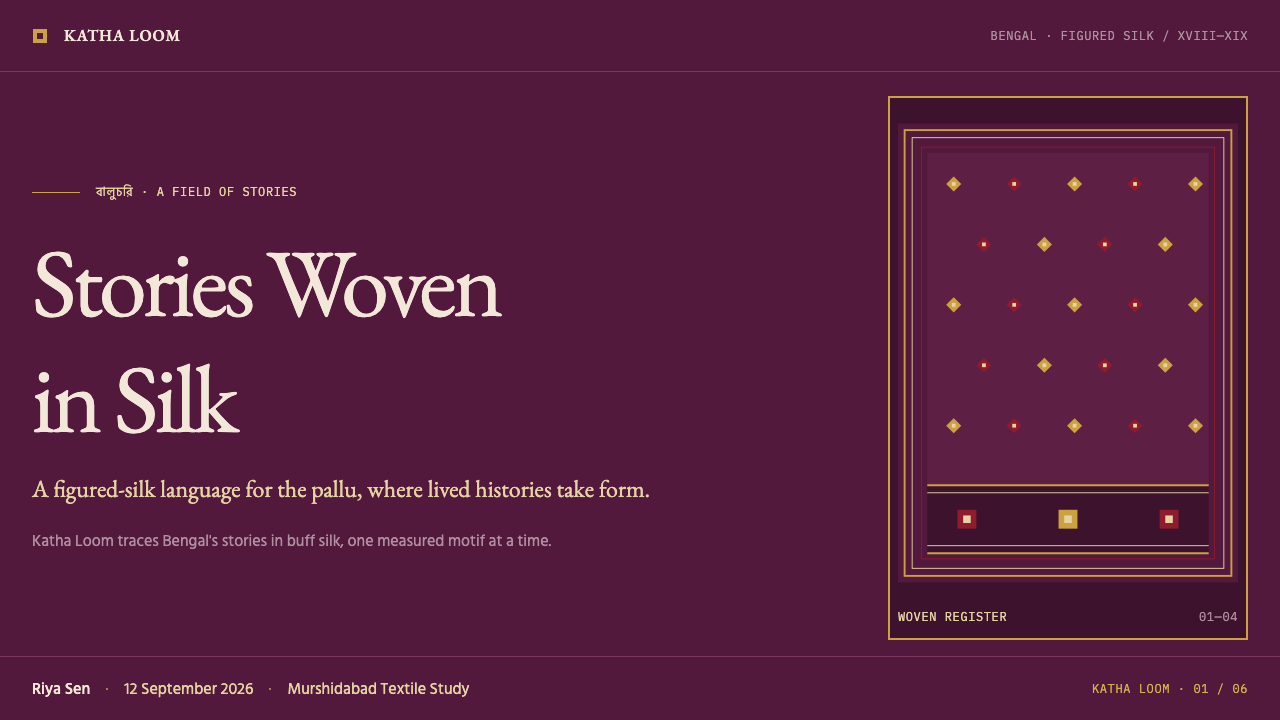
The cloth has two zones that behave very differently. The body of the sari, called the zami, is a deep purple-wine silk dotted with small butis arranged in strict diagonal rows, with plain ground between them. It is calm, ordered and spare. The story gathers in the pallu, the wide terminal band, which is divided into framed rectangular panels. Each panel is a small scene in its own right, kept apart from its neighbours by a heavy frame.
What this produces visually is a rare combination of restraint and storytelling. The field holds back; the panels speak. Colour is rich but limited, since it comes from a few thread colours rather than a printer's full gamut, and form is built from small discrete units. A Baluchari-inspired design therefore feels tightly organised, a little formal, and full of narrative detail that is revealed only when you look closely.
Where does Baluchari Saree come from?
Baluchari takes its name from Baluchar, a place near Murshidabad in West Bengal, and the source also names Bahadurpur nearby. The reference material dates the tradition from 1704 onward under Murshid Quli Khan, the figure whose rule gives the cloth its historical setting. Murshidabad was the seat of the Bengal nawabs, and the cloth that came out of its workshops belongs to a wider tradition of Bengal figured-silk weaving, in which patterns are built into the fabric on the loom.
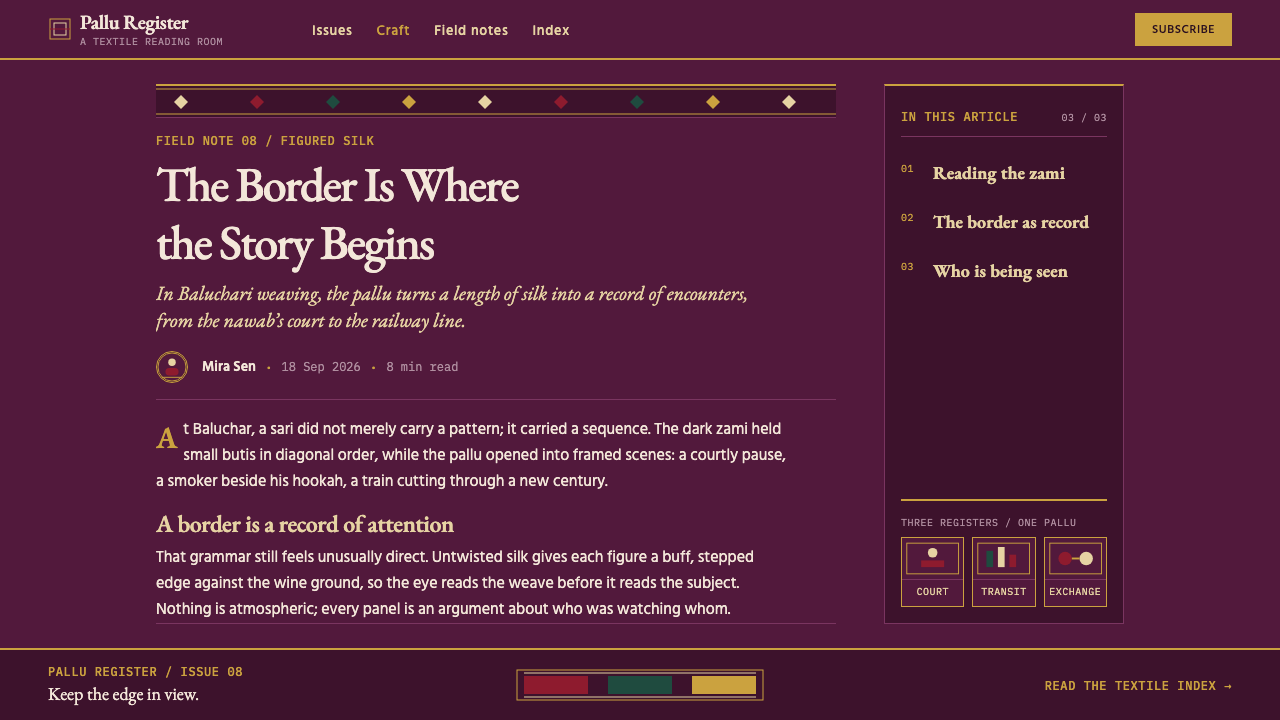
The best-known surviving reference is a Baluchar Buttidar sari held at the V&A and dated around 1855, the kind of piece in which the zami is sprinkled with butis and the pallu carries its panels. The panels are the reason the cloth matters to historians. Alongside epic scenes, the weavers recorded the colonial century as they actually saw it: nawabs reclining on bolsters, men smoking hookahs, Europeans in the middle of conversation, trains and steamboats. The world of the eighteenth and nineteenth centuries appears in miniature in the margins of a garment.
The method of making is what fixes the aesthetic. Figures are not drawn; they are built from discrete weft floats, short stretches of coloured thread passed over the warp. Every shape is therefore assembled from small steps, and every diagonal edge climbs in stairs rather than gliding in a line. This is not a defect but a signature, and the source stresses that the design system keeps that discipline: ordered patterns, edges that are not polished and stories kept in frames.
The tradition did not run unbroken. The source records a jacquard revival at Bishnupur from the 1950s, with the craft relocating from Baluchar and Bahadurpur to that town. Jacquard mechanisms, which control the pattern through a programmed sequence rather than the weaver's hand, allowed the figured work to continue under new conditions. Its movements are listed as Bengal figured-silk weaving, the Baluchari jacquard revival and Swarnachari, a name whose first element means gold in Bengali, which fits the gold that appears in the frames.
What defines the Baluchari Saree look?
Deep wine zami
The ground is a dark purple-wine silk, rich and saturated but without shine. It occupies most of the cloth, which means it sets the mood for everything: serious, warm, inward. The field is meant to be lived in rather than looked at, so it stays quiet and nearly continuous, with just enough variation to feel like cloth. Because it is so dark, every motif placed on it takes on a jewel-like clarity.
Buti in diagonal rows
Small motifs, called butis, are scattered across the zami in strict diagonal lines. They march in order, evenly spaced, with plain ground left open between them. The rhythm is regular but not dense, and nothing fills the gaps. This gives the field an orderly pulse, and the plain areas matter as much as the motifs: they are what makes the pattern read as pattern rather than as texture.
Pallu as narrative band
All the story gathers in the pallu, the wide terminal band at the end of the sari. It is the place where the cloth stops being ornament and becomes record. Design-wise, it is a clear instruction about hierarchy: keep the body of a layout calm and concentrate narrative, imagery and detailed content into a single, deliberately framed zone.
Framed rectangular panels
The pallu is divided into rectangular panels, each held in a heavy frame in gold tones. The frame is what keeps the story contained: each scene has a clear edge, and the eye moves from panel to panel rather than being drawn into one continuous picture. The effect is similar to a comic page or a set of icons, with order maintained by the borders.
Stepped edges
Because figures are built from discrete weft floats, every diagonal and curve is a sequence of steps. The style treats this as a feature. It resembles pixel-like construction, with a clean, quantised quality in which nothing is airbrushed. Interpretations that smooth the stairs into soft diagonals lose the clearest signal that this is a woven, not printed, aesthetic.
Woven, not printed
The tagline of the style is that stories are woven into the cloth, never printed on its surface. It means colour arrives in solid units, with no gradients and no blends, and that imagery is assembled from limited thread colours. In digital terms: flat colour fills, limited palettes and no photographic softness inside the narrative zone.
A history held in the margins
The pallu panels show nawabs, hookah smokers, Europeans in conversation, trains and steamboats alongside epic scenes. That mixture of myth and daily life, local and foreign, gives the style a documentary quality. Content inside the frames can be specific and even humorous, as long as the frames themselves stay formal.

Who shaped Baluchari Saree?
The source dates the tradition from 1704 onward under Murshid Quli Khan, which places the cloth in the world of the Bengal nawabs and their seat at Murshidabad. He is the reference point for the political setting rather than the weaving itself, and the style reflects that setting in its formality: a courtly, structured surface in which everything has a place.
These three names appear together in the style's reference list of key figures, alongside the later chapter of the story: the jacquard revival at Bishnupur from the 1950s. The source gives the names without biographies, so this article does not assign particular works to them. What they stand for in design terms is continuity: a craft carried across a break, with its logic of ordered motifs, stepped edges and framed stories kept intact.
A Baluchar Buttidar sari dated around 1855 in the V&A's collection is the reference piece cited for the style. It shows the whole system at once: a zami with butis in diagonal rows, and a pallu of framed scenes drawn from the world around the weavers. For anyone studying the look, it is the primary exhibit, and the clearest evidence that the design logic described here is historical, not invented.
How do you use Baluchari Saree today?
Baluchari is a style for work that has a lot to say but must stay orderly. Its method is to divide a layout into a calm field and a few strongly framed zones where the real content lives. Use the dark wine ground for the body, keep motifs small and evenly spaced, and let frames, not decoration, organise the narrative.
For presentation slides, a cover can use the deep field with a small diagonal pattern of motifs and a single framed panel carrying the title or key image. Content slides work well as a field with one or two framed panels, each carrying a distinct idea. Data slides suit stepped charts: bars as staircases, lines drawn as steps rather than smooth curves, and legends set in small framed boxes. Keep to a few flat colours, and avoid gradients on any chart element.
For web interfaces, the style fits dark dashboards, learning platforms, history or cultural products and any interface that mixes quiet navigation with rich content. Cards can be framed in a thin gold line, and the page body should stay calm. Pricing pages can present each tier as a framed panel with equal structure. Icons and illustrations should be built from blocky, stepped shapes rather than smooth vector curves, to echo the weft-float construction.
For editorial and marketing work, Baluchari gives a feeling of narrative richness inside strong order. Long features can be built like a pallu, with a calm text column and a band of framed images or illustrated vignettes at the end. Campaign pages can use the motif rows as dividers. The framed-panel idea is also good for timelines and case-study sequences, where each frame holds a moment.
The most common mistake is to smooth it. Anti-aliased diagonals, soft gradients and photographic textures inside the narrative zone destroy the woven logic. A second mistake is to cover the field with gold or dense pattern; the source is explicit that the ground between motifs is plain. A third is to let stories spill outside their frames, which breaks the discipline that keeps the style readable. A final error is to treat the style as decoration only, when its purpose is to carry content.
Baluchari Saree — FAQ
What does 'woven, not printed' mean for a design system?
It means every form is assembled from discrete units of solid colour, in the way a weft float is one short stretch of thread. There are no gradients, no photographic blending and no smooth anti-aliased diagonals in the narrative areas. Edges step, colours stay flat and the pattern reads as constructed rather than painted. It is a rule about construction as much as about appearance.
What are the zami and the pallu?
The zami is the body field of the sari, in this style a deep purple-wine silk scattered with small butis in diagonal rows. The pallu is the wide band at the end of the sari, divided into framed rectangular panels that carry the narrative scenes. Together they give the style its two-part structure of calm field and rich, contained story.
Why are the diagonals stepped instead of smooth?
Because the figures are built from discrete weft floats, short runs of coloured thread laid over the warp. A diagonal made that way can only be a staircase. The source treats the staircase edge as the signature of the cloth and asks that it be kept, so a faithful design leaves its edges stepped and does not polish them.
Is gold part of the style?
Yes, but in a limited role. Gold appears in the frames around the pallu panels, where it defines and contains the narrative. The field itself is not covered in gold thread; the plain ground between the butis is a deliberate part of the look. Using gold as a frame colour fits the style, while spreading it across the field does not.
Can I use photography with this style?
Photographs sit uneasily with it, because the style is built on flat, quantised, woven units. If you need images, keep them inside a framed panel and treat them as a distinct zone, ideally reduced in colour or given a stepped, pixel-like treatment. The more the image looks like a continuous-tone photograph, the more it breaks from the woven logic.
Related design styles
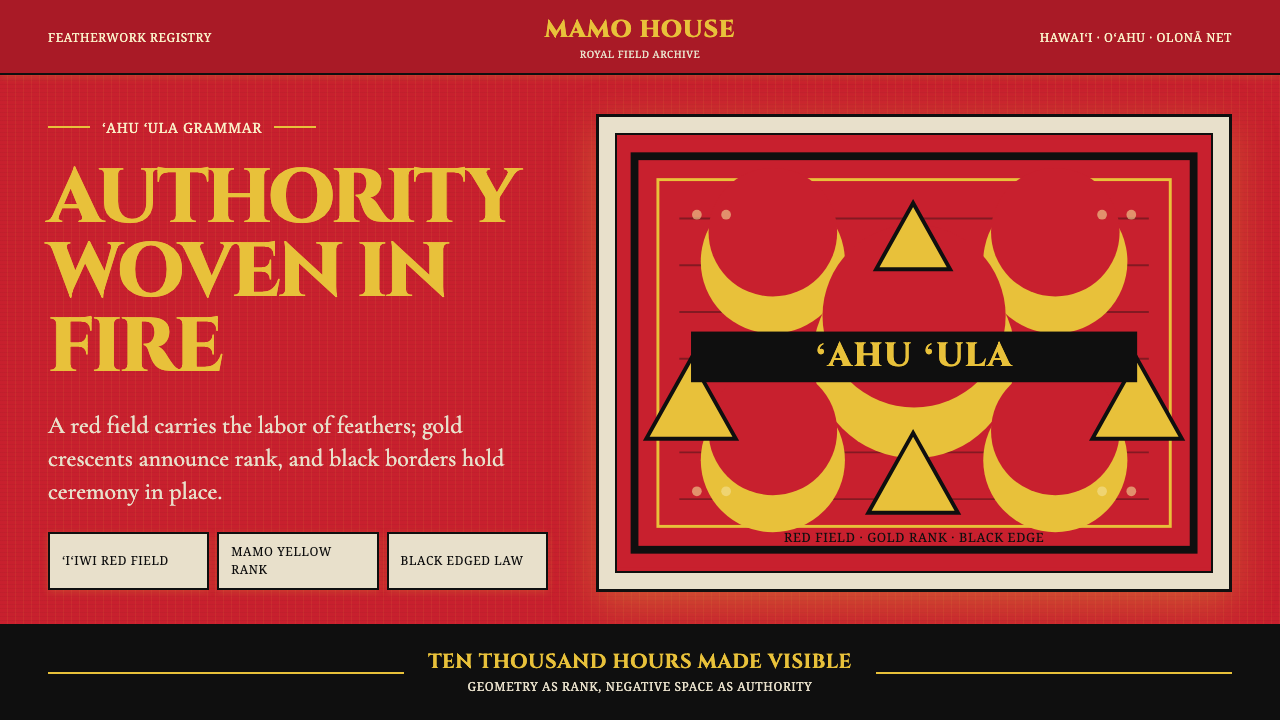 Hawaiian Feather Cape (ʻAhu ʻUla)Ceremony has weight. Red feather fields, mamo yellow crescents, black borders.
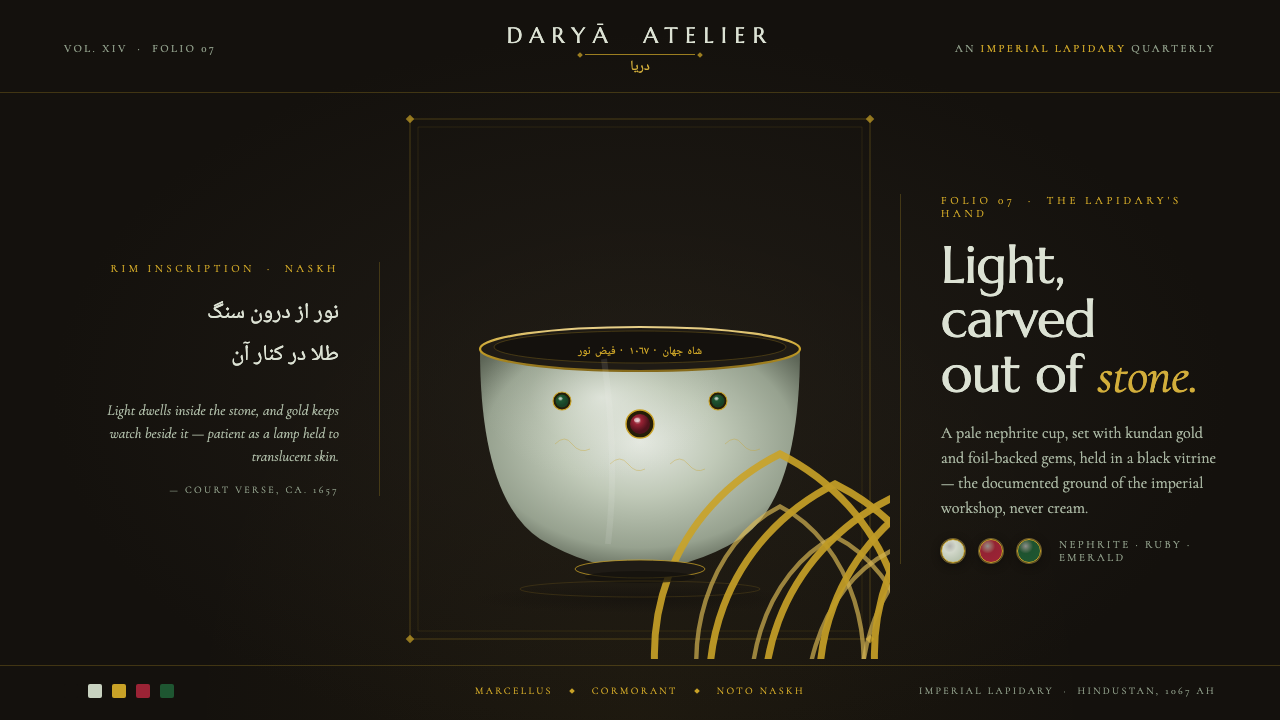 Mughal Jade CarvingImperial luxury, lit from inside. Pale nephrite glows on black, kundan gold f…
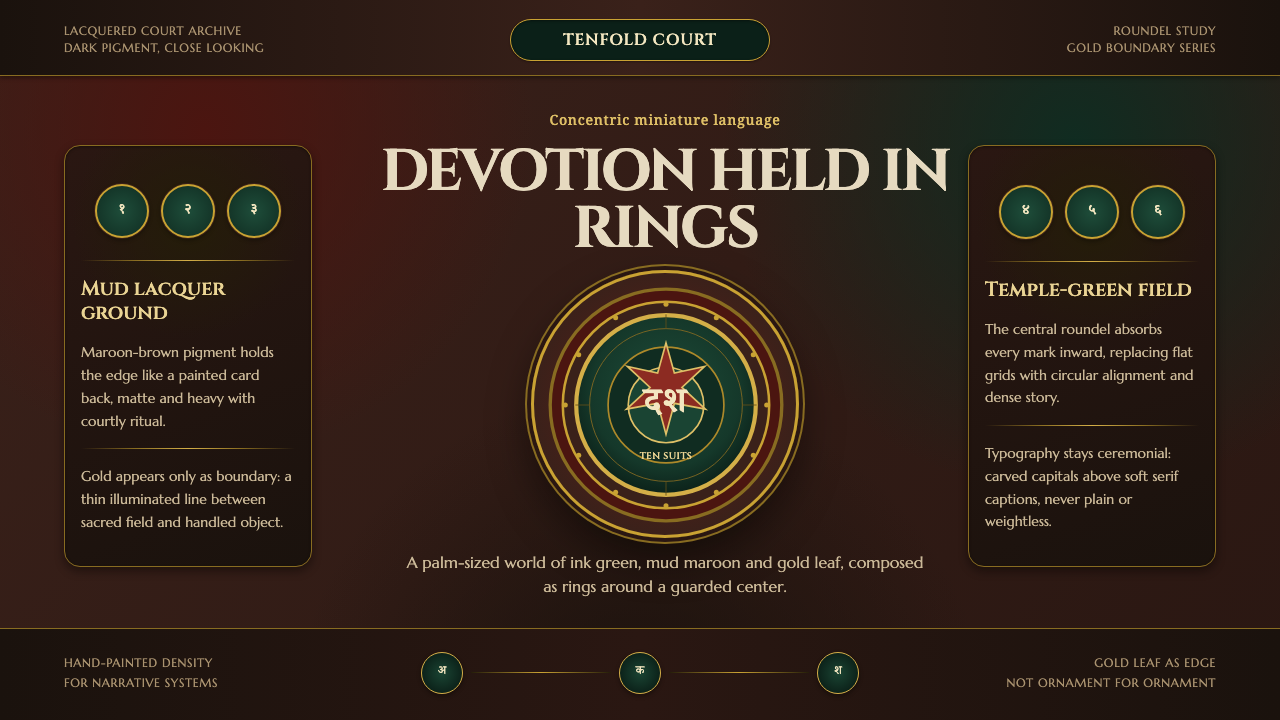 Mysore Ganjifa Playing CardsDevotion held in rings. Ink green centers, mud-maroon lacquer and gold bounda…
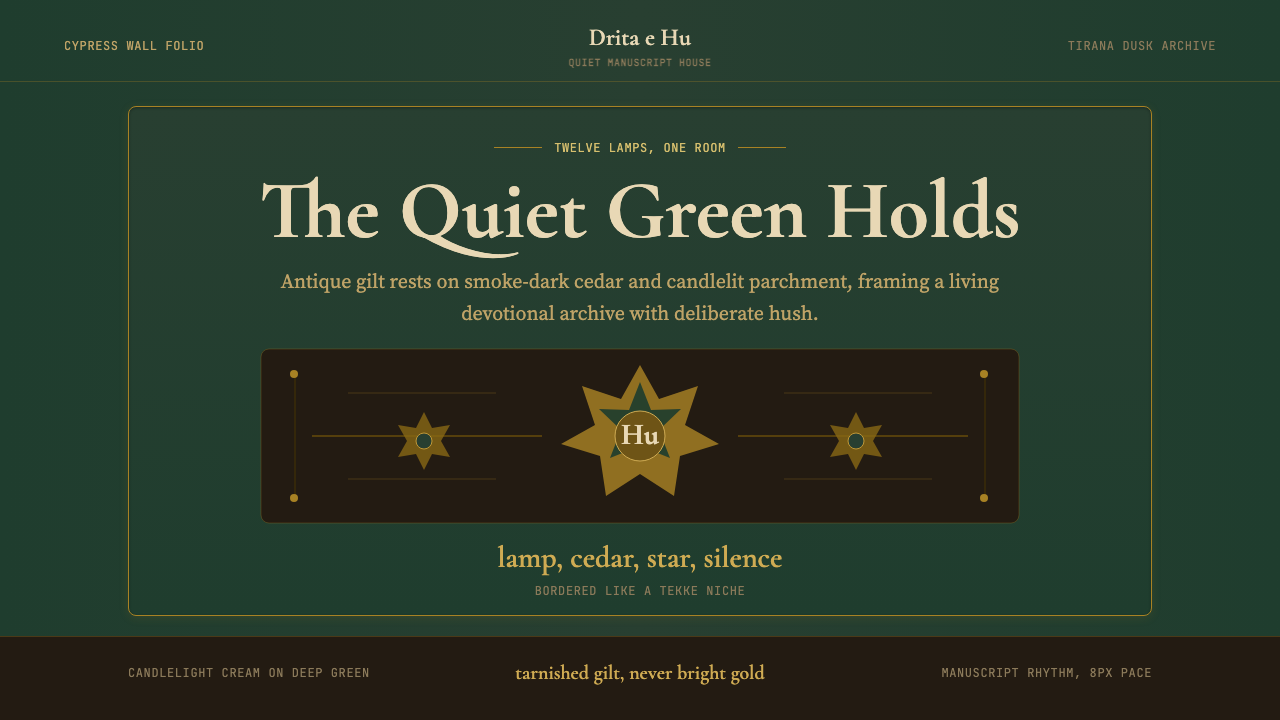 Albanian Bektashi Sufi (Tekke)Sacred quiet in cypress green. Gilt stars and Cormorant type frame a dusk tek…
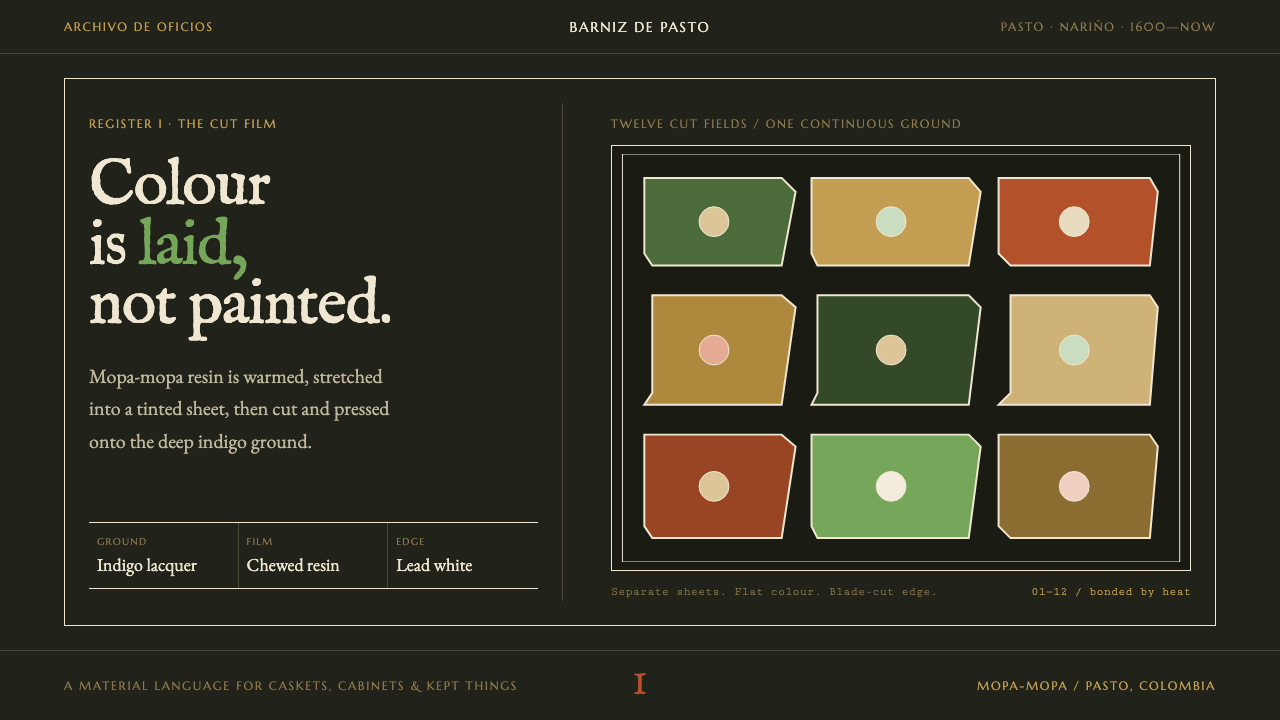 Barniz de PastoColour is laid, not painted. Cut green, gold, and red resin sheets glow on in…
 Baule GoldweightWear is the ornament. Burnished brass and olive recesses make every small wei…