What is Asafo Fante Flag Appliqué?
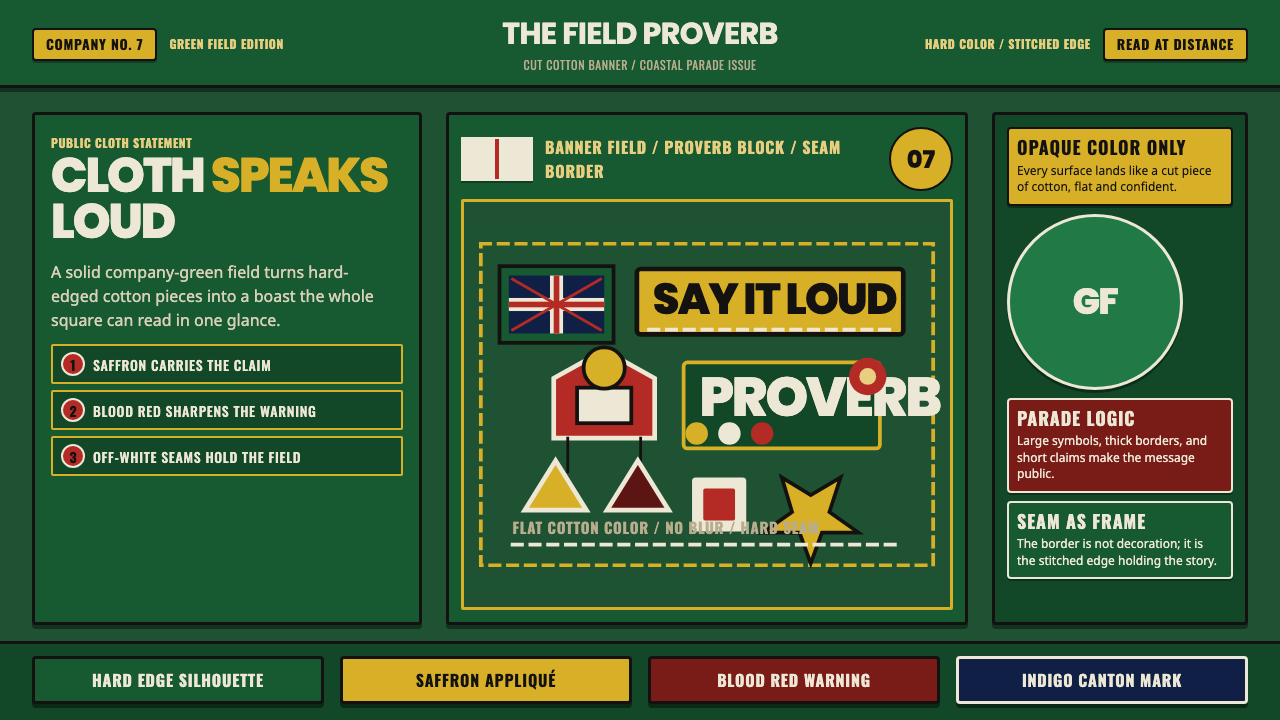
Asafo Fante flag appliqué turns cloth into public speech: a deep field, hard-cut figures, and a proverb strong enough to read across a parade ground.
Asafo Fante Flag Appliqué in brief
Asafo frankaa are appliqué war flags associated with the Fante military companies of coastal Ghana. Their language is made from cotton rather than paint: cut-cloth warriors, animals, and proverb motifs are stitched onto a solid field, producing flat silhouettes with clear boundaries and visible seams. The image is designed for immediate recognition, not gradual inspection.
The deep-green variant uses a company-green ground with saffron-yellow, blood-red, indigo, and off-white appliqué figures. These colors do not dissolve into one another or simulate light. They sit as firm blocks of cloth, making the flag feel at once ceremonial, confrontational, and poster-like.
Each flag stages a visual proverb. Its picture is therefore not merely decoration or illustration; it is a compact statement of strength and wit. A figure, animal, or emblem becomes legible as an assertion, while the stitched construction keeps the work visibly tied to material labor and collective display.
Where does Asafo Fante Flag Appliqué come from?
The tradition belongs to the Fante coast of Ghana in West Africa, where Asafo military companies used appliqué banners as public identifiers and declarations. The supplied historical frame places these flags in the colonial-era Gold Coast, especially from 1900 to 1950. Their visual force came from the need to communicate collectively and at distance: a flag had to hold together in motion, remain readable in open space, and speak for a company rather than a single individual.
The making process is central to the form. Asafo flag-makers, known as frankaakyimfo, cut cotton shapes and stitch them onto a solid-color cotton field. This construction produces opaque forms, hard joins, and an image that is assembled rather than painted. The seam is not hidden evidence of production; it is part of the flag’s authority, giving each motif a physical edge.
The flags belong to a West African appliqué banner tradition and a heraldic-proverb tradition. Their motifs can include warriors, animals, and visual devices that stand for a proverb. Meaning is carried through silhouette, relation, and color contrast, allowing the banner to operate as both textile object and public statement.
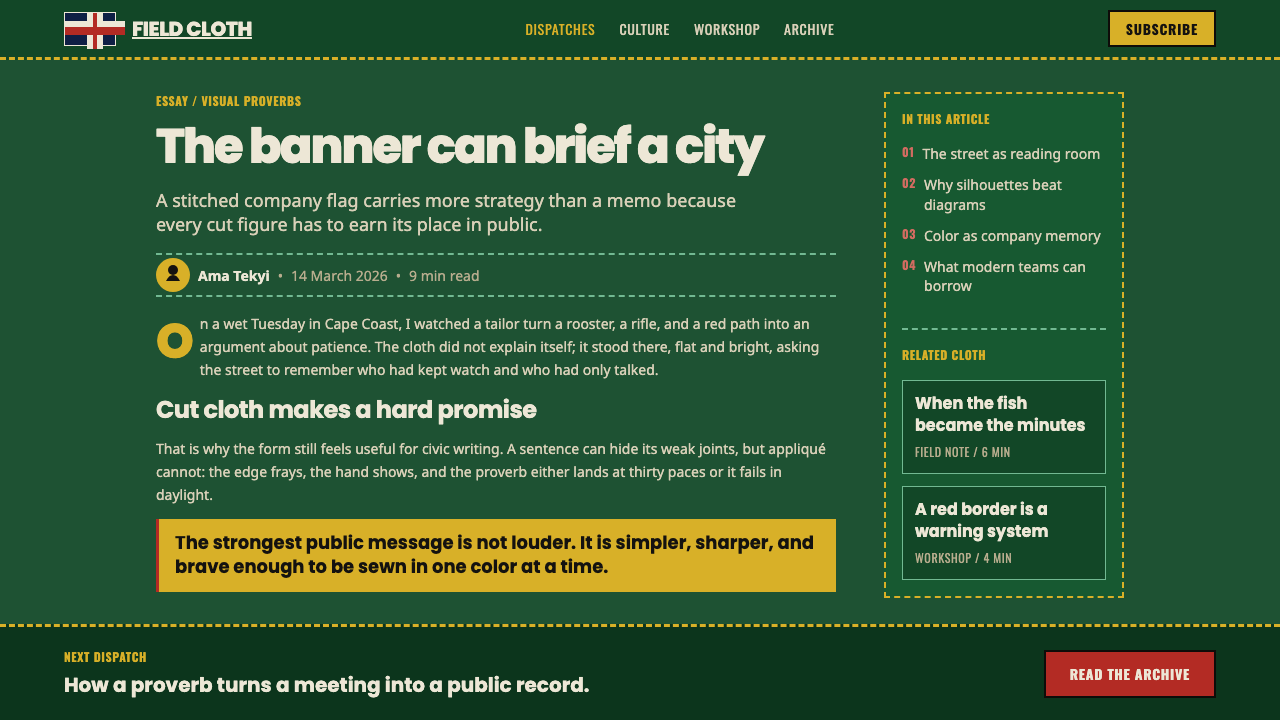
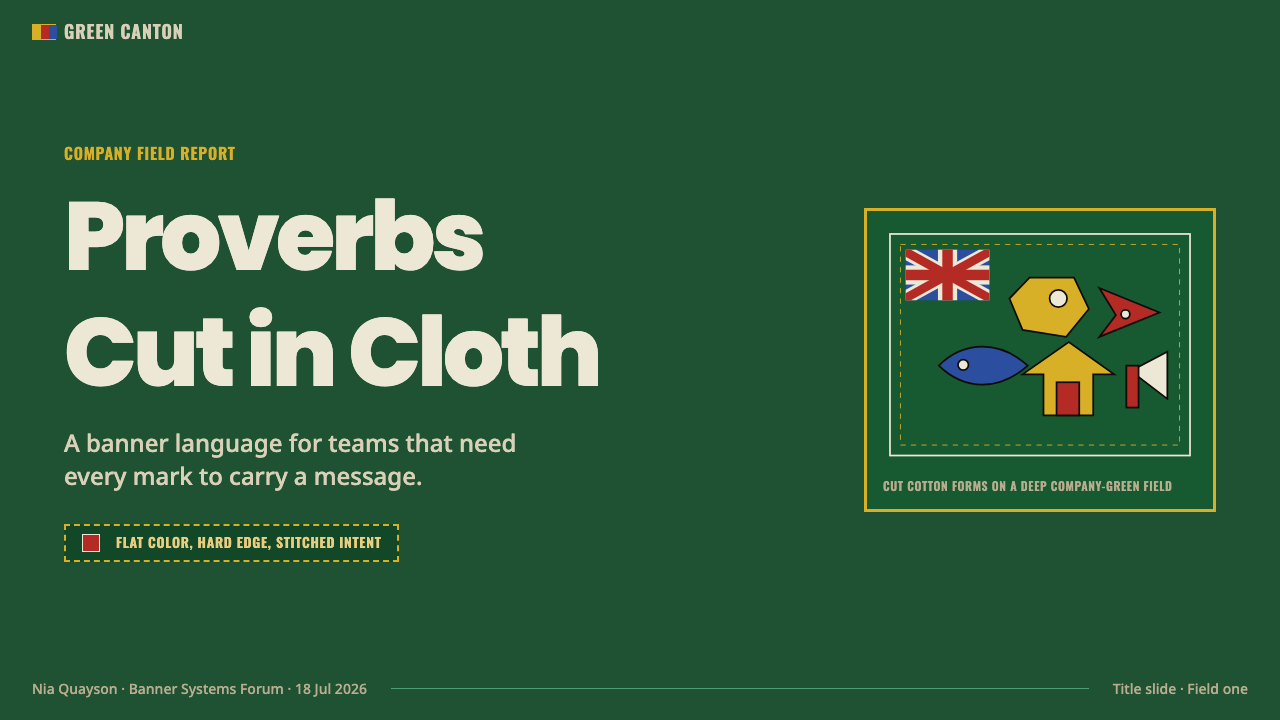
On examples made before Ghana’s 1957 independence, a small Union Jack canton often appeared at the top hoist. That detail locates certain flags within the colonial period without changing the fundamental visual system: a solid field, boldly cut appliqué, and an emblematic scene made to declare the company’s strength and wit.
What defines the Asafo Fante Flag Appliqué look?
Solid Field
The field is a single, uninterrupted expanse of company-green cotton. It provides depth through contrast rather than atmosphere, allowing every appliqué figure to read as a separate declaration against a stable ground.
Cut-Cloth Silhouette
Figures are understood first as silhouette. Warriors, animals, and proverb motifs are reduced to readable contour and opaque mass, so the scene remains legible at a glance rather than depending on fine interior detail.
Declarative Color
Saffron-yellow, blood-red, indigo, and off-white stand firmly against the green ground. Color behaves as an emphatic sign system: it separates motifs, intensifies contrast, and gives the banner its public, poster-like force.
Hard Seams
Stitched joins make the edges explicit. Instead of disguising assembly, the appliqué method announces it: cloth overlaps cloth, forms are bounded, and the construction remains present in the finished image.
Proverb Blocks
A motif is arranged as a visual saying rather than an ornamental scene. The composition asks the viewer to recognize an assertion of strength or wit, giving the flag a communicative density that exceeds simple emblem-making.
Distance Readability
The design is built for a parade ground. Broad fields, opaque figures, and decisive contrast prevent visual hesitation. The flag does not invite subtle tonal reading; it announces itself quickly and collectively.

Who shaped Asafo Fante Flag Appliqué?
The Fante Asafo companies are the collective makers and users represented by this tradition. The flag’s public purpose follows their role: it identifies a company and turns its strength and wit into a visible statement for communal display.
Frankaakyimfo are the flag-makers whose cut-and-stitch method gives the banners their distinctive surface. Their work joins color, silhouette, and seam into a single visual language in which construction remains visible and meaningful.
These are the recurring image-bearing figures of the flag tradition. They do not function as naturalistic illustration; they are flat, opaque signs arranged to make a proverb readable across a shared public space.
How do you use Asafo Fante Flag Appliqué today?
For presentation covers, borrow the flag’s declarative structure rather than treating it as a decorative pattern. Place one large, cut-paper-like motif on a deep field and let the title behave as a direct public statement. Content slides should preserve the same discipline: stable ground, a small set of opaque visual blocks, and clear separation between the main assertion and supporting material. Data slides can use contrasting blocks and simple silhouettes to distinguish categories, while keeping the information legible before the viewer notices the reference.
For web interfaces, the approach suits dashboards or pricing pages that need unmistakable hierarchy and an assertive identity. Use a deep field as a unifying visual plane, reserve saffron-yellow, blood-red, indigo, and off-white for purposeful differentiation, and make panels feel assembled rather than softly floating. Navigation and controls should read as clear labels and bounded objects, not as delicate atmospheric layers.
For editorial and marketing work, the style is strongest when a campaign has a concise proposition worth staging visually. Build spreads around a single proverb-like image or a short declarative line, then support it with broad areas of cloth-like color and hard-edged framing. A marketing sequence can alternate between a deep field with bright appliqué forms and quieter pages that give the central statement room to carry meaning.
The common mistake is to reduce Asafo flag appliqué to a generic palette of green, yellow, red, and blue. That loses the tradition’s communicative core. The visual language depends on cut-cloth construction, visible joins, public-scale readability, and a motif that functions as a proverb. Random animals, ornamental patches, softened shadows, or decorative texture turn a declarative banner system into costume.
Asafo Fante Flag Appliqué — FAQ
Is Asafo Fante flag appliqué mainly a decorative textile style?
No. Its central function is communicative. The flag stages a visual proverb for a Fante military company, using figures and color blocks to make a public statement of strength and wit. Its beauty is inseparable from that purpose.
Why are the forms so flat and sharply bounded?
The figures are made from opaque cut cotton stitched onto a solid cotton field. Flatness and hard edges follow directly from the appliqué method, while also helping the flag remain readable at a glance across a parade ground.
What does the small Union Jack canton signify?
It appears on pre-1957 examples and marks their colonial-era Gold Coast context. It is a historical feature of certain flags, not the defining visual principle of the tradition as a whole.
Can this reference be used without copying a specific flag?
Yes, if the work draws from the underlying language rather than reproducing a particular proverb scene. Preserve the solid field, cut-cloth logic, hard seams, high-contrast silhouettes, and declarative composition, then create a new message appropriate to the project.
What most quickly makes an application feel inauthentic?
Treating the reference as a loose color trend is the fastest failure. If the motif has no proverb-like meaning, the seam disappears, or the image depends on soft atmospheric effects, the result loses the material clarity and public force of Asafo flag appliqué.
Related design styles
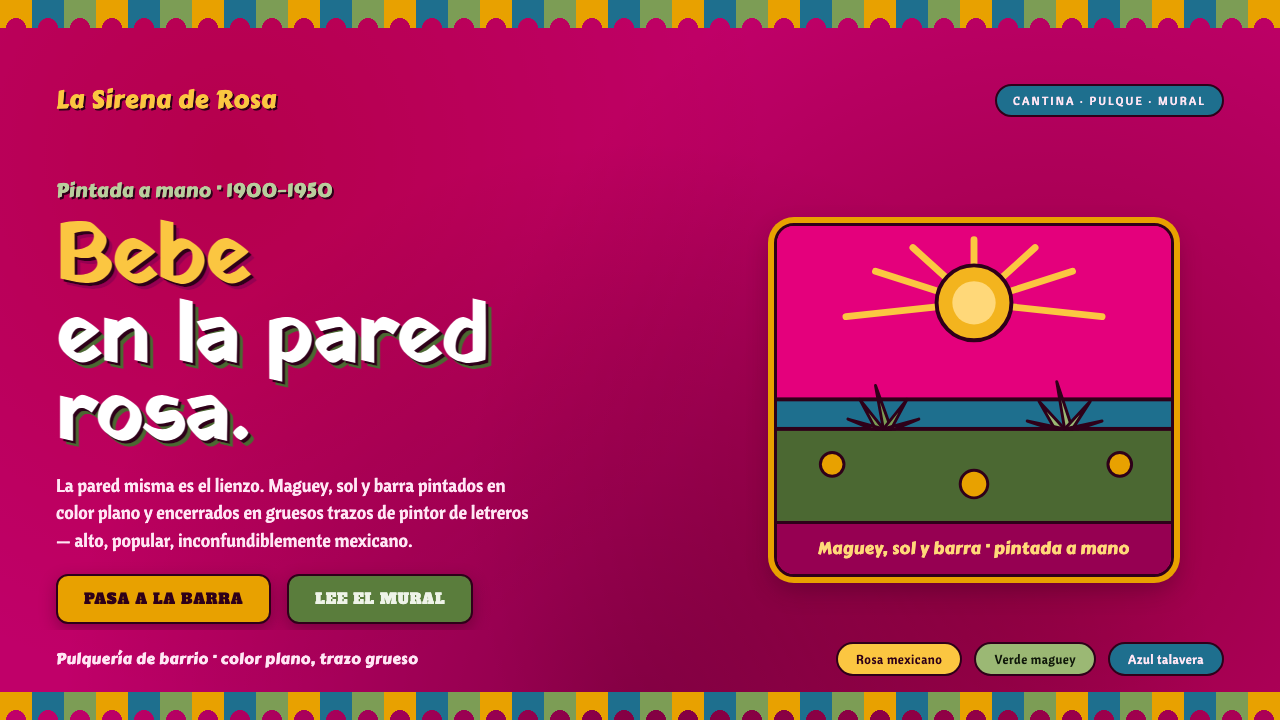 Mexican Pulqueria MuralThe wall is the canvas. Hot rosa-mexicano plaster, maguey green and marigold…
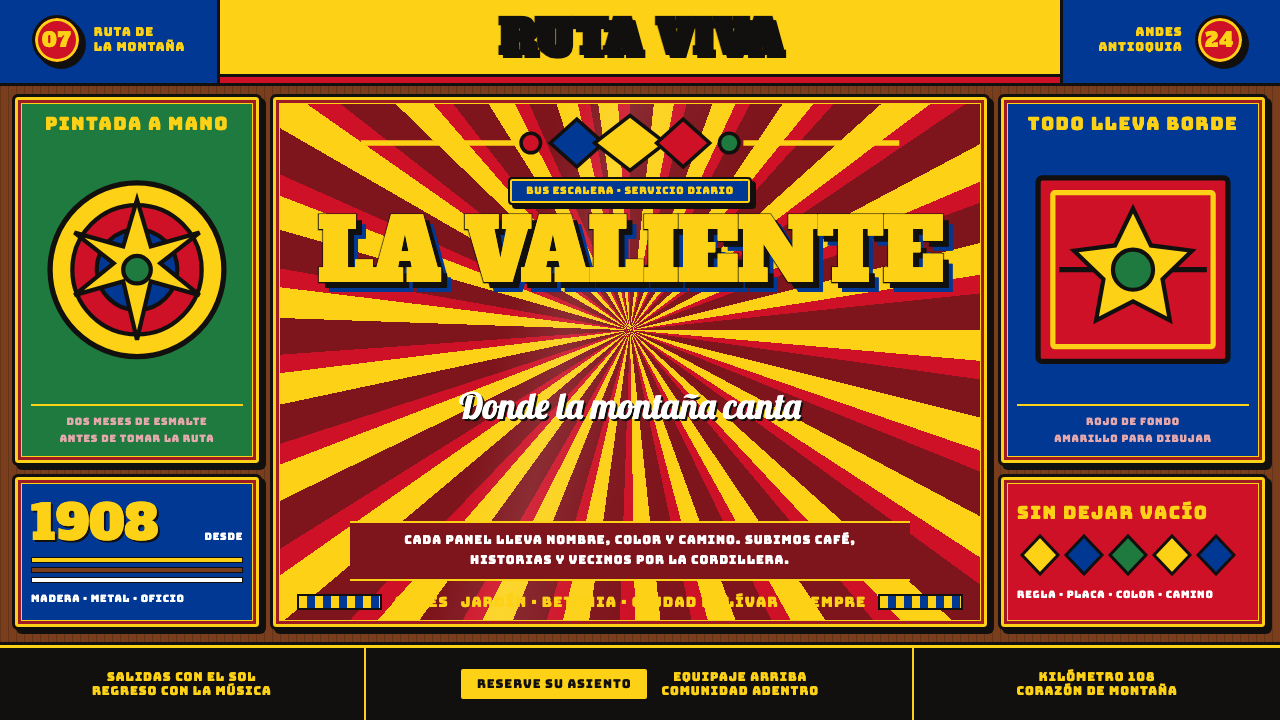 Colombian Chiva BusNothing is left unpainted. Flag-yellow rules, slab lettering and black keylin…
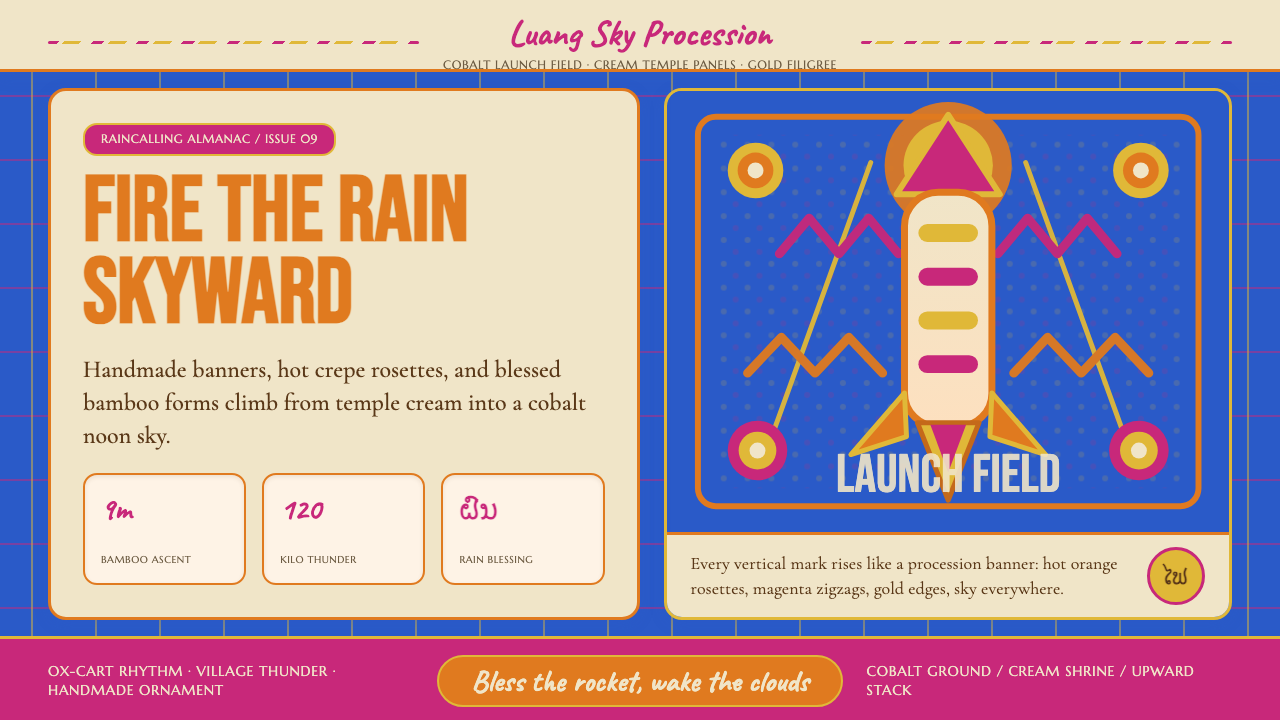 Lao Luang Pho (Bun Bang Fai Rocket)Festival thunder rises. Cobalt sky, Caveat banners, orange rosettes, and gold…
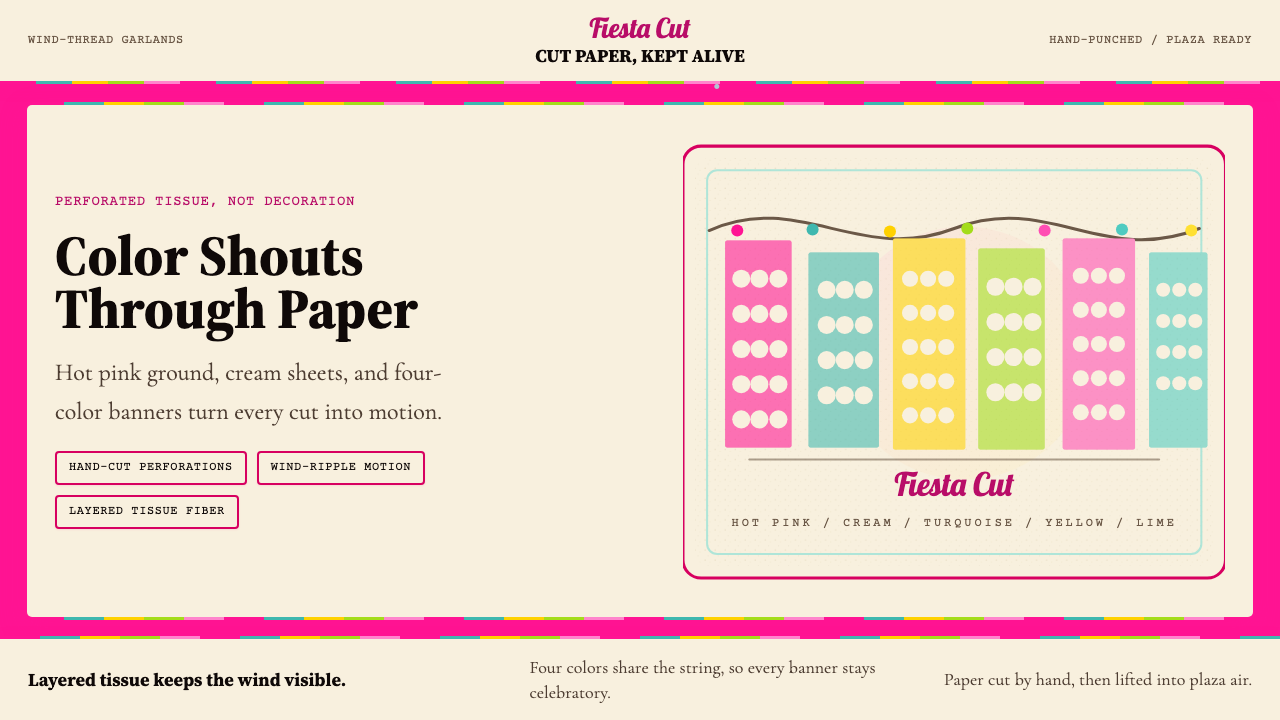 Mexican Papel Picado TissueFiesta cut paper. Hot pink, turquoise, yellow banners and hand-cut perforatio…
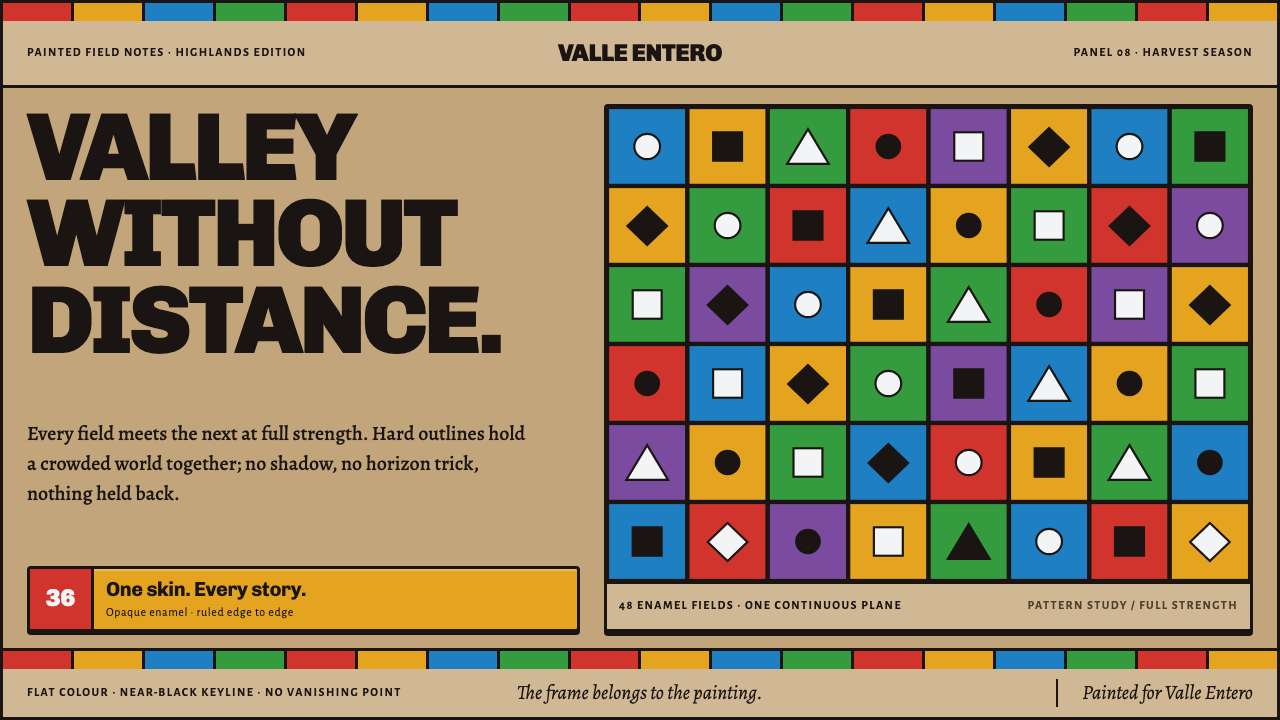 Tigua Sheepskin PaintingA whole valley at full volume. Saturated enamel fields lock together with nea…
 Asmat Bisj Ancestor PoleCeremonial vertical force. Lime-white figures rise from dark wood with red-oc…