What is Tigua Sheepskin Painting?
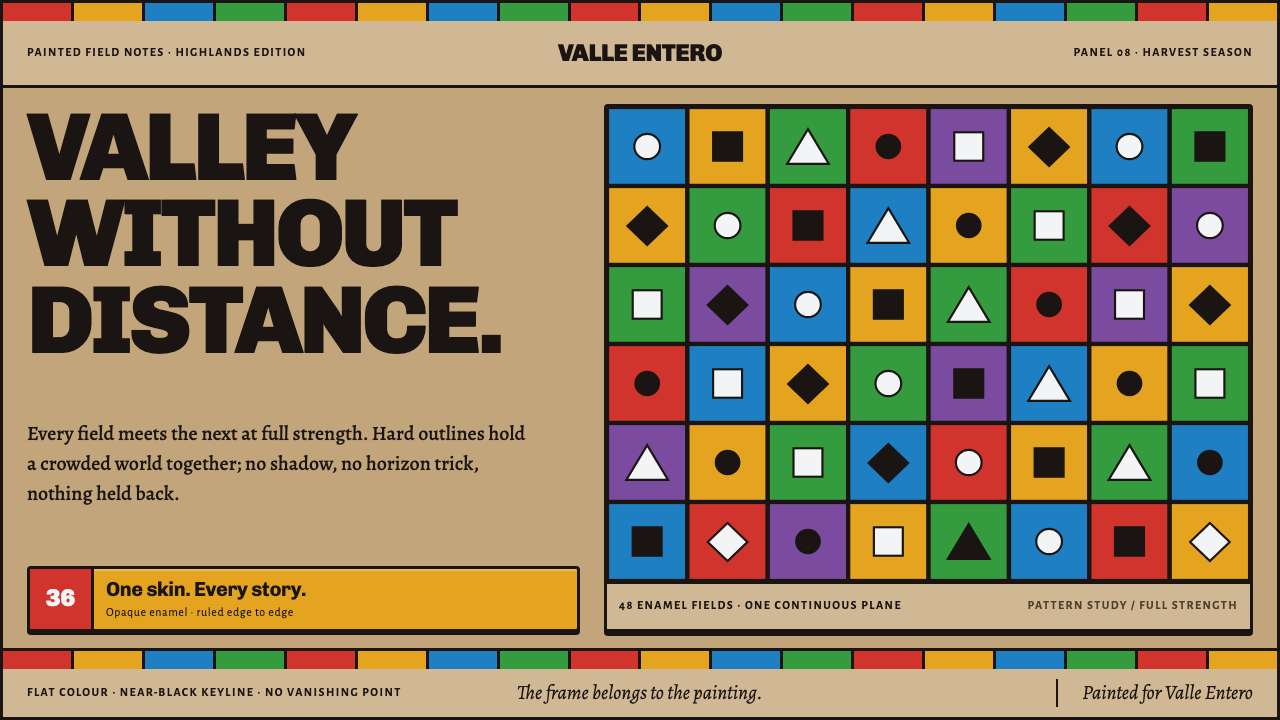
Tigua painting turns a stretched sheep hide into a full valley at full volume: glossy enamel fields locked together by near-black outlines, with no vanishing point to slow the eye down.
Tigua Sheepskin Painting in brief
Tigua painting is a folk art tradition made on a scraped sheep hide stretched drum-tight over a wooden frame, often reusing the retired head of an Andean bass drum as that frame. The medium itself sets the style apart from paper or canvas folk painting: enamel house paint is applied with brushes made from chicken feathers, producing surfaces that are glossy, fully opaque, and completely unmodulated, with no blending or gradient between adjacent tones.
Every shape in a Tigua painting carries a near-black outline, which locks each color field against its neighbors and keeps the composition legible even at high density. Space is flattened deliberately, with no vanishing point: terraced agricultural fields quilt the panel from edge to edge, the snow-capped cone of the Cotopaxi volcano sits on the horizon, and dozens of small figures — herders, weavers, dancers, llamas, condors overhead — fill the valley below in a single continuous scene.
A hand-painted decorative border typically runs around the edge of the composition, treated as part of the work itself rather than as a separate framing element added afterward. The artist's signature is placed openly on the front of the painting, meant to be seen rather than hidden on the back.
Where does Tigua Sheepskin Painting come from?
Tigua painting takes its name from Tigua, a set of Quichua villages in Cotopaxi province, high in the Ecuadorian Andes, sitting between the Cotopaxi volcano and the Quilotoa crater lake. The tradition developed from the 1950s through the 1990s and continues actively today, making it a living folk practice rather than a historical style preserved only in museums.
The tradition is closely associated with Julio Toaquiza, whose work and teaching established it as a recognized painting practice, and with the Toaquiza family school that grew out of his example — successive family members learning and extending the same visual vocabulary of terraced fields, Cotopaxi's silhouette, and densely packed valley scenes.
The subjects painted come directly from the life of the surrounding Quichua communities of Tigua: herding, weaving, dancing, and the agricultural rhythms of the high Andes, populated by the animals — llamas, condors — that share that landscape. This grounds the style in a specific regional and ethnic community rather than in an abstract or invented folk aesthetic.
Tigua painting sits within the broader movements of Andean folk painting and Ecuadorian naïve art, and it shares technical roots with the region's tradition of painting masks and drum heads, which explains both the use of stretched hide as a surface and the retired drum frame that often supports it.
What defines the Tigua Sheepskin Painting look?
Stretched Hide Surface
The painting surface is a scraped sheep hide stretched drum-tight over a wooden frame, often the retired head of an Andean bass drum. This gives the finished work a taut, circular or drum-shaped physical presence distinct from a rectangular canvas or paper sheet.
Glossy Unmodulated Enamel
Colors are applied as enamel house paint with a chicken-feather brush, producing fully opaque, glossy fields with no blending or gradient between adjacent tones. Each color sits flat and complete, distinct from the softer modulation typical of gouache or watercolor folk painting.
Near-Black Outlines
Every shape, regardless of size, is bounded by a near-black outline that separates it cleanly from adjacent color fields. This outline is what allows the densely packed compositions to stay legible rather than dissolving into a single busy field of color.
Flattened, Vanishing-Point-Free Space
The composition rejects linear perspective entirely. Terraced fields, figures, and landscape elements are arranged across the picture plane without a vanishing point, so scale is determined by narrative importance and compositional balance rather than distance from the viewer.
Cotopaxi Horizon Anchor
The snow-capped cone of the Cotopaxi volcano recurs on the horizon of nearly every composition, functioning as a fixed geographic anchor that situates every scene within the same specific Andean landscape.
Dense Populated Valley
Dozens of small figures — herders, weavers, dancers, llamas, condors overhead — fill the valley floor of a single composition, giving the work a full, crowded, community-scale feel rather than isolating one or two focal subjects.
Framing Border and Open Signature
A hand-painted decorative border runs around the edge of the piece as an integral part of the composition, and the artist's signature sits openly on the front, treated as a visible mark of authorship rather than a discreet, hidden detail.

Who shaped Tigua Sheepskin Painting?
Toaquiza's work and teaching established Tigua painting as a recognized practice, setting the visual template — stretched hide, glossy enamel, near-black outlines, densely populated valley scenes — that later generations of painters in the region continued.
The Toaquiza family school grew out of Julio Toaquiza's example, with successive family members learning and extending the same visual vocabulary, turning an individual practice into a sustained, multi-generational painting tradition.
The Quichua communities of the Tigua villages supply the actual subject matter of the paintings — herding, weaving, dancing, and the agricultural rhythms of the high Andes — grounding the style in a specific, living regional and ethnic community rather than an invented folk aesthetic.
How do you use Tigua Sheepskin Painting today?
Because this system is built from glossy saturated color, hard outlines, and dense, joyful composition, it suits projects that want to feel vibrant, communal, and handmade rather than restrained or minimal — cultural and travel branding, folk-art and craft marketplaces, and festive consumer or editorial content.
For presentation slides, a cover slide can use a single large, flat color field bounded by a bold near-black outline, with the Cotopaxi-style horizon anchor as a compositional device — one fixed landmark shape that grounds the rest of the slide. Content slides should keep the outlined, flat-color logic for icons and illustrations rather than shading them, and can embrace density on a single hero slide the way a Tigua painting fills its valley, while keeping data-heavy slides simpler to preserve readability.
For web interfaces, the glossy flat color and hard outline treatment suits cultural marketplaces, travel and tourism sites, and craft-focused e-commerce where warmth and handmade authenticity matter more than restraint. Borders and framing devices can borrow the decorative edge treatment directly, and illustrations benefit from the near-black outline discipline that keeps busy scenes legible.
For editorial and marketing layouts, this system rewards full-bleed, richly populated illustrations over sparse hero images — a single dense scene can carry an entire cover or poster, following the logic of a Tigua painting that fills its entire hide with figures and landscape rather than isolating one subject with empty space around it.
The most common mistake is softening the palette into muted or blended tones, or removing the near-black outlines to make illustrations feel more contemporary and minimal. Both choices erase the exact qualities — glossy, unmodulated color locked together by hard outlines — that make this style recognizable and give it its energetic, communal feel.

Tigua Sheepskin Painting — FAQ
Why is the painting surface a stretched hide rather than canvas or paper?
The stretched sheep hide, often mounted on a retired Andean drum frame, is a technical root Tigua painting shares with the region's tradition of painting masks and drum heads. This gives finished works a taut, drum-like physical presence and connects the painting tradition directly to other regional craft practices rather than treating hide as an arbitrary substitute for canvas.
Does every Tigua-style composition need to include Cotopaxi and dozens of figures?
Those elements are the most recurring and recognizable features of the tradition, but the transferable design principle is the underlying logic — a flattened, vanishing-point-free space anchored by one fixed landmark and populated densely with figures drawn from real community life — rather than a strict requirement to depict that specific volcano every time.
Why does the artist's signature appear openly on the front of the painting?
Placing the signature on the front, rather than hiding it on the back, treats authorship as part of the visible composition rather than a discreet administrative detail. It reflects the tradition's confidence in the individual painter's hand and community lineage, worth preserving whenever a project wants to signal genuine handmade authorship.
Can this style be adapted for a calmer, less densely populated layout?
Yes — the glossy unmodulated color, near-black outlines, and flattened perspective can carry a single subject or a sparser scene without losing the style's identity, as long as those core formal qualities are kept intact. What should not be diluted is the outline discipline and the flat, opaque color treatment, since those are what make the style recognizable regardless of how many figures appear.
Related design styles
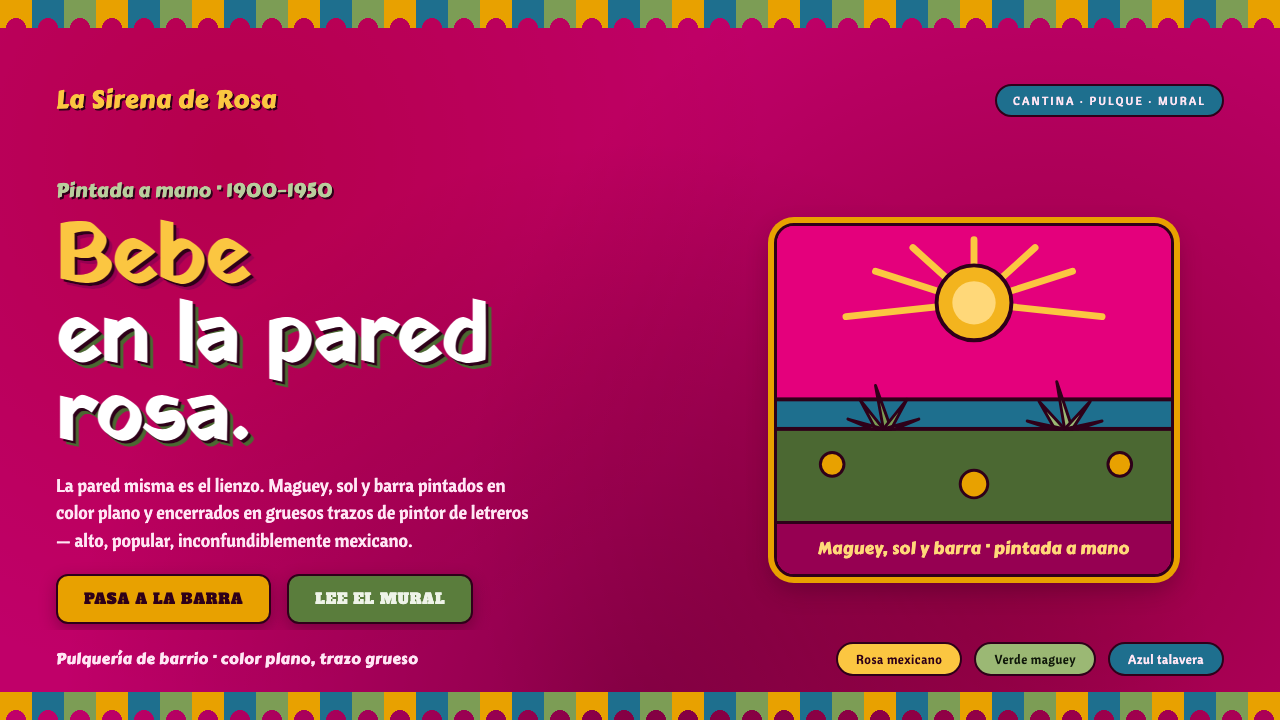 Mexican Pulqueria MuralThe wall is the canvas. Hot rosa-mexicano plaster, maguey green and marigold…
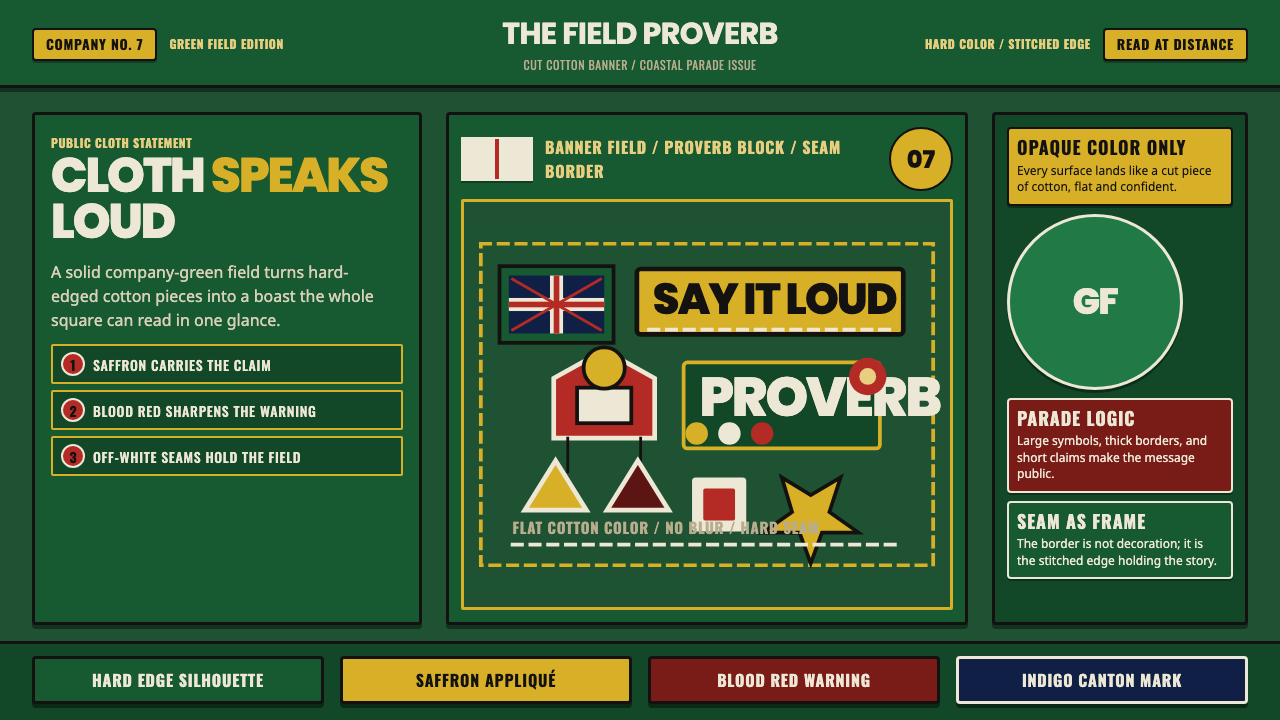 Asafo Fante Flag AppliquCloth speaks loud. Deep green field, saffron appliqué, hard seams, bold prove…
 Lao Luang Pho (Bun Bang Fai Rocket)Festival thunder rises. Cobalt sky, Caveat banners, orange rosettes, and gold…
 Mexican Alebrije Oaxaca (Linares 1936)Fever craft glows. Velvet teal carries magenta dots, turquoise zigzags, and C…
 South Park Cutout (1997)Crude is the charm. Opaque paper shapes, marker-black seams, and snow-bright…
 Bahamian Junkanoo CowbellNight refuses silence. Acid crepe stripes and block type collide like cowbell…