What is Ant Farm Inflatables?
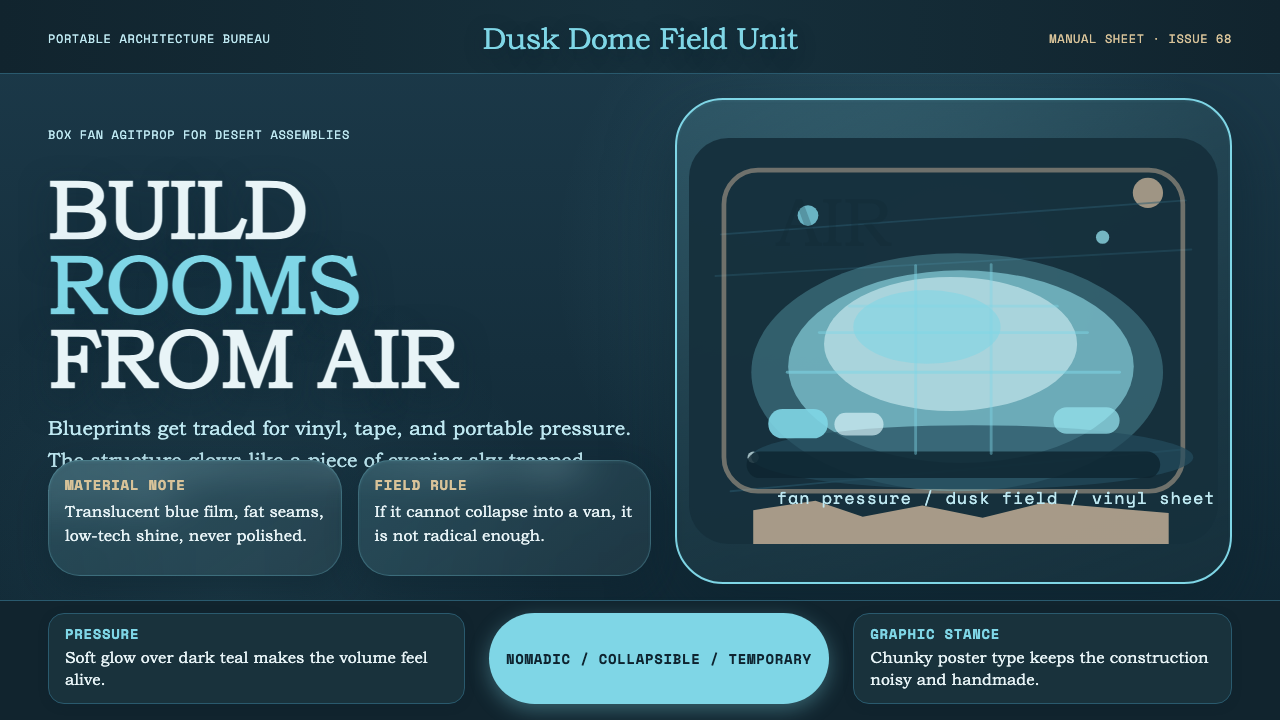
Ant Farm Inflatables made temporary architecture feel alive: vinyl-blue volumes, poster-scale urgency, and the strange glow of air held inside plastic.
Ant Farm Inflatables in brief
Ant Farm Inflatables is the visual language associated with Ant Farm, the San Francisco collective founded in 1968 by Chip Lord, Doug Michels, and later Curtis Schreier. Its central image is pneumatic architecture: translucent vinyl domes and inflatable pillows that swell into usable space, then collapse, travel, and appear again somewhere else. The work belongs to an era in which architecture could be a temporary social instrument rather than a permanent monument.
The style is deliberately anti-polished. It replaces the authority of blueprints, rigid walls, and finished surfaces with air pumps, vinyl sheeting, improvised assembly, and visible contingency. A structure is not presented as a perfected object delivered from above; it is a temporary enclosure made by people, for a gathering, in a particular place. Its bulging surfaces make construction feel bodily and provisional rather than fixed.
Visually, Ant Farm Inflatables combines dark desert-teal surroundings, translucent blue film, chunky poster typography, grainy documentation, and a soft electric glow. The blue does not read as corporate technology or pristine futurism. It reads as sky caught inside plastic: hazy, handmade, slightly unreal, and energized by the contrast between an artificial membrane and open high-desert scrub. The result is DIY agitprop translated into inhabitable form.
Where does Ant Farm Inflatables come from?
Ant Farm was founded in San Francisco in 1968 by Chip Lord, Doug Michels, and later Curtis Schreier. The collective emerged from a countercultural atmosphere in which established professional systems could be challenged through direct action, media, and communal experimentation. Rather than treating architecture as a distant technical discipline, Ant Farm traded blueprints for tools that made rapid, low-cost construction possible: air pumps and vinyl sheeting.
Inflatable form was central because it changed what a building could be. A pneumatic dome did not need to claim permanence, solidity, or institutional authority. It could arrive packed down, expand through air, shelter a gathering, and disappear again. This made the architecture compatible with communes and desert happenings, where mobility and temporary occupation mattered as much as enclosure.
The visual language developed between 1968 and 1975 alongside radical inflatable architecture, media art, and agitprop. Its images did not hide their means of production. Translucent film, seams, air-filled volume, and improvised staging became part of the message. The architecture's apparent softness was therefore not passive; it carried a public, confrontational energy by making an alternative way of occupying space visible.
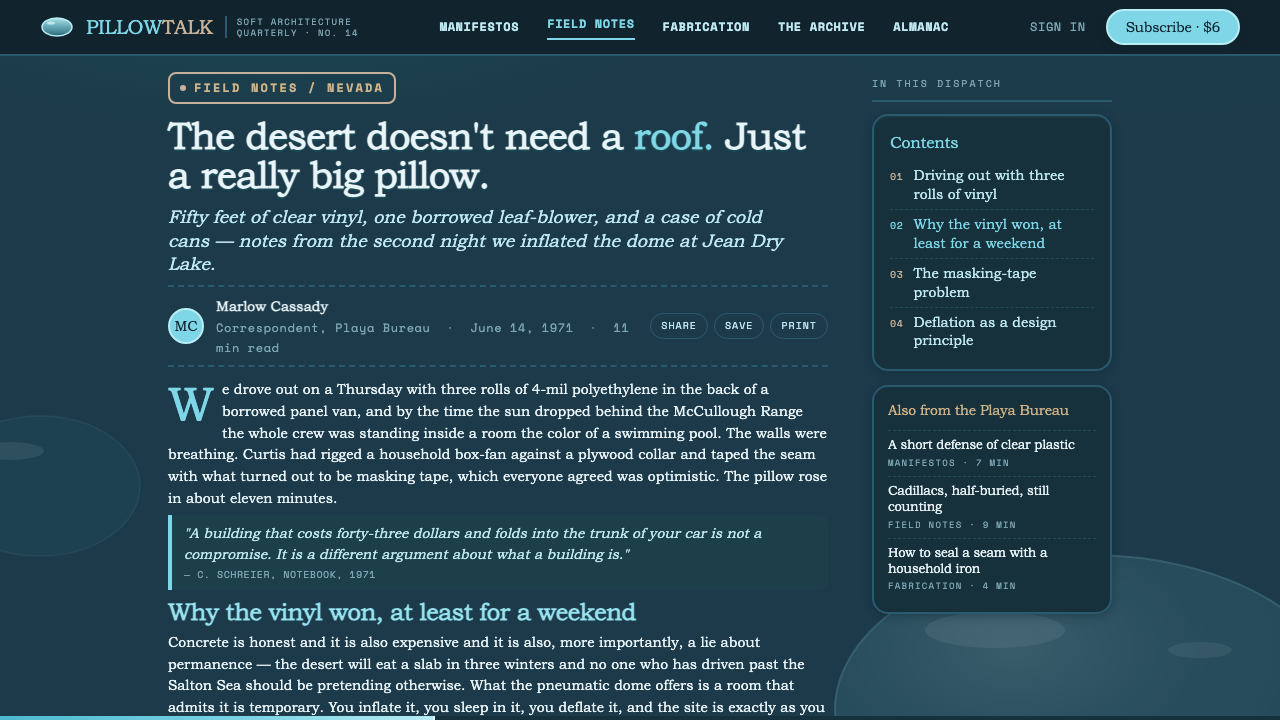
The Inflatocookbook documentation gave this language its enduring atmosphere. Grainy photographs show translucent blue film glowing against darkening high-desert scrub, turning low-cost material into an almost celestial phenomenon. That contrast is essential: the work does not escape its roughness, but uses roughness to make temporary architecture feel charged, collective, and vividly present.
What defines the Ant Farm Inflatables look?
Pneumatic Volume
The defining form is air-expanded rather than rigidly constructed. Domes and pillow-like volumes swell outward, producing soft, rounded silhouettes with no conventional architectural gravity. Their shape suggests pressure, containment, and breath. Even when the structure is large, it reads as temporary because the air that gives it form also implies that the form can be released.
Translucent Vinyl Glow
Blue vinyl is treated as a membrane rather than a solid façade. It filters light and makes interior illumination appear diffused through plastic, creating a soft electric-blue presence against a darkening landscape. The glow should feel trapped, hazy, and imperfect. It is not a clean lighting effect; it is the visible consequence of material, air, darkness, and temporary occupation meeting in one place.
Dark Desert Contrast
The inflatable object gains force from its surroundings. Dark teal, scrubby high-desert terrain, and the fading edge of daylight make the blue membrane appear brighter and stranger. The landscape is not a neutral backdrop; it establishes the work's nomadic scale and countercultural charge. A glowing temporary shell should feel inserted into open terrain, not installed inside a frictionless showroom.
Chunky Poster Type
Typography carries the bluntness of DIY public address. Lettering should be large, heavy, direct, and closer to a pasted poster than a refined identity system. The type does not decorate the inflatable image; it announces it. Its job is to give the composition urgency and collective force, echoing the material's handmade and agitprop character.
Grain and Imperfection
The style welcomes haziness, texture, and documentary grain. Surfaces should not look clinically retouched, and the image should retain evidence of its physical conditions: translucent film, dark surroundings, soft diffusion, and rough reproduction. This is not nostalgia for poor quality. It is a refusal of corporate cleanliness, preserving the sense that the work was made with available means and encountered in real conditions.
Temporary Collective Space
Every visual decision should preserve the idea that this architecture is for gathering and movement. The form is collapsible, cheap, nomadic, and social rather than monumental or exclusive. A successful Ant Farm-derived composition feels ready to be assembled, inhabited, photographed, and moved on from. Its temporary nature is not a limitation; it is the source of its freedom.
Who shaped Ant Farm Inflatables?
Chip Lord was a founder of Ant Farm in San Francisco in 1968. Within the collective's public identity, his importance lies in helping establish a practice that treated architecture as an active cultural medium rather than a settled professional object. Ant Farm's inflatable work made that position visible through low-cost, temporary structures intended for communal use and public encounter.
Doug Michels co-founded Ant Farm and helped define its shift away from conventional architectural seriousness. The collective's use of air pumps, vinyl, nomadic structures, and poster-like communication belongs to a broader challenge to permanence and institutional polish. In this context, the inflatable was both a construction method and a public image of alternative living and gathering.
Curtis Schreier later joined the Ant Farm founding group named in its history. His place in the collective underscores that the visual language was not the product of a solitary architect's signature. It came from a collaborative practice in which temporary architecture, media presence, radical form, and DIY production worked together as one public proposition.
How do you use Ant Farm Inflatables today?
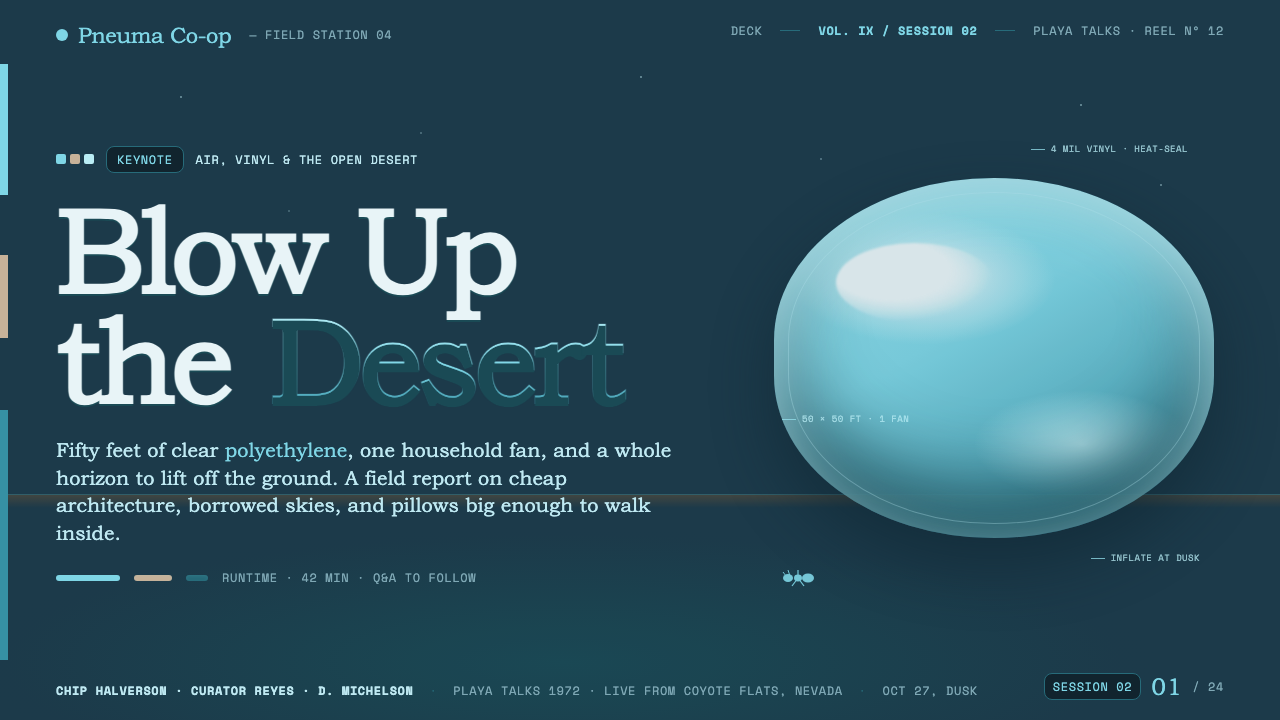
For presentation covers, use the inflatable as a single dominant event. Let a blue, translucent dome or pillow-like volume emerge from a dark desert-teal field, with chunky title type placed as a direct announcement rather than a refined caption. The cover should feel like a poster for a temporary gathering: nocturnal, handmade, and physically charged. Avoid filling the composition with multiple competing objects; one glowing membrane is usually more persuasive than a catalogue of motifs.
For content slides, treat the system as an atmosphere around information, not an excuse to make text difficult to read. Keep the primary reading field calm and use the inflatable language at boundaries: a cropped translucent edge, a dark field that frames a section, or a heavy typographic declaration. For data slides, charts should remain legible and direct. Use the blue glow to distinguish a key idea or a focal series, while the surrounding dark field gives the material a documentary, night-site mood rather than a corporate dashboard finish.
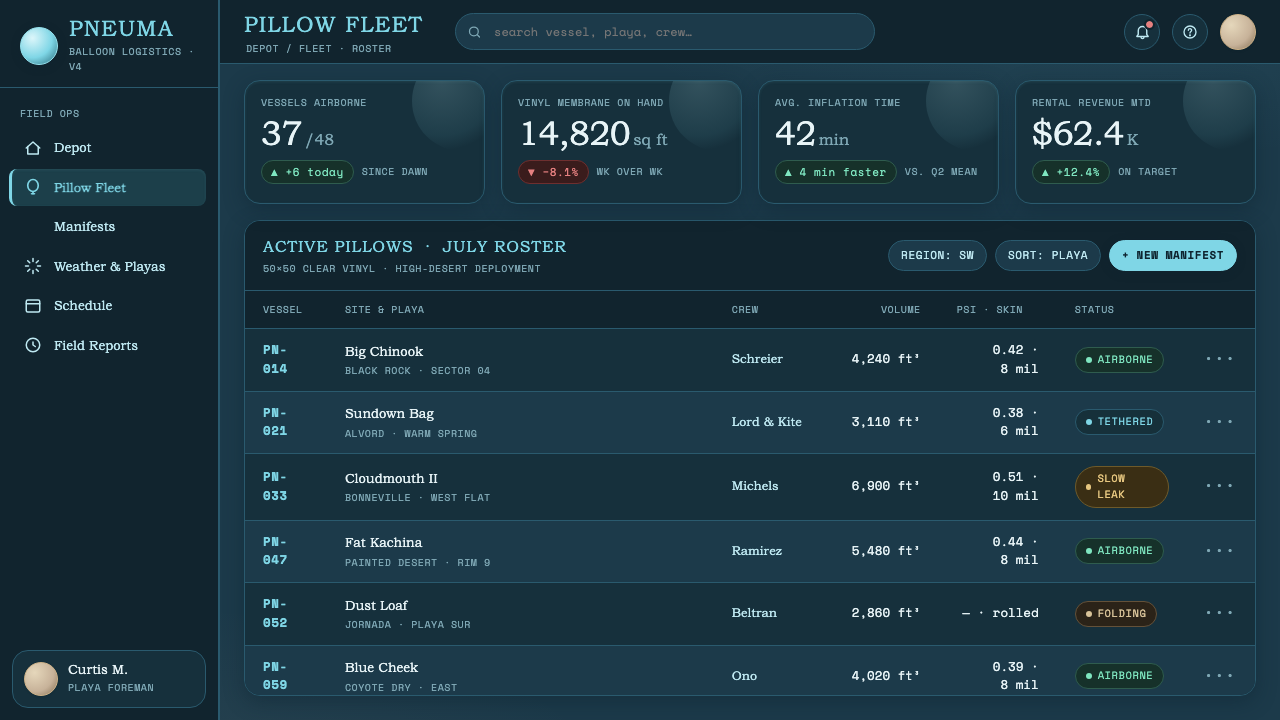
For web interfaces, the style works best where a product wants to signal experimentation, cultural independence, events, community, or an unconventional spatial idea. Dashboards can use dark teal backgrounds, luminous blue panels, and large blunt headings, but information density must remain disciplined. Pricing pages can frame plans as temporary access, participation, or entry into a shared environment, with broad vinyl-like shapes used to separate tiers without making the interface feel like a glossy technology brand.
For editorial and marketing work, build around the tension between rough documentation and an impossible glow. A feature story can open with grainy, dark landscape imagery and then alternate dense text blocks with large poster statements. Campaign material should retain an assembled quality: cropped imagery, blunt headlines, hazy blue fields, and deliberate evidence of material texture. The aim is not retro decoration; it is to make a public invitation feel provisional, collective, and immediate.
The most common mistake is turning Ant Farm Inflatables into sleek blue futurism. Perfectly polished surfaces, immaculate gradients, luxury-tech lighting, and delicate editorial typography erase the style's central contradiction: cheap temporary material made unexpectedly powerful through context and collective use. Another mistake is treating the inflatable merely as a decorative blob. Its form should imply enclosure, mobility, and a gathering. If the design no longer feels buildable, collapsible, or slightly improvised, it has lost the Ant Farm spirit.
Ant Farm Inflatables — FAQ
Is Ant Farm Inflatables simply a retro-futurist style?
No. It can look futuristic because translucent blue pneumatic forms feel unfamiliar and technologically charged, but its character comes from counterculture and low-cost improvisation rather than from polished visions of progress. The structures are temporary, collapsible, and made from accessible materials. Their force lies in turning modest means into a public spatial event, not in presenting a perfected future.
Why is the blue glow so important to the style?
The glow makes the vinyl membrane legible as both material and atmosphere. In the Inflatocookbook images, translucent blue film glows against darkening high-desert scrub, so the structure appears to hold light and sky inside itself. A solid opaque blue object would preserve the color but lose the central experience of permeability, temporary shelter, and air-made volume.
Can this style work on a light background?
It can, but the dark setting is part of what makes the inflatable feel luminous and uncanny. On a light ground, emphasize translucent film, visible overlap, soft haze, and the contrast between an artificial membrane and open terrain. Do not compensate by making the blue excessively clean or intense. The goal is still a handmade atmospheric object, not a polished brand icon.
What kind of imagery fits Ant Farm Inflatables?
The strongest imagery shows inflatable form in a real, slightly rough setting: darkening open land, scrub, translucent film, and visible evidence of temporary assembly. Grainy documentary treatment is more appropriate than immaculate studio rendering. If people appear, they should reinforce scale, gathering, and use rather than turn the image into a luxury lifestyle scene.
Where does the style struggle in contemporary product design?
It struggles when a product depends on calm institutional trust, luxury restraint, or a completely frictionless interface. Its handmade haze, blunt typography, and temporary-structure logic can feel too loud or unstable for contexts that need clinical precision or quiet permanence. It is most convincing when a product can honestly support its values of experimentation, communal encounter, mobility, and visible making.
Related design styles
 90s Aggressive Inline SkateX-Games attitude in plastic and paint. Fluoro lime and magenta slash across m…
 Acid House Smiley (1988)Rave energy hits first. Acid yellow on black, Anton caps, smiley glow.
 Corita Kent SerigraphJoy printed at full volume. Flame red, hot pink, and misregistered type flood…
 Elvis Presley (1956)Rock learned to shout. Bubblegum pink, acid green and jailhouse type land wit…
 Hot Wheels (1968)Velocity in candy metal. Flame-orange tracks and fat italic type tear across…
 MTV Launch Identity (1981)Built to be vandalized. Hot pink, acid green, Bungee blocks, and crooked stic…