What is Zmijanje Embroidery?
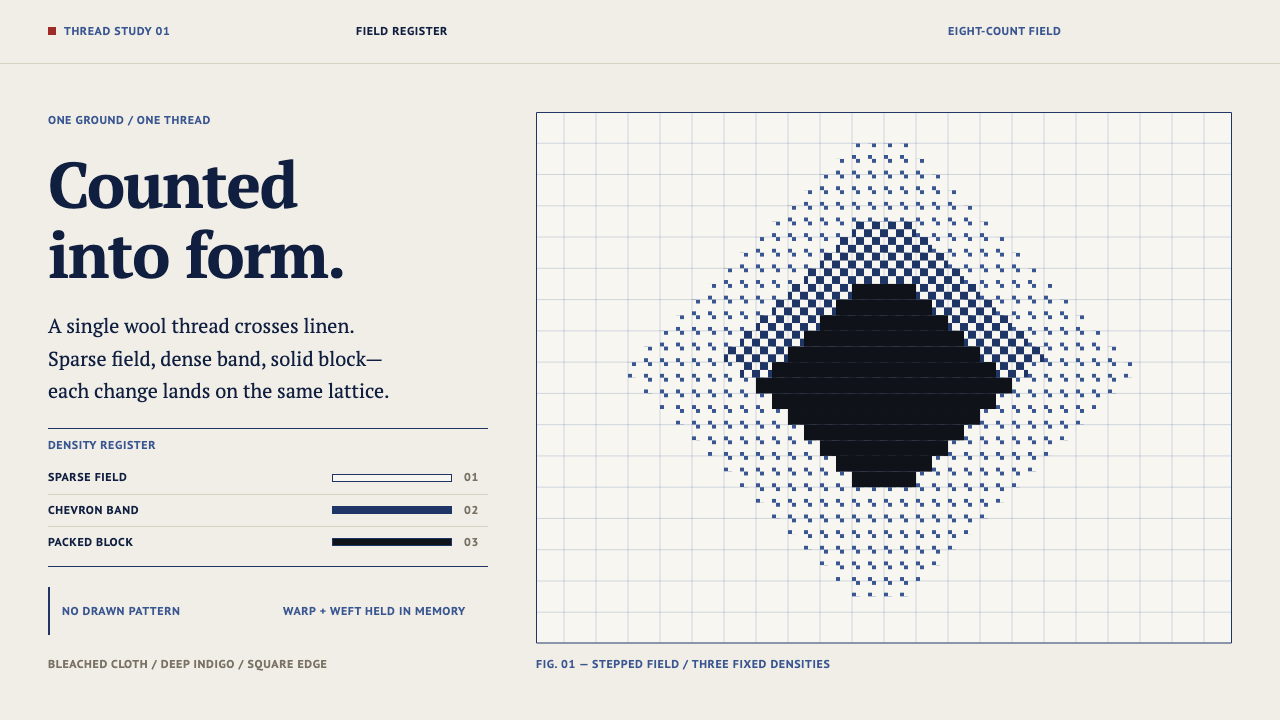
Zmijanje embroidery builds a whole visual system from one indigo thread, one linen ground and a counted grid, and lets density be the only thing that changes.
Zmijanje Embroidery in brief
Zmijanje embroidery is a living textile tradition from the Zmijanje highlands above Banja Luka, in northern Bosnia and Herzegovina. Women embroider without a drawn pattern, counting the threads of bleached homespun linen and working a single deep indigo wool thread across it. Crosses, hooked branches and zigzags are improvised stitch by stitch until they assemble into diamonds.
Its aesthetic is defined by restriction. There is one ground, pale and matte; there is one thread colour, a deep indigo; and there is one variable, which is how densely the thread covers the cloth. A sparse field, a dense band and a solid block act as three distinct registers, and the embroidery steps between them in discrete jumps instead of fading. Because every stitch sits on a square grid, every edge is a staircase and no corner can round.
The result is a pattern language that feels both ancient and strikingly contemporary: monochrome, modular, close to a bitmap, yet rich in rhythm. In 2014 the tradition was inscribed on UNESCO's Representative List of the Intangible Cultural Heritage of Humanity, the first element from Bosnia and Herzegovina to be listed. As a design system it takes the embroiderers' discipline literally: one ground, one thread colour, density as the only voice.

Where does Zmijanje Embroidery come from?
The tradition belongs to the villages of the Zmijanje highlands near Banja Luka, and its authors are anonymous. There are no named designers and no pattern books. Skill passes from woman to woman inside households and villages, carried in the hands and in the habit of counting, and the same few marks are recombined in endless variation. That anonymity is part of the aesthetic: the pattern is a shared grammar, not a signature.
The colour of the thread has a history. In the earlier phase, running into the early nineteenth century, red thread was used. Indigo became dominant from the middle of the century, and once it took over, the practice settled into the single-colour discipline that defines it now. The design system keeps that later, stricter phase: one deep blue against pale cloth, with no second hue to relieve it.
The technique is counted-thread work. Instead of transferring a drawing onto cloth, the embroiderer reads the weave itself as a graph, each crossing of linen threads a possible cell. Cross-stitch is combined with drawn-thread work, and the small marks of cross, hooked branch and zigzag are repeated and stepped until they form lozenges and larger diamonds. Because the pattern emerges from counting, it is naturally modular, and its edges follow the grid in stepped lines rather than curves.
Zmijanje embroidery sits in the wider family of South Slavic counted-thread embroidery, where counted geometry is a shared principle; its own character is an austere indigo monochrome and the use of density as the main means of expression. The institutional record includes SAKUD Republike Srpske, an association of amateur cultural and artistic societies, and the 2014 UNESCO inscription. Both point to a practice that is still alive: the embroidery is not a museum survival but something women continue to make.
What defines the Zmijanje Embroidery look?
Bleached Linen Ground
The ground is homespun linen, bleached pale and left matte. It is not pure white and not a tint; it is the natural, slightly warm light of cloth, with a faint woven irregularity. In interface terms it is a single flat surface colour that never changes behind the content, so that contrast is always the same: dark thread on pale cloth. Shadows and layered surfaces have no place on it.
One Indigo Thread
The only colour is a deep indigo, with the slightly matte softness of wool rather than the sheen of ink. It is the voice of the whole system: text, borders, patterns and emphasis are all this one hue. With no second colour to point at things, anything that needs attention has to earn it through structure, size or density, which is the discipline that gives the style its clarity.
Density as the Only Variable
Density does what colour, shadow and weight do in other systems. A sparse field is rest and open space, a dense band is emphasis and boundary, and a solid block is the strongest statement the cloth can make. The three registers step between each other in discrete jumps with nothing in between, so hierarchy is read at a glance and never depends on subtle tints.
The Counted Grid
Every mark sits on a grid of equal square cells, the grid of the linen weave. Spacing, sizes and alignments are all multiples of one unit, which makes the system modular by nature. Layouts built on it have a very regular internal rhythm, and elements either align exactly or are clearly different, with no near-misses.
Stepped Edges, No Rounding
Cross-stitch cannot curve, so no edge in this system is curved. Diagonals are staircases, circles are approximated by diamonds, and corners are square. The effect is crisp and slightly digital, and it explains why the tradition looks so natural on a screen: a pixel grid and a thread grid obey the same logic.
A Tiny Motif Vocabulary
The vocabulary is tiny: the cross, the hooked branch, the zigzag, and the diamond that they assemble into. Small marks combine into larger forms, and the larger forms are themselves repeated into bands. This nested construction, where a motif is both a part and a whole, produces great richness without introducing any new ingredient.
Improvised Rhythm
Because there is no drawn pattern, every piece is improvised stitch by stitch within the rules. Two borders from the same village are never identical, though they obviously belong together. A system modelled on this keeps strict rules for ground, colour, grid and edges, but allows the arrangement of motifs to vary from page to page, so the result feels hand-counted and not machine-repeated.

Who shaped Zmijanje Embroidery?
The embroiderers of the Zmijanje villages are the real authors of this system, and they signed nothing. They worked from the weave and from memory, without drawn patterns, and handed the grammar of crosses, branches and zigzags down inside families. Any design that borrows from them inherits their central lesson: constraint, repeated patiently, is richer than variety.
SAKUD Republike Srpske is an association of amateur cultural and artistic societies in Republika Srpska, and its name appears in the record beside the embroiderers. It stands for the organised, public side of a practice that is otherwise domestic and anonymous: the folklore societies and groups through which a craft learnt at home becomes visible to a wider audience.
In 2014 Zmijanje embroidery was inscribed on UNESCO's Representative List of the Intangible Cultural Heritage of Humanity, the first element from Bosnia and Herzegovina to be listed. The inscription treats the embroidery as a living practice to be passed on, which is the right way to read the design system too: a method that people continue to use, not a pattern to be copied once and left behind.
How do you use Zmijanje Embroidery today?
Zmijanje is one of the most rigorous single-colour systems in the library, which is both its limitation and its selling point. It rewards projects that value restraint, clarity and craft, and it is quick to learn: choose one ground, one ink, one grid, and make density do the talking.
For presentation slides, a cover works as a pale field with a single band of stepped diamonds in indigo along one edge and the title set in plain indigo type. Content slides use density as hierarchy: open space for the body text, a dense band for the section heading, a solid block for the one figure or statement that matters. Charts avoid a rainbow of series colours and use fill density instead: open outlines, hatched or stippled areas and solid bars, so a chart reads as the same textile as the rest of the deck.
For web interfaces, the style suits documentation, forms, reading tools, calendars and dashboards where calm and legibility matter. Use one ink colour for text, borders, links and buttons, keep corners square, and express state by density: an outlined control, a patterned or lightly filled hover state, a solid selected state. One caution is accessibility: because colour is not signalling anything, every state must also be marked with text, an icon or a shape, and contrast between indigo and the pale ground must stay strong.
For editorial and marketing work, the system is a natural match for textiles, ceramics, tea, books, stationery, museums and cultural institutions. A diamond border makes a distinctive divider between sections, photographs can be treated as indigo monochromes on pale paper, and generous empty field is part of the design rather than wasted space. Long articles gain a quiet, hand-made tone from it.
The most common mistake is to add a second accent colour for convenience, which immediately breaks the discipline that makes the system recognisable. Others include rounding corners, adding gradients or drop shadows to suggest thread depth, and scattering cross-stitch icons as decoration without any underlying grid. A last error is cultural: this is a living tradition with a UNESCO listing, so it should be credited and described as such rather than used as a generic folk motif.

Zmijanje Embroidery — FAQ
Is Zmijanje embroidery just cross-stitch?
Cross-stitch is one of its ingredients, but not the whole. Zmijanje work combines crosses with hooked branches, zigzags and drawn-thread work, all on a counted grid, and it is recognised by its single indigo wool thread on pale linen. In design terms the difference matters: it is not a decorative cross-stitch look but a complete system of ground, colour, grid and density.
Why does the system use only one colour?
Historically red thread was used in the earlier period, but indigo became dominant from the middle of the nineteenth century and defines the tradition as it is known today. The single colour is not a limit on the designer's imagination; it is the reason the pattern reads so clearly. With hue removed, the eye pays attention to rhythm and density, and those two things do all the expressive work.
How do I show hierarchy and states without colour?
Use the three registers of density: open field, dense band and solid block, together with scale and position. A heading can sit on a band; a primary button can be a solid block while a secondary one is an outline; a selected row can be filled while others stay open. Because these steps are discrete, the hierarchy stays obvious. Add text or an icon to each state as well, so that nothing depends on density alone.
Can the style work on a dark background?
Its identity is dark thread on pale cloth. A reversal, pale thread on an indigo ground, can work for a single band or a footer, and it keeps the grid and stepped edges intact. But the reading of density depends on dark marks against a light field, so a fully dark version tends to lose the clarity of the sparse, dense and solid registers. If a dark mode is unavoidable, limit the inverted treatment to the pattern bands and keep reading areas pale.
How can I use the style respectfully?
Treat it as a named tradition, not a texture pack. Credit it as Zmijanje embroidery from the Banja Luka region of Bosnia and Herzegovina, mention its 2014 UNESCO listing where relevant, and borrow its method, meaning the grid, the single thread colour and the use of density, rather than copying a specific embroidered motif wholesale. Context matters most when the subject is far from textiles or Bosnian culture.
Related design styles
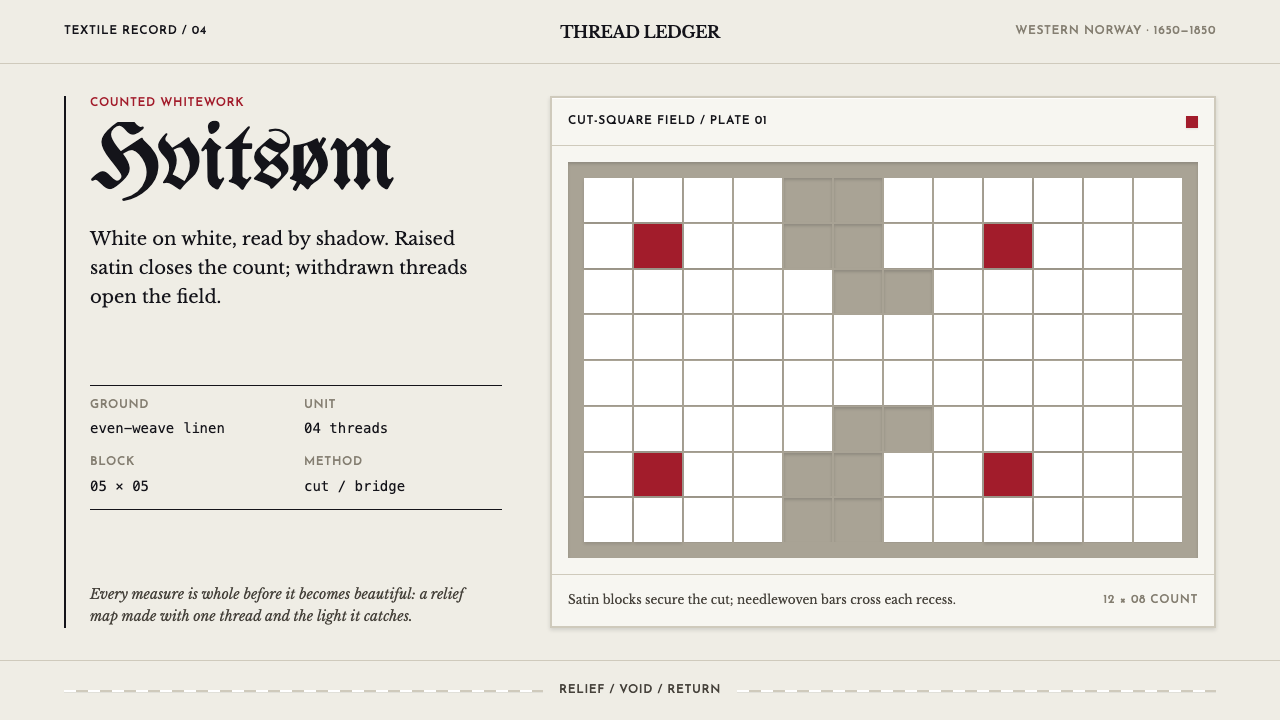 Hardangersøm WhiteworkPrecision becomes relief. White satin and recessed cut squares make linen spe…
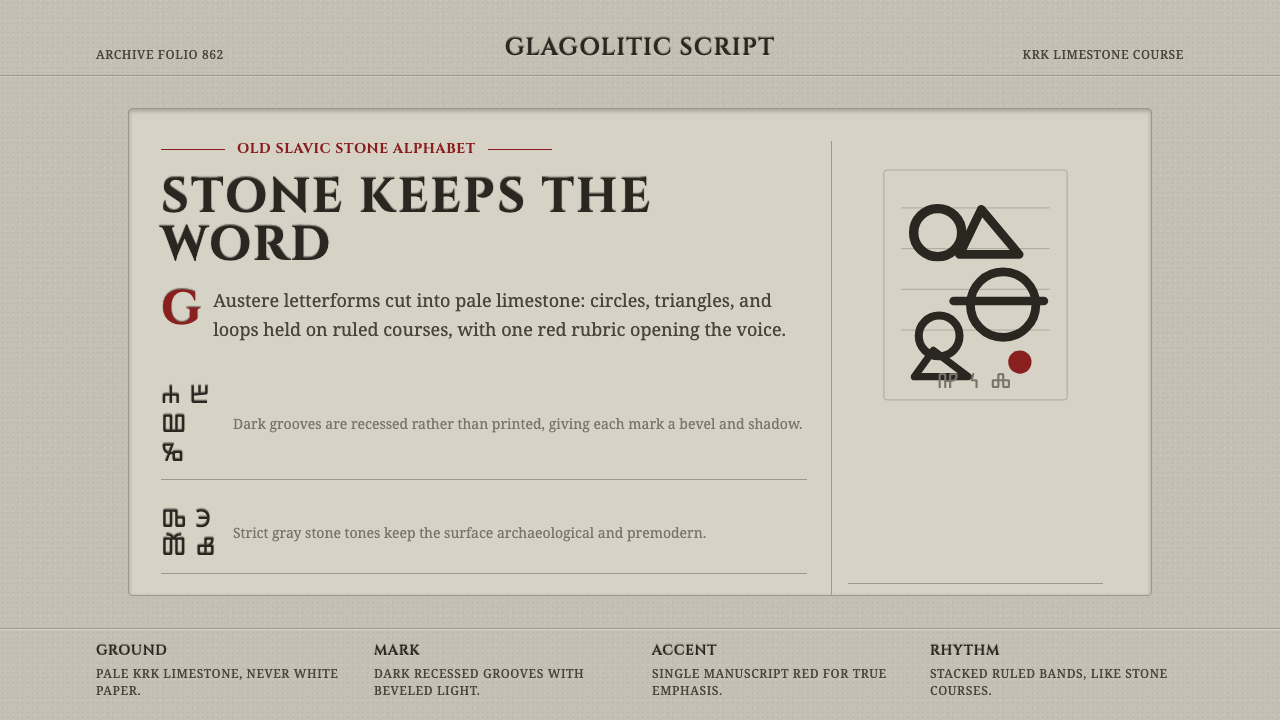 Glagolitic ScriptCarved faith in limestone. Cinzel capitals and red rubrics sit in shadowed gr…
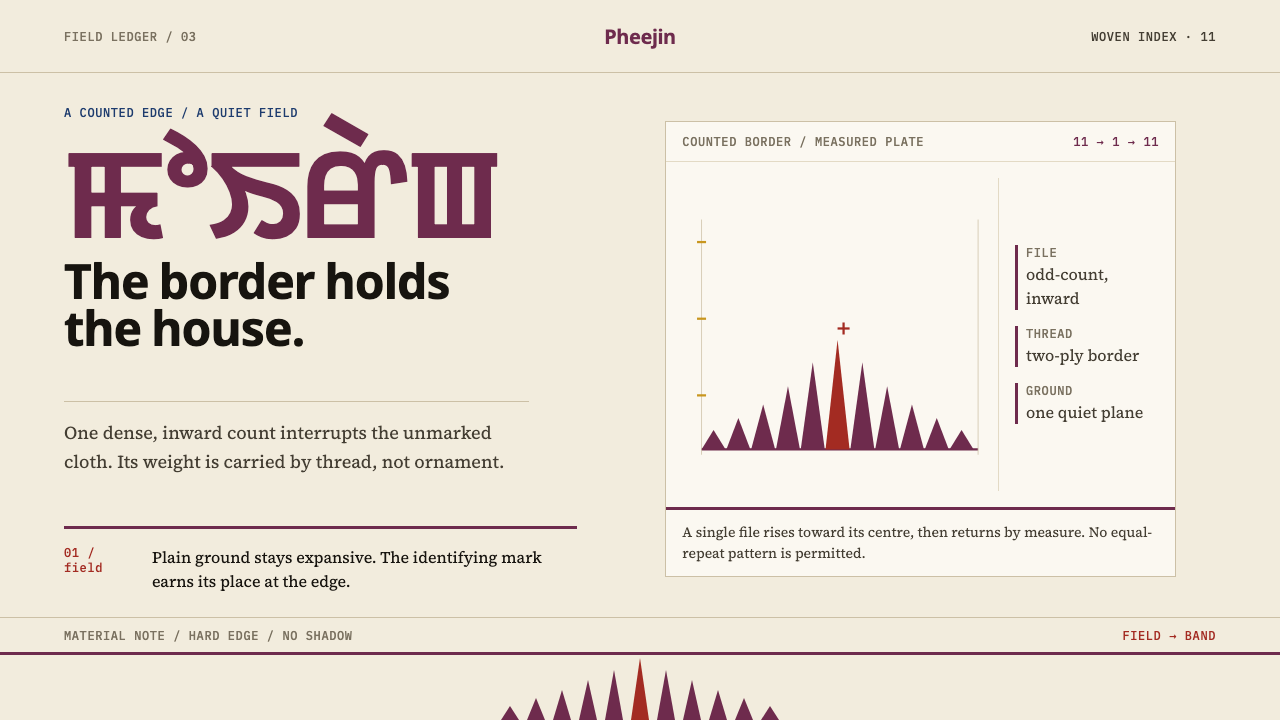 Manipuri PhanekOne border carries the whole cloth. Plum odd-count teeth cut through an expan…
 Nishapur Epigraphic WareRestraint carries the surface. Black Kufic arcs across warm buff clay and ope…
 Persian Carpet CartoonA knot plan before the knot. Dusty plant dyes stair-step across a hand-counte…
 Sakha Yakut Silver BreastplateCold silver hangs in ritual order. Blue-black ground, Roman capitals, and nie…