What is Persian Carpet Cartoon?
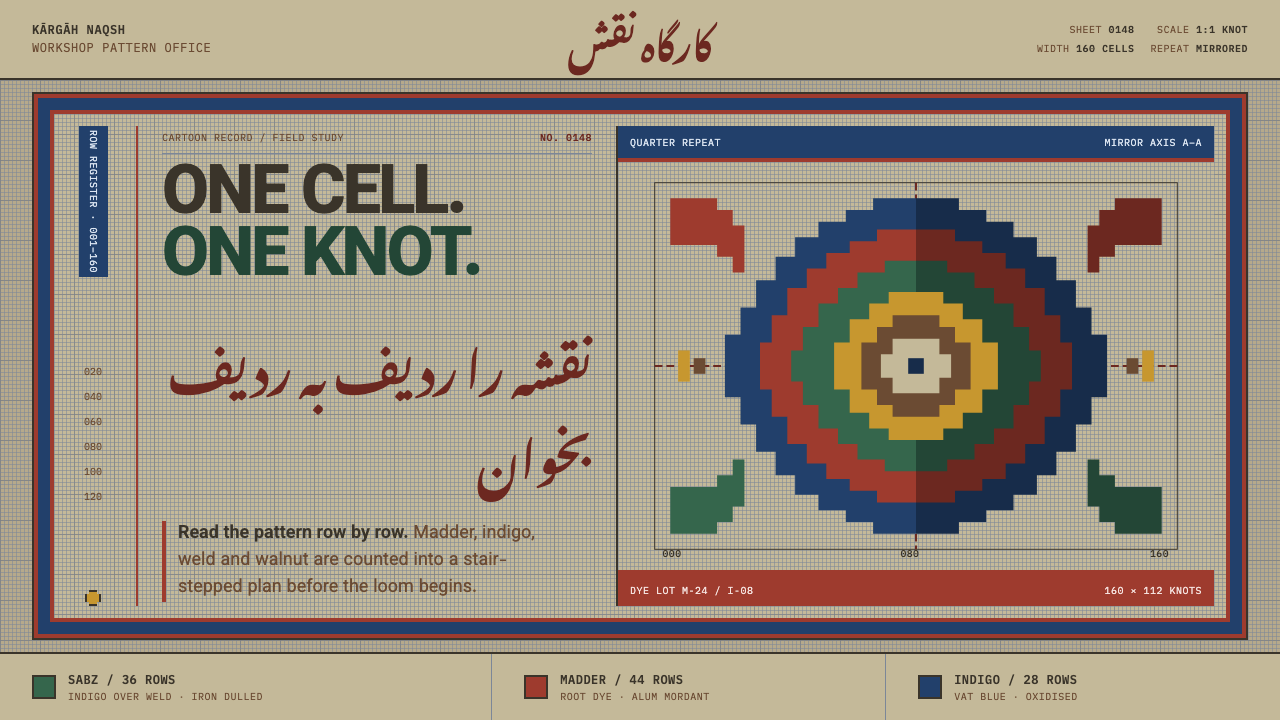
A knot plan before the knot. Dusty plant dyes stair-step across a hand-counted graphite grid, centuries before anyone called it a pixel.
Persian Carpet Cartoon in brief
A Persian carpet begins its life not as thread on a loom but as a naghsheh, a cartoon drawn on hand-squared paper in which one printed or ruled cell corresponds to exactly one knot. A naqqash, the pattern designer, paints this grid in gouache, and the finished sheet is hung above the loom so the weaver can read it row by row, translating each colored cell into a single knot. It is, functionally, a pixel grid that predates any electronic screen by centuries, and it operates by the same core logic: a fixed grid of discrete cells, each holding exactly one unit of color information.
This design system reproduces the working document itself, not the finished woven rug. The ground is tanned khaki paper stock, worn to a soft, uneven tone by handling; the rule lines printed or drawn across it are a cool blue-grey rather than pure black; and beneath the painted color, faint graphite construction lines remain visible where the naqqash sketched the design before committing to paint. Because a knot cannot render a smooth curve, every motif stair-steps to the grid — circles become stacked, staggered rectangles, and diagonal lines advance in small discrete jumps rather than sweeping continuously.
Color in this system is deliberately dulled rather than vivid. The dye set — madder red, indigo blue, weld yellow, and walnut brown — comes from plant sources processed with alum and iron mordants, which push every hue toward a muted, slightly greyed register rather than a bright, saturated one. Nothing in the system has rounded corners, and nothing casts a shadow: this is a flat, ruled, numbered working sheet, not a rendering of a finished object.
Where does Persian Carpet Cartoon come from?
The design ambitions behind Persian carpet-making reach back to the Safavid court of the sixteenth century, exemplified by the Ardabil Carpet of 1539–40, a work whose scale and complexity demonstrate that carpet design was already treated as a serious, court-sponsored art form rather than purely functional craft at this early date. The squared-paper cartoon system that this design reproduces, however, was formalized specifically in the workshops of the nineteenth and twentieth centuries, as carpet production scaled up and needed a transmissible, standardized method for translating a designer's vision into a weaver's actions.
The naghsheh system solved a specific communication problem: a naqqash working in gouache could design at a scale and with a level of painterly nuance that a weaver, working knot by knot at a loom, could not directly interpret from a finished painting. Squaring the design onto a numbered grid converted the naqqash's vision into discrete, unambiguous instructions — one cell, one knot, one color — that a weaver could follow accurately row by row, even across a design with many colors and complex motifs.
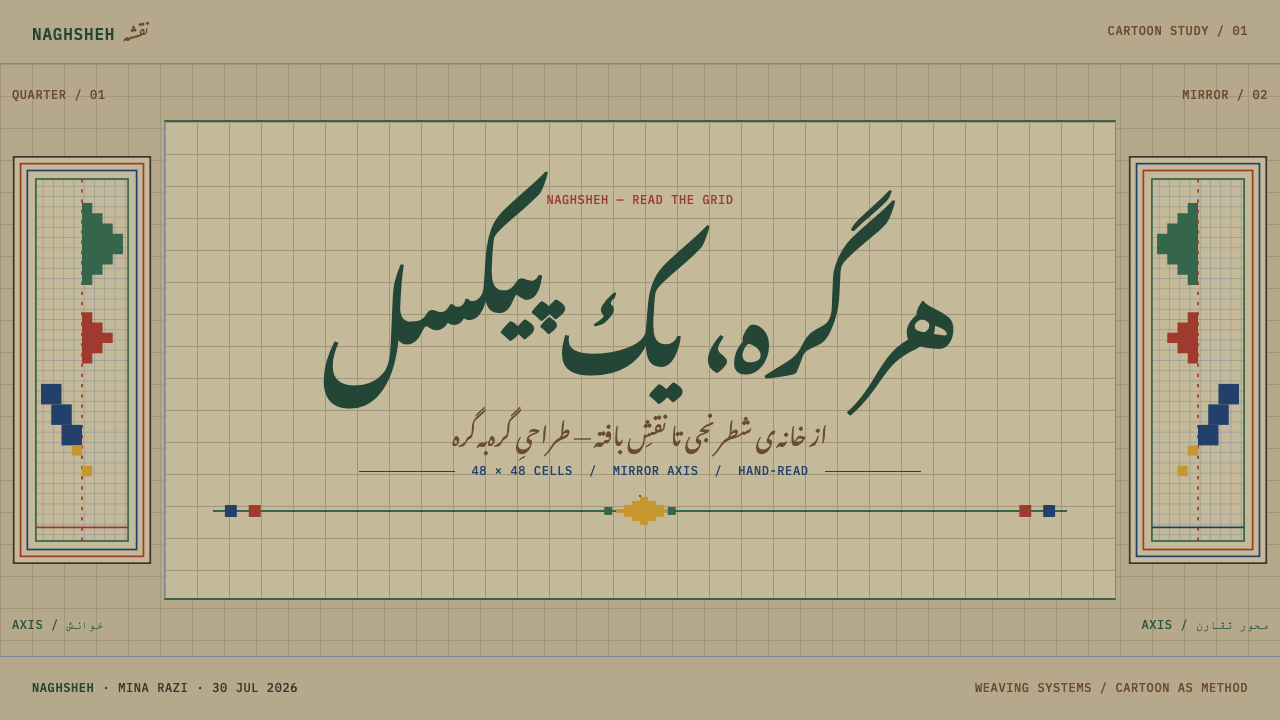
This system also carried a built-in efficiency: because many carpet designs are symmetrical, weavers frequently worked from a cartoon depicting only one quarter or one half of the full pattern, mirroring the remainder in their heads as they worked across the loom. This meant the naqqash's labor, and the paper itself, did not need to reproduce a complete symmetrical design in full to transmit it accurately.
Design workshops in Tabriz, Kashan, Isfahan, and Kerman each developed their own naghsheh conventions and motif vocabularies within this shared grid-based system, with figures such as Maqsud Kashani, associated with the Ardabil Carpet's design tradition, and Haji Jalili of Marand representing the caliber of design ambition these regional ateliers pursued. The underlying grid-and-cell logic remained constant across these regional schools even as their botanical dyeing traditions and motif styles diverged.
What defines the Persian Carpet Cartoon look?
The Grid as Structure
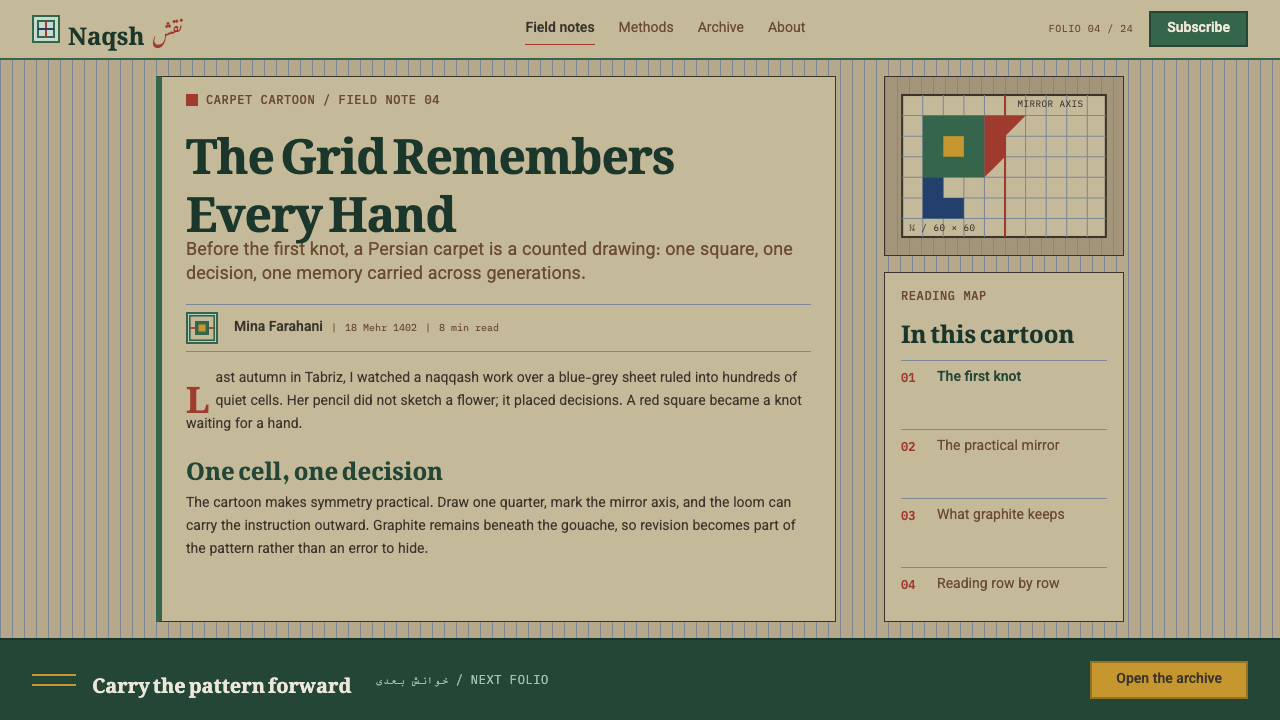
The entire system is organized around a fixed, hand-squared grid in which every cell represents exactly one knot. Nothing in the composition exists outside this grid — every motif, curve, and color field is built from discrete cells rather than from freeform drawing, making the grid itself the primary structural device rather than a background aid.
Stair-Stepped Motifs
Because a single knot cannot render a smooth curve, every rounded or diagonal shape in the design advances in small discrete steps rather than sweeping continuously. Circles become stacked, staggered rectangles; diagonal lines become a jagged, stepped edge. This is a direct visual signature of the grid's constraint, not a decorative choice.
Muted Plant-Dye Palette
The color set — madder red, indigo blue, weld yellow, and walnut brown — is drawn from plant dye sources processed with alum and iron mordants, which naturally pull every hue toward a dulled, slightly grey-cast register. No color in this system reads as bright or saturated in the way a synthetic dye or digital color would.
Khaki Ground with Blue-Grey Rule
The working paper itself is a worn, tanned khaki tone rather than a clean white, and the grid lines ruled or printed across it are a cool blue-grey rather than solid black. This combination gives the whole sheet a working-document quality distinct from either a finished artwork or a clean technical drawing.
Visible Graphite Underdrawing
Faint pencil construction lines remain visible beneath the painted gouache color, evidence of the naqqash's initial sketching pass before color was committed to the page. This layered visibility — sketch beneath paint — is treated as an authentic working trace rather than an error to be erased.
Zero Rounded Corners, Zero Shadow
No element in the system has a softened or rounded edge, and nothing casts a shadow or receives simulated lighting. The sheet is treated strictly as a flat, ruled, numbered working document — an instruction set for a weaver — rather than as a rendering of a finished three-dimensional object.
Who shaped Persian Carpet Cartoon?
Kashani is associated with the design tradition behind the Ardabil Carpet of 1539–40, a Safavid court work whose scale and complexity demonstrate the level of design ambition carpet cartoons were expected to support well before the nineteenth-century squared-paper system was formalized. His association with this landmark work situates the naghsheh tradition within a much older lineage of serious, court-level carpet design.
Haji Jalili worked within the regional design ateliers of the Persian carpet tradition, representing the caliber of workshop-based design ambition pursued in centers such as Tabriz alongside Kashan, Isfahan, and Kerman. His work exemplifies how regional schools developed distinct motif vocabularies while operating within the same underlying grid-and-cell cartoon system.
The design workshops of these four cities each formalized their own naghsheh conventions and motif vocabularies during the nineteenth and twentieth centuries, while sharing the same underlying grid-and-cell cartoon method and the same plant-based dye logic. Their collective, workshop-based practice — rather than any single individual's invention — is what standardized and transmitted the squared-paper system across the wider Persian carpet industry.
How do you use Persian Carpet Cartoon today?
The core transferable idea is the cartoon itself: a disciplined, numbered grid used as an instruction set rather than as a decorative motif, where every cell holds one unit of information and curves are honestly rendered as stepped approximations rather than smoothed away. Applying this well means treating the grid as visibly present and load-bearing, not hidden beneath a polished final rendering.
For presentation slides, this system works well for any content about process, planning, or craft — a cover slide can use a visible ruled grid in blue-grey over a warm khaki-toned background, with a title rendered in a stepped, grid-constrained display treatment that echoes how motifs stair-step across the naghsheh. Content slides should let the grid itself organize information architecture directly — literal ruled columns and rows carrying labeled data — rather than using it as a decorative texture behind conventionally laid-out content.
For web interfaces, the grid-as-instruction-set logic suits configuration tools, color or pattern pickers, and any interface built around discrete, cell-based input — a muted, plant-dye-inspired palette of four or five dulled hues works well as a restrained, non-default color system, and stepped, grid-snapped shapes in icons or illustrations reinforce the underlying logic rather than fighting it with smooth curves that contradict the grid.
In editorial and craft-focused branding contexts, showing the visible construction — grid lines, faint underdrawing, stepped motifs — rather than only a finished, polished pattern communicates process and honesty about how the object was made. This suits brands built around transparency, craft heritage, or design-systems thinking, where revealing the underlying structure is itself the point rather than something to be hidden.
The most common mistake is smoothing the stair-stepped motifs into clean curves to make the design look more 'finished' or contemporary, which erases the exact quality — an honest record of the grid's constraint — that makes the system specific and legible as this tradition rather than a generic geometric pattern. A second common mistake is brightening the plant-dye palette into saturated, synthetic-looking color, which breaks the deliberately dulled, aged character the mineral and plant mordants produced.
Persian Carpet Cartoon — FAQ
Why is this system based on the working cartoon rather than the finished woven carpet?
Because the cartoon — the naghsheh — is where the design's underlying grid logic is fully visible: the numbered cells, the stepped approximation of curves, the faint graphite underdrawing beneath painted color. A finished woven carpet smooths much of this into continuous-looking pattern through the physical density of the knots; the working document preserves the honest, discrete-cell structure that gives this design system its specific identity.
Why do curves and diagonals appear as jagged steps instead of smooth lines?
Because a single knot on a loom is a fixed square unit that cannot itself curve — a weaver can only place knots into a grid of rows and columns, so any circular or diagonal shape in the finished design has to be approximated as a sequence of small steps across that grid. The stepped quality is not a stylistic flourish; it is the direct visual consequence of translating a curved idea into a knot-by-knot, cell-by-cell medium.
Why are the colors deliberately muted instead of bright and saturated?
Because the dye set this system draws from — madder, indigo, weld, and walnut — is derived from plant sources processed with alum and iron mordants, chemical processes that naturally push every resulting hue toward a duller, slightly grey-cast register rather than a bright, synthetic-looking saturation. The muted quality is a direct material property of the dye process, not an aesthetic filter applied afterward.
Is it accurate to describe this as simply a decorative floral or botanical pattern style?
Not quite — while many carpet motifs are botanical in subject, this specific design system is really about the grid-based instruction method behind carpet design, the naghsheh, rather than about any particular motif content. Its defining features — numbered cells, stepped curves, visible underdrawing, a muted plant-derived palette — describe a working method and material process, and would apply even to a naghsheh depicting non-botanical motifs.
Related design styles
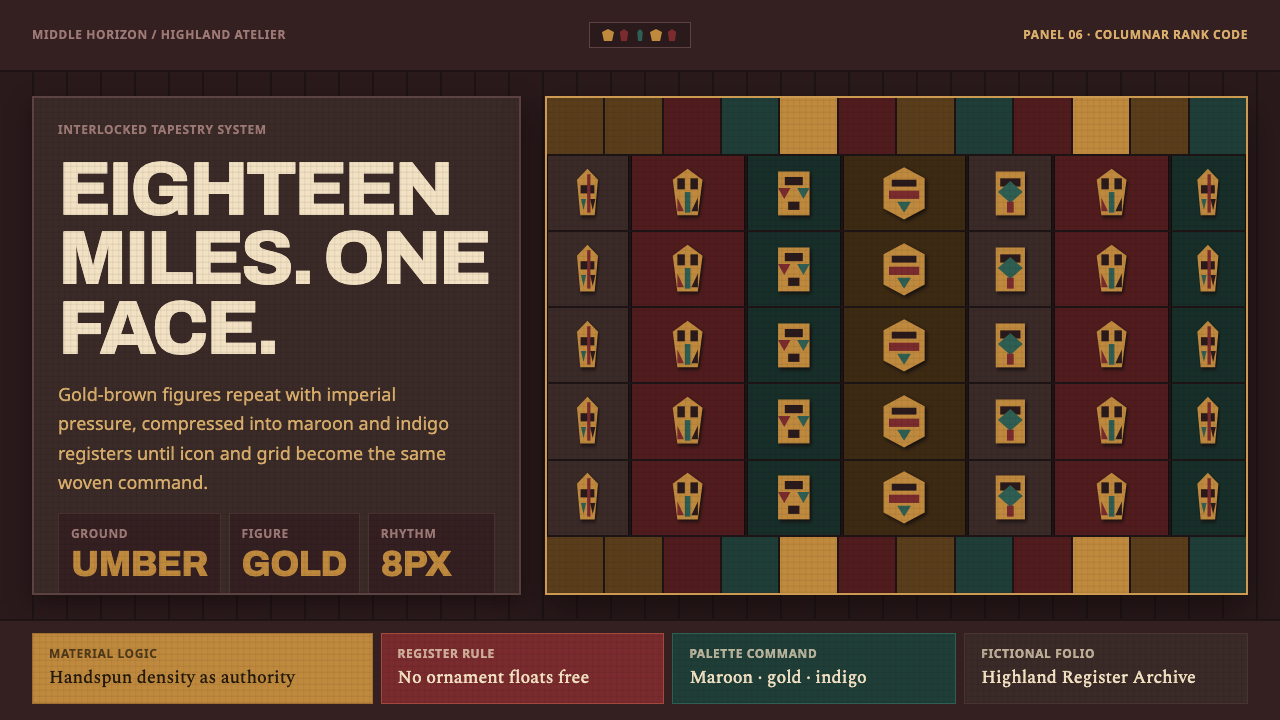 Wari Tapestry TunicAuthority woven into columns. Gold figures march on maroon-umber, compressed…
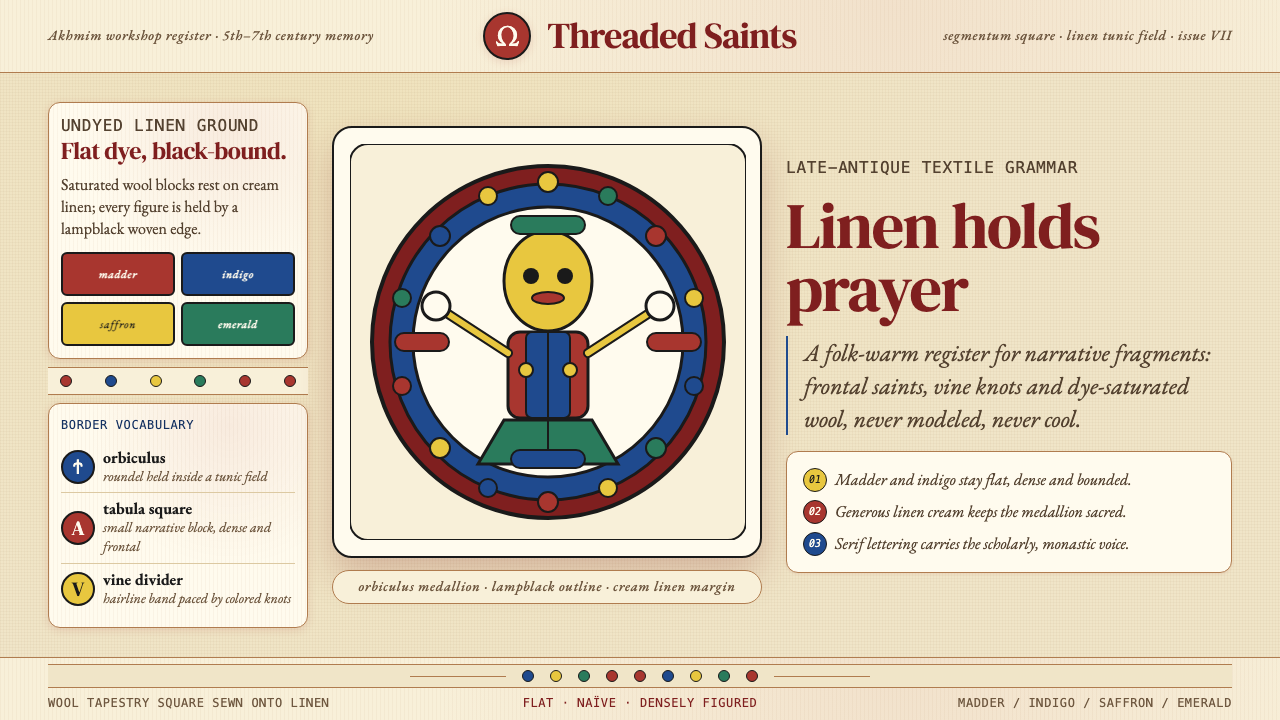 Egyptian Coptic TextileWarmth woven flat. Madder, indigo and saffron medallions sit on linen cream.
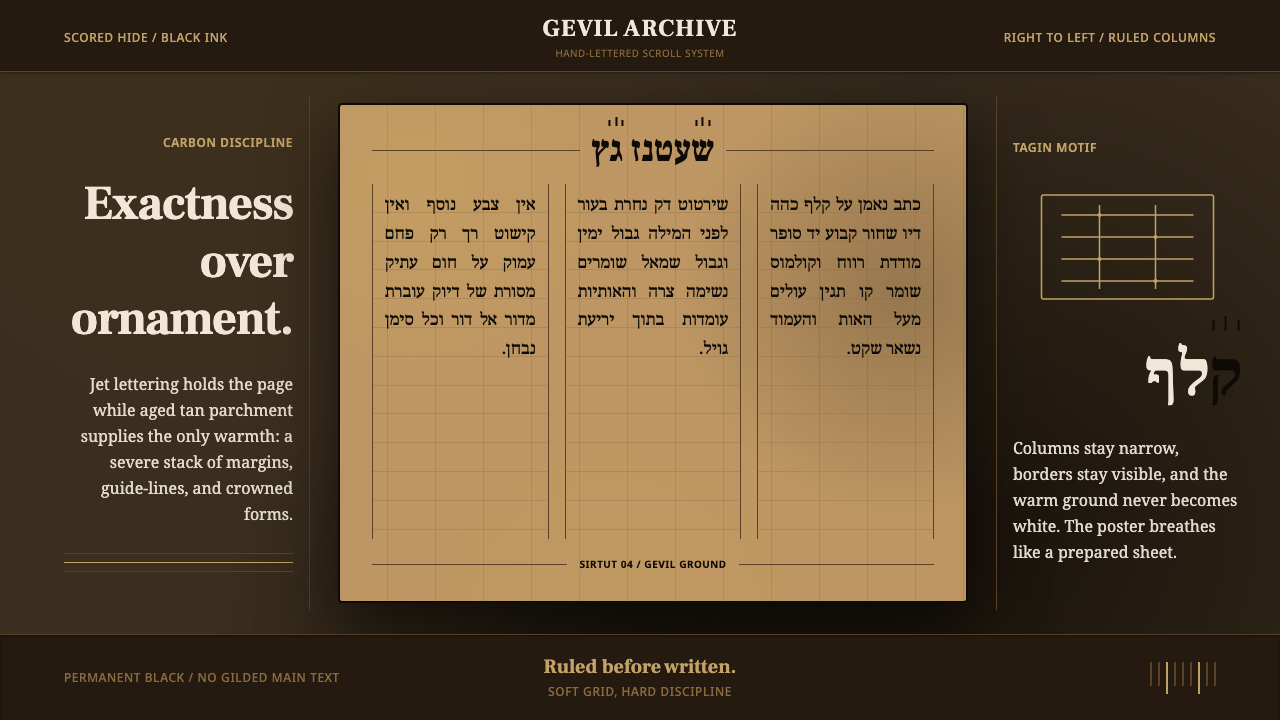 Hebrew STaM ScrollExactness over ornament. Jet ink, ruled Hebrew columns, and amber-tan parchme…
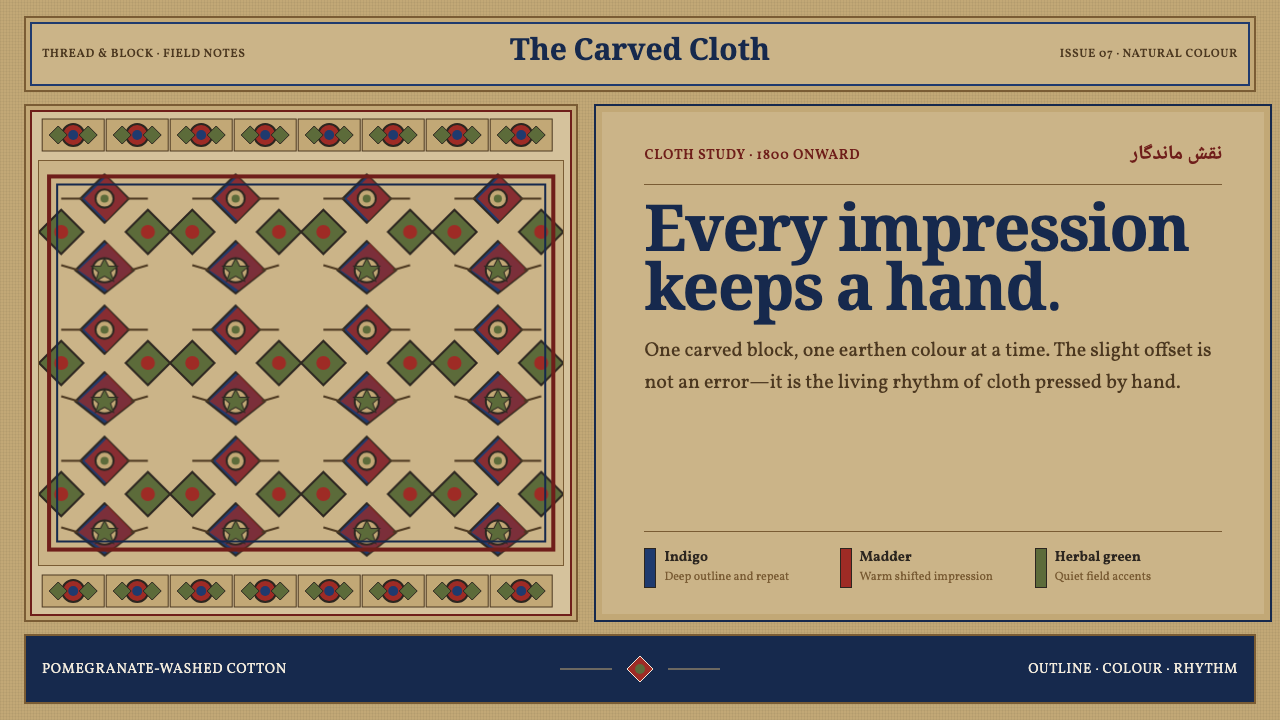 Isfahan Qalamkar PrintEvery impression keeps a hand. Indigo and madder repeats shift softly across…
 Moroccan Mint TeaCeremony glows in brass. Mint green, Cinzel type, and zellige geometry frame…
 Nishapur Epigraphic WareRestraint carries the surface. Black Kufic arcs across warm buff clay and ope…