What is Zelda Ocarina of Time?
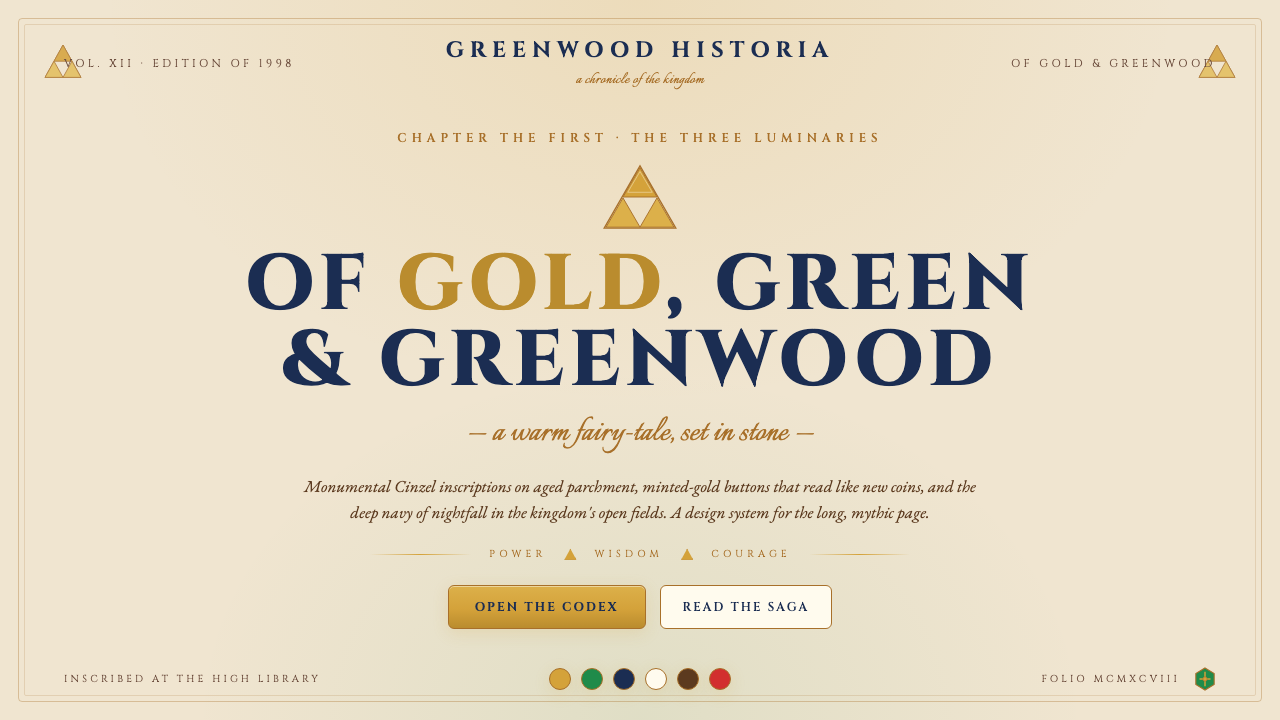
Ocarina of Time distilled a quarter-century of mythic Zelda imagery into a single, instantly legible visual language — parchment warmth, Triforce gold, and the deep navy of Hyrule's midnight sky.
Zelda Ocarina of Time in brief
The Zelda Ocarina of Time design system is a warm-fantasy-medieval aesthetic drawn directly from the visual world Nintendo established in its landmark 1998 Nintendo 64 title. It translates the game's core imagery — golden Triforce, cream-parchment surfaces, Hyrule-green shield motifs, and the deep navy of nightfall over Hyrule Field — into a coherent UI and graphic design language suitable for contemporary layouts.
Where many gaming-derived aesthetics lean on gritty realism or retrofuturist nostalgia, this system occupies a different register: regal and warm, anchored in a sense of ancient legend rather than technology. Monumental serif inscriptions evoke stone carvings and royal proclamations. Gold-tinted interactive elements read like minted coins. Dividers and ornamental rules hint at the Triforce silhouette without reproducing it literally. The result is a system that feels ceremonial without being heavy, fantasy-inflected without being garish.
The style works across a surprisingly broad range of applications precisely because its mythology is universally legible. A full generation of users grew up with the Ocarina of Time visual world, and the resonance it carries — weight, adventure, earned achievement — maps naturally onto products that want to convey those same qualities: launch pages for ambitious projects, educational platforms with a sense of journey, gaming communities, and any brand that wishes to signal depth and longevity rather than novelty.

Where does Zelda Ocarina of Time come from?
The Legend of Zelda series was born in 1986, conceived by Shigeru Miyamoto and Takashi Tezuka at Nintendo in Kyoto, Japan. Miyamoto has spoken often about the childhood experience of exploring the countryside near his home in Sonobe — pushing through dense undergrowth, discovering a cave, entering it tentatively with a lantern — as the emotional blueprint for the entire franchise. That sense of scale, mystery, and intimate bravery found its visual expression almost from the start: parchment-colored interface panels, gold borders, a royal crest that would eventually become the Triforce, and map screens that felt like genuine artifacts from an imagined civilization.
Ocarina of Time, released in November 1998 for the Nintendo 64, was the franchise's full entry into three-dimensional space, and it arrived under enormous creative pressure. Directed by Miyamoto and produced with the oversight of a young Eiji Aonuma — who would go on to become the series' long-running creative director — the game had to carry the entire weight of the Zelda visual canon into a new dimensional register while remaining immediately recognizable. The team worked in Kyoto through a famously grueling development period, extending across nearly three years, and the aesthetic decisions made under that pressure became canonical for decades.
The game's visual identity crystallized around a small set of irreducible symbols. The Triforce — three golden triangles arranged in a larger triangle — had appeared in earlier Zelda titles but became truly iconic in Ocarina of Time, where it appeared in every interface panel, as the background of the inventory, and as the emblem on Link's hand that glows at pivotal story moments. The parchment palette — warm cream and aged ivory rather than pure white — gave every screen a sense of physical materiality, as though the player were reading from an ancient manuscript rather than staring at a CRT display. Nighttime sections introduced the deep navy that now stands as the system's shadow tone.
Eiji Aonuma's long stewardship of the Zelda series after Ocarina of Time — through Wind Waker, Twilight Princess, Skyward Sword, and into Breath of the Wild and Tears of the Kingdom in 2023 — ensured that the 1998 visual vocabulary was not a historical artifact but a living foundation. Each subsequent title has reinterpreted the core palette and emblems in its own register, but the parchment-and-gold base, the Triforce geometry, and the deep navy of night remained constants. The Ocarina of Time iteration of that system is the one closest to the original medieval-manuscript influence, the most legible to the widest audience, and therefore the most transferable into contemporary design contexts.
What defines the Zelda Ocarina of Time look?
Color Palette
The system is built on four foundational tones: parchment cream (the dominant ground, warm and aged rather than clinical white), Triforce gold (the primary accent, carrying authority and interactivity), Hyrule deep navy (the shadow tone, used for nighttime panels and depth), and natural black for text and fine line work. Forest greens appear as secondary accents, referencing the Kokiri Forest and the Hylian shield, but always in service of the four core tones rather than competing with them. Saturation is moderate — the gold is rich but not garish, the navy is deep but not cold.
Typography
Inscriptional serif letterforms with classical proportions carry the primary display weight — the kind of type that reads like a carved stone tablet or illuminated manuscript heading. Body text and UI labels shift to a clean, readable companion face with modest serifs or a humanist sensibility, maintaining warmth without sacrificing legibility at small sizes. The contrast between the monumental display style and the understated body face is central to the system: it communicates that the content occupies a world where epic and intimate coexist. All-caps or small-caps settings reinforce the ceremonial register in section titles and navigation items.
Ornament and Emblem
Unlike purely modernist systems, this aesthetic permits — and indeed requires — controlled ornament. Thin geometric border rules frame panels and cards, referencing the inventory screens and dialogue boxes of the original game. Triforce-adjacent triangular motifs appear in dividers and bullet markers without being literal reproductions. Wax-seal-style circular emblems work as avatar frames or badge components. The principle governing ornament is restraint through geometry: every decorative element derives its form from the same angular, triangular vocabulary as the primary symbol, so the system remains visually coherent even when ornamented.
Surface and Texture
The parchment ground is not a flat neutral — it carries subtle warmth and a sense of age, as though surfaces have been handled and turned in light over time. This tactile suggestion is achieved through slightly off-white tones and warm undertones rather than simulated grain or explicit texture maps. Card and panel backgrounds read as aged pages or weathered stone, not as digital flat surfaces. This quality distinguishes the system from both clinical white-space minimalism and from overt skeuomorphism: the material suggestion is present, but it is carried by color temperature and tone rather than by rendered texture.
Light and Shadow
Depth is established through warm layering rather than hard-edged drop shadows. Components sit in front of the parchment ground with a sense of gentle elevation — as though cards are illuminated scrolls resting on a table surface. When directional shadow is used, it is soft and amber-tinted, consistent with firelight or candlelight rather than the cool, diffuse shadows of neutral design systems. This quality reinforces the medieval-interior atmosphere without resorting to literal candle illustrations.
Iconography
Icons within the system favor angular, slightly heraldic forms over rounded, friendly silhouettes. Shield shapes, sword outlines, ocarina silhouettes, and navigation compasses all serve as recognizable reference points, but they are used sparingly and always stylized to the same geometric register as the Triforce. Functional UI icons — arrows, close buttons, toggles — are drawn with clean lines and a slight angularity that maintains consistency with the display typography. Rounded icons would undermine the regal weight of the system; this is an aesthetic that has earned its authority.
Spatial Rhythm
Layouts favor generous margins and a sense of ceremonial breathing room — the compositional equivalent of an illuminated manuscript's wide vellum borders. Content does not crowd the edges. Section breaks are deliberate and marked, using ornamental rules or geometric spacers rather than raw whitespace alone. The grid underlying the system is not rigid-Swiss-column-counting but rather a looser, more proportional sense of center-weighted hierarchy, where the eye moves from the primary emblem or headline downward through supporting information in a clearly ordered sequence.

Who shaped Zelda Ocarina of Time?
Miyamoto is the architect of the Zelda franchise's foundational emotional logic. His childhood experiences exploring the hills and caves near Sonobe, combined with his background in fine arts at Kanazawa College of Art, shaped the franchise's insistence on environmental storytelling and a sense of wonder communicated through visual scale rather than explicit instruction. His co-creation of the original Legend of Zelda in 1986 with Takashi Tezuka established the parchment-and-gold visual grammar that would reach its fullest expression in Ocarina of Time. Miyamoto's broader influence on Nintendo's design culture — favoring intuitive, legible systems over complex ones — permeates the 1998 title's interface design at every level.
Aonuma joined the Ocarina of Time team as a dungeon designer and later co-directed the project with Miyamoto, going on to serve as the series' chief creative director from Wind Waker onward for over two decades. His role in the visual history of the franchise is as much about stewardship as invention: it was Aonuma's sustained oversight that prevented the Ocarina of Time aesthetic from becoming a frozen historical relic, instead ensuring that each subsequent title reinterpreted the 1998 palette and symbolic vocabulary in ways that kept it alive and generative. His 2023 production of Tears of the Kingdom demonstrates how far the foundational visual language can be stretched while remaining anchored in the same Triforce-and-parchment world.
Tezuka co-created the original Legend of Zelda alongside Miyamoto and served as director of Zelda II: The Adventure of Link. His contribution to the franchise's visual identity lies in the earliest choices about how the world of Hyrule should be represented — the map aesthetics, the item iconography, and the interface panels that established the parchment-and-gold convention before it had a name. The 1986 visual grammar Tezuka and Miyamoto established was already so coherent that subsequent games, including Ocarina of Time, were largely elaborating and dimensionalizing a vocabulary that had been stable from the start.
While Kondo's primary contribution is musical — the Zelda main theme, the Ocarina melodies, the ambient field music — his work shaped the emotional temperature of the visual world in ways that are difficult to overstate. Designers working in the Ocarina of Time aesthetic are implicitly designing for a world where Kondo's music plays: the warmth of the field theme corresponds directly to the parchment palette, the solemnity of the dungeon music corresponds to the deep navy, and the brightness of the fairy fountain corresponds to the Triforce gold. Understanding the music is not a requirement for using the visual system, but it explains why the emotional register of the colors feels so precisely calibrated.
Nakano served as the primary character designer and concept artist for Ocarina of Time, producing the official promotional and box art that introduced many players to the game's visual world before a single frame of gameplay was seen. His illustrations — featuring Link in the Kokiri Forest, the Triforce glowing on an outstretched hand, the silhouette of Hyrule Castle against a stormy sky — established the tonal range of the system: from intimate woodland warmth to epic mythological weight. The promotional imagery Nakano produced has proven remarkably durable, and many contemporary interpretations of the Ocarina of Time aesthetic draw directly on his compositional choices about scale, light, and color temperature.
How do you use Zelda Ocarina of Time today?
The Ocarina of Time design system transfers most naturally to contexts where a sense of earned grandeur, adventure, and historical depth is the desired emotional register. The system carries genuine thematic weight — it should not be applied ironically or to content that undercuts its ceremonial seriousness. Used correctly, it signals that whatever it frames is significant: a product launch worthy of legend, an educational journey with real stakes, a community organized around shared dedication.
For presentation slides, the system excels on both cover and section-break slides. A cover built in this system typically places a large central Triforce-adjacent emblem on a deep navy ground, with the title set in monumental inscriptional type and a secondary line of smaller, warmer text beneath — mimicking the hierarchy of a royal proclamation. Content slides work best on the parchment ground, with section headers in the display serif and body text in a warm, readable companion face. Data visualizations should adopt the palette's four core tones for category differentiation, with gold reserved for the primary data series or the most important metric. Charts and graphs can be treated as heraldic objects — given a thin geometric border and placed on a slightly elevated card surface.
For web interfaces, the system is well-suited to landing pages for ambitious products, game community portals, educational platforms with a sense of progression, and any dashboard that wants to communicate authority without coldness. Navigation bars work with the parchment-and-dark-navy contrast: a cream header with gold typography for the wordmark, deep navy for active states. Cards use the warm layered shadow approach — not the hard-offset drops of modernist systems, but a gentle, amber-lit elevation. Pricing tiers benefit from the gold-versus-navy contrast for tier hierarchy: the premium tier marked in gold on navy, the standard tier in parchment-and-black.
For editorial and marketing design, the Ocarina of Time system produces exceptionally strong results in contexts where a sense of myth, journey, or achievement is the narrative through-line: game reviews, retrospective features, annual report design for ambitious organizations, and launch campaigns where the product wants to be perceived as genuinely important. Full-spread layouts work well with a single large emblem anchoring one corner and the main headline filling the remaining field in large inscriptional type. Marketing pages can alternate between deep-navy and parchment-cream full-width sections, with gold used consistently as the call-to-action color throughout.
A common mistake when applying this system is overloading the ornament. The system permits decorative borders and geometric emblems, but every added element should earn its place by reinforcing the spatial hierarchy rather than simply filling visual silence. A border that frames a hero section is purposeful; a border that frames every single card on a data page is noise. A second frequent error is desaturating the gold into a pale yellow or an orange-adjacent tone — the gold in this system is rich and specific, carrying the authority of the Triforce, and deviating from it toward safer, more neutral tones loses the system's central symbolic weight. The parchment ground should also remain warm; a cool or blue-tinted off-white reads as clinical and entirely breaks the medieval atmosphere.

Zelda Ocarina of Time — FAQ
How does this system differ from generic fantasy or medieval design?
Generic fantasy design typically leans on textured stone backgrounds, serif typefaces that mimic hand-lettered manuscripts, and a chaotic abundance of ornament — dragon motifs, runic borders, aged-leather effects. The Ocarina of Time system is more restrained and more symbolic. It is organized around a small set of irreducible emblems (the Triforce above all), a limited and specific palette (parchment, gold, navy, green), and a clear geometric order underlying all ornamental elements. The result feels mythic rather than costumed — the difference between a coat of arms and a Halloween decoration.
Can the system work in dark mode?
Yes, and the system already contains its own dark-mode logic in the deep-navy night palette. A dark variant centers the deep navy as the primary ground, uses Triforce gold as the dominant accent and for all interactive elements, and brings parchment cream forward as the primary text and surface color against the dark field. This inversion closely mirrors the game's own nighttime interface panels and requires no invented components — the night palette is native to the system. What to avoid: introducing pure black grounds. The system is built on deep navy, not on optical black; substituting true black loses warmth and breaks the medieval atmosphere just as surely as a cool off-white does on the light variant.
Is this system appropriate for non-gaming brands?
Entirely, provided the brand's values are compatible with the system's emotional register: grandeur, depth, earned authority, a sense of journey or legacy. It has been used effectively in educational platforms, publishing, food and beverage brands that emphasize craft or heritage, travel and adventure companies, and technology products that want to communicate longevity rather than novelty. What it does not suit: brands that depend on clinical efficiency, minimal-tech positioning, playful approachability, or ironic detachment. The system makes a serious claim about the weight and significance of what it represents — that claim should be one the brand can back.
How should photography and illustration be handled within this system?
Photography works best when treated to match the system's warm palette: images are color-graded toward amber and gold tones, with shadows deepened toward the navy end of the spectrum rather than toward neutral gray or cool blue. High-contrast treatments that read like illuminated-manuscript miniatures are effective. Illustration should favor clean vector forms with the geometric angular sensibility of the system's iconography — not soft painterly renderings or rounded cartoon styles. When figurative human illustration is used, a treatment that reduces figures to slightly stylized, heroic proportions works better than naturalism. All imagery should be framed with deliberate intent, as though the image itself is an artifact worthy of a carved border.
What is the right way to handle multiple content tiers or categories within this system?
The system's palette provides natural tier differentiation without requiring additional colors. Gold reads as premium or primary — the default choice for the highest-value content, the most important call to action, or the leading tier in a pricing table. Deep navy reads as authoritative and structural — appropriate for secondary emphasis, featured states, or a professional tier. Parchment cream is the neutral ground that everything else sits on. Forest green serves as a fourth tier accent for ecological, growth, or supplementary categories. This four-tone hierarchy is enough to handle most content structures; introducing additional colors weakens the system's symbolic coherence. If a fifth category is unavoidable, use a desaturated or lighter variant of one of the four core tones rather than introducing a fifth hue.
Related design styles
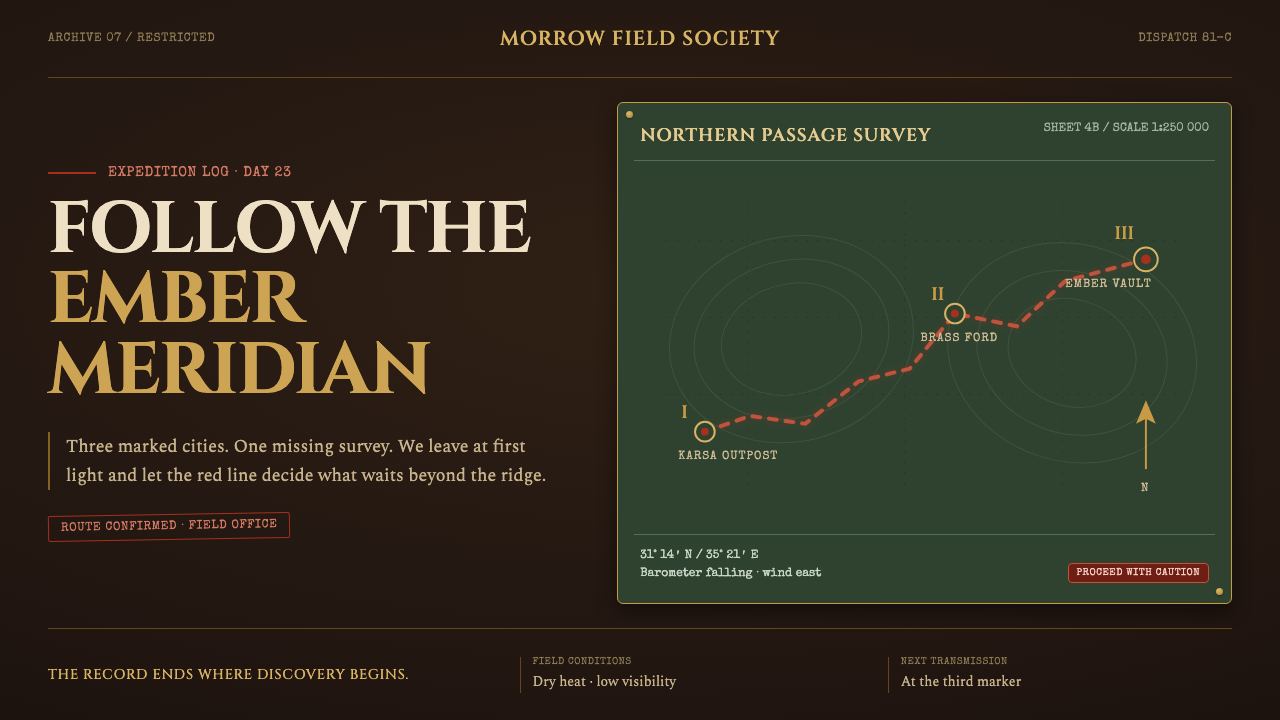 Raiders Expedition (1981)Adventure stays mid-journey. Red routes cross saddle leather under tarnished…
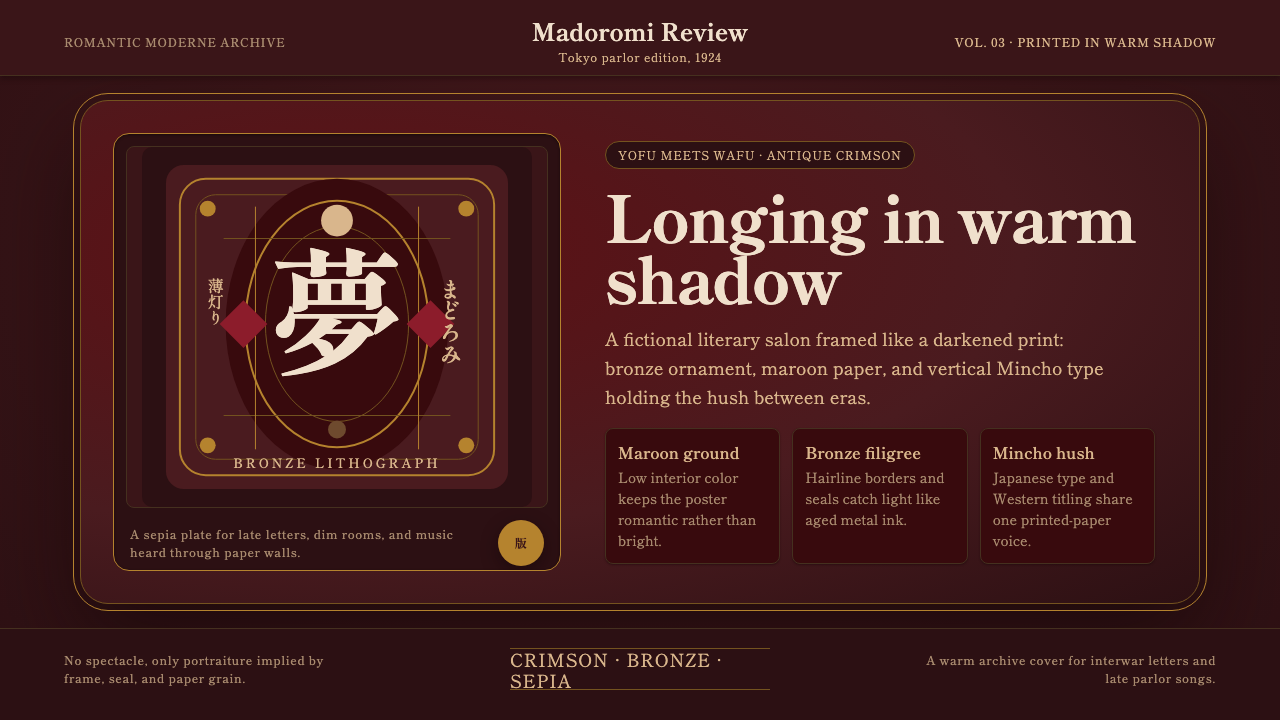 Taishō RomanLonging framed in bronze. Maroon ground, Mincho type, and sepia ornament hush…
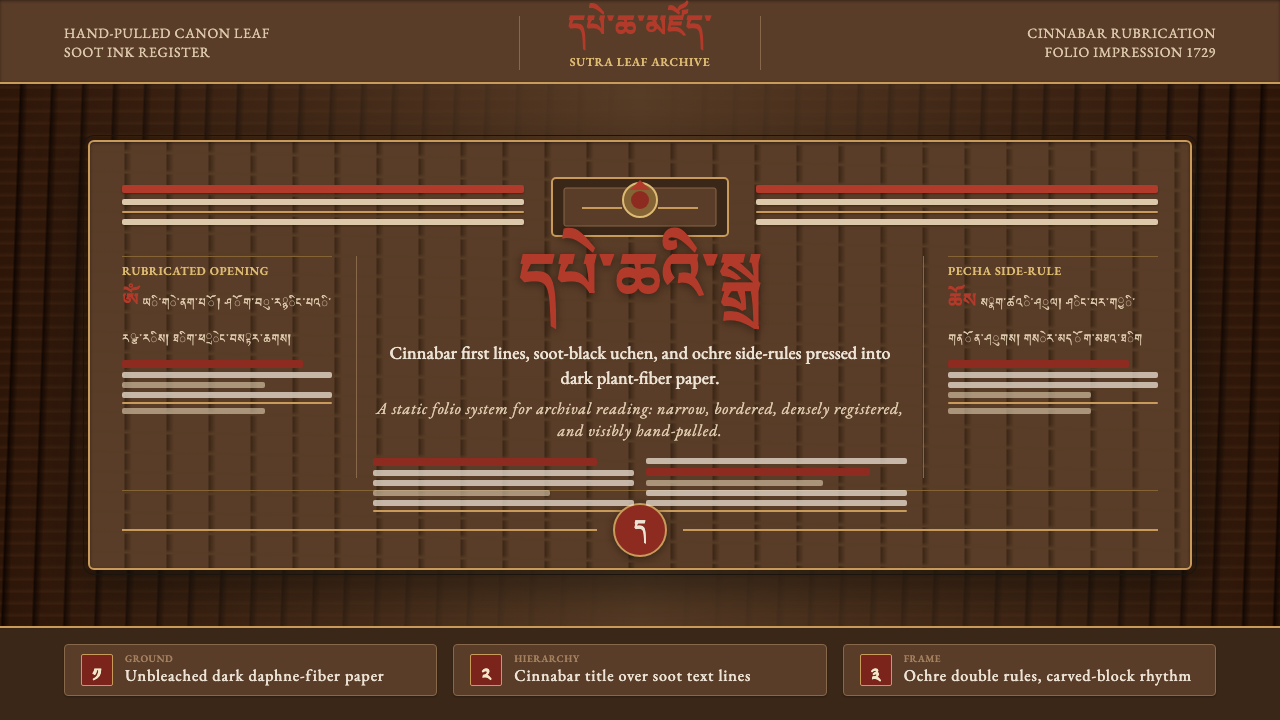 Derge Woodblock Sutra PrintHand-pulled scripture gravity. Cinnabar uchen and ochre rules press into dark…
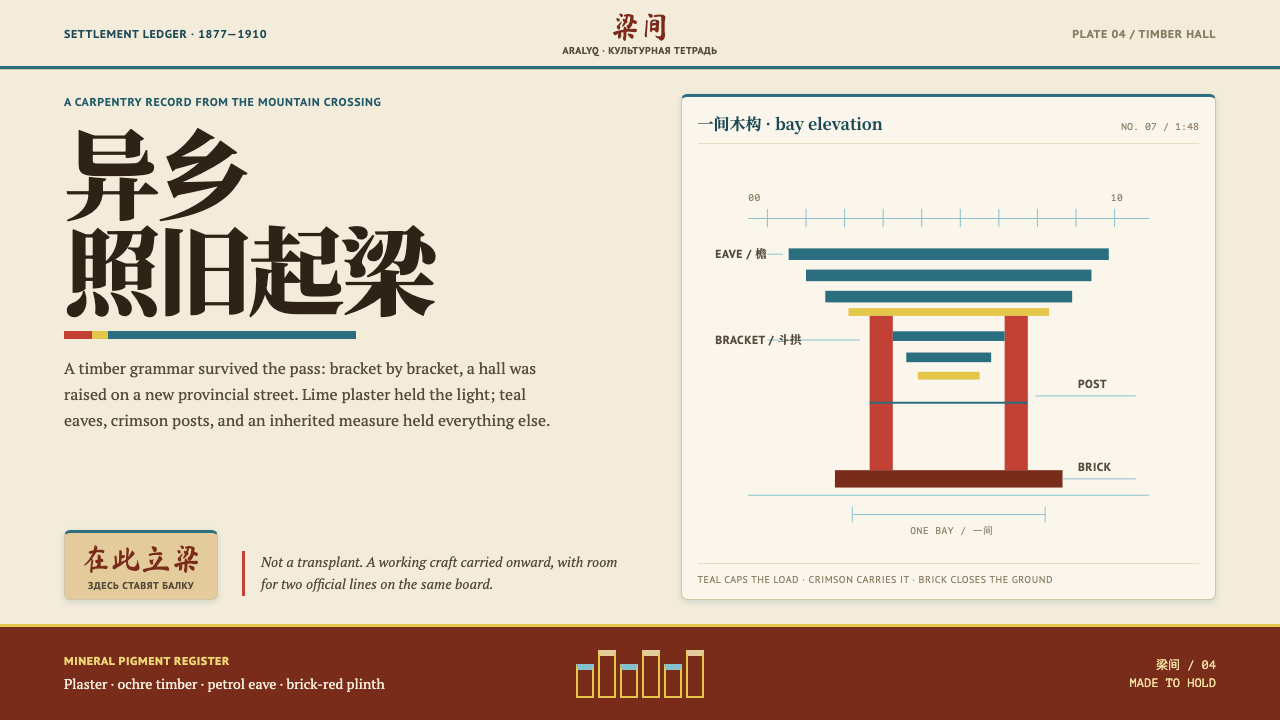 Dungan Settlement CraftCarpentry holds its ground. Teal eaves and crimson posts frame sunlit plaster…
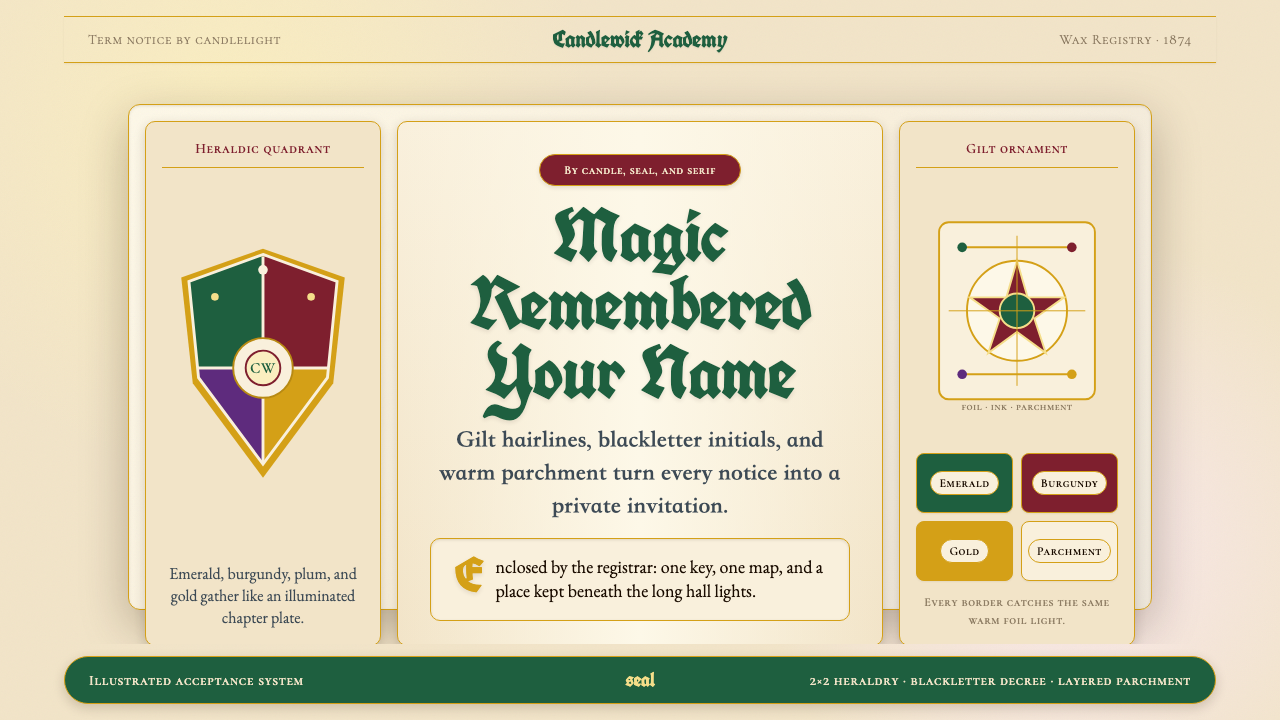 Harry Potter IllustratedMagic arrives by parchment. Emerald, burgundy and gilt borders frame blacklet…
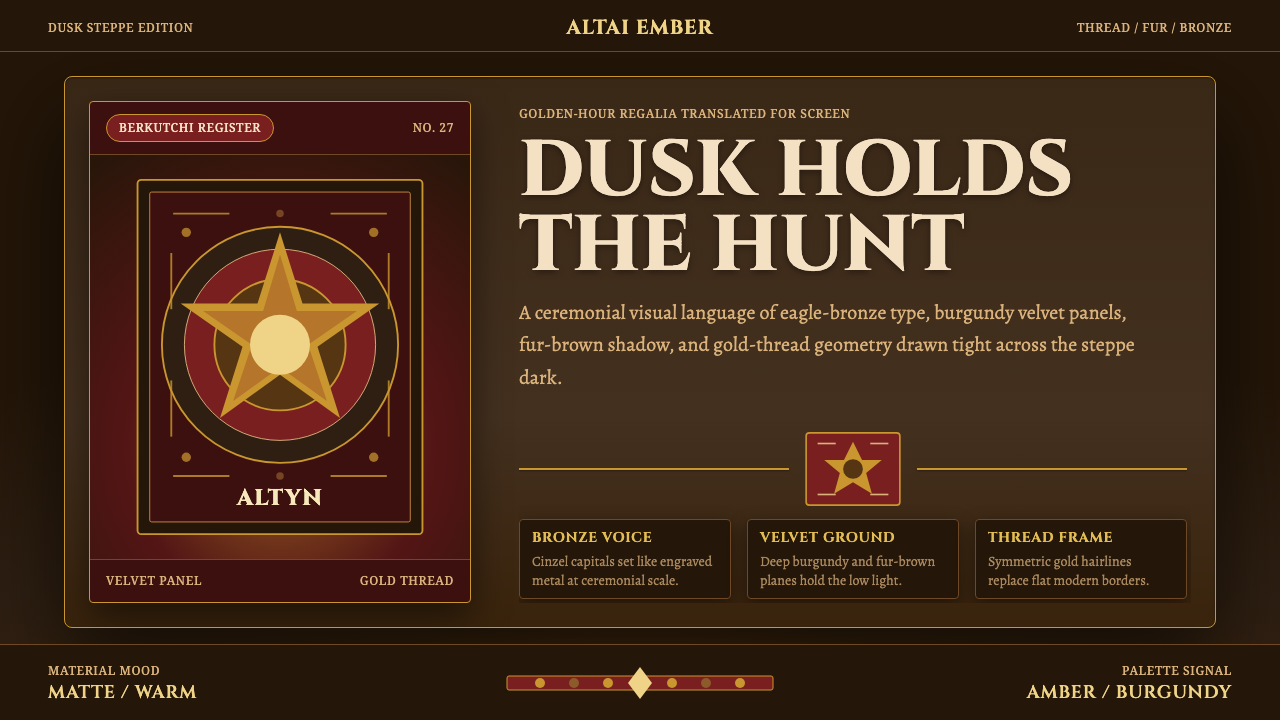 Kazakh Eagle HunterGolden hour feels handmade. Burgundy velvet, bronze type, and gold-thread bor…