What is Harry Potter Illustrated?
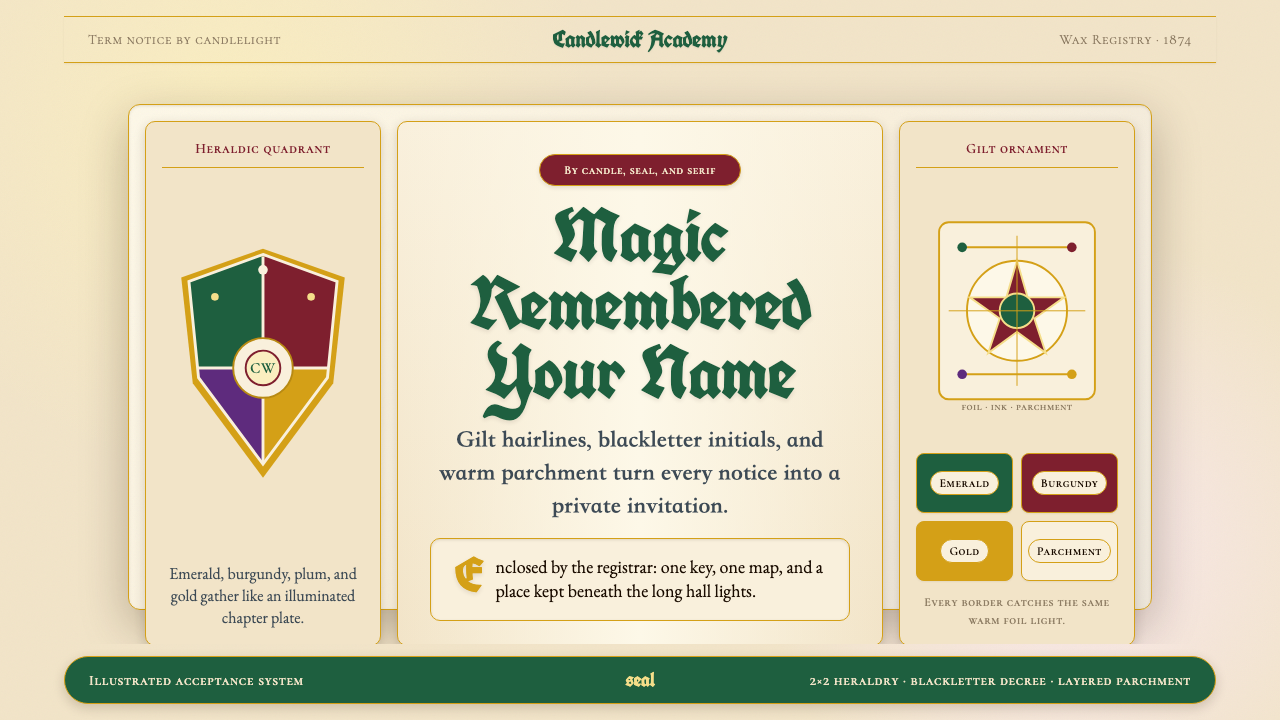
Magic arrives on parchment — blackletter headings, gilt hairline borders, and a candlelit palette that makes every page feel like an acceptance letter found you.
Harry Potter Illustrated in brief
Harry Potter Illustrated is a visual design style rooted in the distinctive aesthetic of the Harry Potter publishing universe — an aesthetic built from Victorian engraved heraldry, Edwardian adventure-book illustration, and the warm candlelit atmosphere of Hogwarts itself. It is defined by blackletter headings that recall acceptance-letter calligraphy, parchment-toned backgrounds that feel worn by owl post, gilt ornamental borders, and a palette anchored in deep emerald, rich burgundy, and warm gold that never strays into cold or synthetic territory.
The style is not mere nostalgia or pastiche. It represents a coherent visual system — one in which every typographic and compositional decision reinforces a sense of hidden history and arcane legitimacy. Heraldic quadrant compositions, four-house color coding, aged-paper textures, and ornate corner flourishes all work together to produce a reading experience that feels simultaneously official and enchanted. When applied to contemporary design problems, the style brings warmth, narrative authority, and a sense that the artifact itself was crafted rather than generated.
What distinguishes the Harry Potter Illustrated style from generic 'fantasy' aesthetics is its specificity. The candlelight warmth is precise — amber and gold rather than orange. The parchment is yellowed and patinated rather than simply beige. The blackletter headings feel institutional rather than merely decorative. The heraldry is four-part, color-coded, and internally consistent. Every element has a referent in the original illustrated editions, from Thomas Taylor's 1997 Bloomsbury cover to Jim Kay's lavish full-illustration volumes, and that specificity is what gives the style its recognizability and emotional weight.

Where does Harry Potter Illustrated come from?
The visual language of Harry Potter was established before the books became a global phenomenon. When Bloomsbury commissioned Thomas Taylor to illustrate the first UK edition of Harry Potter and the Philosopher's Stone in 1997, the brief called for something that felt grounded in British tradition — not generic fantasy, but a world that could have quietly existed alongside Victorian and Edwardian England. Taylor's cover introduced the now-iconic imagery of a boy in robes at a railway platform, rendered in a warm, pen-and-ink style that recalled illustrated adventure stories from a century earlier. That first cover set the tonal baseline: earthy and warm, institutional in its weight, handcrafted in feel.
For the American editions, Scholastic turned to Mary GrandPré, whose illustrations carried a softer, more luminous quality while retaining the essential warmth and the suggestion of an older, richer visual world. GrandPré's chapter headings and cover compositions introduced Americans to the series through imagery that blended art nouveau organic line with the structural clarity of golden-age book illustration. Her visual vocabulary — arched doorways, candlelit interiors, robed figures caught mid-gesture — became the dominant popular image of the series for nearly two decades.
The most systematic elaboration of the Harry Potter aesthetic came with Jim Kay's illustrated editions, beginning with Philosopher's Stone in 2015 for Bloomsbury. Kay, a former Natural History Museum artist, approached the commission with the rigor of a Victorian naturalist-illustrator: hand-rendered pencil underdrawings, layered watercolor washes, meticulous architectural detail, and a compositional language borrowed directly from nineteenth-century book arts. His palette — deep forest greens, candlelit ambers, dungeon greys — was more muted and complex than either Taylor's or GrandPré's, lending the world a texture of genuine age rather than storybook brightness.
A distinct tributary of the aesthetic was developed by MinaLima, the graphic design studio founded by Miraphora Mina and Eduardo Lima, who served as the films' graphic designers from the first production onward. MinaLima created the in-world printed ephemera — the Daily Prophet, Hogwarts acceptance letters, Ministry of Magic decrees — that gave the wizarding world its typographic identity. Their work drew heavily on Edwardian and Victorian newspaper typography, blackletter display fonts, ornamental rule borders, and heraldic layouts. When MinaLima began producing illustrated editions of their own in 2020, they brought this in-world typographic system directly to book design, resulting in layouts where every page spread feels like a designed artifact from within the story.
What defines the Harry Potter Illustrated look?
Palette
The color system is anchored in a quartet of house-coded hues — deep emerald, rich burgundy, warm gold, and cool cobalt — deployed against parchment-yellow or aged-ivory backgrounds. Gold functions as the universal accent, appearing as border gilding, ornament highlights, and typographic detail rather than as a background fill. The overall warmth of the palette is consistent: even the cooler tones, such as the slate grey used for stone or iron, are warmed slightly to keep them within the candlelit register. Cool blues and pure whites are used sparingly, and synthetic or fluorescent tones are entirely absent.
Typography
Headings use blackletter or blackletter-adjacent display forms — letterforms with the angular, compressed weight of historical calligraphy, evoking the hand of a learned scribe rather than a type designer. These heavy display forms are typically set in deep tones or gilded finishes and reserved for titles, section headings, and pull quotes. Body text shifts to a humanist serif or old-style roman that reads comfortably at length while retaining the warmth and slight irregularity of letterpress-era typography. The hierarchy between heading and body is dramatic, with heading forms several times the visual weight of running text — no intermediate weights bridge the gap, which gives layouts an archival authority.
Heraldic Composition
Page and slide compositions are frequently organized around heraldic conventions: a central shield or emblem flanked by supporting devices, a four-quadrant layout distributing content by house or category, or a symmetrical vertical axis with ornamental top and bottom anchors. This compositional logic is inherited directly from European heraldic tradition, where the arrangement of elements within a shield carried specific meaning. In design applications, it translates to layouts that feel ordered by protocol rather than arbitrary grid logic — there is always an implied reason why content occupies a particular zone.
Ornamental Borders and Rules
The style makes extensive use of ruled borders, corner ornaments, and decorative dividers — elements that in most contemporary design systems would be considered excess. Here they are structurally meaningful: a gilt hairline border signals that the enclosed content is complete and official; a decorative rule between sections marks a transition with the formality of a sealed envelope; corner flourishes anchor the reading field and prevent the page from feeling uncontained. The ornament vocabulary draws from botanical engraving, Celtic knotwork, and architectural molding profiles, all filtered through a Victorian sensibility that celebrates handcraft and accumulated detail.
Texture and Surface
Backgrounds are never clean digital white. Parchment textures — with their slight grain, uneven ink absorption, and softly yellowed tone — are the canonical ground for this aesthetic. The texture is subtle rather than theatrical: it should read as age rather than costume. Ink or watercolor washes applied over textured paper create a layered depth that neither flat digital color nor high-resolution photography fully replicates. In digital applications, this surface quality is approximated through warm neutral grounds and restrained use of noise or grain, always in service of making the design feel handled rather than rendered.
Illustrative Detail
Where illustration appears, it favors the pen-and-ink hatching and watercolor wash tradition of nineteenth-century natural history and adventure publishing. Cross-hatching builds shadow and volume without photographic gradation; fine linework captures architectural and botanical detail with a precision that feels encyclopedic. Figures, creatures, and objects are often rendered with a slightly elevated viewpoint and careful attention to texture — scales, feathers, fabric weave — that suggests scientific observation applied to magical subjects. Illustration is never purely decorative: every depicted element earns its place by revealing something about the subject that words alone cannot.
Warmth as System Logic
Across all elements — palette, texture, illustration, border treatment — a consistent warmth functions as the unifying system logic. This warmth is not simply a color temperature setting but a value that governs material choices: the gold is warm-toned rather than cool silver; the green is forest and moss rather than cyan or lime; the parchment leans amber rather than grey. The effect is that even large information-dense layouts feel intimate rather than institutional, as though the information was assembled by candlelight rather than processed under fluorescent office lighting. Cold or purely neutral tones signal discontinuity — they read as intrusions from outside the world.

Who shaped Harry Potter Illustrated?
Taylor created the original UK cover art for Harry Potter and the Philosopher's Stone in 1997, establishing the visual baseline for the entire series before it had found its audience. Working in a warm, pen-influenced style drawn from British children's book illustration tradition, his cover introduced the palette of earthy tones, the robed-figure motif, and a compositional restraint that signaled a real world adjacent to rather than entirely separate from everyday Britain. Taylor's influence on the style is foundational precisely because his work preceded the franchise's commercial machinery — it defined the aesthetic in its most artisan form.
GrandPré illustrated the American editions published by Scholastic from 1997 onward, creating the chapter headings and cover compositions that introduced the series to North American readers. Her style synthesizes art nouveau organic line — soft, gestural, flowing — with the structural clarity of golden-age American editorial illustration. Her palette ran warmer and more luminous than Taylor's, with stronger contrast between highlighted and shadowed areas. GrandPré's visual language became so embedded in the American reading experience that for many readers it remains the definitive visual interpretation of the characters and settings.
Kay was commissioned by Bloomsbury beginning in 2015 to produce fully illustrated editions of the series, starting with Philosopher's Stone. A former Natural History Museum staff artist, Kay brought a naturalist's methodology to the project: extensive research into period architecture and costuming, hand-rendered underdrawings built up through layered watercolor, and a palette that favored muted complexity over storybook saturation. His illustrated editions are the most comprehensive articulation of the style's visual vocabulary — every creature, interior, and landscape treated with the same observational rigor that a Victorian naturalist might bring to a new species.
The design studio of Miraphora Mina and Eduardo Lima served as the graphic designers for the Harry Potter film productions from the beginning, responsible for every piece of in-world printed ephemera: the Daily Prophet, the Hogwarts acceptance letter, Ministry of Magic documents, Diagon Alley shop signs, and hundreds of other props. Their work established the typographic identity of the wizarding world — blackletter display fonts, Edwardian newspaper column structures, ornamental rule borders, and officially stamped formality. From 2020, MinaLima began producing their own illustrated editions of the books, bringing the in-world graphic system directly to page design in a way that makes each spread feel designed from within the story.
How do you use Harry Potter Illustrated today?
Harry Potter Illustrated is among the more demanding styles to apply well, because its coherence depends on maintaining warmth and heraldic logic across every element simultaneously. A layout that gets the palette right but uses a clean geometric sans-serif for headings will feel like a costume rather than a world. Applying the style correctly means committing to its full vocabulary: blackletter or old-style display headings, parchment-toned grounds, ruled and ornamented borders, illustrative touches in ink-wash tradition, and a palette that stays warm and house-coded from cover to last slide.
For presentation slides, the style works most powerfully on cover pages and section dividers, where the full heraldic vocabulary can deploy without competing with dense information. A cover slide benefits from a symmetrical or four-quadrant composition with a central crest or emblem, blackletter title lettering, and a gilt border framing the field. Content slides require more restraint: a parchment ground, old-style serif body text, and a ruled border is sufficient — adding full ornamental treatment to every content slide creates visual fatigue. Data slides translate well when charts and graphs are colored using the house palette and presented against aged-paper backgrounds, giving quantitative information the weight of an official wizarding registry rather than a corporate dashboard.
For web interfaces, the style is best suited to landing pages, event sites, and marketing microsites where narrative immersion is the goal rather than functional utility. A Harry Potter Illustrated web layout uses warm parchment-tone section backgrounds alternating with deep emerald or burgundy fields, blackletter headings for section titles, old-style serif for body copy, and gilt or warm gold accents for interactive elements and calls to action. Navigation should feel archival rather than utilitarian — wordmarks in display type, bordered dropdown menus, no flat-color button fields. Dashboards and data-heavy interfaces are not natural territory for this style: the warmth and ornament that make it immersive in narrative contexts compete with the clarity demands of functional UI.
For editorial and marketing work, the style carries strong authority in contexts that call for celebrating heritage, craft, or special occasion. A Harry Potter Illustrated editorial layout gives body text a slightly narrower measure within a generous page, frames pull quotes with ornamental rules, and uses drop caps in blackletter or old-style roman to open sections. Marketing pages work well when the style's poster-like qualities are embraced: full-width alternating sections in deep emerald and parchment, with gilt accents marking calls to action and blackletter headings announcing each benefit or feature. Promotional materials — invitations, event programs, certificates — are natural territory where the full ornamental treatment can be applied without restraint.
A common mistake when applying this style is over-emphasizing the gothic and medieval associations at the expense of the warmth. Layouts that lean too heavily on blackletter type, deep saturated backgrounds, and dense ornament without sufficient parchment ground and gilt detail will read as generically 'dark fantasy' rather than specifically Harry Potter Illustrated. The style's emotional register is warm invitation, not gothic menace. Equally, attempting to modernize the style by introducing geometric sans-serifs, flat icon systems, or clean neutral backgrounds destroys its coherence entirely — the style either commits to its full vocabulary or it reads as an inconsistent hybrid.

Harry Potter Illustrated — FAQ
Is this style only appropriate for Harry Potter-themed content?
Not at all. The visual system works for any content that benefits from a sense of heritage, arcane authority, handcrafted warmth, or ceremonial formality. Luxury brand launches, academic institution communications, fantasy gaming materials, collector edition packaging, heritage travel campaigns, and special event invitations are all natural applications where the style's vocabulary translates without any explicit Harry Potter reference. What matters is the underlying aesthetic logic — warmth, heraldic order, aged surfaces, blackletter display type — not the specific intellectual property. The style is particularly effective when the product or service wants to signal that it belongs to a tradition worth taking seriously.
How does this style differ from general Victorian or Gothic design?
Victorian design encompasses a very wide range — from dense chromolithography to restrained Arts and Crafts work — and Gothic design proper tends toward darkness, severity, and ecclesiastical weight. Harry Potter Illustrated occupies a specific subset: the warm, illustrated adventure-book tradition that reached its peak in late-Victorian and Edwardian publishing. The distinguishing characteristics are warmth rather than darkness, heraldic four-part structure rather than flowing organic ornament, and a consistent candlelit register that prevents the palette from tipping into the dramatic or theatrical. Where Gothic design might feel like a cathedral, Harry Potter Illustrated feels like a well-loved library — authoritative but welcoming, old but not cold.
Can the style work in a digital-first context without feeling anachronistic?
Yes, provided the translation is done with intent rather than literal imitation. The style does not require scanned textures or hand-lettering to function digitally — it requires warm palette choices, old-style or display serif headings, ruled borders, and a compositional logic that feels heraldic rather than grid-optimized. Many successful applications of heritage styles in digital contexts work precisely because the designer understood which visual cues carry the emotional meaning (warmth, ruled borders, display typography) and which are period-specific production artifacts that can be adapted or omitted (actual parchment grain, physical ink variation). The goal is to evoke the emotional register of the style, not to simulate its production method.
What is the most common failure mode when using this style?
The most common failure is applying the surface markers — blackletter headings and parchment background — while ignoring the system logic that makes those choices cohere. A layout with a blackletter title, a clean white background, a geometric icon set, and sans-serif body text is not Harry Potter Illustrated; it is a collection of mismatched signals. The style requires internal consistency: if the heading is blackletter, the body should be old-style serif; if the background is parchment, the borders should be ruled and ornamented; if the color is house-coded, it should be deployed consistently across related elements. Partial application produces pastiche rather than style.
How should gold be used in this style without feeling excessive?
Gold should function as the accent and finishing element, not as a dominant field or background color. Its proper territory is fine-line borders, corner ornaments, typographic highlights on dark backgrounds, and small heraldic details — the equivalent of gilt lettering on the spine of a leather-bound book rather than the cover material itself. When gold is used as a large background fill or as the primary heading color against a parchment ground, it tends to feel gaudy and loses the precision that makes it feel precious. The rule is that gold earns its effect through restraint: a thin gilt border on an otherwise simple spread will carry more visual authority than a gold-saturated layout where nothing is left to accent.
Related design styles
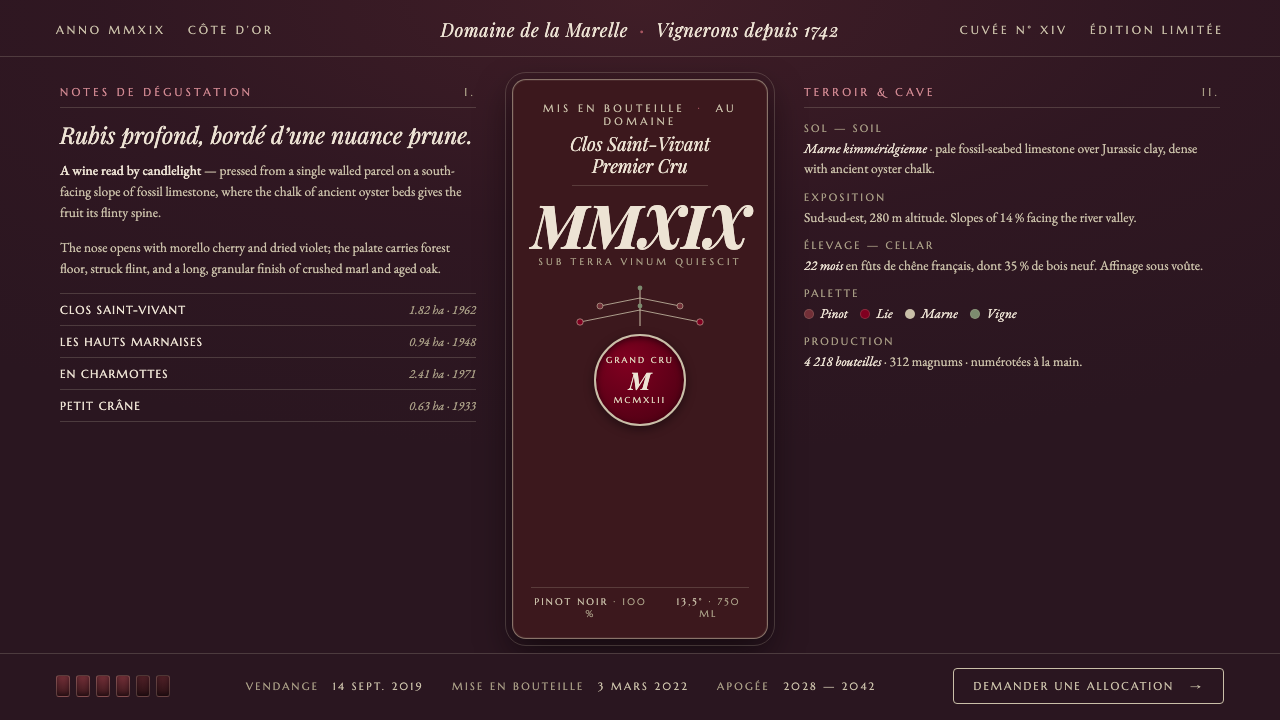 Burgundy VineyardRead by candlelight in a wine-lees cellar. Aged purple-red Pinot on near-blac…
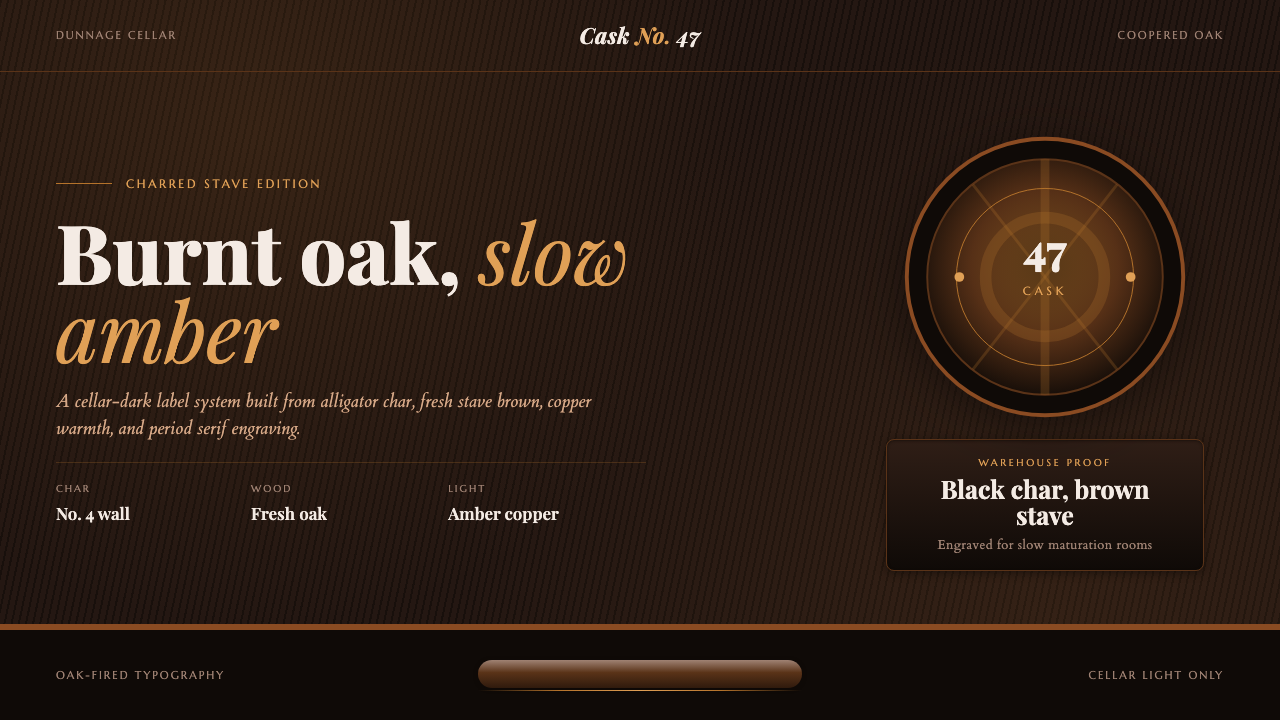 Whisky CooperageBuilt for the long dark. Charred black grounds copper hoops and engraved seri…
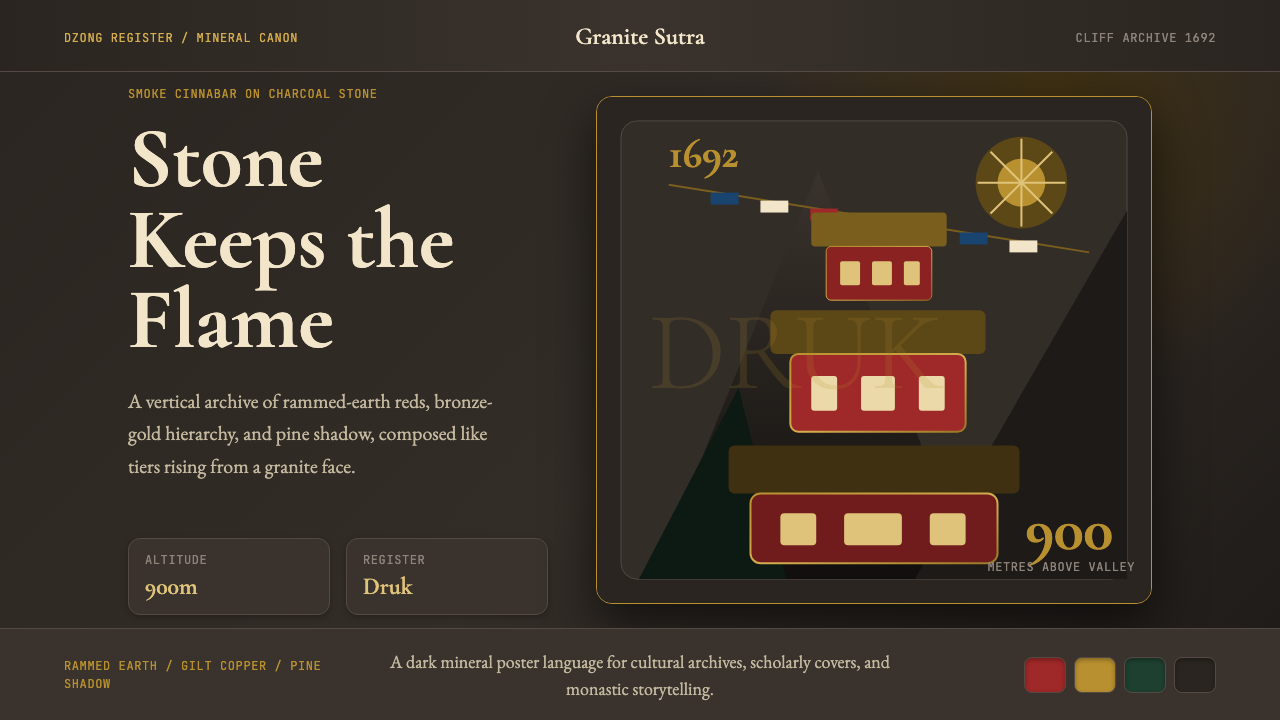 Bhutanese Tiger's Nest Cliff MonasterySacred altitude, mineral-dark. Cinnabar tiers and bronze rules climb charcoal…
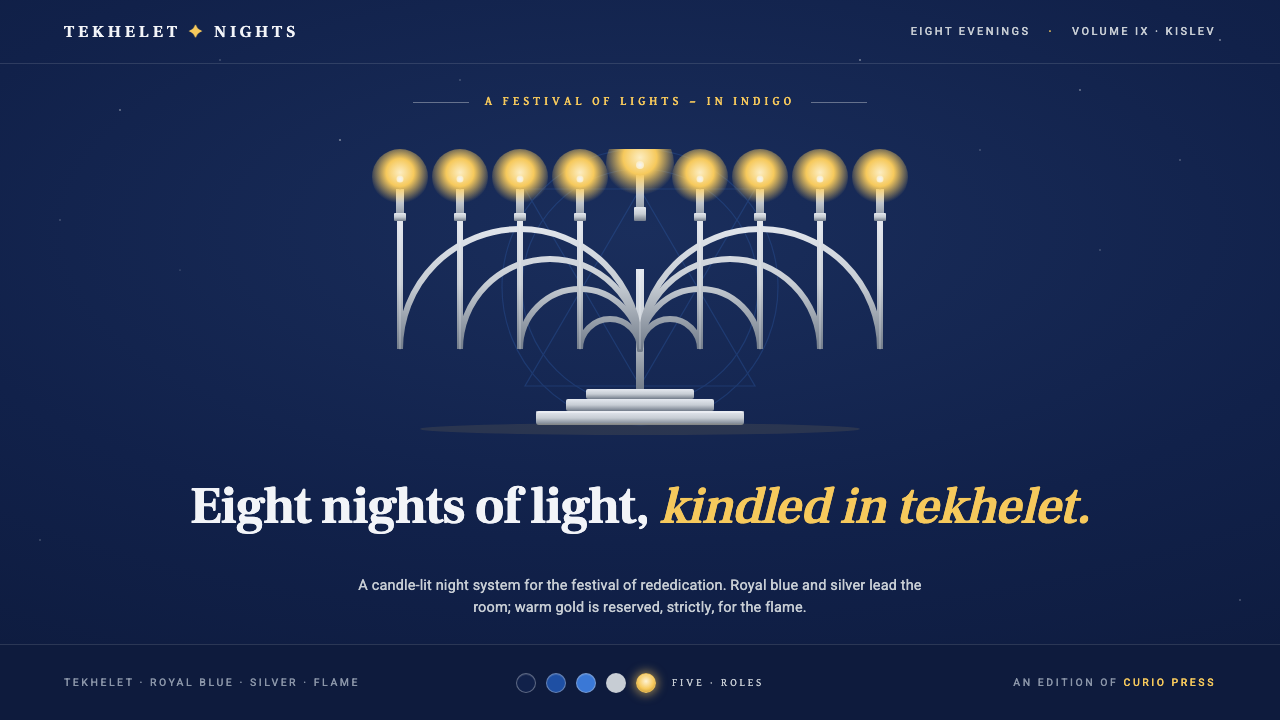 Hanukkah MenorahEight nights kindled in tekhelet. Royal blue and silver hold the dark room; g…
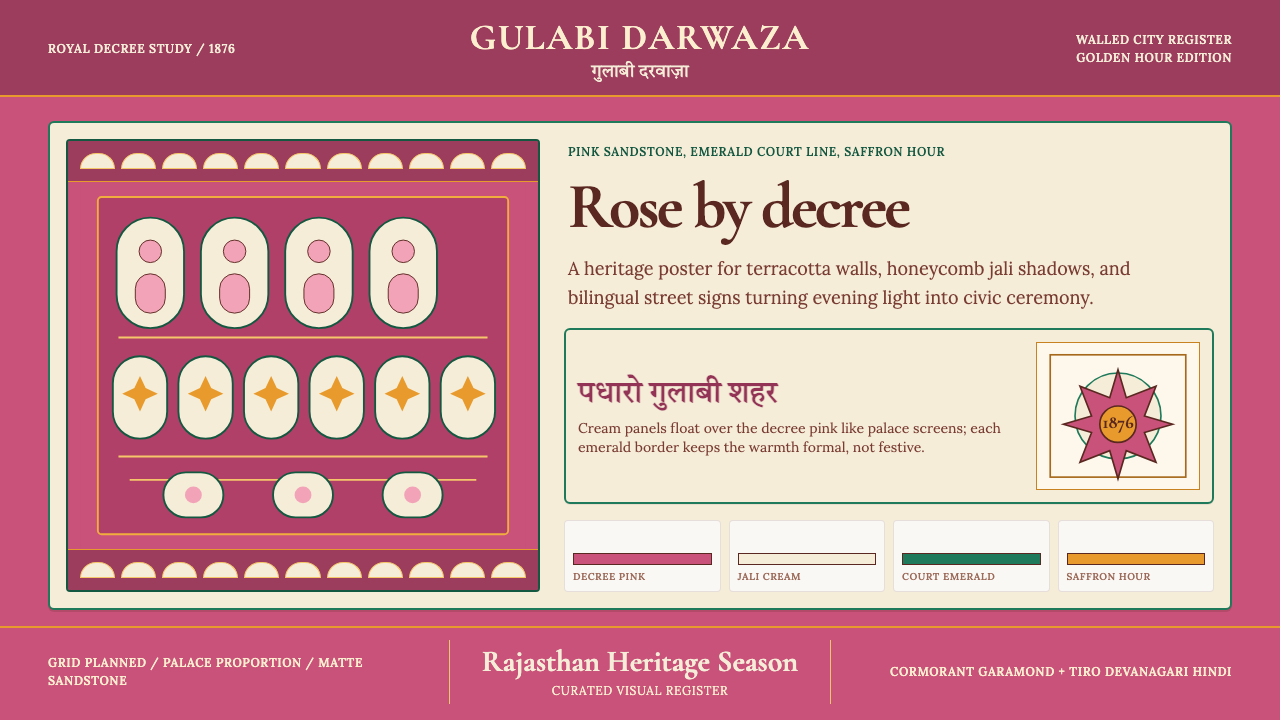 Jaipur Pink City RajasthanRoyal warmth, ordered by decree. Pink sandstone, cream jali, emerald borders.
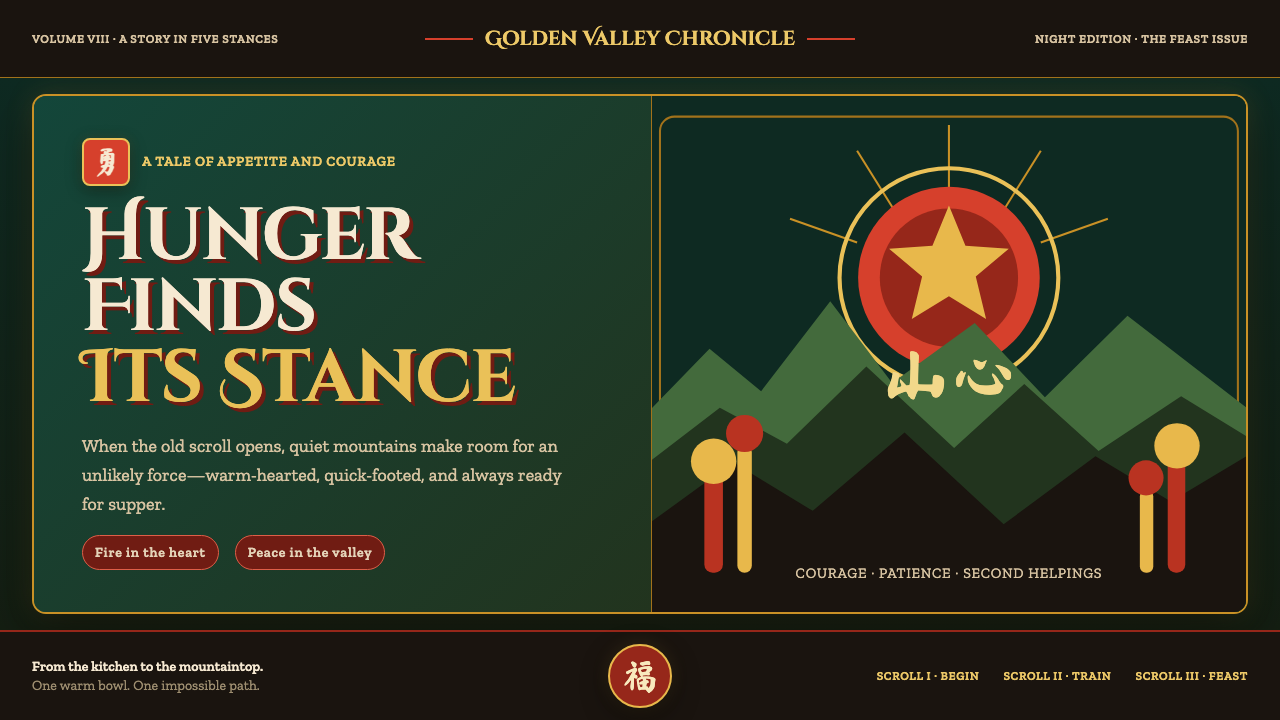 Kung Fu Panda (2008)Ancient calm meets comic momentum. Vermilion, gold and paper-cut peaks glow i…