What is Teotitlán Wool Rug?
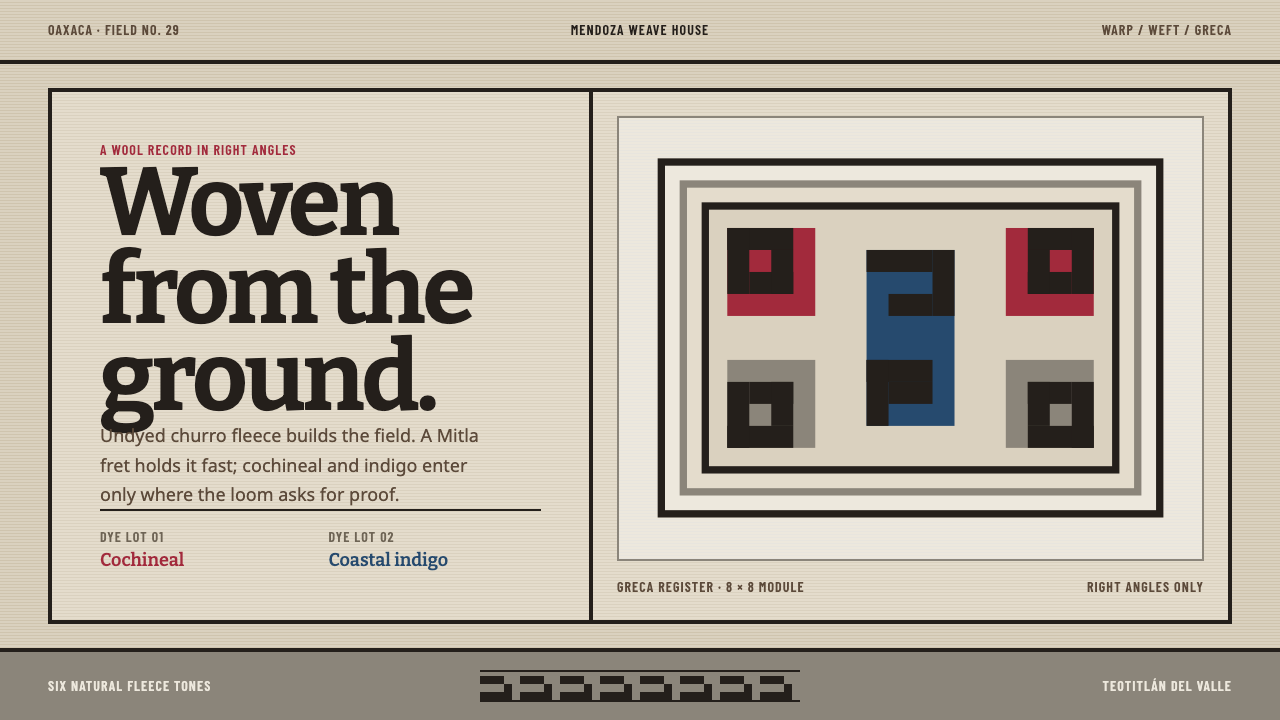
Teotitlán Wool Rug builds the page the way a Zapotec weaver builds a tapestry: undyed fleece for the ground, a stepped fret for the border, two strong dyes for colour, and right angles only, because the loom allows nothing else.
Teotitlán Wool Rug in brief
Teotitlán Wool Rug is a design system drawn from the tapestry rugs of Teotitlán del Valle, a Zapotec weaving town in the Valles Centrales of Oaxaca, Mexico. Its look is an undyed, wool-toned ground in a range of white, cream, tan, grey, brown and black; a hard-edged stepped fret border; and two vivid dye colours, a cochineal red and an indigo blue, set against it.
Its principle is that craft is structural: the construction of the object determines its form. The loom can only make right angles, so the system has no curves and no rounded corners. The wool's natural colour range supplies the neutrals, so there is no need to invent a palette. Dyes cost effort and time, so they are few, and each one carries weight. Type matches this: a sturdy slab serif with the plainness of something made to be used.
The overall impression is tactile, warm and orderly. Compositions are built around a central field framed by borders and arranged symmetrically, in the way the weaving tradition arranges them. Nothing floats; every element is locked into a grid of steps. It is a style for objects with a visible maker, and it communicates trust through the sense of something slowly and correctly made.
Where does Teotitlán Wool Rug come from?
Teotitlán del Valle lies in the Valles Centrales of Oaxaca, and its weaving tradition rests on a Zapotec base that the source dates from about 500 BCE, some 2,500 years ago. What the town weaves today is a layered inheritance: an Indigenous skill with textile, a European machine, and a market of visitors and collectors that has grown around both.
The European layer arrived in the sixteenth century. The Spanish brought churro sheep and the treadle loom, a foot-operated frame that made tapestry weaving faster and tighter. Wool is still the foundation of the craft: the fleece is handspun and used undyed, in the colours it grows — white, cream, tan, grey, brown and black — so natural variation, and even stray fibres, count as part of the pattern. In tapestry weave each colour area is built up by the weft, and the technique naturally produces stepped edges, not curves: a diagonal becomes a staircase, and a curve can only be faked as a series of steps.
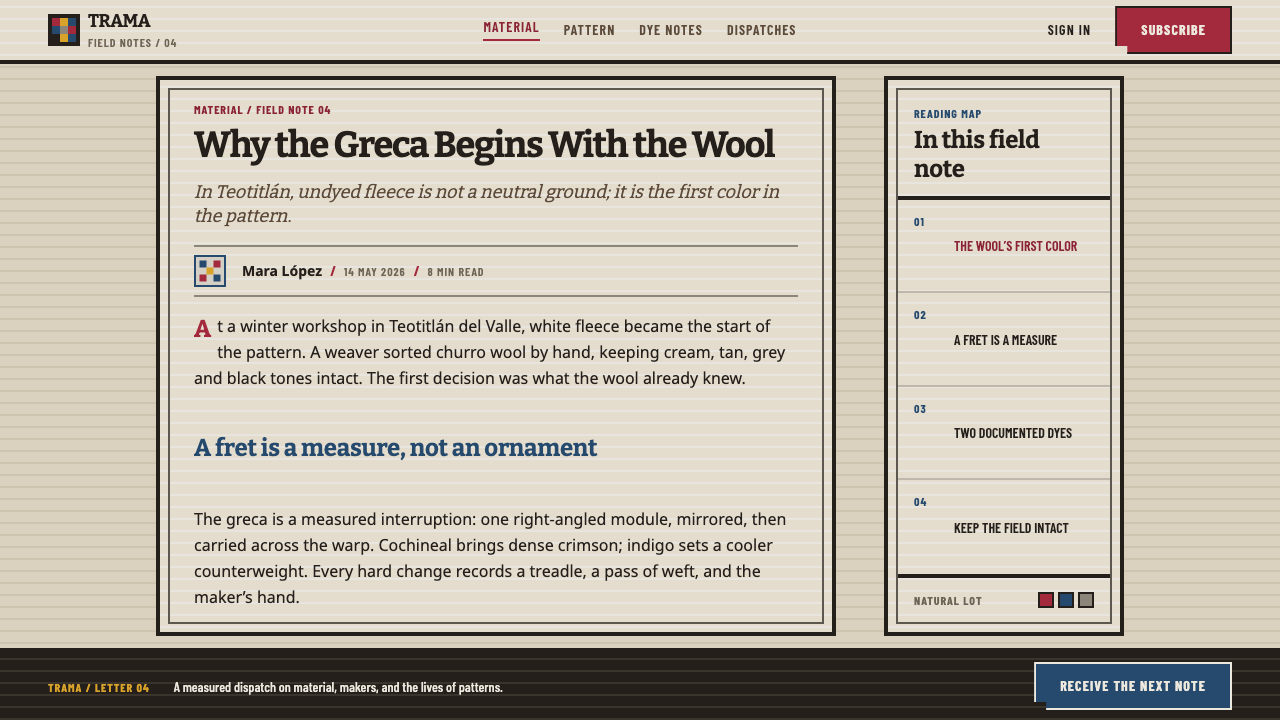
The pattern vocabulary comes from stone. About 29 kilometres away lie the ruins of Mitla, whose carved stone panels are famous for stepped geometric fretwork assembled from small cut pieces into repeating mosaic bands. Teotitlán's weavers lifted this fret directly into wool as the greca, the stepped border that frames a rug's central field. The pattern is Zapotec architecture translated into textile: right angle after right angle, one step at a time, set symmetrically around the centre.
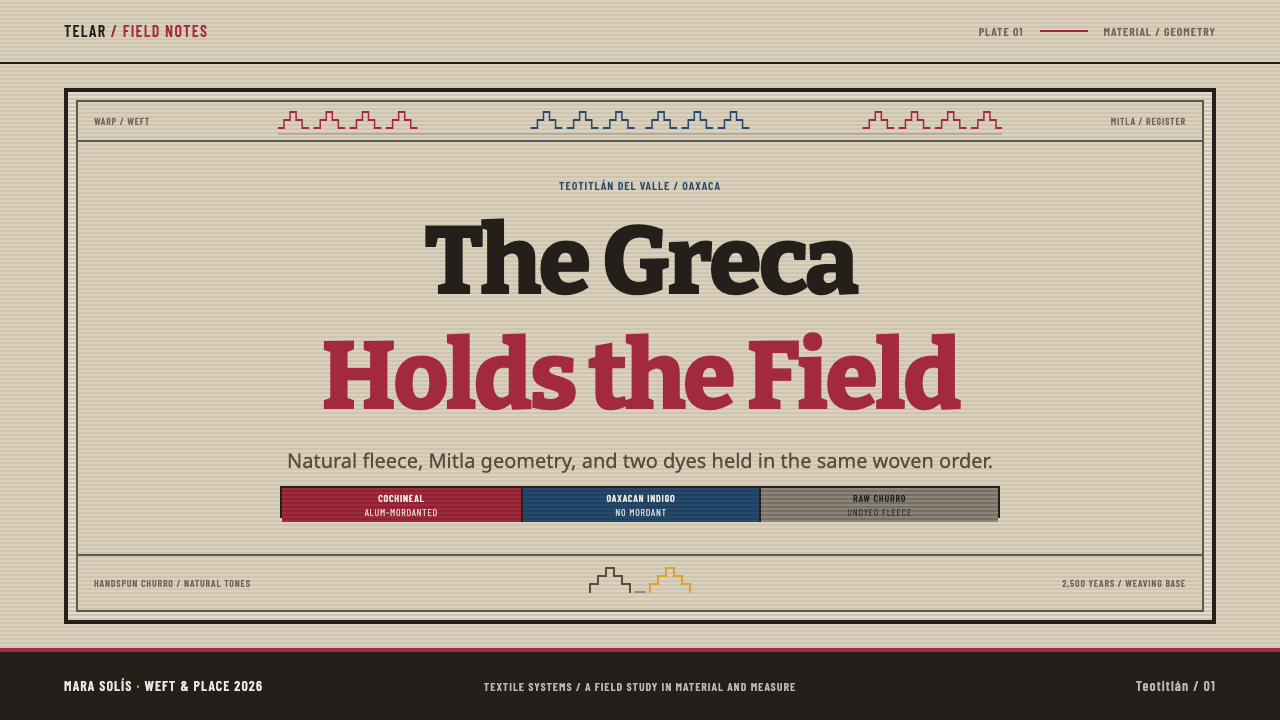
Colour comes from two dyes. Cochineal is an insect that lives on the nopal cactus, farmed for the crimson it yields, and it needs a mordant, alum, to hold the colour on the wool. Indigo from the Oaxacan coast needs no mordant. Neither can substitute for the other. The natural-dye revival, running from the 1980s to the present, in which workshops returned to these dyes, is part of what the style honours. The source lists the families Mendoza, Ruiz and Montaño and the workshop Casa Santiago among its key figures: in Teotitlán the knowledge of dye, design and loom is held by households and passed from generation to generation.
What defines the Teotitlán Wool Rug look?
Raw Fleece Ground
The ground is the colour of wool as it comes off the sheep: white, cream, tan, grey, brown and black, used undyed. These are the system's neutrals, and the slight differences between them are deliberate. A page may shift from cream to tan across a section, or carry a streak of grey, because variation in the fleece is treated as pattern, not as flaw.
Cochineal Red
One of the two strong colours is a deep crimson, the red that cochineal gives on wool. It is rich and saturated but never neon, and it works as the system's main accent: borders, key figures, the call to action. It is a colour earned by labour, and it is used the way a weaver would use it, in committed blocks rather than faint tints.
Indigo Blue
The second strong colour is a deep indigo, the dye of the Oaxacan coast. It sits opposite the red as a cool counterpart and carries secondary emphasis: dividers, secondary actions, a field behind important content. The two dyes are never blended into intermediate shades; each is a distinct material with a distinct origin, and the design keeps them distinct.
The Greca
The stepped fret lifted from the carved panels at Mitla is the system's signature ornament. It runs as a border or band, one step per unit, with hard edges and no smoothing. It frames rather than fills: its job is to mark the edge of the central field, to give a section a start and an end, and to set the rhythm of the whole composition.
Right Angles Only
The loom cannot make a curve, so the system has none. Corners are square; edges are hard; diagonals, where they occur, are staircases of steps. Even where a rounded shape would be conventional, such as a button or a card, the right angle holds. The consistency is what makes it feel made rather than styled.
Central Field and Symmetry
Compositions are arranged around a central field with the border set symmetrically around it, as a rug is. Important content sits in the centre and is protected by the frame; secondary content lives in the border zone. The layout gives a calm, centred weight quite different from the asymmetry of many modern styles, and it suits content that wants to feel settled and trustworthy.
Sturdy Slab Type
Type is a sturdy slab serif with the plainness and weight of something made to be used. It has strong, square-ended strokes that echo the stepped fret and hold well against textured or coloured grounds. Headings are bold and direct; body copy is simple and readable. The type does not decorate. It simply stands up, like the weave.
Who shaped Teotitlán Wool Rug?
The Mendoza family is listed in the source as one of the weaving households of Teotitlán del Valle. As with the other family names here, it points to the way the craft is organised: not in factories but in households, where carding, spinning, dyeing and weaving are shared among relatives and passed on. Treat the name as a pointer to a lineage rather than a brand.
The Ruiz family appears in the source alongside the Mendoza and Montaño families as a recognised name in the town's weaving. Its inclusion makes a point the design takes seriously: there is no single master of the style, and the weave belongs to a community of families whose motifs, colour preferences and techniques overlap and diverge. A faithful use of the system keeps that plurality in mind.
The Montaño family is another weaving household named in the source. Listed with the others, it represents the continuity that the natural-dye revival depends on: dyes such as cochineal and indigo survive because families keep the recipes, the supply of materials and the habits of the dye bath, not because a style guide records them.
Casa Santiago is a house or workshop name rather than a family name, and its place on the list reflects another side of the craft: the house as the place where weaving, dyeing and selling meet. Names like this are one way rugs reach buyers, with the maker's name acting as a mark of provenance. The system echoes that function in its restraint: it trusts craft to carry the page.
How do you use Teotitlán Wool Rug today?
Teotitlán Wool Rug is for work where craft, provenance and warmth are the message: handmade goods, food and drink, hospitality, cultural and educational projects, and brands that want to feel rooted rather than glossy. Its strength is a calm, structured warmth that never feels cold or corporate.
For slides, a cover can be a raw cream field with a greca border running around the edge and the title centred in the middle, with one band of cochineal red or indigo carrying a subtitle. Content slides use the same frame: central field, border on all sides or at top and bottom, content in the middle. Data slides do well with simple, stepped charts, with red and blue used as the two data series, each with a defined role, and the neutral wool tones carrying everything else. Avoid curved lines and rounded bars.
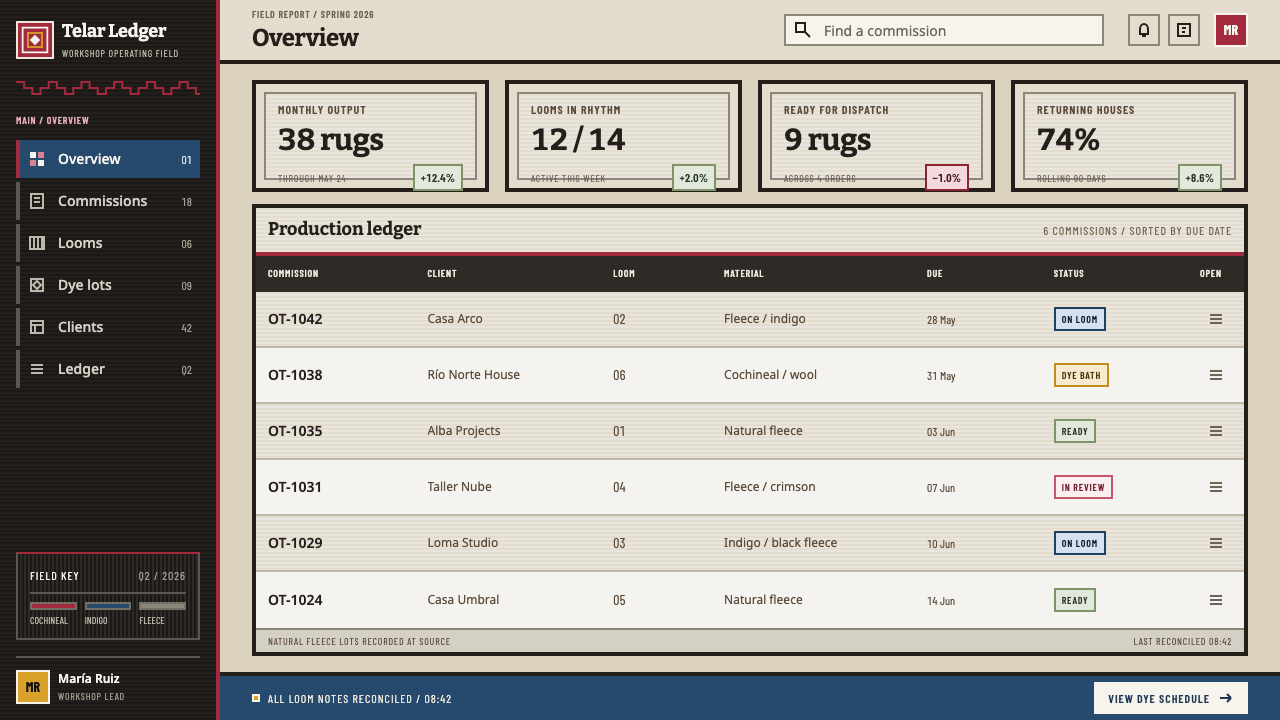
On the web, the system suits storefronts for craft goods, restaurants, boutique hospitality, cultural institutions and long-form brand pages. Buttons and cards are square-cornered; sections are framed by border bands; calls to action are cochineal red and secondary actions indigo. For dashboards, a wool-toned canvas with stepped dividers and minimal colour keeps data readable while giving it a warm tone. Pricing pages can use framed plan panels in the central-field arrangement, with the recommended plan marked by a red border band.
For editorial and marketing work, the style supports stories about makers, materials and places. Article layouts can sit on a raw wool ground with a greca band between sections and pull-quotes set as centred, framed panels. Campaign materials for craft, travel and food can use the border as a recurring identity device. The copy should be concrete about hands, dyes, wool and place: the style is believable only when the words are as specific as the weave.
The most common mistake is using the greca as generic ethnic trim or as a repeating wallpaper pattern. It is a border with a job. A second mistake is softening the system: rounded corners, gradients, drop shadows or pastel versions of the dye colours. A third is adding more colours than the two dyes; the discipline of two is what keeps the system honest. Finally, treat the cultural source seriously: this is Zapotec work from a specific town, not generic Mexican decoration, and the name should be credited wherever the style is used for more than pure abstraction.
Teotitlán Wool Rug — FAQ
Why do cochineal and indigo matter as the only two colours?
Because each is a real material with a different process, and neither can stand in for the other. Cochineal is an insect product that needs a mordant to bind to wool; indigo needs none. Their roles in the system are accordingly distinct: red for committed emphasis, blue for cool, secondary structure. Limiting the palette to the two keeps the page legible and honest.
Why are there no rounded corners?
Because the loom cannot weave a curve. Tapestry weave builds shapes thread by thread; a diagonal becomes a staircase, and a circle must be faked as a polygon of steps. The system takes that limit as a rule of form, so square corners, hard edges and stepped diagonals appear everywhere, and the page feels woven, not drawn.
Is the neutral ground a single white?
No. The ground is the full natural range of the churro fleece: white, cream, tan, grey, brown and black, used as they come. Slight differences in tone across a page are intended, as they are in a rug where uneven fleece colour and the odd stray fibre become part of the pattern.
Is this an Aztec style?
No. It is Zapotec, from the Valles Centrales of Oaxaca, and the stepped fret comes from the stone panels of Mitla, not from the Aztec world of central Mexico. Using the right name matters, both for accuracy and because generic labels tend to flatten distinct traditions into one.
Where does Teotitlán Wool Rug struggle?
It is less comfortable in contexts that want a futuristic, hyper-clean or playful voice: fintech, deep tech, gaming or children's entertainment. Its square, hard-edged geometry and restricted palette can feel rigid in interfaces that need soft, friendly interaction. It does best where warmth, provenance and a visible maker are the point.
Related design styles
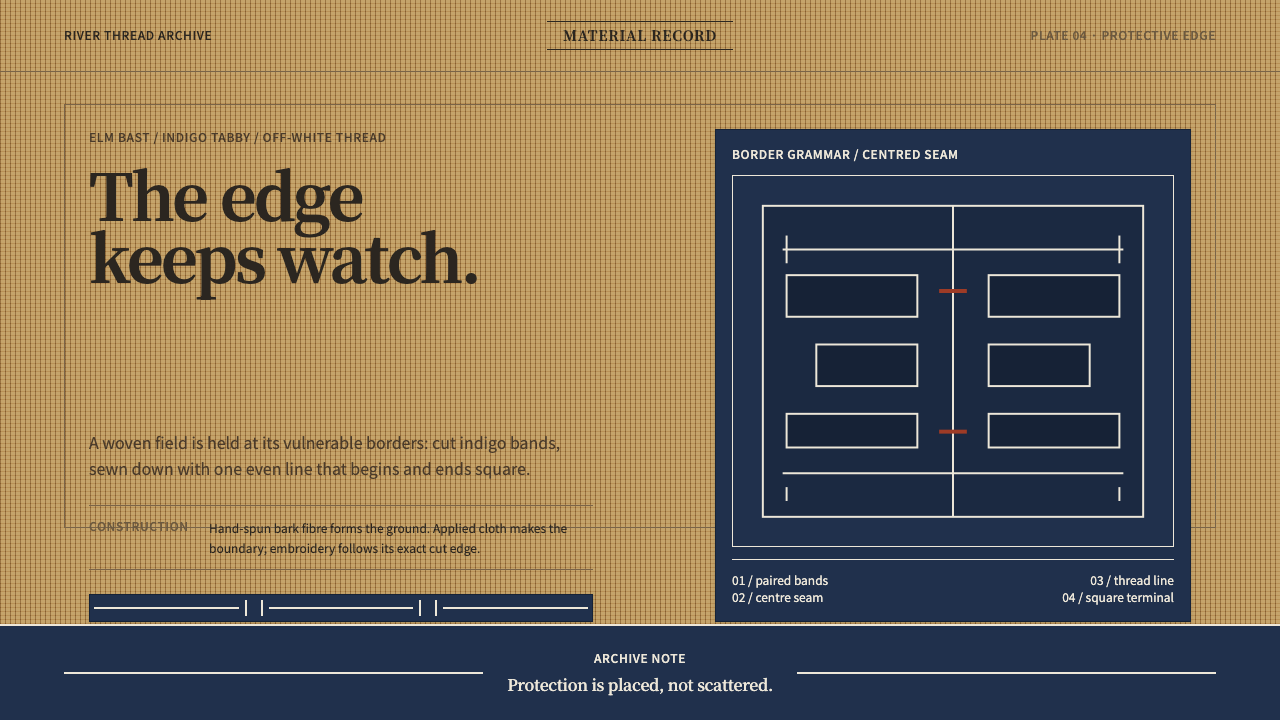 Ainu Attus RobeProtection is cut, not painted. Indigo bands and square-ended thread hold elm…
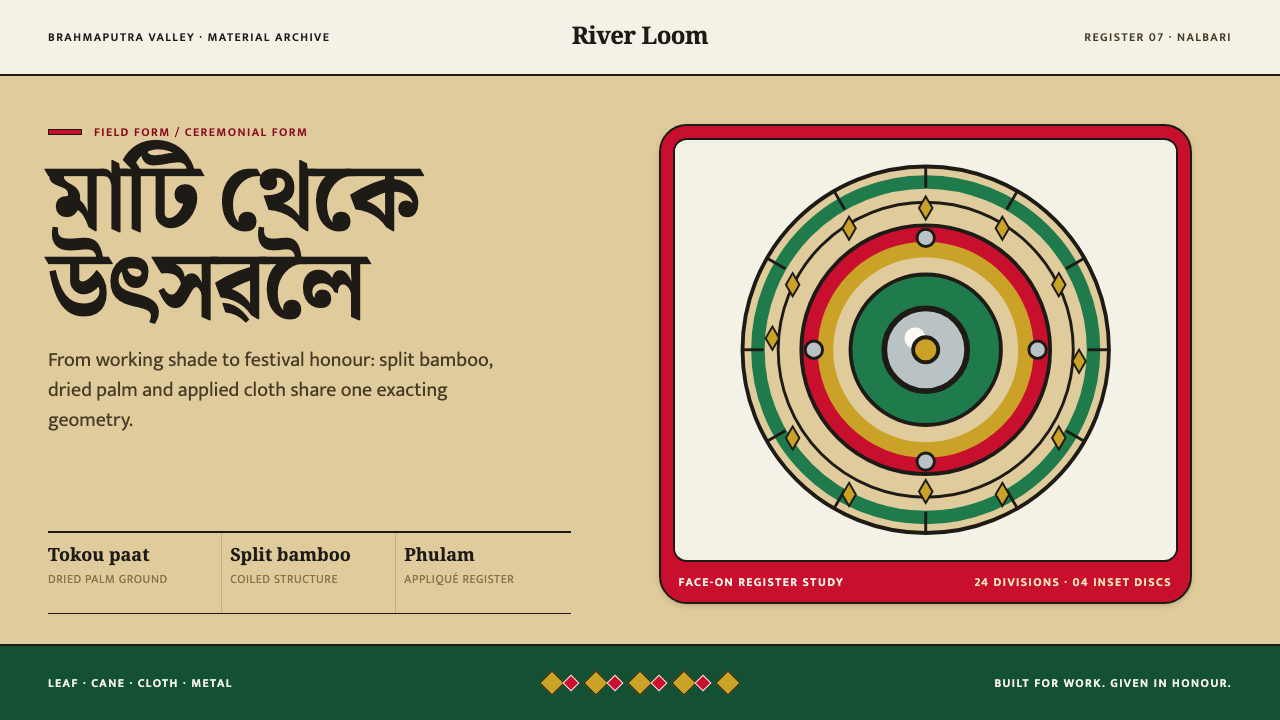 Assamese JapiWork becomes ceremony. Straw-gold rings carry green appliqué, festival red an…
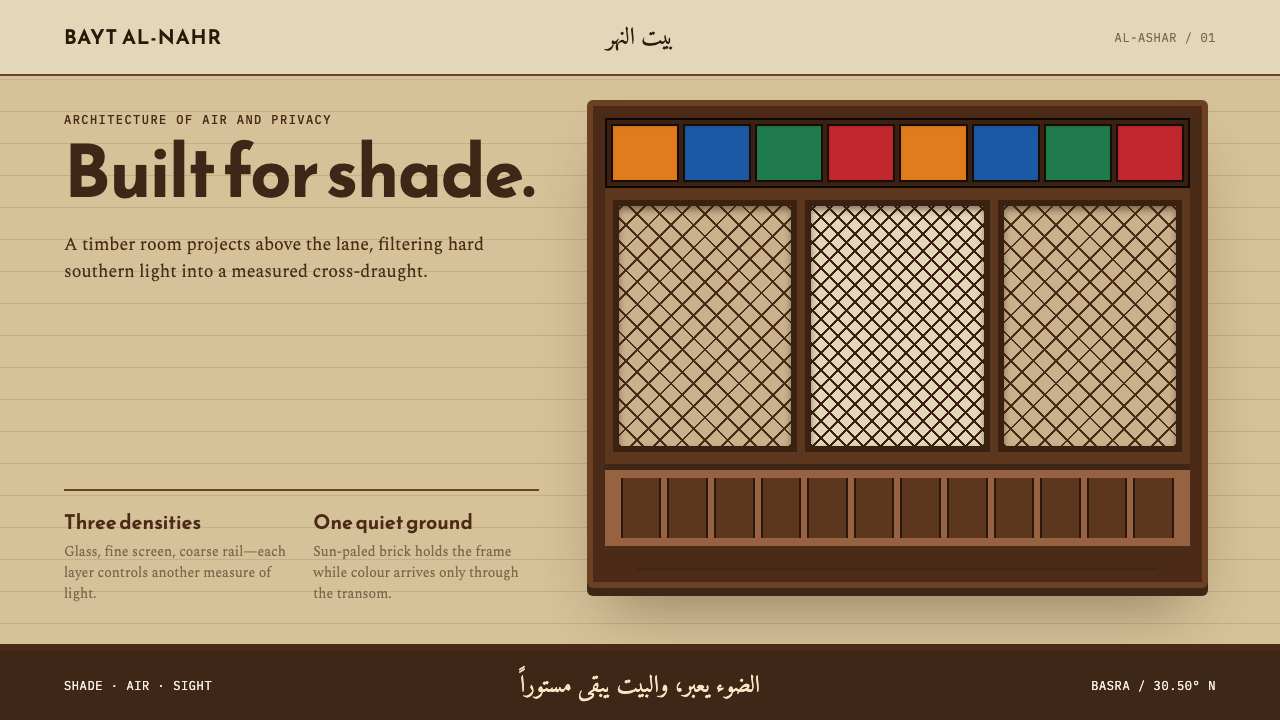 Basra ShanasheelClimate craft becomes ornament. Dark timber lattice projects over sun-paled I…
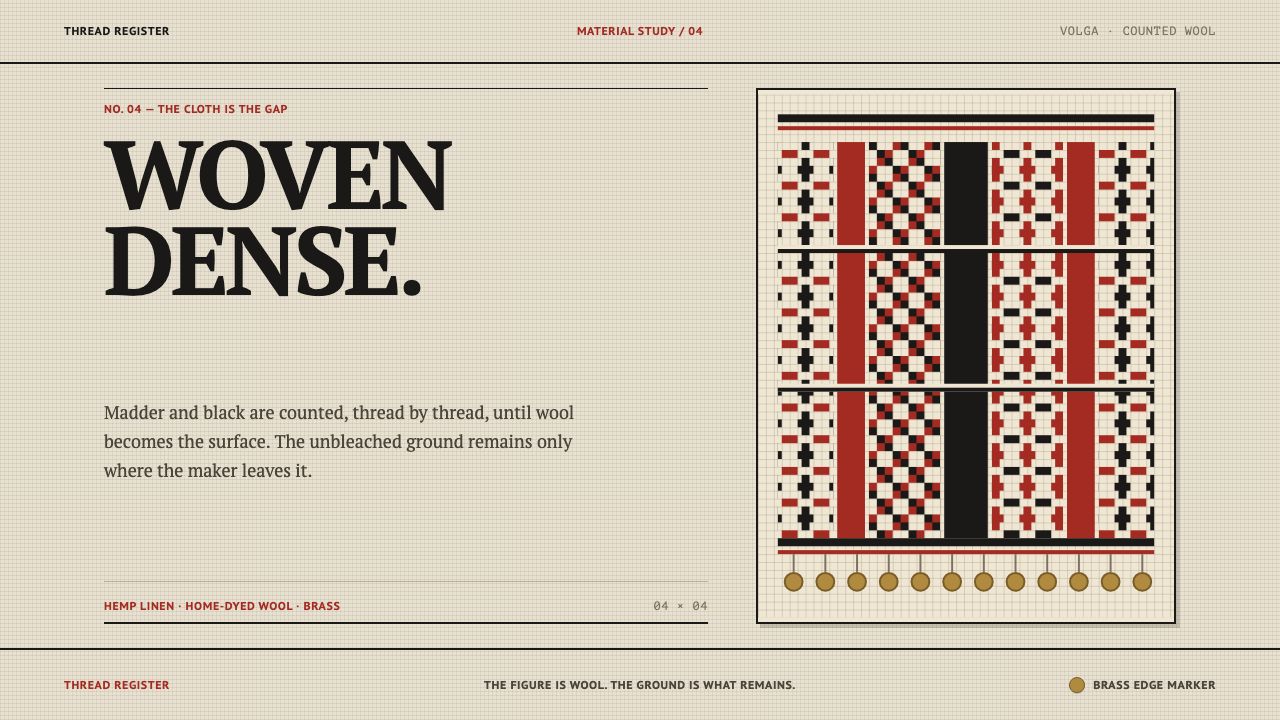 Erzya PangaDensity is the ornament. Madder and black stepped stitches crowd unbleached l…
 Fijian Masi Tapa StencilGeometry keeps ceremony. Soot-black diamonds repeat on bark beige with rust-r…
 Finnish RyijyWool holds its ground. Lamb's-grey centres meet stepped madder and indigo ban…