What is Zabid Brick Lattice?
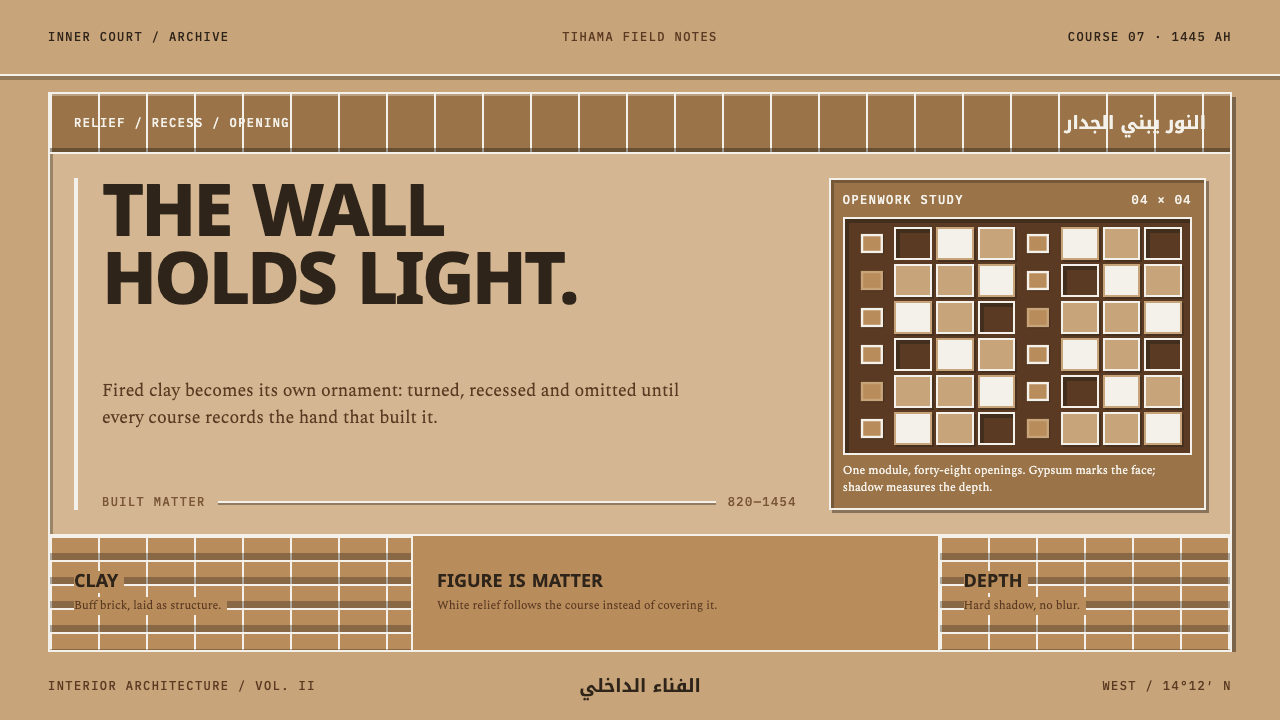
Zabid Brick Lattice builds ornament out of the wall itself — gypsum-white lattice bands stacked over sun-warmed brick, with every motif a real recess that casts a hard shadow.
Zabid Brick Lattice in brief
Zabid Brick Lattice is a design language drawn from the old brick architecture of Zabid, a historic city on the Tihama coastal plain of western Yemen. Its defining idea is that ornament and structure are the same thing. The city's builders did not paint patterns onto walls; they laid fired brick so that the wall itself became pattern, and then picked out the figure in white gypsum.
In the original technique, bricks are turned, recessed or omitted in successive courses until the façade reads as a lattice of openwork and relief. Bands of different patterns stack horizontally up the wall, each separated from the next by a plain course. The street face is deliberately bare; the richness is saved for the courtyard and the interior, where people actually spend time.
The design system keeps all three decisions. The page is a quiet buff-ochre surface, like sun-baked brick. A plain outer frame surrounds a middle zone where dense, rectilinear ornament is concentrated. Every motif casts a hard shadow, because in the source every motif is a physical recess. Depth here is not decoration; it is the proof that the pattern is built, not painted.

Where does Zabid Brick Lattice come from?
Zabid was founded around 820 under the Ziyadid dynasty, whose founder is remembered as Muhammad ibn Ziyad, and it grew into a major centre of learning and trade on the Red Sea side of Yemen. The Tihama is a hot, flat coastal plain, and the city's builders worked with what the plain provided: clay, fired into brick, and gypsum, burned and slaked into a white plaster. These two materials, warm and pale, are the entire palette of the architecture and, by extension, of the design system.
Zabid's decorative apogee came under the Rasulids, who ruled from 1229 to 1454. Rasulid patronage supported mosques, schools and houses, and the brickwork reached its most complex forms in this period. Al-Malik al-Muzaffar Yusuf I belongs among the Rasulid rulers associated with this flowering. The ornamental tradition from this era is usually described through three connected strands: Tihama courtyard architecture, Islamic geometric ornament and the broader Rasulid decorative tradition.
The method of building ornament into the wall is what separates Zabid from cultures that applied decoration to a finished surface. A mason lays brick in plain courses, then at chosen heights turns the bricks to expose their corners, sets them back to form recesses, or leaves out units to open a pierced screen. White gypsum, called nura, is then trowelled over the fired clay to draw the figure. In strong sun, each recess throws a crisp shadow, so the pattern is read through light as much as through colour. The bands are different from course to course, but a plain row of brick between them gives the eye a place to rest.
The city's religious and intellectual life added further layers of reference. The name of Abu Musa al-Ash'ari, a Companion of the Prophet, is attached to the city's early religious foundations, and later travellers such as Ibn Battuta passed through and recorded their impressions. Zabid was listed as a World Heritage site in 1993 and placed on the danger list from 2000, and about four in ten of its old houses have since been replaced by concrete. That loss gives the style a double life: it is both a living design source and a record of a built tradition under threat.
What defines the Zabid Brick Lattice look?
Buff-Ochre Brick Ground
The page surface is a warm, muted buff-ochre, like fired clay seen in strong sun. It is quiet and slightly dusty rather than saturated, which leaves room for the white figure and the dark shadow to do the expressive work. The ground feels material rather than digital, as if the screen were a wall.
Gypsum-White Figure
Pattern is drawn in a soft gypsum white laid over the brick, the way nura plaster outlines the relief on a wall. The white is slightly chalky rather than pure and glossy, so it reads as a mineral material. It is used for the lattice itself and for key linework, and the contrast between white figure and ochre ground is the system's main visual signature.
Stacked Lattice Bands
Ornament is organised in horizontal bands, each with its own repeating pattern, stacked up the page the way courses rise up a wall. A plain course separates one band from the next, giving rhythm and rest. The bands are what make the page feel built: a reader moves upward through layers, each distinct but part of the same wall.
Hard Shadow as Physical Recess
Every ornamental motif casts a crisp, sharply edged shadow, because each motif is meant to be a recess or a projection in the wall. The shadow direction is consistent across the page, as sunlight would be. These shadows are structural evidence, not softening effects, and they are what distinguish the style from flat pattern wallpaper.
Bare Frame, Dense Interior
The outer frame of the page is plain, like the street face of a Zabid house, while the middle zone carries the densest ornament. The effect is a deliberate hierarchy of attention: the edges are calm and the centre rewards close looking. This also gives a practical layout rule, which is to put decoration where the reader is and leave the perimeter quiet.
Rectilinear Geometry
Patterns are built from right angles, diagonals and repeated squares, as brick allows. Curves are rare and, when present, are made of stepped units rather than smooth arcs. This rectilinear logic follows the grid of the brick course and echoes the tradition of Islamic geometric ornament, giving the style an orderly, mathematical calm.
Ornament Is Structure
In the source, the pattern and the wall are the same thing, built by turning, recessing and omitting bricks. In the interface this becomes a rule: borders, dividers and decorative bands should also do structural work, such as separating sections, framing content or marking states. A decorative element that has no job is out of place here.

Who shaped Zabid Brick Lattice?
Remembered as the founder of Zabid around 820 and of the Ziyadid dynasty that ruled from it. His foundation gave the city its place on the Tihama plain, and with it the brick and gypsum building tradition on which the style rests.
A sultan of the Rasulid dynasty, which ruled from 1229 to 1454, the period of Zabid's ornamental flowering. His name stands for the patronage that supported mosques, schools and houses, and thereby for the most elaborate phase of the city's brick decoration.
A Companion of the Prophet whose name is attached to the early religious foundations of Zabid. He represents the city's deep religious and scholarly identity, which is part of why its architecture reads as serious, ordered and inward-looking.
The travelling scholar who passed through Zabid and left an account of it. As a witness from outside, he stands for the way the city was seen by visitors: a place of learning and trade whose beauty was discovered inside its walls rather than on its street face.
How do you use Zabid Brick Lattice today?
Zabid Brick Lattice is a structural style, so it works best when the layout itself is built from bands and courses rather than when a pattern is merely placed on top. It is calm, warm and craft-minded, suited to subjects that benefit from patience and detail. The key habit is to keep the edges quiet and let the ornament live in the middle.
For presentation slides, use the buff-ochre ground with a plain outer margin and a central content zone. A cover can carry a single lattice band under the title, and content slides can be divided by plain courses into two or three stacked sections. Data slides suit stepped bar charts, tables with strong horizontal rules and diagrams drawn in white against the ochre. Use hard, consistent shadows on key blocks only, so the effect of depth stays meaningful.
For web interfaces, the style fits cultural heritage sites, architecture and craft portfolios, hospitality and travel brands, and documentation or reading tools that want a grounded, material feel. Keep headers and footers plain, and put decorative bands in section dividers, hero strips and card headings. Cards and buttons can use hard-edged offset shadows to suggest recess or relief, and interactive states can shift the shadow or the band rather than add colour. Because the ground is warm and mid-tone, check text contrast carefully and favour a dark brown or near-black for body copy.
For editorial and marketing work, it supports travel writing, architectural features, cultural essays, craft brands and anything about place and material. Photography of brickwork, courtyards and light on walls matches the palette naturally. Horizontal pattern bands can serve as chapter breaks in long articles, and a single lattice strip can give a poster or brochure cover a quiet identity.
The most common mistake is to treat the lattice as a texture and spread it over the entire page, which destroys the hierarchy between bare frame and dense interior. Another is using soft, blurred shadows, which turn recess into floating cards; the shadow must stay hard and directional. Over-brightening the ground into clean white, or the gypsum into a glossy pure white, loses the mineral quality. Finally, remember the source is a threatened living heritage; use the vocabulary respectfully and credit Zabid where it fits.

Zabid Brick Lattice — FAQ
Where and what is Zabid?
Zabid is a historic city on the Tihama coastal plain of western Yemen. It was founded around 820 and became an important centre of learning and trade, with its ornamental peak under the Rasulids between 1229 and 1454. It was listed as a World Heritage site in 1993 and has been on the danger list since 2000.
What does it mean that ornament is structural?
In Zabid the decorative pattern is made by the way bricks are laid: turned, recessed or left out. There is no separate decorative layer on top. For design, it means that borders, bands and shadows should do real organising work, such as separating sections or marking depth, rather than serving as surface decoration.
Why are the shadows hard-edged?
Because each motif represents a physical recess in a wall lit by strong direct sun. Strong sun produces crisp shadows with clear edges, and the pattern is partly read through them. Soft, blurred shadows would suggest floating objects instead of recesses and would break the logic of the system.
Can the style handle text-heavy pages?
Yes, as long as the ornament stays in bands and frames and not behind the text. The bare outer frame and plain courses give long-form reading room to breathe, and dark text on the quiet ochre ground can be comfortable. Check contrast carefully, since the ground is a mid-tone, and avoid placing lattice patterns directly under paragraphs.
How should the cultural source be handled responsibly?
Zabid's architecture is a living heritage, and a large share of its old houses has already been lost. Use the style as inspiration for structure and light, not as a generic exotic backdrop. Where it fits, name Zabid and the Tihama tradition in credits or about pages, and avoid combining the vocabulary with unrelated clichés.
Related design styles
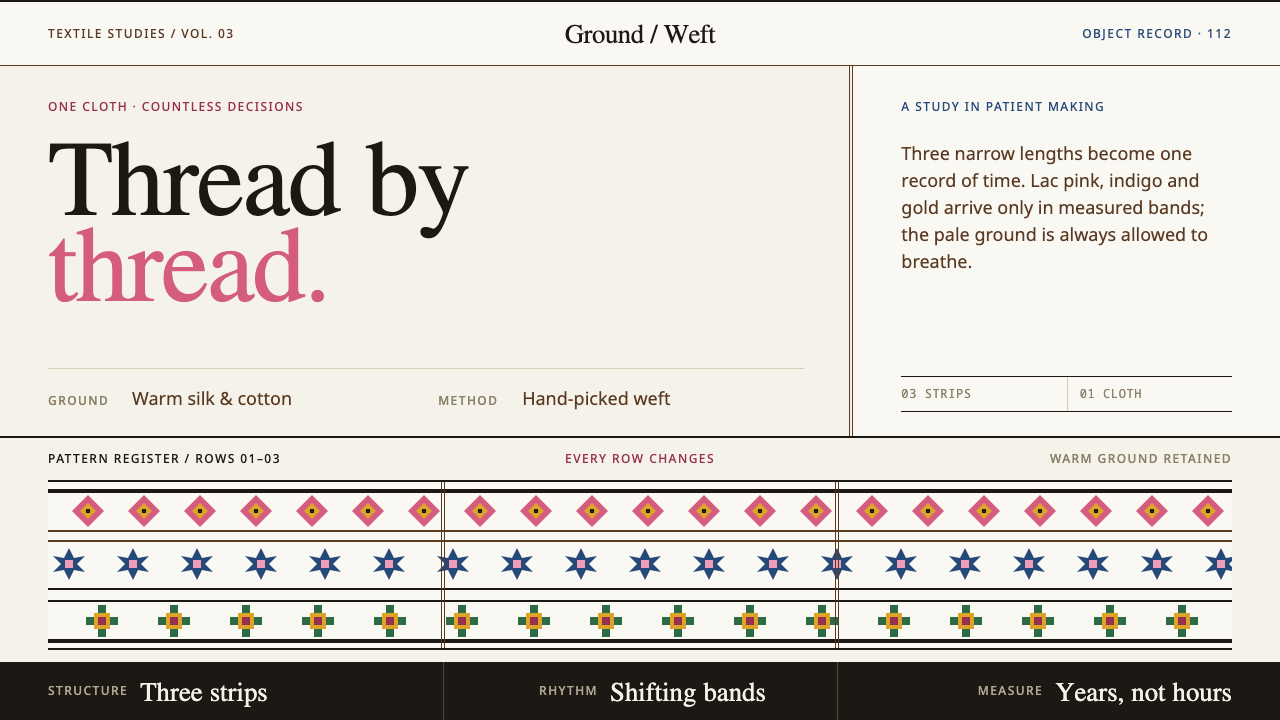 Bhutanese KushutharaPatience made visible. Lac pink and indigo bands shift across a warm silk gro…
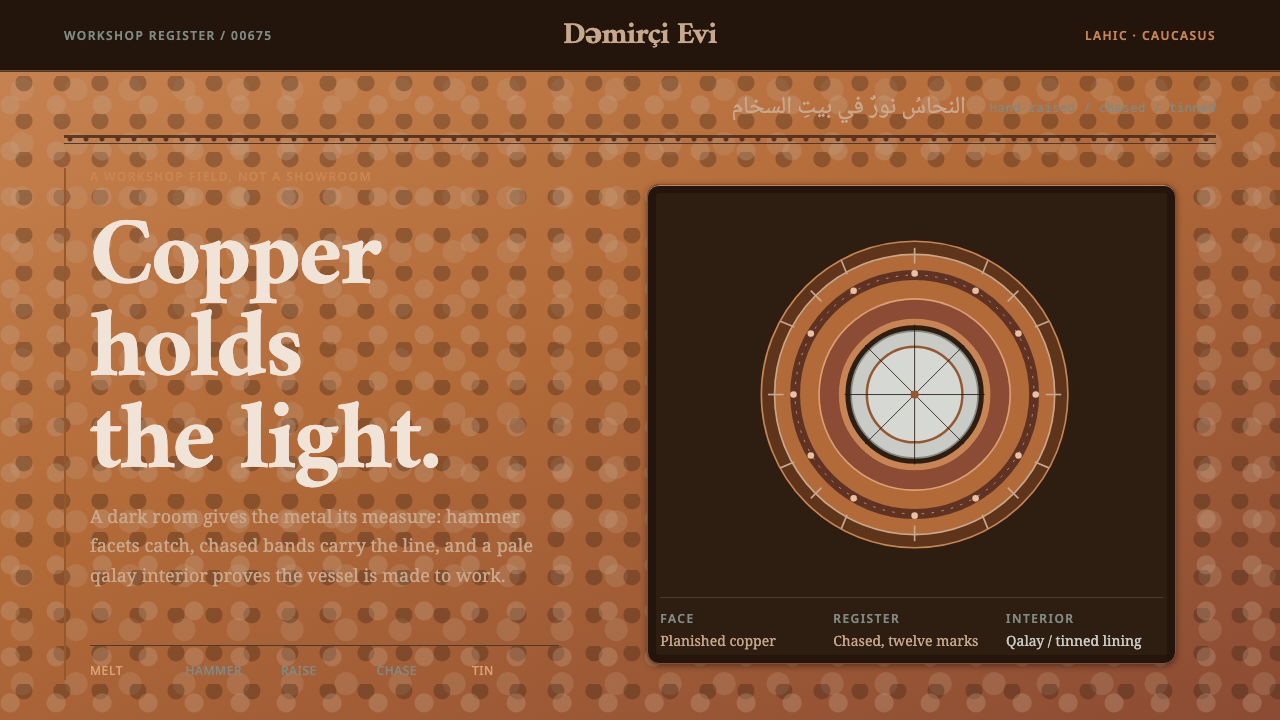 Lahic CoppersmithCopper becomes light. Soot-black bands, Amiri type, hammer facets and tin rev…
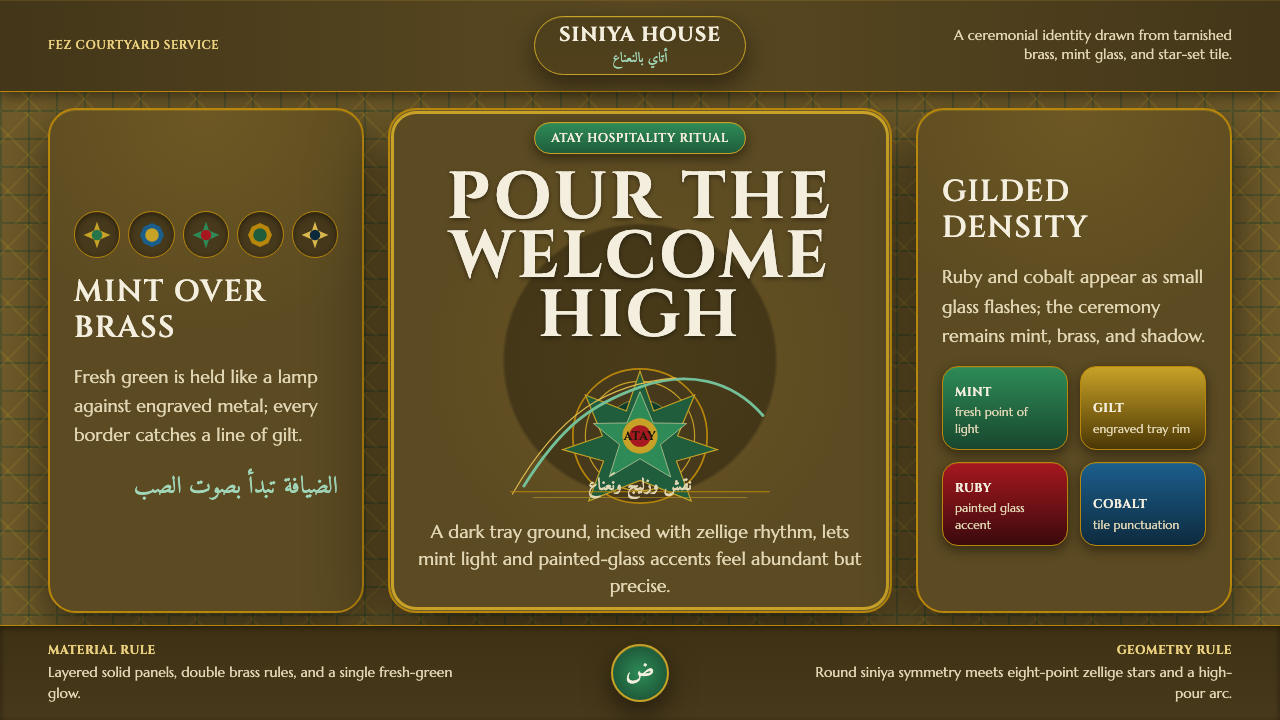 Moroccan Mint TeaCeremony glows in brass. Mint green, Cinzel type, and zellige geometry frame…
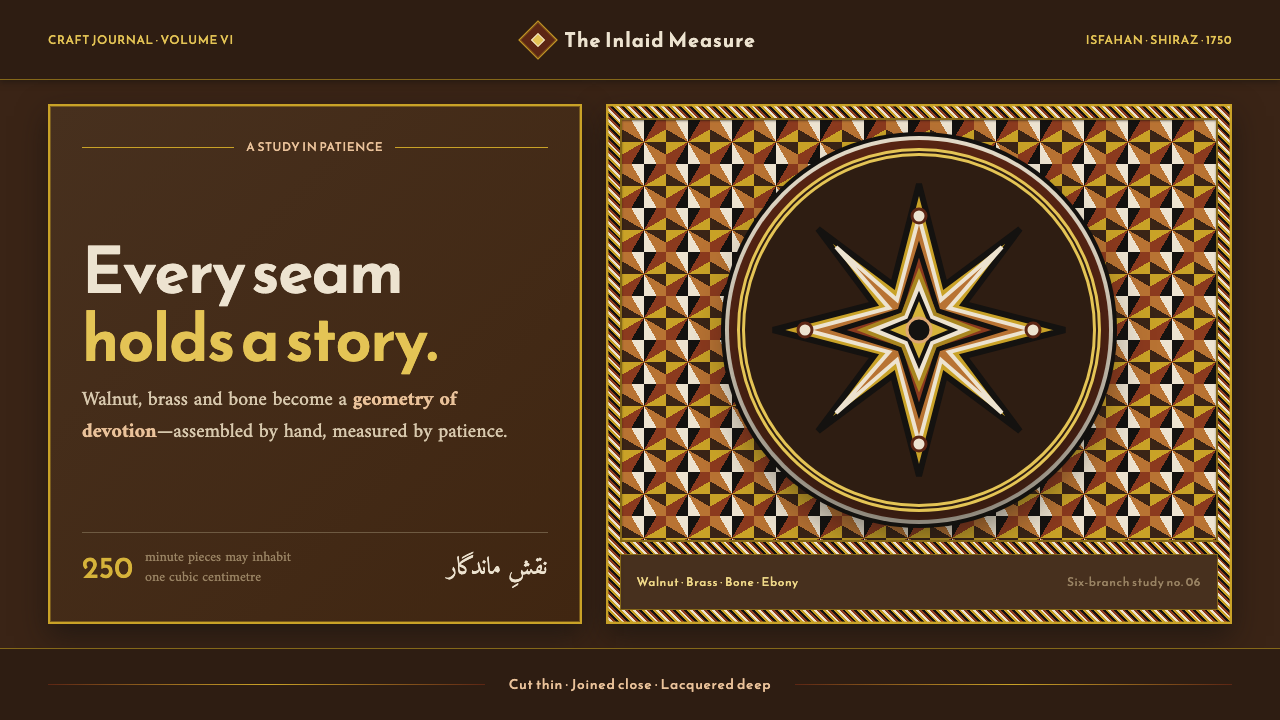 Persian Khatam MarquetryPatience becomes pattern. Brass-and-bone stars tessellate across lacquered wa…
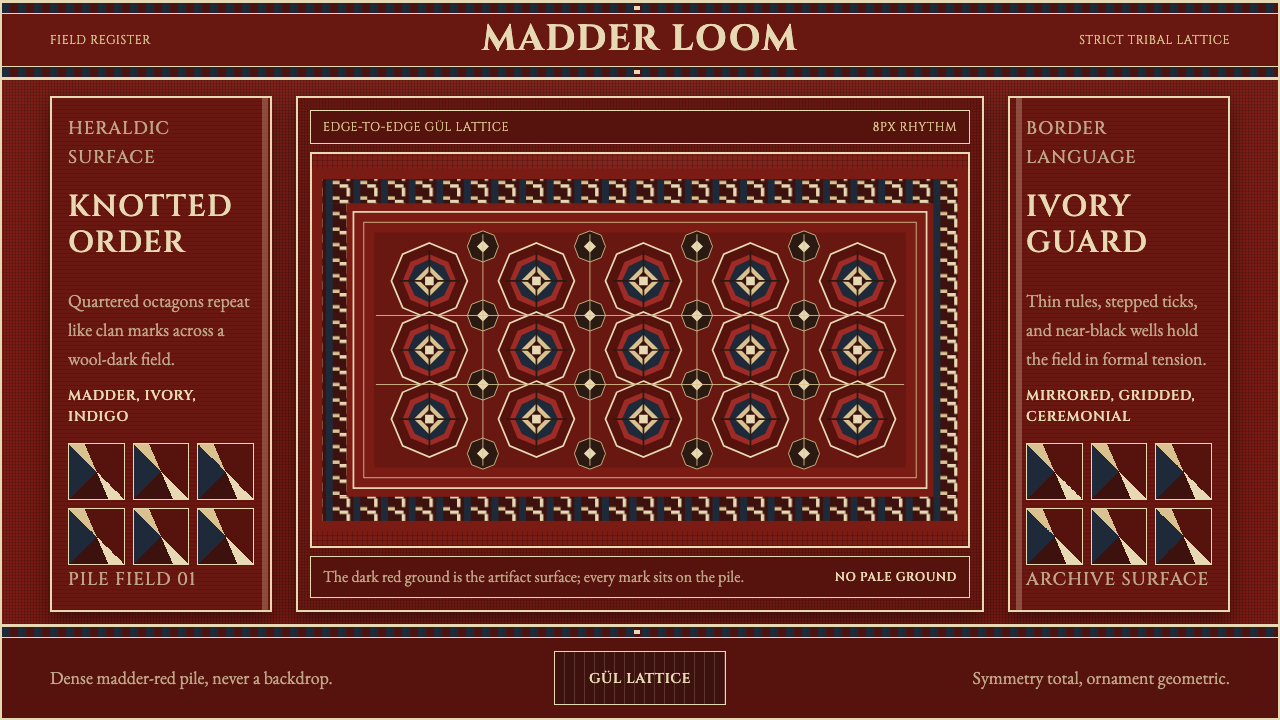 Turkmen Bukhara RugHeraldic and earthbound. Madder red, ivory hairlines, and octagonal güls lock…
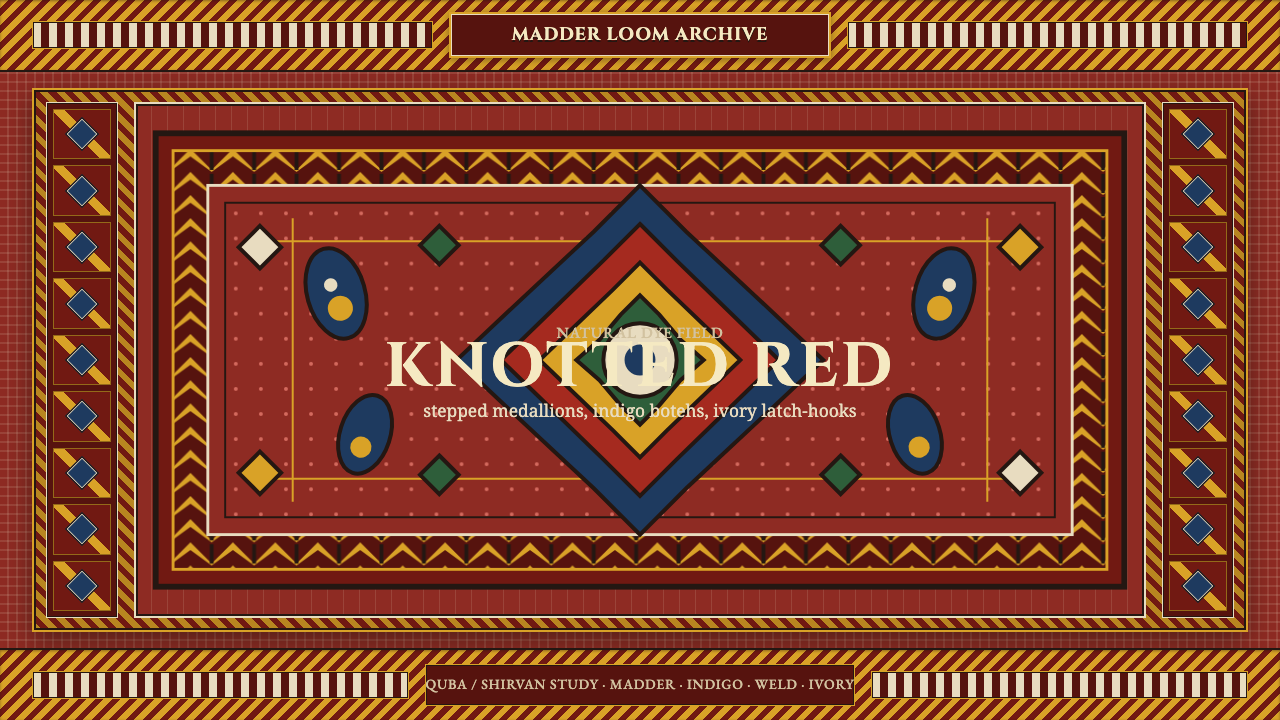 Azerbaijani Quba CarpetRed is the field. Indigo botehs and ivory latch-hooks orbit a stepped medalli…