What is Persian Khatam Marquetry?
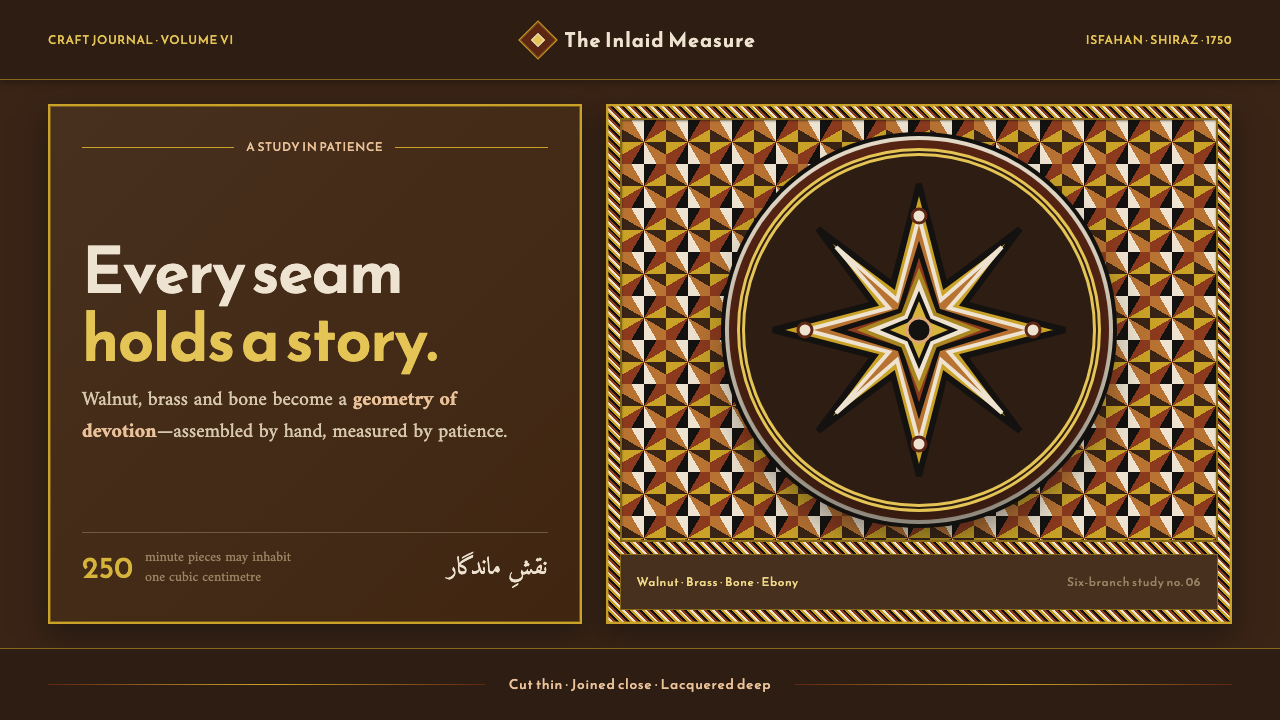
Persian Khatam marquetry turns patience into pattern: brass-and-bone stars tessellate across lacquered walnut until the surface seems to hold an entire geometric sky.
Persian Khatam Marquetry in brief
Khatamkari is the micro-mosaic marquetry tradition associated with Isfahan and Shiraz in Persia, now Iran. Its visual effect comes not from painted decoration but from the repeated assembly of extremely thin rods made from walnut, brass, camel bone, and ebony. These rods are bundled, glued, and sliced across their length, revealing small radial star structures that can be fitted together into hexagonal fields.
The finished object is defined by density. A single star is not an isolated emblem placed on a surface; it is one unit in a larger tessellation, surrounded by further stars, borders, seams, and geometric repetitions. At its finest, Khatam can contain roughly two hundred and fifty pieces within a cubic centimetre. The viewer encounters a brown-and-gold kaleidoscope whose apparent complexity is built from disciplined repetition.
Visually, Khatam is dark, luminous, and exacting. Lacquered walnut provides the dominant field, while brass catches light with warmth and camel bone creates pale flashes inside the structure. Ebony deepens the pattern's recesses. Every seam is evidence of a rod, every star a radial meeting of materials. The result is neither illustration nor loose ornament: it is geometry made tactile.
Where does Persian Khatam Marquetry come from?
Khatamkari belongs to the decorative-arts culture of Persia, with Isfahan and Shiraz identified as its principal centres. The tradition is Safavid-rooted and was perfected under the Safavids, from the sixteenth century onward. Its historical setting matters because Khatam is not simply a visual motif that can be detached from making: the appearance of the finished surface depends directly on the preparation, bundling, slicing, and fitting of its component materials.
The craft begins with rods rather than sheets. Walnut, brass, camel bone, and ebony are reduced into hair-thin linear elements, then arranged so that their cross-sections will form stars and related geometric units after cutting. Bundling is therefore a form of design. The artisan must anticipate a complete pattern before the material is sliced, because the visible face of the work is embedded inside the assembled bundle from the beginning.
Once the bundle has been glued and cut, the resulting pieces can be set into repeating hexagonal arrangements. This process gives Khatam its distinctive radial logic: stars are generated through construction, not drawn onto the object afterward. The pattern is inseparable from the material itself, and its disciplined regularity is the accumulated result of many tiny joins rather than a broad decorative gesture.
By around 1750, Khatam stood within a living Safavid-rooted tradition rather than a closed historical episode. Isfahan bazaar guild masters and Shiraz inlay ateliers carried the practice through workshop knowledge, material handling, and close control of geometric repetition. That continuity remains central to the style's identity: Khatam is best understood as Persian marquetry and intarsia whose visual language emerges from craft procedure.
What defines the Persian Khatam Marquetry look?
Dark Walnut Ground
Khatam begins from a dark lacquered walnut field, never a pale empty ground. Brown is not merely background color; it is the visual atmosphere that allows brass and bone to read as concentrated points of light. The darkness makes the geometry feel embedded, intimate, and materially substantial.
Radial Stars
Six-branch stars are the central visual event. Their power comes from radial convergence: different materials travel toward a shared centre, then repeat outward across the field. The star is not a decorative icon floating above the surface. It is a structural consequence of bundled rods and carefully exposed cross-sections.
Hexagonal Tessellation
Stars are packed inside hexagonal arrangements, giving the surface a continuous rather than pictorial rhythm. The eye does not stop at a single motif; it travels through linked units, borders, and seams. This tessellation produces visual abundance while preserving strict order, because every repetition remains answerable to the same geometric system.
Material Contrast
Walnut, brass, camel bone, and ebony are legible as distinct participants in the pattern. Brass contributes warm metallic light; camel bone creates pale clarity; ebony strengthens shadow; walnut binds the composition with brown depth. The palette is therefore material-led rather than painted, and its variation comes from substance, grain, reflection, and polish.
Micro-Scale Precision
The characteristic density of Khatam gives it a peculiar visual tension: from a distance, the surface reads as a unified geometric shimmer; at close range, it resolves into countless individual rods and joins. This shift between whole and fragment is essential. The work rewards slow looking because its pattern is both immediately legible and technically inexhaustible.
Lacquered Finish
Lacquer gives the completed surface visual cohesion. It gathers wood, metal, bone, and ebony beneath a shared sheen without erasing their differences. The finish should feel polished and deep rather than cloudy or soft. Its role is to make the surface read as a single composed field while preserving the precision of every seam.
Who shaped Persian Khatam Marquetry?
The guild masters of the Isfahan bazaar represent the workshop-based custodianship of Khatam. Their importance lies in the sustained transmission of material preparation, geometric assembly, and fine fitting. In this tradition, expertise is visible not through a signature image but through the coherence and density of the completed marquetry surface.
The inlay ateliers of Shiraz form the other principal workshop context named for Khatamkari. They situate the style within a regional culture of Persian marquetry rather than a single isolated object type. Their work reinforces the central lesson of Khatam: decorative richness is produced through repeatable construction and close material discipline.
Safavid decorative arts provide the historical framework in which Khatamkari was perfected. The tradition's continuing relationship to this framework explains its preference for ordered geometry, rich material contrast, and painstaking surface construction. Khatam is therefore not only a pattern vocabulary but part of a longer decorative-arts lineage rooted in Persian making.
How do you use Persian Khatam Marquetry today?
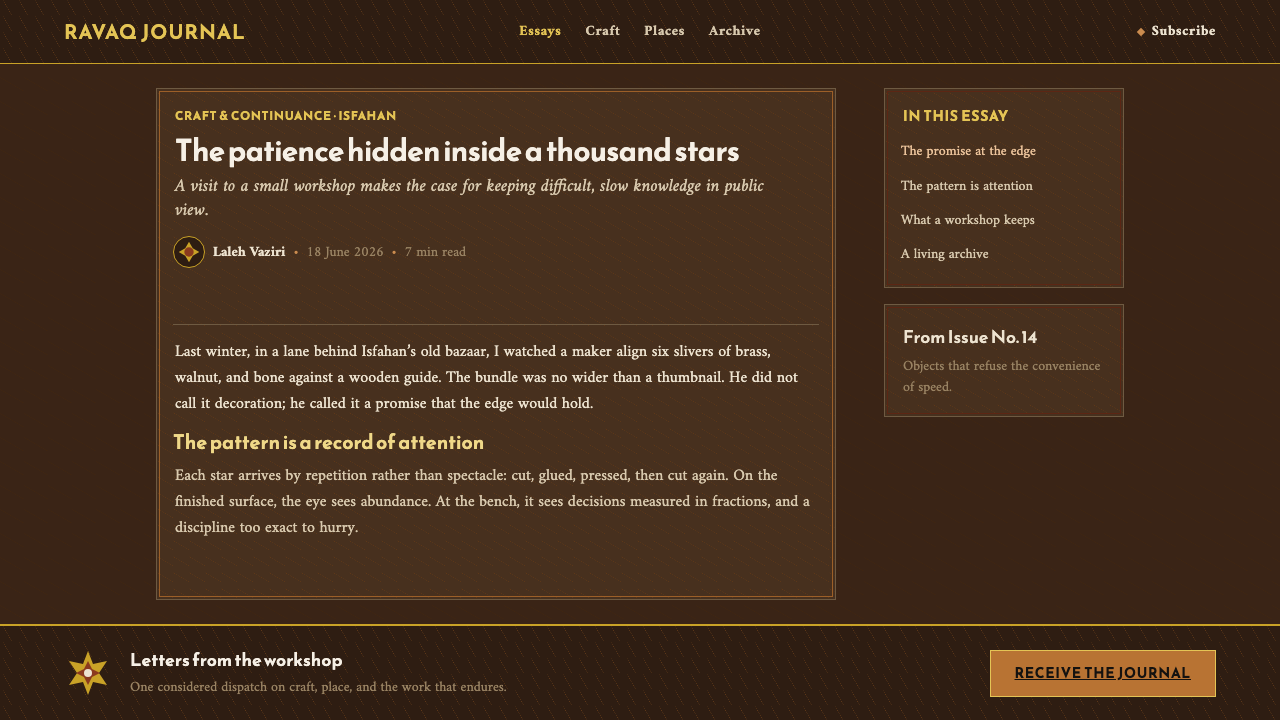
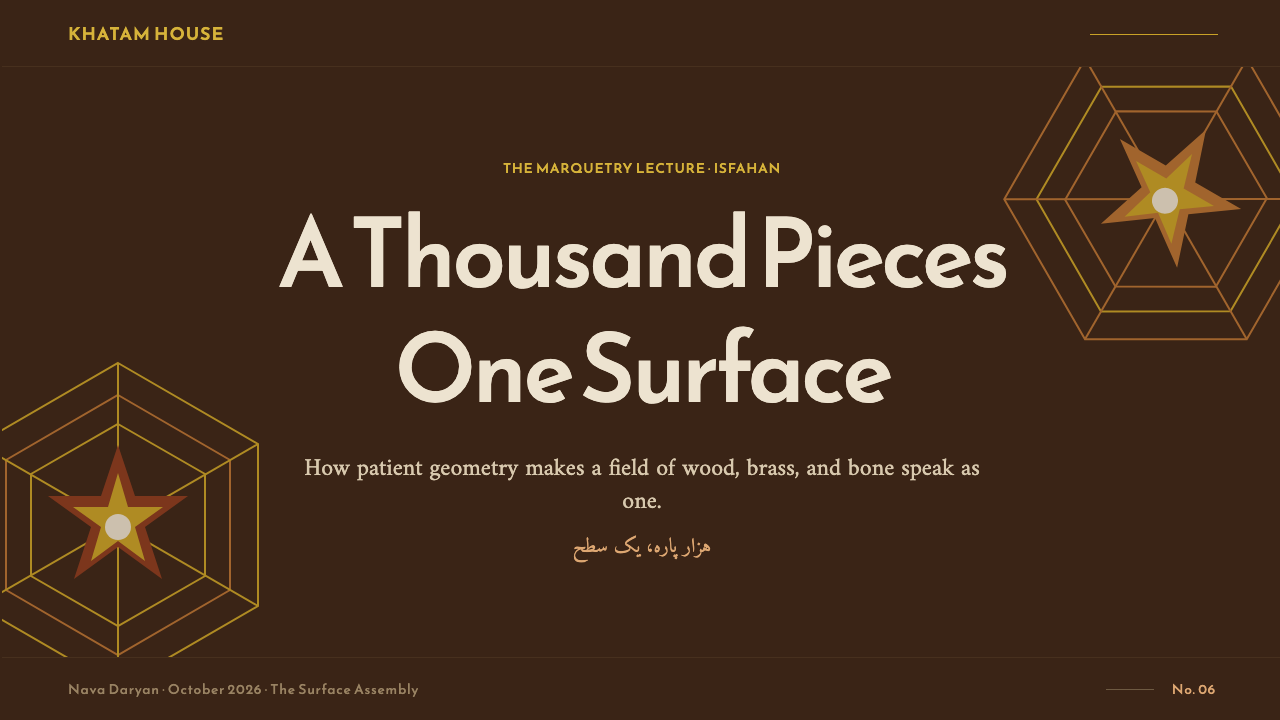
A Khatam-inspired presentation should use the style as a frame of attention rather than as wallpaper. On a cover slide, a dark walnut-like field can support a concentrated star or hexagonal panel, with the title held in a calm, generous area nearby. Let the geometric inlay establish ceremony and depth, then allow the information to remain readable rather than competing with the pattern.
For content and data slides, use Khatam logic selectively. A fine geometric strip can organize a section break, and brass-and-bone contrast can distinguish key categories, while charts should remain simple enough to scan. The useful lesson is not to turn every graphic into a star field; it is to create repetition, material contrast, and a clear relation between small details and the larger composition.
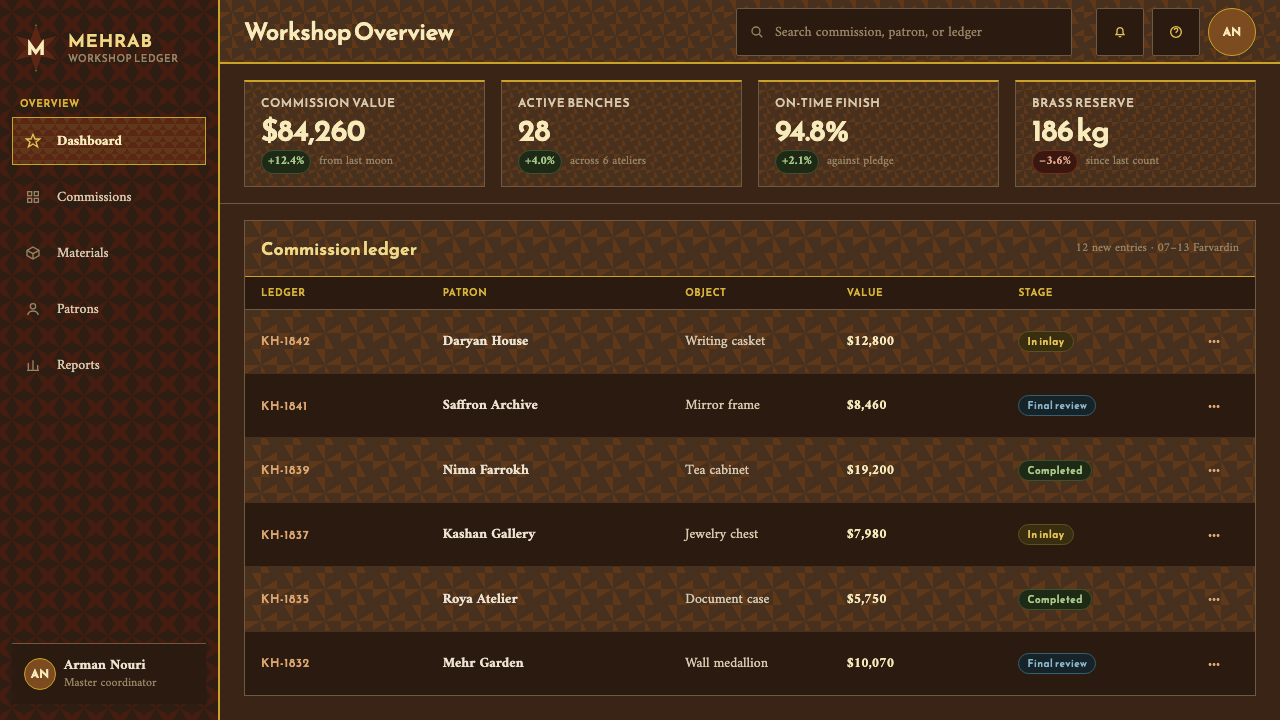
On web interfaces, the style works best in dashboards, premium catalogues, and pricing experiences that need craft, rarity, or ceremonial value. A dark structural background can carry restrained geometric borders, selected dividers, and small radial motifs, while content panels preserve clear reading areas. Use the luminous materials as accents for hierarchy, active states, or focal information, not as constant visual noise.
For editorial and marketing work, Khatam is especially effective when a story concerns heritage, collecting, hospitality, craft, or luxury goods. A campaign can pair close material imagery with generous dark space and a tightly controlled geometric motif. In longer editorial formats, let patterned panels mark transitions, quotations, or chapter openings, while the main text remains comparatively quiet.
The common mistake is treating Khatam as a generic gold-on-dark luxury pattern. That loses the style's essential logic: its stars come from rods, its brightness comes from contrasting materials, and its richness comes from dense construction. Avoid oversized loose motifs, pale backgrounds, arbitrary metallic decoration, or gradients that replace the precise seam-by-seam character of actual marquetry.
Persian Khatam Marquetry — FAQ
Is Khatamkari painted onto wood?
No. Its visible patterns are produced by assembling hair-thin rods of materials such as walnut, brass, camel bone, and ebony, gluing them into bundles, and slicing the bundles to reveal their cross-sections. The stars and geometric fields are therefore constructed within the material rather than painted on its surface.
Why is the background of Khatam usually dark?
The finished surface is characteristically a lacquered walnut field rather than a pale ground. This brown depth makes brass read as warm light and camel bone read as pale clarity, while ebony can deepen the structure. A light background would weaken the material contrast and alter the dark, jewel-like atmosphere central to the style.
What gives Khatam its star pattern?
The six-branch stars emerge when bundled rods are arranged and then cut so their ends reveal a radial configuration. Those star units are packed into hexagonal structures and repeated across the surface. The pattern is therefore the consequence of planning, assembly, and slicing, not a motif added after the object has been made.
Can a contemporary design use Khatam without copying an entire object?
Yes, if it preserves the underlying relationships rather than borrowing only a superficial pattern. A contemporary interpretation can use a dark material-led field, radial geometric repetition, restrained brass-and-bone contrast, and precise seams or borders. It should avoid reducing the tradition to random stars or generic metallic luxury decoration.
Related design styles
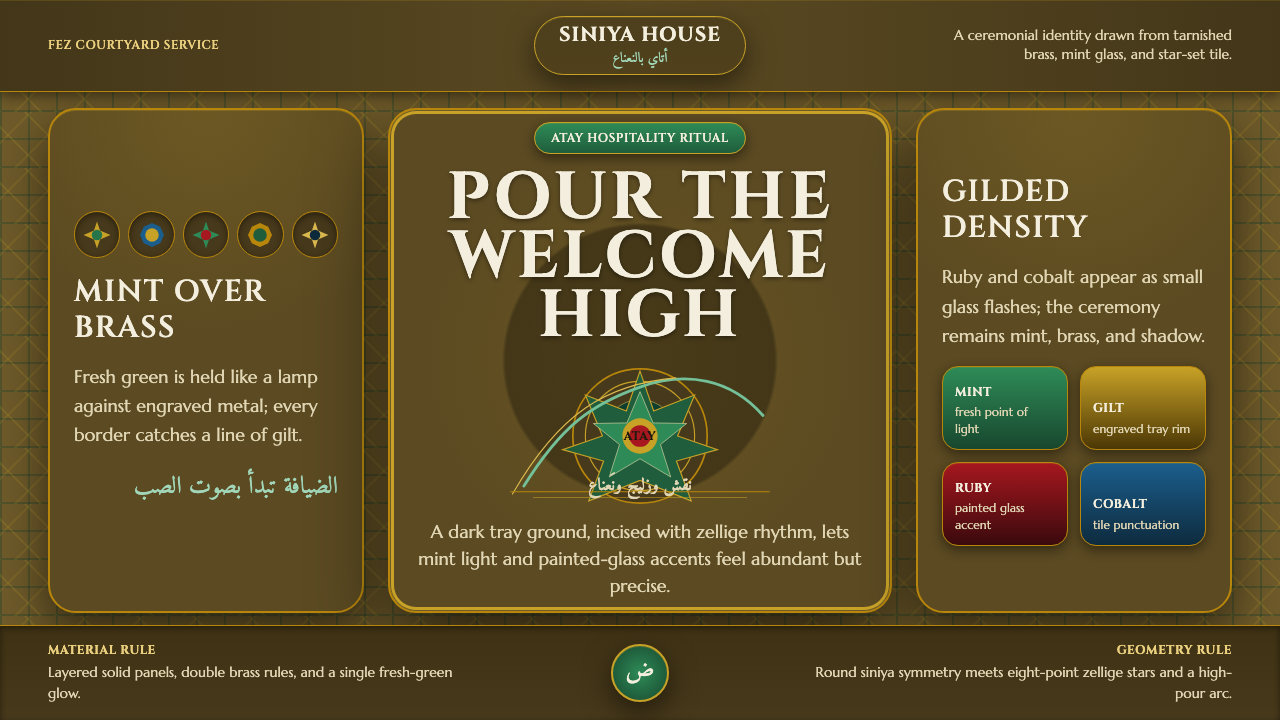 Moroccan Mint TeaCeremony glows in brass. Mint green, Cinzel type, and zellige geometry frame…
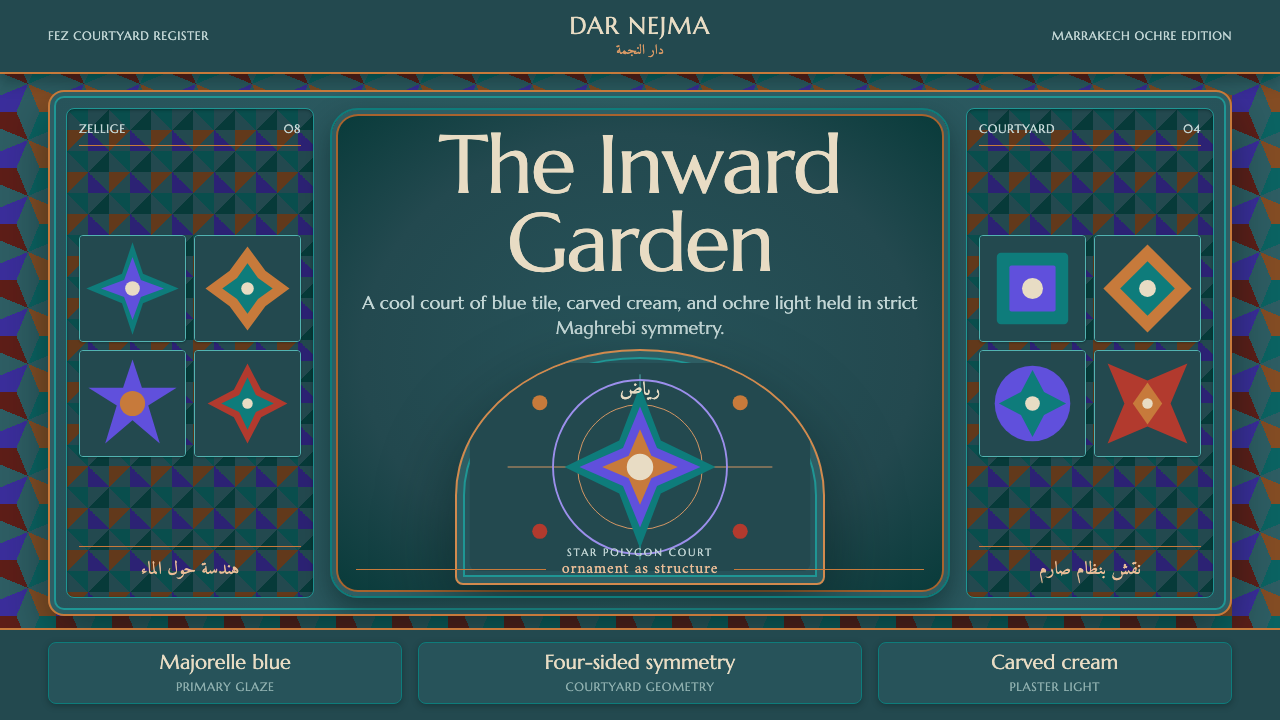 Moroccan RiadOrnament is structure. Majorelle blue and teal zellige frame a symmetrical ar…
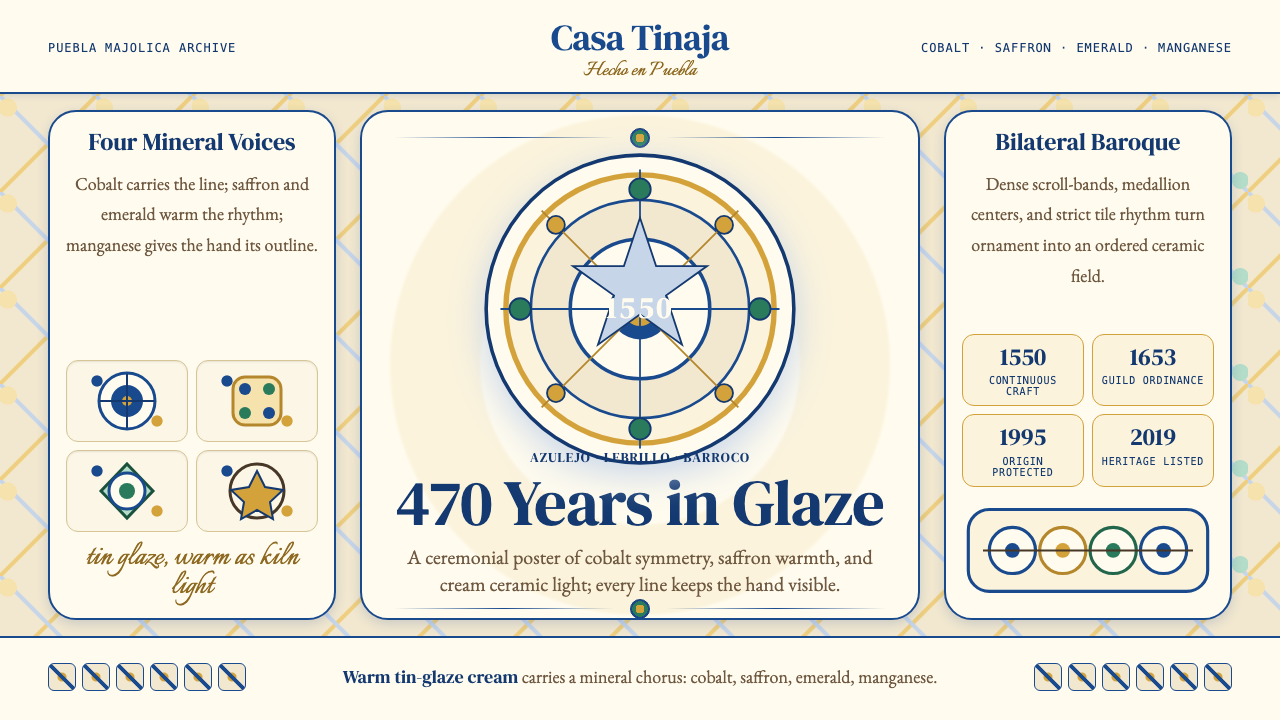 Talavera Poblana CeramicBaroque craft breathes. Cobalt scrollwork on warm tin-glaze cream frames stri…
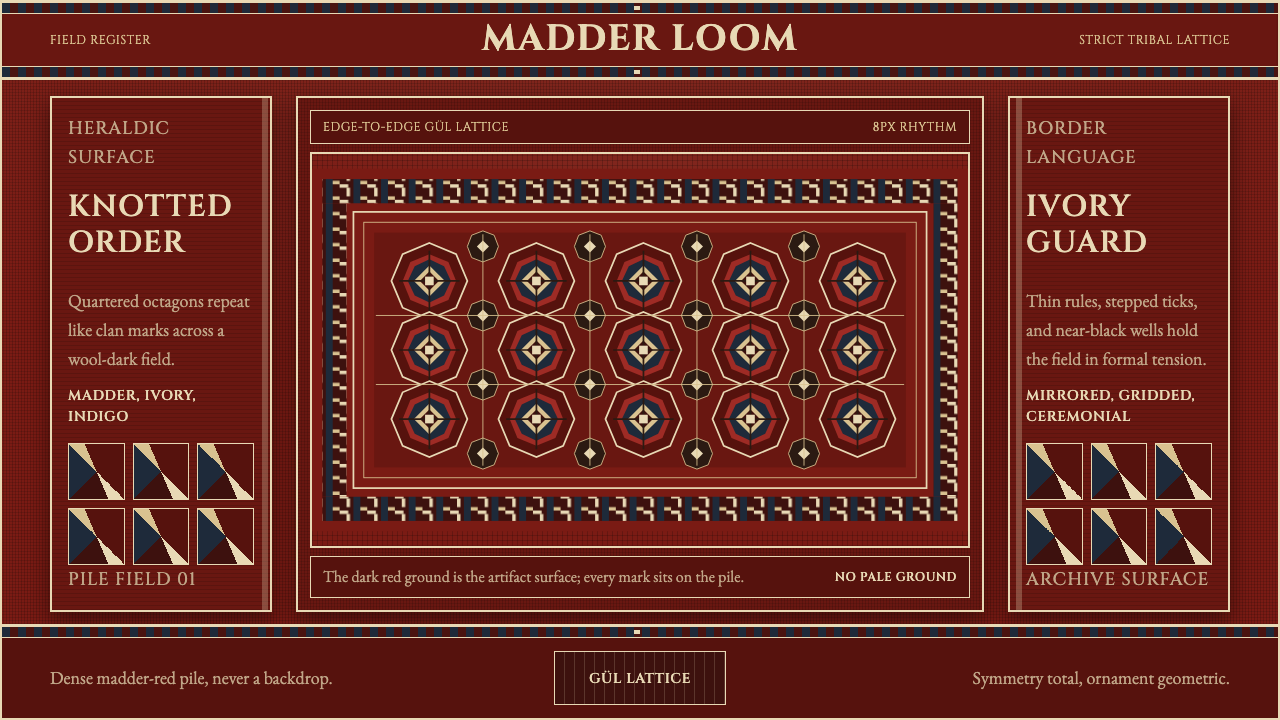 Turkmen Bukhara RugHeraldic and earthbound. Madder red, ivory hairlines, and octagonal güls lock…
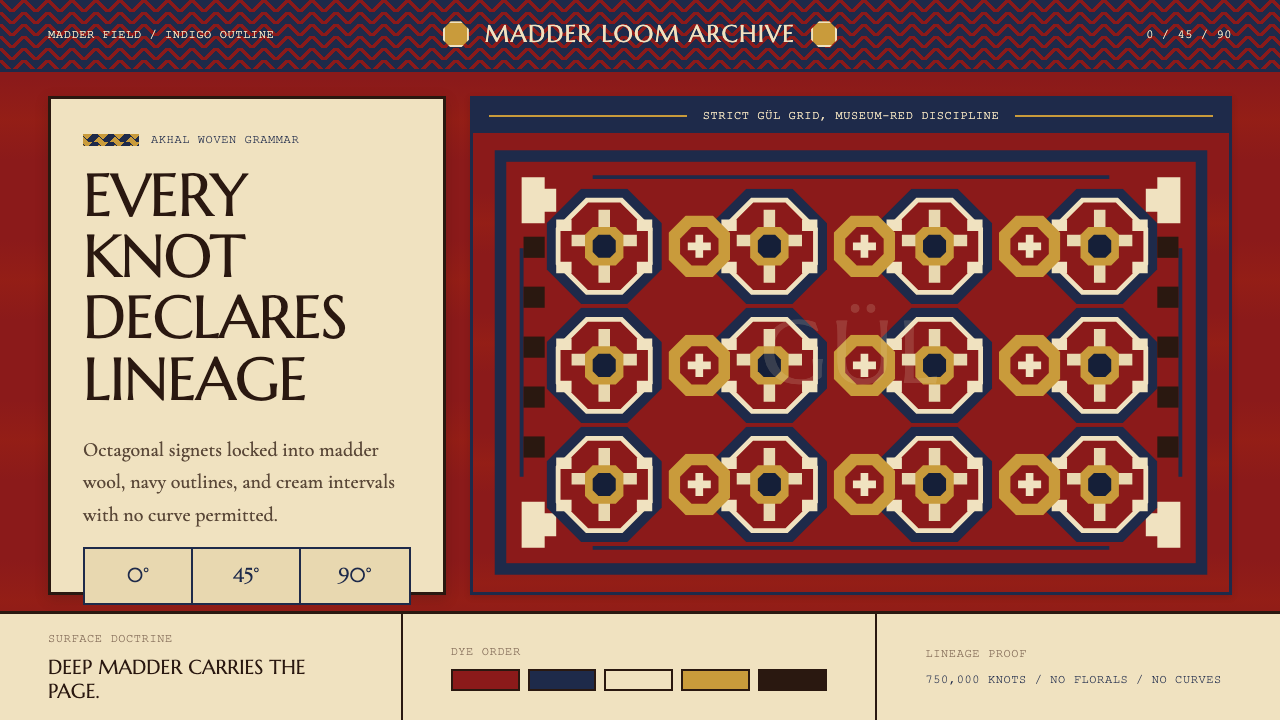 Turkmen Tekke Carpet (Gül Medallion)Disciplined red geometry. Madder field, indigo outlines, cream gül grid.
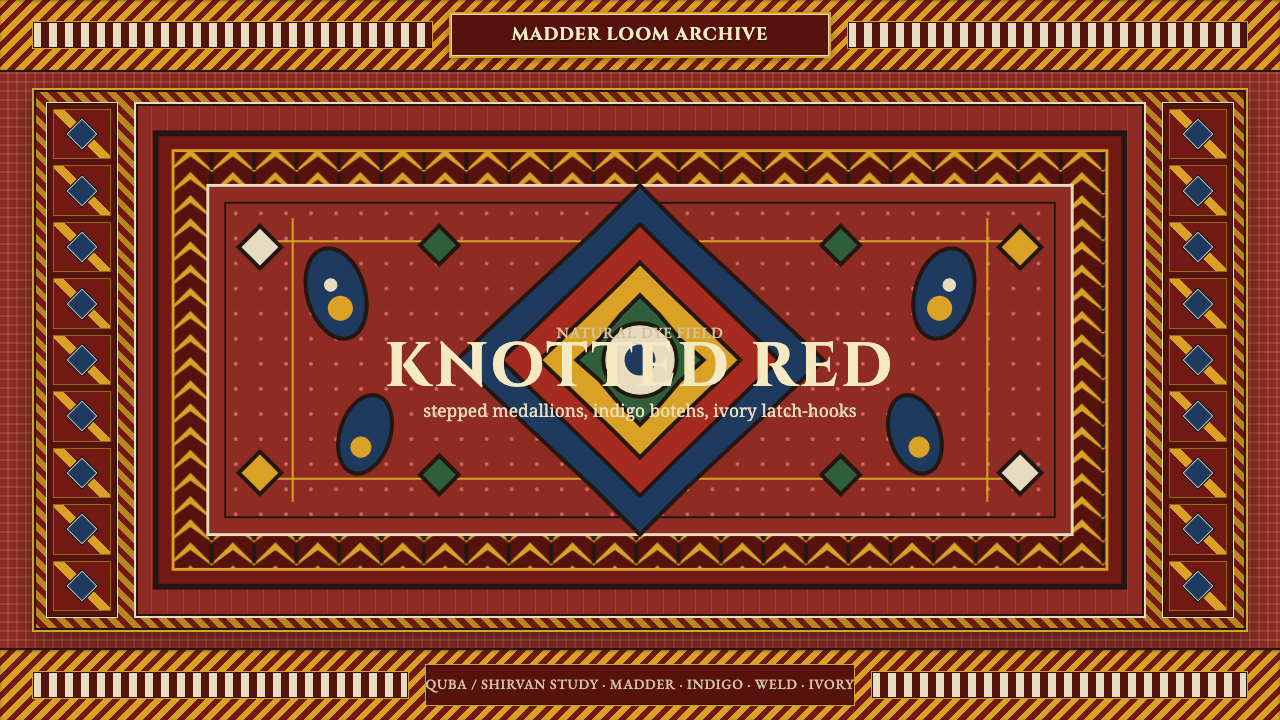 Azerbaijani Quba CarpetRed is the field. Indigo botehs and ivory latch-hooks orbit a stepped medalli…