What is xkcd Stick Figure Comic (2005)?
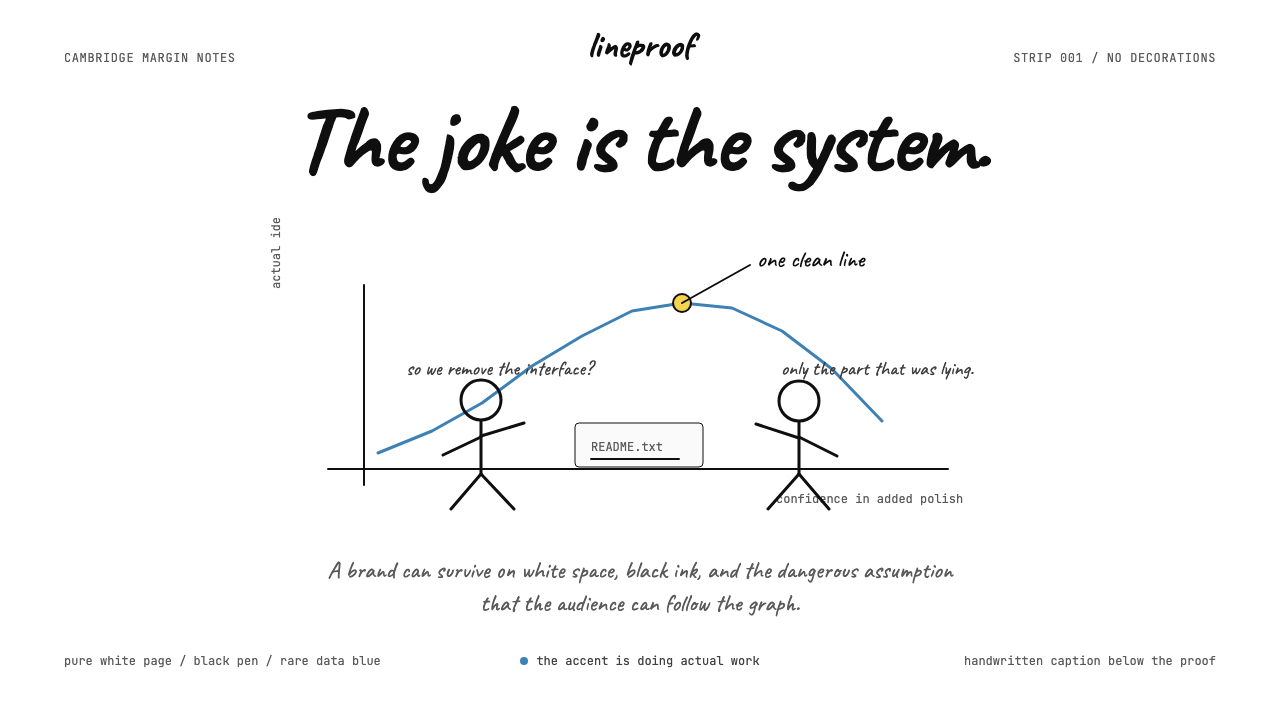
xkcd proved that a stick figure, a white page, and a sharp punchline are all a comic — or a design system — ever needs.
xkcd Stick Figure Comic (2005) in brief
xkcd is a webcomic created by Randall Munroe, a former NASA roboticist, and launched in 2005 from Cambridge, Massachusetts. Its visual language is radically stripped down: stick figures drawn with an unsteady hand, wide expanses of white space, no panel borders, no color except the occasional blue used for charts or a muted yellow for rare highlights, and captions rendered in a loose monospaced lettering style. After nearly three thousand strips, not one element of this aesthetic has been added or changed without good reason. That consistency is itself the argument.
The style operates on a single conviction: the idea is the point, and the drawing should get out of its way. Munroe's stick figures are not charming because they are badly drawn — they are charming because they are willfully indifferent to being well drawn. Every character is just a circle balanced on two lines. Every scene is a flat white field. The result is that all energy goes to the reasoning, the wordplay, the data, or the absurdist logic — and the reader never has to work through visual decoration to reach it.
As a design aesthetic, xkcd occupies a unique position: it is the visual vernacular of a specific intellectual community — programmers, mathematicians, scientists, and the people who enjoy reading about them. Applied to digital products and presentations, it signals intellectual honesty, a dry wit, and a fundamental disinterest in impressing anyone with production values. It is the anti-corporate aesthetic of people who take ideas seriously and ornament not at all.

Where does xkcd Stick Figure Comic (2005) come from?
Randall Munroe began posting xkcd sketches in 2005, initially from a set of old drawings he found in his notebooks while working at NASA's Langley Research Center as a contract roboticist. The early strips were posted without a formal publishing schedule to a small personal website. Within months, the combination of technically accurate humor, self-deprecating romance plots, and surreal math jokes had accumulated a substantial readership among engineers and scientists on early internet forums. By 2006 the comic had its own domain and a growing reputation as the internet's de facto publication for STEM humor.
The aesthetic was never designed — it emerged from constraint and personality. Munroe has repeatedly stated that he draws poorly and has no interest in improving. The monospaced caption style reflects the lettering habits of someone more comfortable with code editors than with calligraphy pens. The absence of color is partly a production shortcut and partly a philosophical position: color decoration would distract from the argument. The white space is not a minimalist choice; it is what happens when someone who does not care about backgrounds simply does not draw one.
The context that gave xkcd its intellectual character was the 2000s webcomic golden age, a period when the internet allowed niche creative projects to find global audiences without passing through traditional publishing gatekeepers. Munroe was part of a generation of online creators who addressed readers as peers — people who would catch a reference to the Halting Problem, enjoy a graph labeled with units like 'number of Stalins per unit of time,' or appreciate a map of the continental United States drawn entirely from memory and annotated with corrections. The comic assumed intelligence and rewarded it.
By the early 2010s, xkcd had become a cultural reference point far beyond its original audience. Munroe's companion books — What If? (2014), Thing Explainer (2015), and How To (2019) — applied the same visual logic to long-form popular science, demonstrating that the stick-figure-plus-diagram approach could carry genuinely complex technical explanation. The style's influence on data visualization and science communication grew substantially during this period, particularly as data journalists began adopting the rough, annotated chart aesthetic to signal accessibility and intellectual approachability over corporate polish.
What defines the xkcd Stick Figure Comic (2005) look?
Palette
The dominant ground is pure white, and the dominant mark is black — the starkest possible contrast, reflecting the look of a pen sketch on blank paper. Color is used as a signal rather than a decoration: a single muted blue appears on charts, graphs, and diagrams to indicate data or emphasis; a warm yellow occasionally marks a highlight or a background region. Flesh tones, gradients, shadows, and any decorative color do not appear. The effect is of a document that treats color as information and withholds it everywhere it would only be aesthetic.
Linework
Lines are hand-drawn in character: slightly wobbly, inconsistent in weight, and free of the mechanical perfection that vector tools produce. Circles for heads are not quite round. Stick-figure limbs taper and waver. This imprecision is not a flaw to correct; it is the defining quality. The handmade line signals that the maker is human, that the communication is direct, and that no intermediary layer of professional polish stands between the idea and the reader.
Typography
Text in xkcd reads as handwritten but monospaced — each letter occupies the same horizontal slot, as if typed on a typewriter or rendered in a code editor. This hybrid of casual handwriting and programming-environment lettering is both the most recognizable element of the xkcd voice and the one that places the comic firmly in the world of people who spend their days in terminals. Captions sit below strips rather than inside speech bubbles wherever possible, keeping the drawing area uncluttered.
White Space
xkcd uses space with unusual generosity. Strips frequently have no background at all — figures and objects float in white void. Long-form comics and infographics spread information across large white surfaces rather than packing it dense. The emptiness is not awkward; it is confident. It says that the content is complete as it is and needs no visual filler to make the page feel finished. In design applications, this principle means breathing room is structural, not incidental.
Data as Visual Object
Among xkcd's most influential contributions is its treatment of charts, graphs, and diagrams as first-class visual elements — not appendices, but the main event. Axes are hand-drawn, labels are annotated with wit, and the chart itself often carries the punchline. The style demonstrates that a bar chart can be funny, a scatter plot can make an argument, and a timeline can tell a story — provided the person drawing it has something to say. The handmade quality of xkcd diagrams signals that data visualization is an act of communication, not a display of software competence.
Radical Simplification of the Human Figure
The xkcd stick figure — a circle, a vertical line, two arm lines, two leg lines — is possibly the most reduced human representation in wide cultural use. It conveys posture, gesture, and emotion entirely through the angle and position of these six elements, with no facial features beyond dot eyes and a curved mouth. This extreme economy means any reader anywhere can project themselves onto the figure. The universality is earned through reduction, not through representational accuracy.
No Panel Borders
Traditional comics use ruled borders to define panels and contain the action. xkcd dispenses with them almost entirely. Scenes exist as freestanding islands on the white page — they begin and end wherever the drawing stops, without a box to contain them. This borderlessness reinforces the impression that the content is unmediated: thoughts and diagrams appear as if directly placed on paper, without the formal structure of a published work. For slide decks and web layouts, the equivalent principle is letting content breathe without containing boxes wherever containment is not functionally required.

Who shaped xkcd Stick Figure Comic (2005)?
Munroe is the sole creator of xkcd and the entire source of its aesthetic. After leaving NASA in 2006 to work on the comic full time, he has produced strips consistently for nearly two decades without significantly altering the visual style. His background in physics and robotics explains the technical precision of the comic's scientific content — references to orbital mechanics, graph theory, and thermodynamics are used accurately, not as decoration. His stated indifference to drawing quality is not false modesty: it is the founding philosophical position of the aesthetic.
Among xkcd's recurring cast, the character identified only by a black hat is the most visually distinctive. All xkcd figures share the same body — a circle and six lines — so character differentiation depends entirely on added accessories. The Black Hat figure wears a single filled circle atop the head circle, functioning as a top hat rendered in two shapes. This character typically represents nihilist reasoning taken to logical extremes, and the hat communicates his identity to readers across thousands of strips without a single additional visual element. The lesson for design: accessories are character.
The unnamed, hatless protagonist of most xkcd strips is referred to by fans as Cueball — a bare circle for a head, no distinguishing features beyond the standard stick figure anatomy. Cueball is most often a stand-in for Munroe himself, or for the reader, or for the rational agent encountering an irrational world. The deliberate blankness of this character is both a production shortcut and a device that maximizes reader identification. In design terms, Cueball is the visual equivalent of a well-designed empty state: maximum possibility, no assumptions.
Munroe's What If? column (started 2012) and subsequent book (2014) extended the xkcd visual system into long-form scientific explanation. A typical What If? entry poses an absurd hypothetical — what would happen if you threw a baseball at near the speed of light? — and answers it with genuine physics, illustrated by xkcd-style diagrams. The diagrams in these pieces demonstrate that the aesthetic scales: it can explain plasma physics as legibly as it can deliver a two-panel punchline. The work established xkcd as a design system, not just a comic aesthetic.
In 2010 Munroe ran a color-naming survey with over two hundred thousand respondents, asking them to name colors displayed on screen. The resulting dataset and analysis — published as an xkcd post — became a widely cited reference in data visualization and human-computer interaction research. The survey was illustrated entirely in the xkcd style: handwritten charts, annotations in the comic's typeface, and the characteristic mixture of rigorous statistical analysis and deadpan humor. It is a case study in how the aesthetic communicates that data is being handled honestly and that the audience is trusted to engage with complexity.
How do you use xkcd Stick Figure Comic (2005) today?
xkcd's aesthetic is more transferable than it first appears, but it transfers well only when the product genuinely shares the underlying values: directness over polish, ideas over impressions, functional communication over persuasive aesthetics. Applying it correctly is less about replicating the stick figures and more about understanding the logic — ruthless reduction, trust in the reader, and the confidence to let white space do structural work. When those values align with the product, the result reads as authentic; when they do not, it reads as affectation.
For presentation slides, the xkcd approach works on both cover and content pages but requires restraint. A cover slide in this style uses a single hand-drawn or sketch-style illustration — a stick figure, a diagram, a rough chart — on a white ground, with a title set in a monospaced or handwritten typeface. The absence of gradient backgrounds, stock photography, and templated layout signals immediately that the content is the point. Content slides should follow the same principle: one idea per slide, text kept to the minimum needed to support the spoken word, and any data rendered as a rough but legible chart with annotated axes. Transitions and animations should be minimal to nonexistent.
For web interfaces, the aesthetic is particularly well suited to documentation sites, developer tools, data dashboards, and any product whose audience self-identifies as technical. The approach: keep the background white, use a monospaced or near-monospaced typeface for body text and labels, reserve the blue accent exclusively for interactive elements and data marks, and let page sections breathe with generous vertical spacing. Avoid decorative imagery entirely. Card components, if needed, should be bordered without shadows rather than elevated with drop shadows — the design should read as flat as a printed page. Pricing pages and feature comparison tables benefit especially from the style's diagrammatic clarity.
For editorial and marketing work, xkcd-style illustration is powerful for science communication, data journalism, and educational content. An annotated diagram of a complex system — drawn with deliberate imprecision, with callouts in a handwritten font — communicates that the explanation is accessible and that the explainer is not trying to impress. Marketing materials using this aesthetic should avoid professional photography; hand-drawn icons and rough schematic illustrations are more consistent with the voice. The style supports strong information hierarchy through scale and spatial arrangement rather than color or decorative framing.
The most common mistake when applying this aesthetic is using it as pure irony — deploying intentionally rough visuals while actually caring deeply about being impressive. Readers are perceptive: a presentation that uses stick figures but over-polishes every other element, or a product page that adopts the typeface but fills it with marketing superlatives, produces a register mismatch that undermines both the humor and the intellectual credibility the style is supposed to convey. The aesthetic only works when the substance behind it is genuinely confident enough not to need ornamentation.

xkcd Stick Figure Comic (2005) — FAQ
Do I need to actually use hand-drawn stick figures to apply the xkcd aesthetic?
Not necessarily, but the closer you get to the original the more authentic it reads. The core of the aesthetic is not the stick figures themselves but the principles behind them: extreme reduction, hand-made imprecision, trust in the reader, and absence of decorative intent. A product that uses clean vector icons and geometric type but applies those same principles — generous white space, no decorative layer, annotation-style labels, rough-chart data visualization — will feel xkcd-adjacent without literal stick figures. What does not work is applying the typeface and color system while keeping polished stock photography and gradient UI components: the result is costume, not aesthetic.
How does the xkcd style differ from generic 'flat design'?
Flat design, as it emerged in the early 2010s primarily through mobile operating system redesigns, is a professional aesthetic discipline: precise geometry, deliberate type choices, systematic color palettes, and the deliberate elimination of skeuomorphic texture. xkcd is none of those things on a technical level — its flatness comes from indifference, not from system. What the two share is the rejection of simulated depth and decorative texture. What differentiates them is intent and voice: flat design communicates 'we are modern professionals who have made careful deliberate choices'; xkcd communicates 'we have something to say and we did not bother to dress it up.' The first is a craft position; the second is an intellectual one.
Is xkcd a suitable aesthetic for consumer-facing products?
With significant qualifications. The xkcd aesthetic resonates strongly with audiences who self-identify as technical, analytical, or intellectually curious — developers, scientists, engineers, quantitatively minded students, and anyone who enjoys reading footnotes. For these audiences, it signals authenticity, competence, and a refreshing absence of marketing pressure. For general consumer audiences — particularly in categories like food, fashion, wellness, or luxury goods — the aesthetic's deliberate roughness and intellectual detachment can read as cold, unfinished, or simply off-brand. The safest test: does the product's core value proposition depend on being smart and honest? If yes, xkcd-adjacent design is likely an asset. If the core value is warmth, beauty, status, or pleasure, look elsewhere.
How should data visualizations be handled in this style?
Data visualizations are the heart of the xkcd style, not an afterthought. The approach is to treat charts and diagrams as the primary illustration, drawn with hand-style imprecision and annotated with plain-language labels rather than legend boxes. Axes should be clearly labeled and include units; the chart title can carry the main insight or even the punchline. The blue accent color marks data series or emphasis points; all other marks are black. Gridlines, if present, should be light and recessive. The key discipline: every data element should be there because it communicates something, not because the charting tool generated it by default. Remove tick marks that do not anchor reading, remove gridlines that do not guide the eye, and add annotations wherever the data makes a point worth calling out.
Can this style work in a dark-background interface?
It can, but the original is a light-ground style and the inversion requires careful handling. On a dark ground, the hand-drawn black line becomes a light or white line, which changes the character substantially — the sketch feels less like a pen drawing on paper and more like chalk on a board. That is not necessarily wrong; chalkboard aesthetics carry their own intellectual associations. The blue accent needs adjustment on dark grounds: a brighter, lighter blue reads better against dark than the muted tone that works on white. The bigger challenge is that the style's signature quality — the illusion of a sketch floating freely on a white page — is lost entirely on a dark background. If dark mode is required for functional reasons, it is worth preserving light-ground panels within the dark layout for diagram and chart areas rather than inverting everything uniformly.
Related design styles
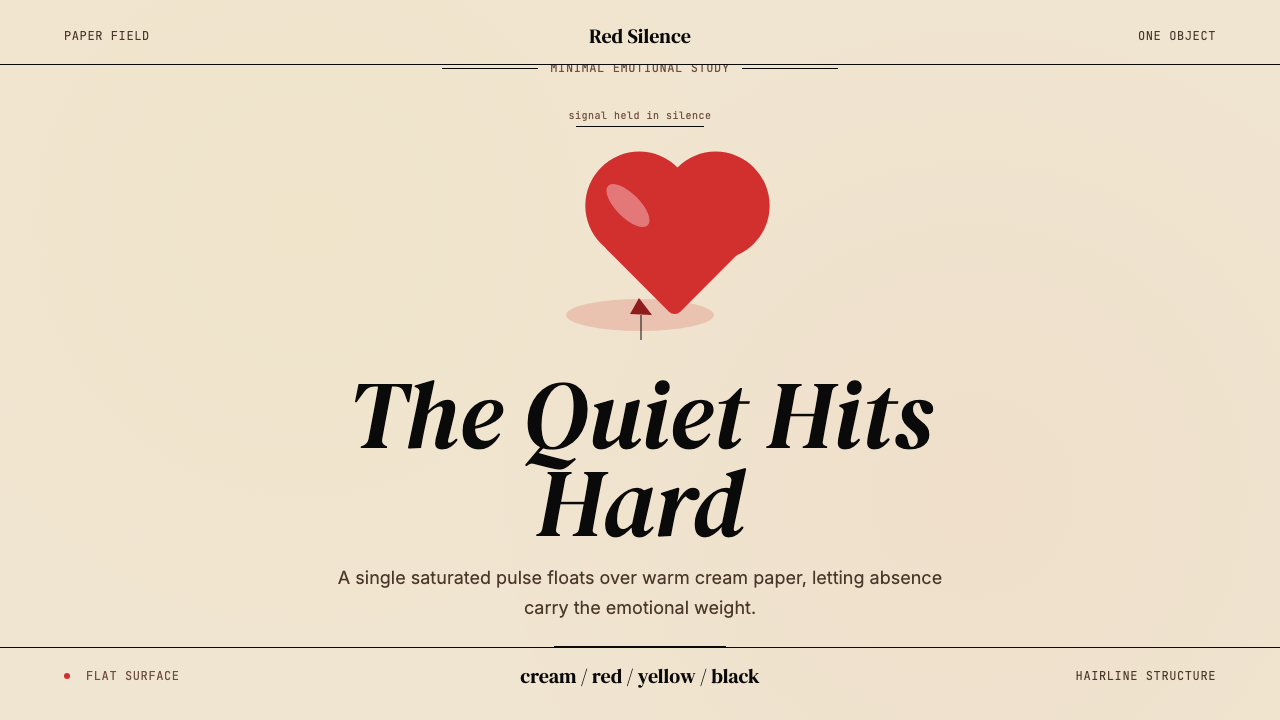 Kanye — 808s & HeartbreakGrief in restraint. Cream paper, one red heart, yellow heat, and a black hair…
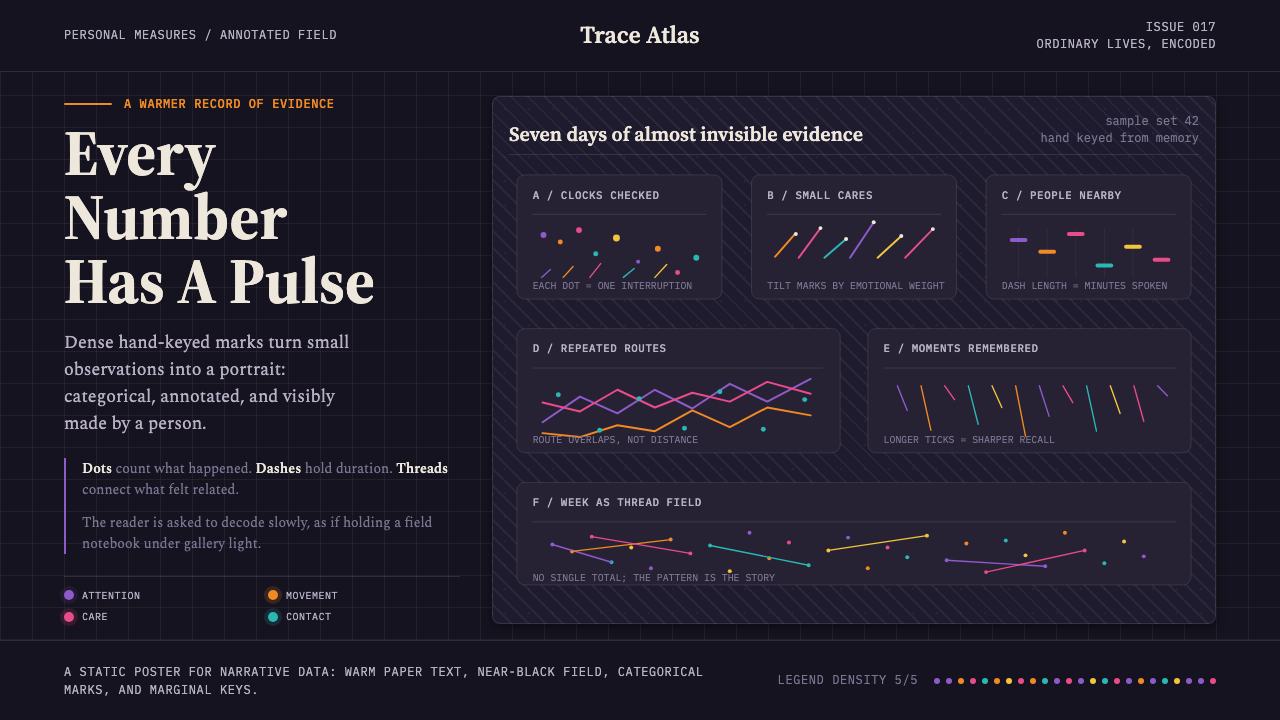 Data Humanism (Lupi)Data feels authored. Near-black fields carry serif notes and categorical hand…
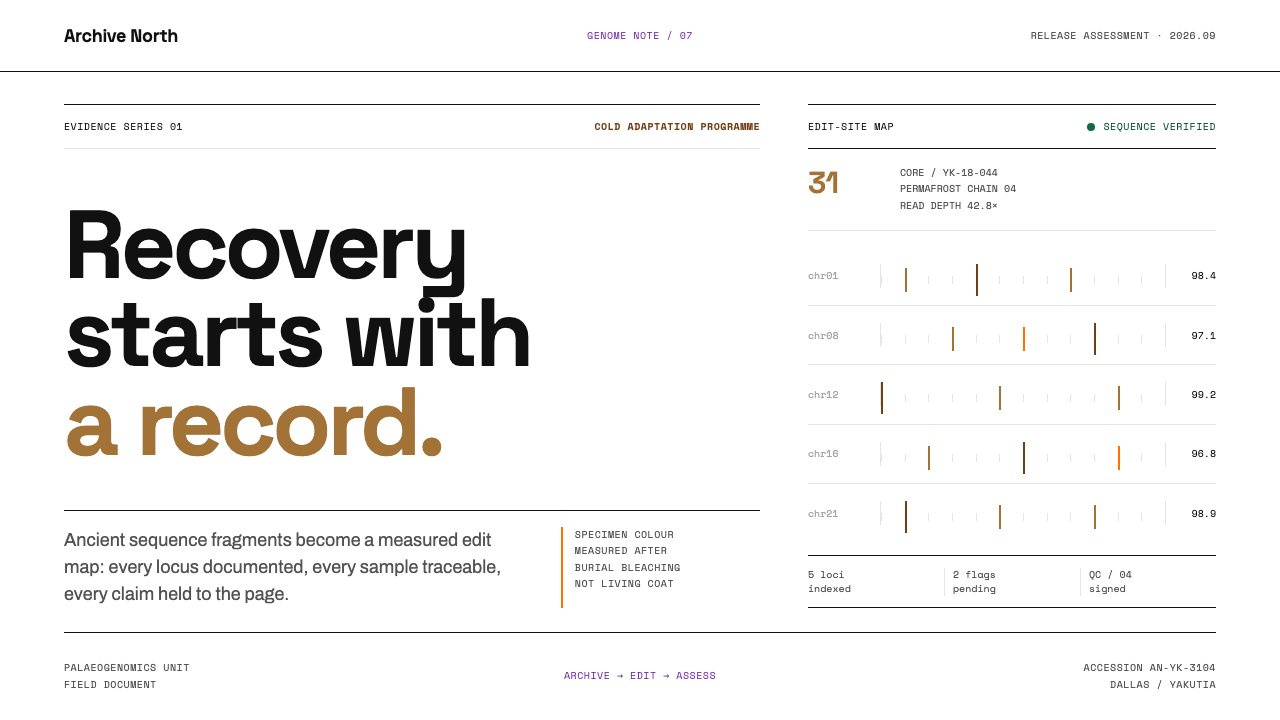 De-extinction LabResurrection reads as evidence. Black rules and specimen brown map every geno…
 Fluxus Event Score (1962)Instruction becomes art. Courier on white card, hairline rules, one sharp red…
 Gravitational Wave ChirpData makes the drama. Near-black grid, mono Hz ticks, and a viridis-hot chirp…
 High Life (2018)Institutional dark, one living light. Matte-black hull, hydroponic green, one…