What is Pentecost Land Diving?
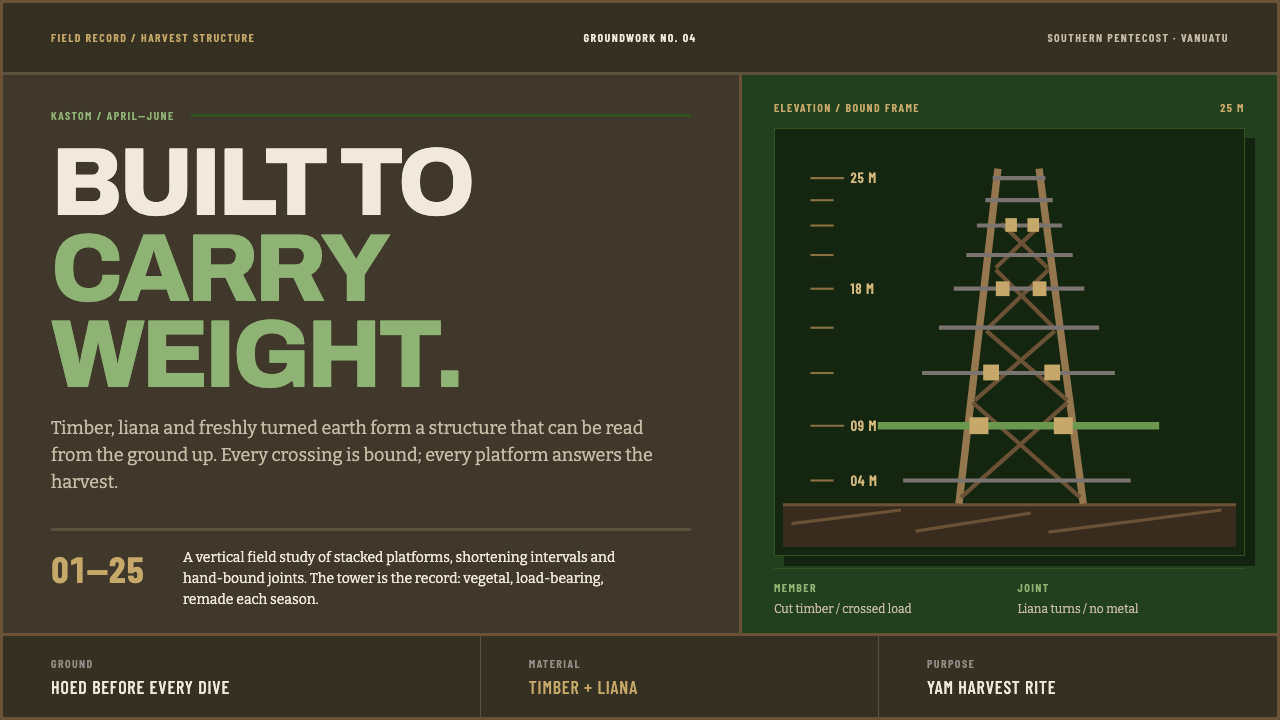
Nagol begins with a tower of timber and liana, and the structure carries the whole ritual: stacked horizontals, diagonal braces, and joints that are bound rather than welded.
Pentecost Land Diving in brief
Nagol is the yam-harvest land dive of southern Pentecost Island in Vanuatu. Each year men build a tall tower of timber and liana on a cleared hillside and climb it. A diver ties a vine to each ankle and leaps, aiming for his shoulders to brush the tilled soil below. There are no nails and no rope in the tower; the structure is entirely vegetal, and the ground beneath it is hoed soft and raked again before every jump.
The ritual belongs to a Melanesian world in which the yam, the harvest and the community’s obligations are bound together. Outsiders often reduce it to a spectacle or describe it as an ancestor of modern bungee jumping, but for the people who perform it, nagol is kastom: customary practice with its own authority, in which the building, the choice of vines and the jumping are each carried out by people who know their roles and the reasons for them.
Curio’s Pentecost Land Diving style takes its structure from the tower, not from the jump. It reads as stacked horizontals at shortening intervals, diagonal bracing, joints that look bound rather than welded, and a ground the colour of freshly turned volcanic earth. Every edge is cut or split, and nothing is milled smooth. It is a language of load-bearing parts, in which every element visibly has a job to do.

Where does Pentecost Land Diving come from?
The practice is pre-colonial, rooted in the island communities of southern Pentecost in Melanesia. It is held at the time of the yam harvest and performed every year between April and June. Outside documentation began in the 1950s, but by then the ritual had been carried out for generations in communities that treated it as an obligation in their own calendar, not as an event staged for visitors.
Kal Muller and Irving Johnson are named in the source record among the outsiders connected with early documentation of the dive, and accounts like theirs helped carry knowledge of the ritual beyond Vanuatu. But the primary authorities are the villagers. In Bunlap, the nagol builders construct the tower; at Londot and Lonorore, dive leaders organise the jumpers and the event. These are specialised roles: a tower is a technical project, and the people who raise it carry knowledge of timber, tension and ground that cannot be learned from outside.
The tower is a piece of vernacular lashed-timber construction. Poles are bound with liana rather than fixed with metal, platforms project from the main frame at different heights, and diagonal braces hold the frame against the pull of the jump. The builders must judge the strength of both timber and vines, and the length of each vine has to be set so that the diver’s shoulders just touch the ground, which is why the earth is loosened and raked beforehand. Because the whole structure is vegetal, the tower is rebuilt every season.
Nagol sits within kastom, the Bislama word for customary practice and the authority that goes with it. Because the ritual is tied to the yam season and to communal obligations, it is not something to be repeated on demand, and it is not a sport. That is why this style takes its guidance from the building, not from the leap: the tower is the part of the tradition that can be studied for its structural logic without trespassing on what belongs to the community alone.
What defines the Pentecost Land Diving look?
Volcanic-Earth Ground
The ground is a deep, dark brown, the colour of soil just turned on a volcanic hillside. It is matte and slightly warm, never glossy and never pure black. All structural elements sit on this earth, so every other colour is read against it, and the page feels grounded in a literal sense.
Liana Green
The main colour is the green of vines and new growth at the forest edge: fresh, a little yellowed, and alive. It is reserved for the parts that do the structural work, such as bracing lines, active states and key markers, so that green means tension and support, not decoration.
Stacked Horizontals
Horizontal members stack up the page at intervals that shorten as they rise, like crossbars on a tower. The rhythm gives a strong sense of height and progression, and it turns a layout into a climb: each section sits on the one below, and the spacing tightens as the reader moves up.
Diagonal Bracing
Diagonals are the style’s signature. They cut across the layout like struts holding a frame, and they are used where the structure needs to be stiffened: behind a hero title, between two sections, or across a large block. They give the page its tension and prevent the stacked horizontals from reading as a static ladder.
Lashed Joints
Joints look bound, not welded. Dividers are drawn as two members crossing and tied, and corners show a visible overlap instead of a seamless merge. Nothing blends into a smooth join. The assembly is honest about being assembled, and the viewer can see where each part meets the next.
Platforms and Height Marks
Cards read as platforms cantilevered from a main spine, and progress bars read as height marks on the tower. This gives the interface a physical logic: panels project from a central structure, and progress is a matter of how high you have climbed. Spacing is purposeful, and containers carry visible weight.
Cut and Split Edges
Every edge is cut or split, and nothing is milled smooth. Corners are crisp, strokes are firm and surfaces are matte. There is no ornament added for prettiness: no gradient, no glow, no soft shadow. If something is on the page, it is there because the structure needs it.

Who shaped Pentecost Land Diving?
Kal Muller is named in the source record among the outsiders who documented the nagol. His inclusion is a reminder that much of what the wider world knows about the ritual arrived through visitors’ descriptions, and that the fullest account will always be the one given by the community itself.
Irving Johnson appears in the same record as an outside witness to the ritual. Early outside documentation is part of why nagol became widely known, but it also carries the limits of an observer’s view, which is why this style draws on the construction, not on any outsider’s image of the leap.
The builders of Bunlap raise the tower from timber and liana, without nails or rope. Their work shows what the style means by structure: a frame whose every part is visibly bound, braced and loaded, built each season with knowledge of the wood, the vines and the ground.
At Londot and Lonorore, dive leaders organise the jumpers and the occasion. They are named in the record as part of the living practice, and they stand for the principle that nagol is a community responsibility with rules and roles, not an individual stunt.
How do you use Pentecost Land Diving today?
The Pentecost Land Diving style suits products where structure, sequence and progress are the point: planning tools, onboarding flows, construction and engineering content, outdoor and environmental projects, and any dark interface that wants to feel physical rather than glowing. It is a style for things that are built, and it rewards layouts that show their frame.
On slides, a cover can use the dark earth ground with a single diagonal brace as its main graphic and the title in a light, firm tone. Content slides work as stacked horizontal bands, with the spacing tightening as the argument moves towards its conclusion. Data and process slides are natural territory: stages become platforms on a tower, and progress becomes a height mark that shows where the project stands.
In web interfaces, the style fits dashboards, project tools and step-by-step flows. Cards become platforms projecting from a central spine, dividers are drawn as two crossing members, and progress indicators read as height marks. Reserve the liana green for active and structural states, keep surfaces matte, and let contrast carry hierarchy. The dark ground is native to the style, so it is well suited to dark-mode products.
In editorial and marketing work, the style supports stories about craft, engineering, communities and the built environment. A long article can use stacked bands as chapter markers, with diagonal braces behind key headings. Because the source is a living ritual, the best marketing uses the tower’s logic rather than its imagery: leave out the jump, the bodies and any thrill-seeking language, and let the structure speak.
The most common mistake is to treat the style as generic tribal decoration, adding fake bamboo textures, woven borders or rustic fonts. Another is to use the dive itself as extreme-sports branding, which turns a community’s obligation into a stunt. Technically, glossy gradients, rounded polished corners and a bright neon green all work against the style, whose force comes from matte surfaces, hard edges and visible joints.

Pentecost Land Diving — FAQ
Is this style about the jump itself?
No. It is about the tower. The jump is the centre of the ritual, but the structure that makes it possible is the part that translates into a design language: stacked horizontals, diagonal braces, bound joints and ground prepared in advance. Keeping the focus on construction keeps the style practical and also avoids turning a community’s ritual into a visual spectacle.
Why does the style use a dark ground?
The ground is the colour of freshly turned volcanic earth, which is dark and rich. In the ritual that earth is a deliberate part of the setting, hoed soft and raked before every jump. A light version would lose that connection, and the liana green would lose the contrast that lets it read as live, structural colour against the soil.
How should the green be used so that it stays legible?
Treat it as a structural colour rather than a fill. Use it for lines, active states, markers and key text on the dark ground, where it has strong contrast, and avoid large patches of green against green. Pair it with text labels and shape, so that state is never communicated by colour alone. A restrained use keeps the green meaningful as the live part of the structure.
Is it appropriate to use this style for extreme sports or adventure brands?
It is better not to. Nagol is a customary ritual tied to the yam harvest and to the obligations of a community, and presenting it as a thrill or a stunt misrepresents it. The style is useful for the logic of its structure, and it works well for engineering, planning and craft subjects. If a brand wants to reference the source, it should do so with acknowledgment and without using the dive as an advertisement.
What does bound rather than welded mean in an interface?
It means joints stay visible. Two panels overlap by a small, deliberate amount instead of melting into one shape, dividers appear as crossing lines, and corners do not disappear into smooth curves. The viewer can see where parts meet and how they carry load. The effect is a structure that feels assembled by hand, with every connection honest and legible.
Related design styles
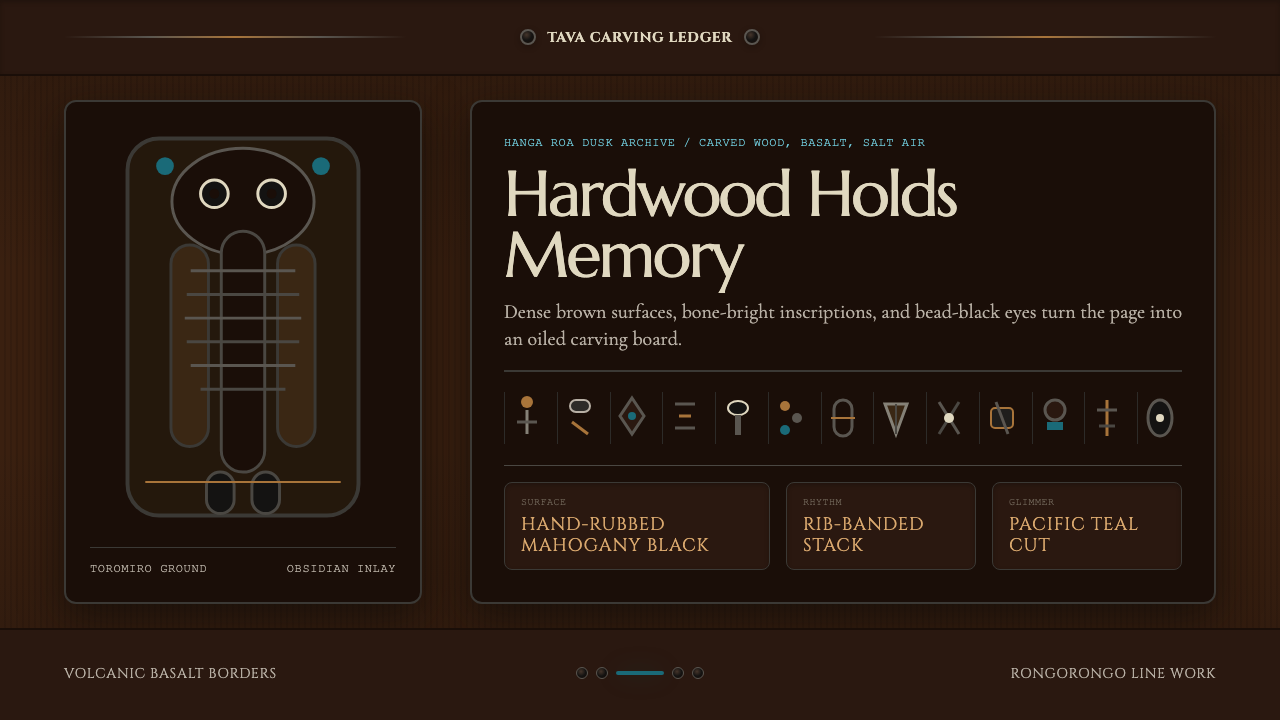 Chilean Rapa Nui Toromiro (Easter Island)Ancient weight, dusk-lit. Toromiro brown, Cinzel capitals, rib bands, obsidia…
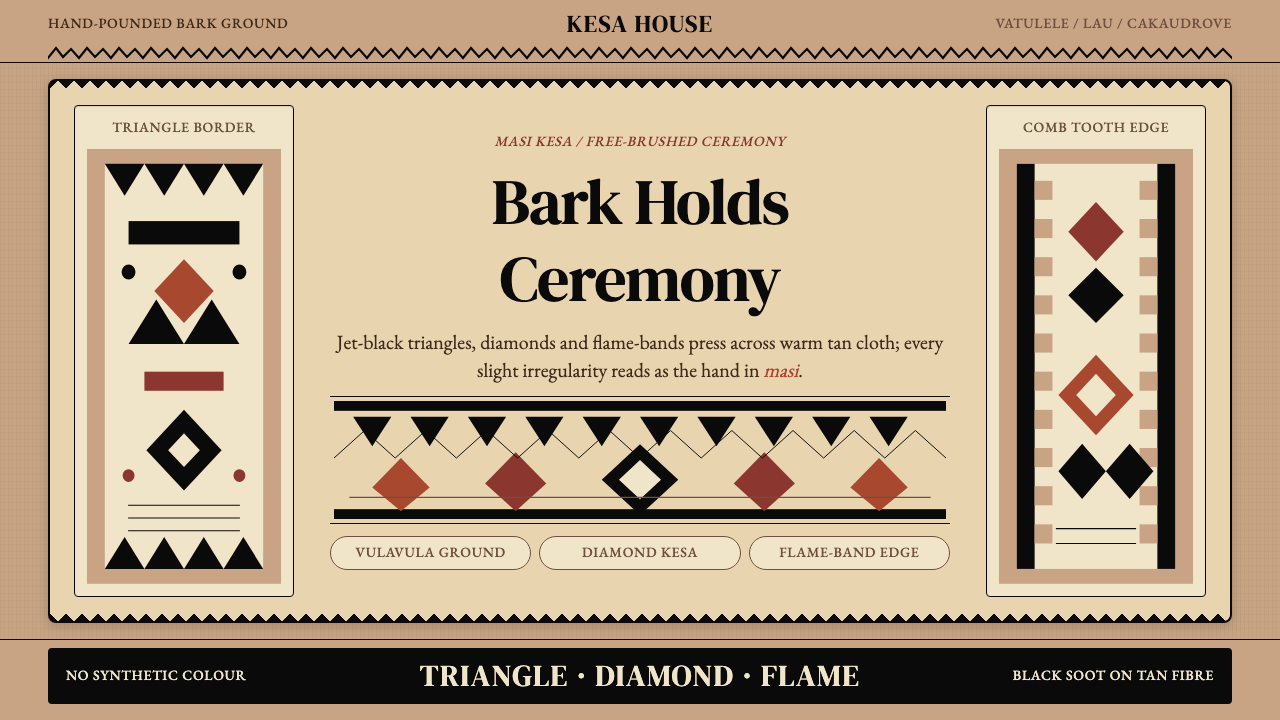 Fijian Masi (Tapa Cloth)Ceremony hits in black. Tan bark ground carries diamonds, zigzags and flame-b…
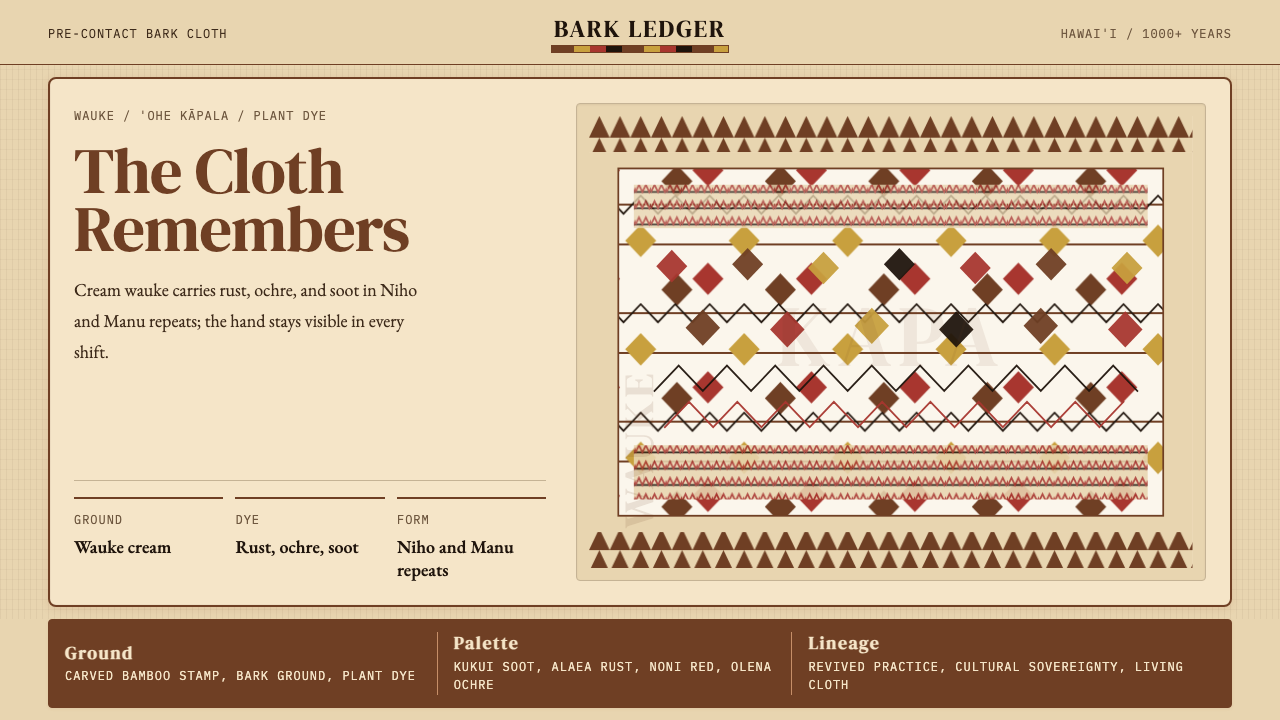 Hawaiian Kapa (Bark Cloth)Ceremonial geometry. Cream wauke, rust, ochre, and soot stamped in repeat.
 Kanak Grande CaseDarkness gives memory form. Bitter type rises on a thatch-brown central axis.
 Māori Koru Spiral (Aotearoa)Carved, not drawn. Totara brown, pounamu green, and mirrored koru geometry ca…
 Moriori Rakau MomoriPressure, not incision. Literata shadows sink softly into pale, lichened bark.