What is Uruguayan Tango Rioplatense 1900?
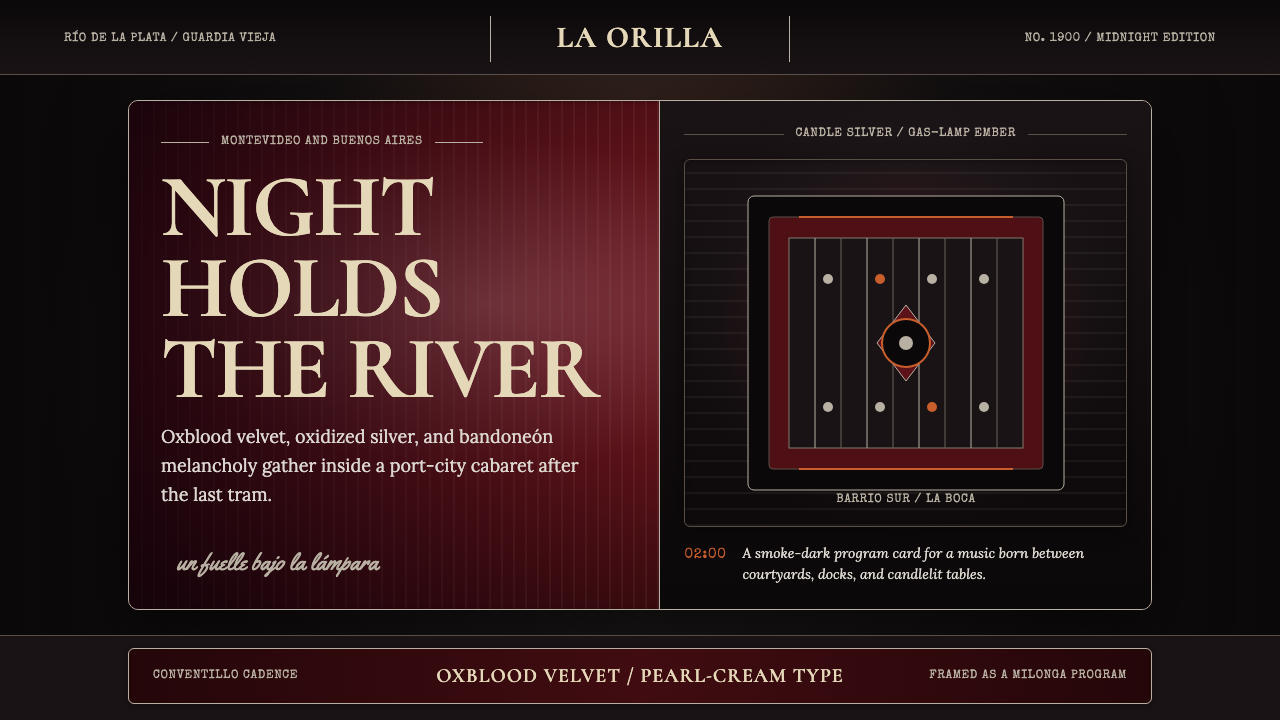
Born in the smoke-stained tenement halls of Montevideo and Buenos Aires, tango rioplatense turned melancholy, velvet darkness, and candlelit silver into a visual language that still aches with longing.
Uruguayan Tango Rioplatense 1900 in brief
Uruguayan Tango Rioplatense 1900 is a design aesthetic rooted in the visual world of the Guardia Vieja era — the late nineteenth and early twentieth century period when tango first emerged from the conventillos, or tenement courtyards, of the Río de la Plata region. Its mood is one of intimate darkness: oxblood velvet, smoke-stained silver, the amber glow of gas lamps, and the deep shadow of a booth at a late-night café.
The style draws on several overlapping visual traditions: the hand-painted enamel signage of the barrio streets, the elaborate scroll-and-flourish ornamentation of fileteado porteño (the decorative painting tradition unique to Buenos Aires and Montevideo), and the graphic language of early tango sheet music covers, which combined portrait lithography with ornate typographic framing. The result is a visual system that is simultaneously lush and melancholic — rich in surface texture, but organized around a palette of deep, light-absorbing tones rather than brightness.
As a design language, tango rioplatense occupies a particular emotional register: it signals intimacy, nocturnal sophistication, and a kind of bittersweet nostalgia. It is not the nostalgia of cheerful heritage branding, but the longing of abrazo — the tango embrace — where connection and loss exist in the same moment. This quality makes it unusually resonant for cultural products, hospitality, and any context that wants to evoke depth, authenticity, and the sensory richness of a specific place and time.
Where does Uruguayan Tango Rioplatense 1900 come from?
Tango emerged in the 1880s from the conventillos of Montevideo's Barrio Sur and Buenos Aires's La Boca — overcrowded tenement houses where recent immigrants from Italy, Spain, and West Africa lived alongside Afro-Uruguayan and Afro-Argentine communities. The music fused Afro-Uruguayan candombe rhythms, the Cuban habanera, European polka and mazurka, and the milonga — a fast-paced dance already popular in the Río de la Plata. Out of this fusion came something that no single community could claim entirely: a form that expressed collective longing, displacement, and desire.
The Guardia Vieja period — roughly 1880 to 1920 — was tango's foundational era. During these decades, the music and dance moved from the conventillos and arrabales (outer neighborhoods) into the cafés and academias (dance halls) of the city centers. The visual world that surrounded it was equally hybrid: street signs lettered in Italian and Spanish, fileteado decorative painting on carts and storefronts, kerosene and gas-lamp illumination, the velvet and mirror interiors of the cabarets that began to absorb tango as the century turned. Ángel Villoldo composed some of the earliest canonical tango pieces in Buenos Aires, while Roberto Firpo was already recording for early phonograph labels by 1912.
The international breakthrough came in 1913, when tango arrived in Paris and sparked an immediate sensation. Parisian ballrooms adopted the dance; fashion houses incorporated its dramatic silhouettes into their collections; the word tango entered the European vocabulary as a color — a deep, saturated orange-red, associated with the passion the dance was perceived to embody. This Parisian moment brought tango back to the Río de la Plata with a new legitimacy: what had been considered a low, popular form was now a cosmopolitan export. Gerardo Matos Rodríguez composed 'La Cumparsita' in Montevideo in 1917, and the piece became the most recorded tango in history, its melancholic descending melody encoding the emotional core of the style.
Carlos Gardel, born in Toulouse and raised in Buenos Aires, became the defining face and voice of tango in the 1920s and 1930s. His recordings for the Odeón label brought tango to international radio audiences; his film appearances gave the style a physical image — the slicked-back hair, the pinstriped suit, the tilted fedora, the slightly pained expression of a man who carries feeling he cannot quite express. Gardel's death in an airplane crash in 1935 transformed him immediately into legend, and the visual iconography of his era — the dark-lit cabaret, the couple in close embrace, the silver-and-oxblood color world — became the enduring aesthetic shorthand for tango rioplatense.
What defines the Uruguayan Tango Rioplatense 1900 look?
Color Palette
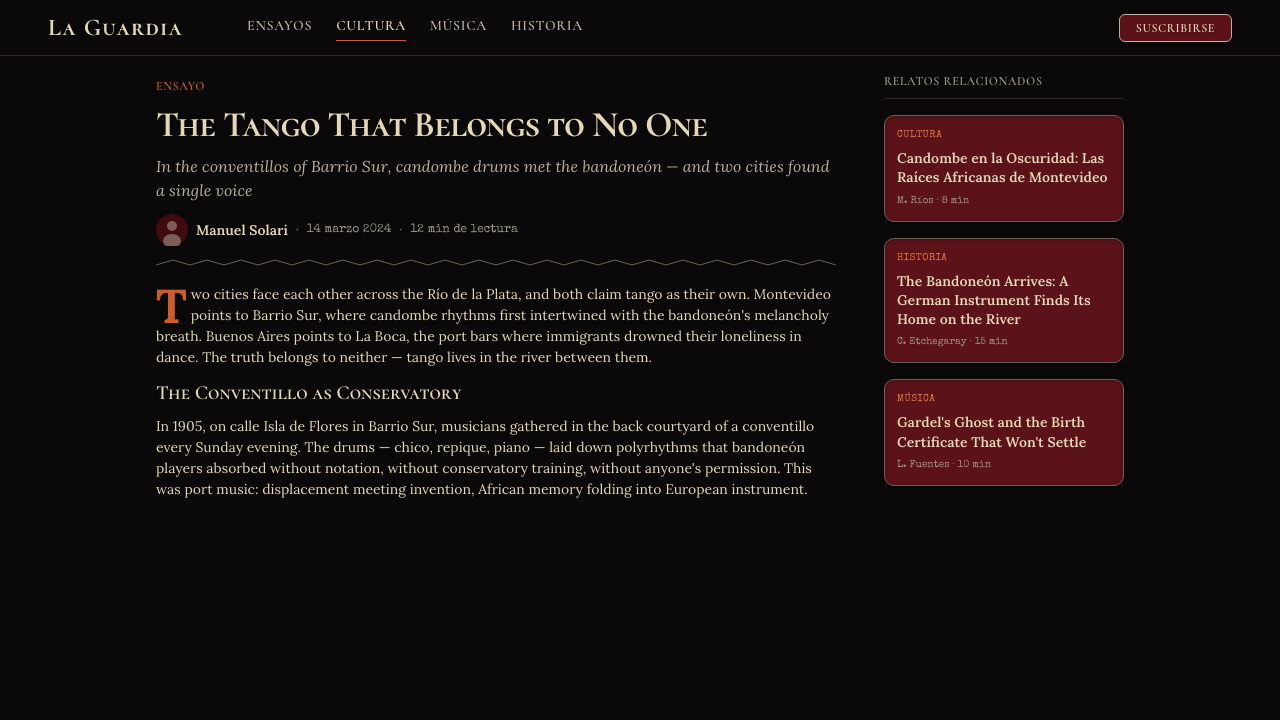
The palette is anchored by deep, light-absorbing tones: oxblood — a dark, slightly brownish red suggesting aged velvet — sits alongside oxidized silver, a tone closer to tarnished pewter than bright chrome. A warm amber, the color of a gas lamp seen through smoke-stained glass, serves as the primary light source within the composition. Near-black grounds, closer to very dark charcoal than true black, give the system its characteristic depth. Accents of ivory and pale cream appear only as highlights — the gleam on a glass, the cuff of a shirt — never as background fields. The overall effect is that of a room lit from within rather than illuminated from above.
Ornamental Typography
Display lettering in this style carries visible weight and elaboration: serifs are bracketed and full, stroke contrast is pronounced, and characters often bear subtle swash extensions or inline detailing. This is not the restrained elegance of fine typography but the theatrical confidence of hand-lettered cabaret signage, where legibility at a distance mattered as much as decorative impact. Body text, by contrast, is set in a compact, close-leaded manner that suggests a newspaper or playbill from the era — economical with space but dense with information. The interplay between ornate display and dense body creates a clear typographic hierarchy that feels of its moment.
Fileteado Flourish
Fileteado porteño — the decorative painting tradition that originated on the horse-drawn carts of Buenos Aires and Montevideo in the late nineteenth century — contributes the style's most distinctive ornamental vocabulary. Asymmetric scrollwork, acanthus-leaf flourishes, banderoles, and stylized flowers rendered in oxblood, gold-tinged silver, and deep green frame the primary content like an illuminated manuscript border. In a design context, these flourishes function as structural frames rather than scattered decoration: they define edges, signal corners, and create a sense of enclosure around content that emphasizes intimacy over openness.
Tactile Texture
Every surface in this visual language implies physical material: velvet carries a nap that absorbs light at one angle and reflects it at another; silver oxidizes into a surface that is simultaneously dull and luminous; the paper of an early twentieth-century printed piece is thick, slightly uneven, and warm-toned rather than bright white. In practice, this translates to layered visual texture — subtle grain, pressed-ink effects, the slight imperfection of a surface that has been touched and used. The aesthetic deliberately avoids the clinical smoothness of contemporary digital surfaces, instead seeking a quality of lived-in warmth.
Compositional Intimacy
Layouts in this style favor enclosed, centered compositions over expansive, asymmetric ones. Content is framed rather than floated — surrounded by ornamental borders, set within ruled panels, or anchored by heavy typographic frames. Negative space is used sparingly and tends to be dark rather than light, so that elements seem to emerge from shadow rather than sit on an open field. This approach creates a sense that the viewer is looking into something — a cabinet of curiosities, a stage set, a locket — rather than at something spread across a page. The resulting compositions feel intimate, curated, and slightly theatrical.
Gas-Lamp Luminosity
Lighting within this visual system is always directional and warm, never ambient or cool. The imagined light source is a gas lamp or a candle — something small, warm, and insufficient to fully illuminate the room, so that deep shadow is always present alongside the glow. In practice this means tonal compositions where the lightest areas are cream or warm silver, mid-tones dissolve into dark amber, and the darkest areas approach near-black without losing all texture. Highlights are treated as precious and deliberate: a single point of light on a glass, a gleam along the top edge of a frame, the shimmer of a sequined fabric caught by an evening lamp.
Emotional Register
The dominant emotional register of this style is melancholic longing — not grief, but the particular sadness of something beautiful that cannot be held. Tango's lyrics and choreography articulate the same paradox: the abrazo (close embrace) between dancing partners is both connection and farewell. Visually, this translates to a system that is lush but never celebratory, rich but never gaudy, intimate but never warm in a domestic sense. The aesthetic keeps the viewer at a precise emotional distance — close enough to feel the texture and depth, far enough that the experience remains one of longing rather than possession.
Who shaped Uruguayan Tango Rioplatense 1900?
Gardel is the defining figure of the tango canon — the singer whose recordings for the Odeón label in the 1920s and early 1930s brought tango to international radio audiences and established its visual iconography. His personal style — slicked-back hair, pinstripe suit, tilted fedora, an expression of handsome melancholy — became the template for how tango was imagined and pictured. His death in a 1935 plane crash at the height of his fame transformed him instantly into a mythological figure. The visual universe of Uruguayan Tango Rioplatense 1900 draws extensively on the graphic language of his era: cabaret programs, phonograph sleeves, sheet music covers, and early film stills.
Matos Rodríguez composed 'La Cumparsita' in Montevideo in 1917 — the piece that became not only the most recorded tango in history but something close to the official anthem of the form. Composed by a Uruguayan student barely out of his teens, the piece's descending, melancholic melody encapsulates the emotional character of tango rioplatense with an economy that made it immediately memorable. The sheet music cover art for early printings of 'La Cumparsita' exemplifies the visual language of the Guardia Vieja period: ornate framing, high-contrast portraiture, and the oxblood-and-silver palette that defines this design system.
Villoldo was among the earliest figures to formalize tango as a musical genre, composing and performing in Buenos Aires from the 1890s onward. His pieces — including 'El Choclo,' which remains one of the most widely recognized tangos — helped establish the structural conventions of the Guardia Vieja period. As a performer who also recorded for early phonograph labels, Villoldo contributed to the material visual culture of early tango: the graphic design of his phonograph cylinders and discs, and the advertising imagery produced for his performances, reflect the emerging visual vocabulary of the style in its first decades.
Firpo was a pianist, bandleader, and arranger whose work helped define the sound and ceremonial character of tango in the early recording era. His arrangements for early phonograph labels from around 1912 onward documented the Guardia Vieja sound for posterity and introduced it to audiences far beyond the Río de la Plata. The promotional materials produced for Firpo and his orquesta típica — the standard ensemble of tango — are among the most visually characteristic artifacts of the period, combining elaborate typographic display with early photographic portraiture in the distinctive graphic idiom of the genre.
Not a single figure but a collective tradition: the fileteadores were the craftsmen who practiced fileteado porteño, the decorative painting style that applied elaborate scrollwork, acanthus flourishes, banderoles, and nationalistic imagery to horse-drawn carts, later trucks, and eventually shop fronts across Buenos Aires and Montevideo. The tradition emerged in the 1890s and reached its peak in the 1920s and 1930s. Its visual vocabulary — asymmetric flourish frames, oxblood and silver and deep green, tightly scrolled organic ornament — is the primary decorative source for the Uruguayan Tango Rioplatense 1900 design system, giving it the distinctively hybrid quality of something both popular and elaborately beautiful.
How do you use Uruguayan Tango Rioplatense 1900 today?
Uruguayan Tango Rioplatense 1900 is a style that rewards commitment: it achieves its full power only when all its elements — the deep palette, the ornamental typography, the texture, the tight compositional framing — are deployed together rather than borrowed piecemeal. Applying one element in isolation (adding an oxblood accent to an otherwise modern layout, for instance) tends to read as vintage decoration rather than genuine aesthetic coherence. The style is most successful when the entire visual environment is controlled.
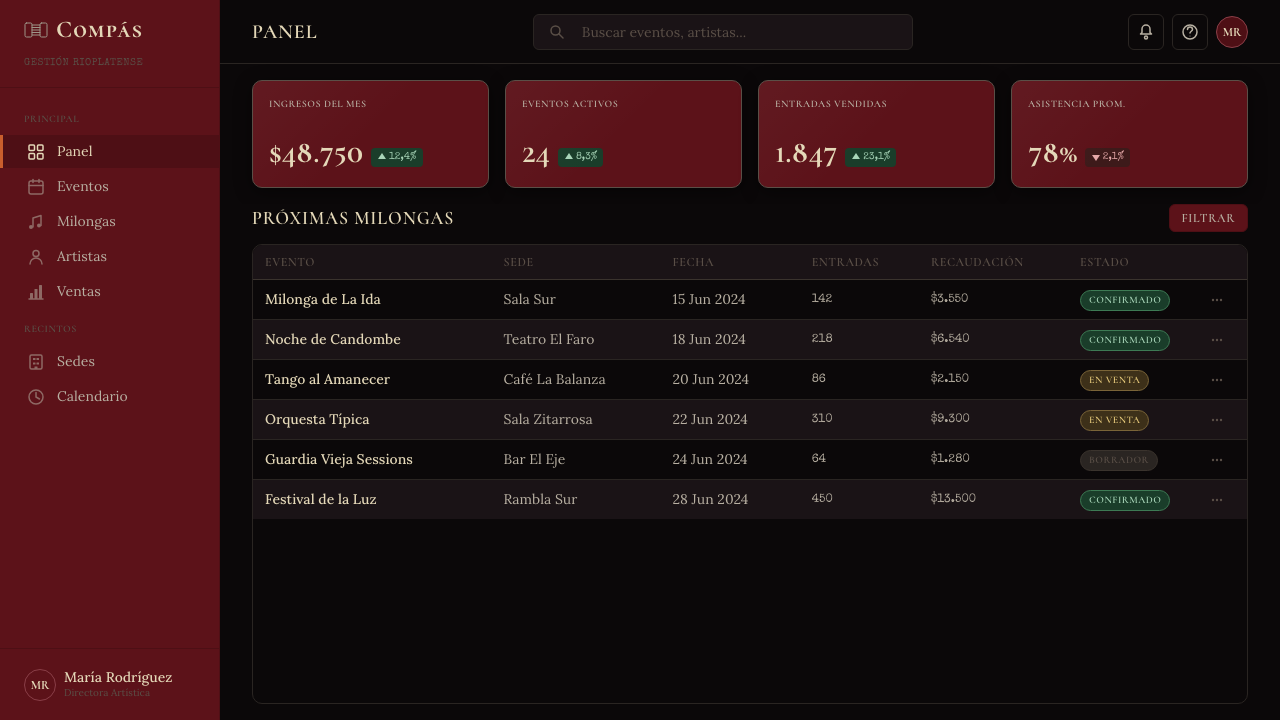
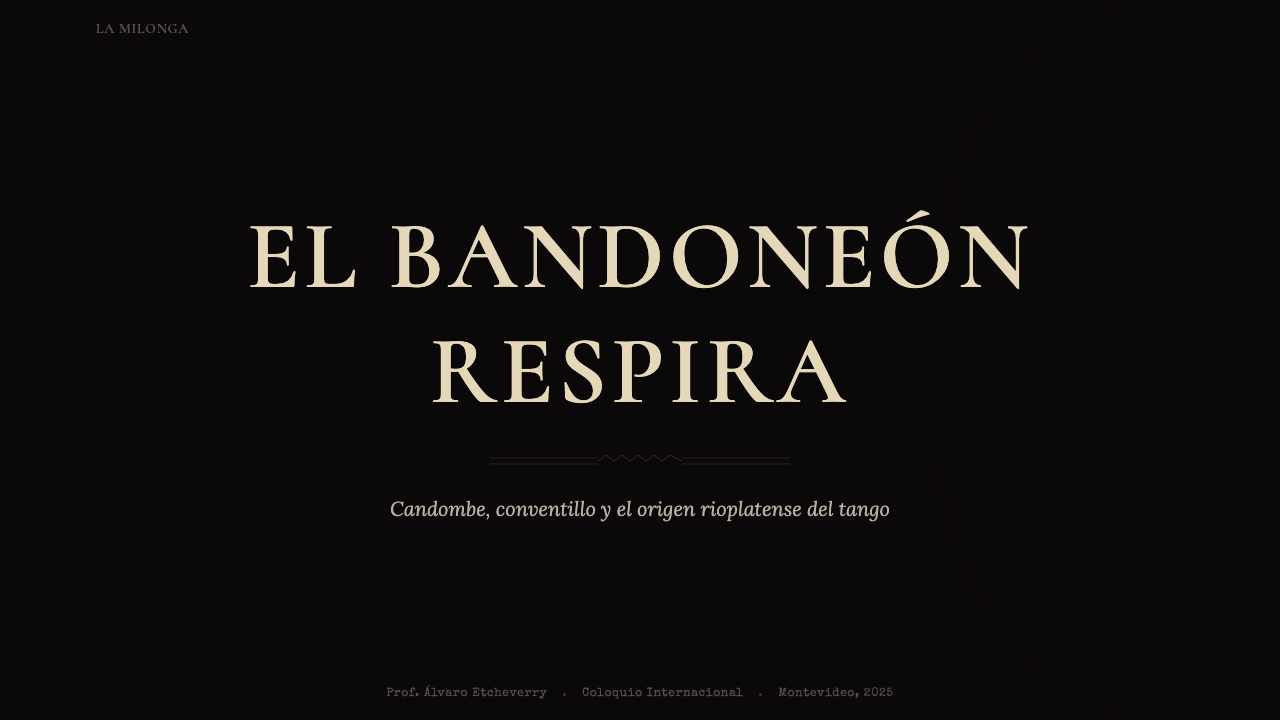
For presentation slides, the style works best as an event or cultural program aesthetic — for performances, retrospectives, film festivals, exhibitions, or any context with an explicitly nocturnal, theatrical, or historical character. Cover slides benefit from the full ornamental treatment: a centered composition within a fileteado-style border frame, deep oxblood or near-black ground, display type in a full-serif face with visible stroke contrast, and a single gas-lamp amber accent for the event name or date. Content slides should simplify the ornament without abandoning it — ruled panels and typographic framing replace the elaborate scrollwork of the cover, maintaining the enclosed, intimate quality without overwhelming the information.
For web interfaces and digital products, the style translates well to contexts where atmospheric immersion is a product value rather than an obstacle: streaming platforms for Latin music or film, hospitality and restaurant websites for venues with a tango or late-night cultural identity, event ticketing pages, or cultural institution microsites. The primary implementation challenge is managing dark-ground legibility: text on deep oxblood or near-black fields requires careful attention to contrast, and the warm amber and cream tones that serve as highlights must be weighted correctly to provide readable foreground without appearing to glow unnaturally. Navigation and interface chrome should remain typographic and minimal, reserving the ornamental vocabulary for hero sections, section breaks, and modal or overlay contexts.
For editorial and marketing work, the style suits longform cultural journalism, music retrospectives, and heritage brand campaigns where historical depth is a genuine value proposition. A spread using this aesthetic might pair a large portrait photograph — treated with high-contrast, warm-toned processing — against a column of close-set type in an ornamental frame, with a fileteado-style border marking the page edge. The effect is more cabinet display than magazine layout, and should feel slightly precious: this is a style for content that claims to be worth lingering over. Marketing campaigns benefit from the style's strong poster-language heritage — a single central image, bold ornate type, and a restricted palette creates high visual impact with few elements.
A common mistake when working with this style is pushing the ornamentation toward Halloween or Gothic rather than tango. The palette — deep red, black, silver — overlaps with those traditions, and without the specific referents (the cabaret program aesthetic, the South American graphic heritage, the warmth of the amber accent) the result can slide into a generic dark-decorative register that loses the style's specific emotional character. The correction is straightforwardness: lean into the amber warmth, use the velvet textures deliberately rather than atmospherically, and ensure that at least one typographic element carries the elaborate display character of period sheet music or fileteado signage rather than generic gothic lettering.
Uruguayan Tango Rioplatense 1900 — FAQ
What distinguishes tango rioplatense aesthetics from other Latin American vintage styles?
The key distinguishing qualities are the palette and the emotional register. Where Mexican vintage aesthetics (Day of the Dead graphics, pulquería painting) tend toward bright saturated colors and celebratory energy, and Cuban vintage graphics often favor tropical warmth and bold primary contrasts, tango rioplatense is defined by its darkness and its melancholy. Oxblood, oxidized silver, and near-black with warm amber accents are specific to the Río de la Plata visual tradition; they reflect not the tropical sunshine of the Caribbean but the grey winters and immigrant nostalgia of the Uruguayan and Argentine capital cities. Fileteado ornament is also geographically specific — it developed in Buenos Aires and Montevideo and is not shared by other Latin American decorative traditions.
Is this style suitable for digital interfaces, or is it primarily a print aesthetic?
It translates to digital contexts, but requires deliberate adaptation. The original visual references — hand-painted signage, gas-lamp lit interiors, printed sheet music — are all physical media with properties (warmth, texture, slight imperfection) that screens render differently. The adaptation challenge is avoiding two failure modes: the style becoming too polished and losing its worn, intimate quality, or the dark grounds becoming oppressive rather than atmospheric. Successful digital implementations treat texture as a design element in its own right — subtle grain, paper-like surface treatments — and use the amber-warm accent colors generously enough to prevent the dark palette from reading as simply gloomy. Loading states and transitions benefit from deliberately unhurried timing, reinforcing the nocturnal, leisurely emotional register.
How does the Uruguayan claim on tango differ from the Argentine one, and does it affect the design system?
Both Uruguay and Argentina have historically contested the birthplace of tango, and UNESCO's 2009 recognition named 'tango' as an intangible cultural heritage of both nations jointly. The Río de la Plata region — the estuary shared by Uruguay and Argentina — is the genuine shared origin, with Montevideo's Barrio Sur and Buenos Aires's La Boca playing equally formative roles in the music's development. The design system reflects this shared geography: it draws on visual traditions common to both cities (fileteado, conventillo culture, the Odeón record label's graphic language) rather than privileging one side of the river over the other. The naming 'Uruguayan' acknowledges that Gerardo Matos Rodríguez, composer of the genre's most iconic piece, was Uruguayan, and that Montevideo's Barrio Sur is one of the earliest documented homes of the form.
How do you prevent this style from reading as simply dark or gothic rather than tango-specific?
The amber and the ornament are the primary differentiators. Generic dark aesthetics — gothic, noir, horror-adjacent — tend toward cool or neutral dark tones (blue-black, cool grey, true black) and either minimal decoration or spiky, angular ornament. Tango rioplatense is distinguished by its warmth within darkness: the amber gas-lamp glow is always present as a reminder that the setting is intimate and inhabited, not abandoned or menacing. The fileteado ornamental vocabulary — scrollwork, acanthus leaves, banderoles, stylized flowers — is specifically South American and visually distinct from both European gothic ornament and contemporary dark aesthetics. Ensuring that at least one central typographic element carries the elaborate, full-seriffed display character of period tango sheet music (rather than condensed gothic or angular blackletter) is usually sufficient to ground the visual register in the right cultural context.
Is there a contemporary design context where this style has genuinely succeeded, or is it primarily historical reference?
Contemporary applications exist and are most successful when the cultural specificity is genuine rather than cosmetic. Boutique hotels in Montevideo's Ciudad Vieja and Buenos Aires's San Telmo neighborhoods have produced visual identities that draw on this aesthetic with real authority — because the environment they are branding actually contains the architecture, the lighting, and the cultural associations the style expresses. Film festival identities for events focused on South American or Argentine/Uruguayan cinema have similarly used the style with credibility. Where it tends to fail is in contexts where the tango reference is purely decorative — a restaurant that serves no South American food, a fashion campaign with no real connection to the Río de la Plata — because the specificity of the style's references becomes a kind of cultural imposture rather than genuine resonance. The style rewards honesty about its sources.
Related design styles
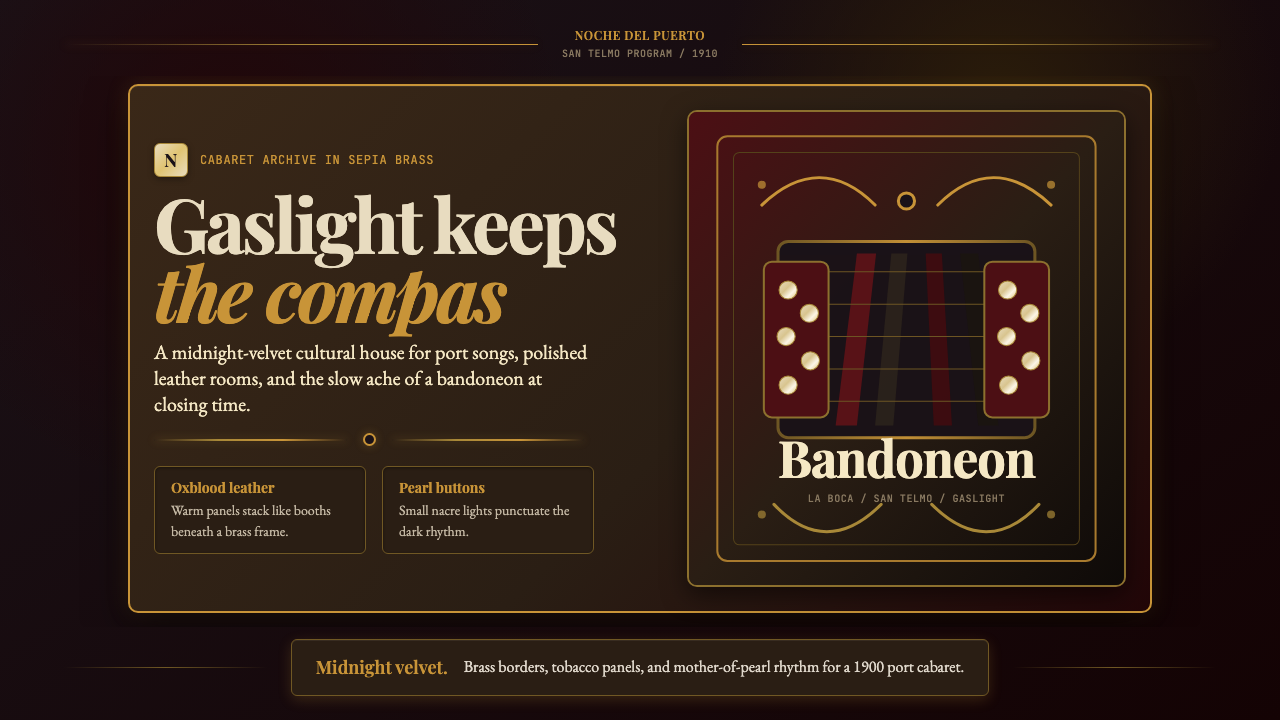 Argentine Bandoneón 1900 (Tango)Gaslit tango luxury. Midnight velvet, brass fileteado, and pearl-button geome…
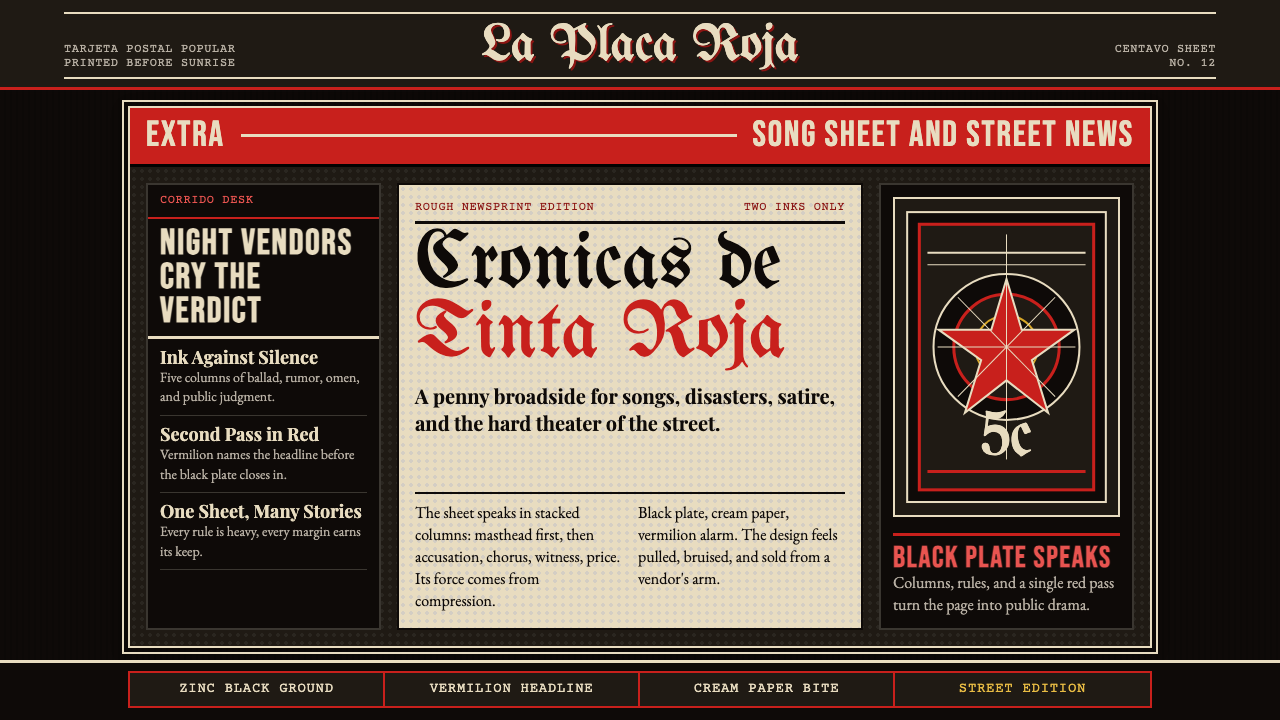 Mexican Tarjeta Postal (Posada Engraving 1900)Tabloid drama in two inks. Fraktur mastheads, vermilion rules, and cream news…
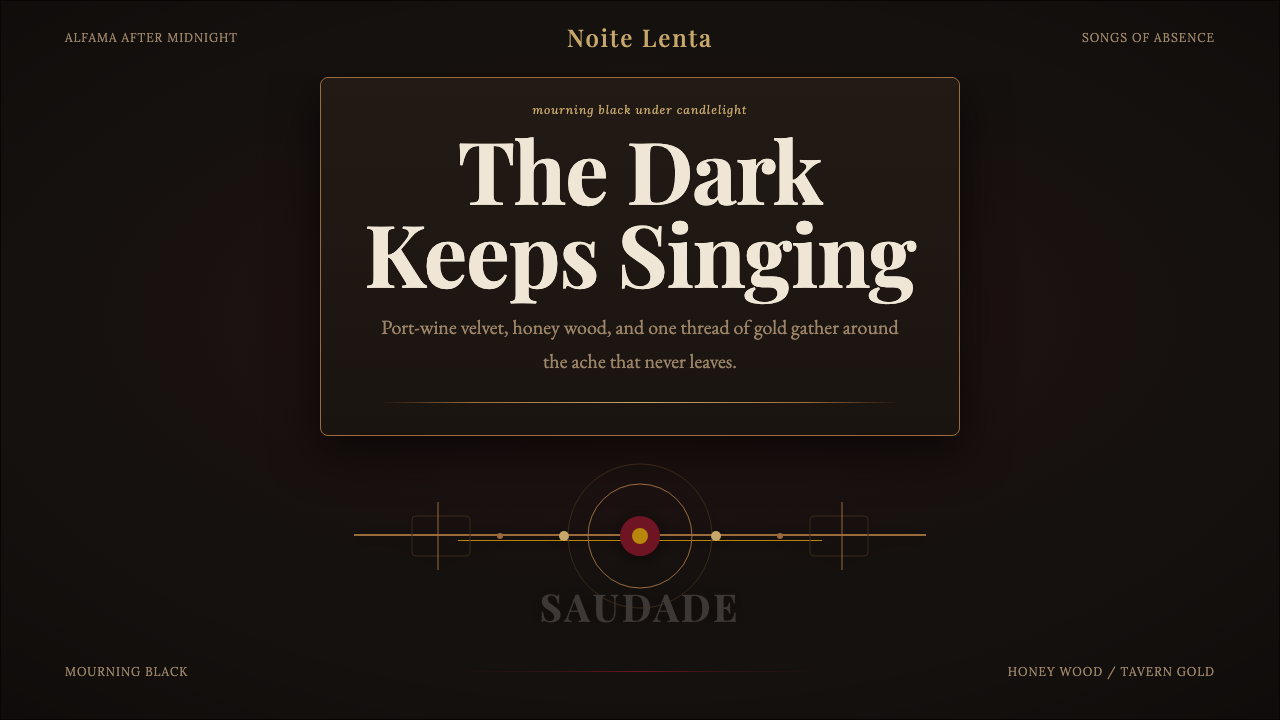 Fado SaudadeSaudade in shadow. Mourning black holds wine red, honey wood, and one gold li…
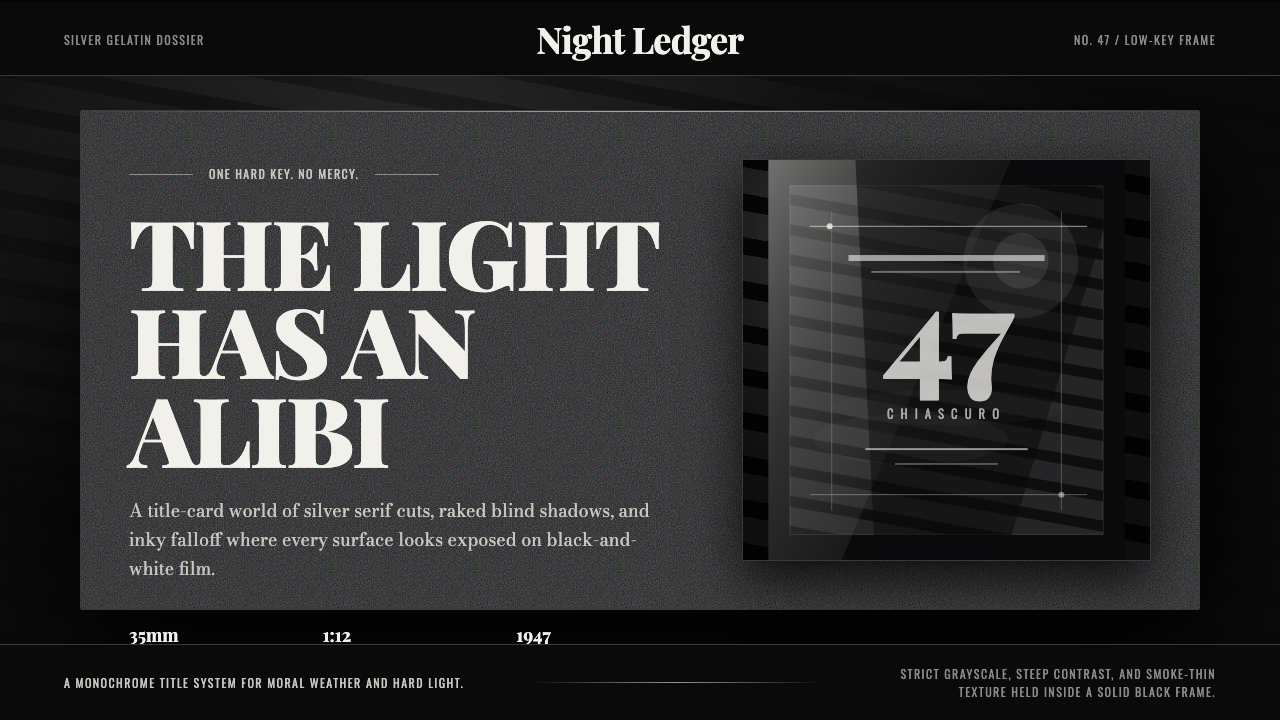 Film Noir ChiaroscuroLight is the crime. Silver serif cards, blind stripes, and grain carve drama…
 Vintage Passport StampsInk remembers passage. Indigo leaf, blue-violet cachets, red seal, typewriter…
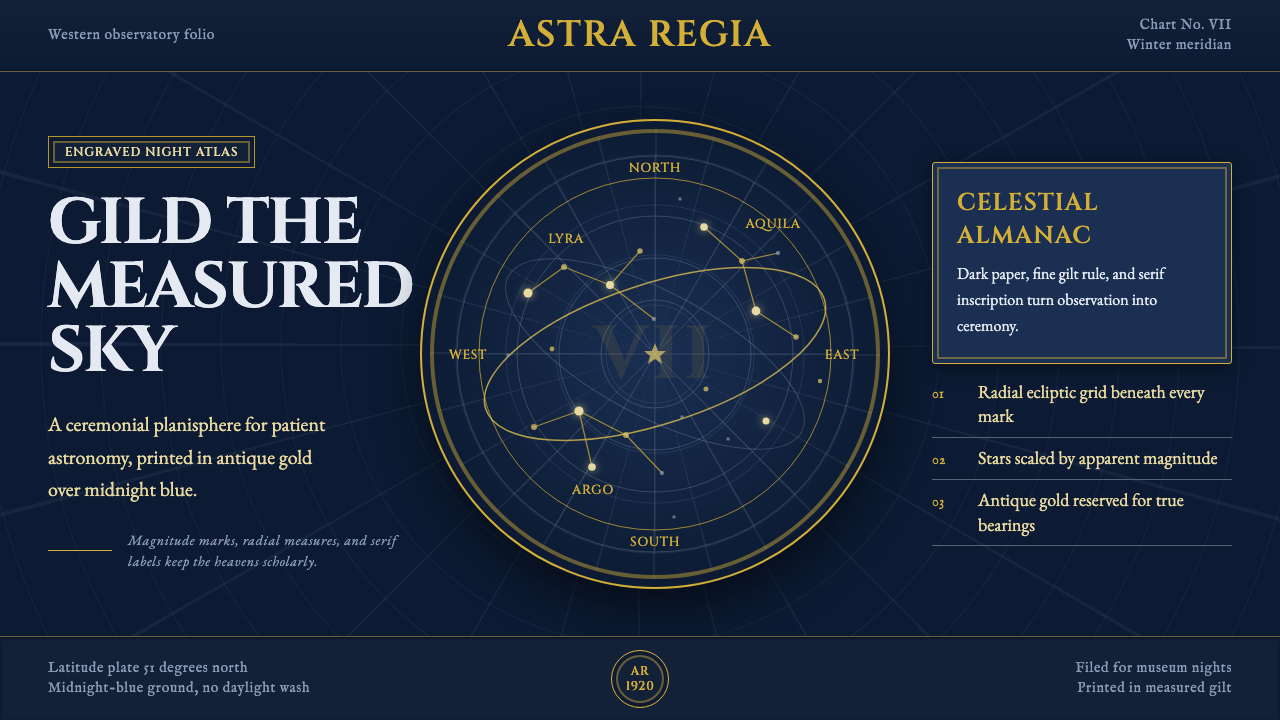 Vintage Star ChartScholarly night, gilded. Cinzel caps orbit gold grids and magnitude stars.