What is Ukrainian Pysanka Wax-Resist Egg?
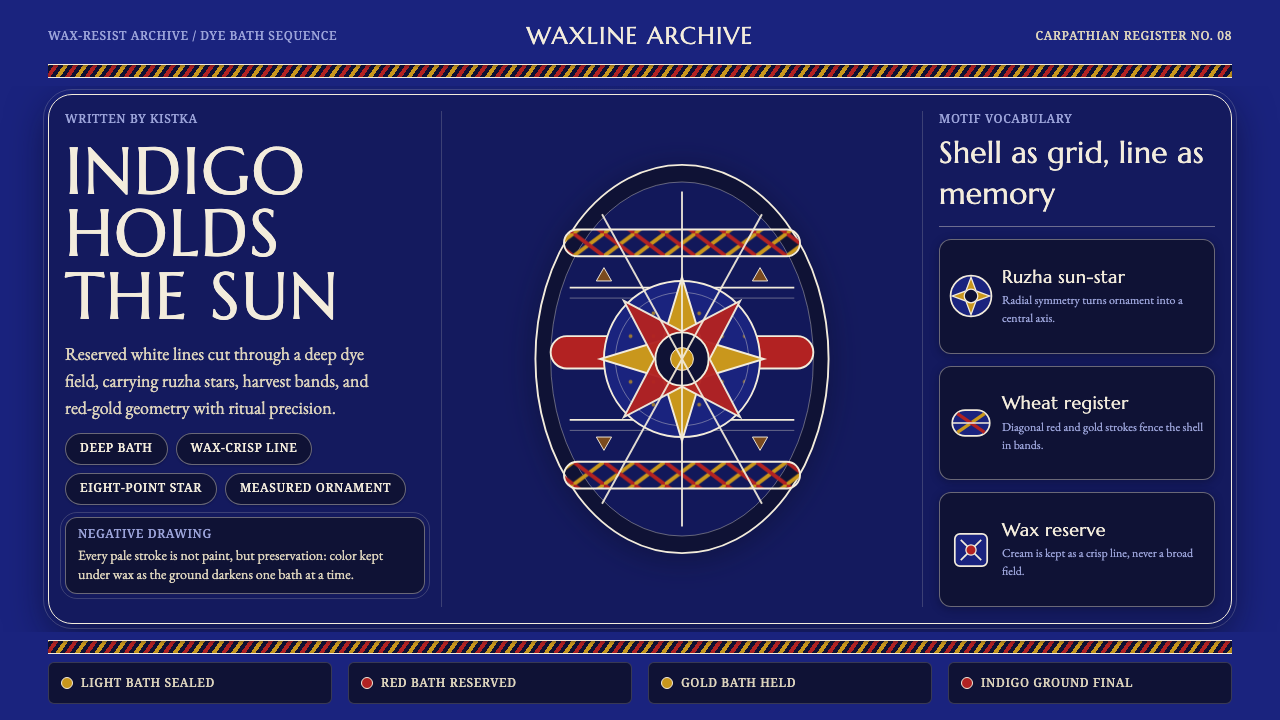
Pysanka turns an egg into a field of ritual geometry, where wax-white lines preserve stars, wheat, and color through a journey from light to dark.
Ukrainian Pysanka Wax-Resist Egg in brief
The pysanka is Ukraine’s wax-resist Easter egg tradition, made by writing a design onto an eggshell with molten beeswax. A kistka stylus carries the wax in fine, deliberate paths; every line protects the shell beneath it from the next dye bath. The image is therefore not painted onto the egg in a single act. It is reserved, concealed, and gradually revealed.
Its visual logic is inseparable from process. The egg moves through dye baths from lightest to darkest, and each fresh wax layer saves an earlier color before the next one arrives. The final visible ground comes from the darkest bath. Deep indigo, purple, and traditional black give the surrounding field its ceremonial gravity, while wax-white lines retain the clarity of the original shell.
In interface terms, the style becomes a saturated dark field structured by crisp pale linework. Eight-pointed ruzha sun-stars, wheat-sheaf bands, repeated borders, and restrained red and gold accents create a system that is decorative without becoming loose. It feels handmade because the motifs originate in drawn wax, yet it remains exact because every mark has to hold its place through successive stages.
Where does Ukrainian Pysanka Wax-Resist Egg come from?
Pysanka belongs to a centuries-old Ukrainian folk ritual tradition, especially associated with the Carpathian and central regions of Ukraine. Its name refers to writing rather than ordinary painting: the design is inscribed in wax before color is introduced. That distinction matters because the craft treats the eggshell as a surface on which meaning is protected layer by layer.
The central makers of this tradition are village pysankarky, the women who write eggs. Their work is both skilled handcraft and a disciplined visual practice. Fine wax lines have to remain legible after repeated immersion, so the maker plans the relationship between ground, border, motif, and accent long before the darkest color covers the shell.
Pysankarstvo, the broader Slavic Easter egg-writing practice, provides the cultural frame for these objects. Within that frame, geometric motifs are not merely pattern for pattern’s sake. Sun-stars, bands, and agricultural forms give the egg a ceremonial order, making its small curved surface feel full without becoming visually chaotic.
A nineteenth-century revival of aniline dyes expanded the available dark grounds. Deep indigo and purple joined traditional black, allowing the reserved wax lines and warmer accents to read with greater intensity. Folk-craft revivalists helped sustain this language as a living craft tradition, while its visual system continued to offer a powerful model for contemporary design.
What defines the Ukrainian Pysanka Wax-Resist Egg look?
Wax-Reserved Line
The defining mark is a pale line preserved by wax rather than applied as paint. It should look crisp, continuous, and intentional against the dark ground. In a digital adaptation, linework carries the memory of the kistka: it separates zones, encloses motifs, and gives every colored area a protected edge.
Dark Ceremonial Ground
The final darkest dye bath becomes the visual field. Indigo or purple can carry the same solemn depth as traditional black while allowing white, red, and gold details to emerge sharply. Darkness here is not emptiness; it is the accumulated result of the egg’s passage through earlier colors.
Ruzha Sun-Stars
Eight-pointed ruzha sun-stars give the composition a concentrated center of energy. They work best as deliberate focal motifs rather than scattered decoration, surrounded by measured spacing and supporting bands. Their symmetry stabilizes the curved shell or screen while the surrounding hand-drawn linework keeps the result alive.
Wheat-Sheaf Bands
Wheat-sheaf bands turn repetition into structure. They can frame a central motif, divide information areas, or travel around an edge as a continuous border. The repeated units should feel hand-built rather than mechanically identical, but their rhythm must remain disciplined enough to read as a coherent harvest pattern.
Reserved Warm Accents
Red and gold accents are strongest when treated as saved moments within the indigo field, not as a second background. Their role is to activate a star, emphasize a band, or establish visual hierarchy. Small areas of warmth become more persuasive when the pale wax lines and dark ground remain dominant.
Bounded Geometry
Pysanka geometry is precise, but it is made for a shell rather than an infinite flat grid. Motifs gather into compartments, rings, and bands that respect the egg’s enclosed surface. This gives the style a useful interface lesson: ornament should clarify zones and edges, never float without a boundary or purpose.
Who shaped Ukrainian Pysanka Wax-Resist Egg?
Village pysankarky are the egg-writing women at the center of the tradition. Their practice joins ritual knowledge to exact handwork: wax is applied with a kistka, colors are reserved in sequence, and motifs must retain their clarity after the final dark dye bath. In design terms, they embody the style’s essential tension between intimacy and discipline.
Folk-craft revivalists are associated with the continued life of pysanka as a recognizable Ukrainian visual tradition. Their significance lies in keeping the craft legible beyond a single household or season, including the expanded possibilities created when indigo and purple joined black as dark grounds during the aniline-dye revival.
Pysankarstvo is the wider Slavic Easter egg-writing tradition that frames the pysanka. It is not a single author but a living craft lineage, one in which the egg becomes a compact surface for wax-resist sequence, ritual geometry, agricultural motifs, and the visual drama of color emerging from concealment.
How do you use Ukrainian Pysanka Wax-Resist Egg today?
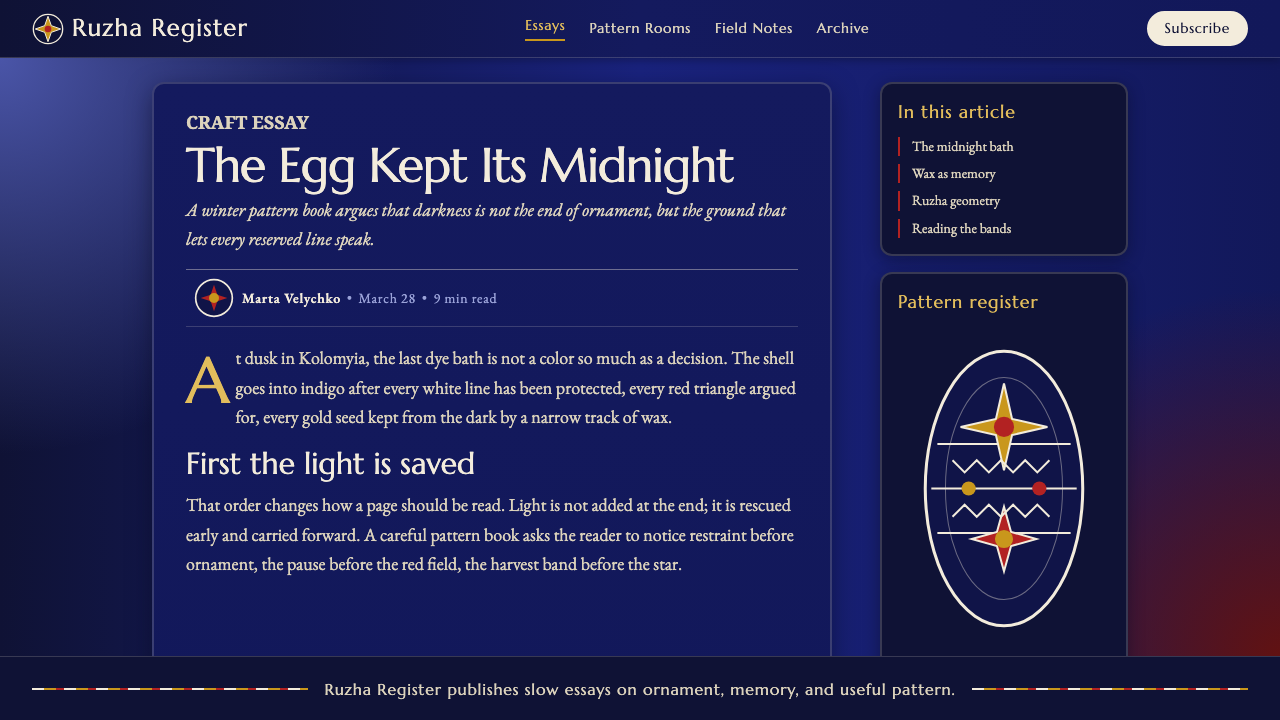
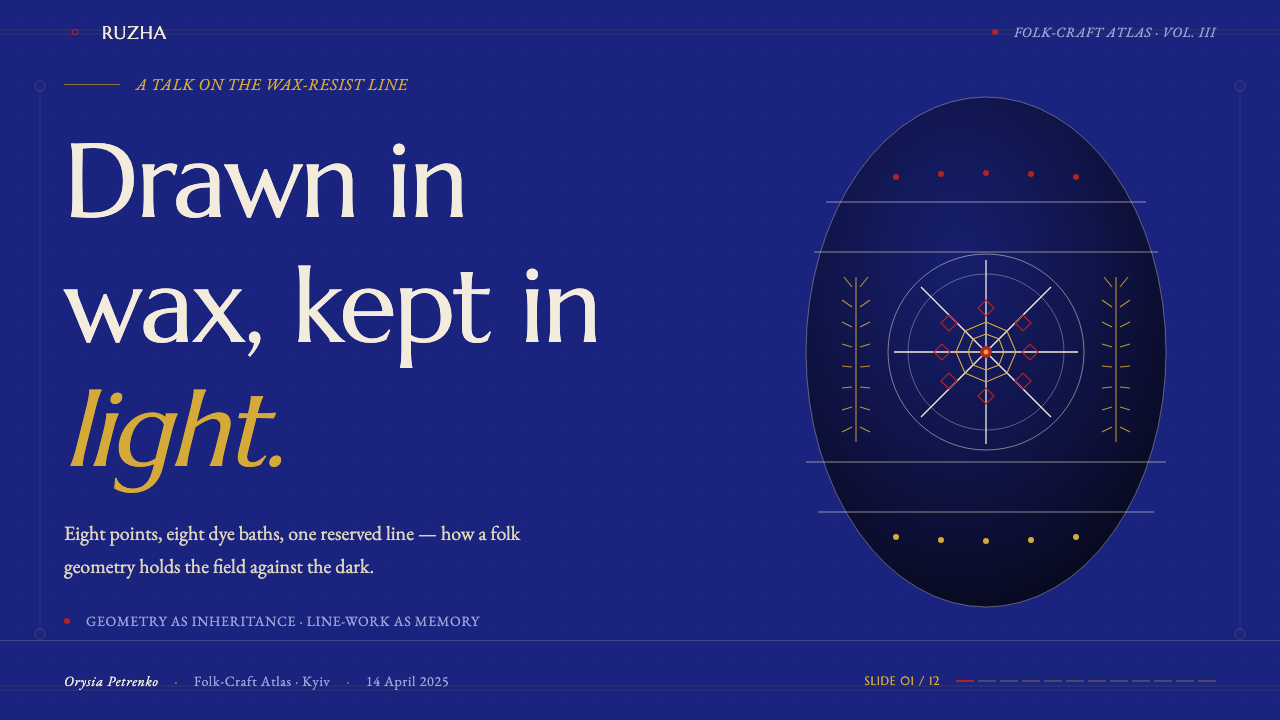
For presentation covers, use the dark indigo field as a quiet ceremonial stage. Let a single ruzha star or a wheat-derived border carry the visual identity, with the title held in a clear pale area rather than competing with every motif. Content slides should use line-bounded zones to organize sections, while keeping the decorative vocabulary concentrated at the edges and transitions.
Data slides can borrow the style’s logic of compartments and reserved color. Treat charts as part of the geometric system: pale rules establish the frame, indigo holds the field, and red or gold distinguishes only the insight that needs attention. A full patterned background behind dense data usually weakens the result; the wax-resist language works best when information has room to breathe.
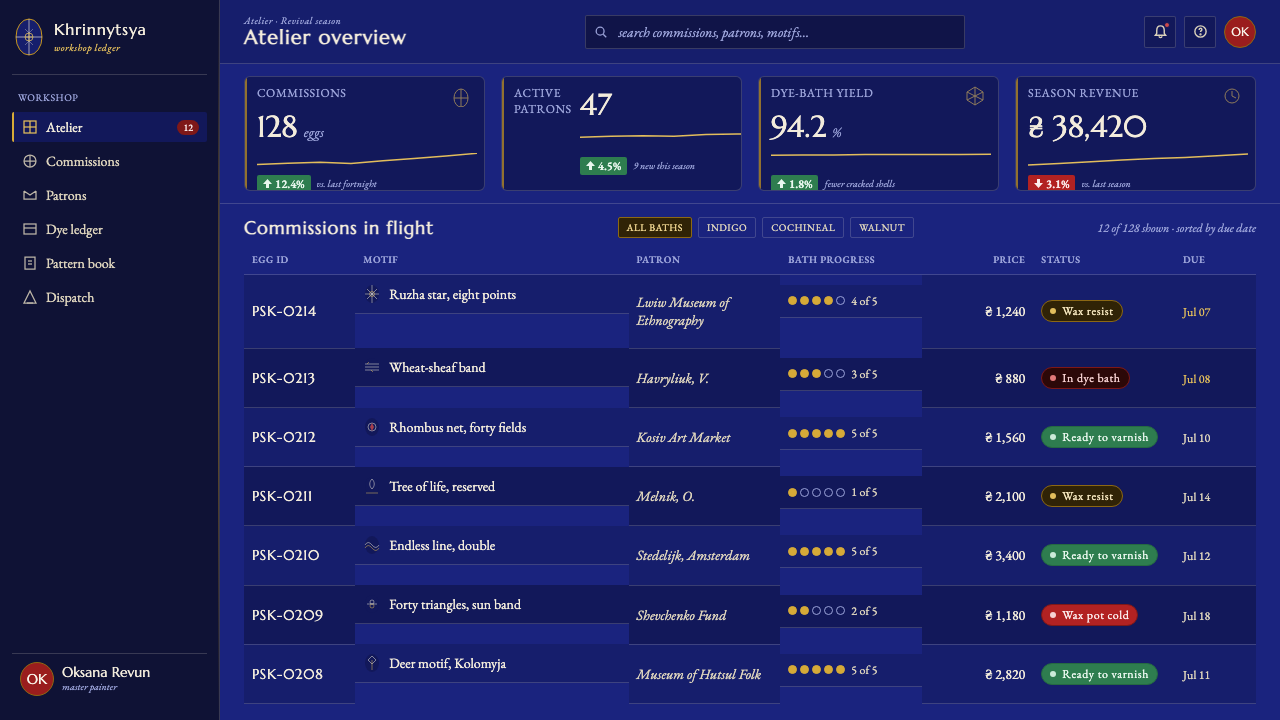
For web interfaces, the style is particularly effective for dashboards, collections, or pricing experiences that benefit from strong sections and a sense of occasion. Use the dark field for navigation, summary areas, or key panels, then make pale linework define cards and groupings. Stars and wheat bands should mark meaningful states, dividers, or milestones rather than become generic icon decoration.
Editorial and marketing work can use pysanka’s visual storytelling especially well. A feature page may open with an indigo hero area, move into calmer reading sections, and return to patterned bands for calls to action or quoted highlights. Crop motifs as borders or partial fields instead of placing a complete egg illustration in every block; the system is stronger when it suggests the shell’s logic rather than repeats it literally.
The common mistake is to treat this tradition as a dark background covered indiscriminately in ethnic-looking pattern. Pysanka depends on sequence, reservation, and hierarchy: pale lines must protect space, motifs must belong to bands or compartments, and warm colors must remain scarce enough to matter. If every surface carries stars, wheat, red, and gold at once, the ritual precision disappears.
Ukrainian Pysanka Wax-Resist Egg — FAQ
Is a pysanka simply a painted Easter egg?
No. Its defining method is wax-resist egg-writing. Molten beeswax is written onto the shell with a kistka, then the egg passes through successive dye baths from lightest to darkest. Each wax layer reserves the color beneath it, so the final design is built through preservation and sequencing rather than direct painting alone.
Why is indigo so important in this adaptation?
The final ground of a pysanka is the darkest dye bath. During the nineteenth-century aniline-dye revival, deep indigo and purple joined traditional black as available dark grounds. Indigo gives the interface version a deep field in which wax-white lines, sun-stars, wheat bands, and restrained warm accents can remain sharply legible.
How should ruzha stars be used in a modern layout?
Use them as focused structural motifs. An eight-pointed ruzha can anchor a cover, mark a key panel, or signal a meaningful transition, but it should have enough surrounding space to retain its symbolic presence. Repeating the star everywhere turns it into wallpaper and loses the concentrated energy that makes it useful.
Can this style work with contemporary interface content?
Yes, provided the craft logic is preserved. Use pale lines to establish clear boundaries, reserve warm accents for hierarchy, and let motifs identify sections rather than obstruct reading. The style is most convincing when contemporary information behaves like a carefully written egg: every area has a role, and every color appears because an earlier decision made room for it.
Related design styles
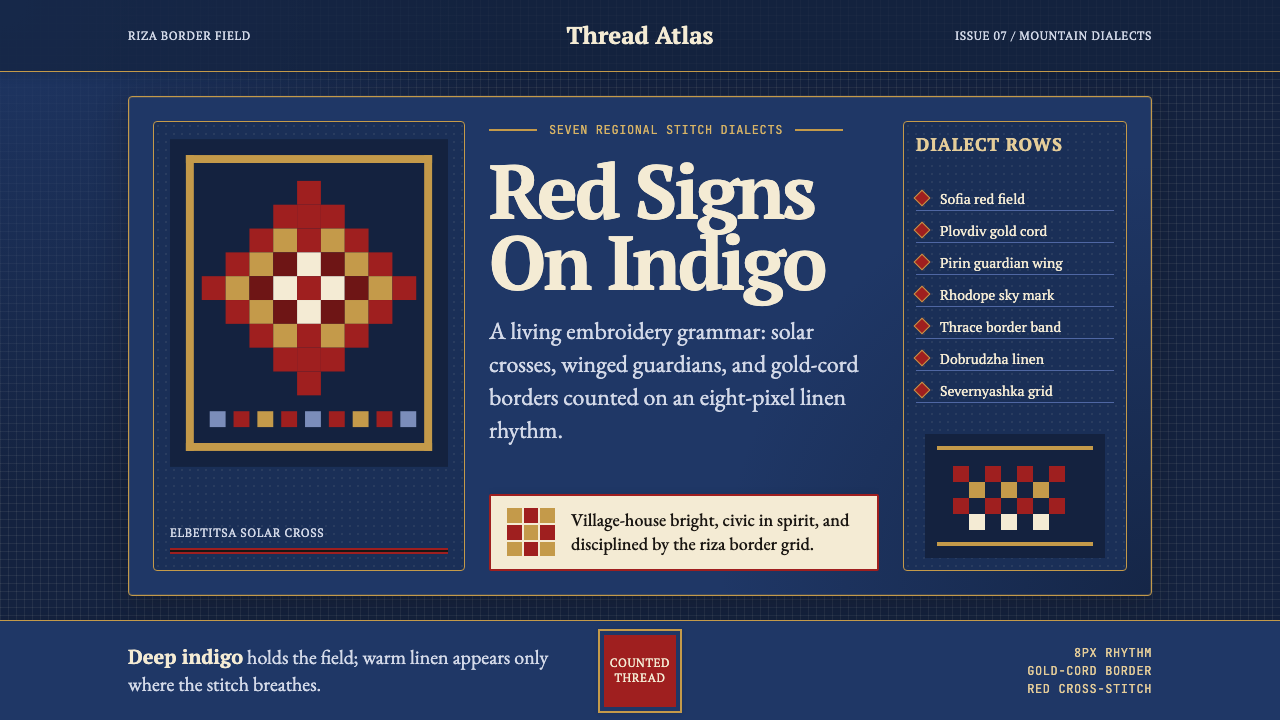 Bulgarian Shevitsa Folk EmbroideryVillage-bright code. Deep indigo carries shevitsa red crosses and gold-cord b…
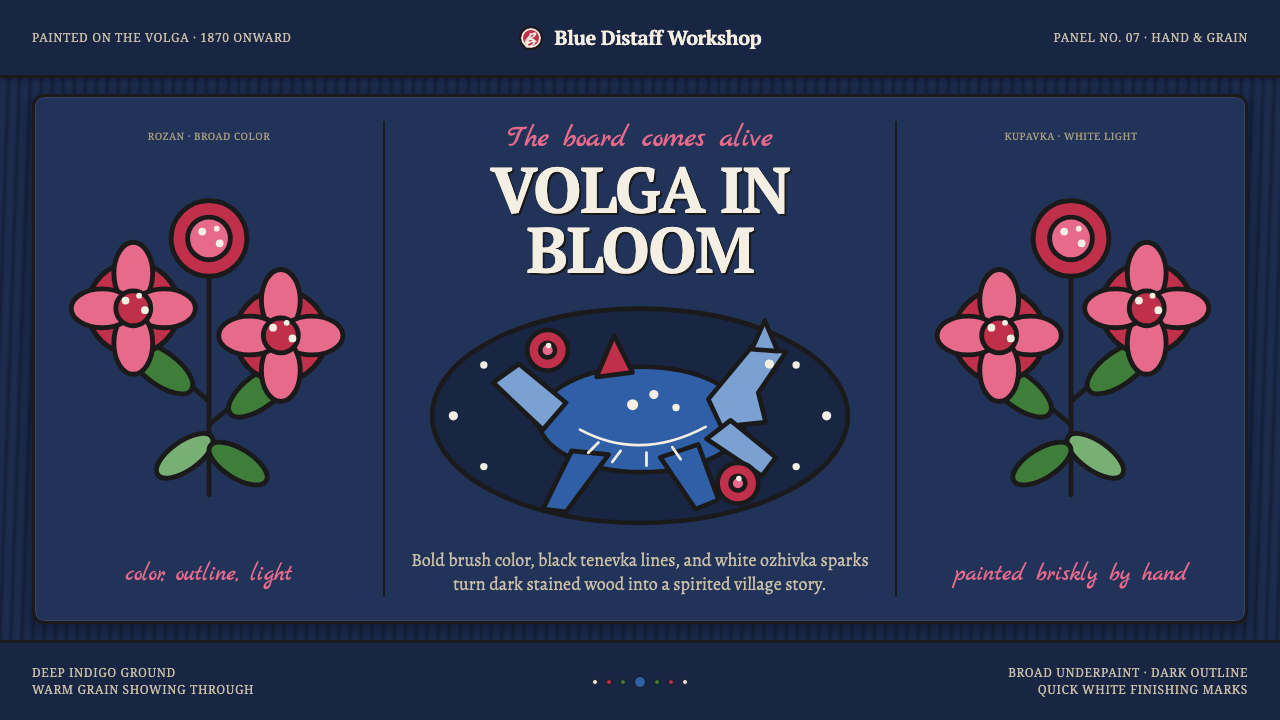 Gorodets Folk Panel PaintingFolk color moves at a gallop. Blue forms, red roses and white dots spark on i…
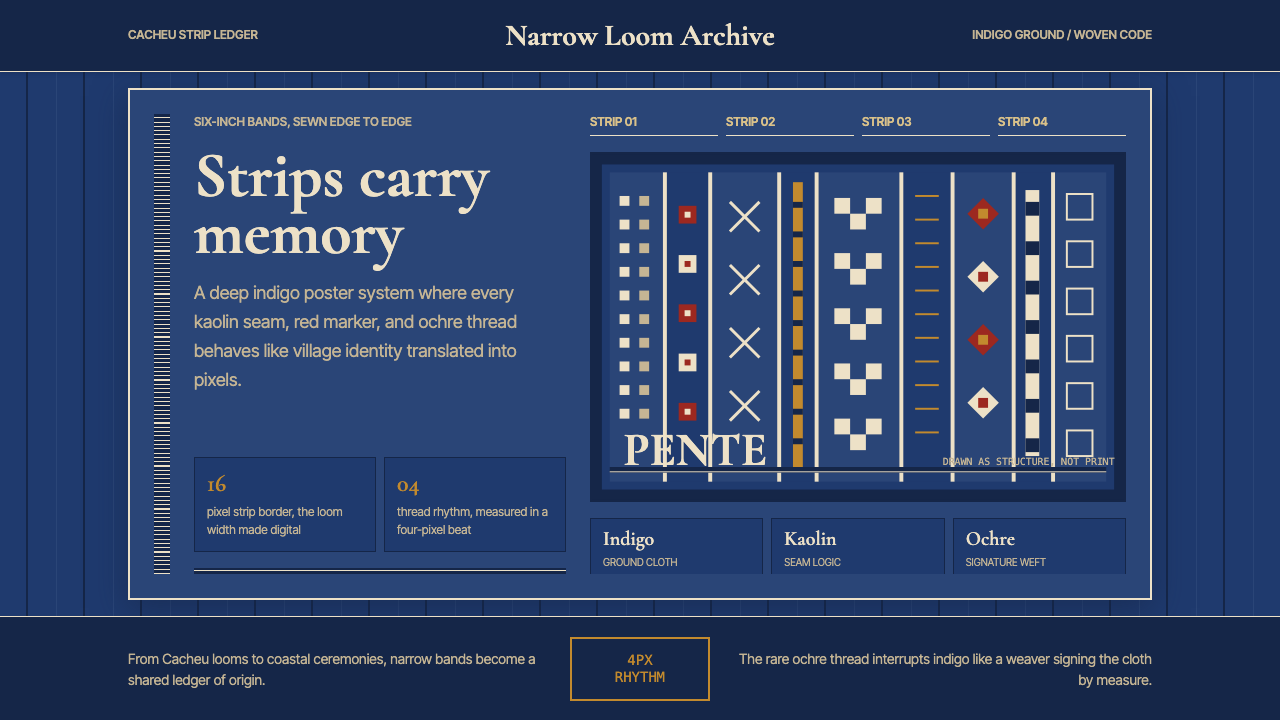 Bissau-Guinean Pano de PenteIndigo remembers. Narrow bands and kaolin seams turn weave grammar into pixel…
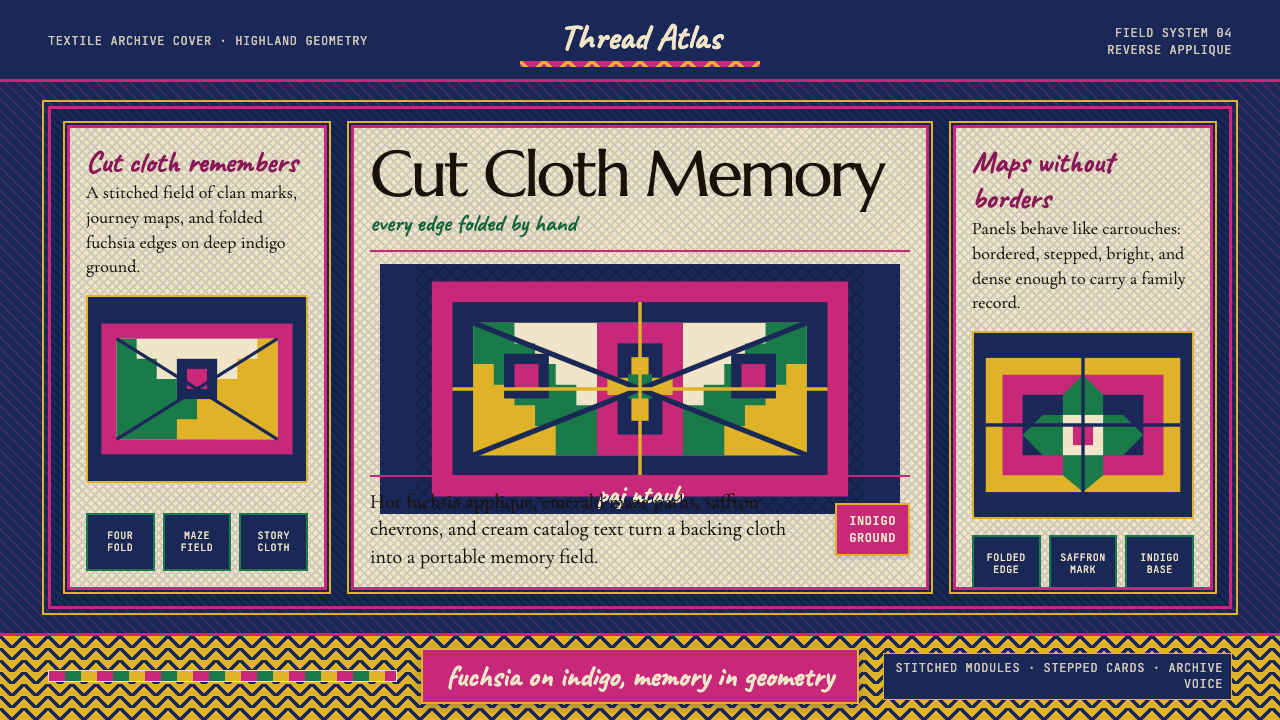 Hmong Paj Ntaub (Flower Cloth)Memory is geometric. Fuchsia applique on indigo forms stepped maze panels.
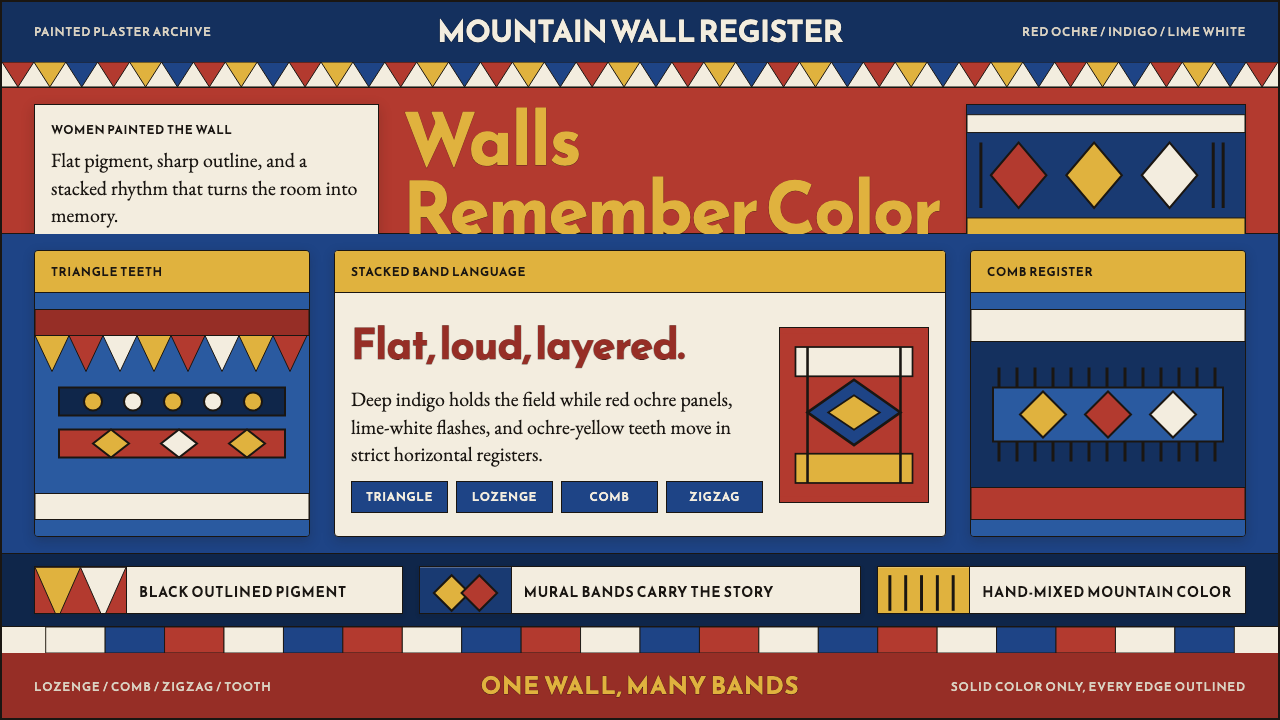 Saudi Asiri Qatt Wall PaintingPainted walls speak loudly. Indigo bands, red triangles, ochre teeth, black o…
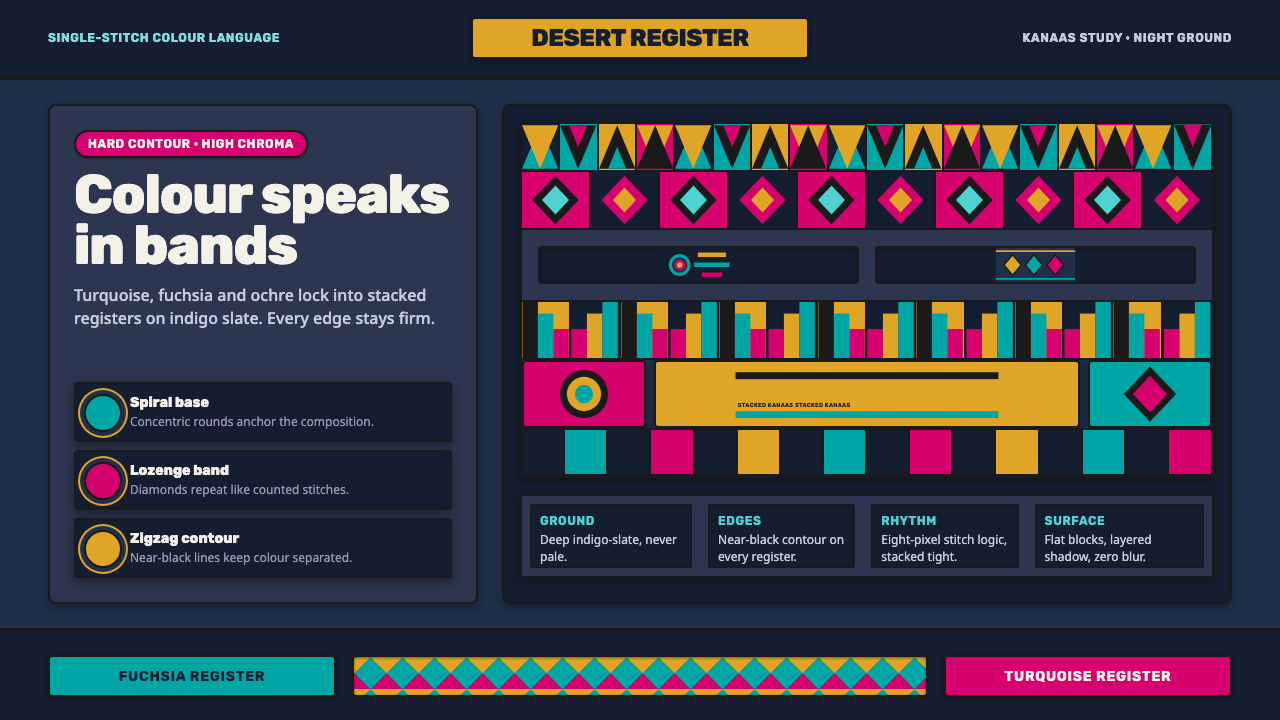 Wayuu Mochila CrochetColour speaks in bands. Turquoise, fuchsia and ochre stack on indigo-slate.