What is Wayuu Mochila Crochet?
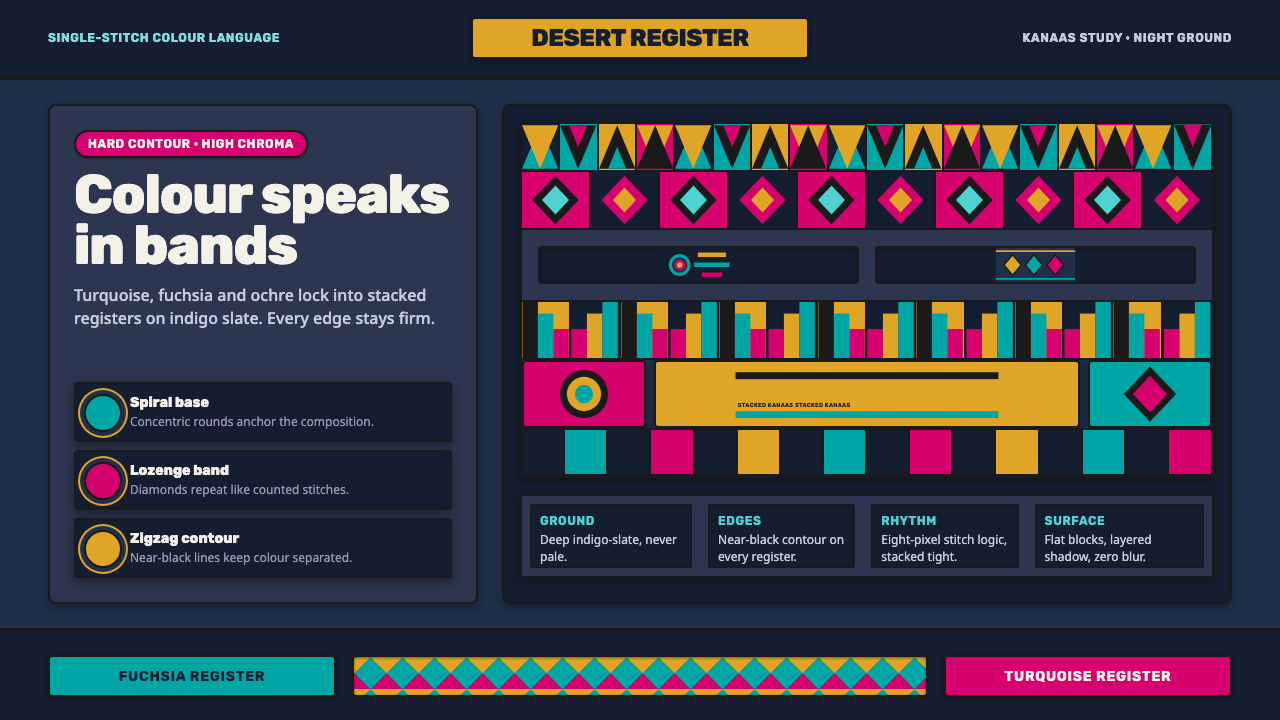
Wayuu Mochila Crochet turns colour into inheritance — saturated bands, dark contours, and patient single-stitch rhythm carrying the memory of La Guajira across every cylindrical form.
Wayuu Mochila Crochet in brief
Wayuu Mochila Crochet comes from the arid desert coast of La Guajira, a peninsula shared by northern Colombia and Venezuela. Wayuu women crochet the mochila one tight single-stitch at a time, gradually building a cylindrical bag from stacked bands of colour. The object is practical, but its surface is also a visual language: inherited geometric patterns appear as spirals, lozenges, and zigzags.
The defining quality of this system is that colour speaks in bands. Fuchsia, turquoise, ochre-gold, purple, and red arrive as bold, saturated blocks rather than blended transitions. Each colour remains distinct, separated from its neighbour by a dark contour line. The result is rhythmic and emphatic, with the pattern reading as a sequence of woven decisions rather than a soft field of decoration.
The ground is essential to the identity of the style. These colours sit on a deep indigo-slate background, evoking desert night rather than desert sun. Applied to design work, the system should feel stacked, woven, and carefully inherited: high-chroma colour held inside disciplined edges, with the patience of handcraft translated into a clear visual structure.

Where does Wayuu Mochila Crochet come from?
The tradition belongs to the Wayuu communities of La Guajira, whose territory extends across northern Colombia and Venezuela. Its setting matters to the visual character. Against an arid desert coast, the mochila carries a concentrated world of colour: bright bands and sharp motifs gathered into a compact form. The deep indigo-slate ground gives the palette its night-like depth and prevents the saturated colours from becoming weightless or merely festive.
Wayuu Mochila Crochet is an ancestral practice transmitted matrilineally and still active in contemporary life. The knowledge is carried through making rather than separated from it. Patterns, colour relationships, and the discipline of the stitch belong to a continuing chain of women weavers. That continuity explains why the style feels both personal and systematic: each object is made by hand, yet its visual vocabulary is shaped by inherited forms rather than spontaneous ornament.
The technique is identified with tapestry crochet using a tight single-crochet stitch. The maker builds a cylinder while managing bands of colour across the surface, allowing geometric motifs to emerge through changes in the stitch sequence and palette. Within the broader field of Indigenous Caribbean and Andean textile art, this practice demonstrates how a functional object can also hold pattern, memory, and communal identity. The mochila is therefore not a decorative reference applied to another medium; it is the visible result of a living process.
What defines the Wayuu Mochila Crochet look?
Banded Colour
Colour is organized in stacked bands rather than blended fields. Fuchsia, turquoise, ochre-gold, purple, and red appear as concentrated blocks with clear separation between them. The palette is high-chroma and declarative, but its energy is controlled by repetition. Colour does not float independently; it follows the logic of the band, returning across the surface as part of a larger inherited rhythm.
Geometric Motifs
The visual vocabulary is built from spirals, lozenges, and zigzags. These motifs are not applied as illustrations on top of a surface; they emerge from the construction of the surface itself. Their repetition gives the work a woven pulse, while their angular or turning paths create movement within the cylindrical form. Geometry here feels inherited, tactile, and active rather than sterile.
Dark Contours
A dark contour line separates neighbouring colour blocks and gives every motif a firm edge. This contour is more than an outline: it is the visual pause that allows saturated colours to remain legible beside one another. In a digital adaptation, boundaries should stay decisive and continuous. Soft blending, atmospheric fading, and blurred transitions would weaken the banded logic.
Indigo-Slate Ground
The deep indigo-slate ground is the field that holds the brighter colours together. It evokes the desert at night and gives the system its dark, immersive character. Light text and saturated accents should emerge from this ground with intention, while empty areas remain quiet rather than becoming pale neutral space. The darkness is structural: it makes the colour bands feel gathered, dense, and materially present.
Handmade Rhythm
The tight single-stitch process suggests patience, accumulation, and measured repetition. A Wayuu-inspired composition should not feel randomly patterned or mechanically scattered. Its rhythm should build through recurrence: a motif returns, a band answers another band, and colour gathers into a coherent sequence. Even when rendered digitally, the system benefits from visible evidence of deliberate making.

Who shaped Wayuu Mochila Crochet?
Wayuu women weavers are the makers at the centre of the tradition. Through tight single-stitch crochet, they construct the mochila as both a useful cylindrical object and a carrier of geometric colour language. Their work joins physical patience with visual precision: each band must belong to the larger rhythm, and each motif must remain clear within the dark contour system.
As custodians of a matrilineally transmitted practice, Wayuu women weavers preserve more than a technique. They carry forward kanaas, the geometric colour bands whose spirals, lozenges, and zigzags connect contemporary making with ancestral knowledge. The continuity of the tradition is visible in the repeated forms, but also in the discipline of passing a visual system through generations.
In the construction of kanaas, Wayuu women weavers turn colour into structure. Fuchsia, turquoise, ochre-gold, purple, and red are not loosely selected accents; they are arranged into a banded sequence and held apart by dark contours. The resulting surface demonstrates how pattern can be built through accumulation, with the cylindrical form giving the inherited motifs a continuous field.
How do you use Wayuu Mochila Crochet today?
For presentation slides, use the deep indigo-slate ground as the visual field and let the cover introduce one strong banded motif rather than a crowded pattern. Content slides can organize information through stacked colour bands, with dark contours separating topics and pale text reserved for essential reading. Data slides should treat charts as woven structures: repeated bars, segments, or markers can echo lozenges and zigzags while a restrained palette keeps the information legible.
For web interfaces, the style suits dashboards and pricing pages that need a strong identity without losing hierarchy. Keep the dark ground continuous across the interface, use saturated colour for status, category, or tier distinction, and preserve dark boundaries between cards and sections. Panels should feel assembled rather than floating. Repeated motifs can guide navigation, but the information must remain primary; the crochet reference works best when it supplies rhythm and grouping rather than visual noise.
For editorial and marketing work, Wayuu Mochila Crochet supports a tactile, story-led voice. A feature article can pair a quiet indigo-slate reading field with colour-band section markers, while pull quotes or campaign statements can occupy bold blocks of fuchsia, turquoise, or ochre-gold. Marketing compositions should suggest accumulated craft: recurring motifs, deliberate alignment, and a sense that the page has been built layer by layer rather than decorated after the fact.
A common mistake is to treat the style as a licence for uncontrolled saturation. Using every bright colour at once, scattering motifs without a band structure, or replacing the dark ground with a pale neutral field removes the system’s identity. Another mistake is to imitate crochet through random texture alone. The essential qualities are inherited geometry, separated colour, dark contour, and patient repetition; surface noise without those relationships is only costume.

Wayuu Mochila Crochet — FAQ
Is Wayuu Mochila Crochet only a colour palette?
No. Colour is essential, but it works together with banded rhythm, geometric motifs, dark contours, and the deep indigo-slate ground. The system also carries a sense of hand-built accumulation and matrilineal transmission. Applying only fuchsia, turquoise, and ochre-gold without the structural relationships would produce a tropical colour treatment, not a convincing Wayuu-inspired design language.
Why is the dark ground so important?
The deep indigo-slate ground is what turns the bright colours into a gathered system. It evokes the desert night described in the source material and creates a strong field against which the bands can remain saturated and legible. A pale ground would change the emotional balance, making the work lighter and more decorative. A dark ground gives the motifs density, continuity, and visual depth.
How should the geometric motifs be adapted for digital work?
Adapt the logic rather than copying a surface pattern mechanically. Use spirals, lozenges, and zigzags as recurring structures that organize sections, highlight key information, or create continuity between screens. Keep their edges decisive and separate neighbouring colours with dark contours. The motif should feel like part of a sequence that has been built, not like an isolated sticker placed on top of an interface.
Does this style suit every kind of product?
It is especially suited to work that benefits from cultural texture, strong colour identity, and a sense of craft or continuity. Editorial platforms, cultural projects, creative commerce, dashboards with a distinctive voice, and campaign work can all use its banded structure effectively. It may struggle where the product requires an extremely neutral or purely utilitarian appearance. The deeper principle is to match the visual system’s sense of inherited making with the product’s own story.
Related design styles
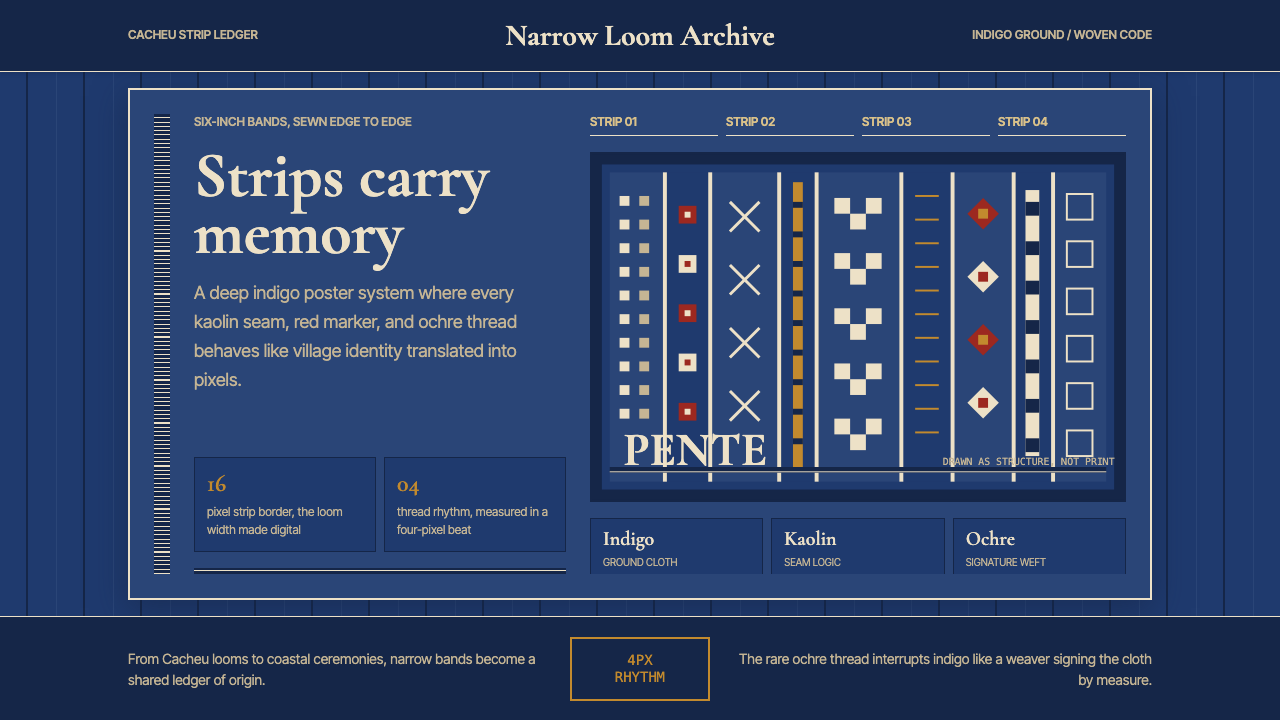 Bissau-Guinean Pano de PenteIndigo remembers. Narrow bands and kaolin seams turn weave grammar into pixel…
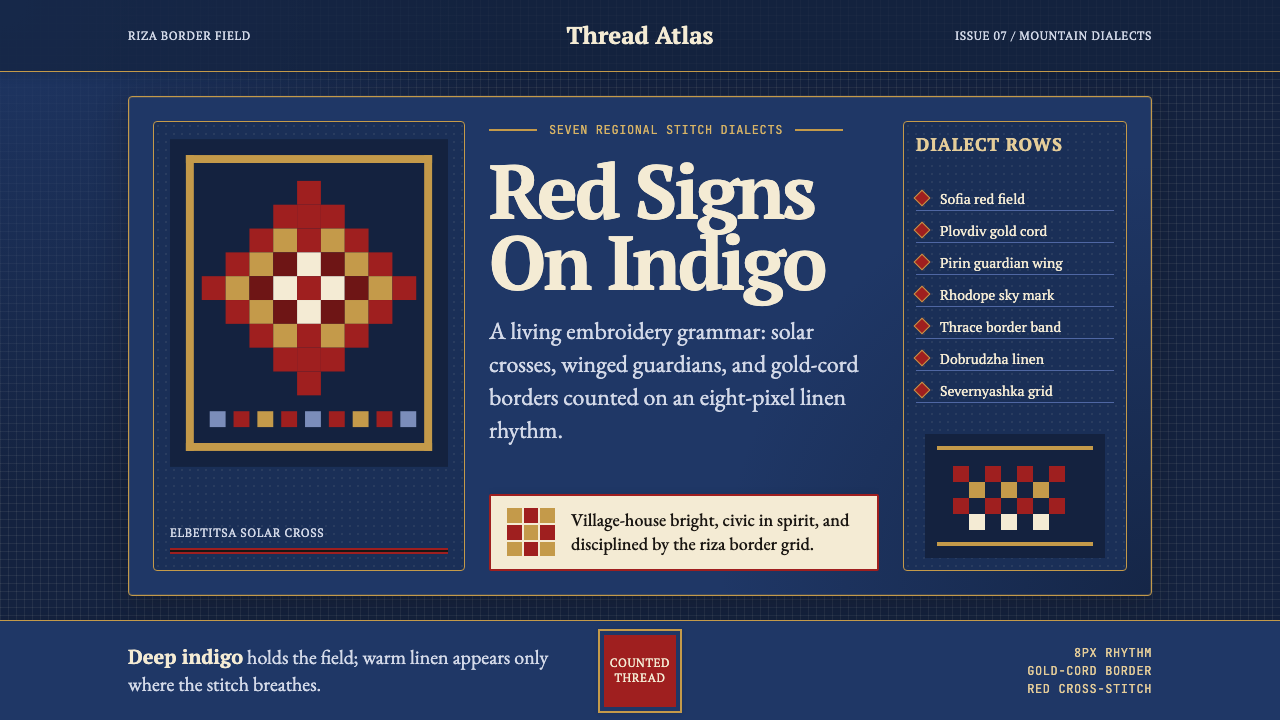 Bulgarian Shevitsa Folk EmbroideryVillage-bright code. Deep indigo carries shevitsa red crosses and gold-cord b…
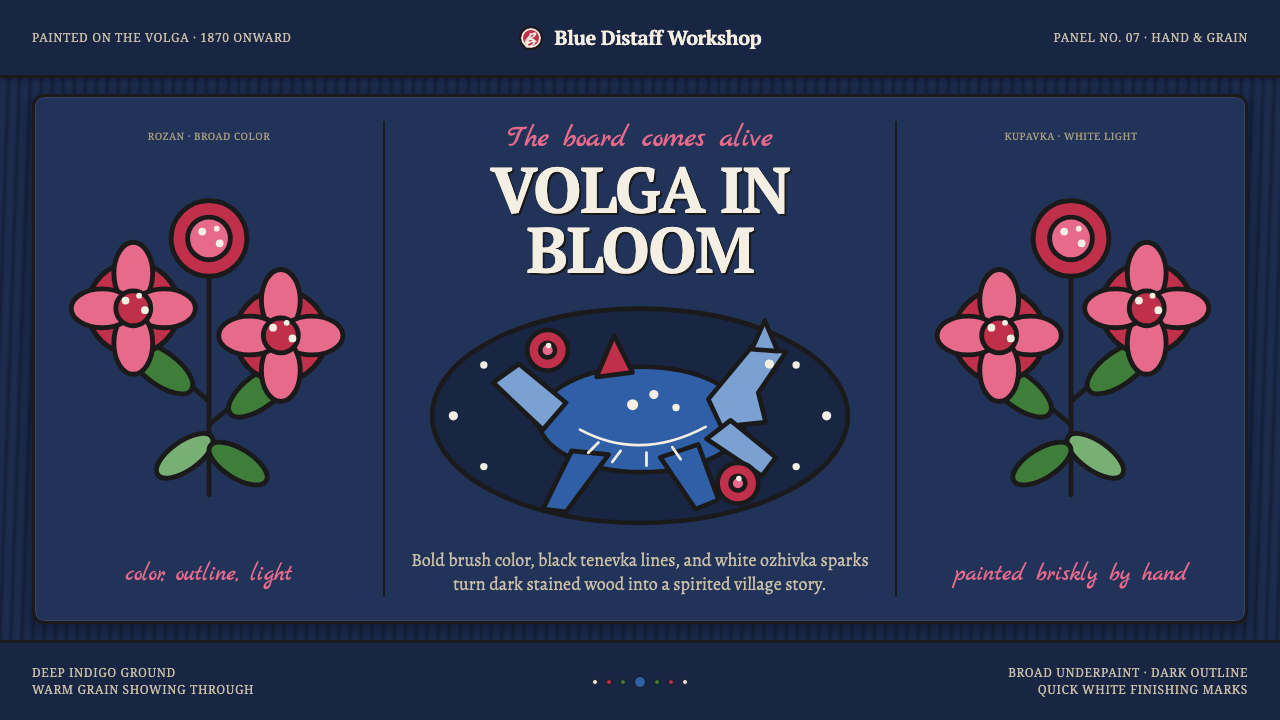 Gorodets Folk Panel PaintingFolk color moves at a gallop. Blue forms, red roses and white dots spark on i…
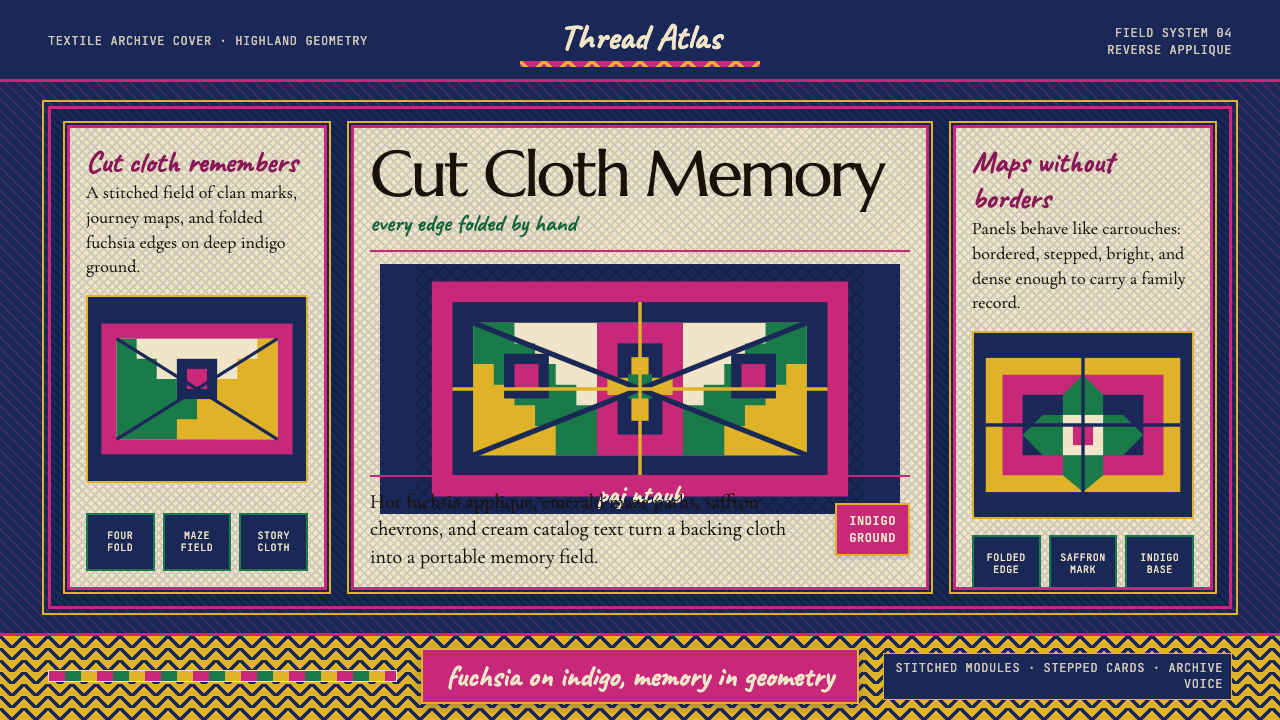 Hmong Paj Ntaub (Flower Cloth)Memory is geometric. Fuchsia applique on indigo forms stepped maze panels.
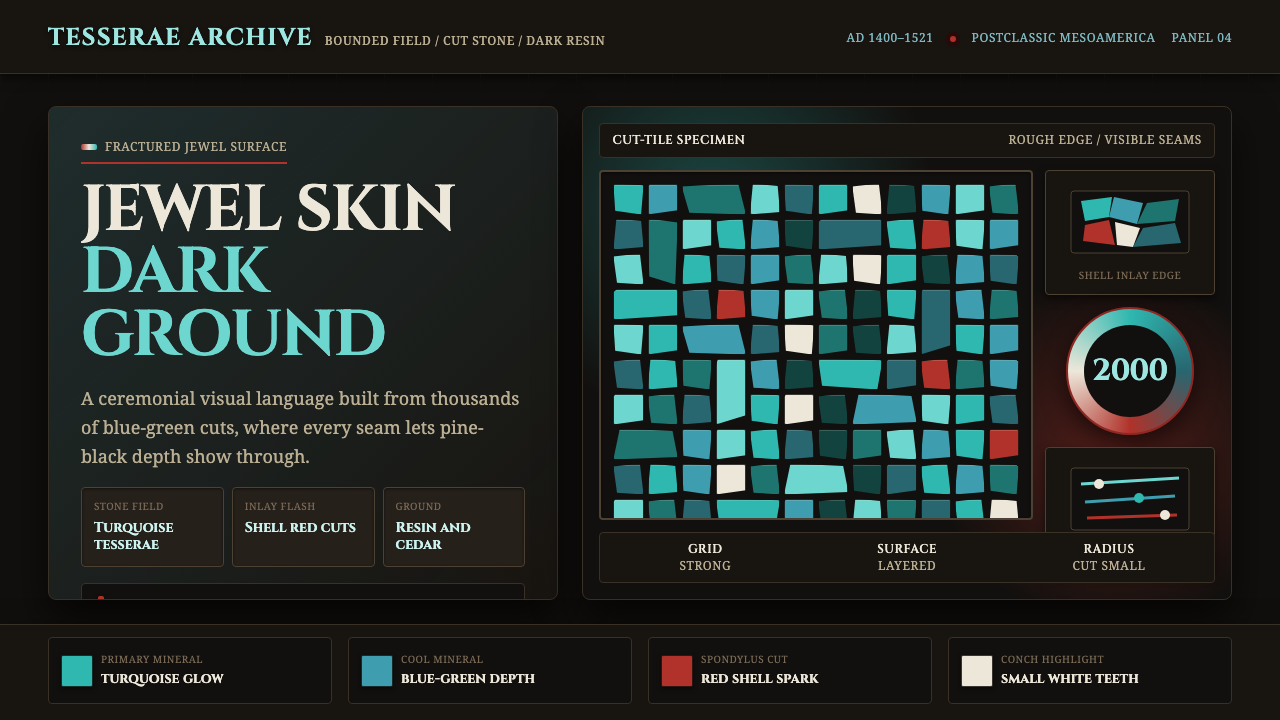 Mixtec Turquoise MosaicDarkness wears a jewel skin. Turquoise tesserae crack open with red and shell…
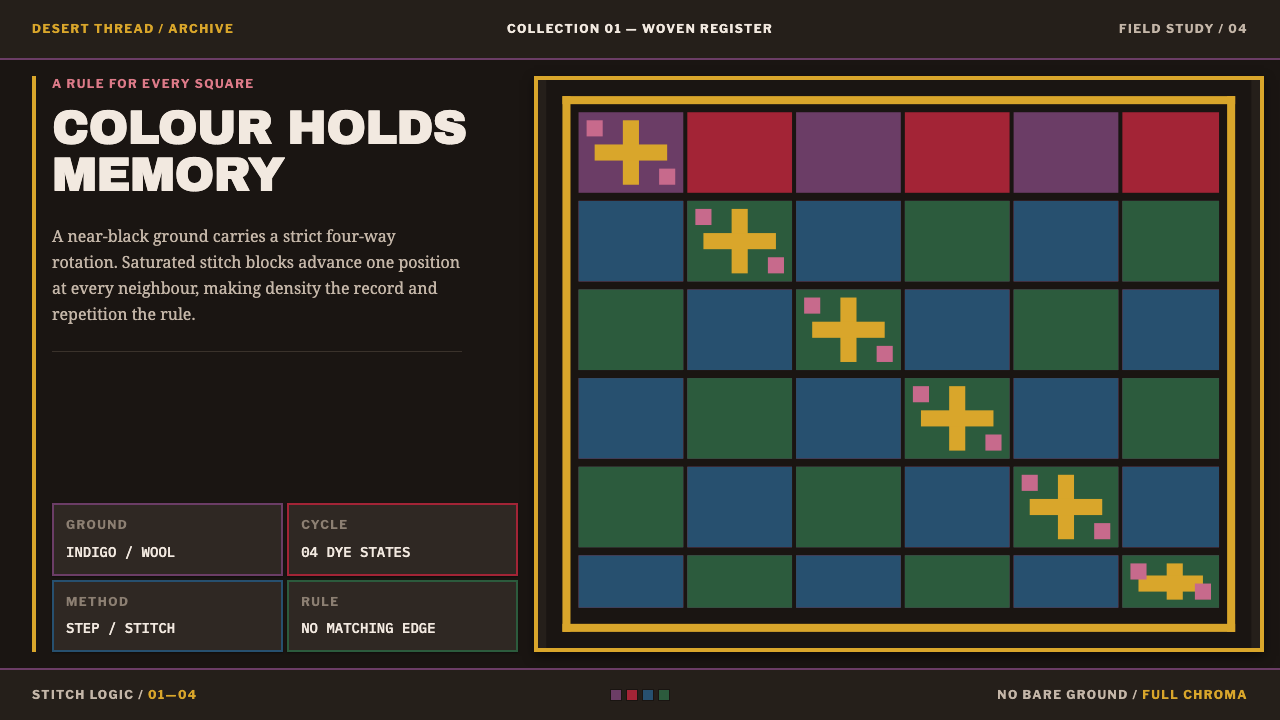 Paracas MantleDensity is the memory. Indigo-black ground drives a four-colour stitched chec…