What is Udaipur Lake Palace?
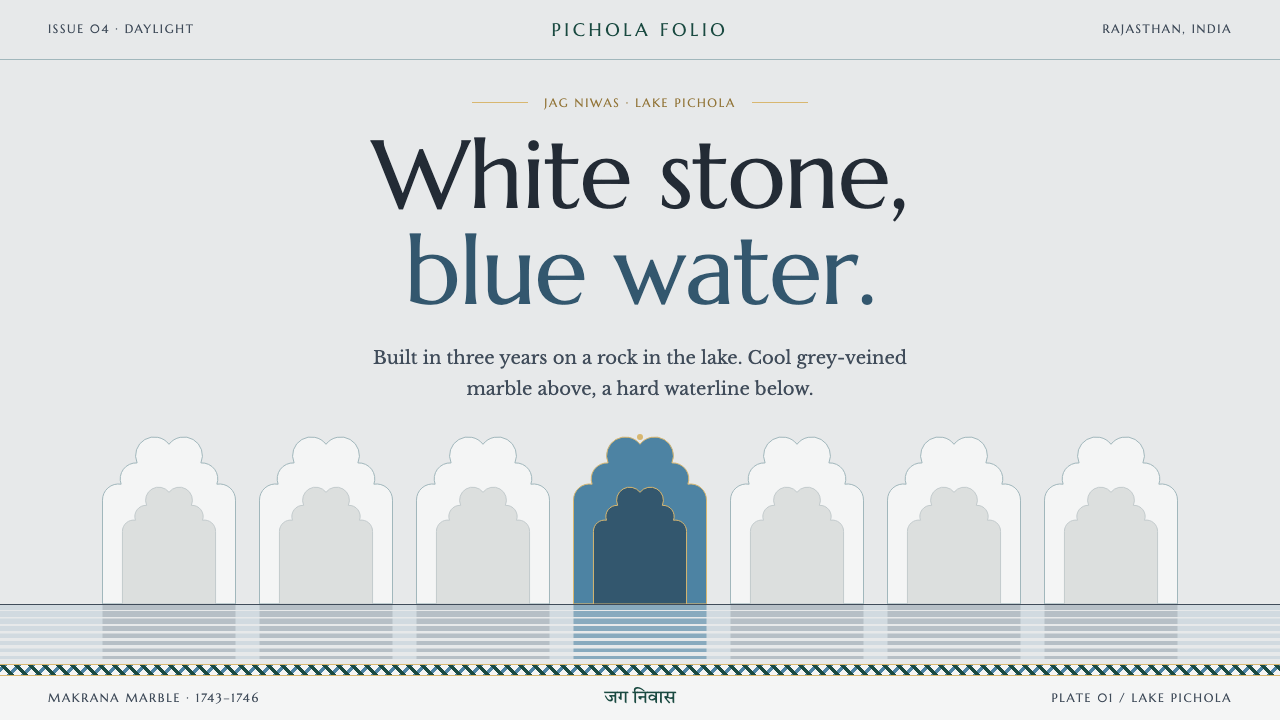
Udaipur Lake Palace is marble seen in daylight: cool grey-veined stone, one lake blue, and a hard waterline holding the whole picture still.
Udaipur Lake Palace in brief
Udaipur Lake Palace is a design language drawn from a single view: a white marble palace standing on a rock in the middle of a lake, with water meeting its walls on every side so that the building seems to float. It descends from Mewar palace architecture and the Rajput–Mughal tradition of marble inlay, and it translates that world into pale stone surfaces, cusped arches and fine brass lines.
The first thing to understand is the stone. The palace shell is Makrana marble, and in daylight it reads cool and grey-veined, not as warm ivory. That distinction governs the whole palette. Pages are a sun-bleached marble grey rather than cream, the single saturated color is the blue of Lake Pichola, and brass appears only as a hairline. There is no glow, no soft focus, and no dark night scene: the palace is meant to be seen in the day.
The second thing is the horizon. A hard horizontal waterline sits beneath every page, a reminder that this architecture rests on water. Above it, forms are symmetrical and framed: cusped arches, panels with inlaid corner ornaments, and narrow inlay bands as dividers. The result is calm, formal and exact, closer to a carved object than to a screen of floating cards.

Where does Udaipur Lake Palace come from?
The palace was originally called Jag Niwas. It was commissioned in 1743 by Maharana Jagat Singh II of Mewar, a ruler of the Sisodia house, and built over about three years on a rock in the middle of Lake Pichola in Udaipur, Rajasthan. The choice of site was the whole idea: an island pleasure palace, reachable only by water, where the court could withdraw from the heat and the city. The building was later extended through the nineteenth century, so what survives is the result of several generations adding to one original gesture.
Its architecture belongs to the Mewar palace tradition, in which courtyards, pavilions, balconies and domed kiosks are arranged around water and light. It also belongs to the older Indian idea of the jal mahal, the water palace, where a lake is not scenery behind a building but part of its composition. Mewar patrons were Rajputs, but they lived in constant dialogue with the Mughal court, and the marble work of the palace shows that exchange: symmetrical arches with scalloped, cusped edges, and fine decorative inlay in the pietra dura manner, where small pieces of colored stone are set into white marble in precise floral and geometric patterns.
The material has its own lineage. Makrana marble comes from the quarries of Rajasthan that supplied some of the most celebrated buildings of the Mughal era, and its fine grain and slightly cool, veined whiteness are exactly what the design keeps. Treating the stone as grey rather than ivory is not a quirk; it is a faithful reading of how the building looks under a hard Rajasthan sun, when warm tones fall away and the surface becomes crisp and pale against the water.
In the twentieth century the palace entered a new life. It has operated as a hotel since 1963 and has been run by Taj Hotels since 1971, and in that role it became one of the most photographed buildings in India. That later chapter matters to the design because it fixed the image people remember: the white palace, the lake, the sky. The system draws on this single, well-known view and strips it to essentials, leaving a visual vocabulary of stone, water, arch and thin gold line. It deliberately omits the candlelit interiors and sunset glow that tourist photography tends to emphasize, because the original building asks to be understood in clear daylight.
What defines the Udaipur Lake Palace look?
Marble grey ground
The page surface is a pale, cool grey-white that suggests stone under daylight, with a faint vein-like variation rather than a flat sheet of pure white. It is deliberately not cream or ivory. This keeps the system crisp and architectural and prevents the warm, sentimental tone that most palace themes slide into.
One lake blue
Pichola blue is the only saturated color in the picture. It is used for links, key actions, selected states and the water band, and almost nowhere else. Because nothing competes with it, a small amount of blue carries a lot of meaning, and the page feels disciplined rather than colorful.
Brass hairline
Metallic accents are kept to a very fine line in muted brass. They trace the edge of a panel, underline a heading or separate inlay bands, but never fill a large area. This honors the real palace, where gold is a detail in the stonework and not a surface.
Cusped arches
Arches with scalloped, pointed edges appear as headers, frames, image masks and navigation motifs. They are symmetrical and crisp, never rounded into a generic soft shape. The cusped silhouette is the most recognizable single form of the system and gives it a clear regional identity.
Framed panels and inlay corners
Cards behave like cut stone slabs: framed with a thin border, sharp or only slightly softened corners, and small symmetric inlay ornaments at the corners. Dividers are narrow bands that echo pietra dura rather than plain rules. Each module feels set into the page, not floating above it.
The hard waterline
A clear horizontal line anchors every layout, usually where stone meets water-blue. Above it, composition is symmetrical and still; below it, the blue field works as a base or footer. This single horizontal gives the system its sense of weight and its quiet, floating-yet-grounded feeling.
Daylight only
There is no dark mode, no glow and no blurred shadow. Elevation is shown with crisp edges and thin lines rather than soft lighting. The system commits to legibility and clarity, the way the palace looks on a bright afternoon, and treats softness as a loss of definition.

Who shaped Udaipur Lake Palace?
The ruler who commissioned the palace in 1743; its island site and water-bound character come from his decision.
The royal house of Udaipur whose court tradition of palaces, pavilions and lakeside architecture frames the whole style.
The Rajasthan source of the fine-grained white stone that defines the palace's surface and, by extension, the system's grey-veined ground.
The hospitality group that has run the palace as a hotel since 1971, keeping its image before a global audience.
How do you use Udaipur Lake Palace today?
For slides, this style gives a formal, quietly luxurious look. A cover can be a pale marble field with a cusped-arch frame around the title and a blue water band along the bottom. Content slides work best with symmetrical layouts and a framed panel for each idea. For data slides, keep charts in the single lake blue with thin brass rules, and let generous empty stone do the work that gradients do elsewhere.
For web and app interfaces, it suits hospitality, heritage, travel, wellness, jewelry, fine dining and any product that sells calm and craft. Hero sections can use an arched image mask over marble grey; pricing tables can become framed slabs; navigation can be a thin brass-lined bar. Dashboards are possible, but keep them sparse and ordered, with blue used only for primary actions and current selections.
For editorial and marketing work, the style supports long-form cultural writing, invitations, brochures, catalogs and annual reports. Headlines read well in a refined serif set against stone grey, with captions in a small, plain sans. Photographs should be taken in clear light, and layouts should be symmetrical, with the waterline used as a footer or section break.
The most common mistake is warming the stone. Once the grey becomes cream or sand, the piece loses its daylight clarity and drifts into generic luxury. A second mistake is adding glow or soft shadow to make the palace feel romantic; the style depends on hard edges and a still horizon. A third is spreading the blue too widely, which dilutes the one saturated note and turns a disciplined system into a decorative one.

Udaipur Lake Palace — FAQ
What is the Udaipur Lake Palace design style?
It is a daylight, marble-based visual language drawn from the Lake Palace on Lake Pichola: cool grey-veined stone surfaces, one saturated lake blue, hairline brass, cusped arches and framed panels resting on a hard horizontal waterline.
Why is the marble grey rather than ivory?
The palace is built of Makrana marble, which looks cool and grey-veined in strong daylight. The style follows what the building actually looks like, and avoiding warm cream also keeps it crisp and architectural.
Who built the Lake Palace and when?
Maharana Jagat Singh II of Mewar commissioned it in 1743 as Jag Niwas. It was built over about three years on a rock in Lake Pichola and extended in the nineteenth century. It has been a hotel since 1963 and run by Taj Hotels since 1971.
Can this style work in dark mode?
Not really. The system is built around pale stone and daylight clarity, with no glow or soft shadow. A dark version would need to be treated as a separate design rather than an inversion of this one.
What projects suit it best?
Hospitality, travel, heritage, wellness, jewelry, fine dining, invitations, brochures and any editorial or product page that wants a calm, formal, craft-centered tone.
Related design styles
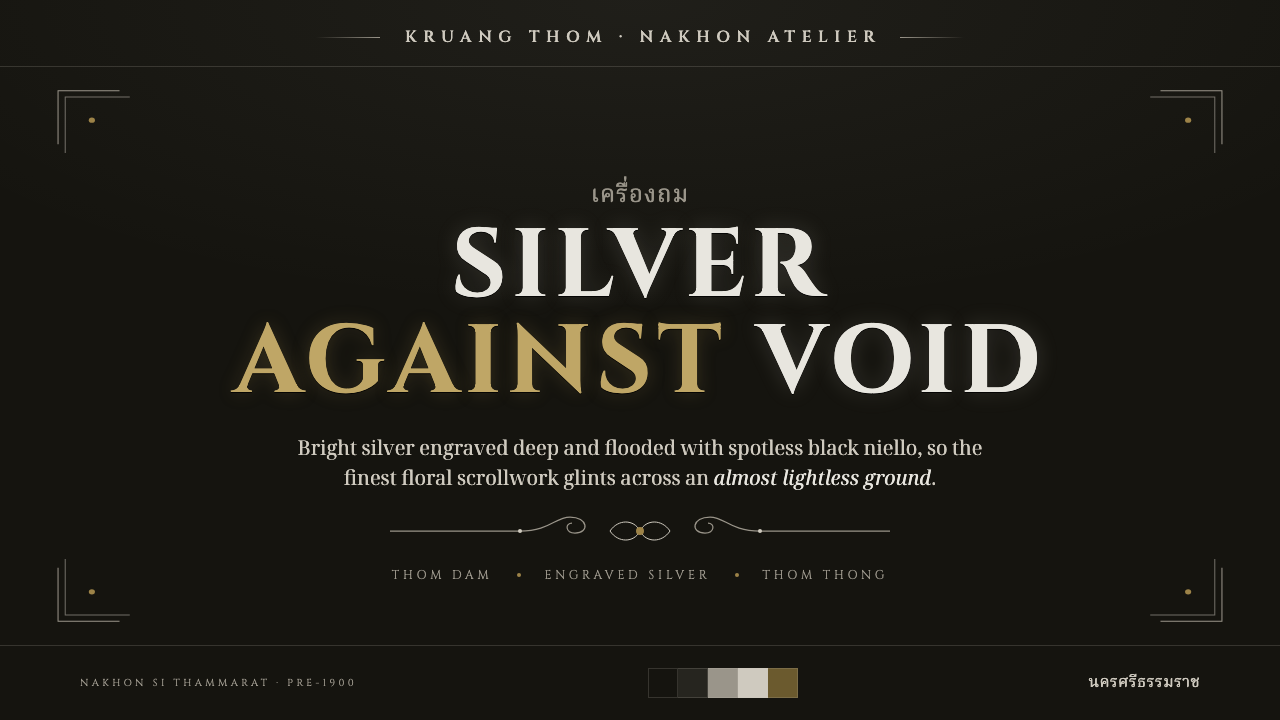 Thai NiellowareSpotless black, one bright line. Silver scrollwork engraved into near-lightle…
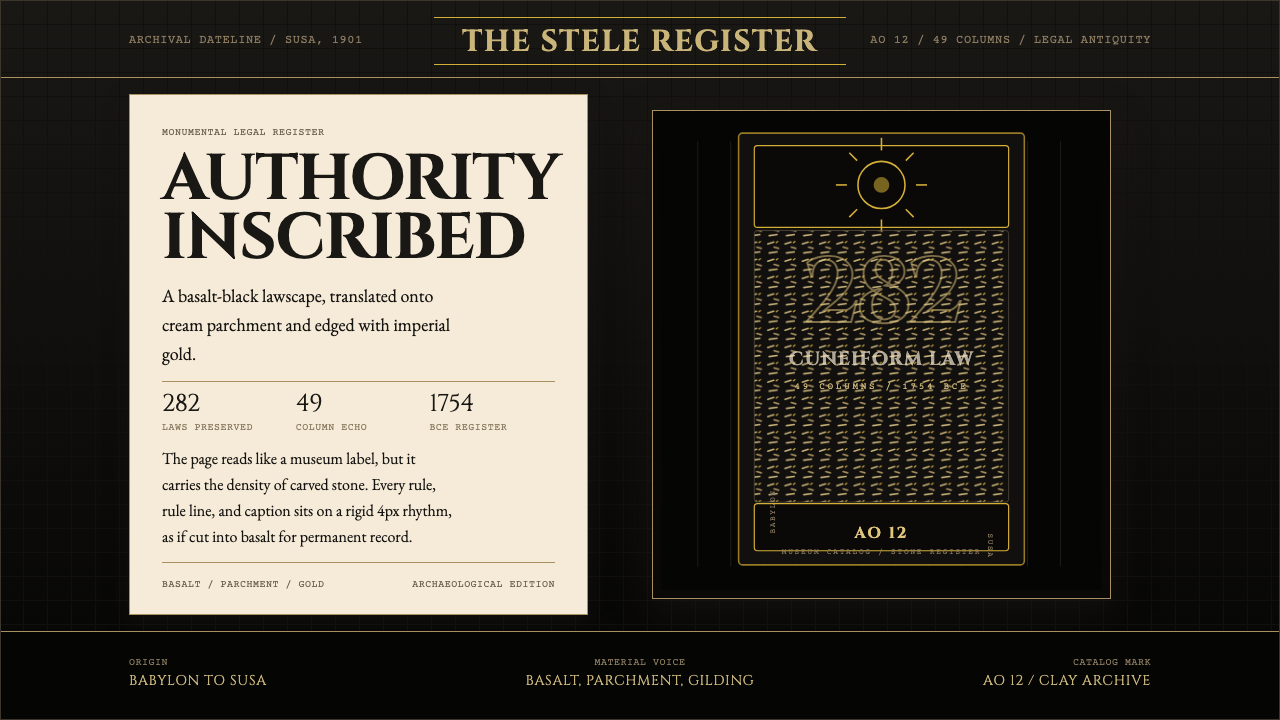 Babylonian Hammurabi SteleAuthority carved in stone. Basalt-black grids, parchment panels, and imperial…
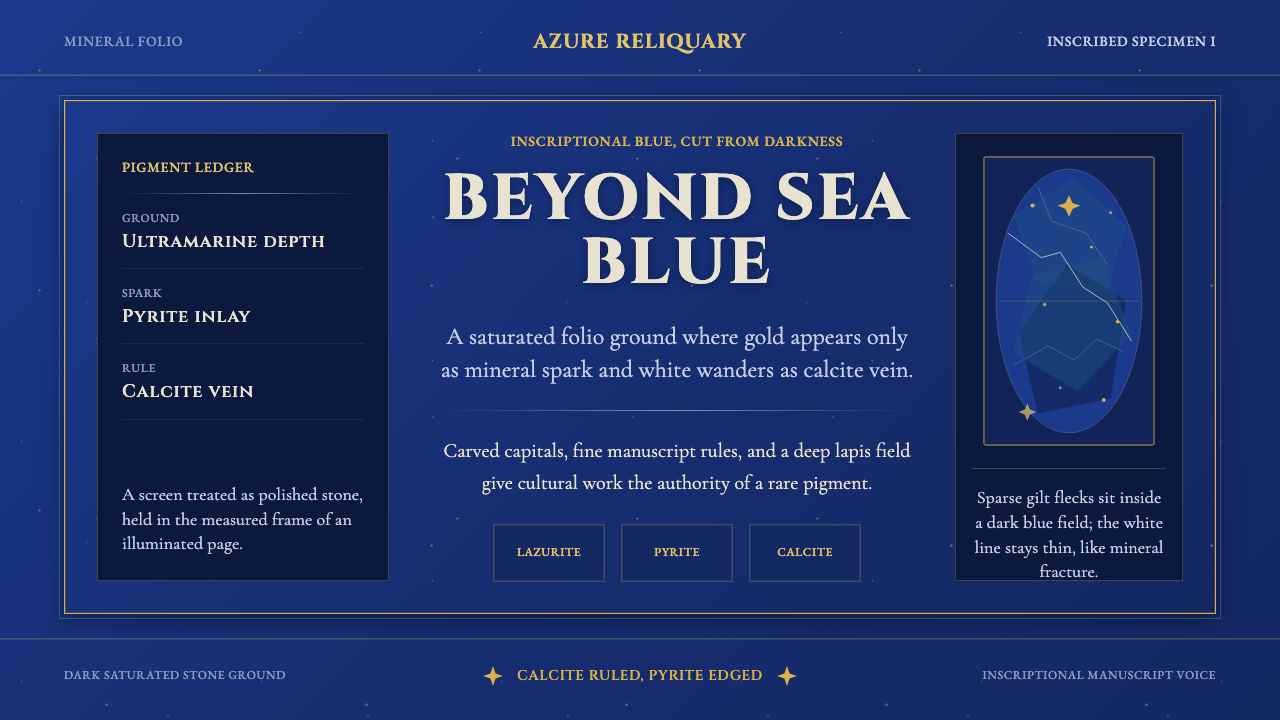 Badakhshan Lapis LazuliStone as manuscript. Ultramarine field, pyrite flecks, calcite veins, carved…
 Bayer UranometriaGrave celestial folio. Olive-slate grid, brass stars, Greek labels, old-style…
 Benin Bronze (Edo, 1500)Royal memory, cast in bronze. Cream plaques and gilded lines carry museum gra…
 Bordeaux Wine ChâteauAged claret authority. Cinzel capitals, gilt rules, and label symmetry on win…