What is Tuvan Khoomei Throat-Song Viz?
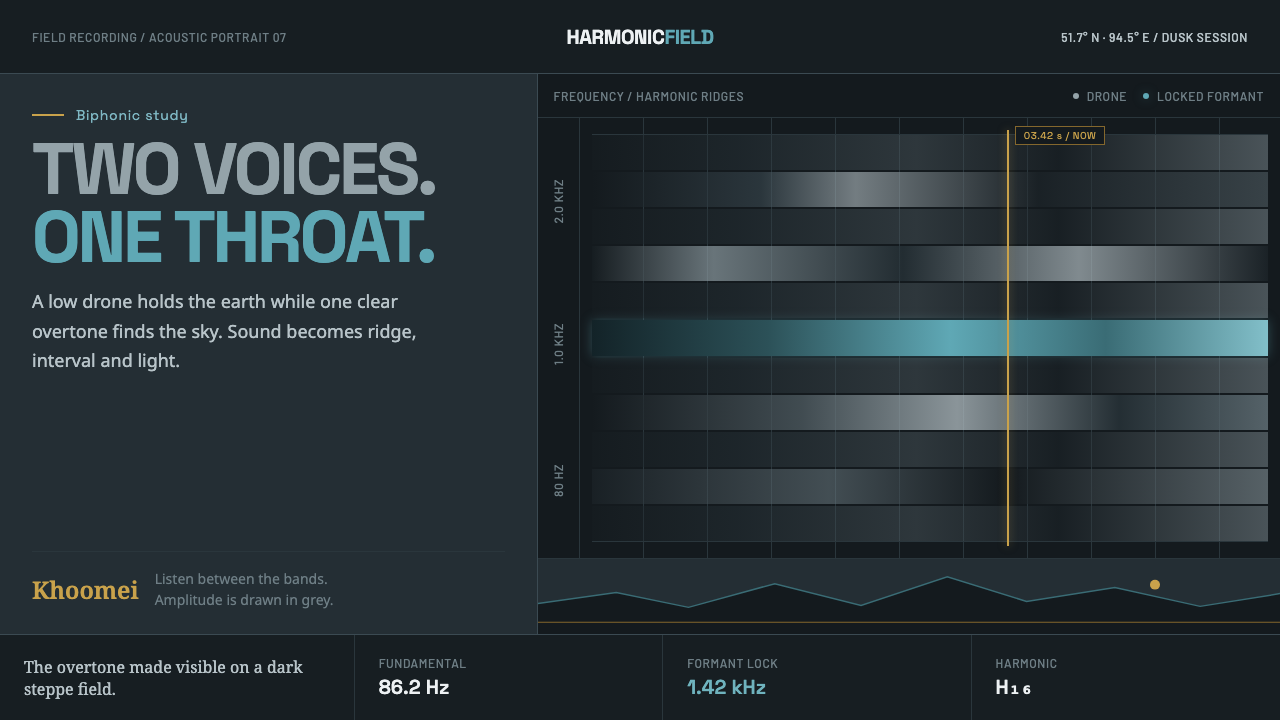
Tuvan khoomei throat-song becomes a moving landscape: a low drone beneath a bright overtone, translated into harmonic ridges across a slate-dark horizon.
Tuvan Khoomei Throat-Song Viz in brief
Tuvan Khoomei Throat-Song Viz is a dark visual language derived from the acoustic character of Tuvan khoomei, a biphonic throat-singing practice of the Central Asian steppe. Its central event is not a melody illustrated by decoration, but a sound made visible: a sustained low fundamental drone carries a focused overtone formant that whistles above it. The visual system treats this dual register as terrain. The drone establishes the dark field and distant horizon; the overtone rises from it as a luminous ridge of repeated harmonic bands.
The system takes its compositional logic from a scientific spectrogram. In that image model, time travels from left to right, frequency stacks vertically, and amplitude appears through tonal intensity. Rather than reproducing a laboratory chart literally, the style turns its structure into atmosphere. Grey harmonic contours accumulate like mountain strata over a slate field. Louder passages deepen and thicken; quieter passages recede. A narrow cyan-teal glow identifies the focused overtone, making the highest audible strand feel like cold air moving above stone.
Its visual identity joins acoustic observation with steppe imagery. The palette remains restrained: dark slate suggests a vast listening field, cool greys carry harmonic information, cyan-teal evokes open sky, and a single ochre accent recalls grassland catching sunlight. A horsehead and mountain silhouette hover at the horizon, not as narrative illustration but as sparse cultural markers. The result should feel measured and elemental at once: part sound study, part dusk landscape, part encounter with a voice that seems to contain more than one body.
Where does Tuvan Khoomei Throat-Song Viz come from?
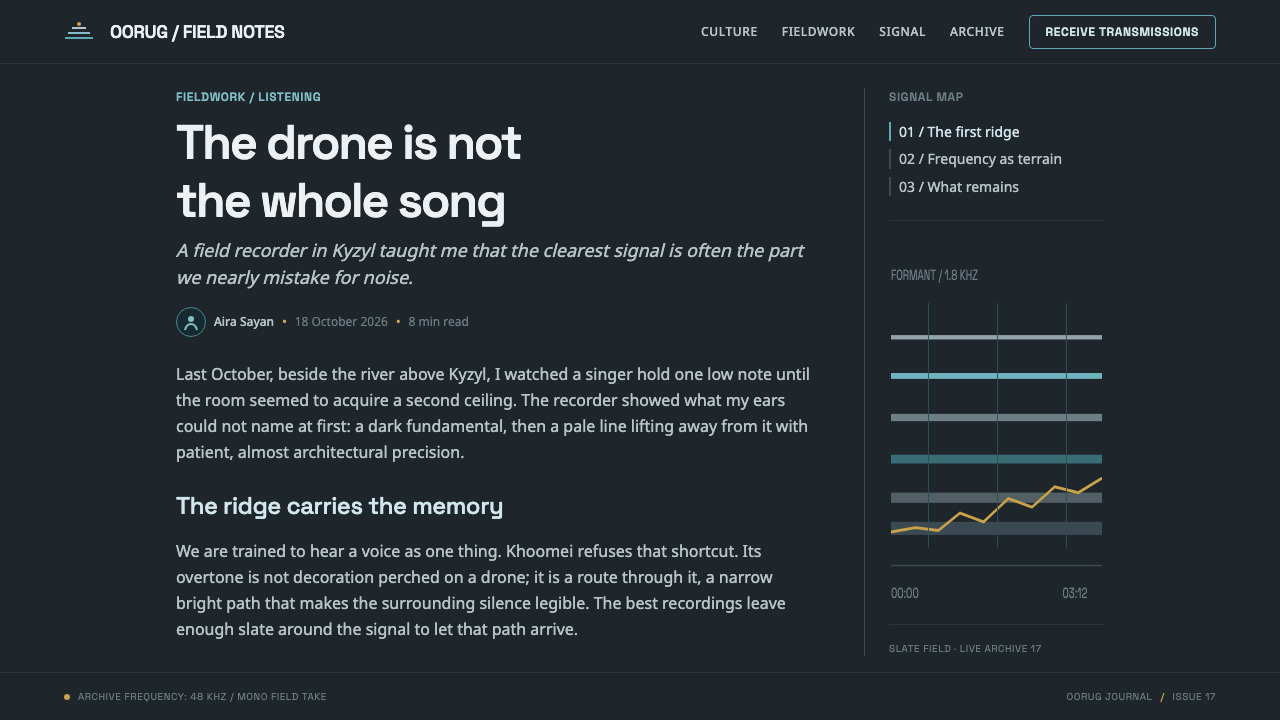
The source practice is Tuvan khoomei, a living tradition from Tuva in South Siberia, within the Central Asian steppe. Its defining acoustic condition is biphonic singing: a low fundamental drone remains present while a selected overtone is brought into sharp relief above it. The focused overtone formant occupies the upper register around 1–2 kHz, producing the whistle-like quality that gives the sound its striking split identity. A listener hears continuity below and precision above, as if one voice were sustaining ground while another traces a line through the air.
Khoomei belongs to a steppe song world described through biphonic overtone singing and shamanic-animist song traditions. This context matters for the visual language because the system should not treat the sound merely as an exotic waveform. Horizon, mountain, sky, grassland, and horsehead motifs emerge from an imagined acoustic geography: a voice encountered across open land, where distance, wind, and terrain are as important to perception as the individual sound source. The imagery remains deliberately spare so that it frames the listening experience rather than replacing it.
The visualization itself belongs to modern acoustic and phonetic imaging, especially the spectrogram-based practice developed through twentieth- and twenty-first-century tooling. Spectrograms allow the overtone’s organization to become legible as stacked harmonic bands. Their analytical language supplies the system’s most important formal rules: horizontal duration, vertical harmonic structure, and grey-value amplitude. Scientific representation is therefore not an added technical flourish; it is the bridge that makes a difficult acoustic event visible without reducing it to a decorative pattern.
The supplied lineage names Kongar-ool Ondar, Huun-Huur-Tu, Christian Herbst, and Ted Levin as key figures around this field. Within the design language, these names establish an important boundary between practice, performance, acoustic study, and cultural listening. The system should preserve that boundary. It can draw on the visual drama of overtone ridges and steppe horizons, but it should remain attentive to the fact that its source is a traditional living practice, not a fictional genre or a generic dark-mode aesthetic.
What defines the Tuvan Khoomei Throat-Song Viz look?
Slate Listening Field
The ground is slate-dark rather than empty black. It should read as air, distance, and acoustic depth: a field spacious enough for the overtone to emerge from the drone. The dark base also makes grey amplitude values legible without turning the composition into a conventional night scene. Darkness is informational here, not theatrical.
Harmonic Ridges
Repeated grey bands form the primary texture. They resemble spectrogram harmonics while also reading as ridgelines, sedimentary layers, or wind-cut terrain. The bands should not become ornamental waves. Their density, separation, and darkness must imply the organized overtones of a sustained vocal sound, with variation arising from acoustic change rather than arbitrary pattern making.
Amplitude as Grey Value
Loudness is encoded through tonal depth. Stronger sound becomes darker and more materially present; quieter sound becomes lighter, thinner, and more distant. This rule gives the image analytical clarity while preserving its landscape metaphor. A viewer should be able to sense intensity without needing labels, legends, or decorative emphasis.
Cyan Overtone Focus
Cyan-teal is reserved for the focused overtone, the whistle-like strand that separates itself from the low drone. Used narrowly, it creates a cold, high-altitude point of attention against the greys. It should feel like steppe sky or a glint on an exposed ridge, never like a general-purpose interface accent scattered across every component.
Horizon Silhouettes
A mountain silhouette and horsehead hover near the horizon as minimal anchors. They establish scale and place without competing with the spectrogram structure. Their treatment should be flat, quiet, and distant, more like an afterimage at the edge of hearing than a detailed illustration. The sound remains the subject; the landscape merely gives it a horizon.
Single Ochre Signal
Ochre appears as a rare warmth within an otherwise cool system. It refers to sunlit grassland and gives the field a brief terrestrial counterpoint to the cyan sky-note. Because the visual language depends on restraint, ochre works best as an isolated event: a horizon glimmer, a small directional mark, or a limited moment of heat rather than a broad secondary background.

Who shaped Tuvan Khoomei Throat-Song Viz?
Kongar-ool Ondar is identified in the source lineage as a key figure connected to Tuvan khoomei. In this visual system, that association reinforces the need to keep the voice at the center: the spectrogram is a way of attending to a living sonic practice, not an excuse to detach its formal beauty from performance and listening.
Huun-Huur-Tu is named as a key presence in the source material. Its inclusion places the theme in a contemporary field of performance and circulation while preserving the larger steppe context. Design applications should use this connection to deepen attention to sonic texture and horizon, rather than turning cultural references into decorative badges.
Christian Herbst is listed among the key figures associated with the theme’s acoustic-phonetics dimension. That dimension is essential to the design language: the overtone is not represented as an abstract flourish, but as a focused acoustic feature that can be observed through spectral structure, harmonic repetition, and changes in intensity.
Ted Levin appears in the source lineage as a key figure around this musical and cultural field. For the system, this supports an approach based on attentive framing. The visual language can make listening more accessible by revealing layered sound, but it should avoid presenting the tradition as a static specimen, a mysterious effect, or a universal symbol of wilderness.
How do you use Tuvan Khoomei Throat-Song Viz today?
For presentation covers, use the system as an acoustic horizon rather than a literal music poster. Let a slate field establish silence, then place a small number of harmonic ridges across it with one cyan-teal overtone line acting as the visual summit. The title should sit with generous isolation, either above the horizon or aligned to its edge. On content slides, retain the left-to-right sense of time through horizontal rules, restrained charts, and text blocks that feel like measured intervals rather than floating cards.
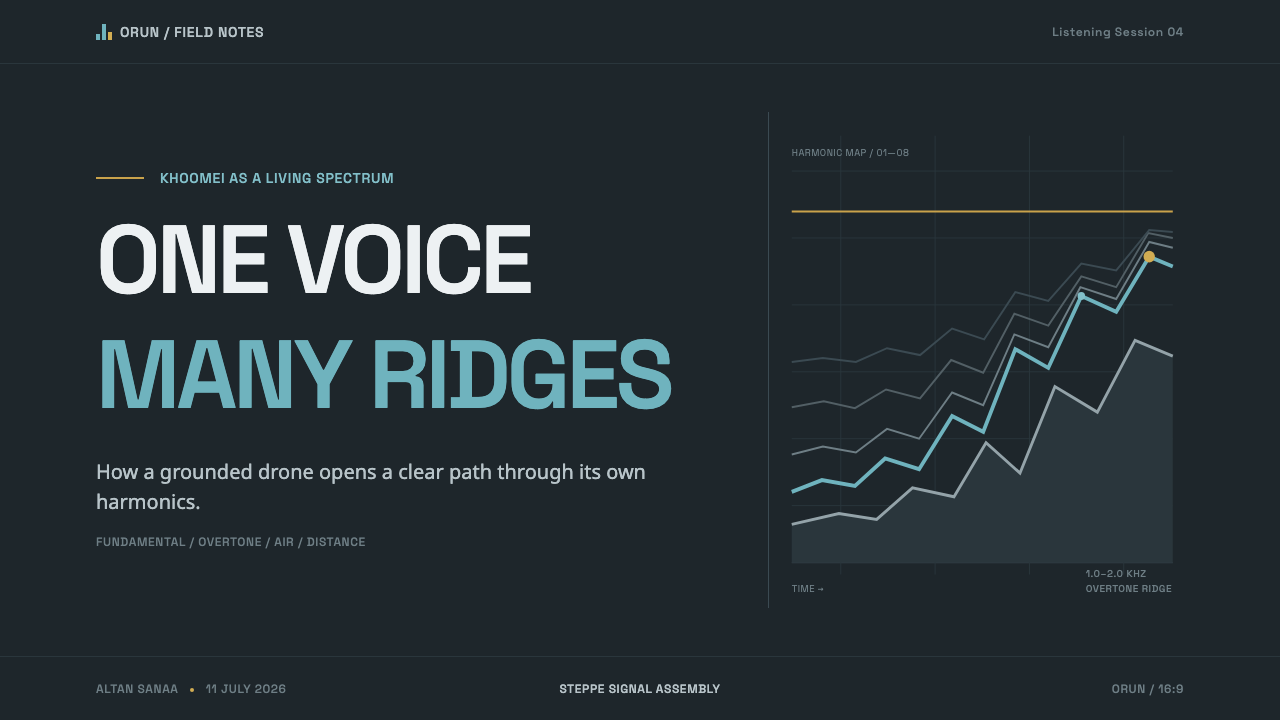
Data slides are especially well suited to this language when their subject concerns audio, signal, research, culture, or changing conditions over time. Treat lines, bars, and stacked series as geological or spectral layers, using grey depth to establish primary information and cyan-teal to identify the one signal that needs attention. Ochre can mark a singular threshold or observed moment. Avoid giving every category a separate bright color; the system becomes clearer when emphasis is rare and consequential.
For web interfaces, this style works well for audio dashboards, listening archives, research tools, and analytical views that benefit from a continuous temporal reading direction. A waveform, spectrogram-derived module, timeline, or activity history can become the central terrain, while navigation and controls remain quiet at the edges. On pricing or product pages, the dark field can establish authority and immersion, but key decisions should remain typographic and plainly legible. The horizon motif should support orientation, not obstruct access to information.
For editorial and marketing work, use the composition to create a sustained mood of attention. Long-form features can open with a wide harmonic landscape, then move into calmer reading zones where grey lines become dividers, captions, or sectional markers. Marketing pages can use an ochre interruption as a moment of warmth amid the dark expanse, especially when introducing an event, a listening invitation, or a featured passage. Keep cultural imagery sparse enough that the overtone structure remains the dominant visual argument.
The common mistake is reducing the style to cyan lines on a dark background. That produces generic technology imagery and loses both the vocal logic and the steppe atmosphere. The system depends on a hierarchy: low drone before bright overtone, grey amplitude before accent color, horizon before illustration, and time before ornament. If every line glows, every region is equally dark, or every cultural marker is enlarged, the image stops reading as an acoustic portrait and becomes visual noise.
Tuvan Khoomei Throat-Song Viz — FAQ
Is this style simply a spectrogram with cultural decoration?
No. The spectrogram provides the structural grammar: time, harmonic stacking, and amplitude through grey value. Steppe references provide atmosphere and location, but they do not sit on top as decorative stickers. The best applications let the acoustic structure lead, then use the horizon, mountain, horsehead, cyan-teal sky note, and ochre grassland signal as restrained contextual cues.
Why must cyan-teal be used so sparingly?
It represents the focused overtone, the unusually clear upper strand that separates from the low drone. If cyan-teal appears everywhere, it loses that acoustic role and becomes a generic glow effect. Reserving it for a ridge, an active trace, or a decisive point preserves the sensation of a high whistle emerging from a broad field of darker sound.
Can the visual language work without the horsehead or mountain silhouette?
Yes. The essential system is the relationship between drone, overtone, harmonic bands, time direction, and amplitude. Horizon silhouettes are optional contextual anchors, useful when a composition needs scale or a stronger sense of place. In dense data views or small editorial modules, omitting them can improve clarity. Their absence should reveal the spectral terrain more clearly, not be replaced with unrelated iconography.
What should be avoided when applying this style to a general product interface?
Avoid treating darkness as an excuse for low legibility, and avoid using every harmonic motif as a background texture. Functional text, controls, and states must remain easy to distinguish from the visual terrain. Also avoid turning Tuvan cultural references into a theme park of symbols. The system is strongest when it preserves a clear boundary between useful interface information, spectral structure, and a small number of carefully placed contextual references.
Related design styles
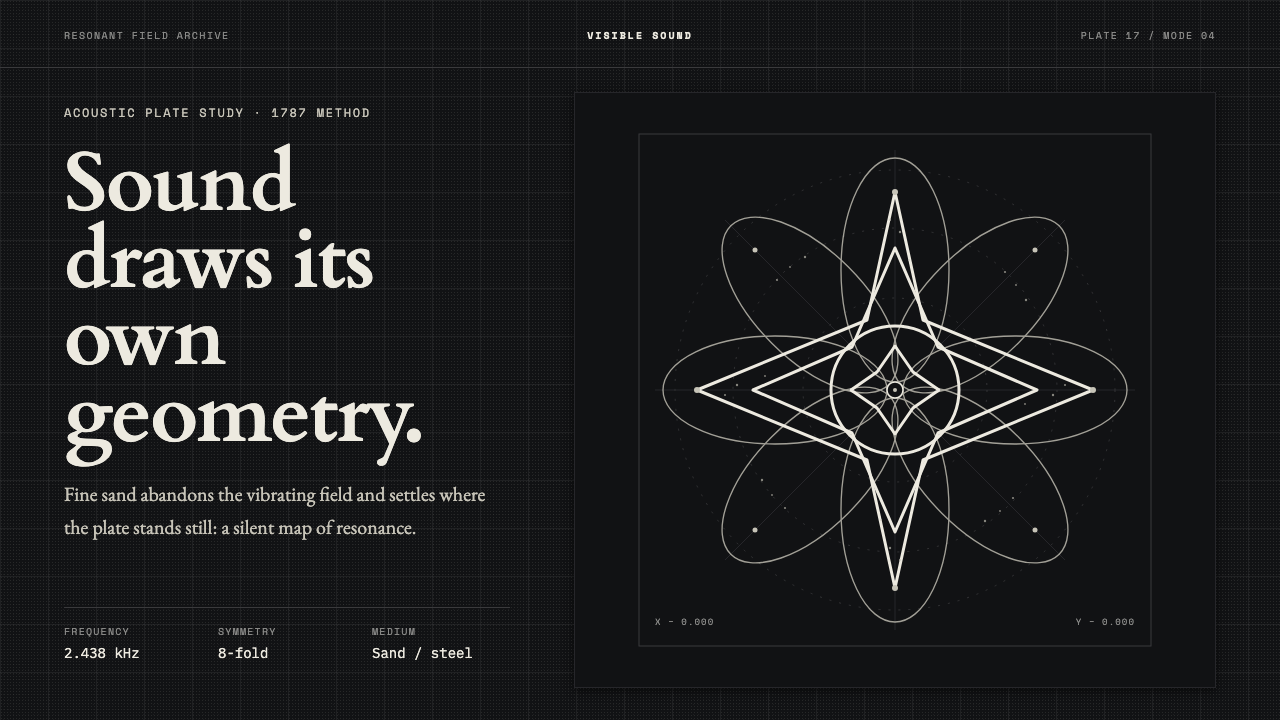 Chladni Acoustic FiguresSound becomes geometry. Bone-white nodal lines settle with exact symmetry on…
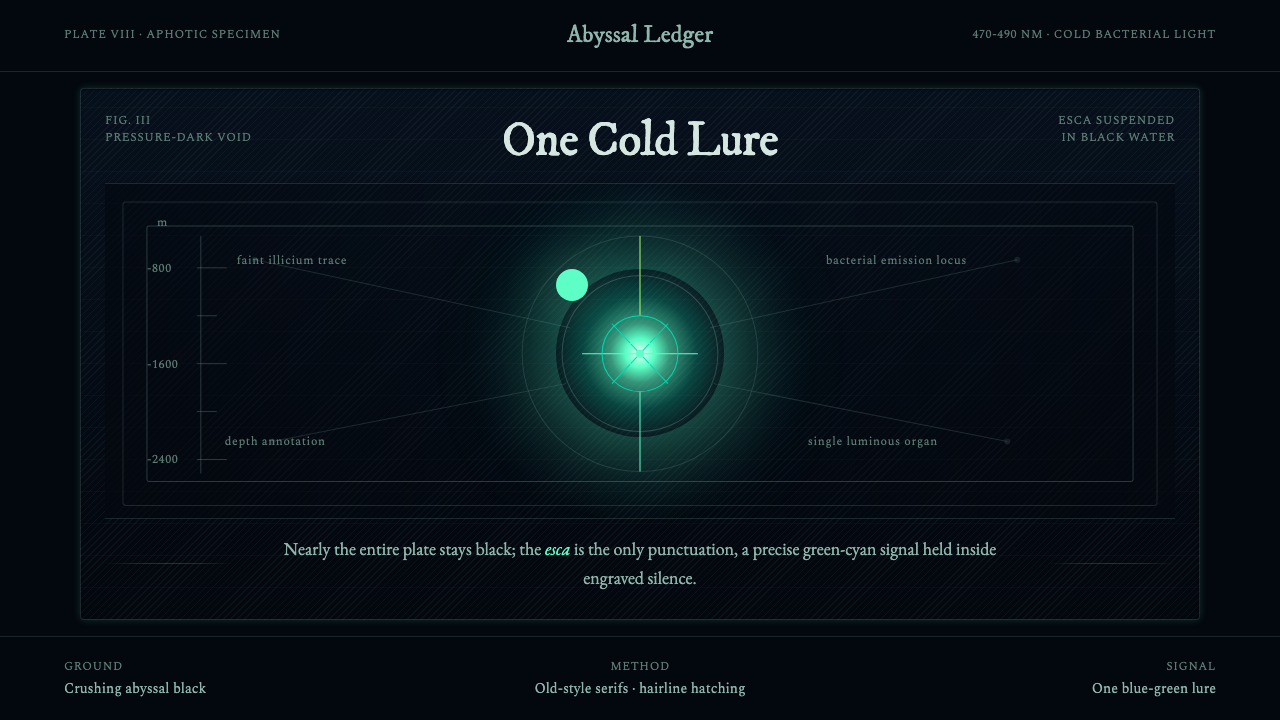 Anglerfish Lure BioluminescenceLight is scarce. Old serifs and hairline rules frame one cold green-cyan lure.
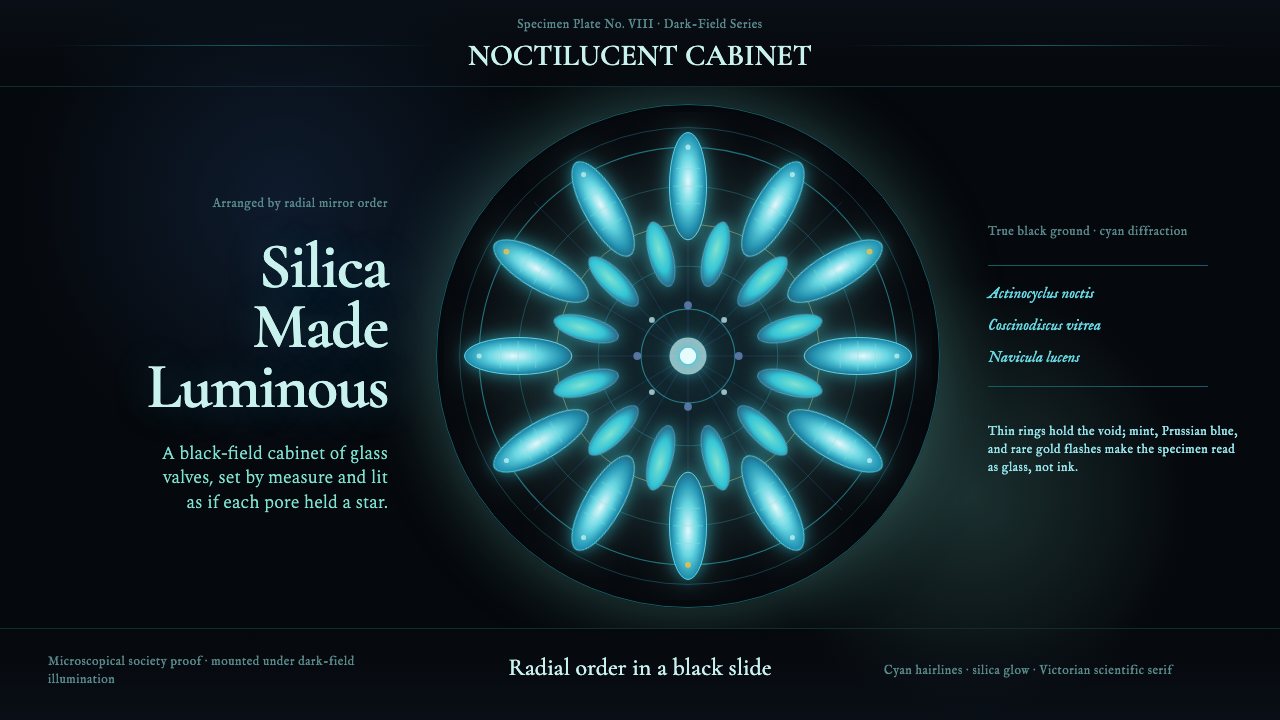 Diatom ArrangementDark-field order. Cyan and mint rosettes glow inside Victorian hairline rings.
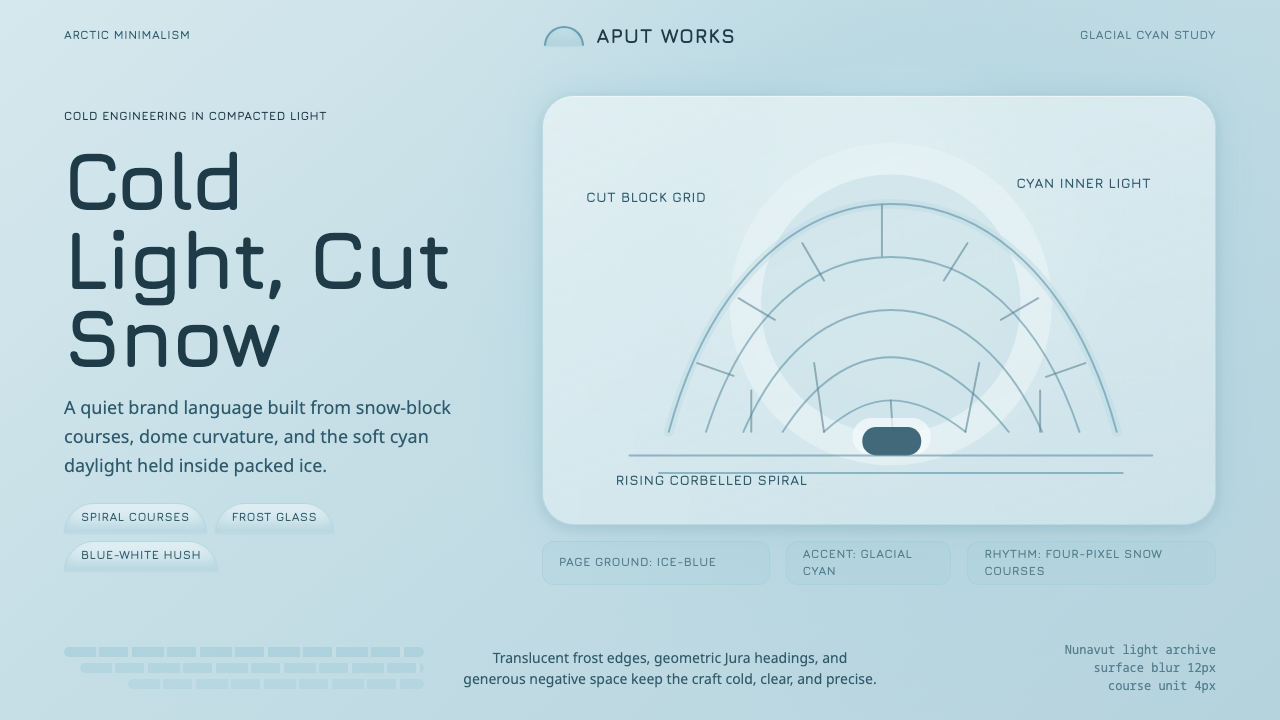 Inuit IglooCold craft, clear light. Glacial cyan and Jura type trace a spiral-block dome…
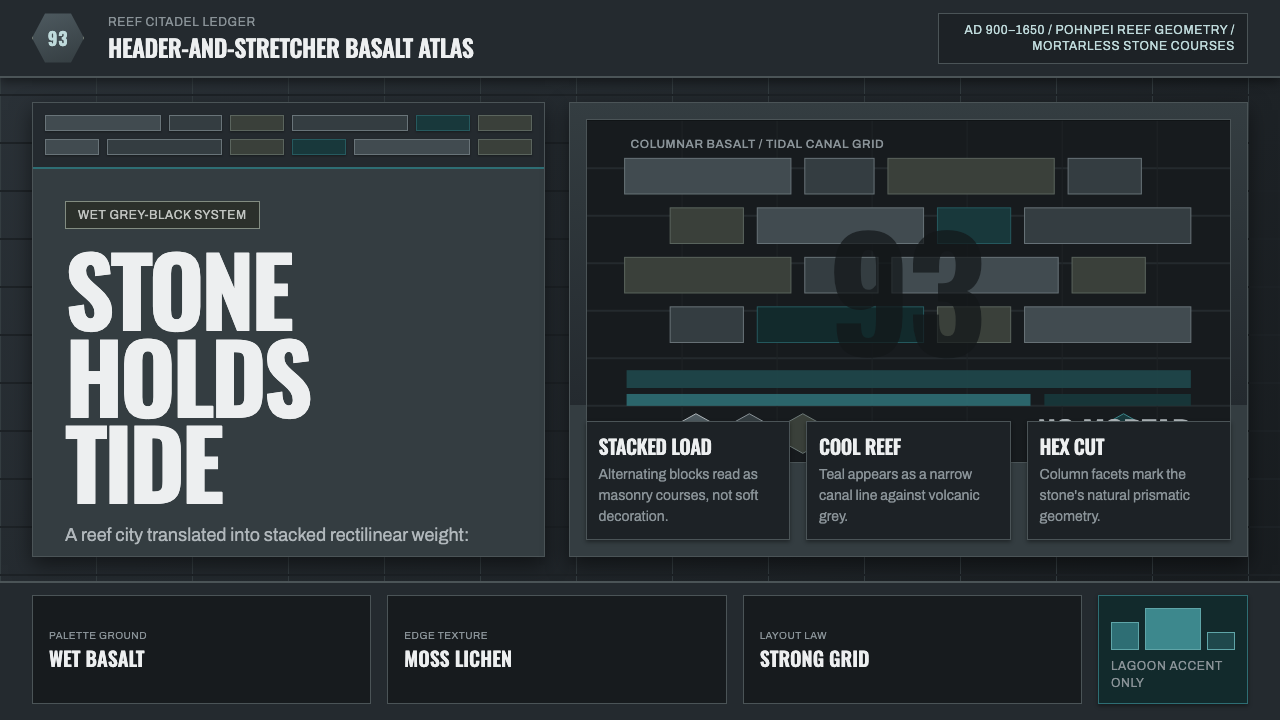 Nan Madol Basalt MegalithStone holds tide. Grey-black basalt grids cut by a narrow lagoon-teal vein.
 UV Scorpion GlowA field guide gone dark. A scorpion fluoresces cyan-green on night-black, rin…