What is Turkish Oya Lace?
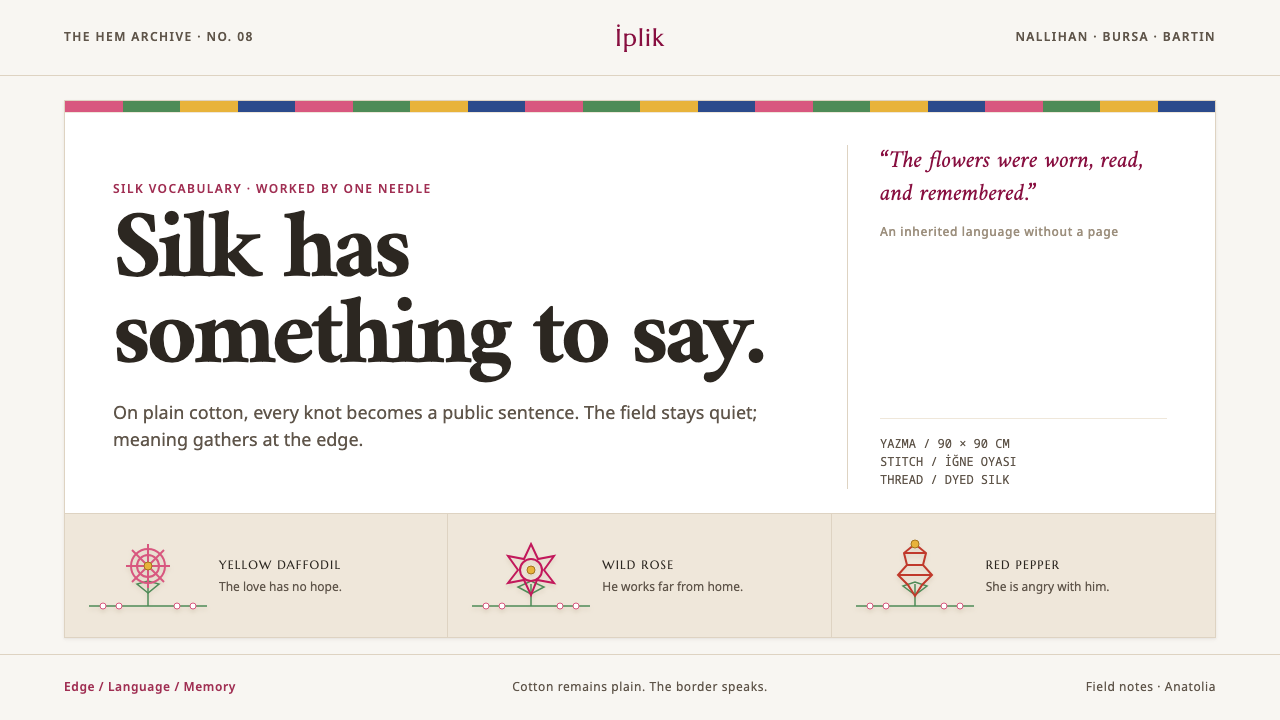
Oya turns the hem of a plain cotton scarf into a language: every silk flower a sentence, every border a letter that was never written down.
Turkish Oya Lace in brief
Oya is the Turkish tradition of working three-dimensional lace along the border of a headscarf. The cloth is the yazma, a printed cotton square about ninety centimetres on each side; the oya is what grows around its edge. With a single needle, a maker builds silk flowers stitch by stitch until the petals curl outward, the stems and calyxes take shape, and the blossom stands off the fabric like something picked rather than stitched. Glass beads are sometimes strung into the work to add a small point of gloss and weight.
What sets oya apart from decorative lace elsewhere is that its flowers are meant to be read. Among people who share the code, a yellow daffodil says the love is hopeless, a wild rose says the husband is working abroad, and a chili pepper says the wearer is angry with him. A scarf could therefore carry a mood, a family situation or a quiet complaint in public without a word being spoken. The grammar was taught by example, from mother-in-law to daughter-in-law and from mother to daughter, and it was never put on paper.
As a visual system, oya rests on a strict division of labour. The middle of the cloth stays plain and quiet; all the ornament is pushed to the edge. The repeat along the hem is steady but never mechanical, because every flower is made by hand and differs a little from its neighbour. And no motif is there merely to fill space: each one is a caption that means something. Curio’s Turkish Oya Lace style keeps exactly these three rules, a calm field, ornament at the border, and nothing without a meaning.

Where does Turkish Oya Lace come from?
Oya is usually described as an Ottoman-era village craft, documented from the eighteenth and nineteenth centuries onward and still made and read today. Its geography follows the old Ottoman world: Anatolia and the Balkans, with Nallıhan, Bursa and Bartın among the places most closely associated with the surviving traditions. Bursa has long been linked with silk, and silk is the material that gives the finest needle-lace flowers their sheen and their ability to hold a sharp, saturated colour. The word oya names the edging itself, as distinct from the cloth it frames.
Three families of technique sit under that one word. İğne oyası is needle lace, worked with a single needle and thread, and it is the form that produces the freestanding, sculptural flowers this style is built on. Tığ oyası is worked with a crochet hook, and mekik oyası with a small shuttle. All three are slow, repetitive, close-up crafts in which a border is assembled one small unit at a time. The silk needle-lace makers of Nallıhan are among the best-known keepers of the first and most sculptural of them.
The craft lived in the household. Girls learned beside older women, copying a flower until their hands knew it, and a finished oya was a gift, a part of a young woman’s trousseau, or a private message worn openly. Because the meaning system was oral, it was never fixed: a motif’s sense could shift between regions and families, and part of the pleasure lay in knowing who was speaking. That looseness is why the tradition feels rich rather than rigid, and why anyone borrowing its look should be cautious about treating it as a dictionary.
The importance of this knowledge has been recognised internationally. UNESCO’s intangible cultural heritage listing treats oya as living practice, a set of skills, meanings and social bonds carried by people, rather than as a pattern archive to be mined. That distinction matters here. The design language of this style is a reading of oya, not a substitute for it, and the most faithful way to use it is to preserve its central idea: ornament should speak, and it should speak from the edge.
What defines the Turkish Oya Lace look?
Quiet Ground
The field is bleached cotton: a calm, slightly warm off-white with no pattern competing for attention. Large areas stay empty on purpose, because only a silent middle lets the hem be heard. Text sits in this field in a restrained dark tone, set with ordinary generosity rather than display drama.
Edge-Only Ornament
Every decorative decision happens at the border. A band of motifs runs along the hem, or in an interface along the lower edge of a card, a section divider or a page footer, while the interior stays purely functional. The effect is a plain object dressed with care, not an object buried in decoration.
Dyed-Silk Colour
Colour is concentrated in the silk: the clear yellow of a daffodil, the warm pink of a wild rose, the hot red of a chili. These accents are saturated but small in area, and each is tied to a motif rather than spread as a theme. Because the ground is neutral, a few tiny points of colour carry real emphasis.
Dimensional Knotwork
Oya is not flat embroidery. Petals curl away from the cloth, stems and calyxes have structure, and beads add small points of gloss. In visual terms this calls for gentle relief: tiny, close shadows and slightly lifted edges on ornamental pieces only, never a deep drop shadow laid across the whole page.
Repetition with Variation
The border repeats, yet no two flowers are identical. Translate this as rhythm without cloning: spacing, size and colour shift slightly from one motif to the next, so the band feels hand-made. A perfectly mechanical tile is the fastest way to lose the character of the style.
Motifs That Mean Something
Every ornament carries a caption. In design terms each decorative element should be tied to content, a status, a category, a short note, so that the border informs as well as decorates. An ornament with nothing to say is the one thing this tradition would never make.
Hand-Made Pace
Every flower takes patient, repetitive work, and that slowness shows up as density at the edge and generosity everywhere else. Layouts should feel unhurried: wide margins, long pauses between bands, no crowded surfaces, and no effect that looks as though it was produced in a second.

Who shaped Turkish Oya Lace?
The makers of Nallıhan are named in the source record as keepers of silk needle lace, the most sculptural branch of the craft. Their work shows what this style is aiming at: flowers fine enough to read as botanical, yet unmistakably made by a single hand with a single needle. Any adaptation takes its standard of finish from makers like these, not from machine-made lace.
The real channel of transmission for oya was domestic. The source record describes the meaning system as passed between mothers-in-law and daughters-in-law and between mothers and daughters, by speech and demonstration rather than by pattern book. They are the true authors of the flower language, and the reason it survives as something people can still read.
The UNESCO listing frames oya as living heritage: skills, meanings and social practices carried by people. For designers it is a reminder to credit the tradition by name and to treat its motifs as culturally specific knowledge, not as a free-floating pattern library.
How do you use Turkish Oya Lace today?
Oya fits products that want warmth and personality without noise, and especially those where meaning matters more than flash. Its core rule, a calm middle and an expressive edge, is easy to apply and very hard to fake, so the results tend to feel considered rather than decorated.
On slides, a cover can leave the field almost empty, set the title in a quiet dark tone, and let a single band of small coloured motifs run along the bottom or one side. Content slides keep their interior plain and place a slim ornamental strip at the base to mark each section. Data slides suit the captioned-motif logic: highlight one or two values with a small coloured marker and a short note, instead of colouring every bar in the chart.
In web interfaces, the style suits profile pages, community products, learning and craft platforms, and pricing pages that want to feel human. Keep the working surface calm and reserve colour for badges, status chips and edge accents that actually mean something. On a dashboard, a small coloured flourish along a card’s lower edge can mark state, provided it is always paired with a text label so that meaning never depends on colour alone.
In editorial and marketing work, the hem becomes a recurring signature: a border along a magazine spread, a footer band on a newsletter, a frame around a product photograph. Crafts, textiles, gifts, hospitality and cultural institutions can use the idea well. Copy can follow the same discipline as the tradition: say a little, and mean all of it.
The most common mistake is to scatter flower motifs across the whole page, which turns a quiet system into wallpaper and abandons its central rule. A second is to tile one perfect motif with no variation at all. A third is to borrow the colours without the meaning, adding decoration that has nothing to say, which is precisely what an oya maker would refuse to stitch.

Turkish Oya Lace — FAQ
Is oya the same thing as lace?
It is a kind of lace, but with a distinct identity. Oya refers specifically to the edging worked along the border of a scarf, and its best-known form is three-dimensional needle lace in which silk flowers stand away from the cloth. Other kinds of oya are made with a crochet hook or a shuttle. In design terms, the key difference from generic lace is that oya is a border with meaning, not an all-over pattern meant to fill a surface.
Is there a fixed dictionary of what each flower means?
No. The system was taught by speech and example rather than written down, so meanings could differ between regions and families. The daffodil for hopeless love, the wild rose for a husband working abroad and the chili pepper for anger are well-known examples, not a complete or official table. This style uses them as proof that ornament can communicate, not as a decoding key to be applied literally.
Can this style work for serious or technical products?
Yes, within limits. The calm field and edge-only ornament make it easy to keep a data-heavy interface legible, and the idea that every decoration must carry information is a good discipline for dashboards. It struggles where a product needs a cold, neutral or highly austere tone, because the style is inherently warm and handmade. Used with a light touch, a thin ornamental edge can soften a technical product without hurting clarity.
How much colour should an oya-inspired layout use?
Very little by area, and it should be placed deliberately. The ground stays neutral, and colour appears in small, saturated accents tied to specific motifs or statuses. A good test is to remove every coloured accent and check whether the page still holds together; then restore only the ones that carry meaning. If more than a thin band of the page is coloured, the layout has drifted away from the tradition.
How should designers treat the cultural source of this style?
With credit and care. Oya is a living tradition held by makers and families, and its motifs carry meanings that belong to them. Name the tradition when you use the style, avoid inventing meanings for specific flowers or implying that a motif says something it does not, and do not treat the look as anonymous decoration. The most respectful adaptation is the one that borrows the principle, that ornament should speak, rather than just the surface.
Related design styles
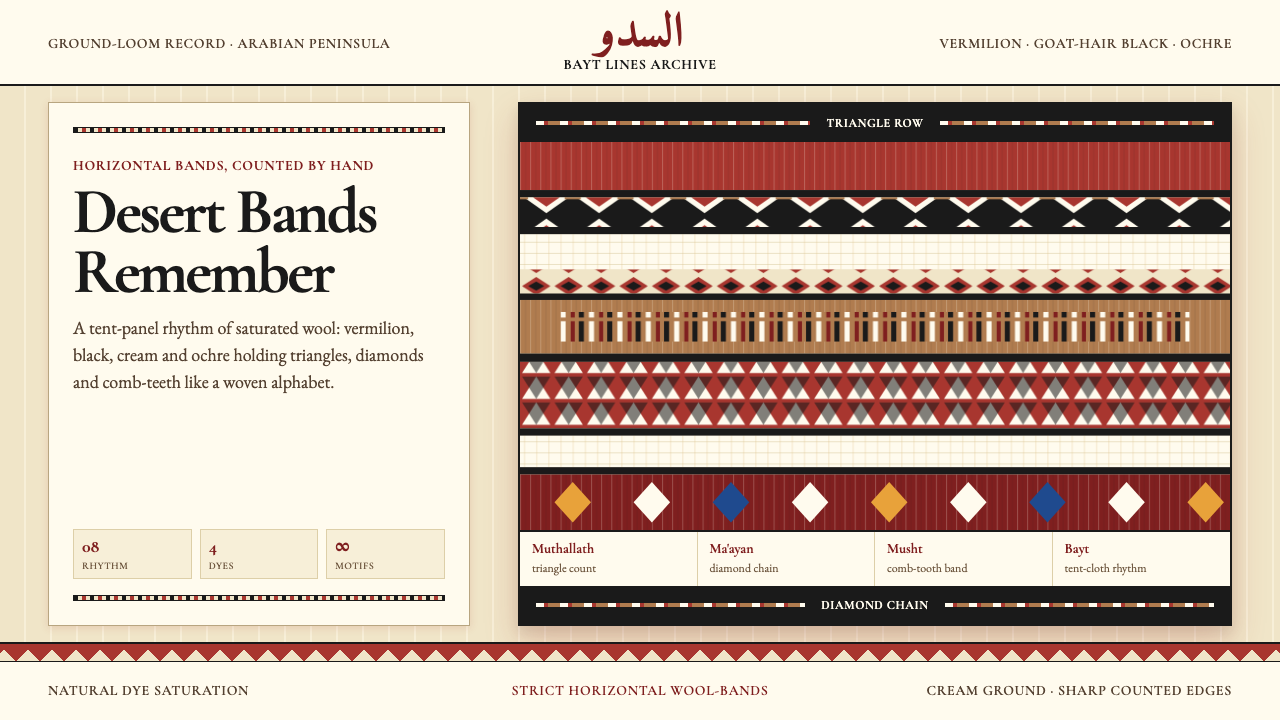 Bedouin Desert Textile (Sadu)Woven memory, not ornament. Vermilion-black bands count triangles and diamond…
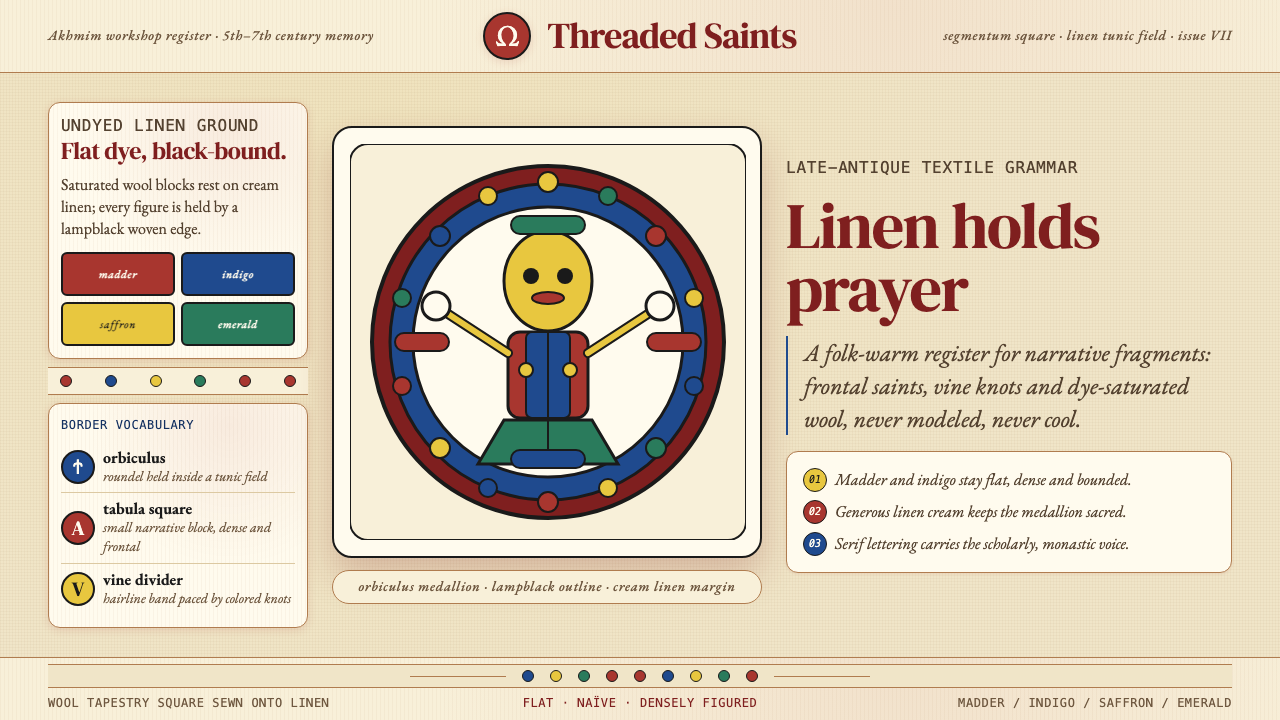 Egyptian Coptic TextileWarmth woven flat. Madder, indigo and saffron medallions sit on linen cream.
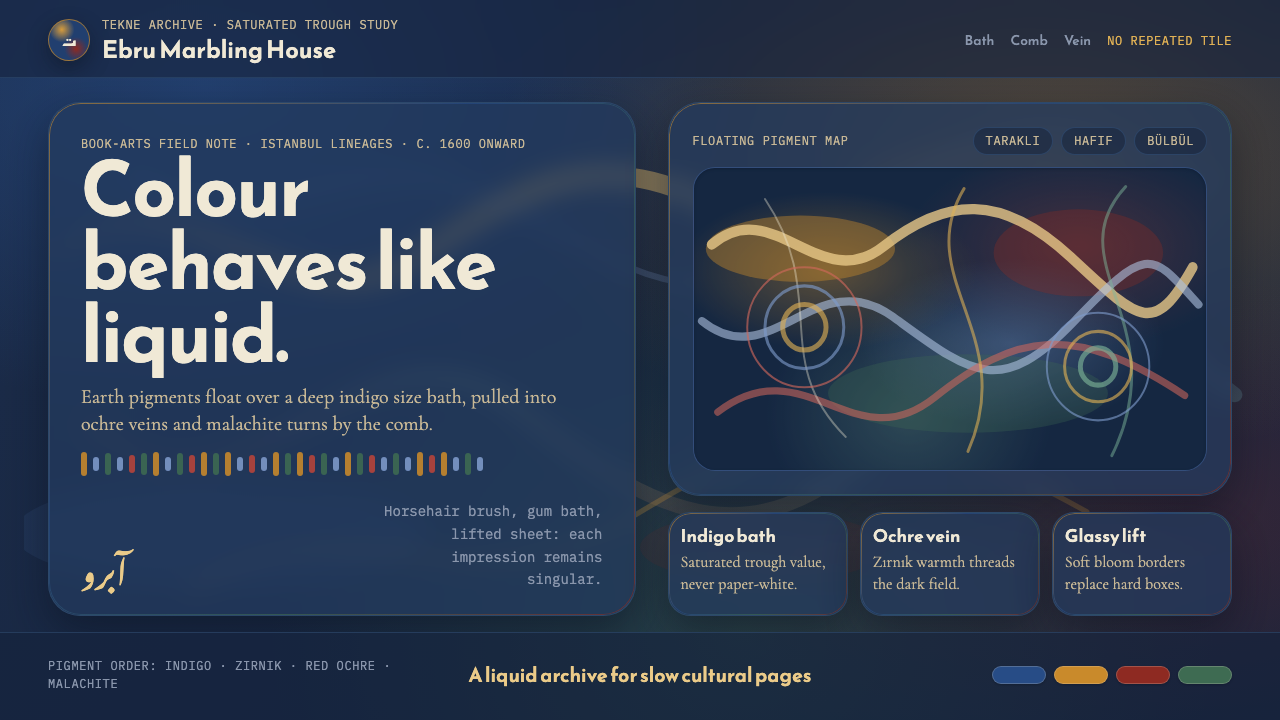 Ottoman Ebru MarblingLiquid, never tiled. Indigo bath, ochre veins, and glassy bloom edges carry t…
 Akuaba Akan Fertility DollDarkness becomes sculpture. Near-black wood, ringed geometry, and one gold be…
 Bambara Chi Wara AntelopeCarved memory in gold. Black serif silhouettes and brass-dot borders carry th…
 Cham My Son TowersWall before ornament. Greyed brick bays recede around cut shadows and sandsto…