What is Turkish İznik Ceramic?
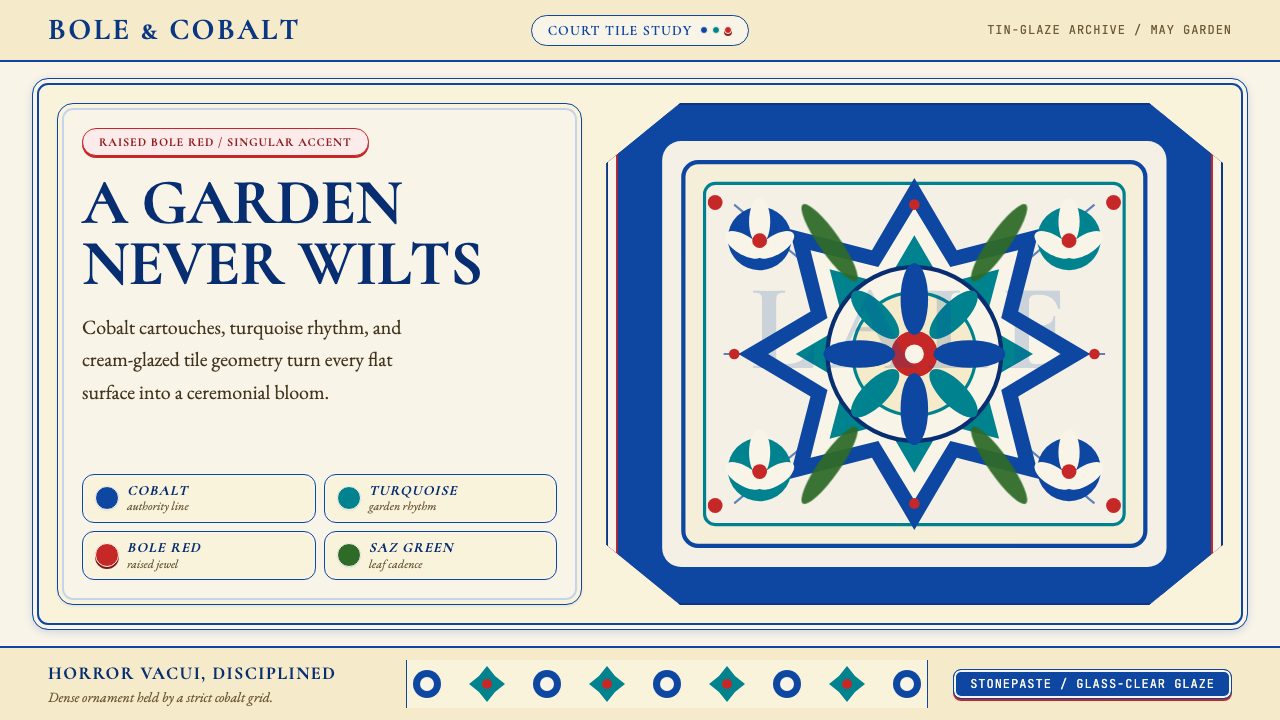
İznik ceramic is horror-vacui made glorious — every surface a garden of cobalt tulips, Armenian-bole red carnations, and saz leaves coiling beneath a glass-clear tin glaze.
Turkish İznik Ceramic in brief
Turkish İznik Ceramic refers to the stonepaste tilework and vessel-painting tradition that flourished in the town of İznik — ancient Nicaea — in northwestern Anatolia between roughly 1480 and 1620. At its height, under the patronage of Süleyman the Magnificent and Selim II, İznik workshops produced some of the most technically perfect painted ceramics ever fired: a dense, symmetrical garden of tulips, carnations, hyacinths, and saz leaves rendered in cobalt, turquoise, sage green, and the inimitable raised Armenian-bole red, all sealed beneath a glassy tin glaze of extraordinary clarity.
The visual system that takes its name from this tradition distills the Ottoman court aesthetic into a set of rules for the screen: a warm tin-glaze cream acts as the ground, cobalt commands authority and structure, Armenian-bole red provides singular emphasis — never repeated, never diluted — saz green supplies organic accent, and calligraphic cartouche shapes serve as framing devices. The result is a surface that blooms without disorder: every element has assigned weight, position, and color, and the whole composes with the density of a tilework panel.
What makes İznik design unusual among historical pattern systems is its discipline within abundance. The compositions are horror-vacui in intention — they resist empty space — yet they never become chaotic, because the hierarchy between primary motifs (large floral heads), secondary motifs (saz leaves and vine stems), and ground color is maintained with exacting consistency. Translated to contemporary design, this principle argues for richness through repetition and rule, not through arbitrary layering.

Where does Turkish İznik Ceramic come from?
The İznik ceramic tradition did not emerge in isolation. It grew from a convergence of three earlier influences: the blue-and-white Chinese porcelain that reached the Ottoman court via Silk Road trade, the Timurid and Persian manuscript painting traditions with their elaborate floral margins, and the indigenous Anatolian pottery workshops that had long supplied the region with functional wares. By the late fifteenth century, Ottoman court taste had developed a clear appetite for hard-paste-like vessels with vivid underglaze painting, and the workshops of İznik — positioned near major clay deposits and timber for kilns — became the preferred producers.
The first distinctive İznik phase, roughly 1480 to 1525, worked primarily in blue and white, absorbing the Chinese porcelain aesthetic but translating it into an Ottoman vocabulary: arabesques replaced dragon motifs, stylized floral scrolls replaced cloud-band borders. The second phase, from around 1525 onward, introduced turquoise and then sage green, expanding the palette while maintaining the cobalt ground. The defining development came in the 1550s and 1560s, when Armenian-bole red — a pigment derived from an iron-rich clay found near Erzincan — appeared as a thick, slightly raised slip that fired to a vivid tomato-red under the tin glaze. This technical achievement, seemingly impossible to reproduce outside the specific combination of İznik stonepaste body and local bole clay, set the peak-period tiles apart from every earlier and later ceramic tradition.
The Ottoman court's relationship with İznik production was direct and interventionist. The Topkapı Palace workshops, under the direction of the Chief Court Painter (Nakkaşbaşı), supplied pattern drawings — called nakış — directly to the İznik kilns. Kara Memi, who served as Nakkaşbaşı under Süleyman and is credited with perfecting the Quatre Fleurs style of naturalistic Ottoman floral painting, is believed to have supplied many of the tulip, carnation, and hyacinth designs that define the peak İznik aesthetic. The architect Mimar Sinan, who built or supervised hundreds of Ottoman structures, specified İznik tile extensively for interior cladding — most visibly in the Rüstem Pasha Mosque in Istanbul (completed 1563) and the Selimiye Mosque in Edirne (completed 1575), both of which remain the most comprehensive extant examples of İznik tile in architectural context.
Production declined sharply after around 1620. The reasons were several: shifts in court patronage toward other materials, increased competition from imported Chinese and later Dutch Delftware, and the loss of the specific technical knowledge — particularly the Armenian-bole preparation method — that had made the peak-period tiles irreproducible. Later İznik and imitation ware tends toward flatter reds, more loosely drawn motifs, and less precise glaze application. The kilns eventually fell silent in the early eighteenth century, and the tradition survived only through the surviving tiles on Ottoman monuments and the collections of major European museums, where İznik pieces arrived as diplomatic gifts and later as acquisitions during the nineteenth-century vogue for Orientalist collecting.
What defines the Turkish İznik Ceramic look?
Color Architecture
The İznik palette is built on a strict hierarchy of four roles. Tin-glaze cream — warm, slightly ivory — serves as the ground, providing the luminous base from which all other colors read. Cobalt anchors the composition, drawn as outlines, fill, and structural motifs; it is the most present color and carries the visual weight of authority. Armenian-bole red appears as a singular accent: one carnation head, one border stripe, never repeated until it has fully resolved. Turquoise and sage green occupy the middle register, filling leaves, secondary petals, and cartouche interiors. Nothing in the palette is cool, harsh, or industrial — the entire range reads as warm, saturated, and court-calibrated.
Horror-Vacui Composition
İznik tile panels resist empty space not through randomness but through an interlocking system of motif scales. Large floral heads — tulips, carnations, hyacinths — occupy the primary positions, their stems branching into saz leaves that fill the middle distance, while tiny rosettes and filler buds close any remaining gap. The effect is total coverage, yet each motif remains individually readable because the hierarchy of scale and color is consistently maintained. The rule, translated to screen: fill the surface, but never confuse the eye about what is primary.
Floral Vocabulary
The İznik floral canon is specific rather than generic. The tulip — long before its association with the Netherlands — was an Ottoman royal emblem, drawn with a sharp, elongated profile and slender petals. The carnation appears as a dense, ruffled globe. The hyacinth reads as a tight vertical spike. The saz leaf, signature to the Ottoman court style, is a long, undulating blade with serrated edges that coils through the composition, connecting motifs and filling negative space simultaneously. These forms are not naturalistic sketches but highly conventionalized symbols, instantly recognizable even at small scale.
The Cartouche Frame
Calligraphic cartouches — elongated, cloud-shouldered, or ogival frames derived from Ottoman manuscript borders — serve as the primary organizing device in İznik compositions. On architectural tiles, cartouche bands separate registers of pattern; on vessels, they contain inscriptions or isolated floral panels. In design application, the cartouche logic translates to contained zones: information blocks gain identity through their bordered shape rather than through color alone, giving the layout a quality of deliberate compartmentalization without rigid grid lines.
Surface as Garden
Unlike Western decorative systems that treat ornament as a frame around a central image, İznik compositions treat the entire surface as the subject. There is no hierarchy between center and edge — the tulips in the corner are as resolved as the tulips at the heart of the panel. This all-over approach means that any portion of an İznik composition is self-sufficient; the pattern is not interrupted by the boundary, merely paused. For design, this principle suggests that backgrounds should be designed with as much intention as foreground elements, and that surface detail is itself a form of content.
Raised Red and Tactile Depth
The Armenian-bole red of peak İznik tiles is not merely a color choice — it is a material phenomenon. The bole pigment was applied in a thick slip that raised slightly from the surface before being covered with tin glaze, creating a barely perceptible relief that catches raking light differently from surrounding painted areas. This tactile dimension reinforced the color's role as singular accent: the red was not only visually dominant but physically present. In flat digital work, this translates to treating one accent tone with extra compositional weight — through scale, isolation, or deliberate contrast — so that its presence registers with a similar quality of emphasis.
Symmetry with Organic Variation
İznik compositions are formally symmetrical — motifs repeat on axes and in registers — yet they never read as mechanical, because each hand-painted repetition carries slight variations in petal angle, stem curve, and color saturation. The system is symmetric; the execution is organic. This balance between rule and hand produces the particular warmth that distinguishes İznik from geometric Islamic abstraction. In design terms, this argues for modular systems where the structure is consistent but individual modules are permitted — even encouraged — to breathe differently from one another.

Who shaped Turkish İznik Ceramic?
Kara Memi served as Nakkaşbaşı — Chief Court Painter — under Süleyman the Magnificent and is credited with developing the Quatre Fleurs style: the naturalistic rendering of tulips, carnations, hyacinths, and roses that became the defining floral vocabulary of peak İznik production. Earlier Ottoman court painting had relied on more abstract, Persianate floral conventions; Kara Memi's innovation was to observe actual Ottoman garden flowers and stylize them into a consistent formal language rigorous enough to be reproduced by workshop painters from pattern drawings. His designs traveled from Topkapı Palace to the İznik kilns as transfer drawings called nakış, and from the kilns to the walls of mosques, palaces, and mausoleums across the empire. He is the most direct link between Ottoman court aesthetic intention and the physical tiles that survive.
Mimar Sinan served as Chief Ottoman Architect from 1538 until his death in 1588, during which time he designed or supervised the construction of over three hundred structures across the empire. His relationship to İznik ceramic was that of the principal specifier: Sinan's interior programs called for tile cladding on a scale that drove demand and shaped the production priorities of the İznik workshops for decades. The Rüstem Pasha Mosque in Istanbul, completed around 1563, is considered the most tile-saturated of Sinan's works, with İznik panels covering not only the interior walls but the portico piers and even some of the exterior surfaces. The Selimiye Mosque in Edirne, completed in 1575 and widely considered Sinan's masterpiece, uses İznik tile in more selective but equally authoritative registers. Without Sinan's commissions, the peak-period İznik industry would have had neither the scale nor the architectural context that defined its highest achievements.
Süleyman I, who reigned from 1520 to 1566, presided over the political and cultural apex of the Ottoman Empire. His patronage was the essential condition for peak İznik production: he funded the construction of the mosques and palaces that Sinan designed and İznik filled, established the court workshops that employed Kara Memi and supplied pattern drawings to the kilns, and created the political stability in which long-term craft traditions could mature without interruption. Süleyman was himself a poet under the pseudonym Muhibbi, and his court valued refinement in applied arts as an expression of imperial legitimacy. The tulip — which his court favored above all other flowers and which appears as the dominant motif in İznik tile — carried associations with paradise and divine order in Ottoman poetic imagery, a symbolic weight that anchors the entire floral canon.
Selim II, who reigned from 1566 to 1574, inherited Süleyman's imperial apparatus and continued the patronage of İznik production at its peak intensity. His name is most directly associated with the Selimiye Mosque in Edirne, which Sinan designed for him and which is considered the fullest expression of classical Ottoman architecture. The tile program of the Selimiye — coordinated in cobalt, turquoise, and carefully rationed Armenian-bole red — represents the most self-aware and theoretically resolved application of İznik ceramic in any surviving building. Selim II's short reign coincided exactly with what historians of Ottoman ceramics regard as the single finest decade of İznik production, the 1570s, when technical mastery, design vocabulary, and court patronage converged at maximum intensity before the slow decline of the following generation.
How do you use Turkish İznik Ceramic today?
İznik Ceramic is among the richest historical design vocabularies available to contemporary practitioners, and its application requires understanding its central logic before borrowing its surface. The style is not a texture overlay or a pattern library — it is a compositional system built on hierarchy, density, and the precise allocation of color roles. Applying it correctly means committing to the full palette architecture: cream ground, cobalt structure, one bole-red accent, green fill. Substituting any of these roles with a neutral or a trendy tone collapses the system into pastiche.
For presentation slides, the style works powerfully on both cover and section-break pages. A cover should treat the slide as a tile panel: a cream or deep cobalt ground filled with the floral vocabulary in a horror-vacui arrangement, the title set in a cartouche-shaped frame at center. The bole-red accent appears once — on the most critical word in the title, or as a single border stripe framing the cartouche. Content slides require restraint: use the cream ground with cobalt for headers and structural lines, reserve the floral motifs for decorative column rules or section dividers, and let body text occupy clean zones. Data visualization slides can incorporate the palette by encoding the most important data series in bole-red, secondary series in cobalt, and supporting data in turquoise or sage, with the chart background in cream.
For web interfaces, the İznik vocabulary translates well to dashboards, heritage brand sites, and editorial platforms where cultural richness and authority are desired values. The approach on a dashboard: use cream as the page background, cobalt for primary navigation, headers, and selected states, saz green for success indicators and secondary badges, and bole-red reserved exclusively for alerts and the most critical call-to-action. Pattern borders drawn from the saz leaf vocabulary can frame card components and section dividers without overwhelming the functional content. Pricing pages benefit from the style's natural tier differentiation: one tier highlighted in bole-red at the center, the others framed in cobalt and sage.
For editorial and marketing applications, the style supports dense, visually confident layouts that read as cultured and authoritative. A feature article layout might open with a full-bleed cream spread carrying a large İznik floral motif as background illustration, with the headline set in a bold, high-contrast letterform against it. Section dividers can use cartouche-shaped ruled elements rather than plain horizontal rules. Marketing pages work well with alternating register logic: cobalt-ground sections with cream text for authority statements, cream-ground sections with cobalt text for product detail, and a single bole-red full-width banner for the primary conversion message.
The most common mistake when applying İznik is reducing it to the red-on-blue color combination without its compositional logic. Authentic İznik work uses bole-red with extreme economy — typically one element per composition — and never as a background or fill. A second frequent error is applying the floral vocabulary at inconsistent scales: peak İznik compositions maintain a clear size relationship between primary flower heads, secondary leaves, and tertiary filler buds. Using motifs at arbitrary scales destroys the hierarchy and produces visual noise rather than richness. A third mistake is treating the cream ground as optional white — the warmth of the ivory base is structurally necessary; a cold white ground pushes the palette toward a graphic severity that contradicts the style's essential warmth.

Turkish İznik Ceramic — FAQ
What distinguishes peak-period İznik from later imitations?
Three technical markers define authentic peak-period İznik work from roughly 1555 to 1600. First, the Armenian-bole red appears as a physically raised, thick slip that catches raking light differently from the surrounding glaze — later imitations produce a flat, often orange-tinted red. Second, the stonepaste body is dense and white, producing the clean luminous ground that makes the cobalt read with its characteristic depth; later work and European imitations often use a yellower, more porous body. Third, the tin glaze is glassy and tight, with minimal crazing; degraded production shows crawling, pitting, or a milky opacity. In design terms, the peak-period sensibility is recognizable by the economy of its red accent, the precision of its floral drawing, and the warmth of its ground — not by quantity of decoration.
Is the İznik style suitable for dark-background or night-mode interfaces?
The canonical İznik system is a light-ground style — the cream or ivory base is not incidental but structurally essential, providing the luminous field from which cobalt and bole-red derive their depth and saturation. A dark inversion is possible, but it fundamentally changes the palette's character. On a deep cobalt or near-black ground, the cream motifs and bole-red accents read as light against dark, producing a more dramatic, lantern-like quality reminiscent of İznik metalwork rather than tilework. This variant works for high-contrast hero sections or event posters, but it is not a simple dark mode of the same system — it is a different register entirely. If dark backgrounds are required, commit to the deep cobalt ground as the base and use cream and red as light sources within it rather than trying to invert all four palette roles simultaneously.
How should the bole-red accent be used when there are multiple points of emphasis in a layout?
The foundational rule of İznik color is that bole-red appears once per composition. When a layout has multiple items that seem to require equal emphasis — a pricing tier, a navigation highlight, a badge — the correct move is to reconsider whether they are truly equal, or whether one of them is genuinely primary. İznik composition does not acknowledge the concept of co-equal primary elements: there is always a hierarchy, and the bole-red marks the top of it. If multiple elements genuinely need distinction, use cobalt for the second level and turquoise or sage for the third; bole-red remains the exclusive marker of the single most important thing on the page. Applying bole-red to more than one element per view will invariably make all of them weaker.
Can İznik be combined with other historical or contemporary design styles?
İznik has natural affinities with other court-derived, pattern-rich historical traditions — Mughal painting, Persian carpet design, Byzantine mosaic — because all of these share the horror-vacui compositional logic and the vocabulary of interlocking floral and geometric forms. Combining İznik with any of these requires care around palette: each tradition has its own dominant tone (Mughal favors warm gold and jewel greens; Persian carpet traditions often use deep madder red as a ground rather than accent), so deliberate choices about which palette to treat as primary are essential. Combining İznik with contemporary minimalist or brutalist aesthetics produces a productive tension only if the geometric structure of the minimalist system is allowed to remain legible beneath the floral detail — the two logics must be in dialogue, not in competition.
Why are tulips so central to the İznik vocabulary, and does their symbolism matter in contemporary use?
The tulip was an Ottoman royal emblem centuries before it became associated with the Netherlands through the seventeenth-century Dutch tulip trade. In Ottoman poetry and court culture, the tulip — lale in Turkish, which shares its letters with Allah in Arabic script — carried associations with paradise, divine beauty, and the ordered garden as a metaphor for the ideal state. Kara Memi's formalization of the tulip as the dominant İznik motif was not aesthetic whim but a deliberate encoding of imperial symbolism into applied craft. In contemporary design, this symbolism is largely invisible to non-specialist audiences, but the tulip's formal qualities — its sharp, elongated silhouette and its capacity to read clearly at multiple scales — make it the most versatile single motif in the İznik vocabulary. Using the tulip form as a decorative or structural element in contemporary İznik-derived work is historically grounded even when the symbolic dimension is not explicitly communicated.
Related design styles
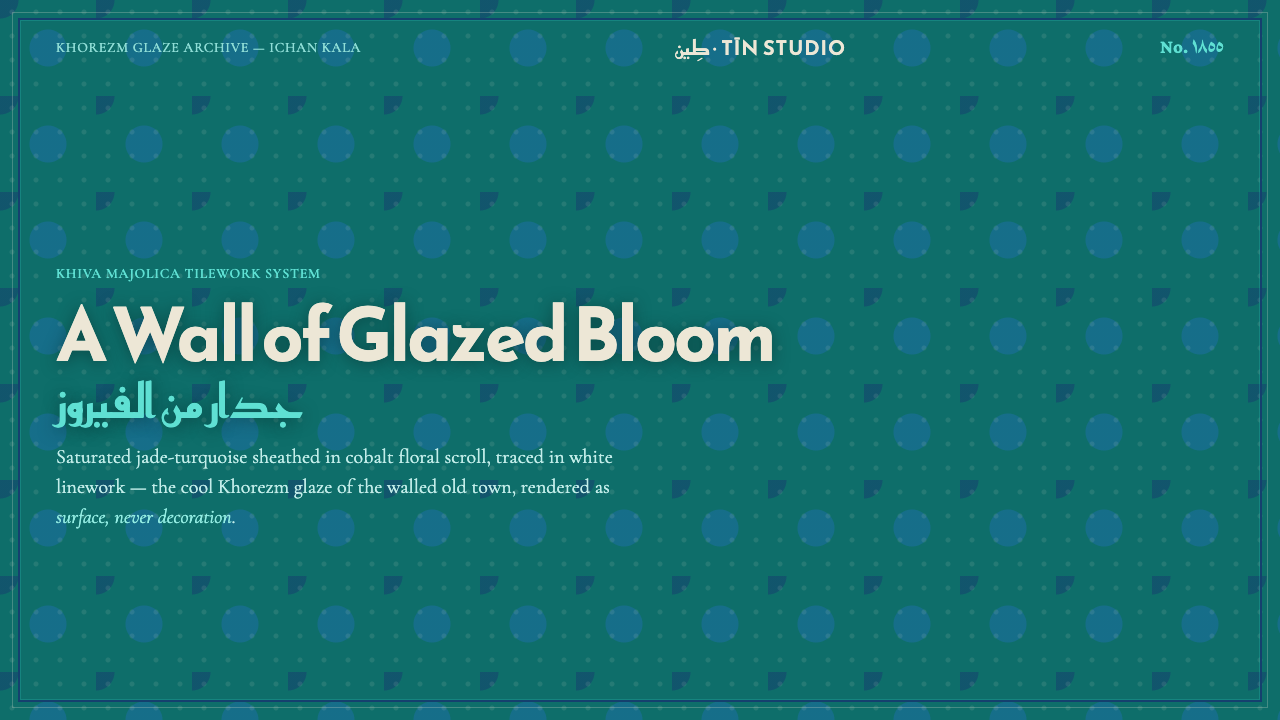 Khiva Ichan-Kala MajolicaJade becomes architecture. Cobalt bands and white tracery lock the surface in…
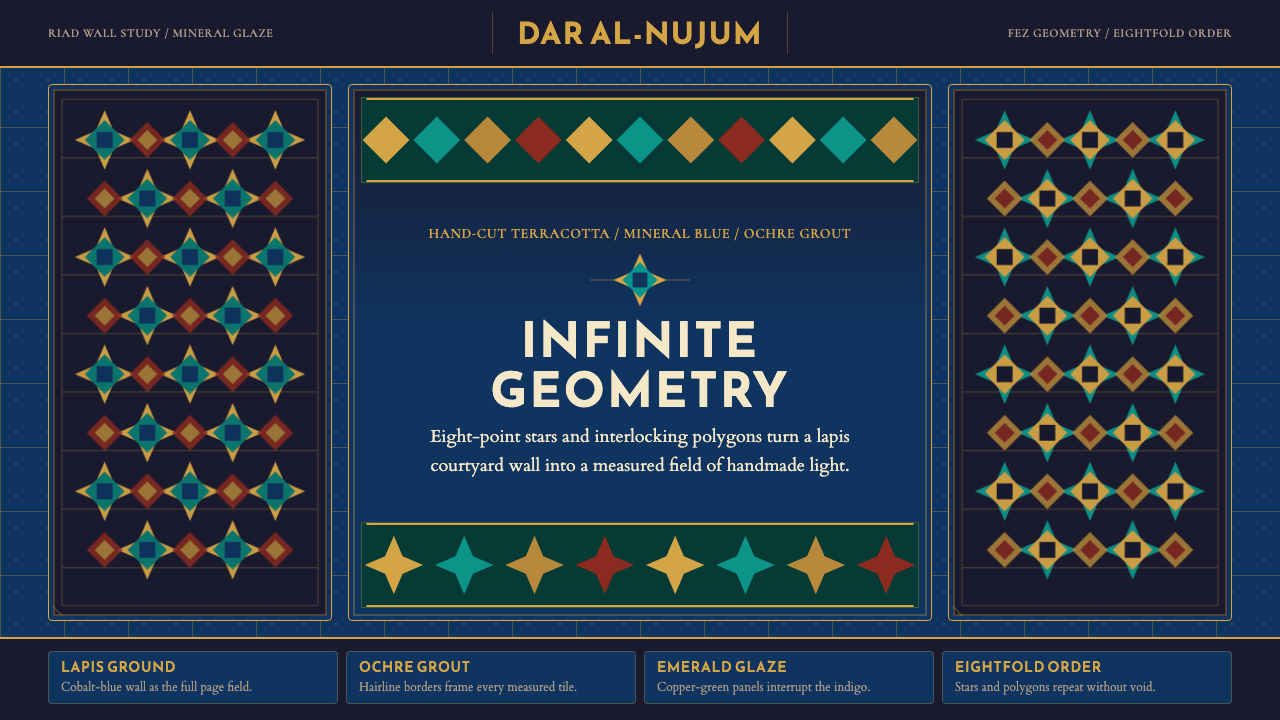 Moroccan Zellige TileLuxurious geometry without void. Lapis ground, ochre borders, and eight-point…
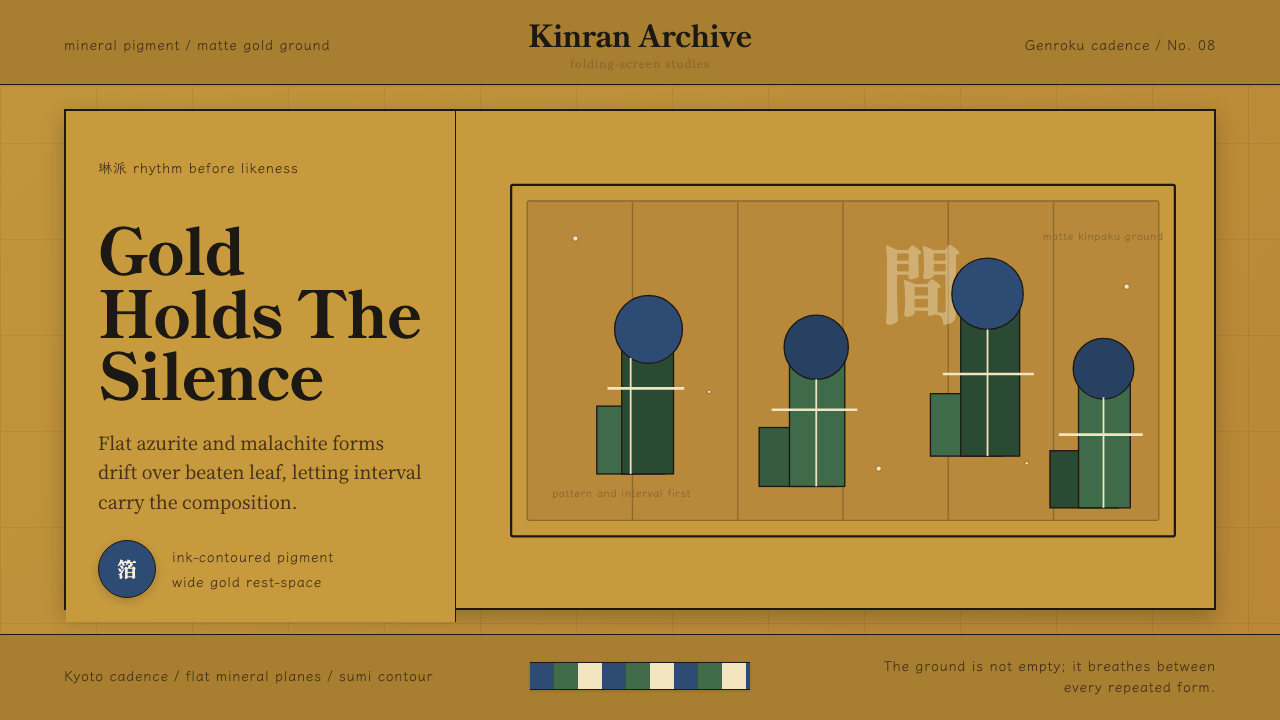 Edo Rinpa (Kōrin)Matte gold breathes. Azurite and malachite repeats float across inked screen…
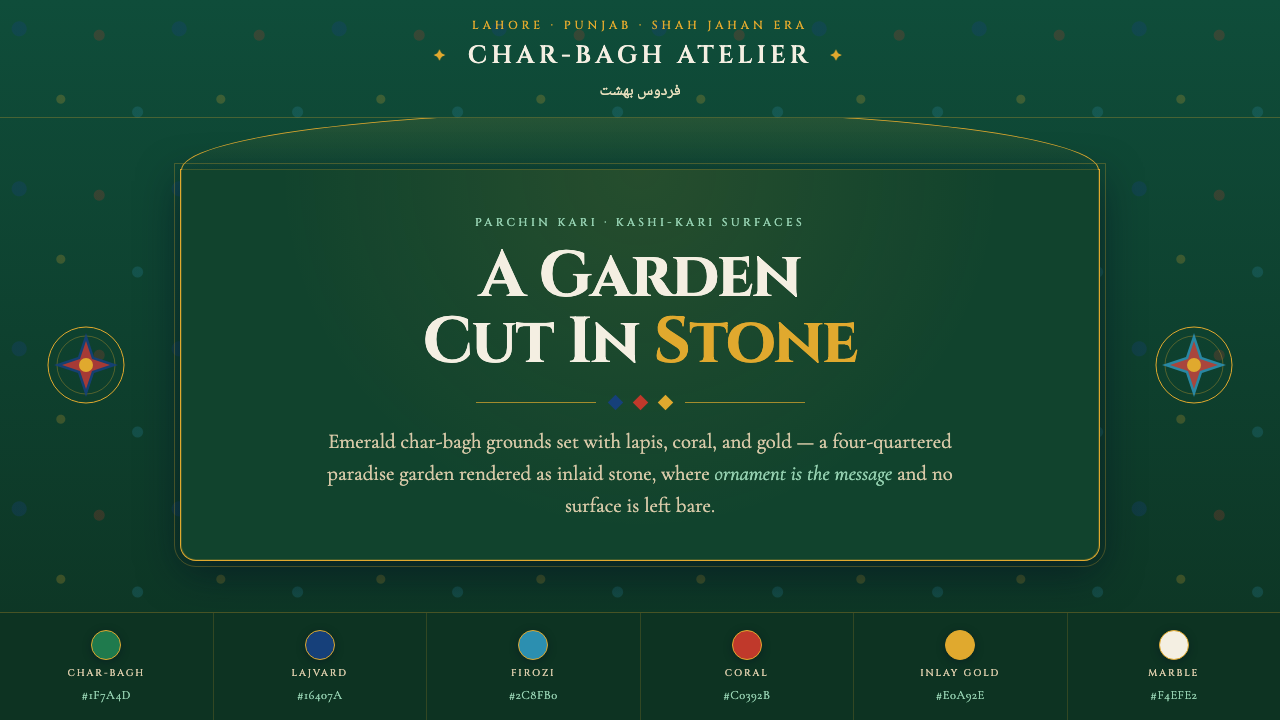 Shalimar Mughal Pietra DuraA paradise garden cut in stone. Emerald char-bagh ground inlaid with lapis, c…
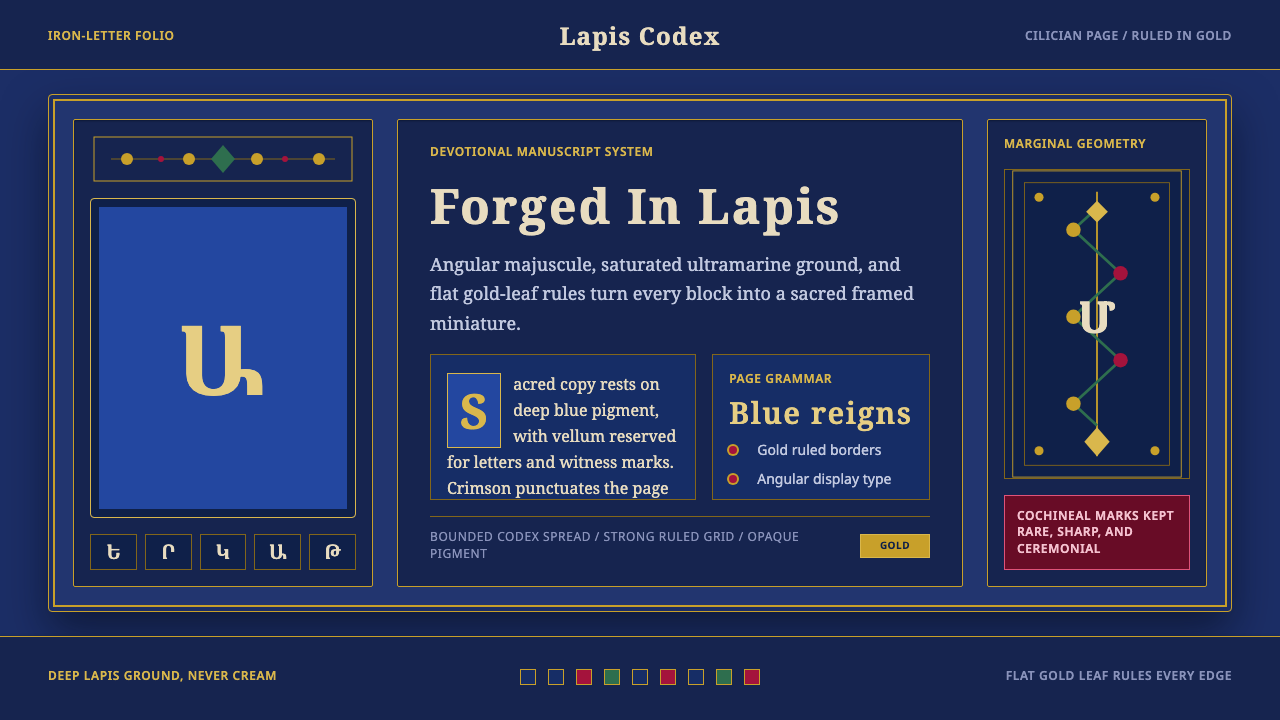 Armenian ErkatʿagirDevotional lapis reigns. Gold rules and angular serif glyphs frame a sacred g…
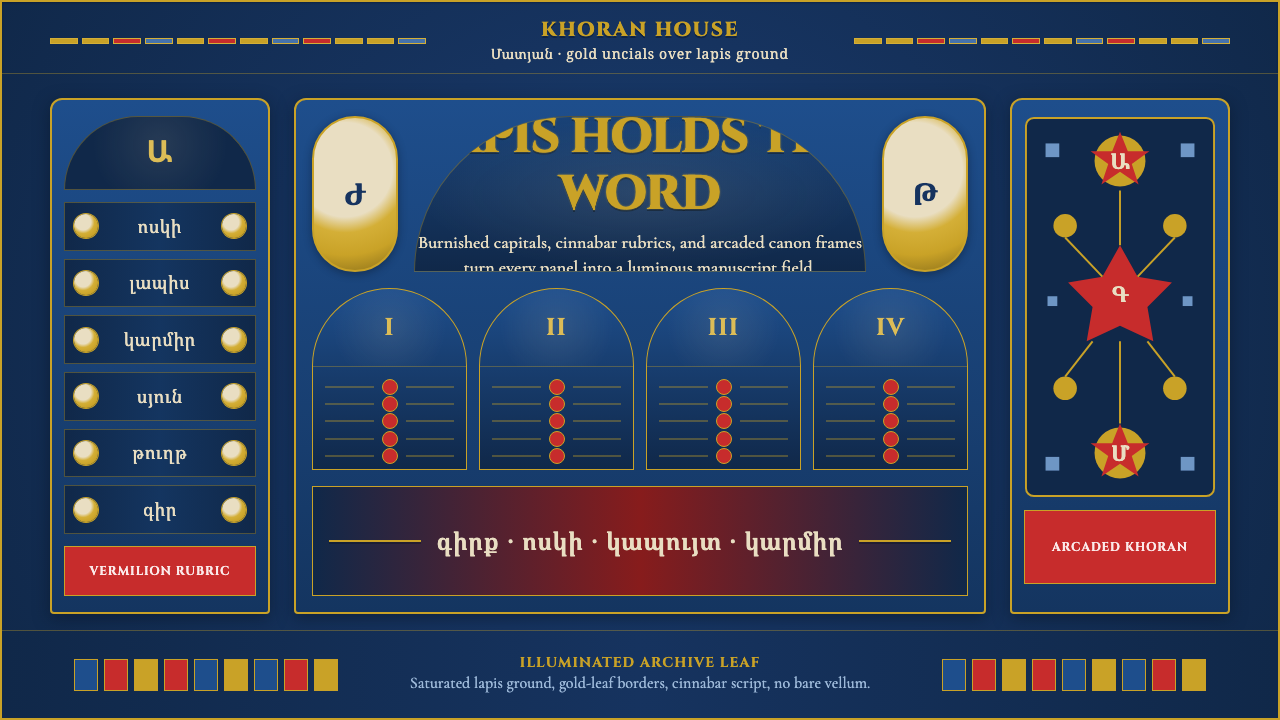 Armenian Manuscript FolkloreJewel-dense devotion. Lapis ground, gold uncials, and vermilion arcades fill…