What is Moroccan Zellige Tile?
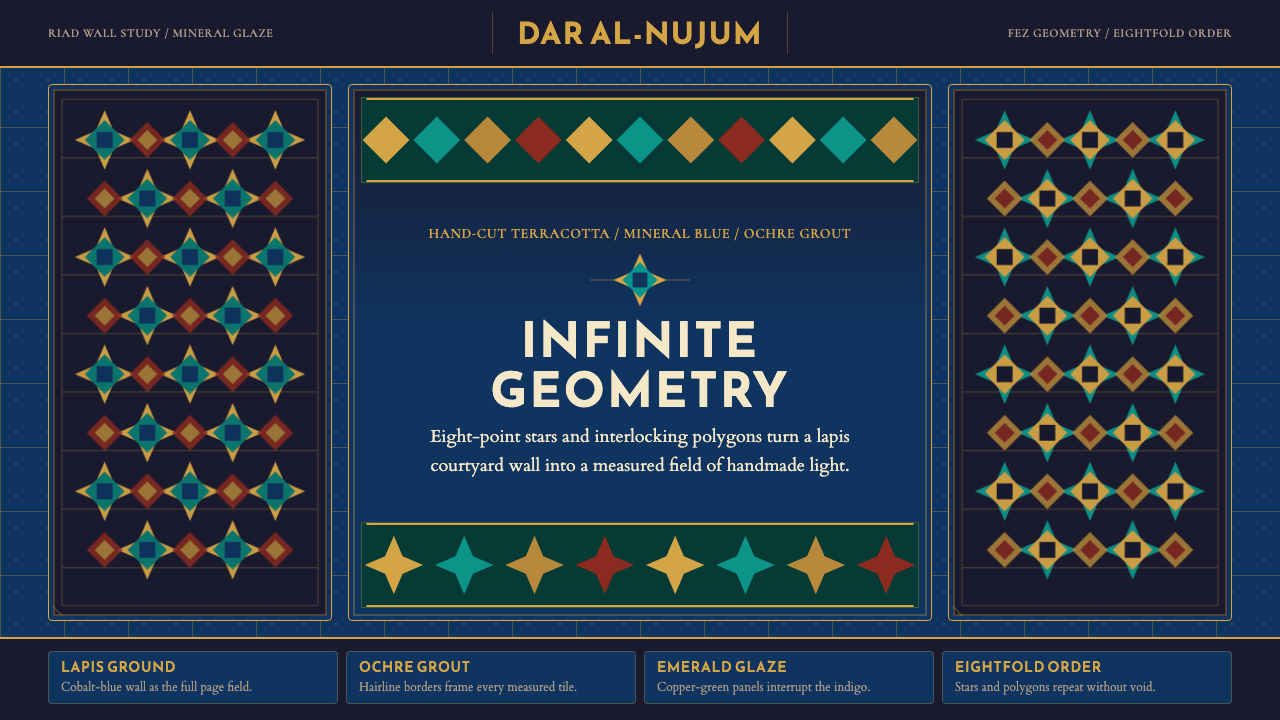
Zellige turns the fear of empty space into a philosophy — hand-cut terracotta tiles, glazed in mineral blues and sun-baked ochres, locked together in star-and-polygon mosaics that have tiled Morocco's most sacred interiors for a thousand years.
Moroccan Zellige Tile in brief
Moroccan zellige (also spelled zellij or zelij, from the Arabic for 'small polished stone') is a mosaic craft in which flat terracotta tiles are hand-cut into precisely shaped geometric tesserae, glazed individually in rich mineral colours, and assembled face-down into interlocking patterns before being mounted on walls, floors, fountains, and columns. The finished surface reads as a continuous field of interlocking geometry — eight-point stars radiating into interlocking hexagons, kite-and-dart polygons cascading in every direction — with no ground left uncovered. This total coverage, called horror vacui in Latin, is not incidental: it is the defining spiritual and aesthetic ambition of the craft.
What separates zellige from generic tile mosaic is the extreme precision of hand-cutting and the depth of the glaze palette. Each tessera is chipped from a fired tile using a small hammer and a pointed steel chisel called a mnqach, producing angled edges that lock neighboring pieces into tight, nearly groutless joints. The glazes — applied before firing at high kiln temperature — produce colours of unusual optical density: deep lapis blues that absorb and return light slowly, leaf greens with an almost metallic sheen, warm amber yellows, and chalk whites that anchor the busier passages of pattern. The combination of tight geometry and saturated mineral colour gives zellige surfaces a jewel-like visual weight found in no other decorative tradition.
As a digital design language, Moroccan zellige translates into an aesthetic of saturated dark grounds, angular geometric layering, dense pattern used as texture and atmosphere rather than illustration, and gold-toned accents that function like the ochre borders in a physical mosaic. The style signals luxury, cultural depth, and handcraft authority — qualities increasingly sought by brands operating in hospitality, fashion, beauty, and premium consumer goods.

Where does Moroccan Zellige Tile come from?
The roots of zellige lie in the broader Islamic geometric art tradition that flourished from the ninth century onward across the caliphates of Mesopotamia, Persia, North Africa, and the Iberian Peninsula. The underlying mathematics — how to tile a plane with interlocking stars and polygons without gaps or overlaps — was systematically explored by Islamic scholars who understood geometry as a form of theological inquiry: the infinite repeatability of geometric pattern was read as an analogue of divine infinitude. Morocco absorbed this tradition through its position at the crossroads of Berber, Arab, and Andalusian cultures, and by the tenth and eleventh centuries, under Fatimid and early Almoravid rule, a distinctive Moroccan variant of geometric mosaic was beginning to take form.
The craft reached its first great flowering under the Marinid dynasty, which ruled Morocco from the mid-thirteenth to the mid-fifteenth century. The Marinids were prolific builders: their reign produced the Bou Inania Madrasa in Fez (begun 1351), the Attarine Madrasa, and significant expansions to the Kairouan mosque complex. In each of these buildings, zellige was deployed from floor level to roughly waist or shoulder height, creating a continuous wainscoting of geometric pattern that framed the carved stucco and cedarwood calligraphy panels above. The Marinid maâlems (master craftsmen) of Fez developed the full vocabulary of zellige geometry — the eight-pointed star as primary motif, the surrounding field of kite, rhombus, and elongated hexagon, and the border systems that frame and terminate each composition. This vocabulary has remained essentially stable for seven centuries.
Fez retained its position as the undisputed capital of zellige craft through the Wattasid, Saadian, and Alaouite periods that followed. The city's medina housed hundreds of workshops organized into specialized guilds: one guild cut the tiles, another glazed them, another assembled the finished panels. The knowledge was transmitted orally and by direct demonstration across generations — the precise angles of the mnqach strike, the kiln temperatures that produced each glaze colour, the grid systems that allowed a master to scale a sixteen-point star pattern from a small sketch to a wall-covering ten meters wide. This transmission was so robust that zellige survived the disruptions of the colonial period largely intact, and contemporary Fez workshops still produce work by the same methods.
The twentieth and twenty-first centuries brought zellige to global attention through two parallel channels. The first was the Hassan II Mosque in Casablanca, completed in 1993 under the direction of French architect Michel Pinseau, which deployed zellige across approximately a third of its vast interior — the largest single commission in the history of the craft, requiring years of work from hundreds of maâlems across Morocco. The mosque's scale and international media coverage introduced zellige to audiences far beyond the Islamic world. The second channel was the global luxury market: designers including Yves Saint Laurent, who maintained his Marrakesh villa Dar es Saada as a creative retreat and had its courtyards refaced in traditional zellige, and more recently Studio KO, whose hotels and residences have featured contemporary interpretations of the craft, brought zellige into the visual vocabulary of international luxury hospitality. Today, researchers and educators such as Eric Broug have systematized the geometric principles into published form, making the underlying mathematics accessible to designers worldwide.
What defines the Moroccan Zellige Tile look?
Ground and Depth
The foundational colour in zellige-derived design is a deep, saturated blue — the blue of lapis lazuli, of glazed Fez tilework at its most iconic — that functions not as a background in the minimal sense but as a presence in itself. This deep ground gives the design its gravity and nocturnal richness. Against it, pattern and accent colours read as if illuminated from within rather than lit from without. A zellige palette without a strong dark ground loses the quality that makes the style distinctive: its sense of embedded, compressed luminosity.
Geometric Vocabulary
The eight-pointed star — formed by overlapping two squares at forty-five degrees — is the primary motif around which all other zellige geometry organises itself. From each star's eight points, subsidiary shapes radiate outward: kite-shaped quadrilaterals, elongated hexagons, smaller four-pointed stars, irregular polygons that fill the interstices. The result is a system of interlocking forms that tiles a plane perfectly, with each shape determined by its neighbours. In digital application, this geometry appears as angular layering, star-derived decorative dividers, and polygon-based structural grids rather than literal tile mosaics.
Colour Saturation and Mineral Quality
Zellige glazes are mineral glazes fired at high temperature, producing colours of unusual optical density and surface variation — no two tiles fire to exactly the same shade, and the slight variations within a colour family give the finished mosaic its living, breathing quality. In digital translation, this principle argues against perfectly flat, uniform fills. Colours should be richly saturated but not electronically bright: the blues lean toward ultramarine and indigo rather than sky blue, the greens toward verdigris and celadon rather than lime, the ochres toward amber and burnt sienna rather than lemon yellow. Subtle tonal variation within large colour fields honours the mineral source.
Horror Vacui — Total Coverage
In traditional zellige, no surface is left bare. The horror vacui principle — the filling of every available space — is not decorative excess but a considered theological and aesthetic position: emptiness is absence, and the divine is found in plenitude of pattern. In digital work, this translates into an embrace of dense pattern in designated zones rather than a fear of white space everywhere. A zellige-informed layout might use a section of dense geometric pattern as a textural background, a border, or a full-bleed panel, while allowing adjacent sections to breathe — understanding that the density becomes meaningful only when it contrasts with quieter areas.
Gold and Ochre Accent
Zellige compositions are traditionally edged and articulated with borders of ochre-yellow and warm gold — colours that reference the brass lanterns, gilded plasterwork, and sunbaked terraces of Moroccan architecture. In digital contexts, these ochre and gold accents function as structural highlighters: they mark the edges of geometric units, outline star forms, differentiate active elements from ground, and lend the overall palette its sense of warmth and material richness. Used sparingly, gold reads as premium; used liberally, it risks visual noise. The discipline is to reserve warm accent for elements that genuinely lead the eye.
Angular Precision
Unlike organic decorative traditions where curves and free-form flourishes are welcome, zellige geometry is entirely rectilinear and angular — every line meets another at a calculated angle, typically a multiple of fifteen or twenty-two-and-a-half degrees. There are no freehand curves in a traditional zellige panel. In digital application, this precision manifests as hard edges, polygon-based shapes, and an aversion to soft rounding or organic forms. Borders are straight; dividers are sharp; shapes are decidedly geometric. This angularity is what gives zellige-derived design its feeling of deliberateness and structural control.
Pattern as Atmosphere
In a physical riad or mosque, zellige does not compete with the activities occurring in the space — it forms the atmosphere within which those activities unfold. The pattern recedes just enough to function as ground rather than figure, creating an enveloping environmental richness rather than a focal point. Digital zellige application works similarly: geometric pattern used as a section background, a card texture, or a framing device enriches the visual environment without demanding direct attention. The pattern supports the hierarchy; it does not replace it.

Who shaped Moroccan Zellige Tile?
The true authors of zellige are the unnamed master craftsmen — maâlems — of Fez, who developed and refined the craft over seven centuries within a guild system that transmitted technique orally and by direct demonstration. No individual name is attached to the great Marinid madrasas or the fountains of Meknes, because the tradition understood authorship as collective and continuous rather than individual. The maâlems established the full geometric vocabulary of zellige — every standard star size, every border system, every canonical colour combination — and their anonymous collective achievement constitutes one of the most sustained acts of applied geometry in human cultural history.
The French fashion designer Yves Saint Laurent discovered Marrakesh in 1966 and returned repeatedly, eventually acquiring a house in the medina and commissioning extensive zellige work in its courtyard. His sustained engagement with Moroccan craft — through his personal residences, his collections, and his partnership with Pierre Bergé — brought zellige and Moroccan decorative arts into the visual vocabulary of international high fashion. The Jardin Majorelle, which Saint Laurent helped restore and preserve, and the Musée Yves Saint Laurent Marrakech, opened in 2017, have since become pilgrimage sites for designers seeking direct engagement with the Moroccan decorative tradition.
The Paris- and Marrakesh-based architecture and design practice Studio KO, founded by Karl Fournier and Olivier Marty, has produced a body of hotel and residential work — most notably the El Fenn hotel in Marrakesh and a series of private villas — that positions zellige and other Moroccan craft traditions within a contemporary luxury hospitality idiom. Studio KO's approach neither historicizes nor exoticizes the craft: they deploy zellige in dialogue with contemporary materials and spatial strategies, demonstrating how the tradition's geometry and palette can anchor a modern interior without nostalgic pastiche. Their work has been widely influential on the global luxury hospitality aesthetic of the 2010s and 2020s.
The Dutch scholar and educator Eric Broug has done more than any other individual to make the underlying geometry of Islamic decorative art — including zellige — accessible to a contemporary design audience. Through his books, workshops, and online courses, Broug demonstrates that the apparently miraculous complexity of zellige patterns is the product of systematic geometric procedure: compass-and-straightedge construction, grid subdivision, and star-point propagation. His work has made it possible for designers without a deep background in Islamic art history to understand the structural logic of the tradition and apply it rigorously, rather than superficially copying surface appearances.
French architect Michel Pinseau was the lead designer of the Hassan II Mosque in Casablanca, the largest mosque in Africa, completed in 1993. Working in close collaboration with King Hassan II — who reportedly sketched the original concept on a napkin and oversaw every major design decision — Pinseau produced a building that synthesised Moroccan architectural tradition with contemporary construction technology. The mosque's interior deploys zellige across a staggering total area, representing the largest single zellige commission in history and requiring the coordinated labour of master craftsmen from workshops across the country. The project demonstrated that zellige was not a museum craft but a living tradition capable of operating at monumental contemporary scale.
How do you use Moroccan Zellige Tile today?
Moroccan zellige is among the richest and most atmosphere-generating of the historical design traditions available to contemporary practitioners, but it is also among the most easily corrupted. The style's visual power comes from the combination of deep saturated ground, angular geometric layering, disciplined accent colour, and the tension between dense pattern and breathing space. Strip any one of those elements and the result reads as generic Orientalist pastiche rather than a considered application of a living craft tradition.
For presentation slides, zellige works powerfully on cover pages and divider slides where the goal is atmosphere and arrival rather than information transfer. A cover benefits from a deep-ground full-bleed layout in which a geometric star or polygon pattern occupies one half or two thirds of the slide, with the title and subtitle sitting in high-contrast light type over the dark ground. Internal content slides should be significantly quieter — a narrow geometric border, a zellige-derived pattern strip at the bottom, or a small star motif as a section marker — allowing text and data to read against a nearly neutral field. Data visualization slides can adopt the colour palette without adopting the density: bars and segments coloured in the zellige blues, greens, and ochres against a dark ground create visual richness without competing with the data.
For web user interfaces, zellige is most effective on dashboards, product pages, and pricing tables serving audiences in luxury hospitality, beauty, fashion, or cultural sectors where premium positioning is explicit. The approach: establish the deep lapis or indigo ground as the primary surface, use the ochre-gold accent for interactive highlights, hover states, and calls to action, and deploy geometric pattern as section dividers or card backgrounds rather than full-page wallpaper. Navigation headers and footers can carry more pattern density than middle-page content areas. Component borders should be sharp and angular rather than rounded, reinforcing the zellige geometry without overwhelming function.
For editorial layouts and marketing campaigns, the style supports strong emotional impact in contexts where cultural richness and handcraft authority are brand values. A zellige-informed editorial spread uses the dark ground as a feature-page background — running text sits in a light, legible weight against it — while photography is framed within geometric polygon cutouts or silhouetted against the ground in ways that recall the shaped tesserae of the mosaic itself. Marketing hero sections benefit from the poster-like boldness of the full-pattern approach: a tight geometric field with the brand message set in clean, weighted type reads simultaneously as maximalist and precise. The key is to let the pattern do the emotional work so that the typography can do the informational work cleanly.
A persistent mistake when applying zellige is importing the complexity of the source tradition without understanding its structural logic. Designers sometimes overlay multiple star-pattern scales simultaneously, mix the geometric vocabulary with organic decorative elements such as florals or brush strokes, or apply the palette at low saturation in an attempt to soften it — each of which undermines the system's coherence. Zellige at its source is mathematically precise and optically intense; digital applications that dilute either quality end up with something that references the tradition without honoring it. Equally, resist the temptation to use the style in contexts where warmth and accessibility are the primary user experience goals — health, children's, and community-facing products will generally be better served by softer, more open traditions.

Moroccan Zellige Tile — FAQ
Is zellige the same as any other Islamic geometric tile tradition?
Zellige is one specific tradition within the broader family of Islamic geometric art, distinguished by its technique and its regional character. The closest relatives are the Persian kashi tile work, Anatolian çini (Turkish tile), and the cut-tile traditions of Andalusia. What sets zellige apart is the method: each tessera is individually hand-cut from a pre-glazed tile and assembled face-down, producing joints of exceptional tightness and a surface where each piece catches light at a slightly different angle. Persian and Turkish tile traditions more often use painted or transfer-printed tiles rather than cut tesserae, producing a more uniform surface with less optical complexity. The Moroccan palette — dominated by lapis blue, verdigris green, ochre, and chalk white — is also distinctive compared with the turquoise-and-white dominance of much Anatolian and Persian work.
Does zellige have to be dark? Can it work on a light ground?
Historically, zellige is used on both dark and light grounds depending on the application: floor zellige in a riad courtyard is often dominated by chalk white and terracotta on a pale ground, while wall zellige in a prayer hall or madrasa tends toward the deeper blues and greens. In digital application, a light-ground zellige interpretation is entirely valid but requires different handling. On a light or cream ground, the geometric pattern becomes the main carrier of colour rather than the gold accent, and the overall effect is airier and more accessible — closer to a Provençal or Mediterranean tile reference than to the nocturnal depth of a Fez madrasa interior. Whether dark or light, the commitment to angular geometry, saturated mineral colour, and total-coverage pattern density should remain.
How do I use geometric pattern without the layout feeling chaotic?
The key is zoning: commit to a clear distinction between pattern zones and content zones, and give each zone a defined role. In a zellige-informed layout, the pattern zone establishes atmosphere and signals the style; the content zone communicates information. The two zones should have a clear boundary — an angular geometric frame, a colour-field shift, or a simple edge — and should not compete for attention simultaneously. Within the pattern zone, keep the pattern scale consistent: mixing two different star sizes on adjacent areas creates visual noise. Within the content zone, keep the background nearly neutral — a slightly warmed dark tone rather than a pattern — so that text and imagery have a stable reading field. The pattern enriches by proximity, not by presence everywhere.
Is this style appropriate for digital products aimed at Western audiences, or does it risk cultural appropriation?
The question is legitimate and worth considering carefully. Zellige is a living craft tradition actively practiced in Morocco, not a historical artifact. The most respectful approach is to understand the tradition deeply enough to apply it with structural fidelity rather than surface quotation — using the geometry, palette, and underlying logic rather than decorative motifs lifted without understanding their construction. Crediting the tradition explicitly in brand communication (noting Moroccan zellige craft as the inspiration) is both respectful and often commercially smart, since it communicates cultural literacy to audiences who recognize it. The problematic applications are those that strip the craft of its geographic and cultural context to produce a vague 'exotic' effect, or that combine Moroccan zellige elements with other Islamic or Middle Eastern visual traditions in a way that collapses distinct cultures. Specificity — naming Fez, naming the Marinid tradition, understanding that this is Moroccan and not generically Islamic — is the best safeguard.
How does zellige differ from Art Deco geometric style, which also uses angular shapes and gold accents?
Art Deco and zellige share a family resemblance — both employ angular geometry and warm metallic accents — but they emerge from fundamentally different structural logics and produce quite different visual results. Art Deco geometry is typically symmetrical, bilateral, and radiating from a central axis or focal point; zellige geometry is all-over, non-hierarchical, and infinite in principle, with no privileged centre. Art Deco uses gold as a prestige surface material in its own right, often against cream or black; zellige uses ochre and amber as one colour among several in a balanced mosaic field. Art Deco compositions typically feature clear negative space and a strong figure-ground distinction; zellige refuses the ground entirely, filling every available surface. In practice, Art Deco reads as theatrical and monumental; zellige reads as immersive and enveloping. Mixing the two styles without understanding these distinctions tends to produce work that is neither.
Related design styles
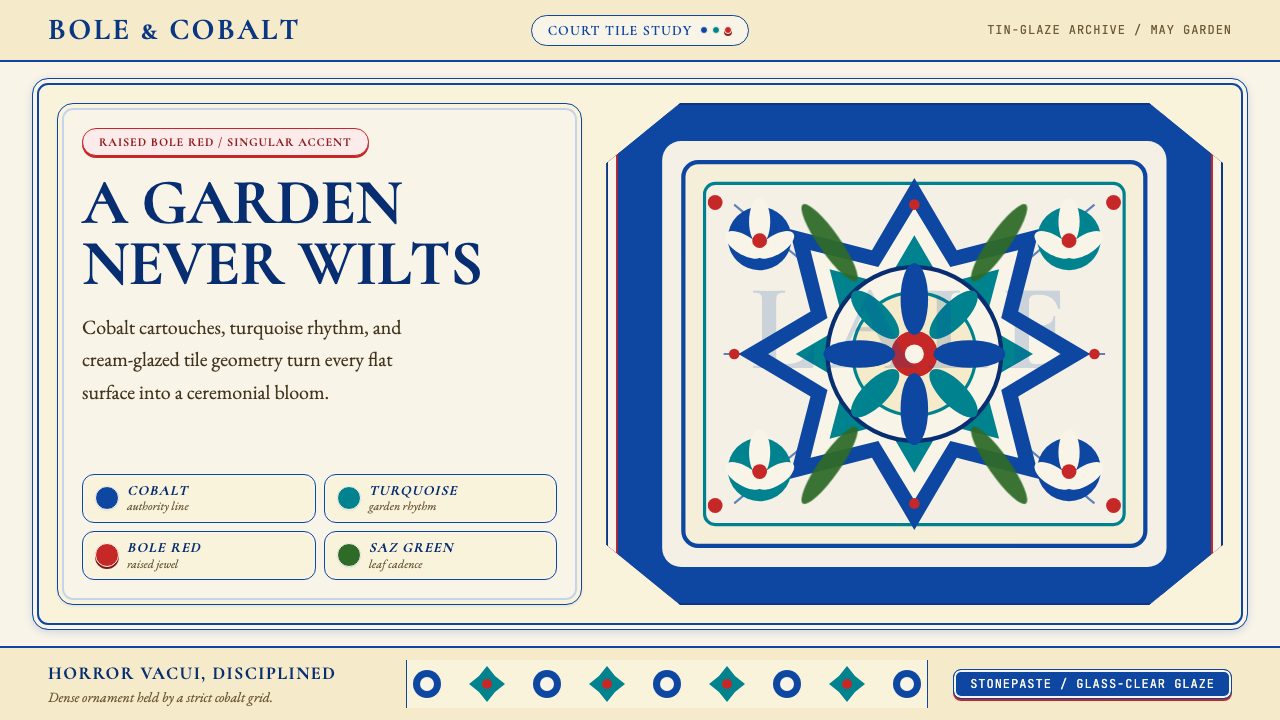 Turkish İznik CeramicBlooms with discipline. Cobalt grid and cream glaze hold turquoise motifs wit…
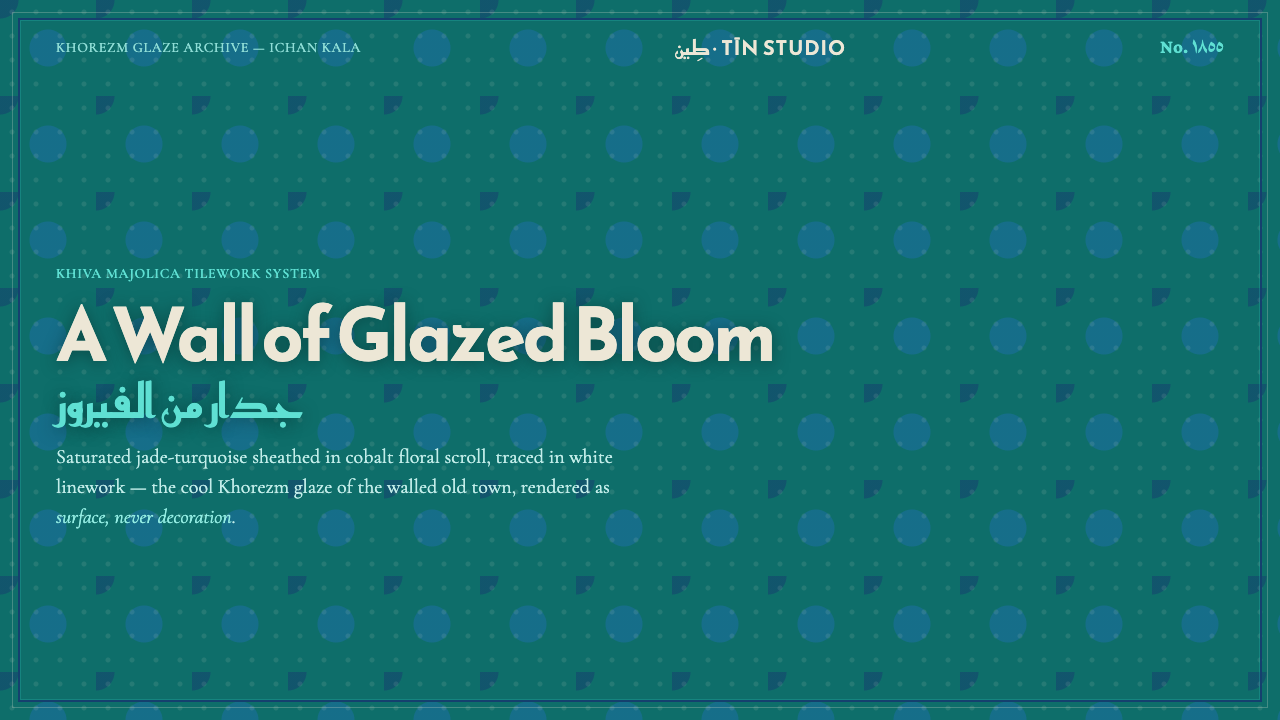 Khiva Ichan-Kala MajolicaJade becomes architecture. Cobalt bands and white tracery lock the surface in…
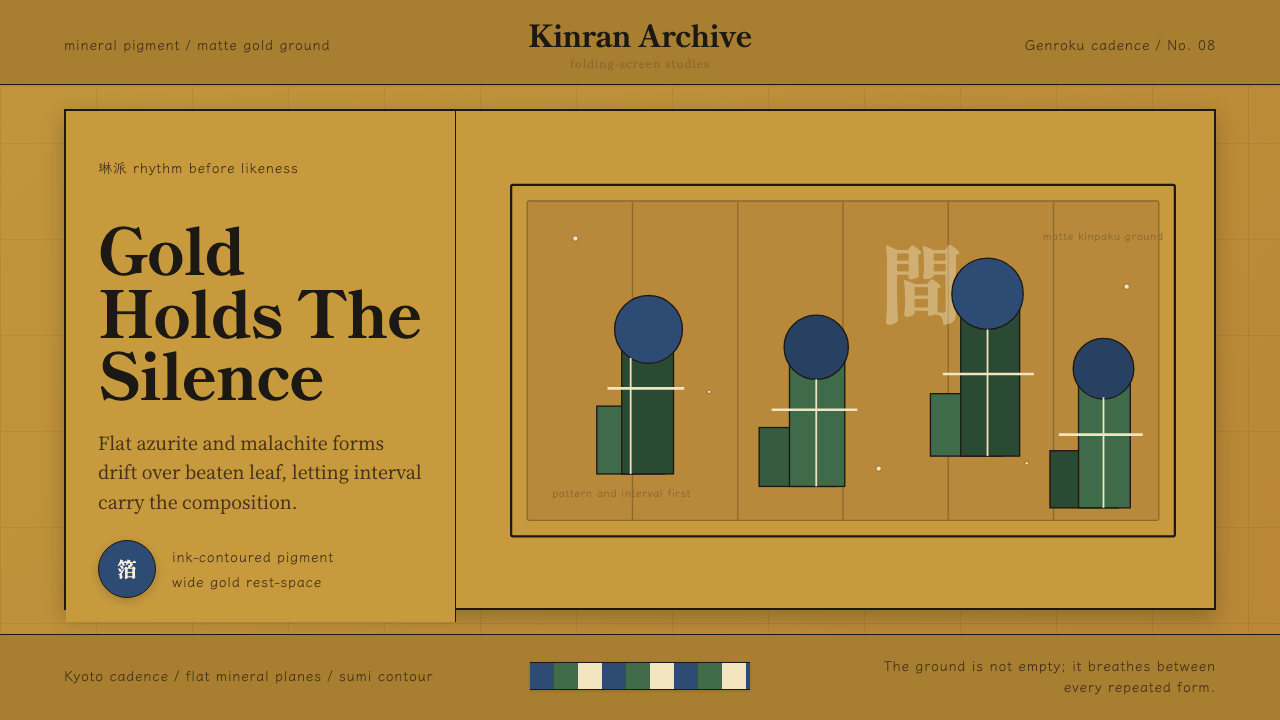 Edo Rinpa (Kōrin)Matte gold breathes. Azurite and malachite repeats float across inked screen…
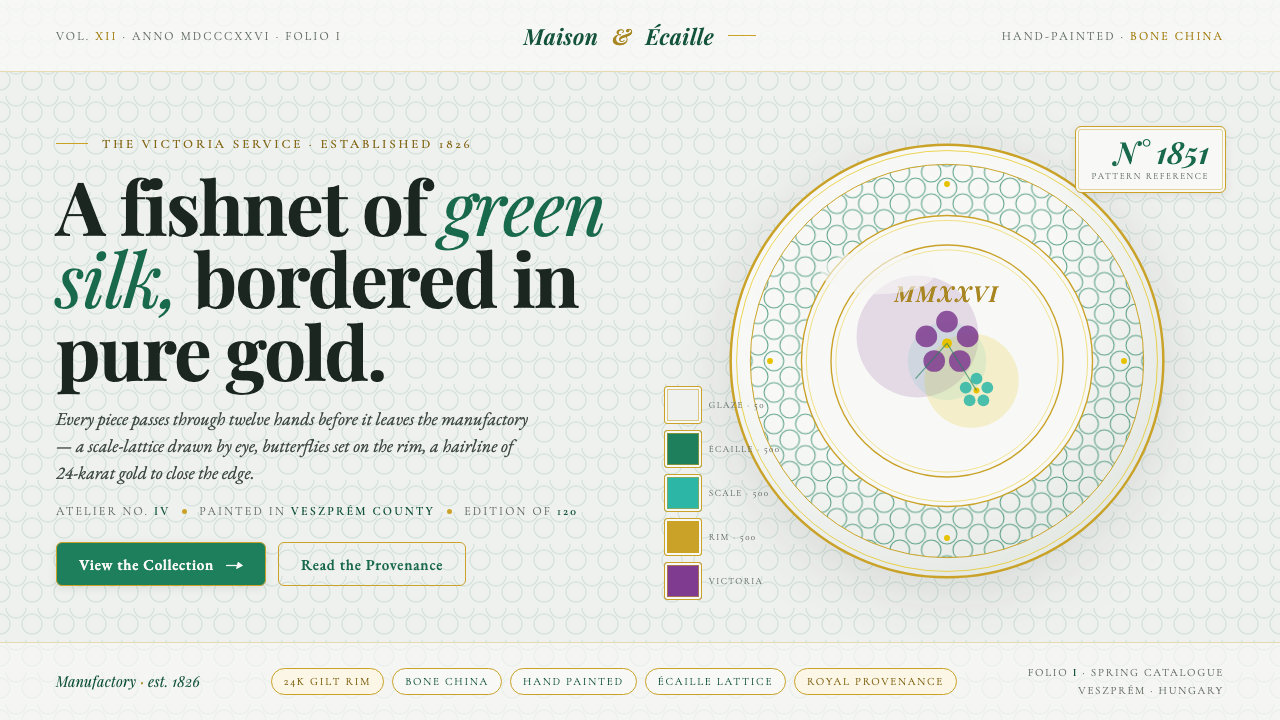 Herend PorcelainRoyal porcelain, drawn by hand. Cool glaze, écaille fishnet, gilt rim, Playfa…
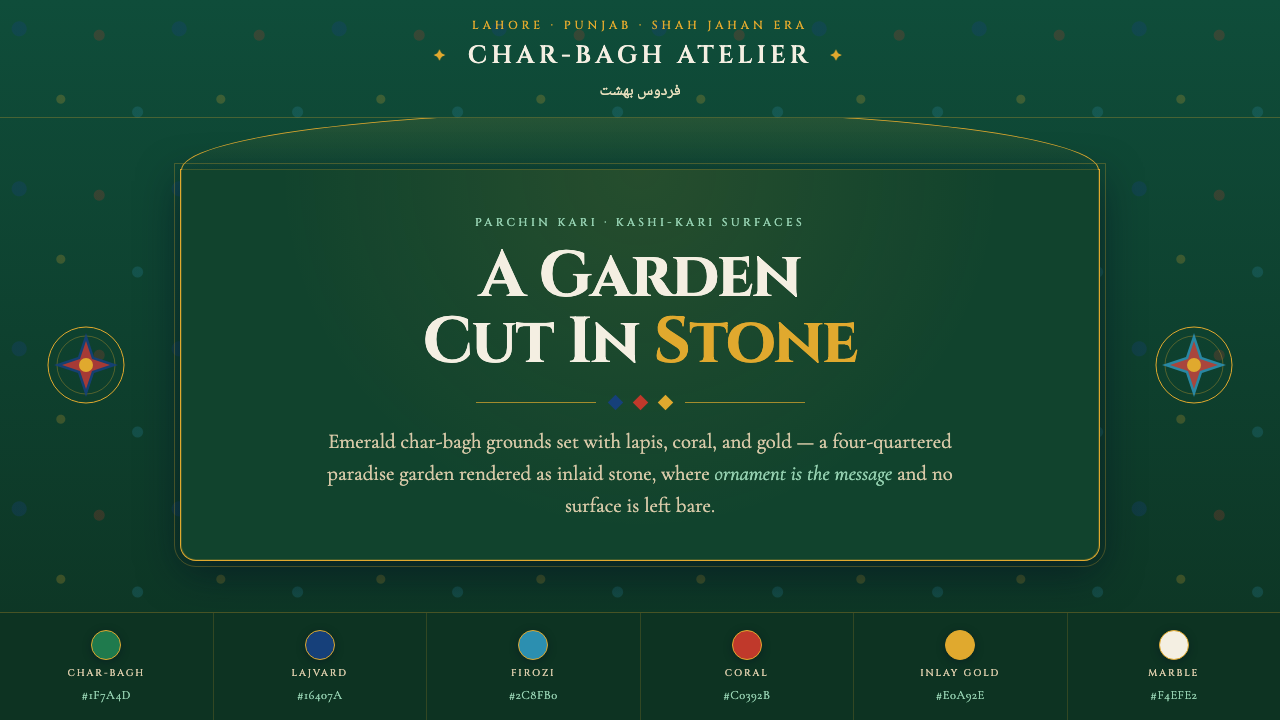 Shalimar Mughal Pietra DuraA paradise garden cut in stone. Emerald char-bagh ground inlaid with lapis, c…
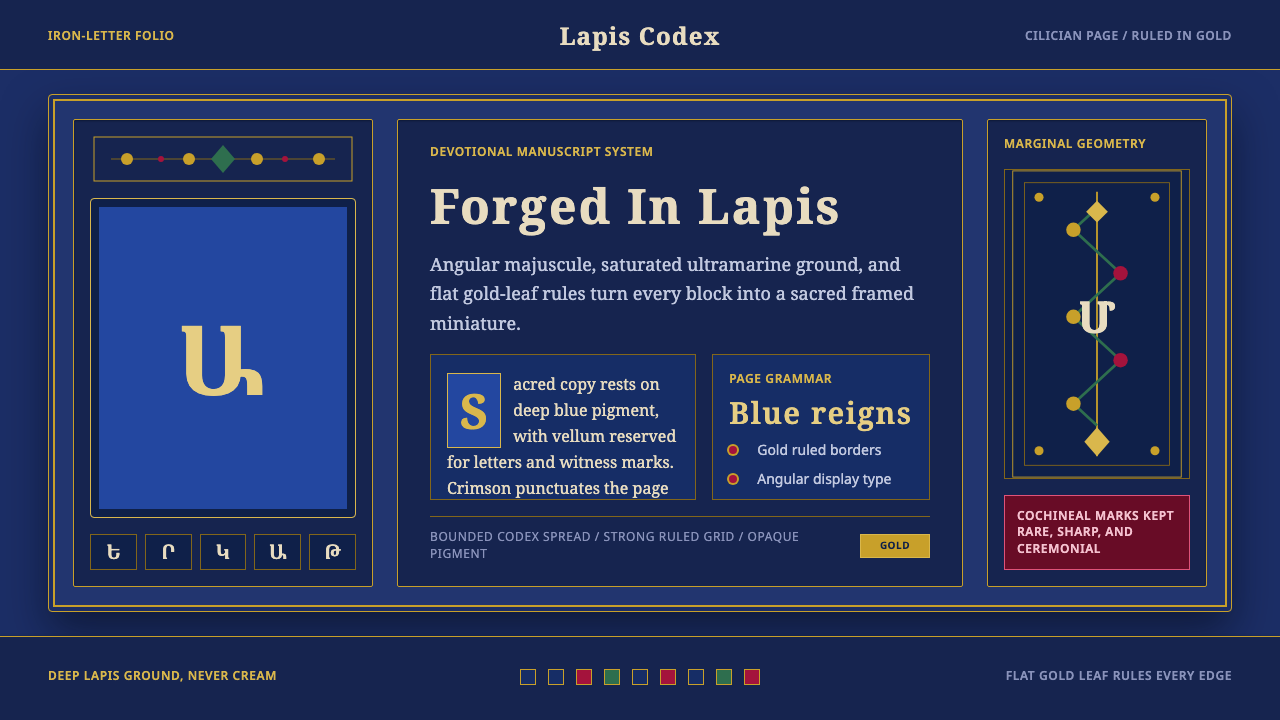 Armenian ErkatʿagirDevotional lapis reigns. Gold rules and angular serif glyphs frame a sacred g…