What is Tuareg Agadez Cross Silver?
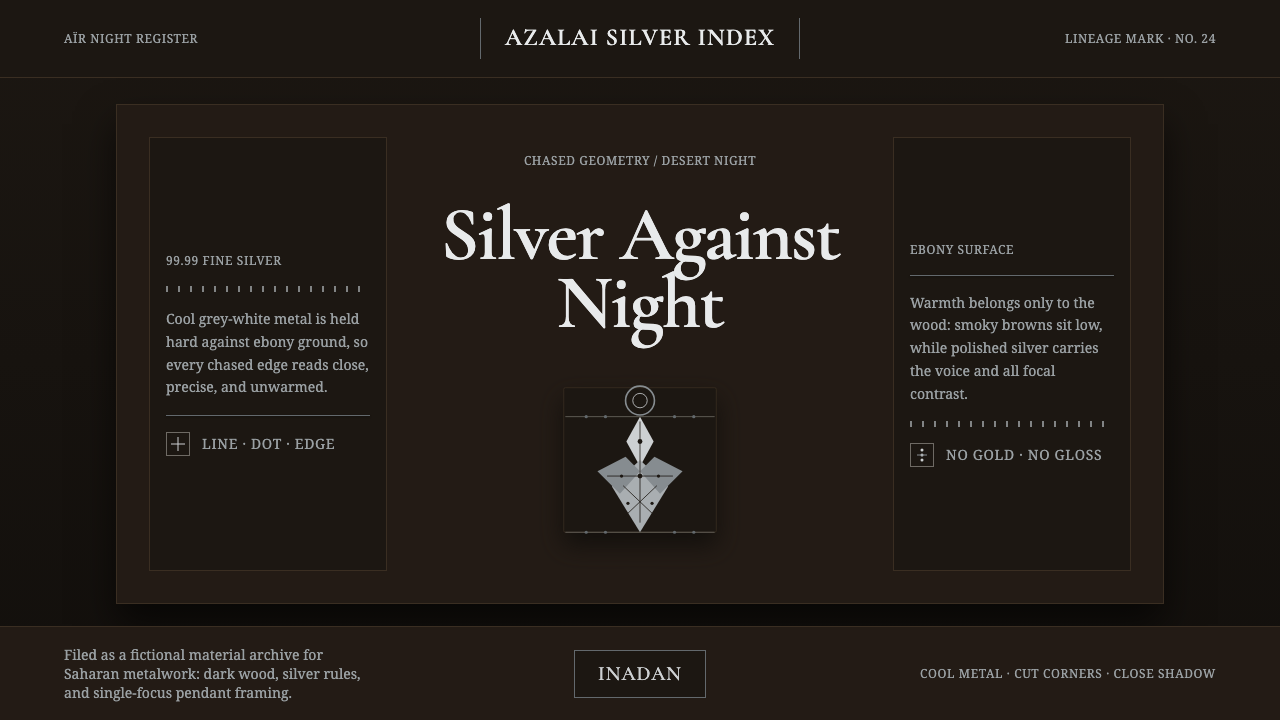
Agadez silver refuses warmth: cool chased geometry cuts across ebony-dark surfaces with the precision of a desert night.
Tuareg Agadez Cross Silver in brief
Tuareg Agadez Cross Silver draws on the silver adornment tradition of Agadez and the Aïr in Niger, within the wider Saharan range of the Tuareg, or Imuhar. Its defining image is not lavish metalwork but a severe meeting of materials: cool grey-white silver, deeply dark wood, and hand-cut geometric detail that catches light without becoming decorative excess.
The Agadez cross is cast and chased in fine silver by inadan, the hereditary blacksmith-jewelers who serve Tuareg nomadic society. Fine engraved lines and dots give the metal its visual structure, while dark ebony or abaka wood beads establish a dense, nearly nocturnal field around it. The result is a discipline of contrast rather than a display of abundance.
This aesthetic is monochrome in feeling even when silver shifts with reflected light. Dark wood absorbs illumination; silver answers it with a hard, cool glint. Geometry is therefore not a surface pattern added after the fact, but the means by which the object becomes readable: incised marks organize the metal, distinguish its worked surface, and make precision visible.
Where does Tuareg Agadez Cross Silver come from?
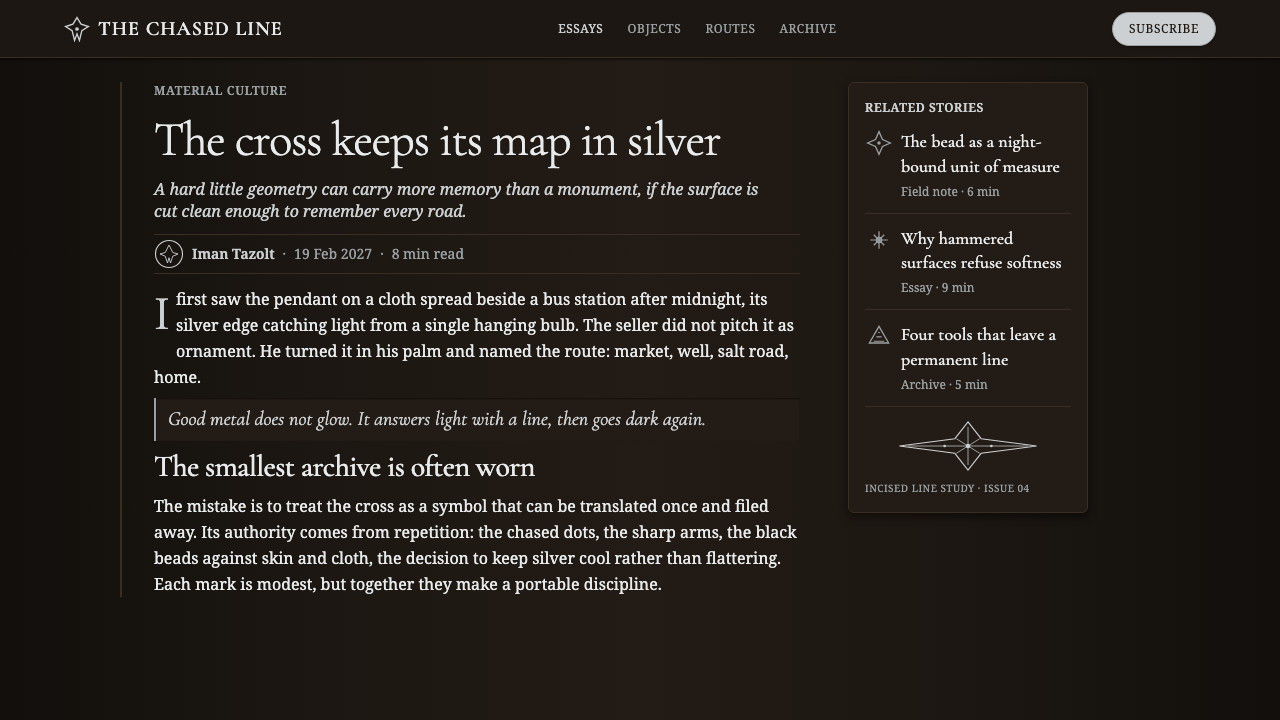
The tradition belongs to the Tuareg and Imuhar world of the Sahara, especially Agadez and the Aïr region of Niger. Before 1900, and through a continuing smith tradition, metal adornment was produced within a nomadic society whose material culture could travel, be worn, and remain legible across regional distance. The cross and its accompanying beads carried more than visual contrast: they could mark lineage, region, and rite of passage.
Its makers were the inadan, a hereditary blacksmith-jeweler caste serving Tuareg society. Their role joins making with social continuity. Casting establishes the silver form; chasing brings its surface into focus through engraved geometric lines and dots. The object therefore holds two kinds of knowledge at once: the visible knowledge of metalworking and the inherited knowledge of who makes adornment, for whom, and within which community.
The Koumama smith lineage is named among the key figures of this tradition. In this context, lineage is not an authorial signature in the modern design sense. It names continuity of craft, transmission, and responsibility. That continuity matters to the aesthetic: the sharpness of the chased geometry and the restraint of the silver-and-dark-wood pairing are inseparable from the hands and social tradition that sustain them.
What defines the Tuareg Agadez Cross Silver look?
Cool Silver
Fine silver is treated as a cool grey-white surface rather than a sign of warmth or luxury. Its reflective quality is most effective when it remains restrained: light catches ridges and incisions, while the larger field stays quiet, hard, and metallic. Gold-toned warmth has no role in this visual language.
Chased Geometry
Fine line-and-dot chasing gives the metal its primary graphic vocabulary. The marks are incised, deliberate, and compact, producing geometry through cuts rather than applied color. Their authority comes from repetition and accuracy, not from visual density.
Ebony-Dark Ground
Ebony or abaka wood beads create the essential dark ground around the silver. The darkness is not empty background; it is an active material field that absorbs light, heightens the metal's coolness, and allows every engraved edge to read with greater clarity.
Monochrome Discipline
The palette is governed by dark wood and silver, with reflected light supplying variation instead of added hues. This is not flatness for its own sake. It is a way of concentrating attention on material, incision, and contrast while refusing distracting warmth.
Hand-Worked Precision
The desired finish is not anonymous smoothness. Casting and hand engraving leave the object visibly worked, but never casual. Precision appears in the control of line, the steadiness of repeated marks, and the balance between a reflective silver plane and its darker support.
Adornment with Meaning
The cross and its bead stringing once marked lineage, region, and rite of passage. This gives the style a crucial limit: its geometry should not be detached into generic decoration. The visual system gains its force from cultural meaning as much as from silver, darkness, and craft.

Who shaped Tuareg Agadez Cross Silver?
The inadan are the hereditary blacksmith-jewelers serving Tuareg nomadic society across the Aïr and wider Sahara. Their work gives the Agadez cross its material reality: casting fine silver, chasing its surface by hand, and maintaining a craft tradition in which adornment remains tied to social identity.
The Koumama smith lineage represents the continuity of inherited making within this tradition. Its significance is not limited to a decorative style. It points to an ongoing chain of knowledge through which metal, engraved geometry, beads, and the social meaning of the cross remain connected.
The Tuareg, or Imuhar, provide the nomadic social and cultural setting in which this adornment tradition is understood. The Agadez cross should be read within that setting: as worked silver and dark beads, but also as an object associated with lineage, region, and rite of passage.
How do you use Tuareg Agadez Cross Silver today?
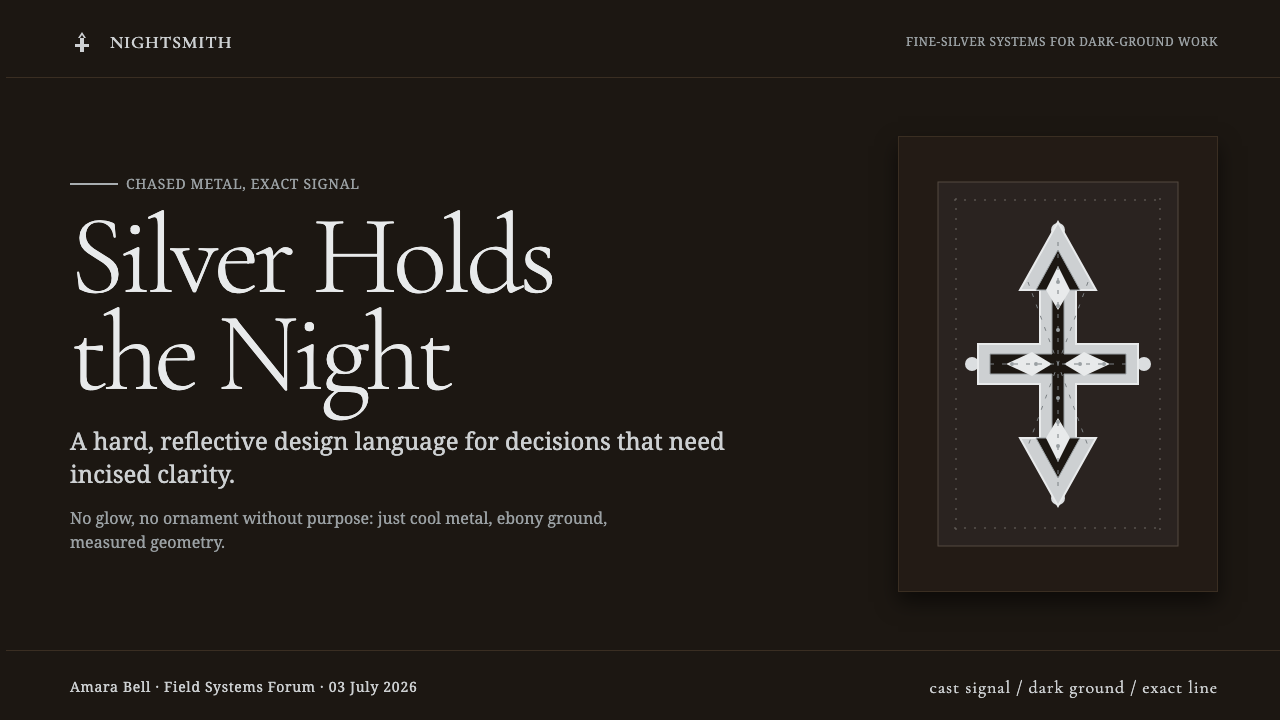
For presentation covers, use an ebony-dark field with one cool silver focal form and a small constellation of chased line-and-dot detail. The title should feel as if it belongs to the dark surface rather than floating above it. Keep the composition quiet, directional, and materially specific; the contrast should come from silver against darkness, not from an accumulation of effects.
For content and data slides, translate chasing into fine dividers, restrained rules, and small repeated marks that organize information. Charts should rely on a dark field and a limited silver hierarchy, allowing emphasis to emerge through brightness, density, or enclosure. Avoid turning every data point into ornament; the reference is engraved precision, not decorative complexity.
For web interfaces, the style is suited to dashboards, premium collections, and pricing pages where a dark environment can support focused reading. Silver-toned text and controls should remain sharply legible against a deep background, while line-and-dot motifs can identify sections, states, or metadata. Treat darkness as a substantial visual material, not simply a backdrop for glowing interface elements.
For editorial and marketing work, pair close material imagery or abstract engraved detail with generous dark space. Headlines can be cool, direct, and compact; supporting copy should sit in calm blocks rather than crowded ornamental frames. This approach works especially well when a page needs to communicate craft, rarity, or cultural specificity without resorting to gold, desert clichés, or generalized luxury styling.
A common mistake is to treat Agadez Cross Silver as a generic dark-luxury look. Adding warm metallic accents, glossy excess, ornate borders, or unrelated tribalized motifs breaks its logic. The essential relationship is narrower and more demanding: cool chased silver, dark wood, geometric restraint, and respect for an adornment tradition whose forms carry lineage, region, and rite-of-passage meaning.
Tuareg Agadez Cross Silver — FAQ
Is this style simply a dark version of luxury design?
No. Its effect does not depend on generalized luxury signals. It comes from the specific contrast between cool fine silver and ebony or abaka wood, along with hand-chased geometric marks. Warm gold, visual abundance, and polished glamour move the result away from the source tradition rather than toward it.
Why is dark wood so important to the visual language?
Dark wood gives silver a field against which its coolness, reflection, and engraved edges become visible. It also recalls the stringing of the cross on ebony or abaka beads. Removing that dark material relationship leaves silver as an isolated decorative finish instead of part of a controlled system of contrast.
Can the chased geometry be used as a repeating pattern?
It can inform repeated structure, but it should remain fine, measured, and secondary to the material contrast. The source uses engraved lines and dots on silver, not an all-over decorative field. In contemporary work, repetition is strongest when it organizes boundaries, labels, or transitions rather than covering every available surface.
Does the style require literal cross imagery?
No. A respectful application can work through the relationship of silver, dark wood, engraved geometry, and restraint without reproducing the cross as a generic symbol. This is often the more appropriate approach when the goal is to learn from the aesthetic rather than detach a culturally meaningful adornment from its setting.
What is the most important constraint when adapting it digitally?
Preserve the hierarchy of materials. Darkness should absorb, silver should define, and geometric detail should clarify. If illumination effects, warm accents, or dense ornament become more noticeable than that relationship, the design has lost the source's central discipline of cool precision on a dark ground.
Related design styles
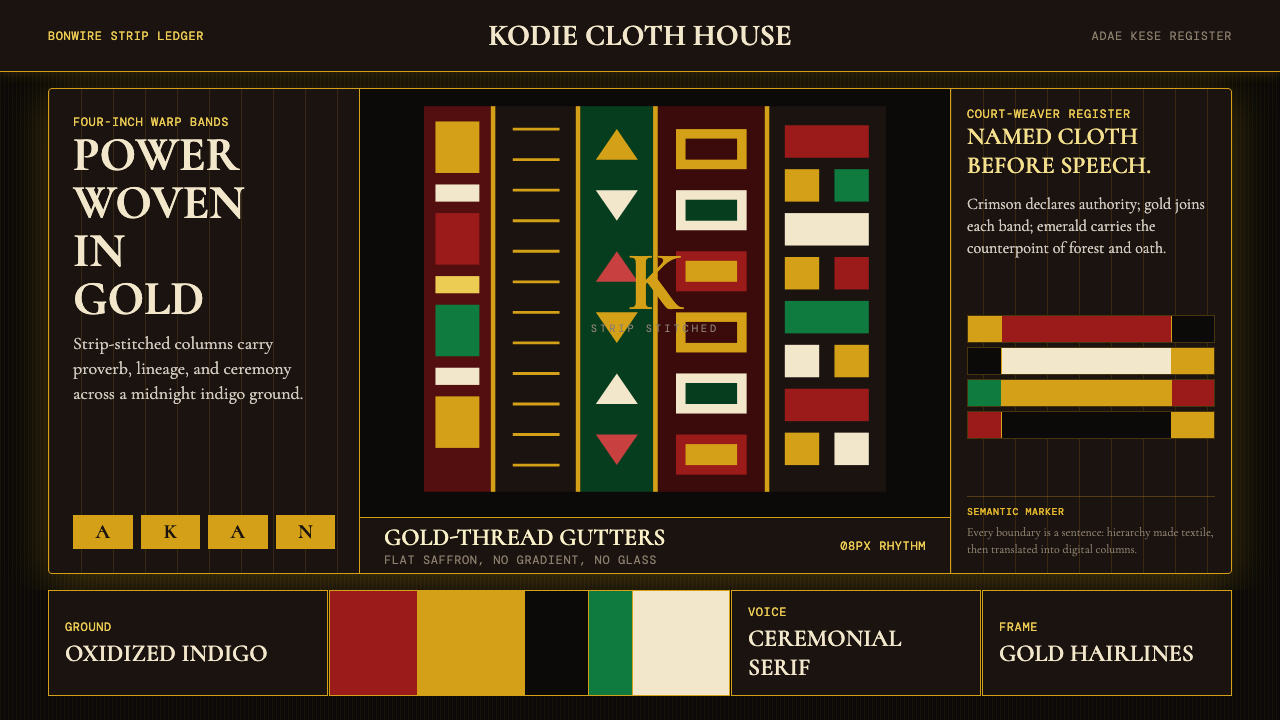 Ghanaian Kente (Asante Royal Gold)Royal authority, woven dark. Gold gutters stitch crimson and indigo strips in…
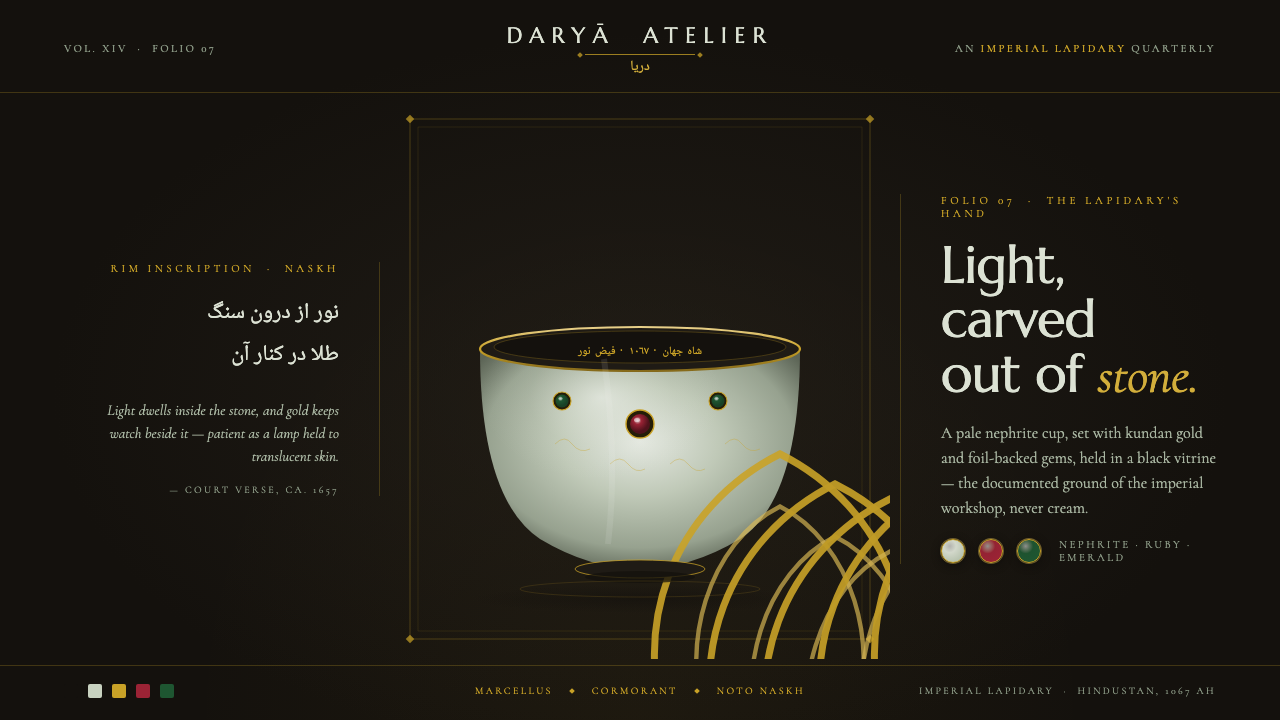 Mughal Jade CarvingImperial luxury, lit from inside. Pale nephrite glows on black, kundan gold f…
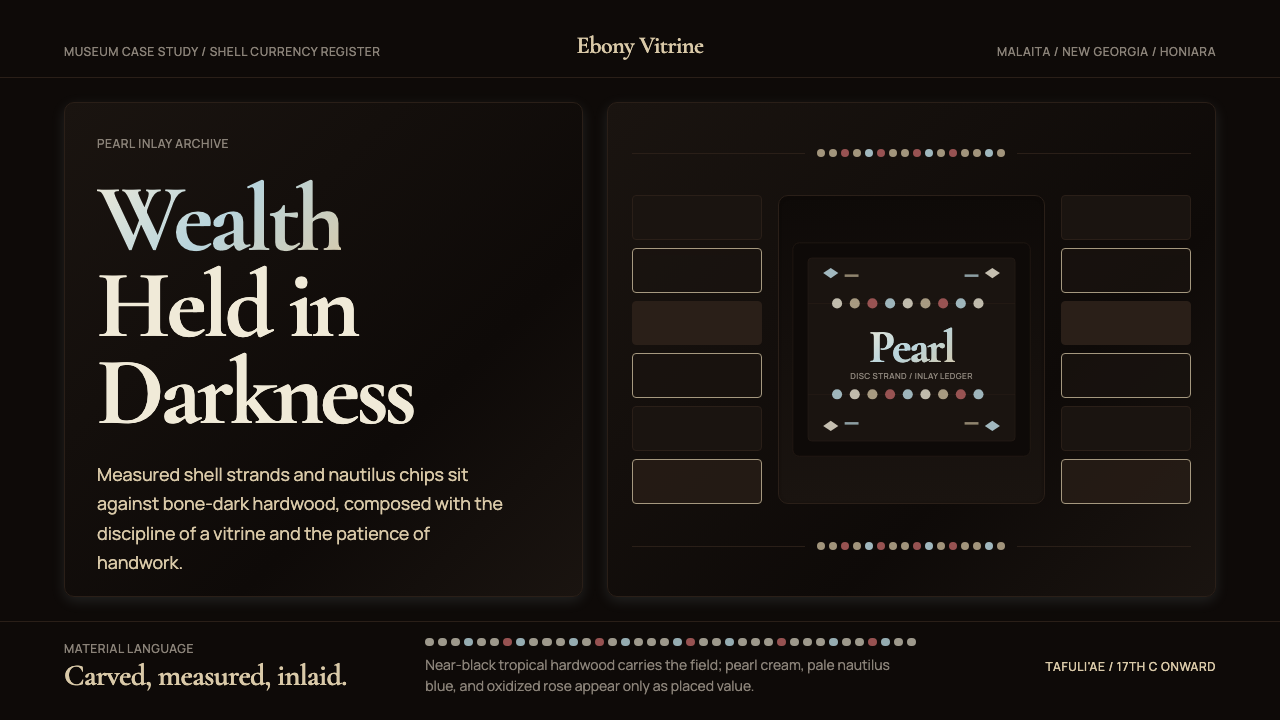 Solomon Shell Money & Pearl InlayDignity inlaid in darkness. Pearl cream and nautilus blue form strict shell-s…
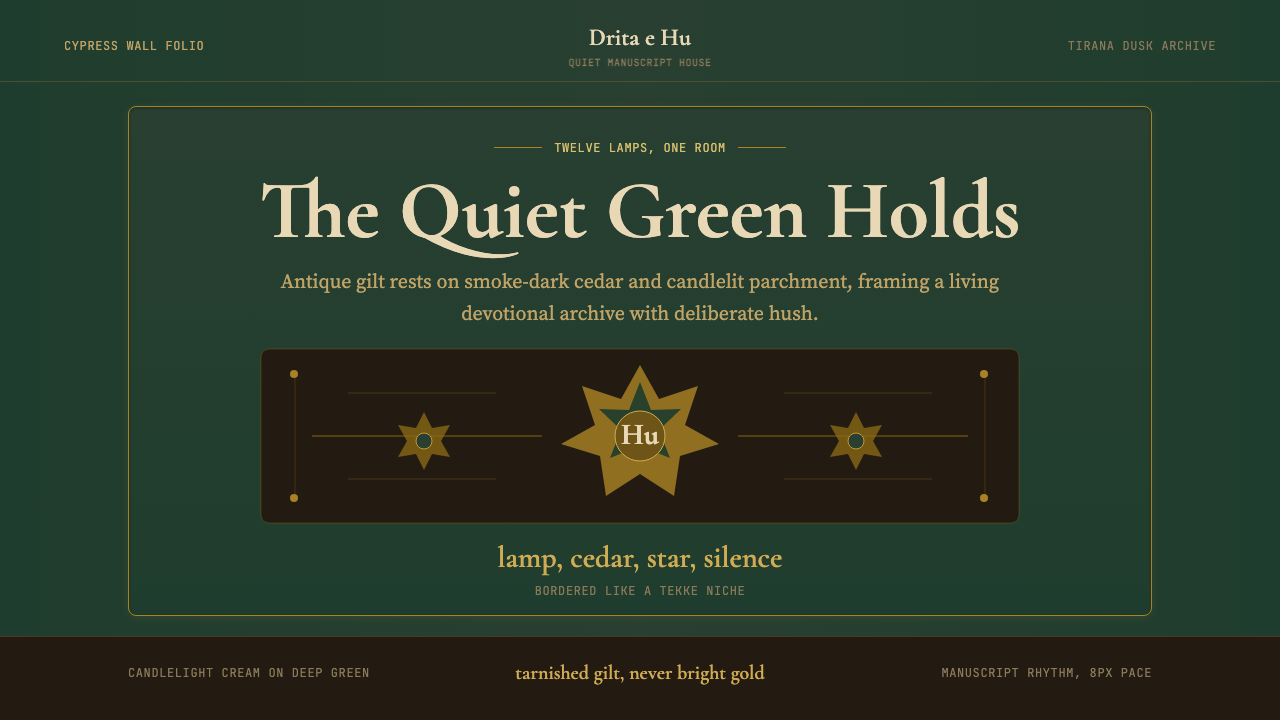 Albanian Bektashi Sufi (Tekke)Sacred quiet in cypress green. Gilt stars and Cormorant type frame a dusk tek…
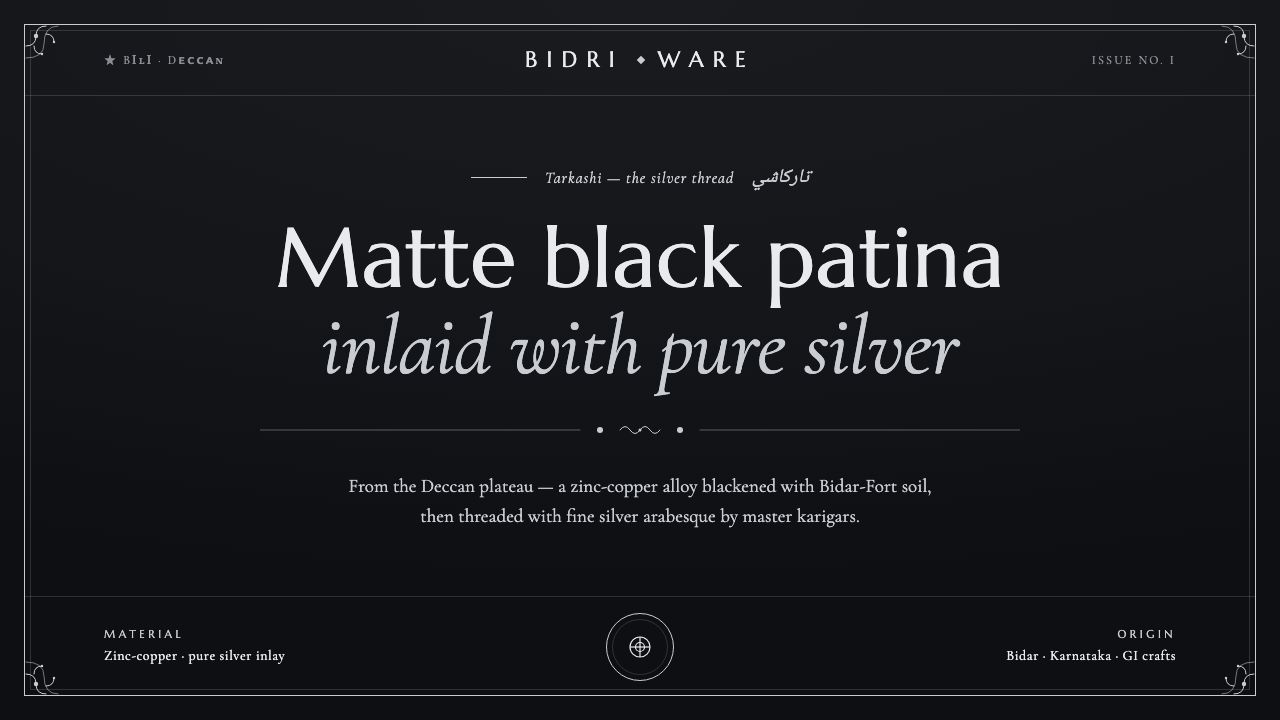 Bidriware Black MetalMonochrome luxury, hammered by hand. Matte-black Deccan patina threaded with…
 Hawaiian Feather Cape (ʻAhu ʻUla)Ceremony has weight. Red feather fields, mamo yellow crescents, black borders.