What is Tibetan Vajrayana Sand Mandala?
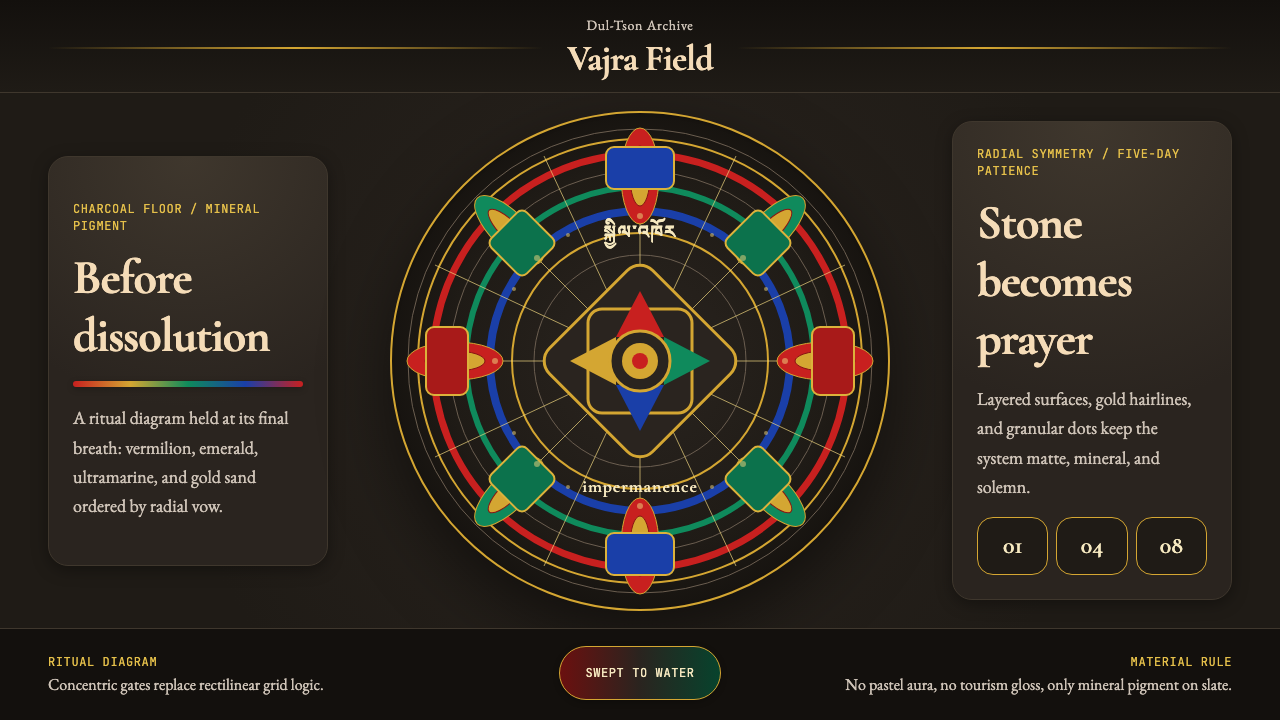
The Tibetan Vajrayana sand mandala is an act of meticulous creation designed to be destroyed — a ritual diagram in colored sand that encodes an entire cosmology, then dissolves into flowing water.
Tibetan Vajrayana Sand Mandala in brief
The dul-tson-kyil-khor, or sand mandala, is a sacred diagram constructed from dyed crushed stone powder laid grain by grain over the course of several days by trained monastic artists. The finished work is a dense field of radial, concentric geometry: nested squares and circles representing the palace of a tantric deity, surrounded by protective rings, petal-like lotus borders, and intricate gateway structures at the cardinal directions. The whole composition unfolds from a single center point outward in a strict mathematical symmetry that governs every color, every proportion, and every directional placement.
What sets this visual tradition apart from other mandala forms is the medium itself. The granular surface of colored sand carries a visible texture unlike any other pigment — light plays across it differently depending on the viewing angle, giving the image a trembling luminosity that flat paint cannot replicate. The palette of vermilion, emerald green, ultramarine, and gold on a deep charcoal ground is not chosen arbitrarily: each color corresponds to a specific directional quadrant, a deity, and a psychological quality in the tantric cosmological map the mandala represents.
The destruction of the completed mandala is as deliberate as its creation. After days of painstaking work, the monks ritually sweep the sand inward, mixing the colors into a single stream of grey, then pour the combined sand into a river. This act is not loss but teaching — the mandala exists as a physical argument about impermanence, and its sweeping is the final instruction. The visual design system that emerges from this tradition captures the moment before dissolution: maximum geometric order poised at the edge of its own undoing.
Where does Tibetan Vajrayana Sand Mandala come from?
The roots of the sand mandala tradition trace to the tantric literature of northern India, where the mandala — derived from the Sanskrit word for circle or sacred enclosure — served as a ritual support for deity visualization practices. When the Indian master Padmasambhava traveled to Tibet in the eighth century at the invitation of King Trisong Detsen, he brought with him the core texts and practices of Vajrayana Buddhism, including the intricate diagrammatic traditions surrounding the mandalas of wrathful and peaceful deities. Tibet's high-altitude monasteries became laboratories for the elaboration and refinement of these systems over subsequent centuries.
The four principal lineages of Tibetan Buddhism — Nyingma, Sakya, Kagyu, and Gelug — each developed their own specialized mandala traditions, associated with particular tantric cycles and empowerment rituals. The Kalachakra mandala, associated with the Wheel of Time teachings and transmitted with particular emphasis by the Gelug tradition, became perhaps the best-known sand mandala in the modern world, partly because the Fourteenth Dalai Lama Tenzin Gyatso has conferred the Kalachakra empowerment in public settings across multiple continents since the 1950s, drawing international audiences who had never previously encountered Tibetan sacred art.
The 1959 Tibetan diaspora created an unexpected preservationist pressure. As Chinese governance of Tibet severely restricted monastic practice on the plateau, communities of Tibetan monks re-established their lineages in India — particularly in Dharamsala, Mundgod, and other settlements — and in Nepal's Kathmandu Valley. The need to demonstrate and transmit these living traditions to international audiences accelerated the tradition of public sand mandala constructions, which became both cultural preservation events and major interfaith encounters. Lama Losang Samten, a monk who had trained in Tibet before 1959 and later settled in the United States, is credited with introducing the public sand mandala construction to American audiences beginning in the late 1980s, bringing the tradition to major museums and universities.
The scholar and artist Robert Beer made the visual codification of Vajrayana iconography accessible to Western practitioners and designers through his illustrated guides to Tibetan Buddhist symbols, published from the 1990s onward. His meticulous documentation of mandala geometry, deity attributes, and the symbolic grammar of the tantric visual language provided a scholarly framework through which the aesthetic system could be studied independently of its ritual context. This documentation work — like the public mandala constructions — was itself a form of diaspora preservation, fixing in accessible form a visual tradition that existed primarily as living monastic transmission.
What defines the Tibetan Vajrayana Sand Mandala look?
Radial and Concentric Geometry
The mandala's entire composition derives from a single center point. Everything radiates outward in precise angular intervals, and every ring or square frame is concentrically nested within those that contain it. The geometry alternates between circular forms — which suggest completeness and cyclic movement — and squared palace structures with defined walls and gateways. This combination of circle and square within a single composition is not decorative but cosmological: it maps the relationship between heaven and earth, boundless space and structured dwelling.
Directional Color Logic
Color in the sand mandala is not chosen for visual harmony in the conventional sense. Each quadrant of the composition corresponds to a cardinal direction, and each direction carries an assigned color: white for the east, yellow for the south, red for the west, green for the north, and blue-black for the center in many traditions. These assignments vary by lineage and by the specific deity whose palace the mandala represents, but the principle is constant — color encodes spatial and theological meaning rather than aesthetic preference. Reading a sand mandala visually means reading a directional map.
Granular Pigment Texture
The use of dyed crushed stone — and historically, precious stones such as lapis lazuli — as the painting medium gives sand mandalas a texture entirely unlike painted or printed surfaces. The granular quality means that edges between color fields are slightly soft, not hard-cut, and that the surface carries a depth and shimmer that changes with the light. When applied at scale in a contemporary design context, evoking this quality means preferring surfaces that carry visible texture or grain, and avoiding the absolute flatness of solid fills. The image breathes rather than sits.
Strict Bilateral Symmetry
Unlike many folk or expressive art traditions that approximate symmetry, the sand mandala demands mathematical precision. Every element on one half of the composition is exactly mirrored on the other. This is achieved through an elaborate preparatory process: monks first draw a precise grid using chalk lines and compass measurements, then lay sand within those invisible structural guides. The resulting symmetry is not a visual preference but a ritual requirement — asymmetry would indicate either error or an incomplete empowerment. Translated into design, this tradition supports compositions where balance is achieved through genuine geometric equivalence rather than approximate visual weight.
Layered Symbolic Density
A completed sand mandala reads at multiple scales simultaneously. At the outermost scale, it is a cosmological diagram mapping the territory of an enlightened realm. At an intermediate scale, it is an architectural plan of a multi-storied palace with distinct rooms, thrones, and approached by four gateways. At the finest scale, individual motifs — lotus petals, vajra thunderbolts, wish-fulfilling jewels, fire borders — each carry their own discrete meanings. The visual system is encyclopedic: the same image functions as map, building plan, icon, and teaching text simultaneously. This layered symbolic density is one reason the imagery translates powerfully into decorative and graphic contexts even when divorced from its original ritual setting.
Impermanence as Structural Principle
Unlike most visual traditions where permanence is the aspiration, the sand mandala is designed from the outset to be destroyed. This is not a practical limitation but a philosophical position made visible: the mandala is the most elaborate, most precisely ordered thing that can be created, and its sweeping demonstrates that even the most perfect order is subject to dissolution. When the visual language of sand mandalas is applied in contemporary design contexts, this principle argues for compositions that feel held at a moment of maximum intensity — where the precision and density of the image implies its own fragility rather than its permanence.
Deep Ground, Luminous Figure
The charcoal or deep-black monastery floor on which sand mandalas are constructed creates a ground of unusual depth. Against this darkness, the vermilion, emerald, ultramarine, and gold of the colored sand appear not simply bright but luminous — as though the image generates its own light from within. This dark-ground approach fundamentally differs from the light-ground traditions of most European painting. The visual logic is reversed: the background is heavy and recessive, the image floats above it, and the relationship between figure and ground creates a quality of sacred emanation rather than illustration.

Who shaped Tibetan Vajrayana Sand Mandala?
The eighth-century Indian tantric master whose journey to Tibet at the invitation of King Trisong Detsen is credited with establishing Vajrayana Buddhism on the Tibetan plateau. Padmasambhava is revered as the transmitter of the tantric texts and practices — including the mandala visualization systems — that would be elaborated over subsequent centuries by the Nyingma and other lineages. His status in the tradition is analogous to a founding architect: the later structures of Tibetan tantric art were built on the doctrinal framework he introduced.
The fourteenth Dalai Lama's decision to transmit the Kalachakra empowerment in large public settings outside Tibet — beginning in the late 1950s and continuing across North America, Europe, Australia, and Asia — brought the sand mandala tradition to unprecedented international visibility. His public empowerments typically included the construction and ceremonial dissolution of a full Kalachakra sand mandala, exposing audiences numbering in the tens of thousands to the visual tradition. This decision transformed what had been largely a monastic practice into a globally recognized cultural and artistic phenomenon.
A Tibetan monk who had trained in the Namgyal Monastery tradition before 1959 and later settled in the United States, Lama Losang Samten is widely credited with introducing the public sand mandala construction to American cultural institutions beginning in the late 1980s. His demonstrations at major museums and universities — typically accompanied by explanations of the symbolic content and the ritual context of destruction — established the template for the public sand mandala events that became common across Western institutions through the 1990s and 2000s. He also trained American students in the construction techniques, helping the tradition take root beyond its monastic origin.
A British scholar and artist who dedicated decades to documenting Tibetan Buddhist iconography, Robert Beer produced illustrated reference works on Vajrayana symbols and mandala structures that made the visual grammar of the tradition accessible to practitioners, artists, and scholars outside the monastic lineage. His methodical diagramming of the compositional rules, color assignments, deity attributes, and symbolic motifs of tantric art created a published record of a tradition that had previously existed primarily as oral and visual transmission within living lineages. His work functions as a visual dictionary for the tantric design system.
Established as the personal monastery of the Dalai Lamas in Lhasa and re-established in Dharamsala after 1959, Namgyal Monastery has served as the primary institutional custodian of the Kalachakra sand mandala tradition in the diaspora. Its monks — trained in the complex procedures for laying out, constructing, and dissolving sand mandalas of multiple tantric cycles — have traveled internationally to construct mandalas at cultural events, universities, and museums across North America, Europe, and Asia. Namgyal is the living institutional source through which the visual tradition is transmitted and verified.
How do you use Tibetan Vajrayana Sand Mandala today?
The sand mandala visual tradition offers a design vocabulary of unusual richness and precision — radial symmetry, directional color coding, layered symbolic density, and granular texture — that translates into contemporary design contexts when handled with understanding of what the system is actually doing. Applying it superficially as an 'Eastern pattern' strips it of the structural intelligence that makes it compelling. The most successful applications preserve the underlying logic: color as directional or hierarchical code, geometry as cosmological map, texture as a quality of depth rather than surface decoration.
For presentation slides, the mandala aesthetic works particularly well in contexts that require the communication of complexity and interconnection. Cover slides can use a centered radial composition against a deep charcoal or near-black ground, with the title emerging from or positioned above the center point — the visual logic of the mandala suggests that everything in the presentation radiates from and returns to a single central idea. Content slides benefit from the tradition's layered approach to information: concentric rings of information, with the most essential at the center and elaborations arranged in outer zones. Color can be used directionally — assigning one warm tone to one category of information and a cool tone to another — following the mandala's quadrant logic rather than using color decoratively.
For web interfaces, the mandala's deep-ground luminosity translates into dark-mode dashboards and data visualization environments where the visual challenge is making complex information readable without visual fatigue. The principle of a rich, textured dark background against which colored elements appear to emit light is directly applicable to charts, maps, and network diagrams where multiple data categories need clear visual differentiation. The directional color logic — assigning specific hues to specific categories with strict consistency — is particularly valuable in dashboard contexts where users must scan and distinguish rapidly. Pricing pages can draw on the layered ring structure: a center tier positioned as the cosmological center, with outer tiers radiating outward, each distinguished by one of the tradition's characteristic colors.
For editorial and marketing work, the tradition's most powerful contribution is its approach to visual weight and sacred geometry. An editorial layout that places a single mandala-derived radial motif at the center of a spread, then builds text and other elements in concentric relationship to that center, generates a sense of intentionality and cosmic order that no grid-based layout quite matches. Marketing work can use the deep-ground/luminous-figure logic at a large scale: a near-black or charcoal background with a single rich color area that appears to glow against the darkness creates immediate visual authority. The granular texture quality — when translated into paper stock or digital grain overlay — adds depth and visual interest that distinguishes the work from the absolute flatness of most contemporary digital design.
A common mistake when drawing on this tradition is reducing it to its most recognizable visual element — the circular mandala shape — and treating it as a decorative motif applied to an otherwise unrelated layout. This produces a result that looks Eastern-inflected but lacks the structural coherence that makes the tradition's visual intelligence compelling. A more effective approach uses the underlying principles — radial organization, directional color logic, layered density, deep ground — without necessarily reproducing the circular mandala form explicitly. The tradition's visual power comes from its structural discipline, not its recognizable silhouette.

Tibetan Vajrayana Sand Mandala — FAQ
What is the difference between a sand mandala and other mandala traditions?
The sand mandala is one specific form within a broader mandala tradition that includes painted thangkas, three-dimensional architectural models, and body-based visualizations practiced in meditation. What distinguishes the sand mandala is the medium and the destruction: the use of granular stone pigment allows an extraordinary level of fine detail and color richness, while the ceremonial sweeping of the completed work is a doctrinal statement about impermanence that is absent from painted or architectural mandala forms. The sand mandala is also typically larger than a painted mandala — often constructed on a platform several feet across — which gives it a physical presence that changes the viewer's relationship to the image.
How long does it take to construct a sand mandala, and how many monks are involved?
A full Kalachakra sand mandala typically takes four to five days of concentrated work by a team of four to eight trained monks, though particularly elaborate mandalas may require longer. The process begins with the consecration of the ground, followed by the chalk-line measurement and drawing of the geometric grid, and then the meticulous application of sand using metal funnels called chak-pur, which are rubbed against each other to create a controlled vibration that releases the sand in fine streams. Each session typically lasts several hours. The construction follows a strict inward-to-outward sequence determined by the ritual text, and each section must be completed correctly before the next can begin.
Can the sand mandala visual aesthetic be used in secular or commercial contexts without cultural appropriation concerns?
The question deserves careful consideration. The sand mandala is a living sacred tradition embedded in a specific religious lineage, not an orphaned historical artifact, and using its visual elements requires a degree of awareness about context and intent. Drawing on the underlying structural principles — radial geometry, directional color logic, layered density, deep-ground luminosity — in design work is generally less fraught than directly reproducing recognizable tantric iconography such as specific deity images, vajra symbols, or seed syllables in contexts with no relationship to the tradition. Aesthetic inheritance is legitimate and unavoidable in design; what distinguishes sensitive application from appropriation is usually transparency about the source, genuine engagement with the tradition's structural logic rather than surface lifting, and avoiding the reduction of sacred imagery to purely decorative functions.
Is this style better suited to dark-background or light-background applications?
The tradition is fundamentally a dark-ground aesthetic: the deep charcoal monastery floor is not incidental but structural — it is what makes the colored sand appear luminous rather than merely bright. A light-background application of sand mandala-inspired design loses the most distinctive quality of the tradition, which is the sense that the image generates light from within. That said, individual elements from the tradition — particularly the radial geometric forms and the directional color logic — can be adapted to light backgrounds when the application requires it, typically by converting the deep-ground approach to a white ground and adjusting the color palette to work in reflection rather than emission. The result will feel more decorative and less cosmological, but the underlying geometry can still carry the tradition's structural intelligence.
How does this tradition relate to other geometric sacred art traditions, such as Islamic geometric patterns or Hindu yantras?
These traditions share a deep structural affinity — all use geometric precision as a vehicle for the sacred, and all ground their visual systems in cosmological rather than purely aesthetic reasoning. The key distinction lies in compositional logic: Islamic geometric patterns are typically based on infinite tiling that could extend in any direction, with no privileged center; the Hindu yantra and Tibetan mandala both use radial symmetry emanating from a center point, but the yantra is typically simpler, using fewer concentric zones and a smaller set of geometric elements. The sand mandala is the most elaborate of these center-outward traditions, combining architectural representation with symbolic color coding and multiple scales of meaning simultaneously. Designers working across these traditions will find that their structural intelligences are complementary rather than interchangeable — each creates a different relationship between viewer, center, and edge.
Related design styles
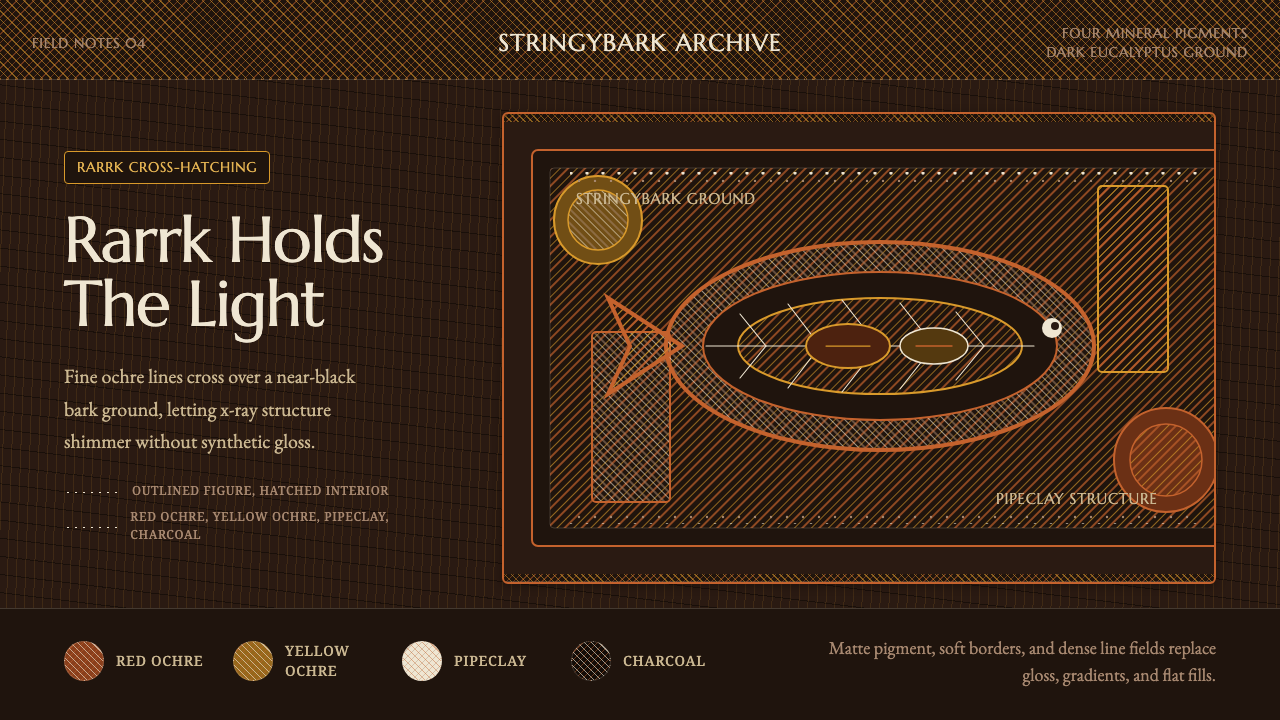 Arnhem X-Ray Bark PaintingShimmers without gloss. Ochre rarrk lines vibrate on dark stringybark.
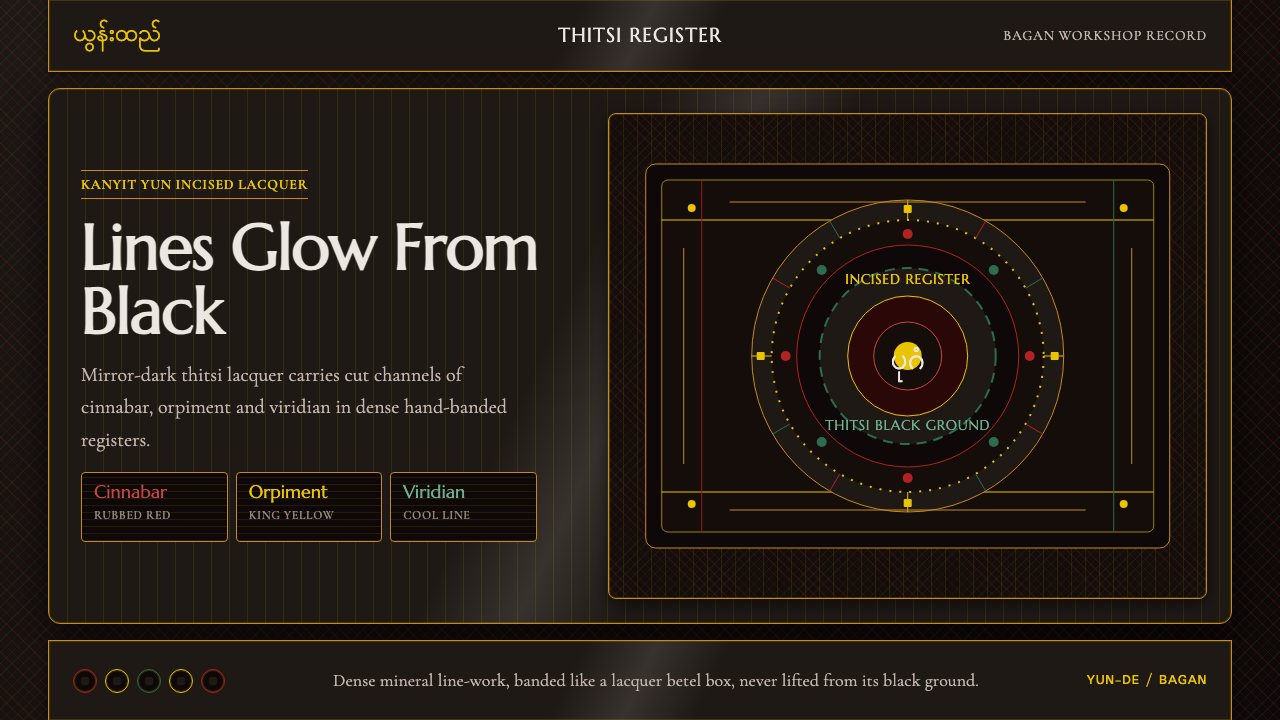 Burmese Yun LacquerwareLacquer glows in cut lines. Cinnabar, orpiment and viridian band a mirror-bla…
 Grimm Fairy Tales (Black Forest Woodcut)The dark wood closes in. Bone-white cuts and aged-gold frames score a pine-bl…
 Macedonian Ohrid Fresco (Byzantine)Sacred darkness breathes. Tarnished gold rings, cinnabar folds, and plaster g…
 Malagan CarvingCarved for the dead feast. Ochre, lime and charcoal pierced into dark wood, e…
 Newar Tundal Strut CarvingCenturies-darkened sal-wood. Carved deities and pierced lattice in mid-brown…