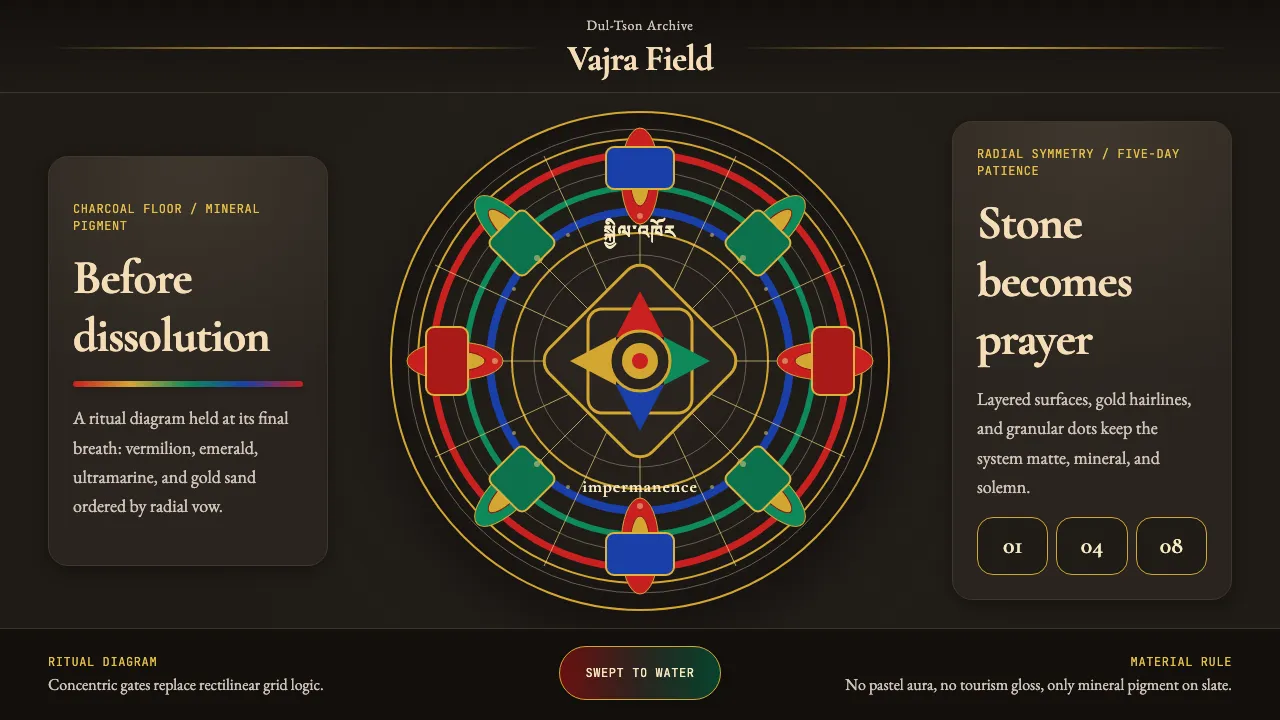
About Tibetan Vajrayana Sand Mandala
The dul-tson-kyil-khor sand mandala is a ritual diagram constructed over days in dyed crushed-stone powder, then ceremonially swept into flowing water. This design system captures the moment before dissolution — radial concentric geometry rendered in vermilion, emerald, ultramarine, and gold on a charcoal monastery-floor ground.
Drawing from eight centuries of tantric diagrammatic tradition codified across the Nyingma, Sakya, Kagyu, and Gelug lineages, the visual language honors bilateral and radial symmetry, granular sand-pigment texture, and the theological weight of impermanence made visible.
- Origin
- Tibet (U-Tsang, Kham), Dharamsala, Mundgod, Kathmandu
- Era
- 8th-c. Indian tantric origin via Padmasambhava; formalized 11th–17th c. Tibetan lineages; contemporary diaspora tradition 1959–present
- Key figures
- Padmasambhava · Tenzin Gyatso (14th Dalai Lama) · Lama Losang Samten · Robert Beer
- Movements
- Vajrayana Buddhism · Kalachakra empowerment tradition · Tibetan diaspora preservation movement
Tibetan Vajrayana Sand Mandala design spec
Colors
Typography
The other 11 sections — buttons, cards, spacing, motion, techniques and more — open once you unlock. Download the DESIGN.md or send it to your AI in one click. Unlock once, yours forever.
Sign up nowStyles similar to Tibetan Vajrayana Sand Mandala
Also inspired by crafts & folk art, with a close feel.
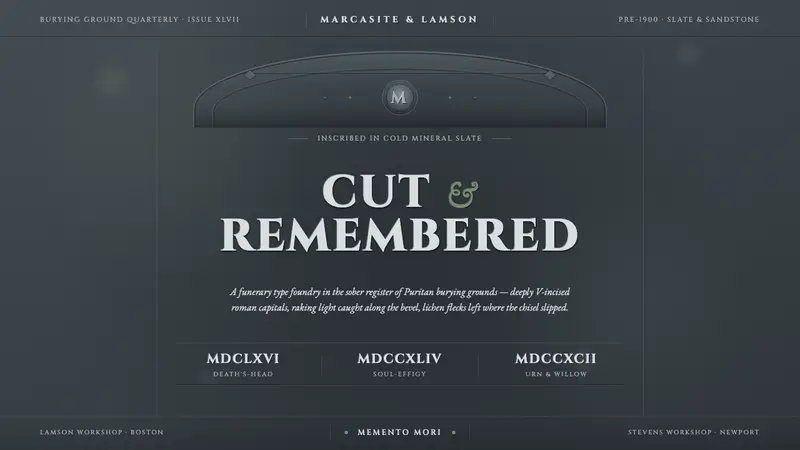 Slate Headstone LettercuttingCold mineral, never paper. V-cut roman capitals catch a thin bevel highlight on dark slate stone.
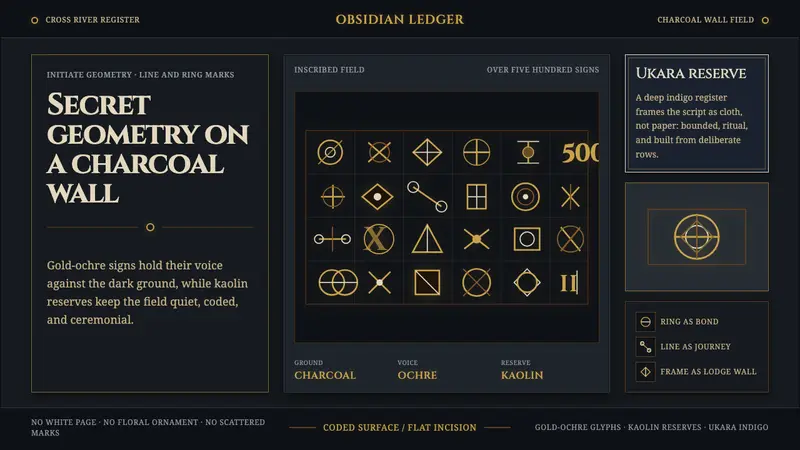 Nsibidi Script Cross RiverSecrecy glows in ochre. Ring-line glyphs sit on charcoal with kaolin and indigo reserves.
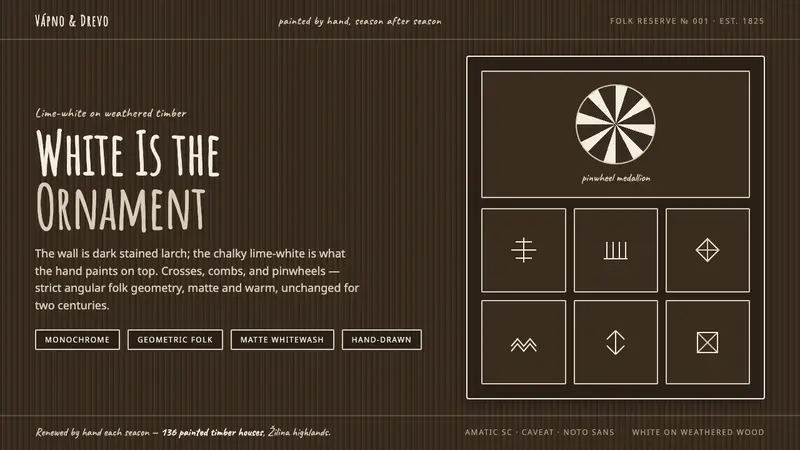 Čičmany Painted House OrnamentWhite is the ornament, not the page. Lime-white folk geometry on dark weathered Slovak timber.
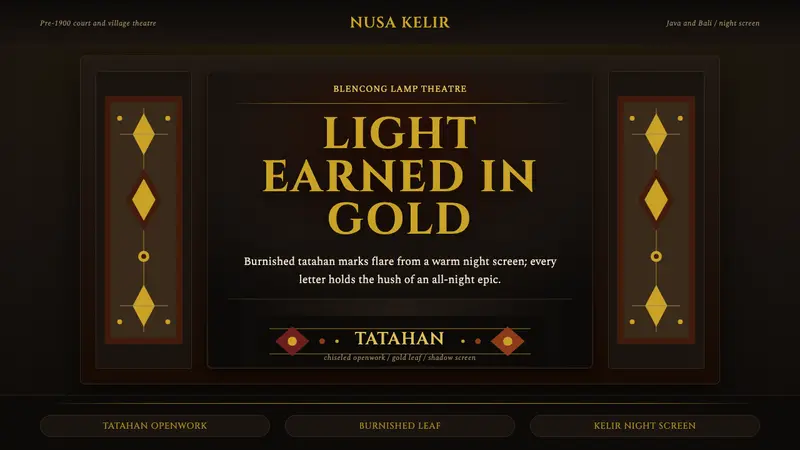 Wayang Kulit ShadowNight makes gold sacred. Cinzel capitals and perforated ochre frames glow like lamp-cut hide.