What is Tibetan Prayer Flag Modern Rainbow?
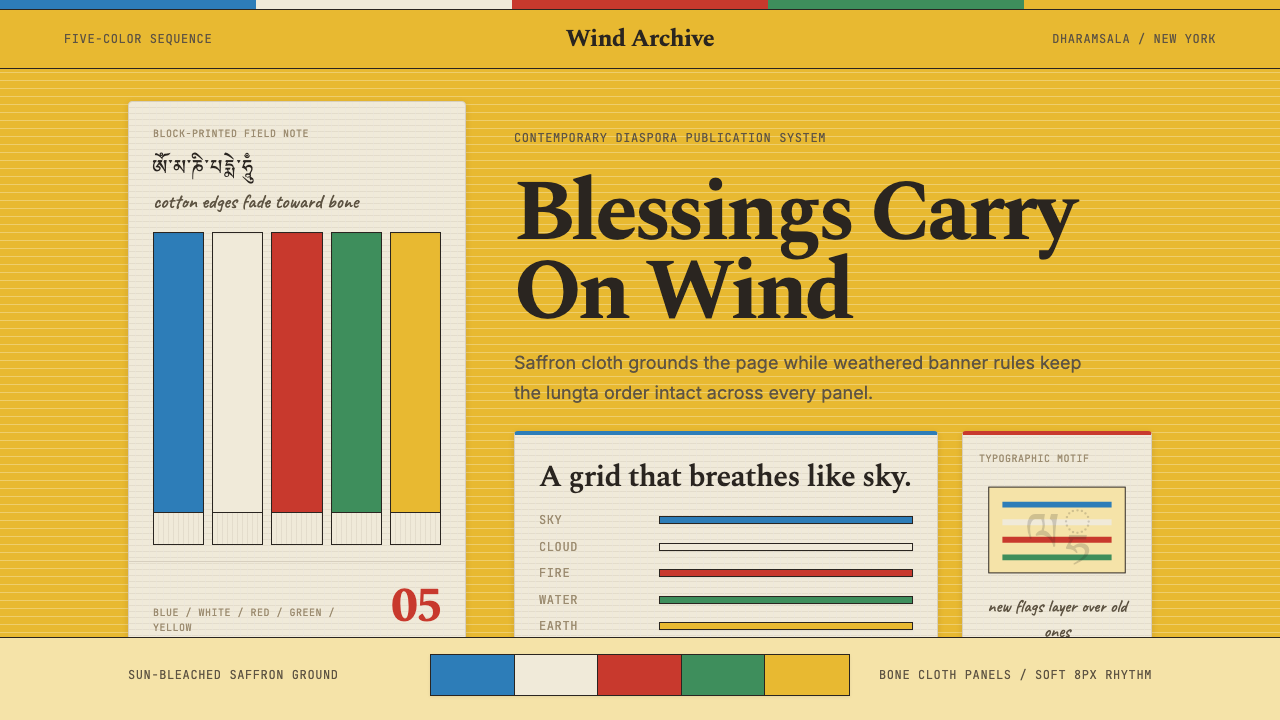
Tibetan Prayer Flag Modern Rainbow translates a five-century-old sacred color sequence — blue, white, red, green, yellow — from mountain wind and woven cotton into the screen-based design language of the Himalayan diaspora.
Tibetan Prayer Flag Modern Rainbow in brief
Tibetan Prayer Flag Modern Rainbow is a contemporary design system rooted in the visual tradition of lungta, the wind-horse flags that have hung across Himalayan mountain passes, monastery courtyards, and rooftops since at least the fifteenth century. The system preserves the five-color sequence — blue for sky and space, white for air and wind, red for fire, green for water, and yellow for earth — as a fixed, non-negotiable structural logic. Where the original cloth flags fade, layer, and fray in wind and sun, the modern interpretation translates this weathered quality into a digital aesthetic defined by warmth, texture, and intentional imperfection.
The style emerged not from Lhasa itself but from diaspora studios — design collectives and independent practitioners working in Dharamsala, Kathmandu, Boulder, and New York, who needed a visual language capable of carrying Tibetan cultural identity into print publications, nonprofit websites, and contemporary art books without resorting to flat ethnic pastiche. The result is a design register that feels both ancient and immediately legible: it respects the sacred origin of its color system while deploying it with contemporary compositional rigor.
What distinguishes this system from generic world-culture eclecticism is its structural constraint. The five colors do not appear in random combination or as decorative accent. They appear in the fixed lungta sequence, in horizontal banner strips, in typographic rules, and in proportions that reference the physical dimensions of printed prayer flag cloth. Saffron yellow — the color of a monk's robe in October sunlight — anchors the page as a ground, while the other four colors appear above it as ordered layers of meaning rather than decorative flourishes.
Where does Tibetan Prayer Flag Modern Rainbow come from?
The prayer flag tradition in Tibet traces to the intersection of two older systems: the pre-Buddhist Bon religion's use of colored cloth as elemental markers, and the later integration of Buddhist mantras into the woven fabric itself. By the time the Tibetan Buddhist tradition had consolidated its visual conventions in the fifteenth and sixteenth centuries, the five-color sequence and the lung-ta iconography — a horse bearing a wish-fulfilling jewel — had become standardized across the Himalayan region, spreading through religious exchange networks that connected Lhasa, Kathmandu, Ladakh, and Bhutan. The flags were never purely ornamental: each color corresponded to an element and a direction, and the wind that passed through the flags was understood to carry the printed mantras outward as an act of prayer without requiring active recitation.
The transition from sacred object to design system began after 1959, when the Chinese government's consolidation of control over Tibet sent the fourteenth Dalai Lama and tens of thousands of Tibetan refugees into exile, settling primarily in Dharamsala in the Indian state of Himachal Pradesh. The diaspora's urgent task of cultural preservation — documenting texts, training practitioners, establishing institutions — required printed materials, and the designers who produced those materials needed to establish a Tibetan visual identity that was legible to both the diaspora community and an international audience. The five-color system, already universally recognized as Tibetan, became the natural foundation.
From the 1990s onward, a generation of Tibetan artists working between traditional training and contemporary art education began codifying the visual possibilities of this inheritance. Gonkar Gyatso, born in Lhasa and educated at the Central Tibetan University of Nationalities before moving to London and then New York, developed a body of work that placed traditional Tibetan iconography in dialogue with street culture, consumer imagery, and Western abstraction. Tsherin Sherpa, trained in classical thangka painting in Kathmandu before settling in Oakland, California, pursued a parallel trajectory — using the conventions of sacred art as raw material for paintings that interrogate Tibetan identity in exile. Tenzing Rigdol, also trained in thangka and later at the University of Colorado Boulder, brought this sensibility explicitly into installation and performance work that traveled the flag's physical form to new contexts.
The design codification came partly through publication work — the volumes produced by Snow Lion Publications in Boulder, Colorado from the 1980s onward, which served the English-language Buddhist publication market, gave a generation of cover designers and art directors sustained practice in adapting Tibetan visual conventions for Western print reproduction. The Mechak Center for Contemporary Tibetan Art, established in Dharamsala, provided institutional support for practitioners navigating between traditional forms and contemporary media. By the time digital design became dominant in the early 2000s, a sufficiently stable visual vocabulary had formed: the fixed color sequence, the cotton-weave texture reference, the horizontal band structure, and the generous breathing space that echoed the vast sky margin of Himalayan landscape.
What defines the Tibetan Prayer Flag Modern Rainbow look?
Color Sequence
The five colors appear in a fixed, non-negotiable order — blue, white, red, green, yellow — derived directly from the lungta tradition's elemental correspondence. This sequence is never shuffled or reassigned for aesthetic preference. Blue occupies the position of sky and expansiveness; white carries the quality of clarity and breath; red is warmth and fire; green is flowing vitality; yellow is the ground and earth. When used in horizontal bands, the sequence runs from top to bottom or left to right, mirroring the physical arrangement of prayer flags strung along a line. The saffron-yellow ground, which appears on the dominant page field, is warm and slightly burnished — closer to the robe of a monk in afternoon light than to a sharp primary.
Texture and Weathering
One of the most distinctive qualities of this design system is its embrace of impermanence as an aesthetic value. Cotton-weave texture references are woven into background fields, not as photographic simulation but as structural pattern — a regularity that implies the physical artifact without reproducing it literally. Color fields are not flat and uniform but carry subtle variation, as if the dye has been absorbed unevenly into cloth fibers. Edges fade toward bone or pale ground rather than terminating cleanly. This quality of weathered softness is not accidental; it is the system's most direct translation of the Buddhist concept of impermanence into visual form.
Horizontal Band Structure
Layout organization follows the physical logic of flags strung horizontally: content is organized in layered horizontal registers rather than vertical columns. A typical composition places the dominant information field — headline, main content — against the saffron ground, with the remaining four colors appearing as narrower decorative and structural bands above or below. These bands function simultaneously as color markers, section dividers, and typographic baselines. Their width is not arbitrary: they reference the proportions of actual printed prayer flag cloth, typically square or nearly square, creating a rhythm across the page that carries a sense of repeated devotional gesture.
Typographic Sky-Margin
Type is treated with exceptional generosity of surrounding space — what practitioners in this tradition call sky-margin. This is not simply generous leading or padding in the conventional sense; it is a deliberate compositional principle that the text must breathe, that the space around words carries as much meaning as the words themselves. This quality reflects the visual experience of Tibetan landscape: the vast open sky above every mountain pass, the way a single monastery appears almost weightless against a vast panorama. In practical terms it means heading-level type appears in isolation, with no crowding from adjacent elements, and body text is set at a reading measure that leaves substantial open field on at least one side.
Mantra Rules and Typographic Lines
Thin horizontal rules appear throughout this design system as structural elements that reference the printed mantra lines on physical prayer flags. These rules are not merely decorative dividers; they carry a residual sense of the repeated sacred text that fills every inch of printed flag cloth. In contemporary application they function as column dividers, section separators, and caption baselines. They are always horizontal — never diagonal or curved — and they run full-width or to a consistent margin stop rather than floating freely. Their weight is delicate relative to the warmth of the color fields around them, which gives them the quality of text rendered too small to read rather than a conventional graphic element.
Warmth Over Precision
Unlike design systems that prize mathematical exactness and mechanical uniformity, this system deliberately tilts toward warmth, organic variation, and hand-made quality. The color palette carries the warmth of natural dyes — ochre rather than saturated yellow, indigo rather than electric blue, a red that reads closer to iron oxide than fire-engine. Illustration, when it appears, draws on the icon conventions of thangka painting — layered, symbolic, non-perspectival — rather than flat vector minimalism or photographic realism. Even spacing and alignment carry a slight tolerance for variation that signals handcraft rather than digital precision. The overall impression is one of intention rather than automation.
Impermanence as Aesthetic
The theology of the original prayer flag tradition — that the flag's power increases as it fades and frays, carrying its mantras outward on the wind — informs a design philosophy that finds beauty in age, wear, and transition rather than pristine newness. This distinguishes the system from both Western minimalism, which prizes pristine geometric precision, and from traditional folk aesthetics that rely on vivid saturated color for their energy. The Tibetan system's saturation is intentionally muted, its textures intentionally imperfect, and its overall mood intentionally contemplative rather than energetic. This is a design language suited to the long view.

Who shaped Tibetan Prayer Flag Modern Rainbow?
Born in Lhasa in 1961, Gonkar Gyatso received classical training at the Central Tibetan University of Nationalities in Beijing before pursuing contemporary art studies in London and later settling in New York. His paintings place traditional Tibetan iconography — mandalas, thangka conventions, sacred color systems — in direct conversation with consumer advertising imagery, street sticker culture, and Western abstraction. He is among the first Tibetan artists to systematically explore what diaspora identity means for a visual tradition, and his work has established a critical framework for understanding how the five-color system can carry secular and sacred meaning simultaneously in contemporary contexts.
Tsherin Sherpa was born in Nepal in 1968 and trained in classical thangka painting under his father, a master thangka artist, in Kathmandu. After moving to Oakland, California in 1998, he developed a body of work that treats thangka conventions — layered iconographic figures, jewel-toned palette ranges, the fixed spatial grammar of sacred composition — as raw material for paintings that interrogate identity, trauma, and cultural survival. His work has been exhibited at major international institutions and has helped bring Himalayan visual traditions into the discourse of contemporary art without reducing them to ethnographic curiosity.
Tenzing Rigdol trained in classical thangka painting in Kathmandu before completing an MFA at the University of Colorado Boulder. His installation and performance works engage directly with the physical form of the prayer flag as a vehicle of collective memory and political witness. His most celebrated project, Our Land Our People (2011), involved secretly bringing twenty thousand kilograms of Tibetan soil to Dharamsala so that exiled Tibetans could stand on their native ground for the first time in decades — an act that used material, color, and sacred geography in ways that directly parallel the prayer flag tradition's relationship between physical object and immaterial longing.
Robert Beer is a British scholar and artist who spent decades in Kathmandu documenting and hand-drawing the complete iconographic vocabulary of Tibetan Buddhist art. His reference works — particularly The Handbook of Tibetan Buddhist Symbols — have become foundational resources for designers and practitioners working with Tibetan visual traditions outside of Tibet. Beer's contribution to the modern design system is indirect but significant: by providing the first comprehensive English-language visual glossary of Tibetan iconography, he enabled a generation of diaspora designers to work with precision and cultural accountability rather than approximate borrowing.
The Mechak Center, established in Dharamsala in the 2000s, has been the primary institutional space for artists navigating the intersection of traditional Tibetan visual forms and contemporary media. Its workshops, residencies, and publications have supported practitioners working across painting, printmaking, digital media, and textile art. As an institution, it represents the organized effort of the Tibetan diaspora to maintain a living, evolving visual tradition rather than a frozen ethnographic exhibit — ensuring that the prayer flag's color logic and compositional values continue to develop in dialogue with contemporary design practice.
How do you use Tibetan Prayer Flag Modern Rainbow today?
Tibetan Prayer Flag Modern Rainbow is a style built for contexts where warmth, cultural depth, and contemplative quality are the desired emotional register. Its application requires understanding the structural logic beneath the surface warmth — the fixed color sequence, the horizontal banding system, and the principle that sky-margin is not empty space but load-bearing breathing room. Applied correctly, the style produces work that feels rooted and considered; applied carelessly, it produces visual kitsch that borrows surface markers without honoring their structural origin.
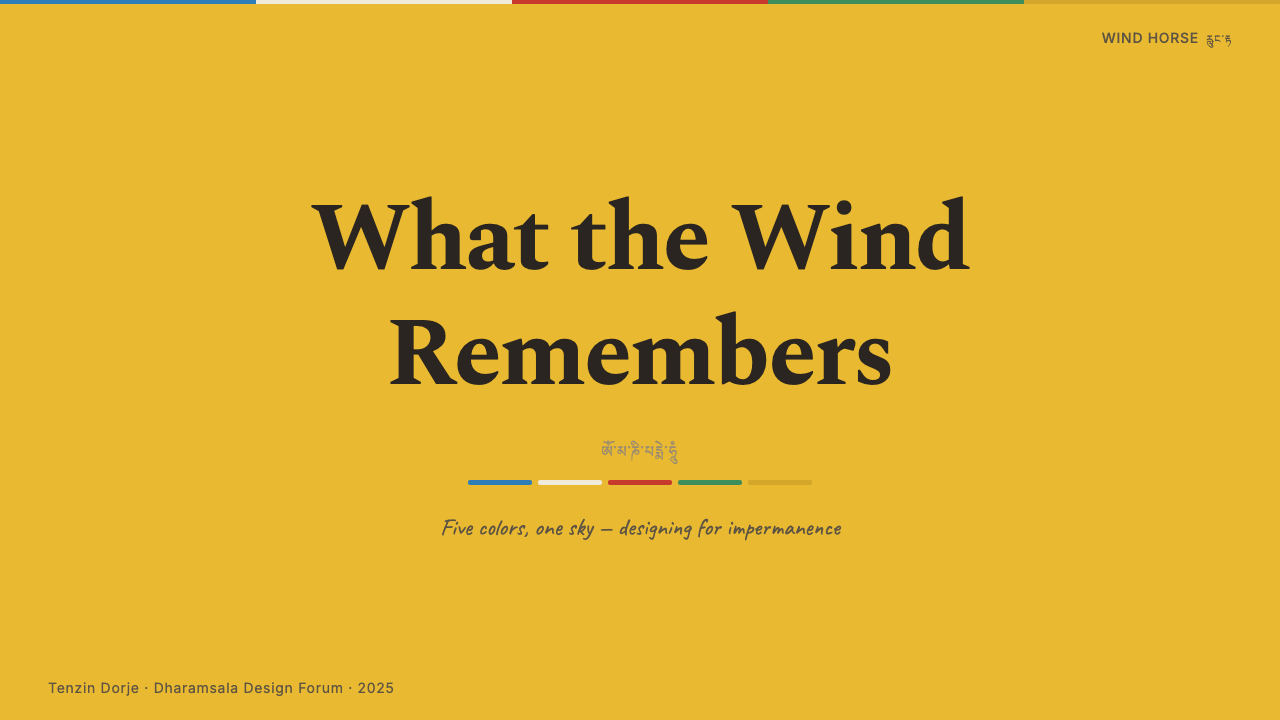
For presentation slides, this style works exceptionally well for opening covers and transitional section breaks. A cover built in this system uses the saffron ground as the primary field, with the title positioned with generous space above and below, and a set of five colored bands running either horizontally across the top or bottom edge. Content slides use the banding structure to organize visual hierarchy: each section of a talk or report can carry a distinct band color drawn from the five-color sequence, creating a navigational system that is both visually warm and structurally legible. Data slides benefit from the style's tolerance for imperfection: charts and diagrams appear as warm-toned visual objects against the saffron field, avoiding the cold precision of technical graphing conventions.
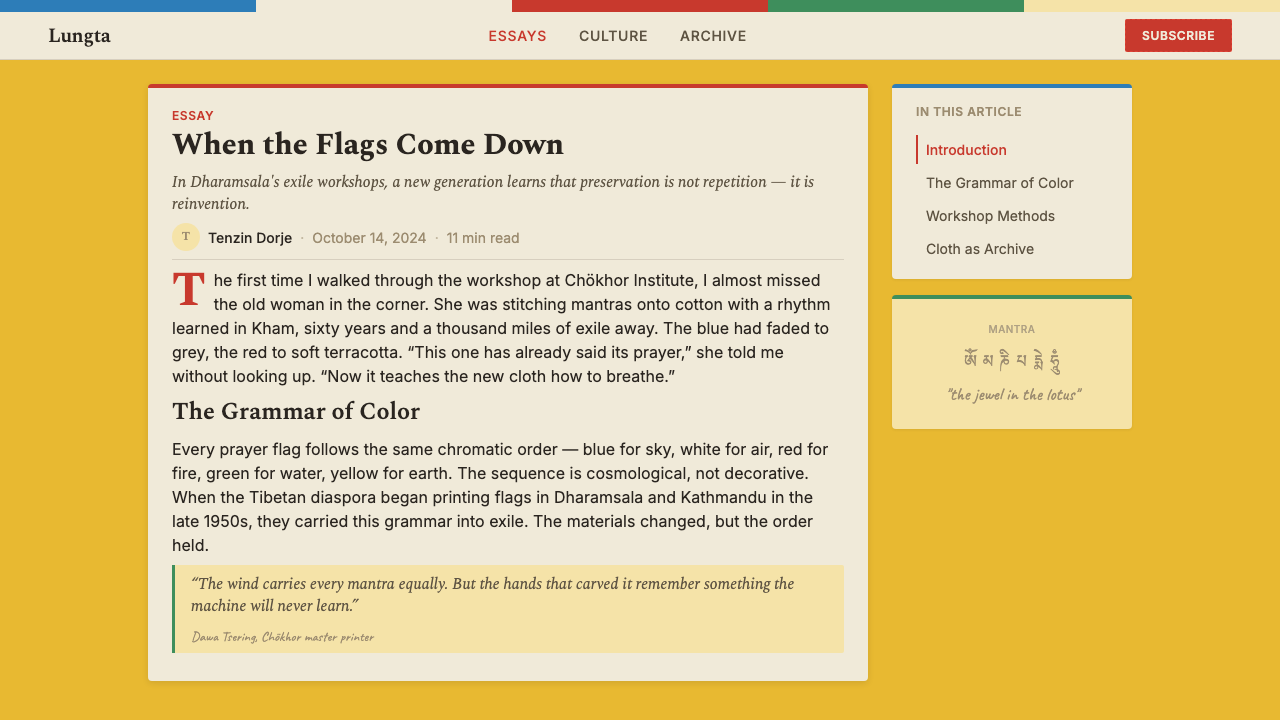
For web interfaces, the style is best suited to nonprofit and cultural organization sites, editorial platforms, and any context where the content itself carries meditative or reflective value — wellness applications, learning platforms, personal publishing tools. The approach: establish the saffron ground as the dominant tone, use the five-color bands as navigational color-coding for major sections, and maintain the sky-margin principle throughout by resisting the temptation to pack content tightly. Cards and modules should use shadow rather than hard borders, with slight texture variation in their backgrounds to reference the cotton-weave quality. Navigation should be text-led, with color as secondary orientation signal rather than primary identifier.
For editorial and marketing materials, the style supports layouts with strong cultural personality. An article layout draws the five-color sequence into typographic rules between sections, uses the saffron ground as a pull-quote background, and reserves ample margin space for photography or illustration treated with the subdued, slightly faded quality of weathered material. Marketing pages benefit from the style's poster sensibility: large type on saffron ground, the five-color bands organizing the flow of feature blocks, and a general restraint on animation and visual noise that reinforces the contemplative quality. This is not a style suited to urgency or aggressive calls to action; it rewards patience.
A common mistake when working with this style is treating the five colors as interchangeable or reordering them for aesthetic preference. The sequence has a fixed cultural meaning, and breaking it produces compositions that look merely colorful rather than culturally grounded. Another error is pushing the saturation of the five colors too high — the warmth of this style comes from the muted, slightly desaturated quality of natural dyes, not from electric or fully saturated primaries. A third mistake is eliminating the texture references in favor of flat uniformity — without the cotton-weave quality, the saffron ground becomes simply yellow, and the system loses its most distinctive emotional characteristic.
Tibetan Prayer Flag Modern Rainbow — FAQ
Is it culturally appropriate to use this style for non-Tibetan commercial products?
This is the central question for any designer approaching this system. The answer depends on how the style is applied. Using the five-color sequence in its correct order, maintaining the structural principles of the system, and treating the tradition as a coherent visual language rather than a decorative texture — these are the markers of respectful engagement. Problems arise when the sacred color sequence is randomized, when Buddhist iconography is used as surface ornament without structural purpose, or when the commercial application directly contradicts the values the tradition embeds. A wellness brand, a cultural institution, or a nonprofit working in the Himalayan region can apply this style authentically. A fast-food brand or a gambling product is a different matter entirely. The system rewards awareness and punishes carelessness.
How does this style handle dark backgrounds?
The authentic ground for this system is warm and light — saffron yellow, bone white, or the pale dusty quality of aged cotton. A dark background inversion is possible but structurally challenging. On a dark ground, the five-color sequence loses its elemental hierarchy — the sky-blue that reads as expansive and airy on a warm ground becomes merely a color chip on dark. If a dark variant is needed, the most coherent approach commits to deep indigo or near-black as the ground and uses the saffron yellow as the primary foreground element, with the other four colors appearing only as structural band markers. The cotton-weave texture reference is harder to maintain on dark grounds and often reads as noise rather than warmth — use it sparingly or replace it with a very subtle woven pattern at lower contrast.
How does this style relate to other Buddhist-influenced design traditions?
Tibetan Prayer Flag Modern Rainbow is distinct from other Buddhist-influenced design traditions in several important ways. Japanese Zen-derived aesthetics — wabi-sabi, the use of negative space, the beauty of imperfection — share some surface similarities but are structurally different: the Tibetan system is chromatically rich and ceremonially colorful, where Zen aesthetics lean toward neutrality and restraint. Thai and Southeast Asian Buddhist design traditions tend toward golden richness and ornamental density that is almost opposite to the structural austerity of the lungta system. The closest relative is perhaps Bhutanese festival design, which shares the five-color tradition, but Bhutanese visual conventions are generally more ornamental and figurative. The Tibetan diaspora system's particular contribution is combining sacred color structure with contemporary compositional clarity in a way that no other Buddhist tradition has fully codified.
Can this style work for digital product interfaces like dashboards or SaaS tools?
It can, but with significant structural adjustments. The style's strength — warmth, texture, contemplative spacing — is also its challenge in high-density functional interfaces where information compression and rapid scanning are primary requirements. A dashboard in this style would need to use the five-color sequence as a semantic coding system for data categories, maintain the saffron ground in a modular rather than full-page way, and substantially reduce the texture references to prevent visual noise in dense data displays. The sky-margin principle, which demands generous breathing space, works against the information density typical of dashboards. The most successful applications would be in interfaces with a meditative purpose — journaling tools, reflection apps, mindfulness products — where the contemplative quality is a feature rather than an obstacle.
What makes this style different from generic world-music or global-culture visual eclecticism?
The distinction is structural rather than stylistic. Generic global eclecticism borrows surface markers — ethnic patterns, bright regional colors, folk motifs — and deploys them decoratively without regard to the internal logic of the source tradition. The result is visually busy, culturally interchangeable, and structurally arbitrary. Tibetan Prayer Flag Modern Rainbow, when applied correctly, is the opposite: every visual decision derives from the internal logic of the lungta tradition. The color sequence is fixed because it has elemental meaning, not because it looks attractive. The horizontal band structure references the physical string arrangement of actual flags, not a generic decorative border. The texture references weathered cotton, not a generic ethnic pattern. The sky-margin principle reflects Himalayan spatial experience, not a fashionable design trend. A correctly applied system produces work that could only be this tradition; a generic eclecticism could be from anywhere.
Related design styles
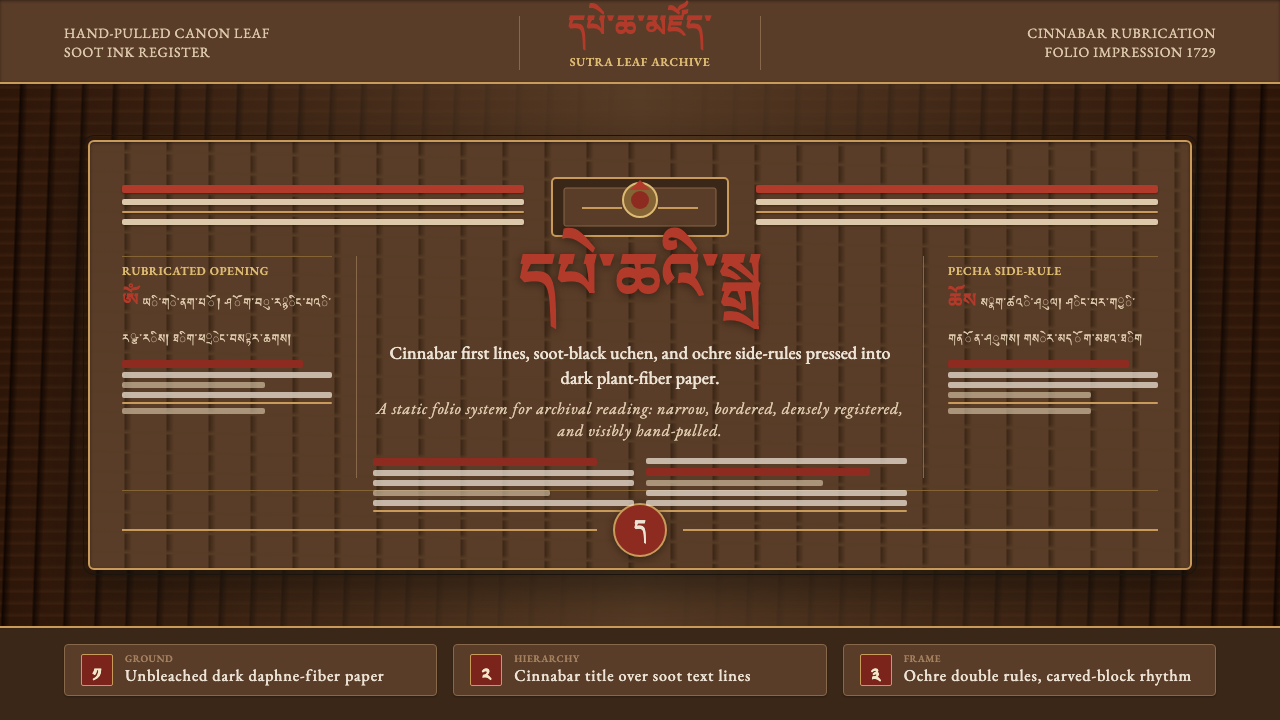 Derge Woodblock Sutra PrintHand-pulled scripture gravity. Cinnabar uchen and ochre rules press into dark…
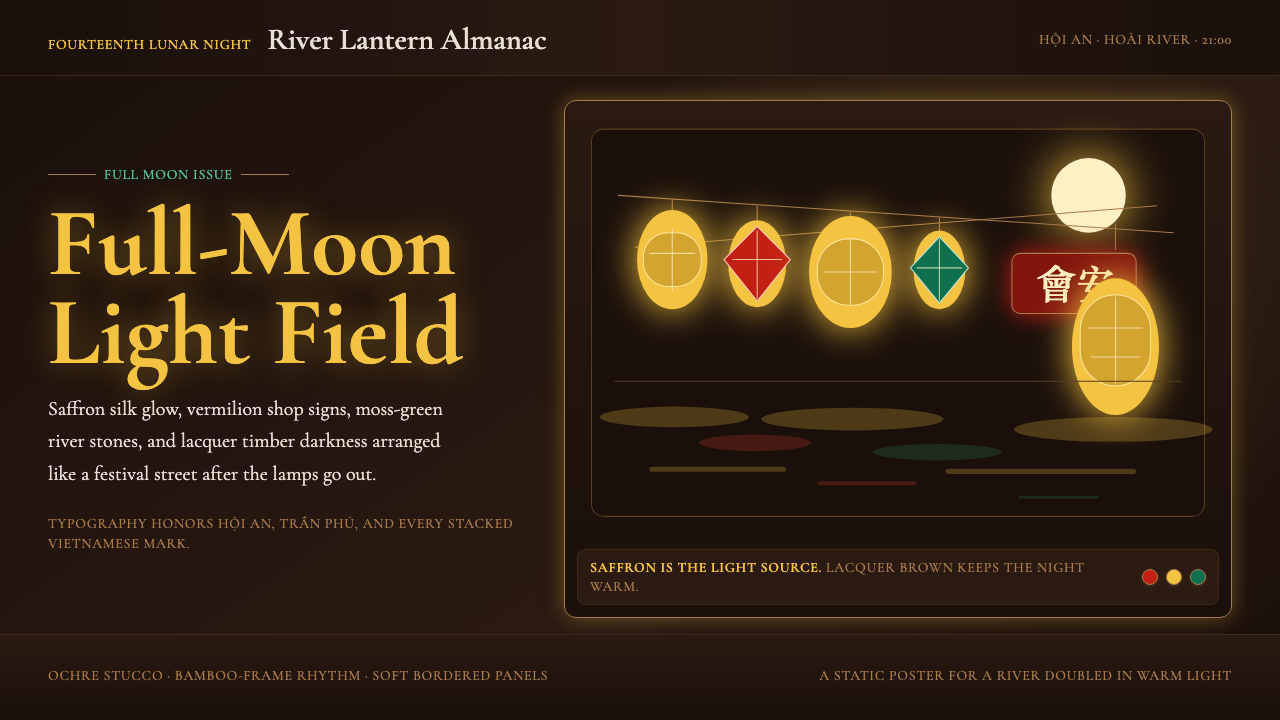 Hoi An Lantern YellowGlows after dark. Saffron serif type, lacquer black, and geometric lantern fr…
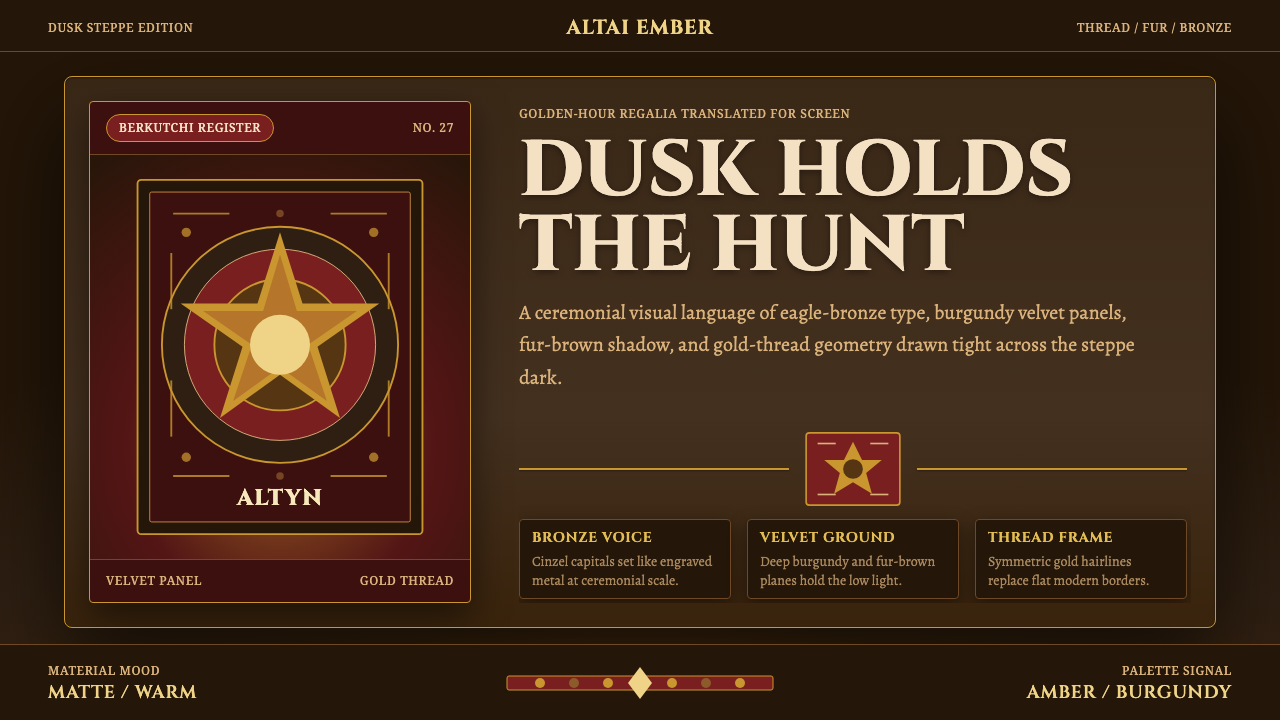 Kazakh Eagle HunterGolden hour feels handmade. Burgundy velvet, bronze type, and gold-thread bor…
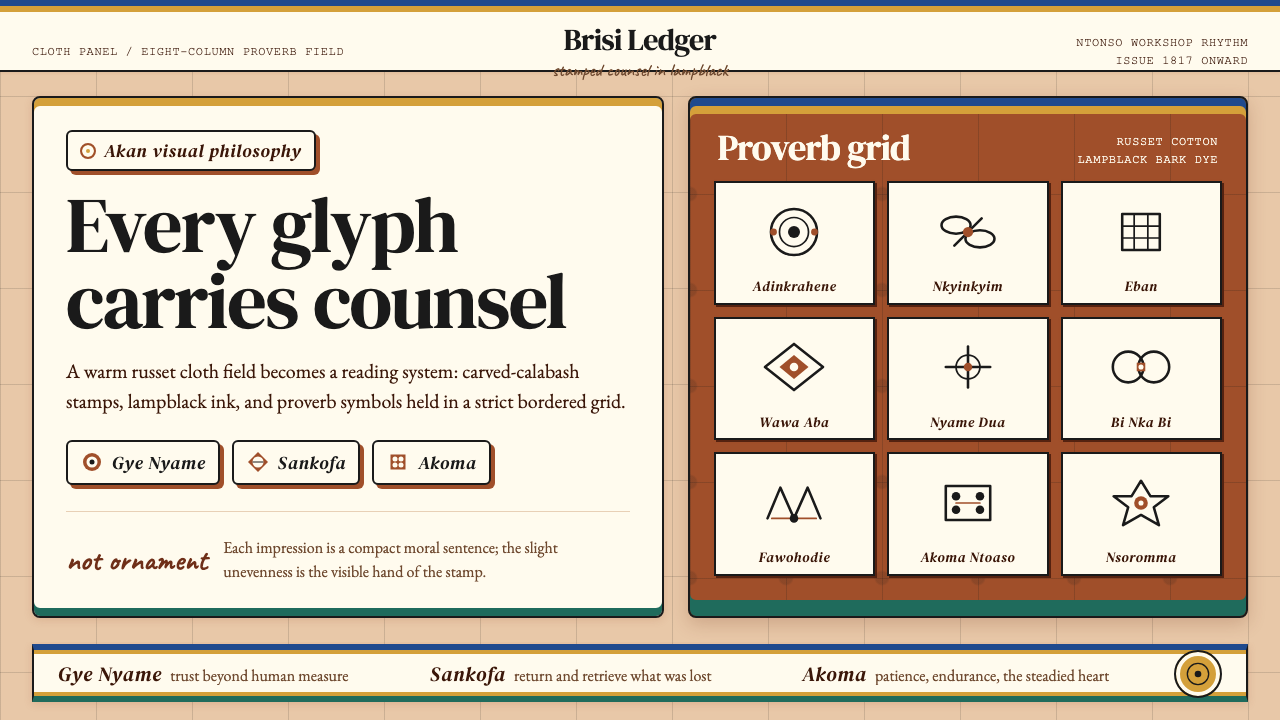 Akan Adinkra (Ghana)Proverbs become cloth. Russet grids, lampblack serif marks, and gold-edge ban…
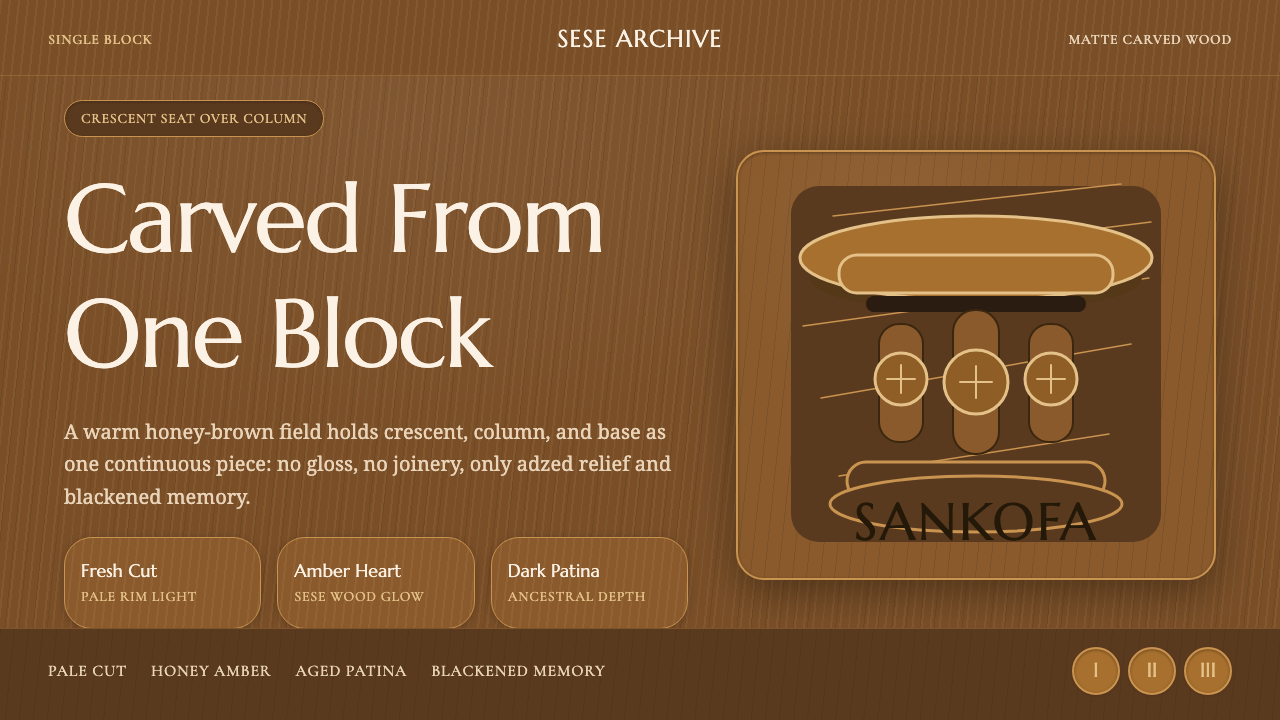 Akan Carved StoolMatte wood carries memory. Honey amber, Marcellus type, and crescent-column r…
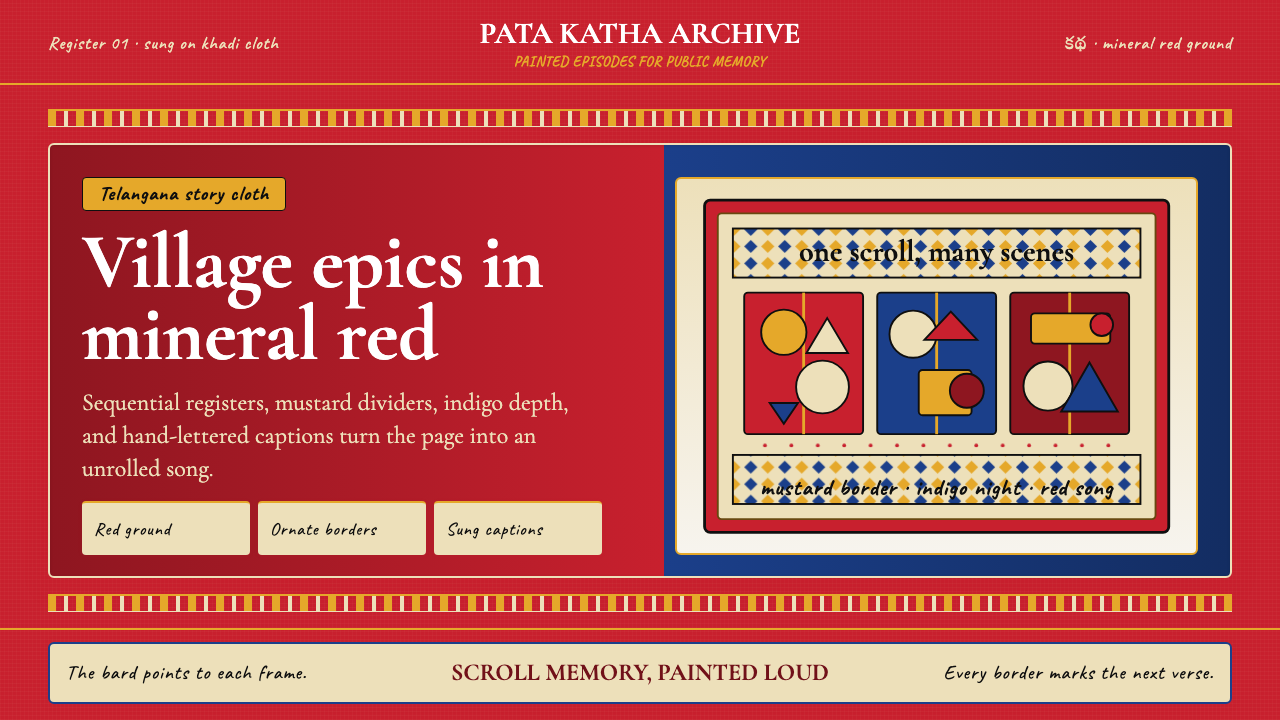 Andhra Cheriyal Scroll PaintingSaturated oral memory. Mineral red registers, mustard diamonds, and serif son…