What is Threads (Meta)?
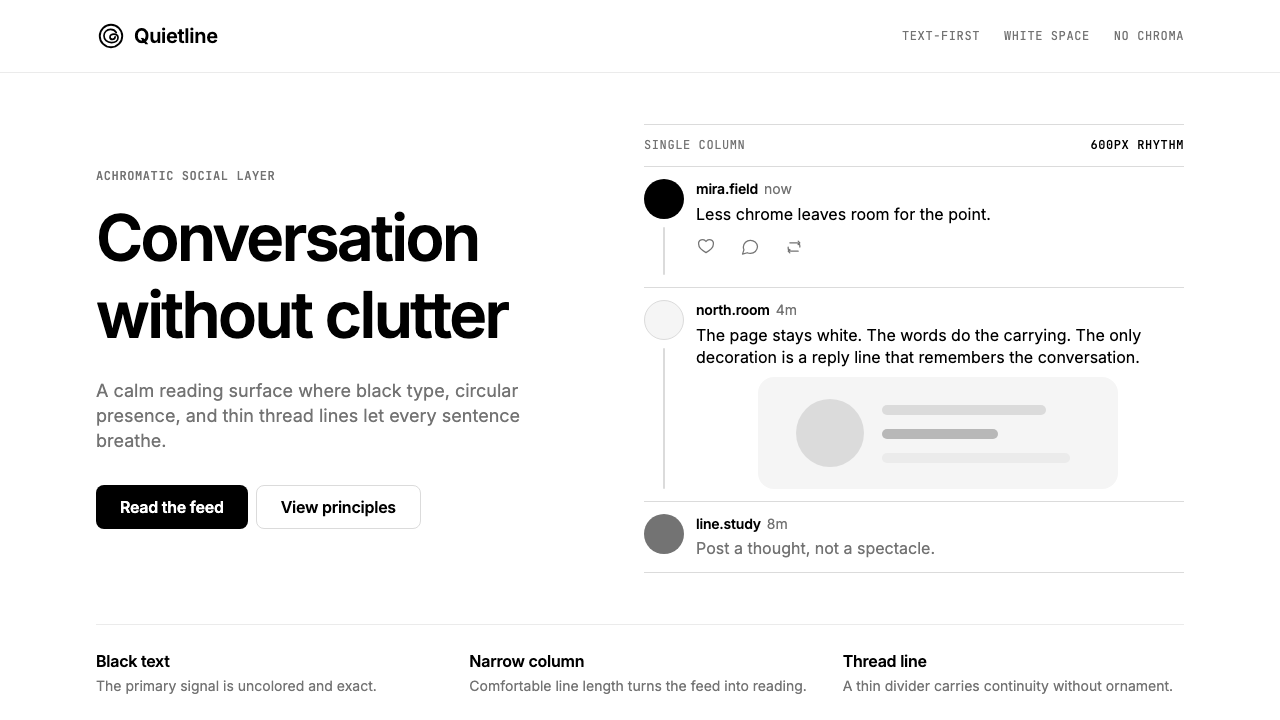
Threads arrived in 2023 and made restraint a product strategy — pure black type, pure white air, and nothing else.
Threads (Meta) in brief
Threads is a text-first social feed created by Meta's Instagram team, launched on July 5, 2023, as a direct response to the turbulence at Twitter. Its visual language is defined by a single, radical decision: the removal of color from the interface entirely. Where virtually every major social platform at the time competed on the vibrancy of its brand palette, Threads arrived achromatic — pure black type on a pure white ground, with no accent color in the chrome, no interactive badge hues, no decorative flourish of any kind. Within five days of launch it had reached one hundred million users, demonstrating that the design's austerity was itself a form of invitation.
The aesthetic is grounded in the sensibility of Instagram, from which Threads inherits its core structural DNA: generous whitespace, circular avatar crops, softly rounded media containers, and a typographic rhythm that breathes rather than crowds. What Threads adds to this inheritance is a strict text-first editorial logic. Photography and video appear, but as guest elements within a reading flow — not as the dominant medium. The connective thread motif, expressed as a thin vertical line linking avatar to reply, is among the most minimal pieces of interaction design in any major consumer product: a single stroke that transforms a linear feed into a visible conversation tree.
In design terms, Threads represents a bet that radical subtraction can be a differentiator. The interface trusts the user's own content — profile images, attached photography, link previews — to supply whatever color and visual interest the screen needs. The system itself remains neutral, almost monastic. It is closer in spirit to a well-set book than to a traditional social application, and that comparison to print typography is not accidental: the team made deliberate choices about measure, line spacing, and vertical rhythm that place prose legibility at the center of every decision.

Where does Threads (Meta) come from?
Threads was conceived and shipped during an unusually compressed timeline in the first half of 2023, as Meta moved to capture users disaffected by the ownership transition and policy upheaval at Twitter. Adam Mosseri, the head of Instagram, led the product effort alongside Mark Zuckerberg. The design team was drawn primarily from Instagram's existing mobile design organization, which meant the visual system was built on established internal components rather than invented from scratch. The decision to launch without a distinct brand color — an almost unheard-of choice for a consumer social product — appears to have been both a design principle and a strategic one: the absence of accent color positioned Threads as a neutral town square rather than a branded destination.
The platform launched with support for ActivityPub, the open social networking protocol that underlies the federated Fediverse, including Mastodon. This technical commitment to interoperability had a subtle but real influence on the aesthetic: a platform designed to connect to a broader, decentralized ecosystem needed a visual language that would not impose its brand on conversations that might ultimately live outside its walls. The achromatic restraint is, in this reading, not only an aesthetic stance but a statement of intent about platform architecture — a product that does not demand to be seen.
Instagram's design language at the time of Threads's launch had itself been through a significant evolution. The original Instagram aesthetic of the early 2010s — warm filters, rounded icons, the gradient logo introduced in 2016 — had given way by 2023 to a considerably more neutral and typographic product. Threads inherited this mature Instagram sensibility and distilled it further. The gradient, the warm filter, the playful icon — all were stripped away. What remained was the structural logic: circular avatar, soft media radius, generous vertical spacing. The design team applied these elements with even greater discipline than their parent app, producing something that felt simultaneously familiar and pared back to essentials.
The Inter typeface, used throughout Threads for both interface labels and user-generated text, had by 2023 become the dominant sans-serif in professional digital interface design, chosen by dozens of major products for its exceptional legibility at small sizes and its neutral, functional character. Its selection for Threads was consistent with the overall philosophy: use the most readable, most neutral tool available and let content lead. The thin connector line linking threaded replies — the motif that gives the product its name — was reportedly refined through multiple iterations before launch, with the team testing various weights and lengths before settling on the lightest possible stroke that remained perceptible across all device sizes and ambient conditions.
What defines the Threads (Meta) look?
Achromatic Palette
Threads operates in a strict black-and-white register for all interface elements — navigation bars, action icons, type hierarchy, interactive states, and structural dividers. No brand color appears in the chrome. The only color on screen at any moment arrives through user-uploaded photography, video thumbnails, and link-preview images. This makes Threads perhaps the most color-restrained major consumer application ever shipped, a choice that reads as confident neutrality rather than aesthetic poverty.
Thread Connector Line
The thin vertical stroke linking a post's avatar to the avatars of its replies is the defining original motif of the Threads visual system. It transforms what would otherwise be a flat sequential list into a visible branching conversation structure. The line is drawn at the absolute minimum weight where it remains perceptible — gossamer-thin, clearly intentional, never decorative. It is simultaneously an interface affordance and the source of the product's name.
Typography-Led Hierarchy
Without color to establish visual hierarchy, Threads relies entirely on typographic contrast — variation in size, weight, and opacity — to distinguish username from handle, post body from timestamp, primary action from secondary one. The system uses a small number of clearly differentiated text styles applied with consistency across every surface. Labels are clipped to their necessary minimum; prose gets room to breathe. The result is a reading environment unusually well calibrated for sustained text consumption on a mobile screen.
Circular Avatars and Soft Radii
Inherited from Instagram, the circular avatar crop is applied with structural consistency across the entire Threads interface — in feed items, reply chains, notification rows, and profile views. Attached media — photographs, link cards — use a generously rounded corner radius that softens the rectilinear grid without introducing organic irregularity. The combination of circular portrait and rounded rectangle creates a visual vocabulary that is warm and approachable while remaining entirely geometric.
Generous Vertical Spacing
Threads allocates significantly more vertical space between feed items than most competing social feeds, a decision that creates a calm, unhurried reading rhythm. The padding above and below each post, combined with the thin separator line between items, gives every piece of content its own zone of visual quiet. This is not wasted space — it is the mechanism by which the interface avoids the cramped, attention-fragmented quality that characterizes high-density social feeds. The generous spacing also makes the thread connector line legible at a glance.
Minimal Iconography
The action icons — reply, repost, like, share — are drawn as outlines at a relatively small touch target, using strokes that match the weight family of the typeface. No filled icons appear in resting state; fill is reserved for active or selected states, creating a quiet before-and-after that communicates state change without color. The icon set is deliberately small: Threads avoids the icon inflation common to feature-dense platforms, keeping the visual vocabulary of actions to an interpretable minimum.
Dark Mode Inversion
Threads supports a dark mode that inverts the light-ground logic to a near-black ground with near-white type. The achromatic discipline transfers cleanly to the dark variant: because there is no brand color to manage, the dark mode is a pure luminance inversion rather than a palette renegotiation. The connector line remains a single stroke; the avatar circles hold their shape; the typographic hierarchy reads identically. This consistency across modes is only possible because the system has no color to lose.

Who shaped Threads (Meta)?
As head of Instagram, Mosseri served as the primary product leader for Threads from conception through launch. His public communications during the development period consistently framed Threads as a platform for public conversation that prioritized a calmer, less algorithmically aggressive experience than its competitors — a positioning that the visual system's restraint directly embodies. Mosseri has continued to guide the product's evolution through its post-launch phase, including decisions about feature addition and federation rollout that have shaped the platform's design priorities.
Zuckerberg's involvement in Threads extended beyond executive oversight to active product participation: he was among the earliest and most prolific users of the platform, using his own account to model the conversational, text-forward behavior the product was designed to encourage. His decision to ship Threads with ActivityPub support — a technically complex choice that required significant engineering investment — reflects a broader platform philosophy that influenced the product's positioning as an open alternative, and indirectly reinforced the visual system's studied neutrality.
The collective Instagram design organization — rather than a single named designer — is the credited creative force behind Threads's visual language. The team brought to the project the accumulated expertise of building and iterating Instagram's mobile design system over more than a decade, including its component library, spacing system, and typographic conventions. The decision to build Threads on Instagram's existing design infrastructure rather than establishing a wholly distinct visual identity gave the product an immediate coherence and production quality that would have been impossible to achieve in the compressed launch timeline otherwise.
While not a design team in the traditional sense, the developers and community advocates behind the ActivityPub open protocol — including those working on Mastodon and the broader Fediverse — exerted indirect influence on Threads's design posture. By building toward federation, Meta committed to a product that needed to work within an ecosystem it did not control, which reinforced the logic of building a visually neutral, content-forward interface that would not feel like an imposition in decentralized social contexts. The eventual rollout of federation features in 2024 validated the design team's early instinct toward restraint.
How do you use Threads (Meta) today?
Threads's visual language translates effectively to designed artifacts because its principles are unusually clear and easy to state: remove color from the system, let content supply it; establish hierarchy through typographic contrast alone; use the thinnest possible structural elements. The style is best understood as a discipline of subtraction rather than a specific set of visual components, which makes it both highly portable and easy to misapply.
For presentation slides, the Threads approach works well across both cover and content pages, though it requires more confidence in negative space than most designers are accustomed to exercising. A cover built on this system uses a black typeface at a large scale on a white ground, perhaps with a single thin horizontal rule as a structural accent. The absence of a background color or graphic element will feel stark initially — that starkness is the style. Content slides should use two or three levels of type size and weight to create the full hierarchy, with generous margins and generous space between text blocks. Data visualizations in this system become monochrome diagrams: bar charts in solid black, axis labels in a lighter weight, no gridlines or only hairline gridlines. The data is the color.
For web interfaces and dashboards, the Threads aesthetic translates to a system built on near-white or pure white backgrounds, black body text, and a single typographic variable — opacity or weight — to signal interactivity. Navigation elements are text-only or use outline icons; no filled icon appears at rest. Cards and containers use a thin border in a lighter gray rather than a drop shadow. Interactive states — hover, focus, selected — are expressed through weight change, underline, or a background shift to a very light gray rather than through any color accent. The style is particularly suited to reading-heavy interfaces: documentation platforms, content management views, long-form editorial environments.
For editorial and marketing contexts, the style's poster-like typographic confidence produces strong results when applied with discipline. A full-page editorial treatment in this system alternates between black type on a white ground and white type on a black ground — the only form of color variation available. Section breaks are marked by a thin rule rather than a decorated divider. Marketing pages use large-scale typographic headlines as their primary visual element, with secondary information in a noticeably smaller weight. Photography, when used, is allowed to carry all the color — cropped generously, given ample surrounding white space, never decorated with overlaid text or graphic elements.
The most common mistake when applying Threads's visual language is interpreting the absence of color as an invitation to substitute a brand accent at key moments — to add a blue call-to-action button, a green success state, a red error indicator. These additions are not wrong in themselves, but they represent a departure from the system's logic rather than an application of it. Threads handles error and success states through iconography and type weight changes, not color. If a product needs color for semantic reasons — accessibility standards, regulatory requirements, established user expectations — those needs should be addressed directly, and the resulting design should be understood as a color-modified version of the system rather than the system itself. Attempting to add color in a piecemeal way produces results that feel inconsistent rather than intentionally adapted.

Threads (Meta) — FAQ
Is Threads a minimalist design style or something more specific?
Threads is best described as achromatic product design rather than minimalism in the broad sense. Minimalism as a design philosophy encompasses many different approaches — some use rich color in a simplified palette, some rely on generous negative space with textural variation. Threads is more specific: it eliminates brand color from the interface entirely and achieves its visual reduction through the removal of chromatic information rather than through spatial simplicity alone. The result can feel minimal, but the mechanism is a particular kind of color restraint that distinguishes it from, say, a white-heavy material design or a sparsely laid out typographic layout that still uses a strong brand hue.
How does Threads handle visual hierarchy without color?
Entirely through typographic means: variations in size, weight, and opacity. A username is displayed at a specific weight; the handle beneath it appears at the same size but in a visibly lighter opacity; the post body text is set at a larger size and a regular weight; the timestamp and engagement counts are smaller and lighter still. This creates a five or six-level hierarchy using nothing but the same typeface in different configurations. Interactive elements are distinguished by their proximity to icons and by subtle weight shifts on press, not by color. It is a system that demands more from the type design and from the spacing decisions than a color-assisted hierarchy would, and the fact that it reads clearly is evidence of careful calibration.
Can the Threads style work for a product that needs strong brand recognition?
This depends on where brand recognition is being sought. Threads has achieved significant brand recognition without a dedicated interface color — its recognizability comes from the distinctive thread connector motif, the circular avatar system, and the overall reading-environment quality of the feed. These elements function as brand markers as effectively as a color would. For products that need to compete visually in high-color environments — retail shelves, advertising placements alongside vivid brand work — the absence of color may be a liability. For products that live within their own interface and are recognized by name and interaction pattern rather than by hue, the achromatic approach can work effectively. The Threads case suggests it is a viable choice for any product confident enough in its structural identity to forgo the shortcut of a distinctive color.
What is the relationship between Threads's design and Instagram's design?
Threads is best understood as a further reduction of the visual language Instagram had arrived at by 2022 and 2023. The shared elements are clear: circular avatars, soft media radii, generous vertical spacing, a typographic system built on a single sans-serif at multiple sizes and weights. The divergence is equally clear: Instagram retains color in its interface — gradient icons, colored story rings, algorithmic highlight states — while Threads eliminates all of it. Threads is what Instagram's structural logic looks like when its chromatic elements are removed. This makes Threads something like a stress test of the underlying design system: if the hierarchy and legibility still work without any color, the structural foundation must be sound.
Does the Threads style work in print and offline contexts?
Unusually well, for reasons intrinsic to its achromatic foundation. Designs built on pure black and white require no color management, no Pantone matching, no CMYK conversion anxiety, and no consideration of how a brand color will shift between screen and paper. A Threads-styled event poster, publication, or environmental graphic reproduces identically whether output on a commercial press, a laser printer, a photocopier, or as a screen display. The thin connector line motif and the typographic hierarchy translate cleanly to any medium with sufficient resolution. The only adaptation required is ensuring that the structural elements — particularly the thin rules and lightweight type — are specified at a weight that will hold up through the production process, since single-weight hairlines can be lost in certain printing conditions.
Related design styles
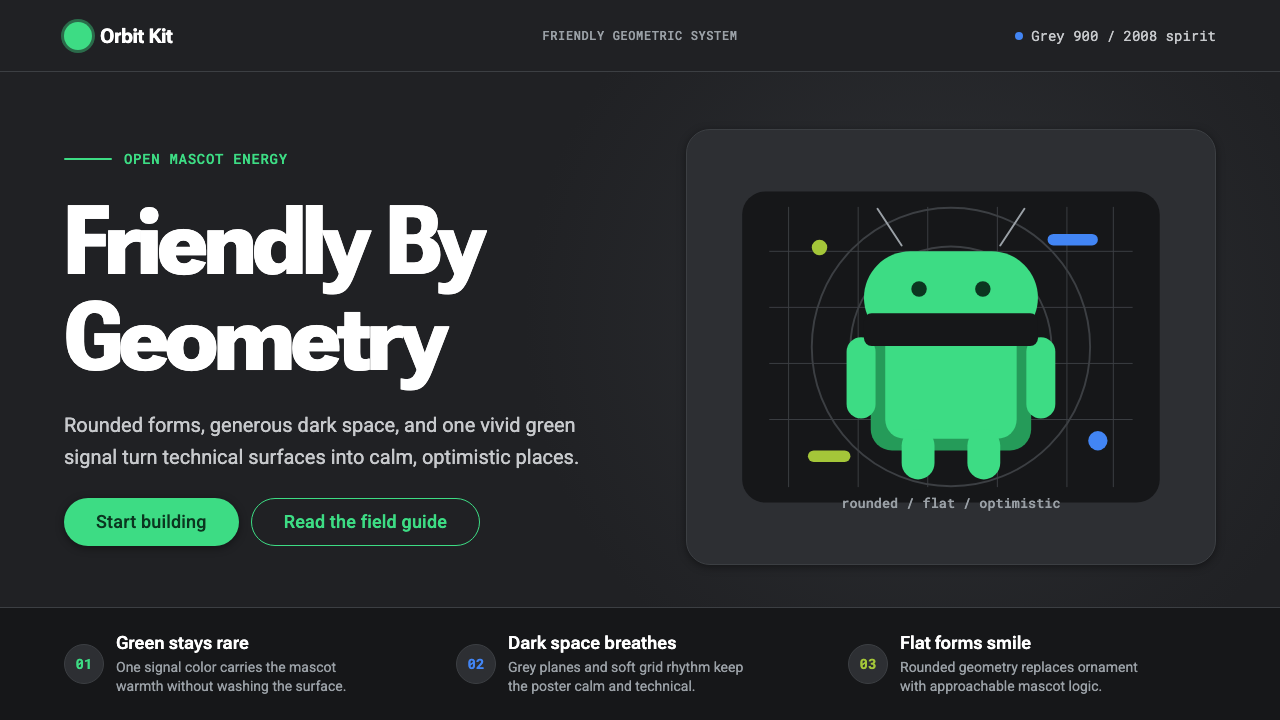 Android Bugdroid GreenFriendly tech, reduced to geometry. Vivid green pops from Grey 900 and rounde…
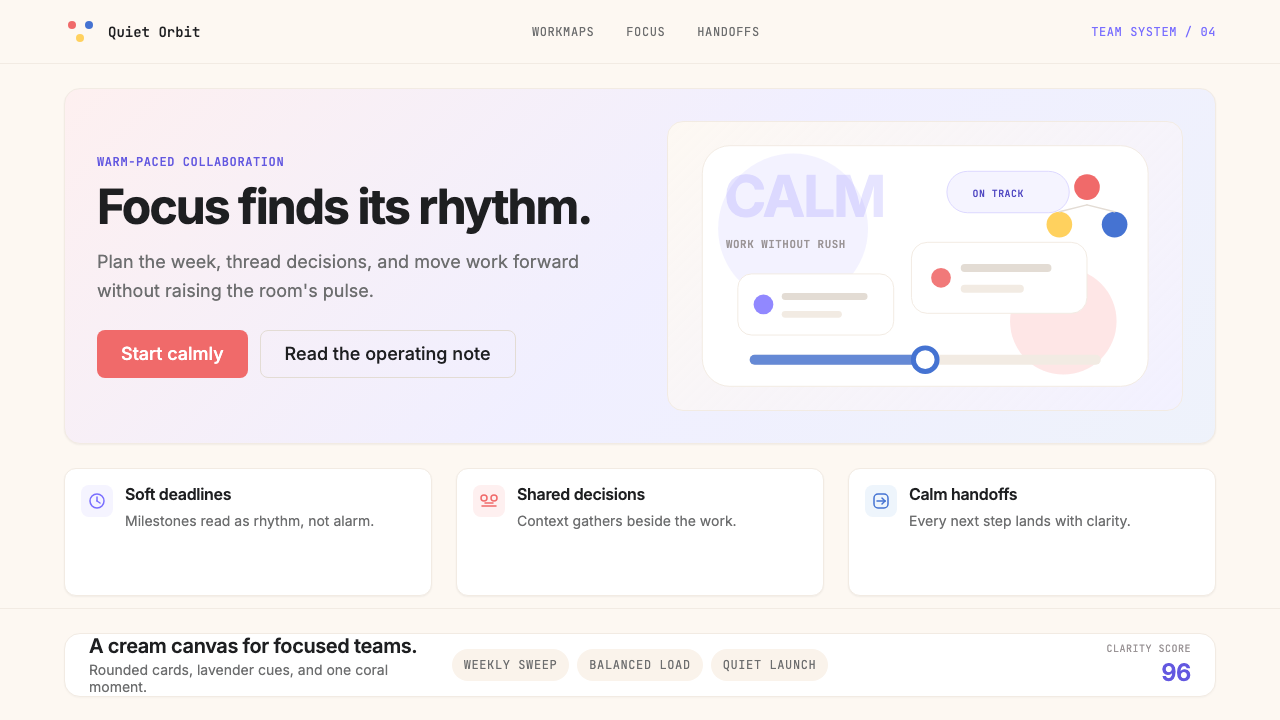 AsanaCalm productivity breathes. Cream canvas, lavender panels, coral-blue-yellow…
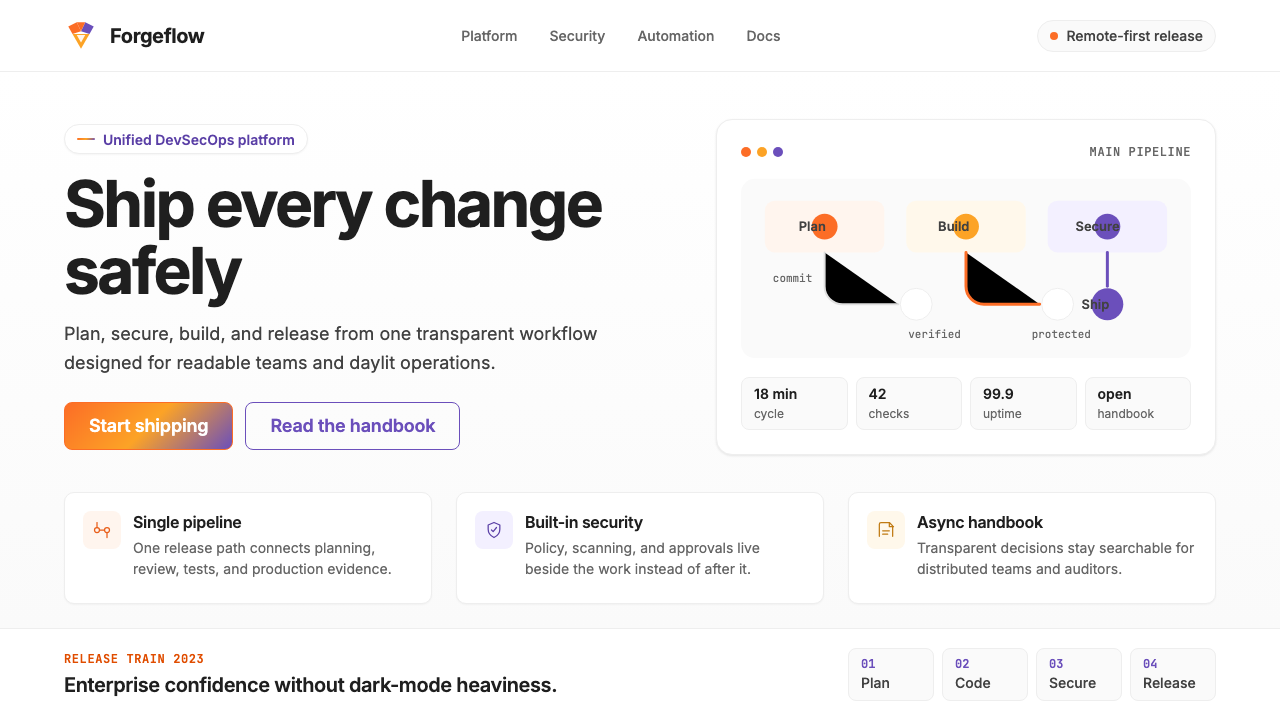 GitLab 2023DevOps in daylight. Tanuki orange-to-purple gradient, Inter, warm enough for…
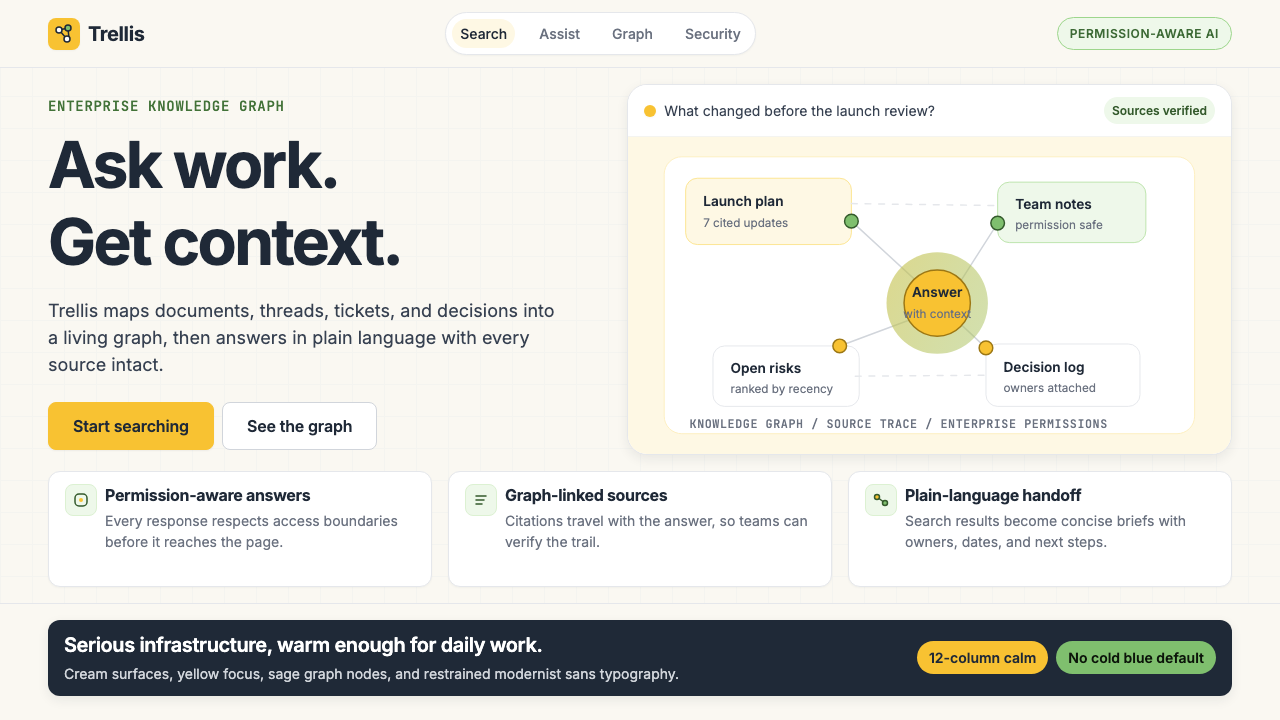 Glean Enterprise-SearchWarm enterprise AI. Cream ground, yellow focus, sage graph nodes, and sans ca…
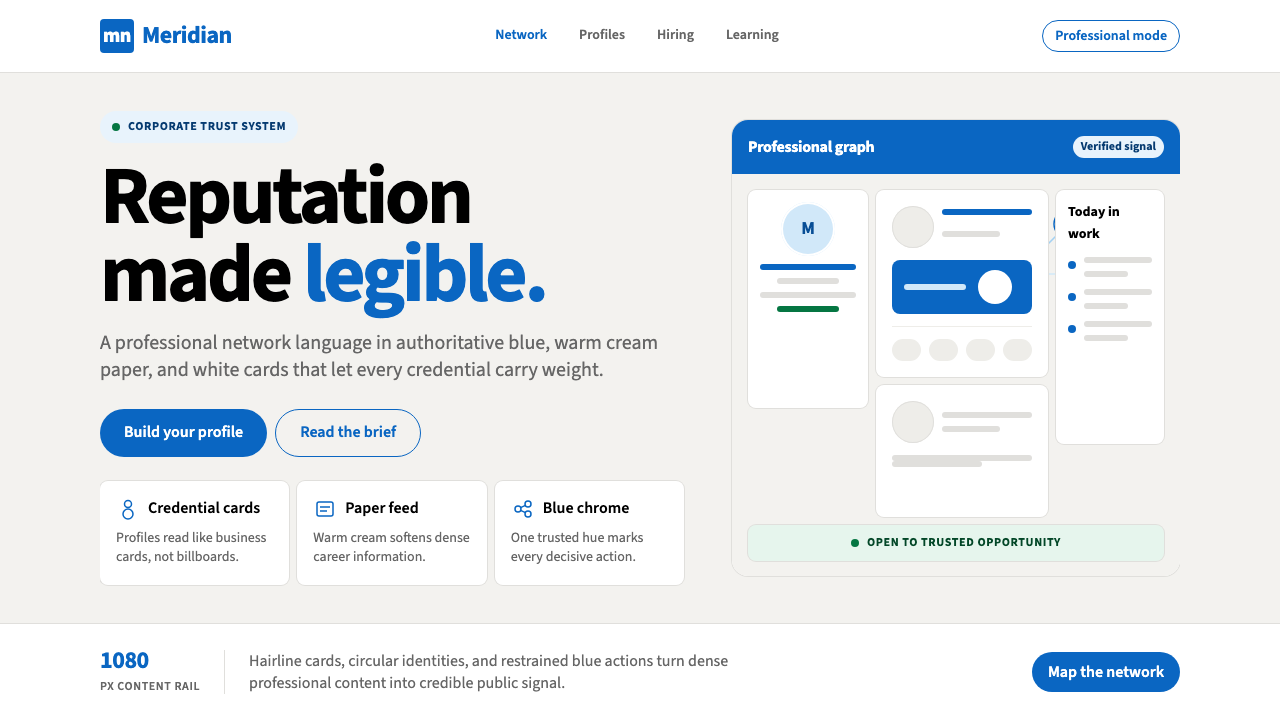 LinkedInCorporate trust, digitized. Authoritative blue frames white cards on warm cre…
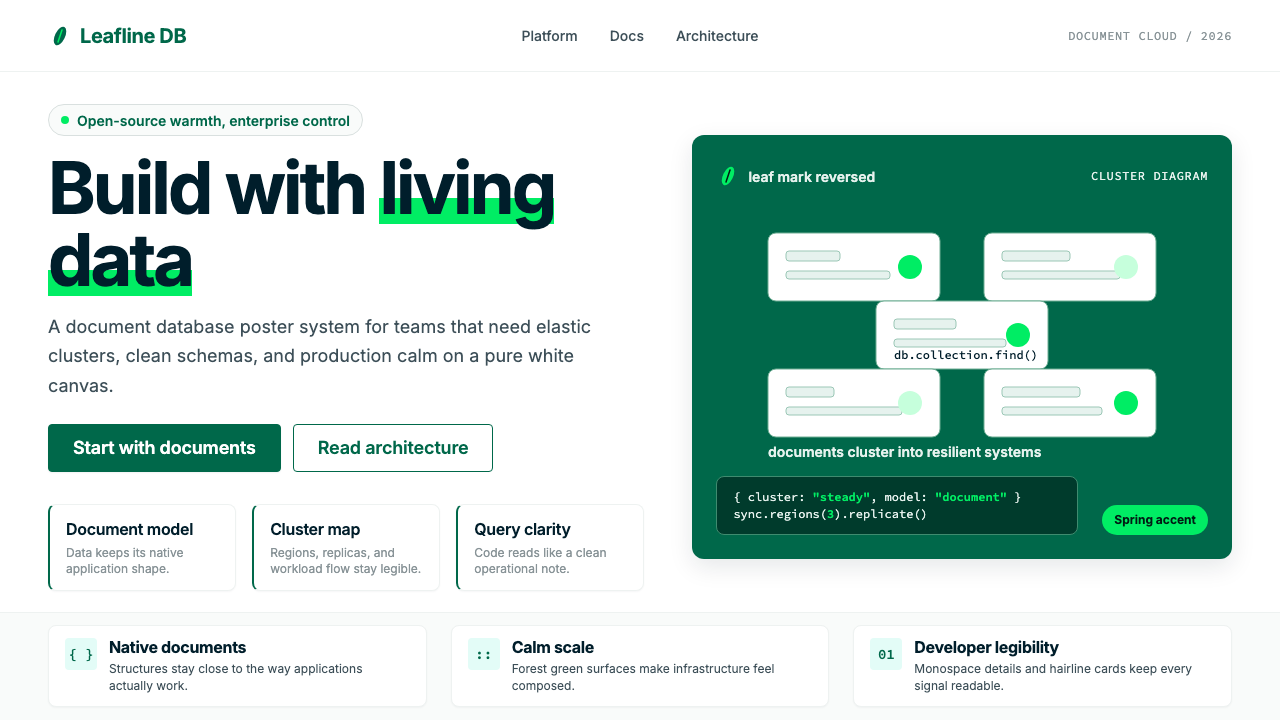 MongoDB Leaf GreenDisciplined green, open warmth. Forest leaf forms and Spring accents breathe…