What is Tibetan Tsakli Initiation Cards?
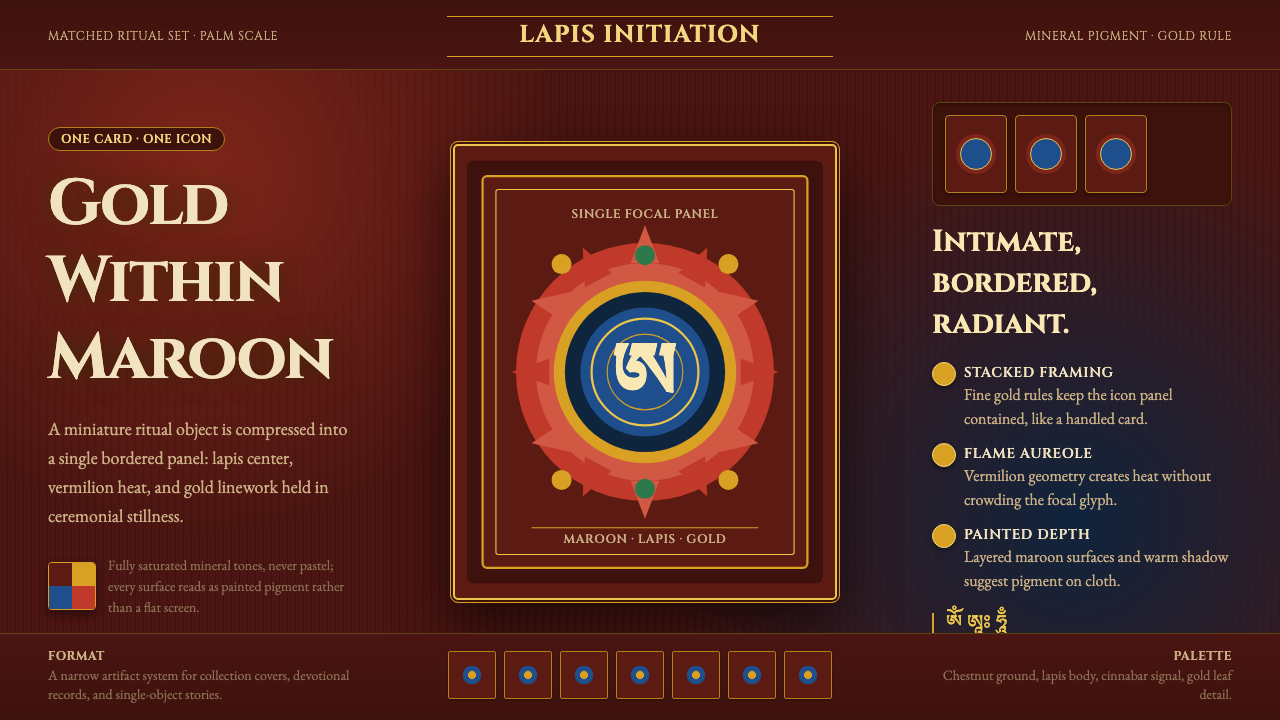
Tibetan tsakli initiation cards compress an entire ritual cosmos into the palm: a single luminous deity, a field of deep maroon, and fire held inside gold.
Tibetan Tsakli Initiation Cards in brief
Tsakli, also written tsakali, are palm-sized Tibetan Vajrayana initiation cards painted in matched sets like miniature thangkas. Usually no larger than a small square panel, each card gives visual priority to one yidam deity. The card is not a general illustration or a decorative picture: during monastic empowerment, it provides a concentrated visual focus through which a disciple can be aligned with a particular deity.
Their visual language is compressed but never casual. A single central figure, painted with gold and lapis blue, stands against a deep maroon-red field. An orange-red flame aureole surrounds that figure, and gold rules define, separate, and energize the image. The format makes the composition unusually direct: rather than asking the eye to travel through a crowded scene, it presents one sacred presence with almost absolute clarity.
Tsakli use the same mineral-pigment vocabulary associated with full-scale thangka painting: azurite and lapis blue, cinnabar vermilion, malachite green, orpiment yellow, and real gold. Yet their small scale changes the experience. The visual system becomes intensely saturated and icon-like, concentrating the thangka tradition into a portable ritual panel. One figure, one ground, and one ring of flame become enough to establish a complete ceremonial image.
Where does Tibetan Tsakli Initiation Cards come from?
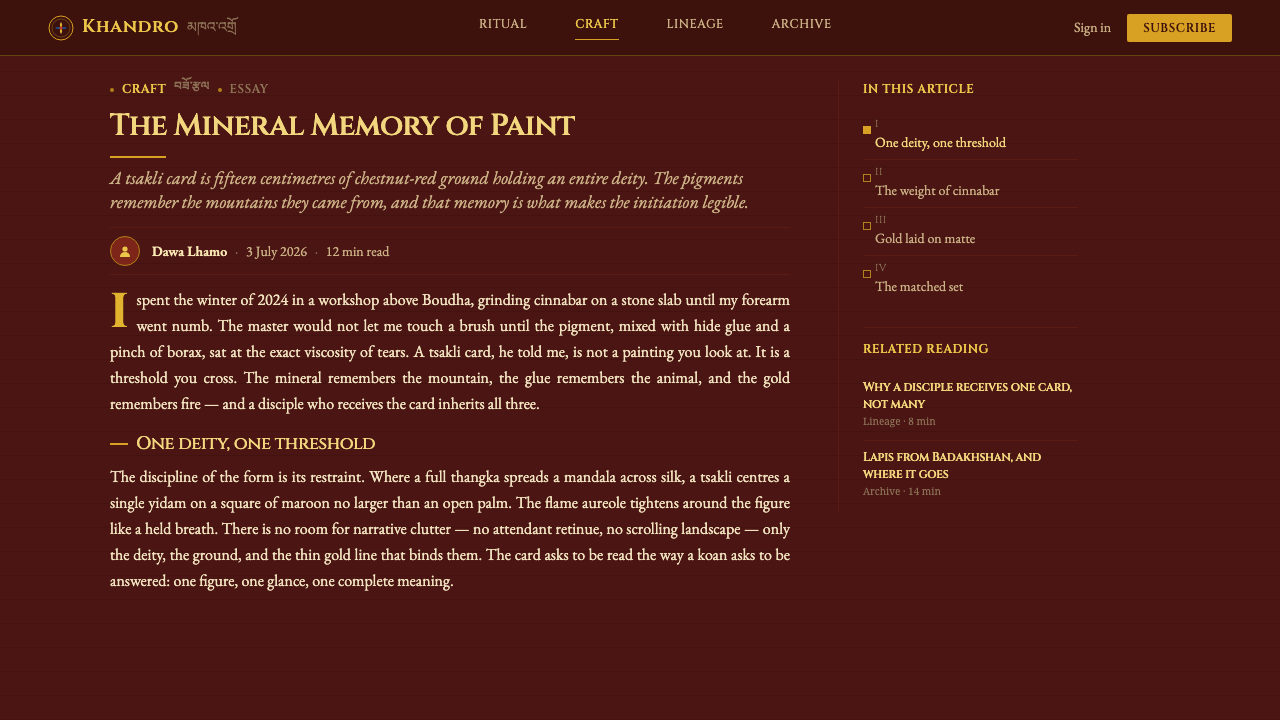
Tsakli belong to the Tibetan Vajrayana ritual tradition and to the wider Himalayan Buddhist world. Their miniature thangka form is documented from around the fifteenth century onward, and they continue to be painted today. This long continuity matters: tsakli are not a historical style recovered only for display, but a ritual image form whose visual identity remains tied to devotional and initiatory practice.
The cards developed within the broader language of Tibetan thangka painting. Like a thangka, a tsakli relies on mineral pigment, gold, centered sacred imagery, and disciplined iconographic structure. But it translates those elements into a much smaller field. The reduction is not simply a matter of scale; it creates a distinct visual condition in which the figure, halo, pigment ground, and gold detailing must carry the whole image without the expansiveness of a large hanging painting.
Their ritual setting is Vajrayana initiation, or abhisheka. A matched set allows multiple deity images to be commissioned and used together, while each individual card can concentrate attention on one yidam deity. The form therefore links visual order to ceremonial function: repetition across a set creates continuity, while the singularity of each card preserves the focused relationship between disciple and deity.
The tradition depends on several linked forms of expertise. Monastic thangka painters execute the miniature panels and their mineral-pigment surfaces; lamas commission matched tsakli sets for ritual use; yidam-deity iconographers establish the image vocabulary that makes each central figure recognizable within its sacred context. The resulting object sits at the meeting point of painting, ritual commission, and iconographic knowledge.
What defines the Tibetan Tsakli Initiation Cards look?
Concentrated Sacred Center
A single yidam deity occupies the compositional center. This centrality is not merely a layout convention: it gives the card its ritual focus. Supporting elements do not compete for narrative attention. They frame, intensify, and clarify the presence of the deity, allowing the small panel to function as a direct object of visual alignment during empowerment.
Deep Maroon Ground
The deep maroon-red ground acts as a dense, enclosing field behind the figure. It is not an empty background in the modern decorative sense. Its darkness gives gold, lapis blue, and vermilion flame a stage of strong visual separation, making the central image appear contained, heated, and ceremonially charged.
Gold Delineation
Gold appears as more than a precious accent. It works as a defining line, establishing contour, order, and radiance across the image. Against the maroon pigment ground, gold rules give the miniature panel a crisp inner architecture. The line carries visual authority without needing broad ornamental complexity.
Mineral Saturation
Azurite and lapis blue, cinnabar vermilion, malachite green, orpiment yellow, and real gold create a pigment system with material intensity. The colors are not treated as a broad atmospheric spectrum. Each has a distinct role within the icon panel, and the small scale makes their density feel concentrated rather than diffuse.
Flame Aureole
An orange-red flame aureole rings the central deity. It creates a threshold between the figure and the maroon field, enclosing the image in an energized perimeter. In a tsakli, the flame is not incidental ornament around a portrait-like subject; it is a primary structural device, making radiance visible through repetition, contour, and color contrast.
Matched-Set Rhythm
Tsakli are commonly painted as matched sets, and this repeated format is central to their character. Individual cards are highly concentrated, yet a set creates a larger ritual rhythm through shared materials, framing logic, grounds, and iconographic discipline. The system holds variation and consistency together: each deity is singular, while the painted set remains visibly unified.
Who shaped Tibetan Tsakli Initiation Cards?
Monastic thangka painters are among the makers responsible for translating the large-scale thangka vocabulary into the miniature tsakli format. Their work requires the same mineral-pigment and gold-based visual language to remain legible and intense within a palm-sized image field. In this role, painting is inseparable from the card's ritual purpose.
Lamas commissioning matched tsakli sets connect the painted object to the setting of Vajrayana initiation. Their commissions establish the need for a coherent group of cards rather than an isolated image alone. The matched set makes visual continuity available within the ceremonial context while preserving the focus of each individual deity panel.
Yidam-deity iconographers provide the image knowledge through which a central deity can be rendered as a recognizable ritual presence. Their role matters especially in the compressed tsakli format, where a limited number of forms, colors, outlines, and surrounding elements must convey the full identity of the image without the space of a larger thangka.
How do you use Tibetan Tsakli Initiation Cards today?
As a contemporary visual reference, Tibetan tsakli initiation cards are best understood as a system of concentration, not a storehouse of decorative motifs. The transferable lesson is the disciplined relationship between one central image, one dense ground, one enclosing halo, and a restricted group of luminous materials. A design can draw on this structure without treating ritual imagery as a generic surface pattern.
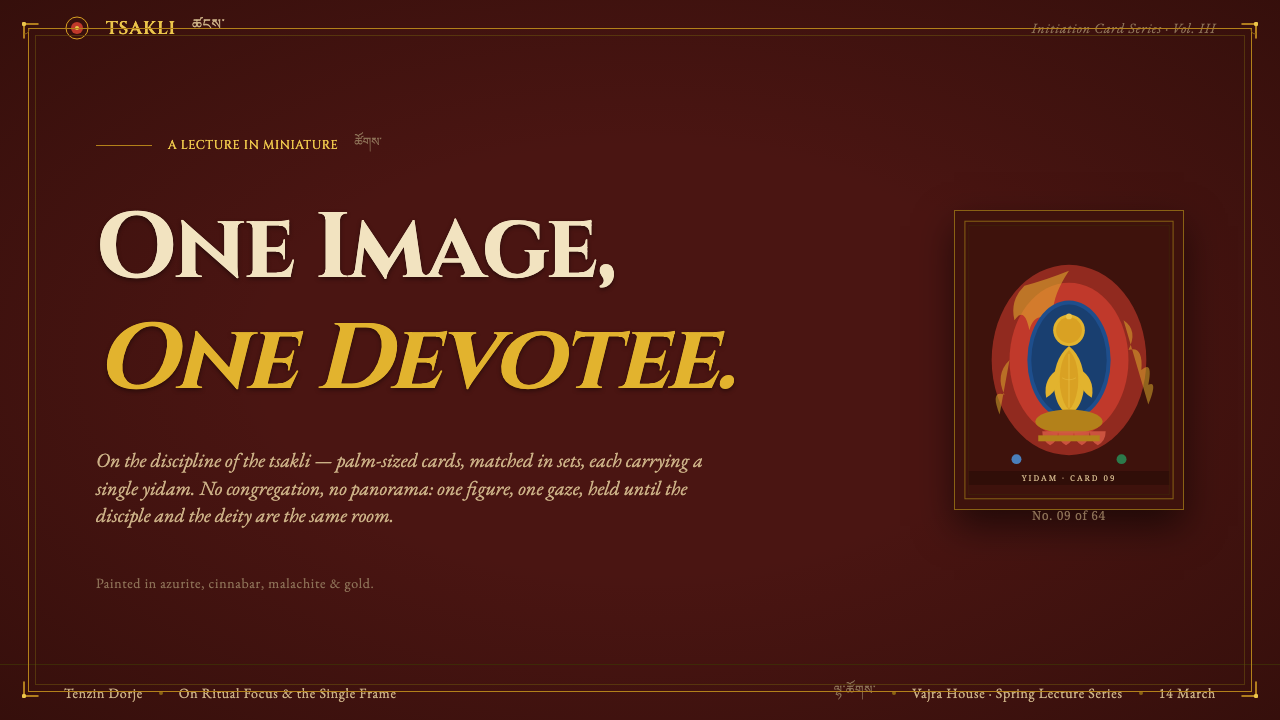
For presentation slides, the strongest application is a cover with one centered emblematic form, a dark maroon-like field, and a restrained gold-like framing gesture. Content slides should preserve the same hierarchy while becoming quieter: one key idea receives the visual center, supporting text remains subordinate, and section transitions can use a contained flame-like perimeter or ruled border as a structural signal. Data slides can adopt the same logic by making one metric or category visually dominant rather than distributing equal emphasis across every mark.
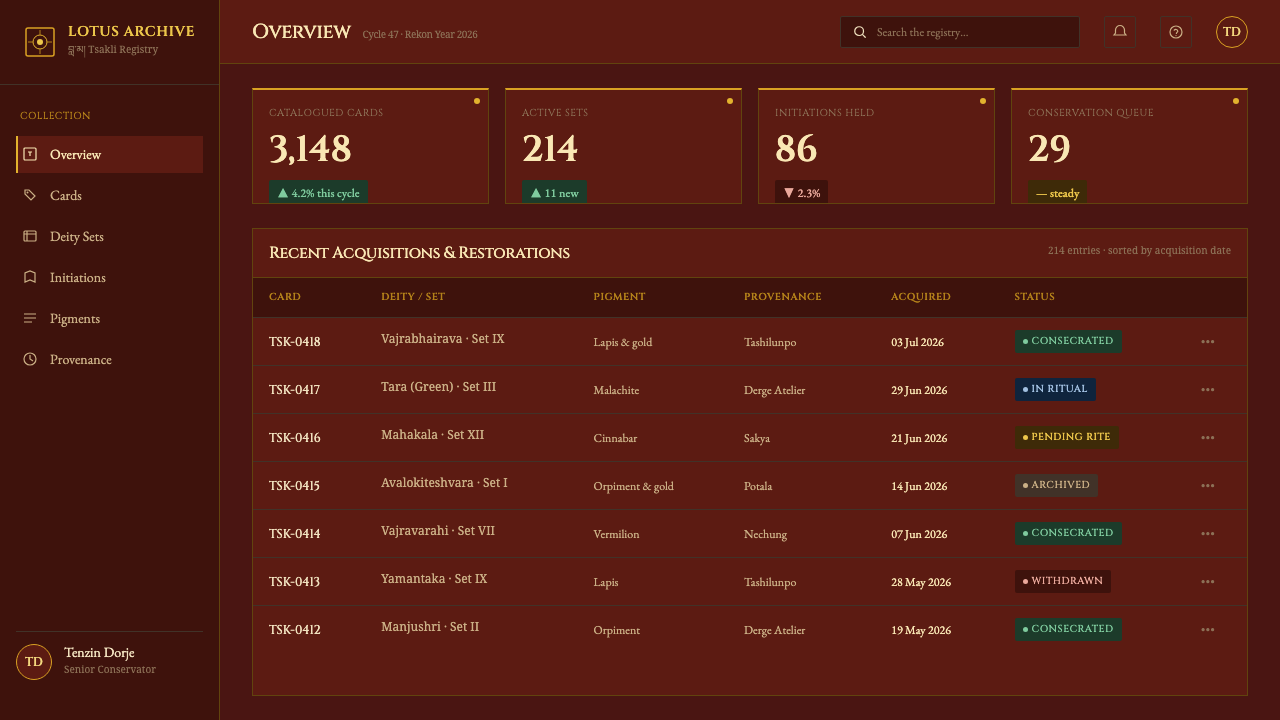
For web interfaces, the reference works particularly well for dashboards, archives, and collection pages that need a sense of focused attention. A deep field can hold a single primary panel or object, while luminous linework separates navigation, metadata, and selected states. The essential principle is enclosure: interfaces should make the active object feel deliberately framed, rather than allowing every card, badge, and control to compete at once.
For editorial and marketing work, the tsakli model supports compact, high-intensity compositions. A feature image or campaign panel can use a single subject surrounded by an active perimeter, with a rich ground and sparse metallic-looking detail creating ceremonial gravity. Editorial spreads can repeat a common frame across several panels, echoing the matched-set rhythm without copying sacred figures. This works especially well when a series needs continuity but each installment needs a distinct center.
A common mistake is to reduce the style to maroon backgrounds, gold decoration, and flame motifs. That produces atmosphere without the visual discipline that gives tsakli their force. The source tradition depends on concentration, iconographic clarity, material richness, and ritual purpose. If a contemporary design fills every area with competing symbols, textures, and accents, it loses the card's essential quality: a carefully bounded field in which one image is allowed to command attention.
Tibetan Tsakli Initiation Cards — FAQ
Are tsakli simply miniature thangkas?
They share the material and visual vocabulary of thangka painting, including mineral pigments, gold, sacred imagery, and disciplined iconographic structure. But tsakli are a distinct palm-sized initiation-card form, commonly painted in matched sets and used within Vajrayana empowerment. Their small scale and ceremonial function make concentration central to the format: one deity is presented as a focused object of visual alignment.
Why is the central figure usually isolated so strongly?
The cards are used to align a disciple visually with one yidam deity during monastic empowerment. A strongly centered figure gives that relationship immediate clarity. The maroon ground, gold delineation, and flame aureole do not distract from the deity; they create the bounded, radiant setting that makes the figure visually unmistakable.
What gives tsakli their unusually intense color?
Their intensity comes from the use of the mineral-pigment system also found in full-scale thangkas: azurite and lapis blue, cinnabar vermilion, malachite green, orpiment yellow, and real gold. Within a miniature panel, these materials are experienced in concentrated proximity. The deep maroon-red ground further heightens the separation between the central figure, the flame aureole, and the gold-lined details.
Can contemporary design borrow from tsakli without using deity imagery?
Yes, if it borrows the formal logic rather than treating sacred imagery as decoration. Useful principles include a singular focal image, a dense enclosing ground, restrained luminous outlining, a perimeter that concentrates attention, and a repeated series structure. A contemporary project should preserve the distinction between these compositional lessons and the ritual images whose meaning belongs to Vajrayana practice.
Related design styles
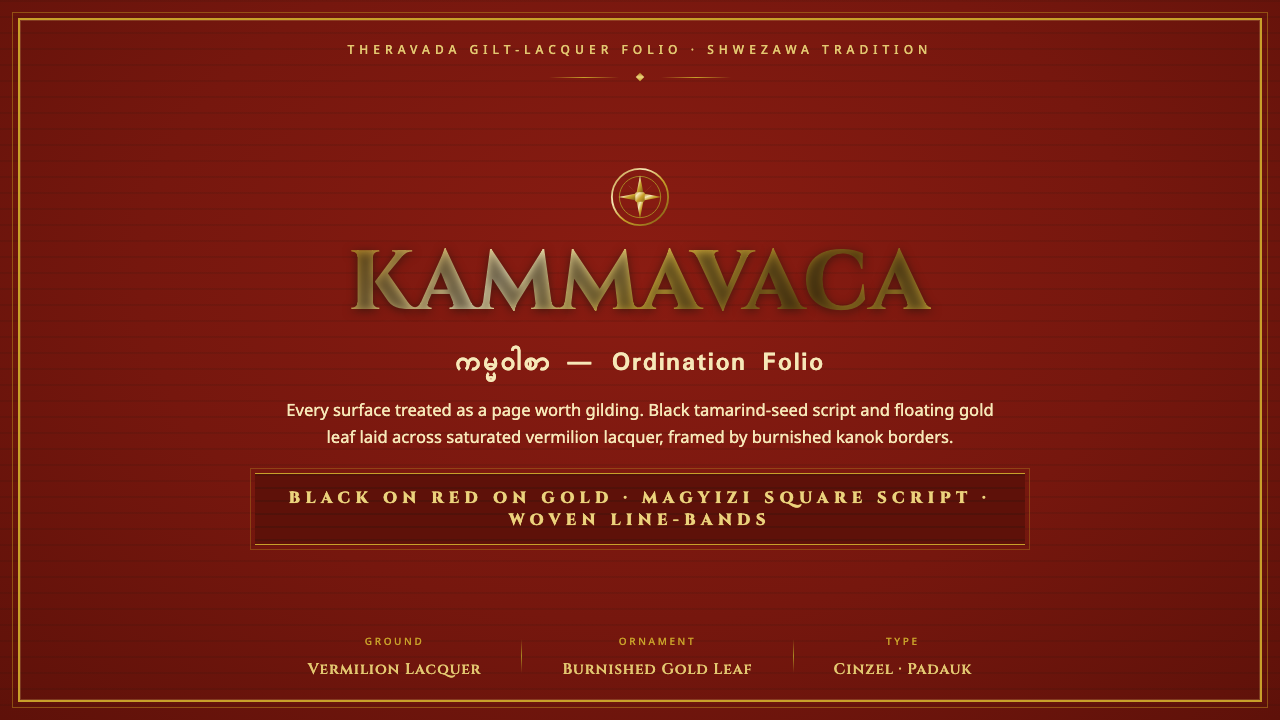 Kammavaca ManuscriptEvery surface worth gilding. Black tamarind-seed script and floating gold lea…
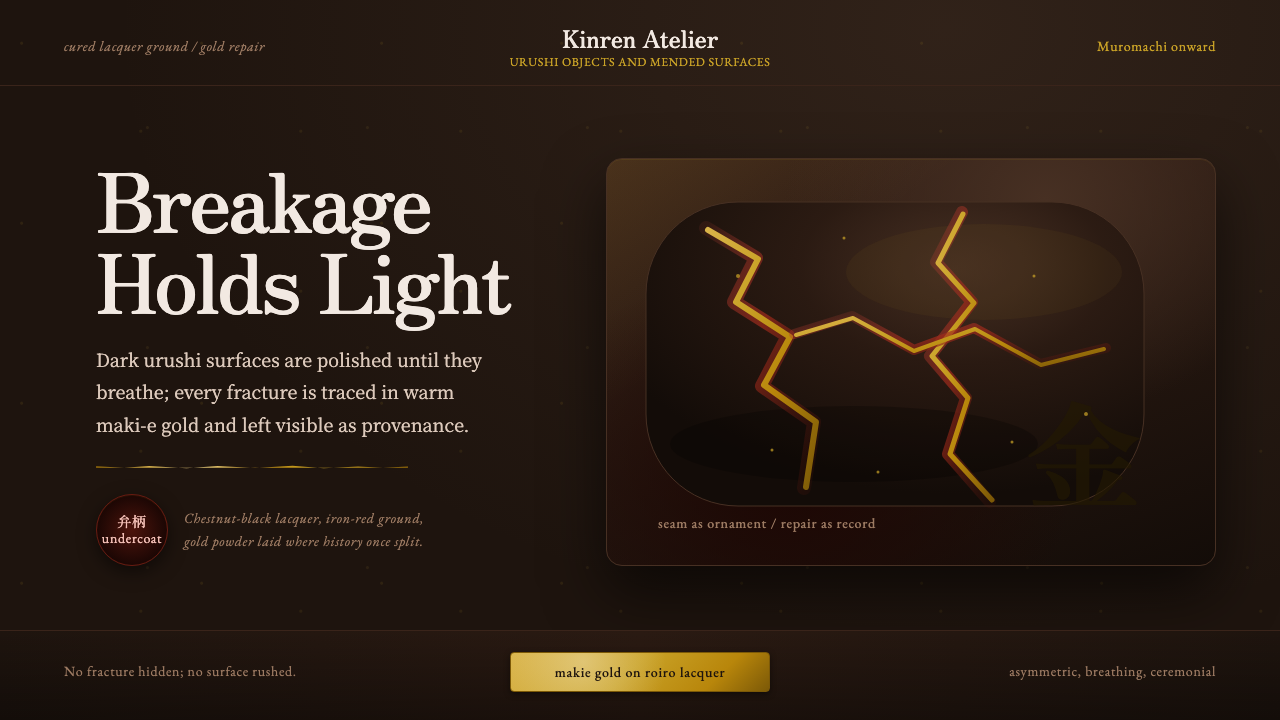 Kintsugi & Urushi LacquerBreakage becomes ceremony. Urushi black-brown carries gold seams and asymmetr…
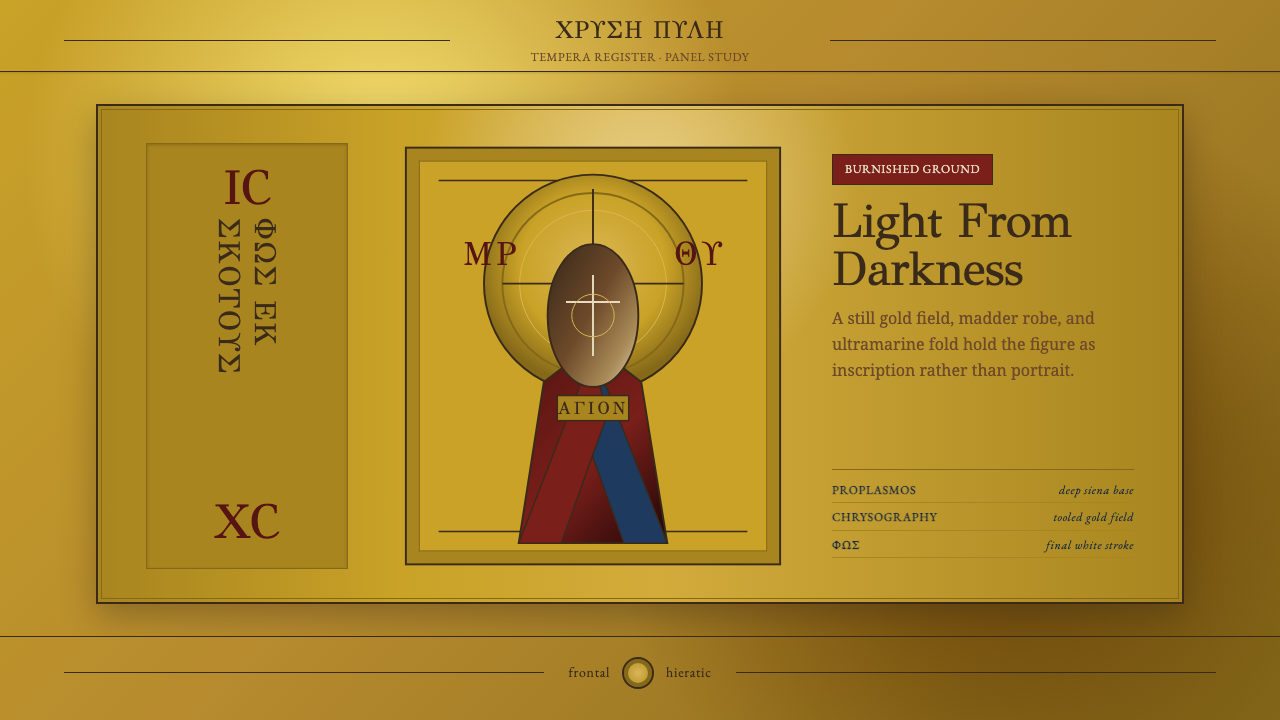 Mount Athos IconStillness becomes light. GFS Greek inscriptions frame madder, ultramarine, an…
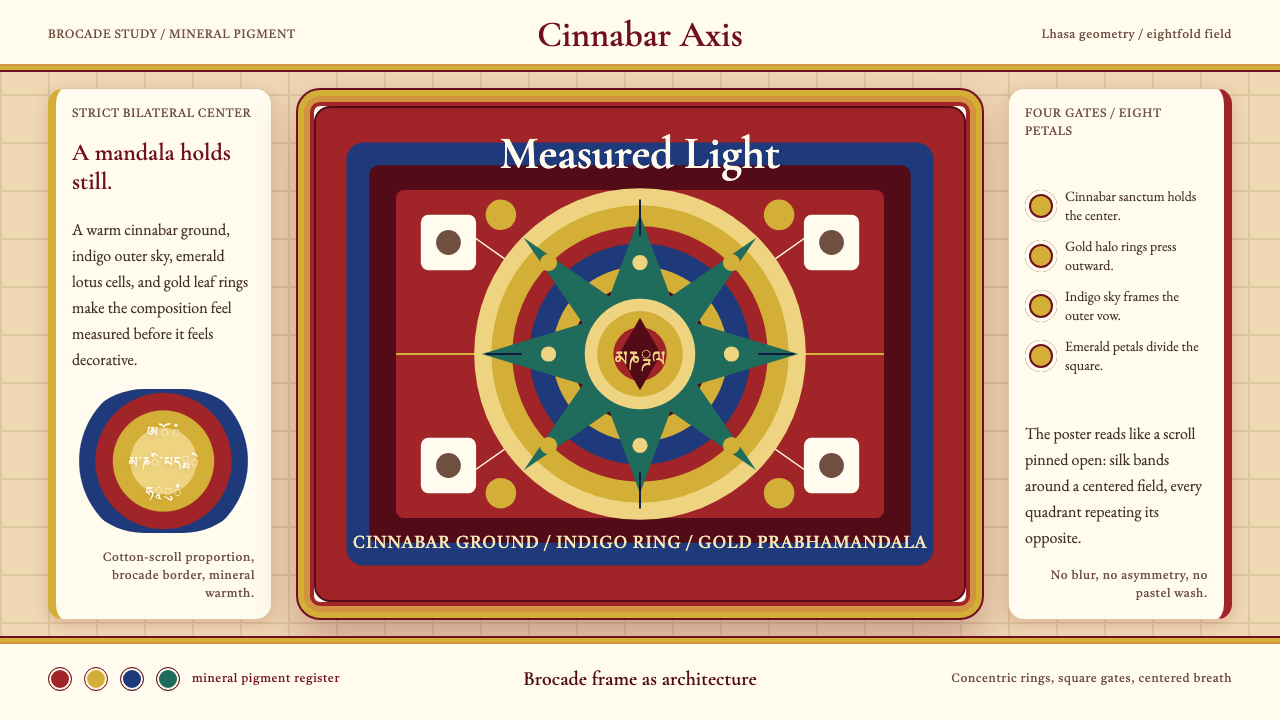 Tibetan Thangka MandalaSacred order burns warm. Cinnabar symmetry, gold halos, indigo rings, brocade…
 Alchi Monastery MuralDevotional depth. Lapis fields and coffered grids glow on terracotta plaster.
 Bhutanese Dzong (Fortress Red)Monumental red holds the page. Cobalt frames and gold bands lock the fortress…