What is T'boli T'nalak?
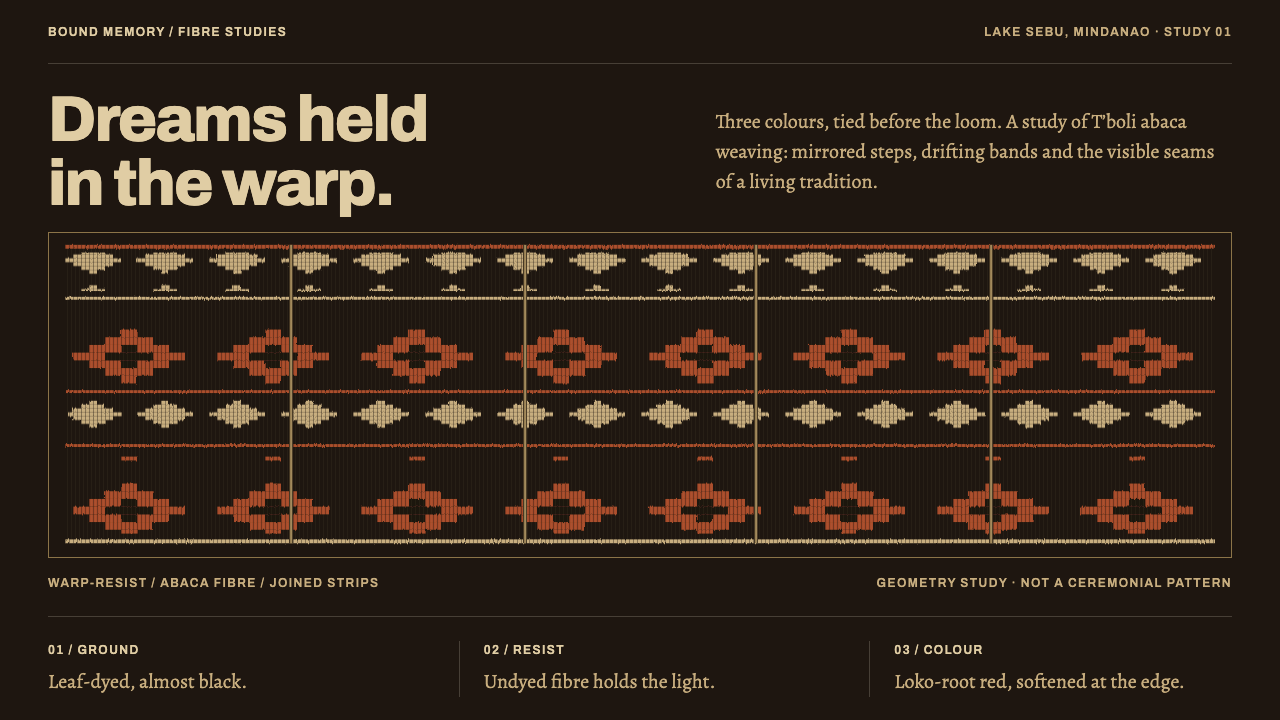
T'nalak is a cloth whose patterns are said to arrive in dreams — rust red and undyed abaca marching in mirrored, stepped bands across a ground boiled near-black, with every hand-tied edge left to feather.
T'boli T'nalak in brief
T'nalak is a warp ikat cloth woven from stripped abaca fibre by T'boli women around Lake Sebu in Mindanao, in the southern Philippines. In ikat, the threads are tied and dyed before weaving, so the pattern is built into the warp itself rather than printed or embroidered afterwards. T'nalak uses only three colours: a ground boiled near-black, figures left the colour of the natural undyed fibre, and a rust red drawn from root. The effect is dark, dense and quietly dramatic.
Its visual signature is a disciplined geometry that is never quite mechanical. Every figure is stepped and bilaterally mirrored, so that the left half of a motif answers the right half, and the figures march in horizontal bands along the length of the warp. Yet nothing is machine-true. The bands drift a little, dye creeps under each tie and feathers the edge of every shape, and narrow woven strips are joined selvedge to selvedge with the seam left showing.
As a design system, T'nalak translates this into a near-black ground, mirrored and stepped ornament, three-colour restraint and edges that soften slightly instead of cutting cleanly. It is a style that rewards patience: its richness comes from repetition and from handmade irregularity inside a rigorous structure, not from variety of colour or ornament.

Where does T'boli T'nalak come from?
T'nalak belongs to the T'boli people of Lake Sebu in South Cotabato, Mindanao, and Curio's source treats the tradition as continuous from before 1900 to the present. It sits within the wider family of Southeast Asian warp ikat and, more locally, within the indigenous textile traditions of the Philippines. Its raw material is abaca, a plant of the banana family whose fibre is stripped from the leaf sheath, then prepared into thread: a craft with its own long history in the Philippines.
The tradition is defined by where its designs are said to come from. T'boli weavers, women who are sometimes called dream weavers, receive their patterns in dreams from Fu Dalu, the goddess of abaca. The weaver is therefore less an inventor than a custodian: her role is to carry a received pattern faithfully into cloth. This shapes the aesthetic. The motifs are inherited and repeated, and the system's authority comes from continuity rather than novelty.
The making is slow and physical. Abaca is stripped and prepared, threads are tied into bundles to protect the parts that will remain undyed, and dye is applied in stages. The near-black ground is boiled in the leaves of the k'nalum tree; the rust red is drawn from loko root; the tied parts stay the natural colour of the fibre. According to the tradition the three colours carry meaning: the undyed fibre stands for purity, the red for the blood of the ancestors, the black for the earth from which the people come. After weaving on a narrow loom, the cloth is beaten and burnished with cowrie shell, which leaves a dull, waxy sheen. Because the loom is narrow, wide cloths are made by sewing strips together edge to edge, and the seams stay visible.
T'nalak is also a living, regulated practice. Curio's source names three weavers as key figures: Lang Dulay, Barbara Ofong and Sebulan Dulay. The cloth carries ritual and social weight, and tradition holds that it should not be stepped over or cut carelessly. For designers, this is an important context: the visual logic of t'nalak can inspire a system, but the cloth and its motifs belong to a community, and the system should be approached with respect for that ownership rather than as free decorative material.
What defines the T'boli T'nalak look?
Near-Black Ground
The ground is boiled into a deep near-black, not a pure flat black: a dense, slightly warm darkness with a faint matte, waxy quality. Everything else is read against it, so the contrast is never subtle. Because the dark is the dominant field, the system is dark by nature, and the figures glow out of it like light coming through threads. A layout in this style should commit to the dark ground rather than hedging with mid-tones.
Three-Colour Restraint
Only three colours are allowed: the near-black ground, the natural tone of undyed abaca for figures, and a rust red. The tradition gives each a meaning — purity, ancestral blood, the earth — and the palette feels inevitable rather than chosen. No fourth colour is introduced for emphasis, no tints or gradients smooth the transitions. The limit is what lets simple repetitions produce a rich result.
Stepped Angular Figures
The motifs are built from steps and angles: diamonds, crocodile and frog forms, flame-like saw-tooth rows. Curves are rare, because figures are made by tying bundles of thread, which resolves everything into stepped edges. The geometry is closer to pixel art or cross-stitch than to smooth vector drawing. Ornament in this style should be assembled from small repeated units rather than drawn as flowing outline.
Bilateral Mirroring and Horizontal Bands
Each figure is mirrored left to right, and the figures line up in horizontal bands that run along the warp. The effect is a steady, processional rhythm: bands of ornament separated by plain stretches of dark ground, repeating like a chant. Symmetry is local to each figure, while the larger cloth can still shift and drift. This structure translates well to headers, section dividers, tables and timelines.
Feathered Ikat Edges
Where thread was tied, dye creeps underneath and leaves a soft, fuzzy transition, so every figure has a feathered rather than a razor-sharp edge. This is the signature imperfection of ikat, and it should be kept in ornamental areas as a slight softness at the boundary of shapes. Text, controls and data should stay crisp for legibility; the feathering belongs to the decorative bands and large hero fields, where it adds warmth and the sense of thread.
Drift, Seams and Waxy Burnish
Nothing is machine-true: bands drift slightly out of line, narrow strips are joined edge to edge with the seam left visible, and the whole cloth is burnished with cowrie shell until it carries a dull, waxy sheen. The surface is low-gloss, never shiny and never rough. In design, this argues for small misalignments, visible joins between panels, and surfaces with a soft matte finish instead of glossy highlights.

Who shaped T'boli T'nalak?
Lang Dulay is the best-known T'boli master weaver and is honoured by the Philippine state as a National Living Treasure. Her name appears first among Curio's key figures, and she is widely regarded as a symbol of t'nalak as a transmitted skill. For designers she represents the tradition at its most disciplined: strict three-colour palettes, rigorous mirrored motifs and a practice rooted in dreams and continuity rather than novelty.
Barbara Ofong is a T'boli weaver named in Curio's source alongside Lang Dulay. Her presence in the list is a reminder that t'nalak is a community practice carried by multiple weavers, not a single master's invention. The cloth survives because several people keep tying, dyeing and weaving to the same inherited standards, each hand leaving small differences that make the surface alive.
Sebulan Dulay is the third weaver named in the source. Together the three names point to continuity: a tradition that is transmitted among practising weavers around Lake Sebu and sustained by their repeated labour. For the design system, that continuity explains why the style prizes repetition, patience and tiny handmade variation over spectacle.
Fu Dalu is the goddess of abaca, who according to T'boli tradition gives weavers their patterns in dreams. She is the origin of the cloth's authority: designs are received, not invented, and the weaver's task is faithful rendering. For anyone borrowing from the style, Fu Dalu is a reminder that the motifs carry a spiritual lineage and deserve to be handled with care.
How do you use T'boli T'nalak today?
T'nalak is a dark, textural system with a strong cultural lineage, so it works best when the project has something to say about craft, fibre, memory or place. Borrow its logic — near-black ground, three colours, mirrored bands, soft ikat edges — and avoid copying specific traditional motifs as a decorative skin. The structure alone is distinctive enough.
For presentation slides, the cover can be a near-black field with a single horizontal band of rust-red and natural-tone stepped ornament, mirrored around the centre, and the title in the natural fibre tone below. Content slides stay mostly dark and plain, with a thin band repeated as a section marker. Data slides suit horizontal bar charts and timelines especially well, since the cloth itself is organised in horizontal bands; limit them to the three colours and avoid gradient fills.
On the web, the style suits dark-mode editorial sites, craft and textile shops, cultural platforms, museum and archive sites, and sustainability or heritage brands. A header can carry a mirrored band, dividers can echo the stepped pattern, and cards can sit on the dark ground with a soft waxy surface rather than a glossy one. Keep controls, form fields and body text crisp and high-contrast; apply the feathered, hand-tied softness to the ornamental bands only, so that the interface stays accessible.
In editorial and marketing work, the system can support long-form stories about makers, materials and sources. Narrow text columns on a dark ground mirror the narrow loom; pull-quotes can sit between stepped bands; photography of fibre, thread and hands works best treated simply, in warm tones, without heavy filters. Credit the tradition and its weavers where the design draws on it explicitly, and keep claims accurate.
The most common mistake is making the pattern too clean. Perfect vector edges, perfectly aligned bands and razor-sharp shapes remove the sense of thread and hand. Other mistakes include adding extra colours for emphasis, reversing the scheme so that undyed cream becomes the page and the dark becomes a minor accent, using glossy effects against the waxy matte finish, and reproducing traditional figures such as the crocodile or frog as free clip-art. Take the structure, the restraint and the rhythm; leave the sacred motifs to the weavers.

T'boli T'nalak — FAQ
What is t'nalak, and how is it made?
T'nalak is a warp ikat cloth woven from stripped abaca fibre by T'boli women around Lake Sebu in Mindanao. Threads are tied into bundles to resist dye, then dyed in stages: a near-black ground from k'nalum leaves, a rust red from loko root, and the tied parts left in natural fibre colour. The cloth is woven on a narrow loom, strips are joined edge to edge, and the finished surface is burnished with cowrie shell to a dull, waxy sheen.
Why does the system use only three colours?
Because the cloth itself uses only three: the near-black dyed ground, the natural undyed fibre and a rust red. In the tradition each carries meaning, and the limitation is a large part of the style's strength. A narrow palette makes repeated bands read as rhythm rather than variety, and it keeps the dark ground dominant. Adding a fourth colour breaks the logic, so a new accent should be created by changing proportions, not by introducing a new hue.
Should the feathered edges be reproduced in interface design?
Only in decorative areas. The feathering comes from dye creeping under each tie and is one of the cloth's defining qualities, so ornamental bands and hero artwork can carry a slight softness at the boundary. Text, buttons, form fields and charts should remain crisp to stay legible and accessible. A useful rule is to separate ornament from information: let ornament look hand-tied, and let information look clear.
Is it appropriate to use a design system based on T'boli cloth?
It can be, if the use is respectful and informed. The system borrows structural ideas — a dark ground, three colours, mirrored stepped bands, visible seams — rather than reproducing sacred figures. The tradition holds that the patterns are received in dreams and that the cloth carries ritual weight, so avoid using traditional motifs as casual decoration, avoid claiming authenticity for products unrelated to the community, and credit the T'boli and their weavers when the reference is explicit.
Can T'nalak work on a light background?
It is a dark-ground system by nature, with the undyed fibre appearing as figure rather than field. A light version would invert the relationship and lose the glow that makes the style work. If a light surface is required, use a restrained panel of natural fibre tone inside a mainly dark layout, with the near-black and rust red bands acting as structure. Treat this as an adaptation, and keep the three-colour rule intact.
Related design styles
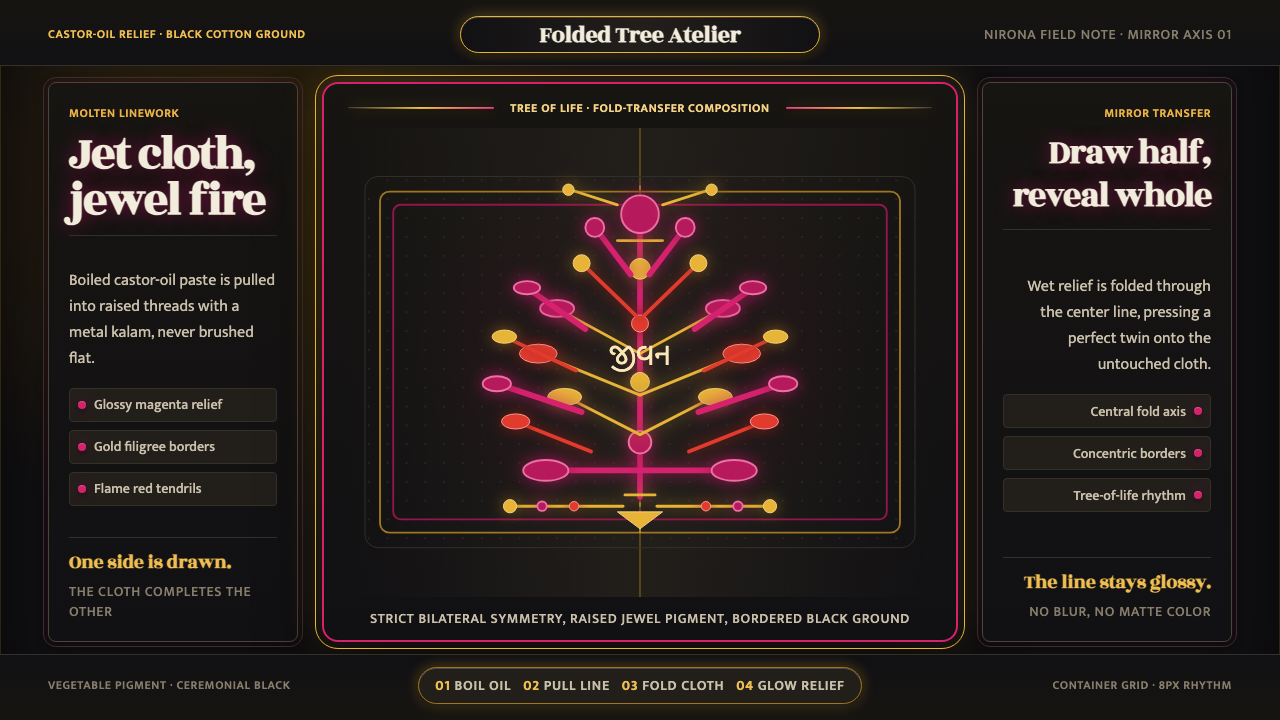 Kutch Rogan Castor-Oil PaintingGlossy symmetry holds the dark. Magenta castor-oil lines mirror across black…
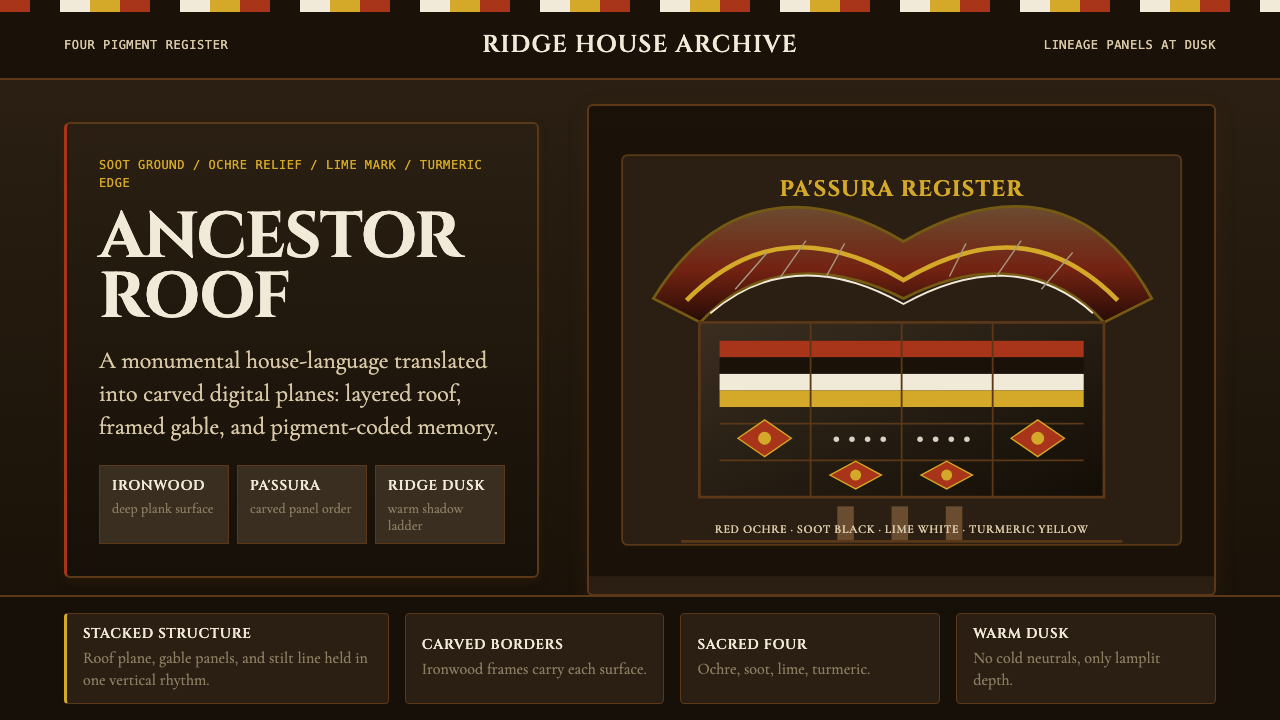 Torajan Tongkonan (Boat-Roof House)Ancestral dusk, carved in color. Soot black frames ochre, lime white, and tur…
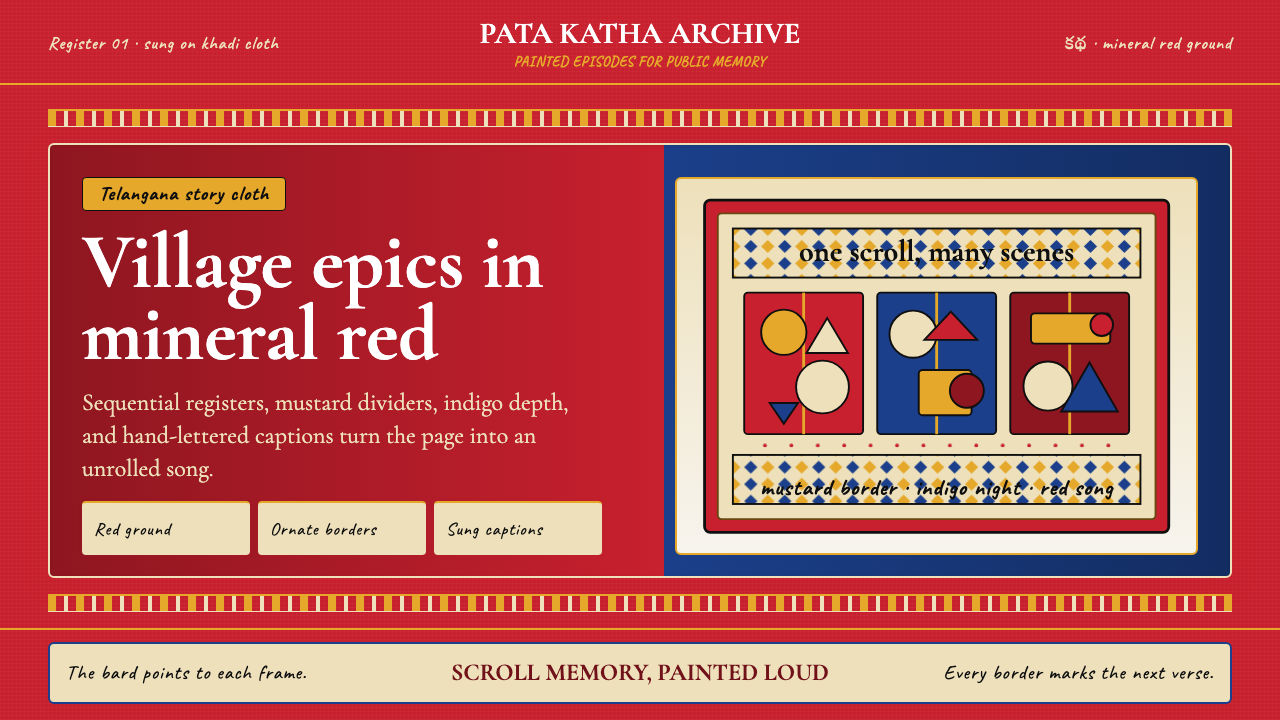 Andhra Cheriyal Scroll PaintingSaturated oral memory. Mineral red registers, mustard diamonds, and serif son…
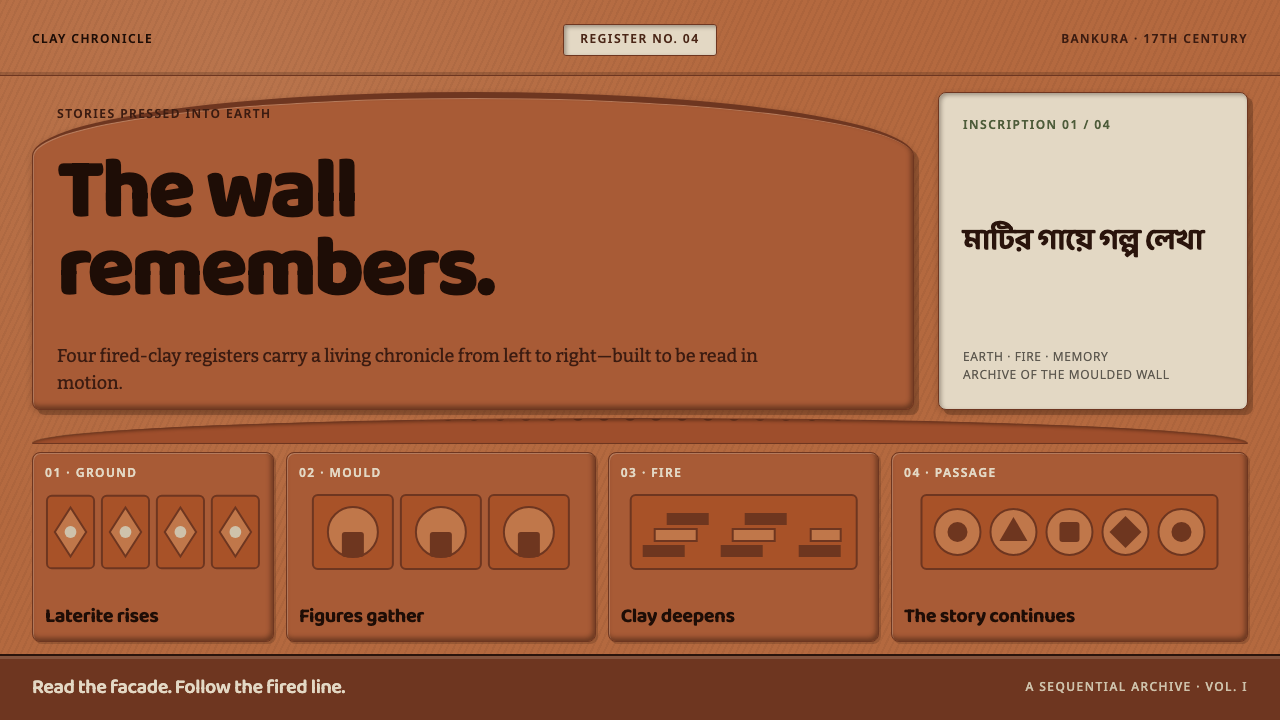 Bishnupur Terracotta TemplesThe wall tells the story. Fired-clay relief panels unfold in warm horizontal…
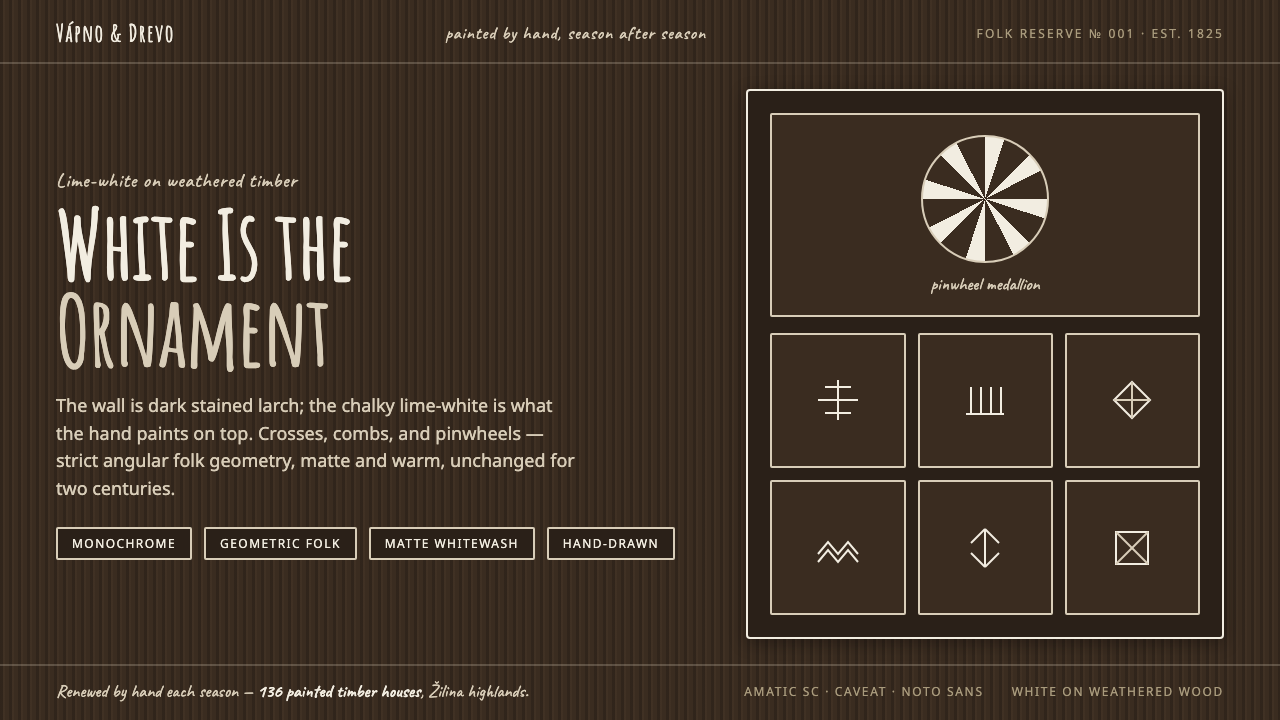 Čičmany Painted House OrnamentWhite is the ornament, not the page. Lime-white folk geometry on dark weather…
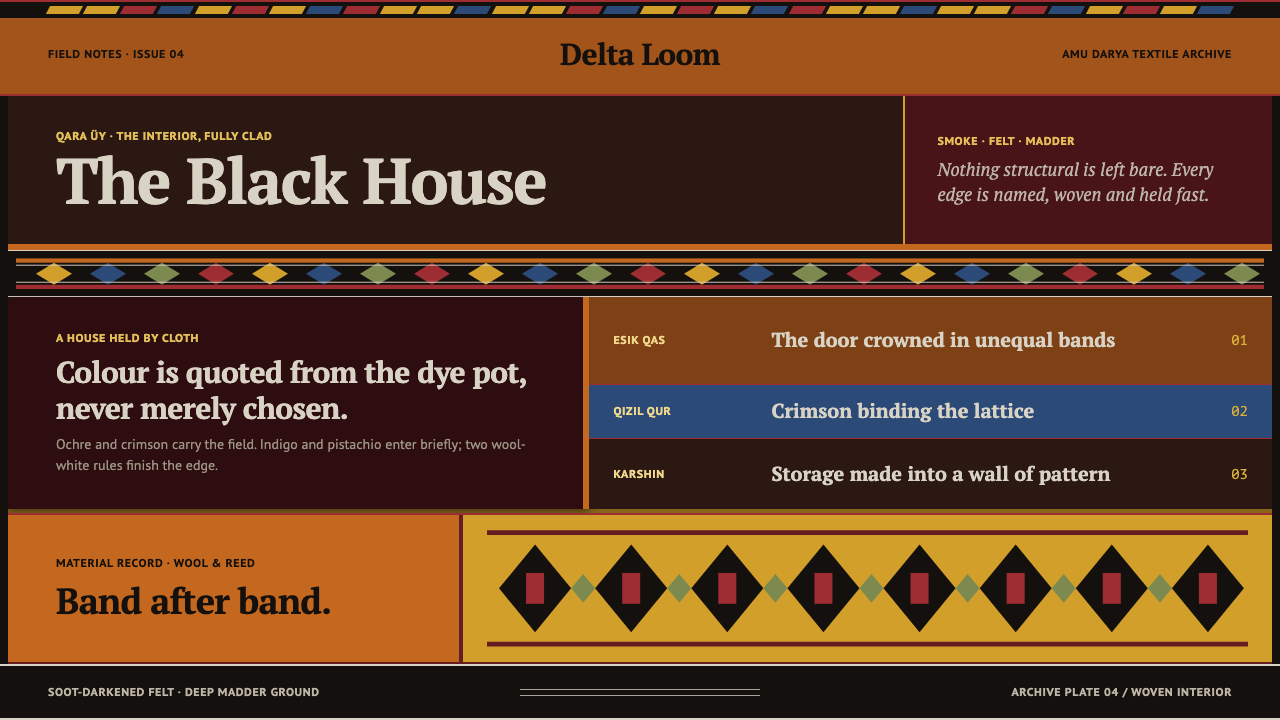 Karakalpak Yurt InteriorNo surface is left bare. Ochre, crimson and indigo bands wrap a smoke-darkene…