What is Sundanese Angklung?
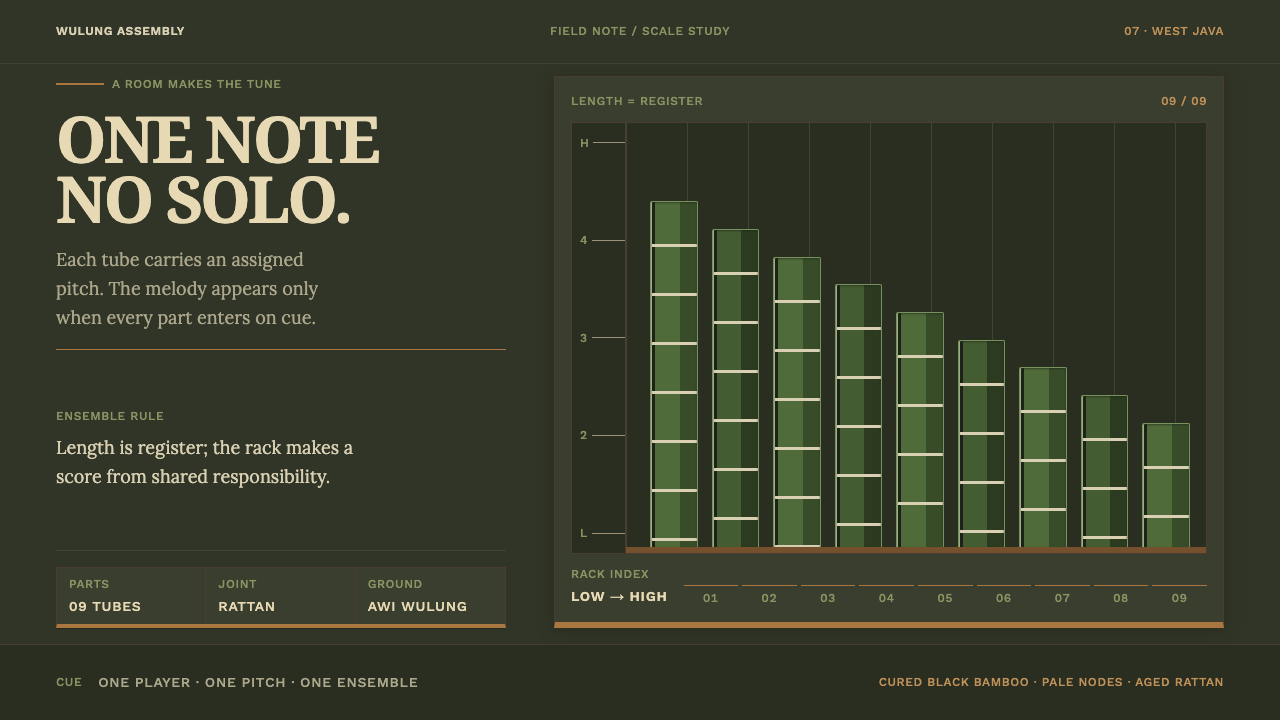
No single angklung can play a tune — each sounds one pitch only — so the Sundanese design system is built from graduated bamboo parts that only make sense together.
Sundanese Angklung in brief
An angklung is a Sundanese bamboo instrument made of two or three tubes tuned in octaves and hung loose inside a lashed frame. Shake it and it sounds one pitch, only one, forever. A melody therefore needs a room full of people, each holding a single note and entering on cue. As a design system, the angklung turns that constraint into a structure: every surface is a part of an assembly, and no element is a finished solo object.
The look follows from the material. The ground is cured black bamboo, dark and matte, with a faint green-brown warmth rather than a cold digital black. Tube lengths step down across a rack, so a scale reads as a bar chart made of bamboo. The pale rings at the joints of the cane become the graduations of an interface, and the rattan that lashes the frame together becomes its connectors. The result is dark without being dramatic, quiet without being empty.
What this system teaches is shared authorship. A layout built in its spirit does not ask one hero element to carry the page. It distributes roles: each tile, bar and panel has one job, one note, and the composition only completes when all of them are present and in order. That is the aesthetic of ensemble, and it suits any product whose value comes from people or parts working together.

Where does Sundanese Angklung come from?
The angklung belongs to West Java, Indonesia, and the source places it in the Sundanese highlands, in Bandung and in the Baduy villages. It dates the practice to centuries of Sundanese playing before 1900. The instrument is cut from awi wulung, a black bamboo, and put together as a small frame with tubes hanging inside it. Everything about it is hand-assembled and tuned, and everything about it is designed to rattle: the tubes are loose precisely so that a shake sets them sounding.
The source places the angklung within Sundanese karawitan, the tradition of Sundanese music-making, and names angklung buncis among the village forms. This is a communal instrument by origin. Because one angklung gives one note, playing was always a group activity, and playing a tune meant arranging players like the pitches in a scale. The Baduy villages and the highlands are not museums for this idea; they are where it still happens, and the design system inherits that sense of use rather than display.
A decisive change came in 1938, which the source calls Daeng Soetigna's diatonic reform. By retuning the instrument to the diatonic scale, Soetigna made it possible for groups of players to perform melodies familiar well beyond West Java, and to teach large groups quickly, since each person needs to master only one note and one cue. The reform did not alter the central principle of the instrument. If anything, it sharpened it: the instrument remains a machine for making individuals into an ensemble, only now in a scale that most listeners can hum.
The second name the source offers is Udjo Ngalagena, associated with Bandung and with the work of bringing angklung to audiences and learners. The tradition's modern recognition arrived in 2010 with its inscription on UNESCO's list of intangible cultural heritage. The inscription frames the angklung as a living practice rather than a relic, and it is the right frame for the design language too: this is a system for things that are played, taught and passed along, not for objects that sit alone in a case.
What defines the Sundanese Angklung look?
Cured Matte Ground
The ground is the colour of cured black bamboo: dark, matte and faintly warm, with a trace of green and brown that keeps it from reading as the cold void of a screen. It absorbs light rather than reflecting it. Everything else is placed on this ground the way tubes hang in a frame, which gives the system a calm, grounded presence that suits long sessions of reading and monitoring.
The Graduated Rack
Tubes step down in length across a rack, each shorter than the last, and the sequence is the scale. This is a bar chart before it is anything else: height is pitch, position is order. In a layout the graduated rack becomes a signature element for rankings, tiers, progress and comparisons, and it carries the idea that a series of different parts is more informative than any single one.
Node Rings as Scale Marks
The pale rings where the bamboo nodes sit become the graduations of the interface. They appear as light, thin marks along the dark bars, and they function as scale, tick and divider. Because they come from the cane itself, they feel structural rather than applied. Use them sparingly and regularly, as markers of position and measure, never as decoration.
Rattan Lashing as Connectors
The frame is lashed with rattan, and in the design the lashing is the joint: the way one part is tied to the next. Connectors, brackets, lines between nodes and the bands that group several items all take this role. They are visibly functional, firm without being heavy, and they show that the parts belong to the same assembly. The tie is a visual idea as much as a physical one.
One Part, One Note
No element carries the melody alone. Each tile, panel or bar is responsible for one thing, and the page is only complete when all of them are present. This is the opposite of the hero-centred layout, where one image or one headline does the work. In this system, a missing part is audible, and an over-large part drowns the others, so balance is the primary design problem.
Entering on Cue
Because each player has a single note, timing is everything: a player shakes the tube only at the right moment. In an interface this becomes sequence and rhythm. Elements arrive in order, steps are staged rather than dumped at once, and states change when it is their turn. The motion is measured and restrained, closer to a conductor's nod than a flourish, and it never competes with the content it is cueing.

Who shaped Sundanese Angklung?
The source dates his diatonic reform of the angklung to 1938. By retuning the instrument to the diatonic scale, he made it possible for groups to play melodies familiar far beyond West Java, and to teach whole classrooms quickly. His contribution is a design lesson in itself: he did not change the one-player, one-note principle, he changed the scale the principle serves, and in doing so widened the audience without weakening the idea.
Udjo Ngalagena is the source's second key figure, associated with Bandung and with taking angklung to learners and audiences. His name stands for the teaching side of the tradition, where the instrument is shared with people who have never played it. For a design system, this is the model of onboarding: give each newcomer one clear note and one cue, and let the group carry the rest.
The source names the Sundanese highlands, Bandung and the Baduy villages, with angklung buncis among the village forms. The players in these places are mostly unnamed, and that anonymity is consistent with an instrument that has no soloists. Their presence in the record is a reminder that the style belongs to communities that play, not to the designers who borrow from it.
UNESCO is not a person, but its 2010 inscription of the angklung on the list of intangible cultural heritage is a defining event in the source. It recognised the angklung as a living practice, handed down and performed, and it brought wider attention to the tradition. It also frames the right attitude for designers: borrow the structure respectfully, name the origin, and treat it as something alive.
How do you use Sundanese Angklung today?
The angklung system works for any product or document whose value comes from parts in relation to each other. Its principles are structural: a dark matte ground, graduated bars, light measuring marks and a firm sense that no part is complete alone.
For presentation slides, the cover can lead with a rack of graduated bars rising from the lower edge of a dark field, with the title set in plain, light type above or beside it. Content slides should treat each element as one note in the ensemble, so keep one idea per block, arrange blocks in an ordered row or grid, and let them appear in sequence. Data slides are the system's natural home: ranked bars, stepped distributions and comparisons across categories look right in graduated columns with thin light ticks along the side.
For web interfaces, the style fits dashboards, analytics, collaboration tools, status boards and any product with shared state. Keep the interface on the dark, matte ground, build cards as parts of a rack, and use thin light rules as scale and connection. Pricing pages can present tiers as graduated tubes, each tier a different length of the same family. Resist single dominant widgets; a screen in this system should read as several collaborating parts.
For editorial and marketing work, the angklung suits music education, community and cultural projects, events with many participants, team and open-source stories, and campaigns that depend on collective action. A poster might show a long, descending row of bars standing for people joining one by one. The tone is warm, communal and unhurried, and copy should speak in terms of 'together' and 'in turn' rather than 'the one'.
The most common mistake is to render literal bamboo, with photographic texture, glossy highlights or a skeuomorphic frame, which turns a structural idea into a themed costume. A second mistake is to restore the hero element, a huge centrepiece that overpowers the rack and defeats the ensemble logic. A third is to brighten the ground or the node rings until the dark matte quality is lost; the rings are marks, not highlights, and the ground is cured wood, not neon on black.

Sundanese Angklung — FAQ
Why does an angklung play only one note?
Because it holds two or three tubes tuned in octaves, so shaking it sounds the same pitch in more than one register, and nothing else. Each tube hangs loose in a lashed frame and is built to resonate at one frequency. That is why a tune needs a room of people, each with a different instrument, entering on cue. The limitation is the whole idea: the instrument turns a group into a single, many-voiced player.
What is awi wulung, and why does the dark ground matter?
Awi wulung is the black bamboo from which the angklung is made. In the design system its cured, matte, faintly green-brown darkness becomes the ground on which everything sits. It matters because it keeps the system warm and tactile rather than glossy, and because it gives the pale node rings and the graduated bars something to read against. Replace it with pure black or a bright background and the character changes.
What did Daeng Soetigna change in 1938?
The source calls it a diatonic reform. Soetigna retuned the instrument to the diatonic scale, which allowed groups to play melodies that listeners far beyond West Java could recognise, and which made it easy to teach many players at once. The core principle of one player and one note stayed the same. In design terms he updated the scale the system plays in without touching its logic.
Is the graduated rack just a bar chart?
It reads as one, and that is useful, but it is more than a chart. The rack carries the idea that each part has a specific role and that the whole only works when all of them are present and ordered. Use it for data when you want to show a series, and also for navigation, tiers and progress. Keep the bars unglossy, give them thin node-ring ticks, and tie them together with a lashing-like connector so they feel like one instrument.
Does the style work on a light background?
It is designed as a dark-ground system, where cured black bamboo is the surface and the pale rings and bars read against it. A light inversion is possible for print or accessibility needs, but the matte, warm darkness is the identity. If you must invert, keep the same graduated structure, use a warm off-white rather than a stark one, and keep the node-ring marks dark and thin so the sense of a bamboo rack survives.
Related design styles
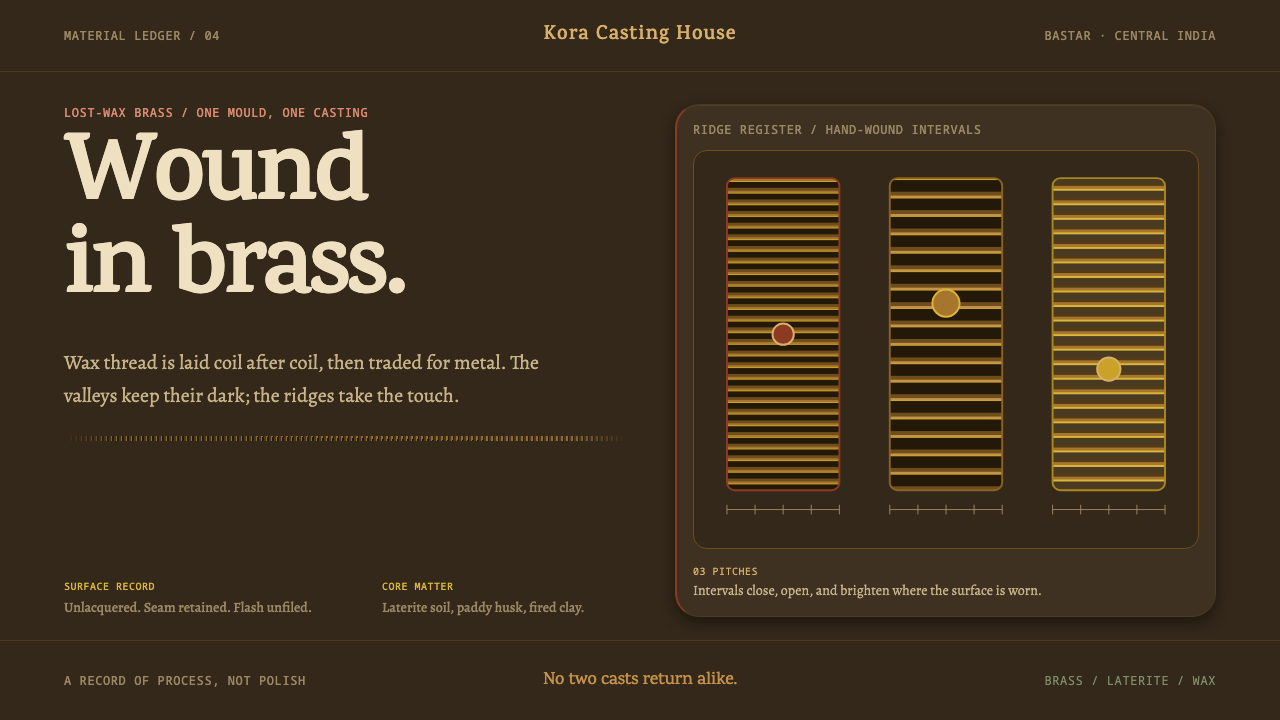 Dhokra Bastar BronzeProcess stays visible. Dark coil valleys and rubbed brass ridges make every c…
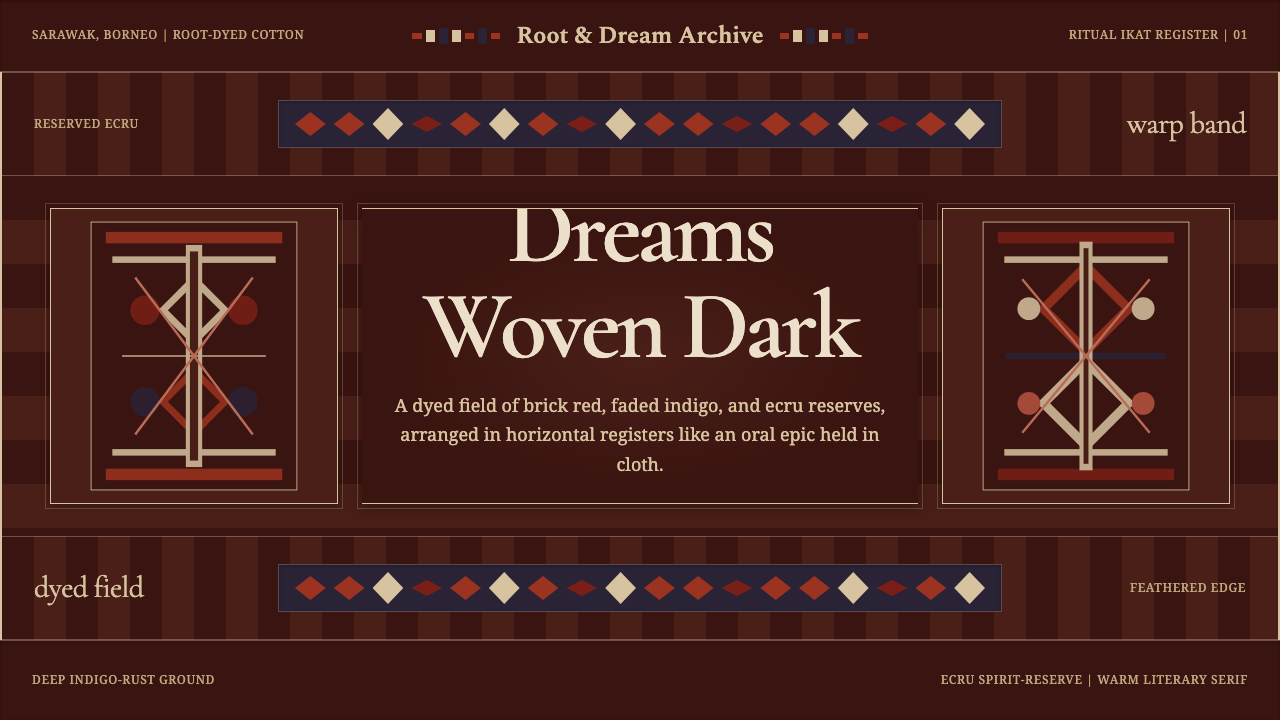 Iban Pua KumbuSacred cloth logic. Indigo-rust bands, ecru reserves, and blurred ikat edges…
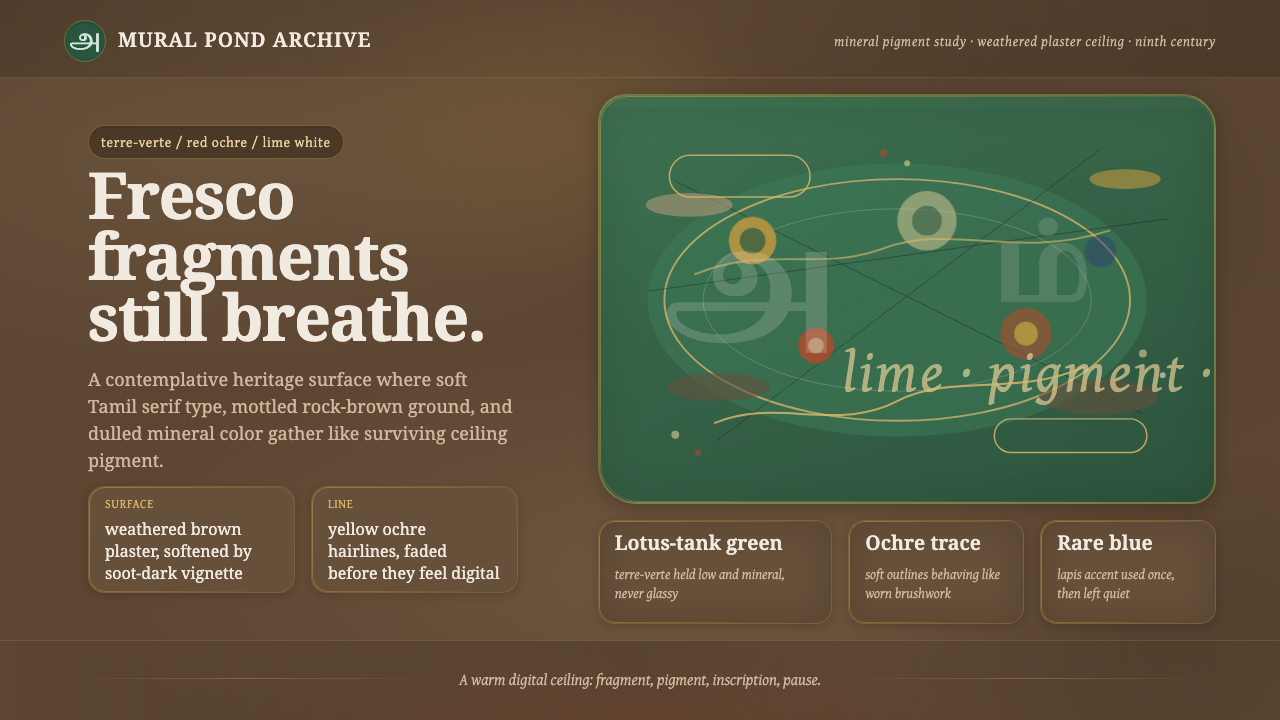 Sittanavasal Jain Cave FrescoBreathes through age. Terre-verte green and ochre lines fade into brown plast…
 Altai Kai EpicEpic voice burns until dawn. Smoke-brown layers meet one pale string and a si…
 Cheese Affinage CavePatience reads as stone. Rind brown, mold green, and oak shelf grids glow in…
 Desert VarnishStone remembers. Sandstone glyphs cut through near-black varnish in stacked f…