What is Sufi Whirling (Konya)?
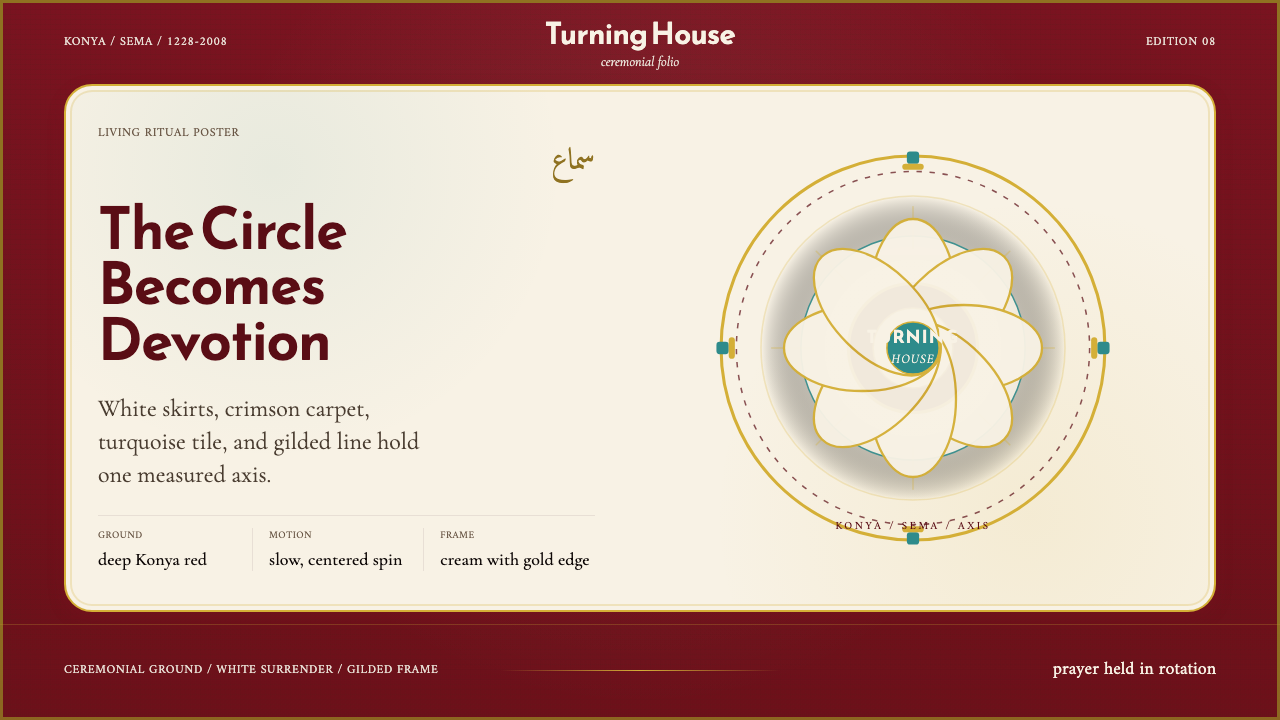
The Mevlevi sema turns devotion into visual language — deep crimson grounds, white arcs of surrender, turquoise from a poet's tomb, and gold from centuries of Ottoman reverence.
Sufi Whirling (Konya) in brief
Sufi Whirling (Konya) is a design system rooted in the visual world of the Mevlevi sema ceremony — the ritual whirling practice of the Mevlevi Sufi order founded in thirteenth-century Konya, Turkey. Its palette, compositional logic, and typographic sensibility all derive from that living ceremony: the deep-crimson Anatolian carpet on which dervishes spin, the pure white of their wide-skirted tennure robes signifying spiritual surrender, the luminous turquoise of Rumi's tomb dome rising above the city, and the gilded calligraphic ornament of Ottoman manuscript and tilework tradition.
The system is not a historical pastiche. It takes a ceremony still performed today — listed by UNESCO as an Intangible Cultural Heritage of Humanity in 2008 — and distills its essential visual grammar into a design language suited to contemporary screens, printed matter, and spatial environments. The result is simultaneously ancient and immediate: colors that read as warm and ceremonially weighted, compositions that carry a sense of circular, meditative motion, typography that honors both the Arabic calligraphic tradition and the classical Latin serif forms that have long coexisted in Turkish cultural life.
Where many design systems built on historical sources extract only surface detail — a color here, a motif there — Sufi Whirling (Konya) is structured around the ceremony's underlying logic: rotation as organizing principle, layered translucency as metaphor for spiritual proximity, and the tension between the earthly crimson ground and the pure white figure spinning above it. These structural ideas generate compositions that feel coherent and purposeful rather than merely decorative.

Where does Sufi Whirling (Konya) come from?
The Mevlevi order traces its founding to Mevlana Jalaluddin Rumi, the Persian-speaking mystic poet who settled in Konya around 1228 and remained there until his death in 1273. Rumi's thousands of verses — collected in the Masnavi and the Divan-i Kebir — form the theological and poetic foundation of Mevlevi practice. The sema ceremony itself, as a codified ritual form, was shaped significantly by his son Sultan Veled after Rumi's death, around 1312, when the order was formally established with Konya as its spiritual center. The ceremony's seven movements, each carrying distinct symbolic meaning, the specific garments worn, and the musical ensemble featuring the ney reed flute and the kudum drum were all formalized in this period.
Ottoman patronage from roughly 1450 onward transformed the Mevlevi order from a regional Anatolian institution into an empire-wide religious and cultural force. Sultans and viziers endowed mevlevihaneler — the lodge-complexes where dervishes lived, trained, and performed — across the empire from Istanbul to Damascus to Cairo. This patronage brought the order into contact with the full weight of Ottoman visual culture: the master tilework of Iznik ceramics in their characteristic turquoise and cobalt, the gilded illuminated manuscripts of the imperial scriptorium, the geometrically complex arabesque ornament of mosque interiors. The visual identity of Sufi Whirling (Konya) draws on this Ottoman synthesis as much as on the ceremony itself.
The order was suppressed along with all other Sufi orders in Turkey by Atatürk's secular republic in 1925, and the Konya tekke was closed. For nearly three decades the sema could not be publicly performed. A significant reversal came in 1953, when performances were allowed to resume in Konya — initially framed as cultural rather than religious events. The decades-long interruption paradoxically helped preserve the ceremony's visual and musical form by subjecting it to scholarly documentation and curation rather than organic evolution. When full practice resumed, the ceremony's aesthetic details — the specific shade of the dervish's white robe, the proportions of the tall felt sikke hat, the arrangement of the musical ensemble — had been carefully recorded and were restored with unusual fidelity.
UNESCO's 2008 inscription of the Mevlevi sema on the Representative List of the Intangible Cultural Heritage of Humanity marked the ceremony's global recognition not only as a living spiritual practice but as a form of embodied cultural knowledge. Today the sema is performed regularly in Konya and in Mevlevi communities around the world. The visual material generated by centuries of Mevlevi and Ottoman practice — the architectural fabric of the Mevlana Museum complex in Konya, the surviving illuminated manuscripts, the ceramic tilework, the embroidered textiles — constitutes one of the richest documented visual traditions in the Islamic world, and it is from this record that the Sufi Whirling (Konya) design system takes its precise aesthetic cues.
What defines the Sufi Whirling (Konya) look?
Palette: Crimson, White, Turquoise, Gold
The four-color palette is derived directly from the ceremony's visual field. The deep crimson — the color of the traditional Konya carpet and of the earthly plane in Sufi cosmology — serves as the dominant ground tone, warm and weighty. Pure white, the color of the dervish's robe, reads as luminous and expansive against this ground. Turquoise, taken from the glazed tile of Rumi's tomb dome, provides the system's coolest note — a color historically associated with paradise and divine mercy in the Persian-Turkish tradition. Gold, derived from Ottoman gilded calligraphy and illuminated manuscript borders, functions as an accent of reverence, used sparingly and with intention. These four colors carry accumulated cultural meaning; they are not simply chosen for aesthetic balance.
Rotational Composition
The organizing compositional principle is circular rather than rectilinear. While the system uses grid structures for text and data, its visual focal elements — figures, imagery, decorative motifs — are arranged along curves and arcs, or positioned to imply rotation around an implied center point. This reflects the sema's central act: the dervish spinning with right hand raised toward heaven and left hand turned toward earth, the body as axis between the divine and the earthly. Compositions built on this principle carry a sense of continuous, unhurried movement — a quality distinct from the static grid compositions that dominate contemporary digital design.
Layered Translucency
Unlike design systems that enforce flat, opaque surfaces, Sufi Whirling (Konya) uses overlapping translucent forms to suggest depth and spiritual proximity — the idea, central to Sufi thought, of veils between the perceiver and the real. White forms set against crimson grounds with reduced opacity create a luminous, diaphanous quality reminiscent of the dervish's robe in motion. Gold elements rendered as semi-transparent overlays on turquoise evoke the effect of gilded manuscript illumination on a colored ground. This translucency is not decorative softness; it is a structural device that creates visual hierarchy and an atmosphere of contemplative depth.
Calligraphic Typography
The typographic sensibility of the system honors two parallel traditions: the Arabic Naskh calligraphic script — one of the primary scripts used in Rumi's manuscripts and in Ottoman religious texts — and classical Latin serif letterforms, which carry a comparable sense of historical weight and craft. The two traditions are not mixed within a single text block; rather, they are used in counterpoint — calligraphic forms for headings, ornamental labels, or pull quotes where contemplative character is desired, and classical serifs for body text where legibility over extended reading is the priority. Both traditions share a quality of deliberate, measured stroke; this shared sensibility makes them visually compatible despite their different cultural origins.
Geometric Arabesque Ornament
The system incorporates geometric arabesque patterning — the mathematically precise interlaced star and polygon forms characteristic of Ottoman tile, woodwork, and manuscript borders — as a controlled ornamental register. Unlike styles where decoration accumulates without discipline, arabesque ornament here is used at borders, separators, and background fields in a carefully modulated way: present enough to establish cultural register and visual warmth, restrained enough not to compete with content. The patterns used are geometrically derived from historical Konya and Ottoman sources, characterized by six- and eight-pointed star geometries with interlaced continuous lines.
Meditative Negative Space
The sema ceremony is organized around stillness as much as movement — the dervishes spin, but the space between them and the watching sheykh is charged with silence. The design system reflects this by treating negative space not as emptiness to be filled but as active presence. Generous margins, wide leading in text, and compositional voids around central figures create a quality of breath and contemplation. This approach is at odds with the density-maximizing tendency of much contemporary digital design, but it is precisely this expansiveness that gives the style its ceremonial gravity.
Warm Material Weight
The overall tactile quality of the system is weighted and textured rather than sleek and cool. This is achieved not through photographic texture overlays but through the inherent warmth of the palette — the deep red ground reads as fabric-like, the gold accents read as metallic — and through the use of slightly irregular, handcrafted-feeling calligraphic forms alongside the geometric precision of the arabesque. The result is a system that reads as simultaneously rigorous and humanly made: the precision of a master craftsman's tile rather than the precision of a laser-cut template.

Who shaped Sufi Whirling (Konya)?
Rumi (1207–1273) is the founding poetic and theological authority of the Mevlevi tradition. Born in Balkh (present-day Afghanistan) and educated across the Persian-speaking Islamic world, he settled in Konya around 1228, where he would spend the rest of his life. His Masnavi — a six-volume spiritual poem in Persian, often described as the Persian Quran — and the lyric verses of the Divan-i Kebir are the textual foundation of Mevlevi practice. Rumi's tomb, housed in the Mevlana Museum complex in Konya, is topped by the distinctive fluted turquoise dome that gives the design system one of its defining colors. His influence on Persian, Turkish, and globally translated mystical literature is without parallel.
Sultan Veled (1226–1312), Rumi's eldest son, is credited with formally organizing the Mevlevi order after his father's death and codifying the sema ceremony into the structured ritual form it retains today. He established the order's administrative hierarchy, defined the roles of the sheykh and the dervishes within the ceremony, and composed music for the sema including some of the earliest-known Mevlevi compositions. Sultan Veled's organizational work transformed his father's spiritual circle into an enduring institutional order, ensuring that the ceremony's visual and musical forms were transmitted across generations with the consistency that makes them recoverable centuries later.
Şefik Can (1919–2005) was a Turkish scholar, poet, and Mevlevi practitioner who played a central role in the preservation and transmission of Mevlevi practice through the decades when it was suppressed and then carefully restored in Turkey. His extensive scholarship on Rumi's poetry and on Mevlevi ritual practice provided the documentary foundation that allowed authentic restoration of the ceremony's details — including its visual and musical dimensions — when public performance resumed. Can Dede represents the scholar-practitioner model through which living knowledge of the ceremony's precise aesthetic forms survived the institutional rupture of the twentieth century.
The Mevlevi tradition produced some of the finest examples of Persian and Turkish calligraphy and manuscript illumination across several centuries of Ottoman patronage. The anonymous master calligraphers and illuminators who produced the gilded, turquoise-bordered, and geometric-patterned manuscripts held in the Mevlana Museum and in Istanbul's Topkapi Palace archives are the direct visual ancestors of the Sufi Whirling (Konya) design system's typographic and ornamental language. The precise geometric arabesque borders, the calibration of gold and turquoise against warm cream vellum, and the relationship between calligraphic text and illuminated margin all inform the system's visual decisions in ways that no named individual can fully claim credit for.
How do you use Sufi Whirling (Konya) today?
Sufi Whirling (Konya) is a system defined by warmth, ceremonial weight, and meditative pacing. Applying it effectively requires understanding what it is doing structurally — using the tension between a heavy crimson ground and luminous white forms to create depth, using rotational composition to create movement, using gold and turquoise as carefully rationed accents of reverence and serenity — rather than simply layering its colors onto a neutral layout.
For presentation slides, the system is strongest when applied with restraint and scale. A cover slide benefits from the full weight of the palette: a deep crimson ground with a centrally or asymmetrically placed white form — a circle, an arc, a silhouette — and a title set in classical serif type with gold used only as a single accent element. Content slides should keep body text in white or near-white on the crimson ground, with section headings differentiated by size and by turquoise rather than by additional typefaces. Data slides work well when chart elements are assigned palette colors with purpose — crimson for primary series, turquoise for secondary, gold for highlight — and surrounded by sufficient margin that the data reads within the system's contemplative pacing rather than in spite of it.
For web interfaces, the system suits platforms where trust, cultural depth, and considered experience are the desired values: cultural institutions, luxury goods, editorial platforms, retreat and wellness services, and educational environments in the humanities. Dashboard applications can use the palette effectively by assigning the crimson ground to header regions and navigation, white to content areas, and turquoise to interactive states or positive data indicators. The rotational composition principle translates well to hero sections and feature spotlights: circular image treatments, arc-shaped dividers, and radially arranged iconography all extend the system's logic into interface patterns.
For editorial and marketing work, Sufi Whirling (Konya) delivers strong visual authority in contexts where the content carries historical or spiritual weight — cultural journalism, arts and humanities publishing, travel editorial focused on Turkey or the broader Islamic world, and luxury brand stories with artisan or heritage narratives. A Sufi Whirling editorial spread works well with a predominantly crimson or near-black background, generous white text set in classical serifs at a relatively large measure, and turquoise used for pull quotes or section breaks. Marketing pages benefit from the system's poster-like ability to hold a single strong figure — a white-robed form, a calligraphic headline, a geometric motif — against the weighted crimson ground, reserving gold for calls to action that should feel earned rather than urgent.
A common mistake when applying Sufi Whirling (Konya) is treating it as a general warm-toned Middle Eastern style — loosely mixing its colors with other regional motifs or defaulting to a generic 'exotic' visual register. The system is specific: it is Mevlevi, Ottoman, and Anatolian, not broadly Islamic or generically Eastern. A second common error is deploying all four palette colors simultaneously at full saturation, which erases the system's careful tonal hierarchy. Authentic use typically leads with the crimson ground, carries the white as the primary figure, and uses turquoise and gold sparingly — the way a dervish's single gold-embroidered collar mark reads against an otherwise undecorated white robe.

Sufi Whirling (Konya) — FAQ
Is this system only appropriate for projects with Islamic or Turkish content?
No, though cultural fit matters. The system's visual language is specific enough that applying it to unrelated content will create a strong sense of borrowed identity — which can work as deliberate artistic choice but feels incongruous as a general-purpose corporate style. It is most naturally suited to projects that share some of its underlying values: contemplation, craft, historical depth, and ceremonial seriousness. A cultural institution, a heritage brand, a spiritual practice platform, or a humanities publisher can use the system authentically even without direct Islamic or Turkish subject matter. A consumer tech startup or a casual entertainment product would feel misaligned.
How do you distinguish authentic Sufi Whirling application from generic 'Islamic-inspired' design?
The key is specificity and structural logic. Generic Islamic-inspired design tends to borrow surface elements — crescent shapes, arabesque swirls, gold filigree — without a consistent underlying system, resulting in decoration that feels applied rather than structural. Sufi Whirling (Konya) is built around a specific ceremony's visual logic: the crimson-white tension is not just a color combination, it is the earth-spirit duality of the sema; the rotational composition is not just a layout choice, it is the ceremony's central act made visual. Authentic application keeps this structural logic visible. When the palette, composition, and typographic choices all reinforce the same underlying idea — meditative rotation between earth and spirit — the result is coherent. When only the surface ornament is borrowed, the result is pastiche.
Can the system work on a light or white background, or does it require the deep crimson ground?
The deep crimson ground is the system's canonical base, and it is where the style's full weight is expressed. A light-background variant is possible and useful for long-form reading contexts — white or warm cream with crimson used as a strong typographic and border accent, turquoise for interactive elements, and gold used very sparingly. However, the light variant sacrifices the system's most distinctive quality: the luminous contrast between the weighted crimson earth and the white figure above it. If that tension is replaced by a light ground, the design will read as warm and classical but will lose the specific ceremonial gravity that differentiates it from other historically-informed serif styles. Use the light variant where readability over extended text is the primary requirement; use the crimson ground for high-impact, feature, and cover contexts.
How does the arabesque ornament work without making the design feel busy or dated?
The key is treating arabesque pattern as a tonal texture rather than a featured motif. When arabesque appears at low contrast against its ground — a slightly lighter crimson pattern on a crimson field, or a gold-toned pattern at reduced opacity on a cream background — it reads as surface depth rather than decoration. It enriches the ground without competing with the content placed above it. When arabesque is used at full contrast as a primary visual element, it becomes the focus, and the design's informational or narrative content has to compete with it. The former approach is authentic to how arabesque functions in its source contexts — as the background fabric of architectural surfaces and manuscript borders — while the latter is the error of treating an architectural material as a poster element.
What is the correct balance between the calligraphic and the Latin serif typographic registers?
The two typographic registers should be used in counterpoint, not in competition. The calligraphic register — whether realized through actual Arabic Naskh forms or through Latin serif typefaces with strong calligraphic heritage — belongs at the level of display: large headings, ornamental labels, opening pull quotes, and any typographic element meant to be seen before it is read. The classical Latin serif belongs at the level of extended text: body paragraphs, captions, data labels, and any context where reading over time is the purpose. Mixing them within a single text hierarchy — a calligraphic subheading immediately above a calligraphic pull quote above a calligraphic caption — eliminates the contrast that makes both registers legible in their distinct roles. One register should clearly dominate at any given scale; the other should appear only when the scale or function changes.
Related design styles
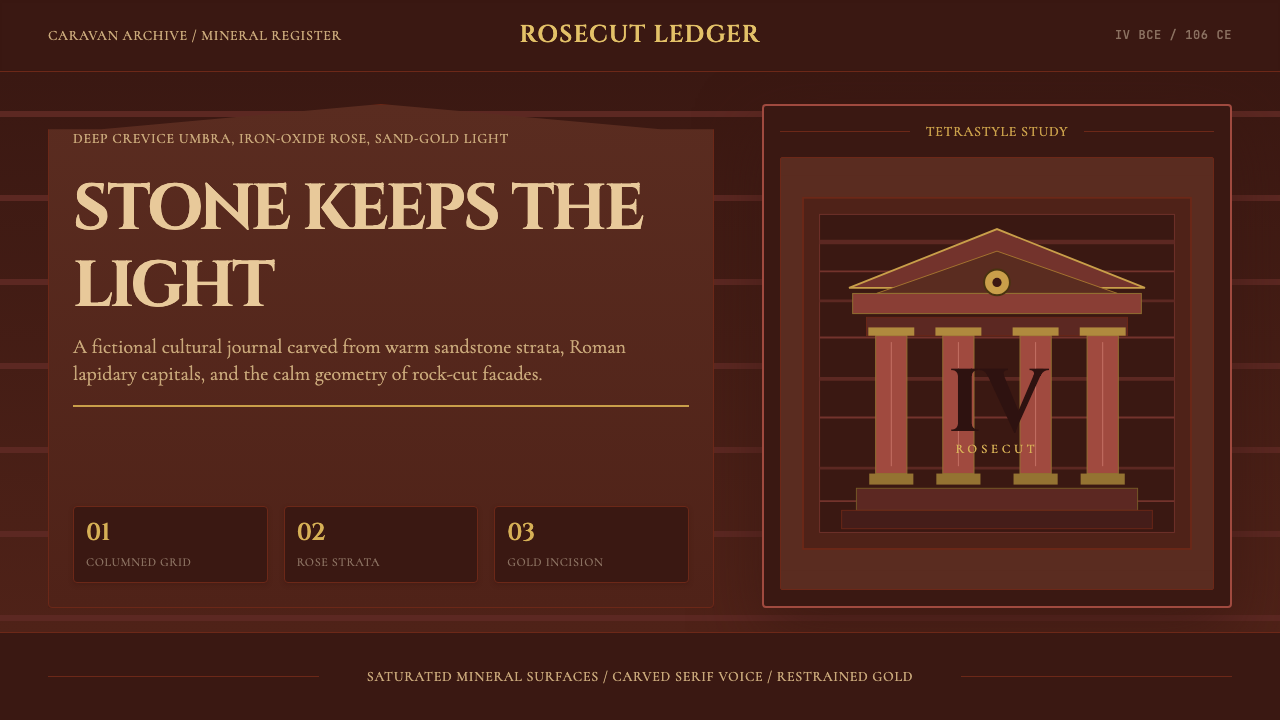 Jordanian Petra Rose NabataeanGeology feels monumental. Crevice umbra, rose strata, and Cinzel capitals car…
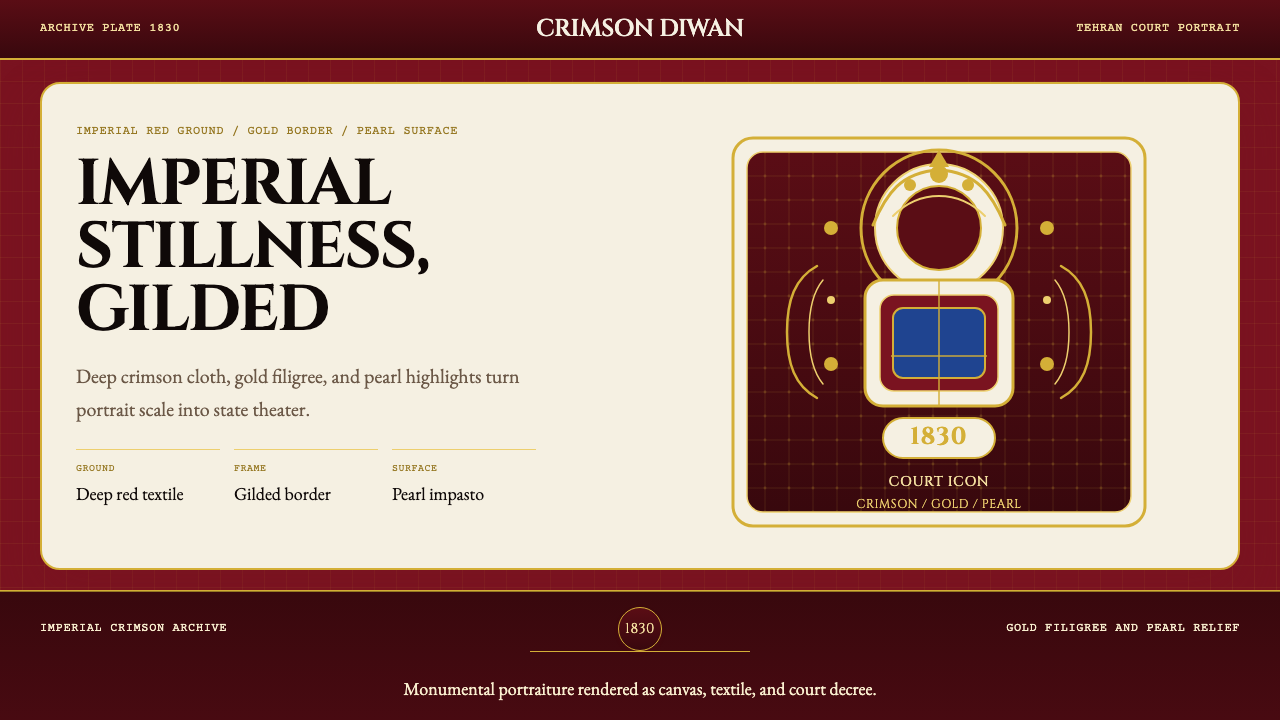 Persian Qajar Portrait (1830)Imperial stillness, gilded. Deep crimson, gold filigree, and pearl accents st…
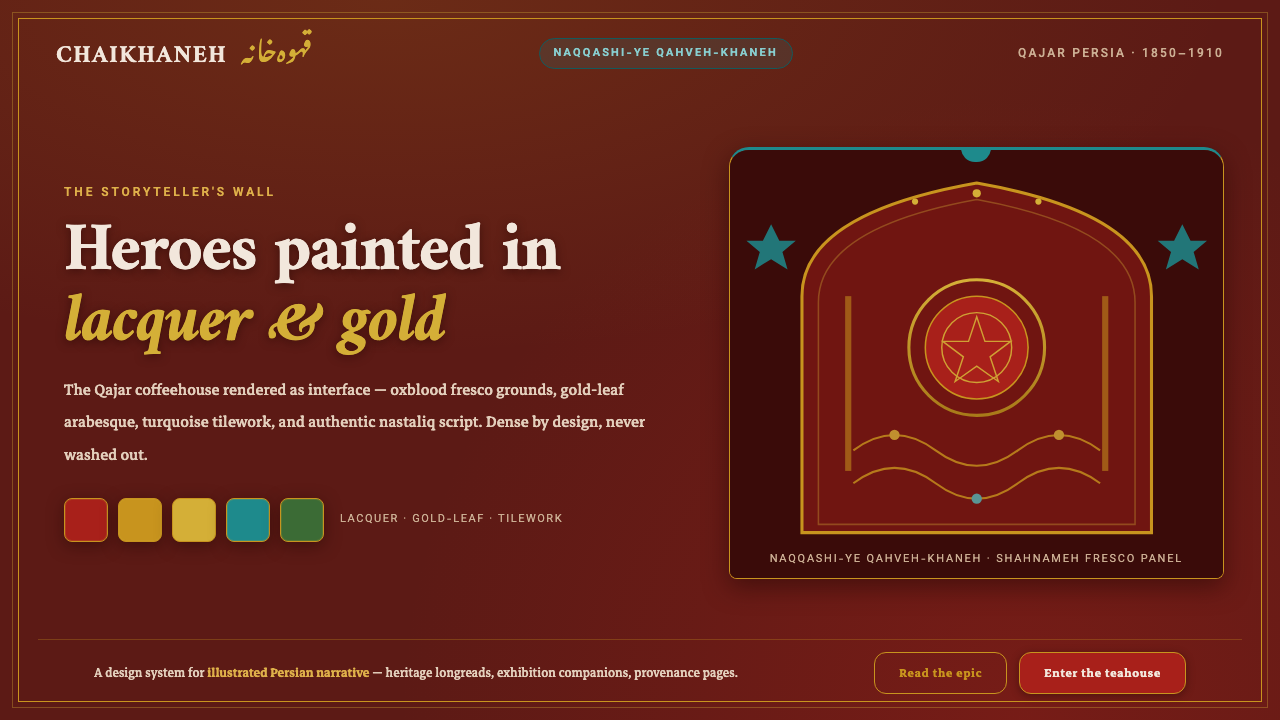 Persian Teahouse ChaikhanehQajar coffeehouse maximalism. Lacquer-red heroes, gold-leaf arabesque on deep…
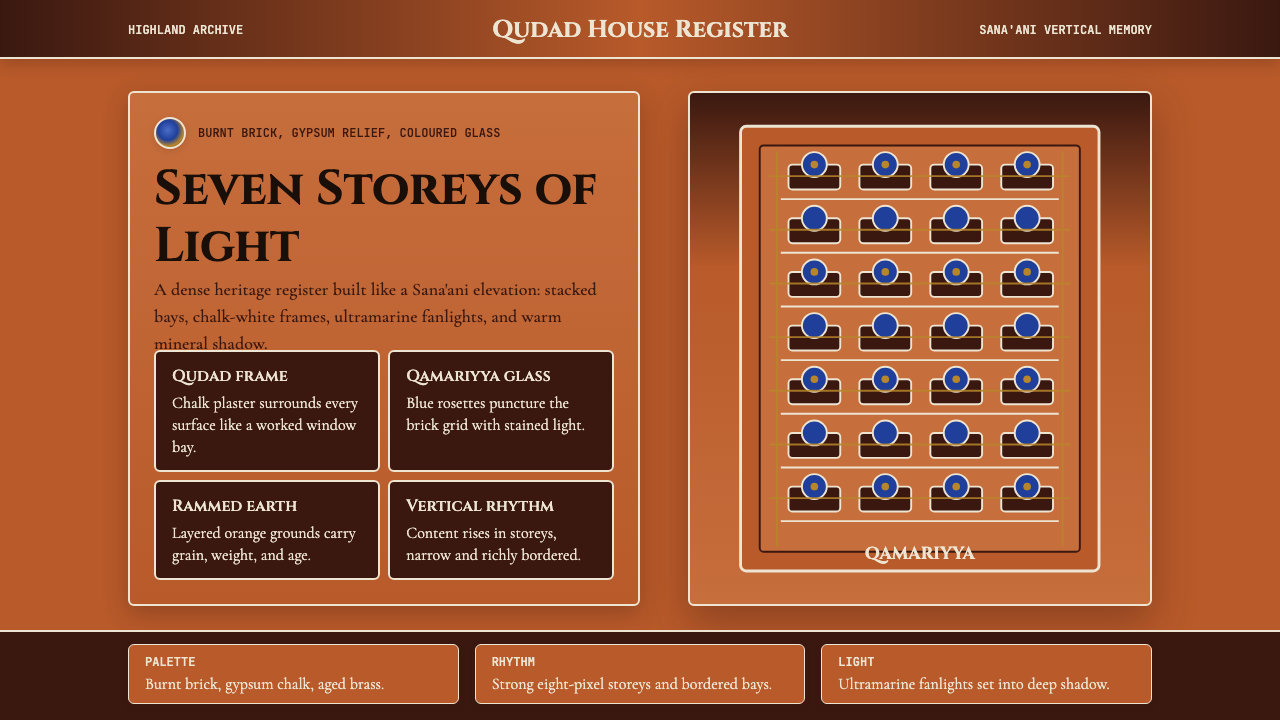 Yemeni Sana'a Old City Tower-HouseVertical memory, densely framed. Brick orange, gypsum white, and blue rosette…
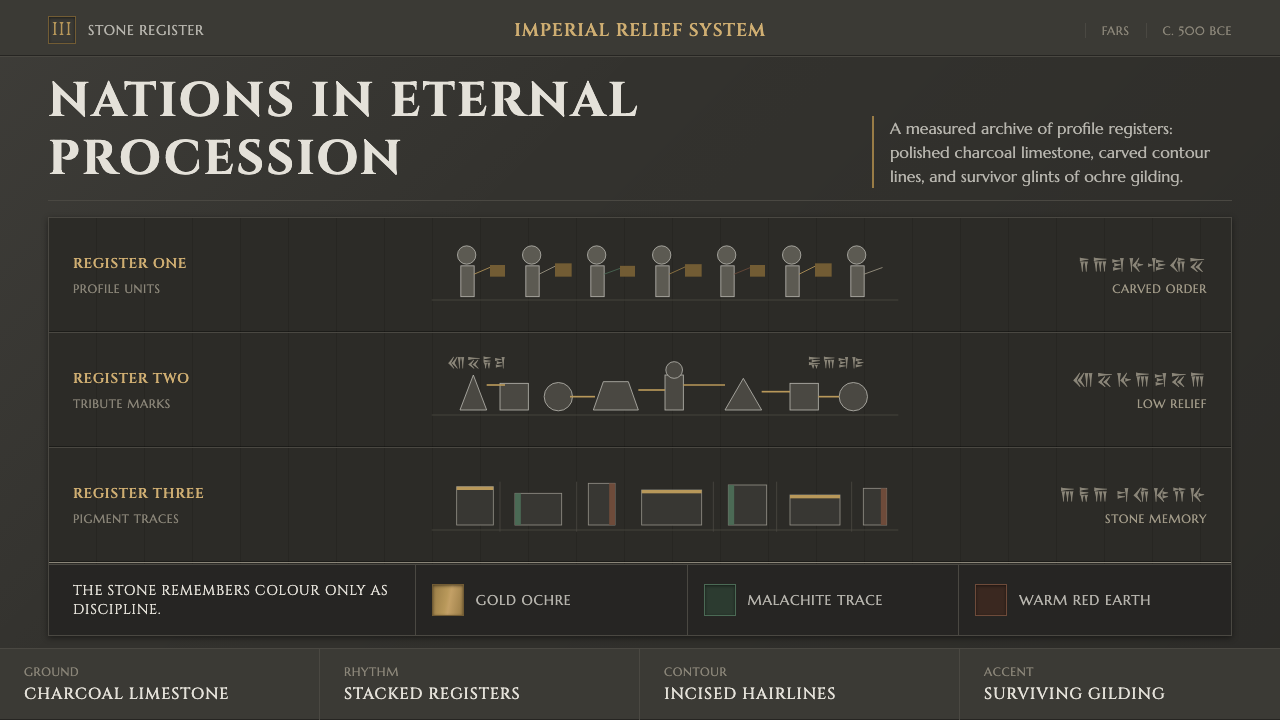 Achaemenid Persepolis ReliefImperial restraint in stone. Charcoal registers carry ochre, green, and red p…
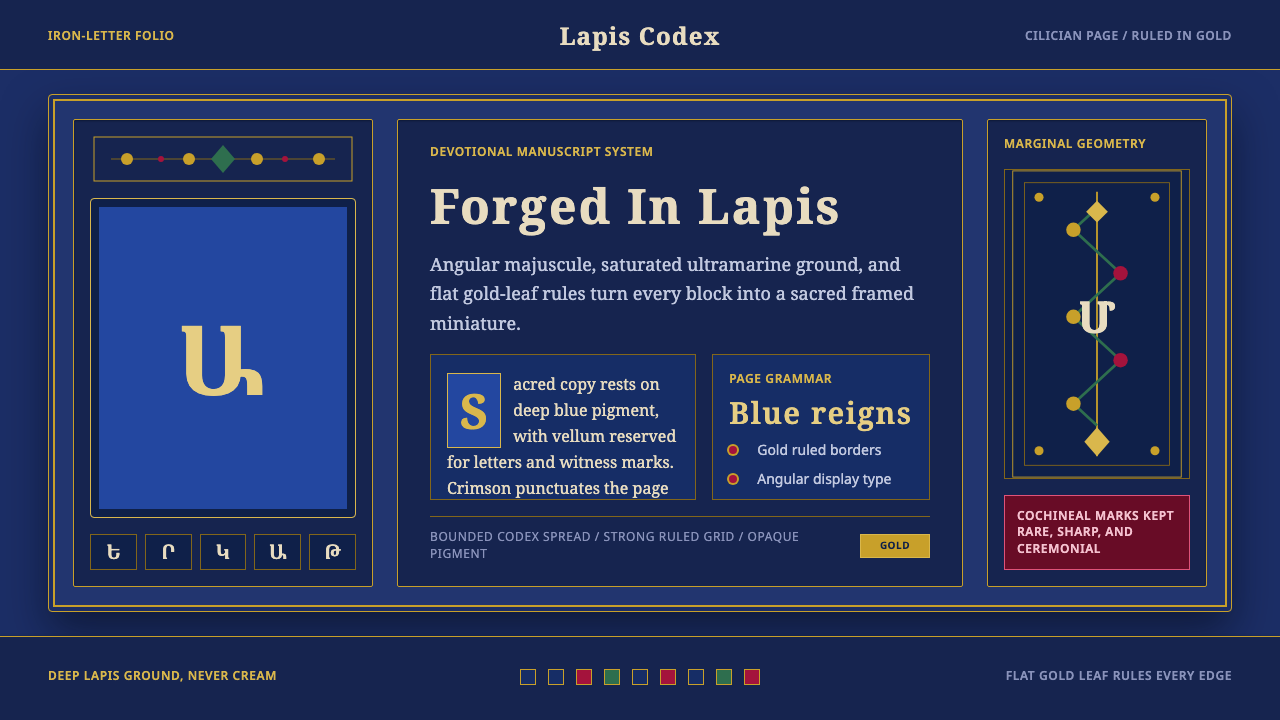 Armenian ErkatʿagirDevotional lapis reigns. Gold rules and angular serif glyphs frame a sacred g…