What is Studio Ghibli (Miyazaki)?
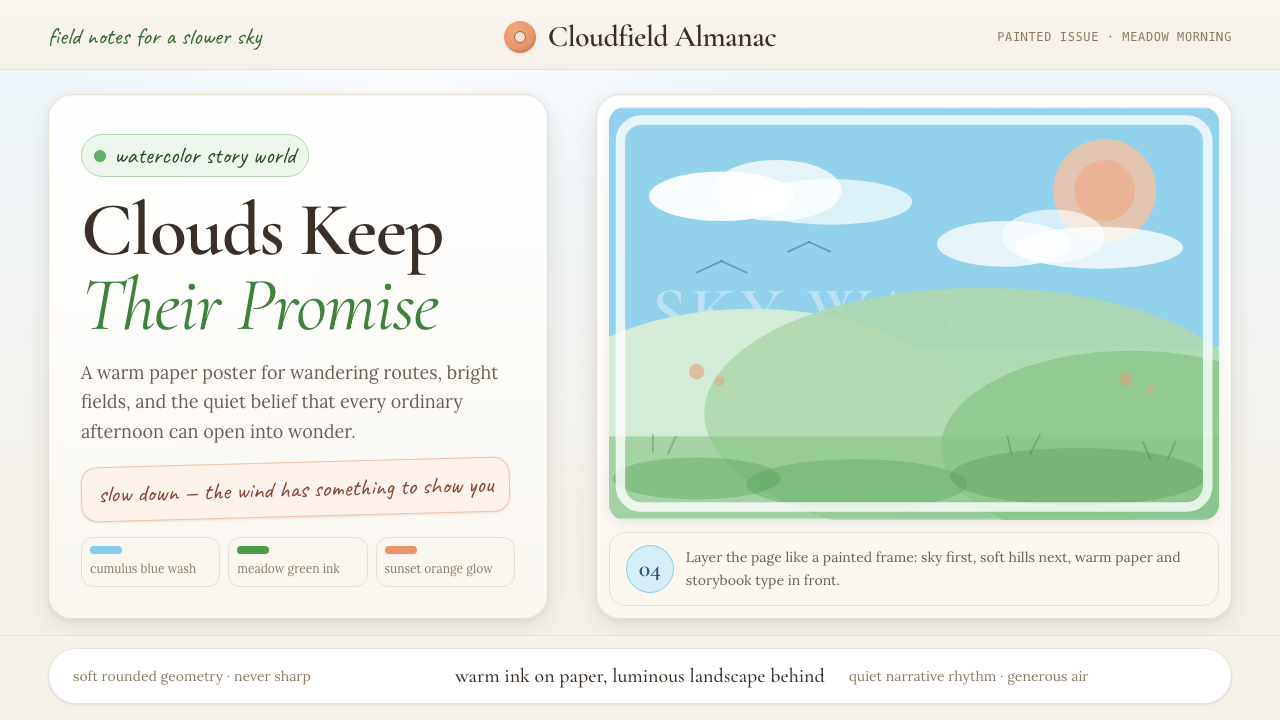
Studio Ghibli's visual language is a hand-painted world where watercolor skies, meadow greens, and a deep respect for stillness teach every frame — and every layout — to breathe.
Studio Ghibli (Miyazaki) in brief
Studio Ghibli's aesthetic is defined by a commitment to the hand-made image: watercolor-washed skies that shift from pale morning grey to deep cumulus blue, meadow greens that feel sun-soaked and alive, surfaces that carry the faint grain of paper or brushwork rather than the clinical smoothness of digital production. It is an aesthetic of presence and slowness — of clouds that move, of grass that bends in an unseen wind, of light that falls at a precise and meaningful angle.
As a design system, the Ghibli visual language translates those painterly qualities into interface and layout decisions. The palette leans toward muted naturalism: soft blues derived from overcast skies, warm olive and sage greens borrowed from hillside meadows, dusty sunset oranges that anchor attention without shouting, and a paper-warm off-white that replaces the cold neutrality of pure white. Typography is literary and slightly hand-touched — faces with visible calligraphic heritage rather than engineered geometric construction. Geometry is rounded and organic; hard corners are rare and feel out of place.
What separates this aesthetic from generic 'soft' or 'natural' design is its insistence on craftsmanship as a visible value. Every element should look considered, not algorithmic. The texture of a background, the weight of a headline, the curve of a button — each should feel like it was drawn rather than specified. This is not nostalgia for its own sake; it is a deliberate argument that warmth, attention, and care can be legible in visual form.

Where does Studio Ghibli (Miyazaki) come from?
Studio Ghibli was founded in June 1985 in Koganei, Tokyo, by directors Hayao Miyazaki and Isao Takahata, producer Toshio Suzuki, and businessman Yasuyoshi Tokuma. The studio's name derives from an Italian word for the Saharan sirocco wind — a detail chosen by Miyazaki that signals, from the outset, the studio's refusal to be provincial. The founding followed the commercial success of Nausicaä of the Valley of the Wind (1984), a film made at Topcraft that demonstrated there was an audience for feature-length animation that took both children and adults seriously.
The distinctive visual language crystallized around two early masterworks. My Neighbor Totoro (1988) established the studio's color sensibility: the deep greens of the Sayama Hills in Saitama Prefecture, rendered in backgrounds painted by art director Kazuo Oga, created a landscape so specific and luminous that it felt simultaneously like memory and like a place you had never been but recognized immediately. Oga's backgrounds — executed in gouache and watercolor with a meticulous attention to seasonal light — became the aesthetic foundation the studio would return to and refine for decades. Spirited Away (2001), which won the Academy Award for Best Animated Feature in 2003, extended the language into stranger and more dreamlike territory: the bathhouse at the center of the film is a collision of Meiji-era Japanese architecture, Edo-period woodblock color, and pure invention.
The studio's visual philosophy was shaped in significant part by Miyazaki's explicit rejection of computer-generated imagery as a primary tool. In a period when the broader animation industry was moving rapidly toward CGI, Ghibli maintained hand-drawn production through films including Princess Mononoke (1997) and Howl's Moving Castle (2004). This was not mere conservatism — it was an argument that the trace of the human hand carries information that machine-generated imagery cannot replicate: the slight tremor of a line, the variation in wash density across a cloud, the evidence of decision-making at the level of individual brushstrokes. The aesthetic consequence is a world that feels inhabited by makers.
Joe Hisaishi's musical collaborations with Miyazaki — spanning My Neighbor Totoro, Spirited Away, Princess Mononoke, and many others — are inseparable from the visual identity. The unhurried pacing of Hisaishi's scores, their willingness to dwell on a moment of ordinary beauty — a field, a doorway, a character's expression — reinforced the visual aesthetic's central proposition: that the best way to honor a moment is to remain with it. This cross-media coherence between image and sound is part of what has made the Ghibli aesthetic so recognizable and so widely loved across cultures and generations, from its Japanese origins through its international reception.
What defines the Studio Ghibli (Miyazaki) look?
Color
The palette is built around soft, slightly desaturated naturals: cumulus sky blues that lean neither cold nor garish, meadow and hillside greens that feel sun-warmed rather than synthetic, muted sunset oranges and dusty golds used as focal accents. Paper-warm off-whites replace pure white as the resting ground. The governing principle is that every color should feel as though it could be made with a watercolor brush — no color is perfectly flat, and no color calls attention to itself apart from the composition. Saturation is restrained; contrast is achieved through value rather than chromatic intensity.
Typography
Typefaces carry a literary and slightly hand-touched quality — serif faces with visible calligraphic origins, where strokes taper and swell in ways that recall the movement of a pen or brush rather than the regularity of a drawing instrument. A note-like hand-lettered quality in secondary text reinforces the sense that the design was assembled by a person, not generated by a system. Type is set with generous leading and moderate measure, creating a reading rhythm that encourages dwelling rather than scanning. Headlines are weighty but not aggressive; they invite rather than demand.
Texture and Grain
Perhaps the most distinctive characteristic of this aesthetic is its embrace of subtle surface texture. Backgrounds carry the faint tooth of watercolor paper; washes show gentle variation in density; flat color areas are softened by a light grain that removes the clinical perfection of digital flatness. This texture is never decorative in a busy or distracting sense — it is a quiet reminder of the hand that made the image. In digital application, it is achieved through paper-toned grounds and carefully restrained noise overlays rather than heavy photographic textures.
Organic Form and Roundness
Shapes in this aesthetic follow organic rather than geometric logic. Corners are rounded generously; containers feel more like vessels than boxes. Illustrations and decorative elements — when used — draw on the natural world: cloud forms, plant silhouettes, irregular stone shapes, flowing water. Hard-edged geometric shapes feel intrusive and are used sparingly, if at all. The underlying message is that the designed object belongs to a living world rather than to an industrial one, and every formal decision reinforces that belonging.
Light and Atmosphere
Ghibli's animators are masters of atmospheric light — the diffuse golden quality of late afternoon, the blue-white luminosity of overcast mornings, the warm amber of lamplight in an interior. This sensitivity to light conditions is the aesthetic's most emotive quality. In design application, it translates to a careful attention to background tone and layering: elements are not simply placed but seem to exist in a consistent atmospheric envelope. Shadows, when present, are soft and diffuse — traces of light rather than geometric assertions.
Stillness and White Space
One of Miyazaki's most celebrated directorial techniques is the 'ma' — the deliberate pause, the held moment, the frame that contains nothing but sky or a character's resting expression. This principle of meaningful stillness translates directly into layout: generous white space is not an absence but a presence, allowing each element to be noticed individually rather than competing for attention. Crowding is the enemy of this aesthetic; a design in this style should always feel like it has room to breathe.
Narrative Warmth
Every element in a Ghibli frame serves a story — the worn leather of a bag, the particular green of a hillside in summer, the specific way steam rises from a bowl of food. Design in this aesthetic should aspire to that same narrative specificity: details that feel chosen rather than defaulted to, choices that accumulate into a coherent world. This is not about adding decorative storytelling elements but about making every design decision — color, type, spacing, imagery — feel like it comes from a person with something particular to say.

Who shaped Studio Ghibli (Miyazaki)?
Co-founder of Studio Ghibli and its defining creative force, Miyazaki directed My Neighbor Totoro, Princess Mononoke, Spirited Away, Howl's Moving Castle, and The Wind Rises, among many others. His insistence on hand-drawn animation, his deeply ecological worldview, and his technical command of movement and atmospheric light established the studio's aesthetic signature. His concept of 'ma' — the meaningful pause, the held moment of ordinary beauty — is perhaps the single most transferable principle from his filmmaking to contemporary design practice. He received an honorary Academy Award in 2014.
Art director and background painter, Oga is responsible for the luminous landscape backgrounds that define the studio's visual identity. His work on My Neighbor Totoro established the foundational palette and texture language — the specific greens of Japanese summer hillsides, the quality of overcast and golden light, the way traditional rural architecture sits in a landscape. Working primarily in gouache and watercolor, Oga achieved a density of observation and a warmth of execution that have never been fully replicated digitally, and his backgrounds remain the clearest statement of what the Ghibli aesthetic actually is at a technical level.
Co-founder and director, Takahata brought a different but complementary sensibility to the studio. His films — including Grave of the Fireflies (1988), Only Yesterday (1991), and The Tale of the Princess Kaguya (2013) — explored more realist, painterly, and at times deliberately rough-hewn aesthetic territories. The Tale of the Princess Kaguya in particular, with its sketch-like, ink-wash backgrounds that intentionally preserve the marks of the drawing process, represents a radical extension of the studio's commitment to visible craft. Takahata's work proves that the Ghibli aesthetic is not a single locked style but a shared commitment to the value of handmade image-making.
Composer and long-term collaborator, Hisaishi has scored nearly every Miyazaki film since Nausicaä of the Valley of the Wind (1984). His musical language — unhurried, harmonically rich, with a characteristic willingness to let a theme breathe and recur rather than drive — mirrors the visual aesthetic at an auditory level. The emotional resonance of the Ghibli aesthetic cannot be fully understood without accounting for Hisaishi's contribution: the pacing, the lightness, the sense that ordinary moments deserve orchestral attention, are as much musical propositions as visual ones.
Producer and co-founder, Suzuki's role in shaping the Ghibli aesthetic is often underestimated. As the bridge between Miyazaki's creative vision and the realities of production and distribution, Suzuki made decisions that protected the studio's commitment to quality and craft at a commercial level. His insistence that Ghibli films be given the time and resources necessary to realize their visual ambitions — rather than compressed into conventional animation schedules — is a significant reason the aesthetic reached the level of refinement it did.
How do you use Studio Ghibli (Miyazaki) today?
The Ghibli aesthetic translates most naturally into contexts where warmth, care, and an unhurried reading experience are desirable values. Applying it correctly means understanding its underlying logic — that texture signals craft, that soft color signals safety and belonging, that generous space signals respect for the viewer — rather than simply layering watercolor wash effects over a standard layout. The first question to ask when applying this style is not 'how do I make this look like a Ghibli film?' but 'what would this look like if it were made by hand, with patience, by someone who cared deeply about the subject?'
For presentation slides, this style works best on covers that establish mood and on content pages that need to convey trust and thoughtfulness rather than data density. A cover built in this aesthetic uses a warm off-white ground, a painterly or softly textured background element, and type set in a literary serif at a weight that reads as considered rather than urgent. Content slides should resist the temptation to fill space — generous margins, single ideas per slide, and type set with enough leading to feel like it is breathing. Data visualization in this style is gentle and rounded: soft color fields rather than hard bars, smooth curves rather than angular line charts, with annotations that feel like handwritten notes rather than system-generated labels.
For web interfaces — particularly editorial sites, portfolio pages, wellness products, cultural institutions, and educational platforms — the aesthetic provides a natural vocabulary. Background tones should stay warm and slightly papery rather than pure white; interactive elements benefit from rounded corners and soft hover transitions rather than hard-shadow or flat-color state changes. Navigation should feel understated: quietly typographic, with enough space around each element that clicking feels like a gentle choice rather than a target acquisition. Hero sections work best with full-width painterly imagery or illustration that occupies space the way a landscape does — unhurriedly, with things worth noticing at the edges.
For editorial and marketing work, the style supports long-form reading and brand storytelling particularly well. Article layouts in this aesthetic use a comfortable reading measure, generous line height, and subheadings that feel like chapter titles rather than section dividers. Pull quotes can be set in a hand-touched italic at a larger size, treated as moments of emphasis that slow the reader down. Marketing pages benefit from the style's capacity for emotional warmth: full-width feature sections with softly textured backgrounds alternate with clean body-copy sections; calls to action are warm and inviting rather than urgent and imperative.
A common mistake when applying this aesthetic is over-texturing — adding so much grain, paper effect, and watercolor wash that the texture becomes the message and the actual content is lost. The Ghibli films succeed because texture serves the world-building rather than announcing itself; a background in Oga's paintings is rich and specific, but it does not compete with the characters. The same discipline applies in design: texture should be felt rather than seen, and if a viewer's first impression is 'nice texture' rather than 'this communicates clearly,' the balance has tipped too far. Similarly, this aesthetic is not well-suited to contexts that require urgency, high information density, or a sense of sharp technological precision — those contexts call for different visual values.

Studio Ghibli (Miyazaki) — FAQ
Is this aesthetic the same as general 'cottagecore' or 'soft' design?
They overlap in palette and texture but differ fundamentally in intent and craft standard. Cottagecore and similar trends are primarily decorative — they apply a visual mood without a corresponding commitment to quality of detail. The Ghibli aesthetic, derived from films where every background was painted individually by master craftspeople, carries a higher standard of specificity and care. A true application of this style requires every detail to feel considered: the particular green of a specific hillside in a particular season, not just 'a green.' The difference shows in the density and coherence of a finished design, and in whether the texture feels like a surface choice or a worldview.
Can this style work for technology products and SaaS interfaces?
It can, but with meaningful caveats. SaaS and technical products typically require a sense of precision, reliability, and sharp information hierarchy that can work against the style's core values of warmth and organic softness. The aesthetic works best in tech contexts where human connection is a deliberate brand value — educational tools, creative platforms, journaling or wellness apps, consumer-facing products in categories like travel or culture. It is poorly suited to developer tools, financial dashboards, or analytics products where the user needs to trust that every number is precise and every state is unambiguous. Applying a soft, papery texture to a data-dense interface risks making the data feel uncertain rather than authoritative.
How do you avoid making this style look like a Ghibli knockoff?
The risk of imitation is real, and it increases when designers work from visual references (screenshots, stills) rather than from principles. The Ghibli films are so visually specific that direct reference to their imagery — the Totoro silhouette, the Spirited Away color story, the Howl's Moving Castle mechanical aesthetic — immediately reads as borrowing rather than inspiration. The path to an original application of this style is through its principles: commit to watercolor-like palette behavior, visible texture, generous space, and literary typography, but build every specific element from the project's own subject matter. The warmth and handmade quality should feel like yours, not like something borrowed.
Does this aesthetic work in dark mode?
Dark mode is a genuine tension point for this style. The canonical Ghibli aesthetic is built on light-ground luminosity — the warmth of paper, the brightness of sky, the way afternoon light lifts a hillside. A dark inversion loses these foundational qualities. That said, a night-time Ghibli palette is meaningful within the films themselves — the deep indigos and star-lit blacks of night sequences in Spirited Away or Castle in the Sky have their own beauty. A dark variant can work if it commits fully to the night-sky as its organizing metaphor: deep blue-blacks rather than neutral dark greys, warm amber or soft gold as accent lights, and a continued commitment to soft textures and organic forms. The mistake is creating a dark mode that simply inverts the light version rather than reconceiving it.
How does this aesthetic handle photography and real images?
Photography is the greatest challenge for this style, because unprocessed photographs carry the visual logic of the camera — sharp edges, lens bokeh, photographic color science — which is fundamentally different from the logic of watercolor and gouache. The most successful approaches either avoid photography entirely (using illustration, painting, or heavily treated imagery instead) or apply a consistent treatment that moves photographs toward the painterly register: muted tones, slightly reduced contrast, a warm color grade, and a light texture overlay that softens the photographic sharpness. Photographs of natural subjects — landscapes, plants, sky, water, food — adapt more readily than photographs of technology, architecture, or people in formal settings. The editorial test is simple: if a photograph reads as a photograph first and a part of the composition second, it is working against the style.
Related design styles
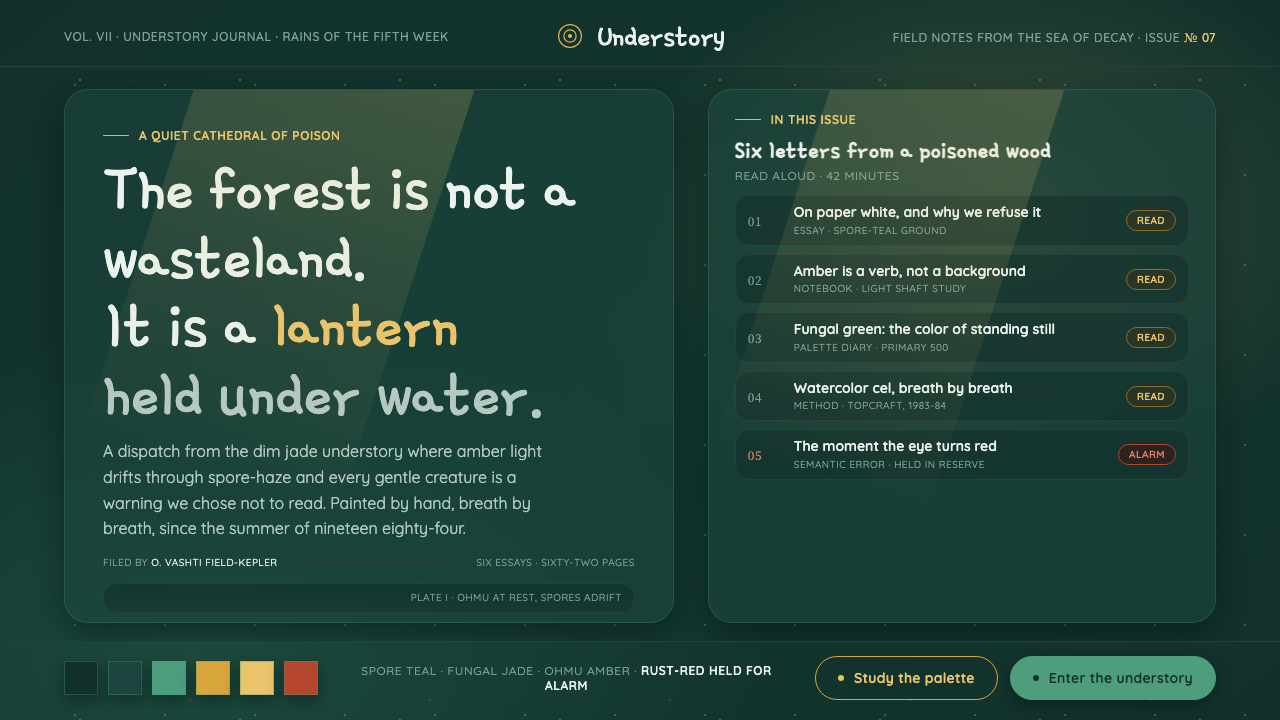 Nausicaä Toxic JungleRefuses paper-white. Jade-teal understory lit by drifting amber spores, rust-…
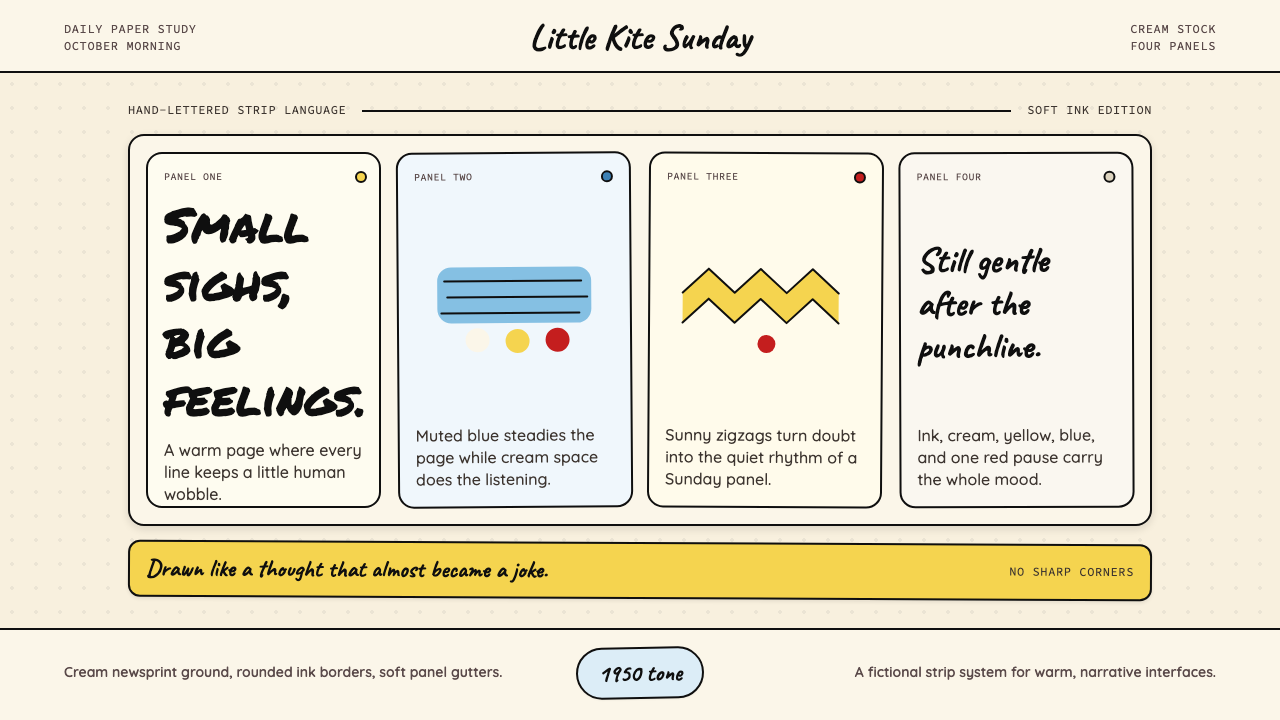 Peanuts Comic Schulz (1950)Gentle melancholy on newsprint. Caveat lettering, cream panels, yellow and bl…
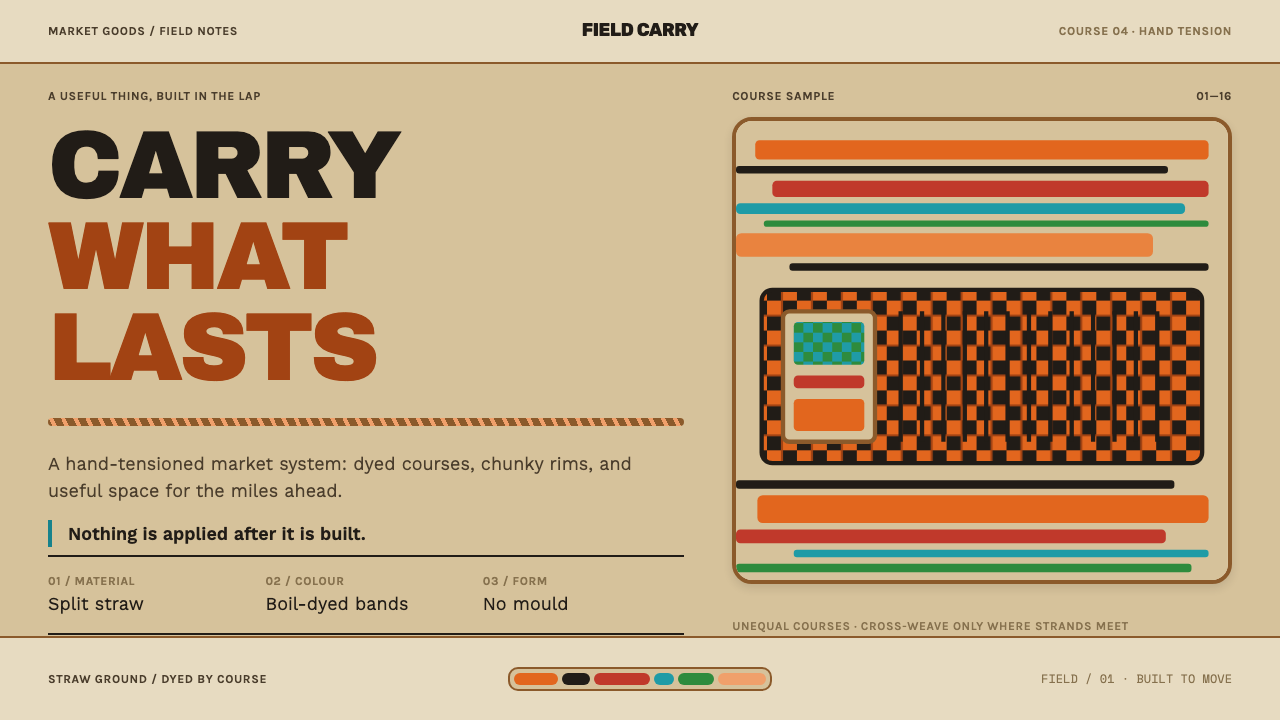 Bolga BasketStructure is the ornament. Unequal orange, red and turquoise bands cross on s…
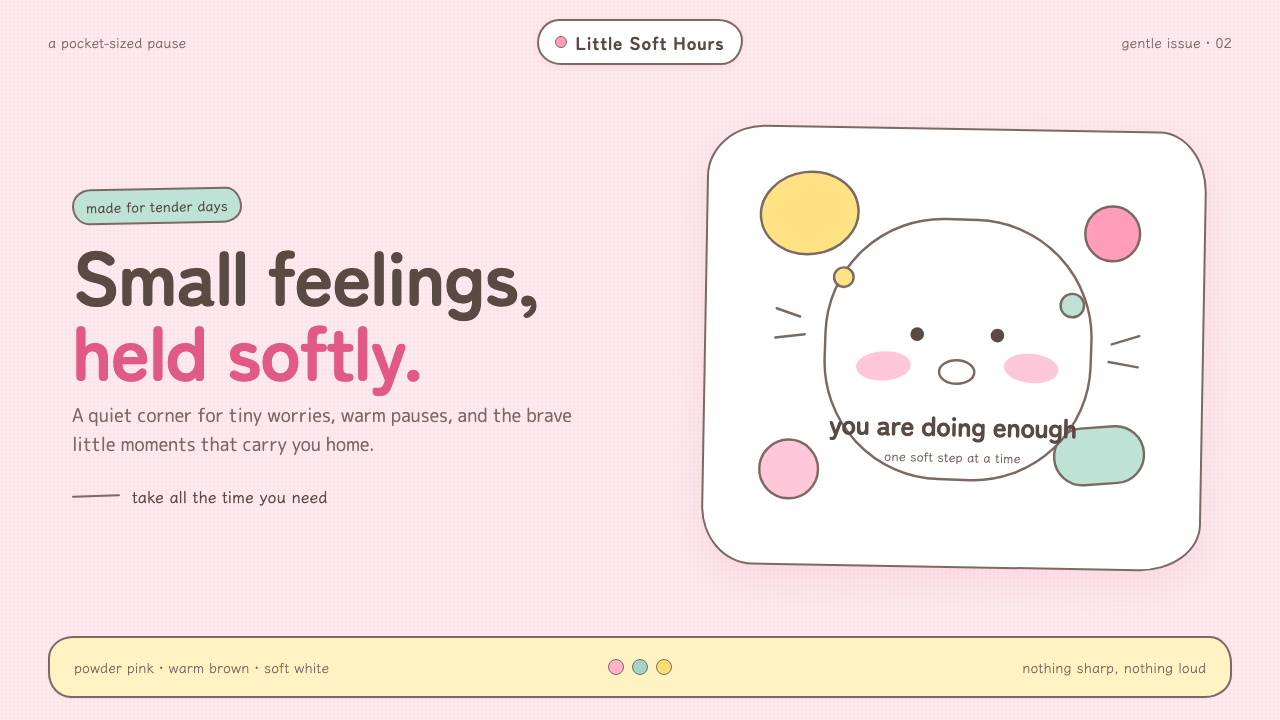 Chiikawa (2022)Tenderness made visible. Powder pink, warm-brown wobbles, and pill-soft forms…
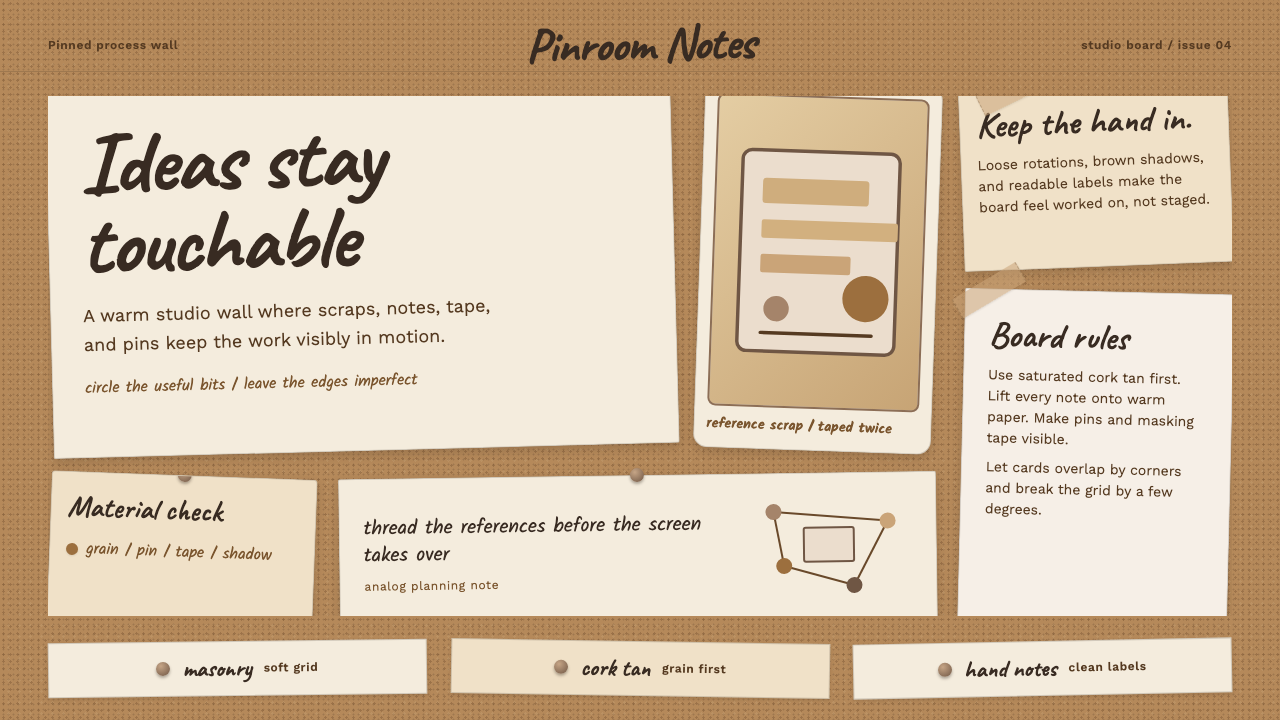 Cork Board StudioWarm ideas stay tactile. Cork tan, Caveat handwriting, pinned paper, and tape…
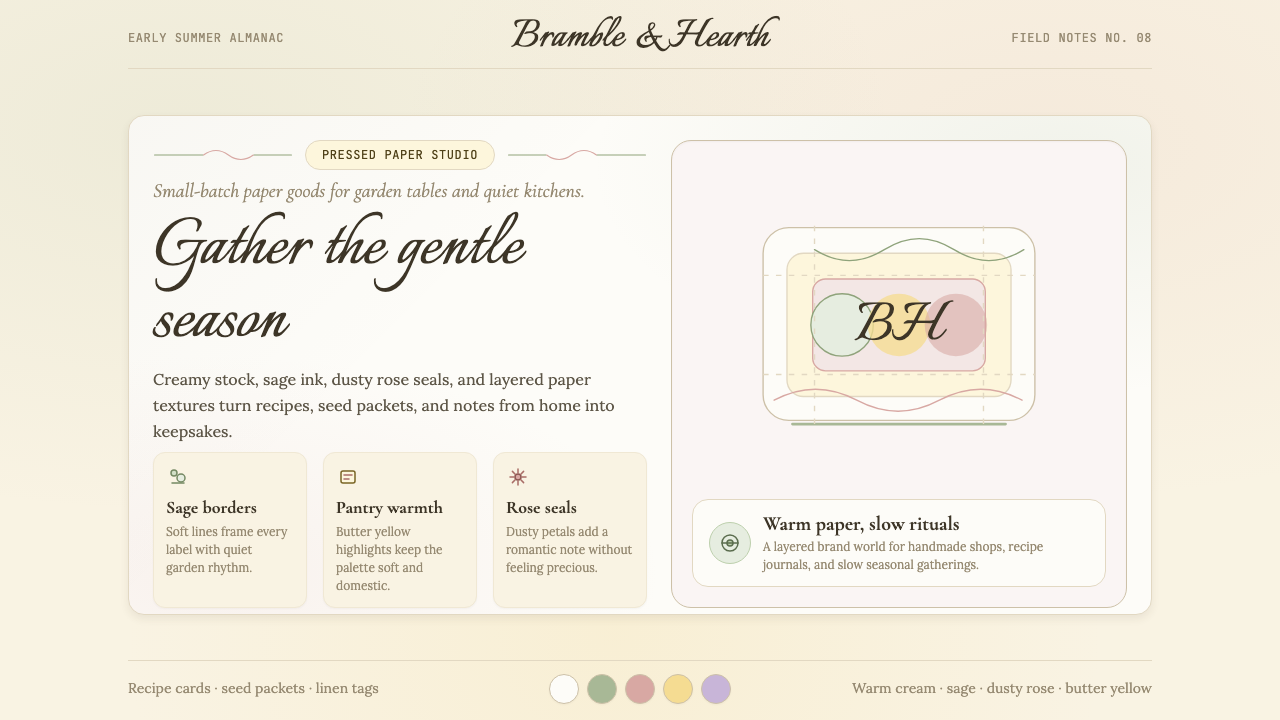 CottagecoreRural romance, hand-drawn. Sage and dusty rose, gingham textures, serif paire…