What is Lofi Hip-Hop Anime Girl (2018)?
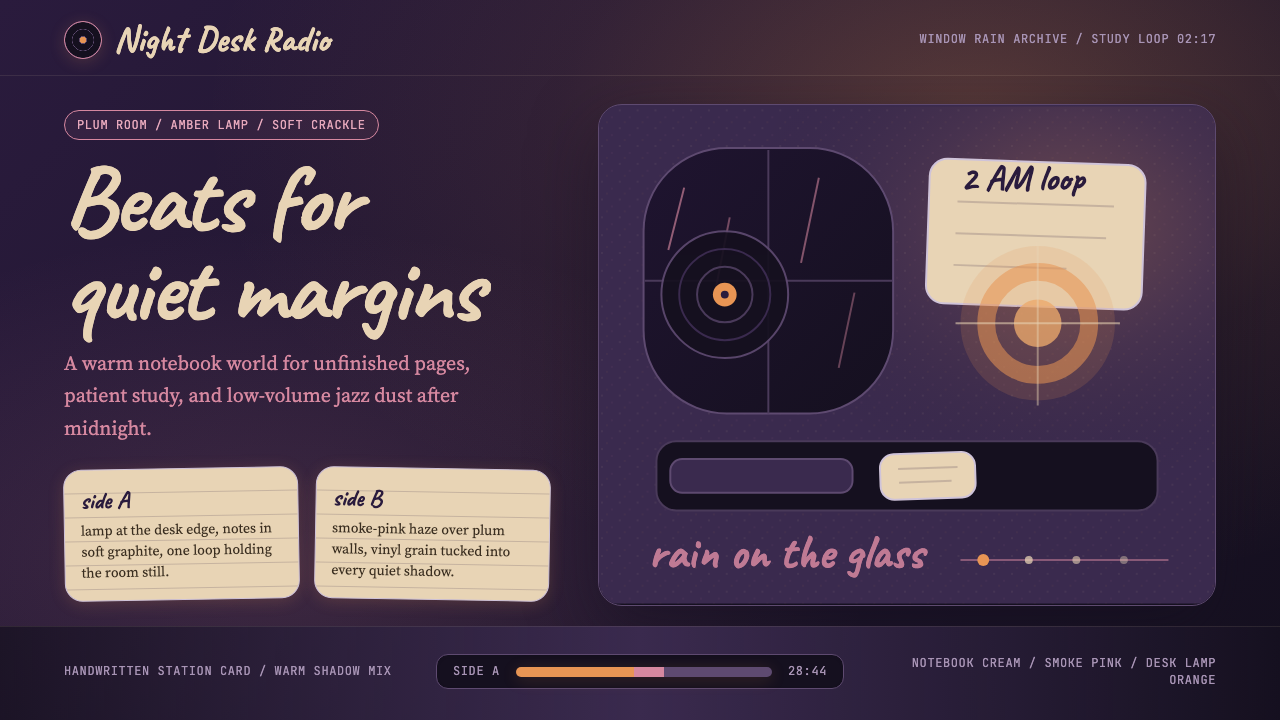
A hand-drawn anime girl studying by lamplight became the internet's most comforting loop — and spawned a design language built entirely from warm amber glow, plum-violet darkness, and the quiet grain of vinyl.
Lofi Hip-Hop Anime Girl (2018) in brief
The Lofi Hip-Hop Anime Girl aesthetic — associated with the ChilledCow (later Lofi Girl) YouTube channel and its ever-looping study stream — is a visual system built around a specific emotional state: productive solitude at two in the morning. The aesthetic translates that feeling into a dark, warm, textured palette where a single desk lamp is the sole light source, casting everything in amber and leaving the corners in plum shadow.
Unlike design movements that begin with manifesto or principle, this style evolved from a single piece of illustration: Colombian artist Juan Pablo Machado's cozy bedroom drawing, set on loop against an audio stream mixing jazz samples, dusty drums, and crackling vinyl. The visual grammar that emerged — soft paper textures, notebook-card surfaces, hand-lettered type, a cat on a windowsill, rain behind glass — is inseparable from its musical context. It is, first and last, a mood.
The design system is dark by nature. Its backgrounds are deep plum, dusty navy, or near-black, illuminated only where the lamp reaches. Color is not used symbolically or structurally in the Bauhaus sense; it is used atmospherically — warmth pushing back against darkness, amber and smoke-pink co-existing with inky shadow. Every surface carries the faint ghost of analog imperfection: film grain, vinyl static, worn notebook paper. Nothing is crisp or clinical. The aesthetic is an argument for imperfection as comfort.
Where does Lofi Hip-Hop Anime Girl (2018) come from?
The aesthetic's musical roots run deep and cross continents. In Tokyo, Jun Seba — known by his production name Nujabes — was fusing jazz harmony, hip-hop rhythm, and philosophical melancholy through the 1990s and into the early 2000s. His beats, built from sampled jazz piano and brushed snare, carried a quality of late-night studiousness that would later define the lofi genre's entire emotional register. In Detroit, James Dewitt Yancey — J Dilla — was doing something parallel: slowing the tempo, making drums swing and stutter, and pressing the imperfections of analog hardware into the surface of the music. Both died young (Nujabes in 2010, Dilla in 2006), and their posthumous canonization gave lofi hip-hop a melancholy undertow it has never fully shed.
The visual component arrived through a different channel. In 2017, the streaming channel ChilledCow launched a YouTube live stream — eventually titled 'lofi hip hop radio — beats to relax/study to' — that would run for years and accumulate hundreds of millions of views. The channel cycled through several visual identities before settling on an illustration by Machado: a young woman in a cozy bedroom, headphones on, bent over a notebook, a cat at her side, rain on the window behind her. This image, animated in a gentle loop, became one of the most recognized images on the internet. YouTube removed the stream briefly in 2020 over copyright claims; public outcry was immediate and international, confirming how culturally embedded the image had become.
The aesthetic also owes a debt to Japanese anime visual culture — specifically to the quiet domestic scenes of slice-of-life anime (Studio Ghibli interiors, the bedroom aesthetics of shows like 'Toradora' and 'Your Lie in April') where ordinary spaces are rendered with extraordinary warmth. Machado's illustration drew consciously on this tradition, and the resulting visual grammar carries the grain of both analog music culture and Japanese animation: soft line work, expressive eyes, backgrounds full of domestic objects rendered with affectionate detail.
The style's peak cultural moment was roughly 2018 to 2022, when the ChilledCow stream ran continuously and inspired thousands of imitations — other channels, other illustrations, other artists working in the same palette and atmosphere. The term 'lofi aesthetic' entered the vocabulary of independent creators, bedroom musicians, and indie designers who saw in it a visual language that matched the sensibility of making things alone, at night, with headphones on. Dimitri Somoguy, the creative force behind ChilledCow, shaped both the channel's tone and its visual continuity during this period, establishing the aesthetic as a recognizable brand before the style diffused into the wider internet.
What defines the Lofi Hip-Hop Anime Girl (2018) look?
Warm Amber Light Against Deep Darkness
The defining visual tension of this style is the single warm light source — a desk lamp — pushing back against a deep, dark background. The illuminated zone glows in amber and golden tones; the surrounding space recedes into plum violet, dusty navy, or near-black. Color is not distributed evenly across the composition but radiates from one focal point, creating a vignette effect where warmth and darkness exist in constant, comforting tension. This light-against-dark structure gives every composition a sense of intimacy and enclosure.
Analog Texture and Grain
Every surface in this aesthetic carries the visible imperfection of analog media. Paper textures breathe through card backgrounds; vinyl grain drifts across the composition like a low haze; soft noise overlays mimic the static of a cassette tape at the end of a side. These textures are not applied for decorative effect — they are the style's emotional mechanism, signaling that something handmade and imperfect is present. Smooth, pristine surfaces feel alien to this system. The grain is what makes it feel warm.
Handwritten and Casual Typography
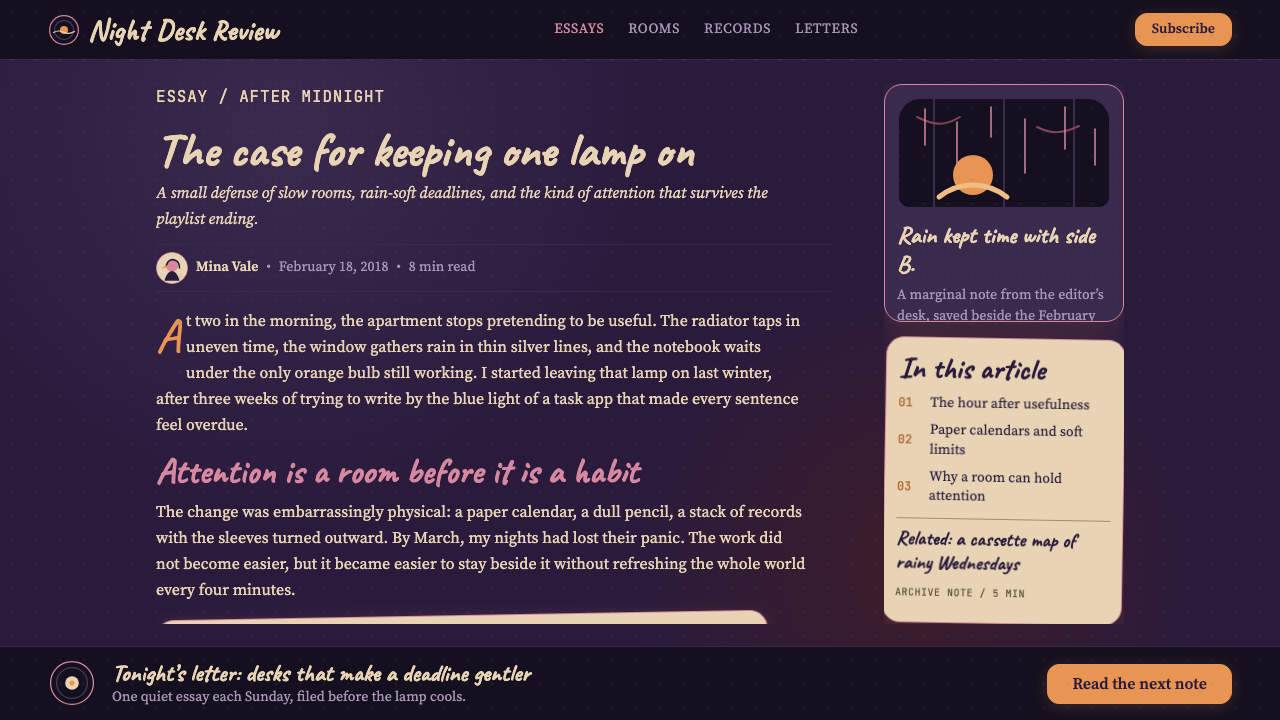
Type in this style resists the clean authority of geometric sans-serifs. Handwritten letterforms — rounded, slightly uneven, carrying the human trace of a real pen or pencil — are preferred for headings, labels, and decorative text. The handwriting quality signals informality and personal presence, as though the interface is a notebook being filled in rather than a system being operated. Where mechanical type appears, it tends toward rounded, soft forms rather than sharp geometric construction.
Notebook and Paper Card Surfaces
Content is typically contained in surfaces that evoke paper — cards with the slight warmth and roughness of notebook pages rather than the clinical whiteness of a screen. These surfaces are often slightly off-white or cream, with subtle edge shadows that suggest physical stacking rather than digital floating. The metaphor is consistent: this is a study desk, and the elements on screen are the materials on that desk. Even data and interface components take on the quality of handwritten notes or printed ephemera.
Smoke-Pink Haze and Muted Midtones
Between the warm amber of the lamp and the deep plum of the shadows lies a range of desaturated, atmospheric midtones — dusty roses, smoky mauves, and hazy lavenders that function like the ambient light of a bedroom at midnight. These muted tones never read as flat or empty; they carry the quality of air, of something slightly out of focus, of the space between wakefulness and sleep. The palette avoids bright, saturated accent colors, preferring instead to let warmth and coolness blur at the edges.
Intimate Domestic Iconography
The visual vocabulary is populated with objects from a specific, carefully bounded domestic world: a steaming mug, an open notebook, a lamp on a desk, a sleeping cat, books stacked unevenly, rain against a window, potted plants, loose earbuds. These objects are not chosen arbitrarily — each one signals comfort, solitude, and productive absorption. Iconography that suggests urgency, social performance, or consumption is absent. The world of this aesthetic is private, small, and sufficient.
Slow, Cyclical Rhythm
The style's relationship with time is cyclical rather than progressive. Its origins are a looping animation — the same few seconds of gentle movement playing indefinitely — and this quality bleeds into the design sensibility. Micro-animations, where used, are slow, breathing, and repetitive rather than energetic or directional. Transitions prefer dissolves over cuts. The overall impression is of something that does not begin or end but simply continues — comforting precisely because it makes no demands.
Who shaped Lofi Hip-Hop Anime Girl (2018)?
A Japanese record producer and DJ based in Tokyo, Nujabes worked through the 1990s and 2000s fusing jazz samples, hip-hop rhythm, and a quality of introspective melancholy that became the defining sonic template for lofi hip-hop. His albums — most notably 'Metaphorical Music' and 'Modal Soul' — built a world that felt both deeply Japanese and universally late-night. His death in a traffic accident in 2010 transformed him into a posthumous icon, and his music's sustained streaming numbers in the 2020s confirmed that the aesthetic he helped create had outlasted him by a generation.
A Detroit producer whose influence on rhythm and sonic texture is foundational to the lofi aesthetic's sound. Dilla's production — characterized by deliberately imperfect drum quantization, warm analog bass tones, and a sense of rhythmic suspension — introduced the idea that musical imperfection could be a form of expression rather than a flaw to be corrected. His posthumously released album 'Donuts', recorded in a hospital bed in the final weeks of his life, became a touchstone of emotional depth matched to sonic simplicity, and its ethos directly shapes the atmosphere that lofi visual design tries to evoke.
A Colombian illustrator whose bedroom drawing became the face of the ChilledCow channel and one of the most-viewed looping animations in internet history. Machado's style draws from Japanese slice-of-life anime illustration — soft line work, warm interior lighting, domestic objects rendered with careful affection — and applies it to a setting that feels universal enough to belong to anyone studying alone. His illustration is the visual origin point of the entire aesthetic, and its success demonstrated that a single piece of illustration work, if it resonates with a mood, can anchor a global cultural moment.
The creative director and chief driving force behind ChilledCow during its defining years, Somoguy shaped both the channel's musical curation and its visual identity. Under his stewardship, ChilledCow moved from generic chill-music channel to a recognizable aesthetic platform, commissioning Machado's illustration, maintaining visual consistency across years of uninterrupted streaming, and eventually rebranding the channel as Lofi Girl. His decisions — particularly the choice to center the channel's identity on a single looping illustration rather than shifting imagery — were instrumental in cementing the aesthetic as a coherent visual language rather than a passing trend.
How do you use Lofi Hip-Hop Anime Girl (2018) today?
The Lofi Hip-Hop Anime Girl aesthetic is not a universal style — it belongs to a specific emotional register, and applications succeed when they match that register rather than simply borrowing its surface. The style works when the product is about quiet focus, creative solitude, personal productivity, or late-night work. Study apps, journaling tools, ambient music players, portfolio sites for independent artists, and bedroom-scale creative products are natural fits. The moment the product calls for urgency, social performance, or corporate authority, the aesthetic works against it.
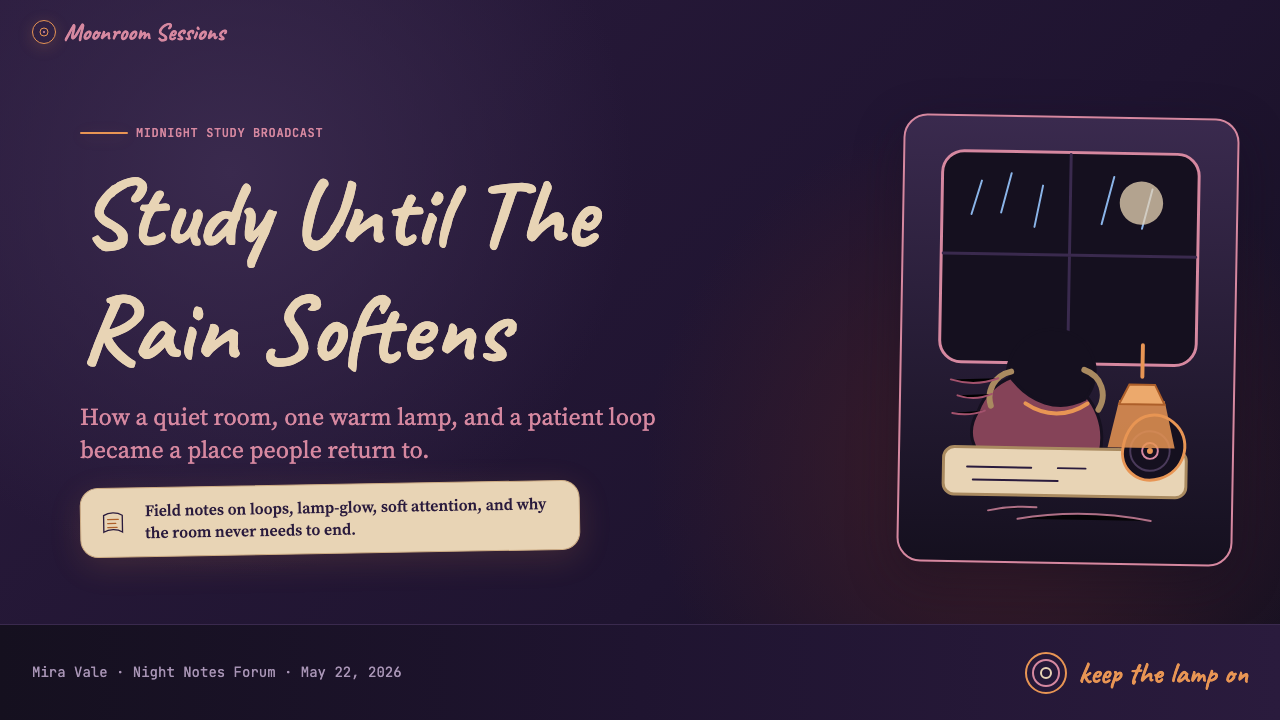
For presentation slides, this style is best applied to personal and creative contexts rather than professional or analytical ones. A cover slide benefits from a dark background with a single warm color zone — amber light blooming from the center or a corner — and type set in a hand-lettered or rounded style. Content slides should carry forward the paper texture metaphor: card-surface containers against a dark background, with a deliberate restriction on the number of colors used simultaneously. Data visualizations work when treated as handmade objects — bar charts that feel chalked rather than rendered, scatter plots with imperfect dot sizes — though the style will struggle on slides requiring precision or formal authority.
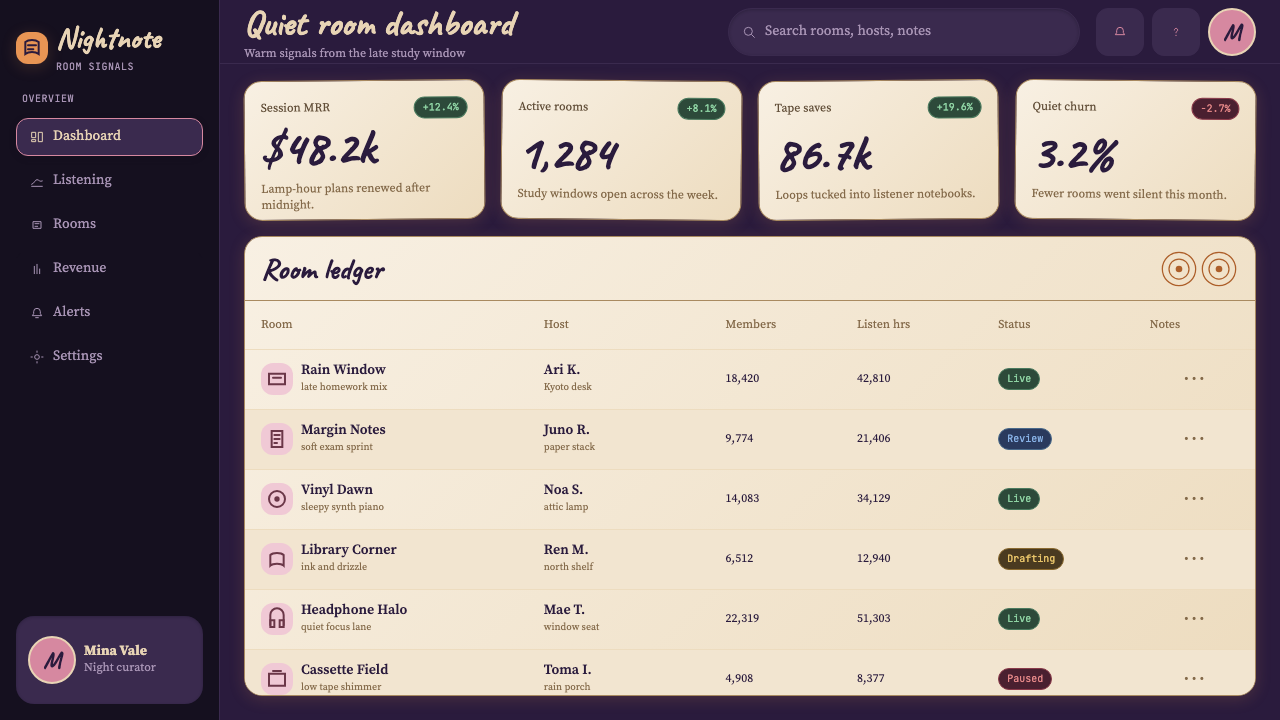
For web interfaces, the style suits personal dashboards, note-taking apps, ambient music and focus tools, and indie creative platforms where the user experience should feel intimate and unhurried. The approach is to establish the dark background first, then define one warm light zone that becomes the primary focus area. Navigation and structural elements should be typographic and understated, receding into the dark rather than asserting themselves. Card components should feel like physical objects — slightly warm in tone, with a gentle depth that suggests paper resting on a surface rather than pixels floating in a void.
For editorial and marketing applications, the style works on long-form content that is meant to be read rather than scanned, on artist profiles and creative portfolios, and on brand communication for products associated with focus and calm. Editorial layouts benefit from generous line height, warm-toned backgrounds, and section breaks marked by subtle texture shifts rather than hard rules. Marketing pages for focus tools, music platforms, or creative applications can use the aesthetic to differentiate from the clean, bright, high-saturation language of most consumer software — the darkness and warmth are themselves a product promise.
A common mistake is applying the style's visual surface while ignoring its underlying mood logic. Adding grain filters, dark backgrounds, and handwritten fonts to an interface that is fundamentally urgent — a project management tool, a news feed, an e-commerce checkout flow — will produce visual dissonance rather than atmosphere. Equally, the style loses its power when its palette is brightened: replacing plum and amber with navy and orange, or making the background lighter for readability, removes the late-night intimacy that gives the style its emotional charge. The grain, the darkness, and the single warm light source are not optional elements — they are the style's argument.
Lofi Hip-Hop Anime Girl (2018) — FAQ
Is the Lofi Girl aesthetic the same as vaporwave or synthwave?
They share an interest in nostalgia and analog media, but they are distinct in mood, palette, and cultural reference. Vaporwave is ironic, lurid, and saturated — it pillages 1980s consumer culture and early internet aesthetics with a sense of detached commentary. Synthwave is energetic, chrome-edged, and cinematic, referencing retrofuturism and the visual vocabulary of 1980s action films. The Lofi Girl aesthetic is intimate, quiet, and genuinely warm rather than nostalgic-as-critique. Its darkness is soft and enclosing rather than neon and exposed. Where vaporwave makes a joke about late capitalism and synthwave makes a film trailer, the Lofi aesthetic makes a cup of tea.
Can this style work for a product that isn't about studying or music?
Yes, but the transfer requires honest assessment of whether the product shares the emotional values of the aesthetic — solitude, quiet focus, personal time, comfort in imperfection — rather than just its visual surface. A journaling app, a sleep tracker, a creative writing tool, an indie game, or a personal finance app framed around calm reflection could all carry this aesthetic credibly. A fast-food ordering interface, a live sports scoreboard, or a real-time collaboration tool cannot — not because of visual incompatibility but because the emotional registers are fundamentally opposed. The style's grain and darkness signal slowness, and slowness is a promise the product must be able to keep.
How do you maintain accessibility in such a dark palette?
Dark palettes create real accessibility challenges, and the Lofi aesthetic does not exempt itself from them. The key is to treat the warm amber tones — the illuminated zones — as the primary legibility area, and to ensure that any text or interactive element falls within or near that warm zone rather than in the shadowed periphery. Text placed against deep plum or near-black backgrounds must carry sufficient luminance contrast to remain readable; the grain overlay, while atmospheric, cannot be allowed to reduce contrast below acceptable thresholds. The style's own logic actually assists here: if the lamp is the light source, content should be near the lamp.
What is the difference between authentic lofi aesthetic and a generic dark mode?
Dark mode is a functional inversion of a light interface, typically using neutral dark grays as backgrounds to reduce eye strain. The Lofi aesthetic is not a functional mode — it is an emotional environment. The difference shows immediately in color temperature: dark mode uses cool to neutral grays; the Lofi style uses warm, chromatic darks — plums, dusty navies, warm near-blacks — combined with amber accent light. The critical addition is texture: the grain, the paper surfaces, and the analog noise overlays are entirely absent from dark mode and essential to the Lofi aesthetic. A dark mode looks like a system. A Lofi interface feels like a room.
Does the style age well, or is it tied too closely to a specific cultural moment?
All aesthetics are tied to the cultural moment that produced them — Bauhaus is inseparable from Weimar Germany, and Art Deco is inseparable from interwar prosperity. The question is whether the emotional need the aesthetic addresses is durable. The Lofi aesthetic addresses the desire for calm focus and productive solitude in an environment of distraction and speed — a desire that appears to be intensifying rather than fading. Its specific iconographic markers (the anime girl, the cat, the rain on the window) will date it to the early 2020s in the way that specific motifs always date their moment of origin. But the underlying mood logic — warm darkness, slow texture, intimate scale — is old enough to have appeared in candlelit Dutch interior painting and new enough to be the visual grammar of a generation of digital creators.
Related design styles
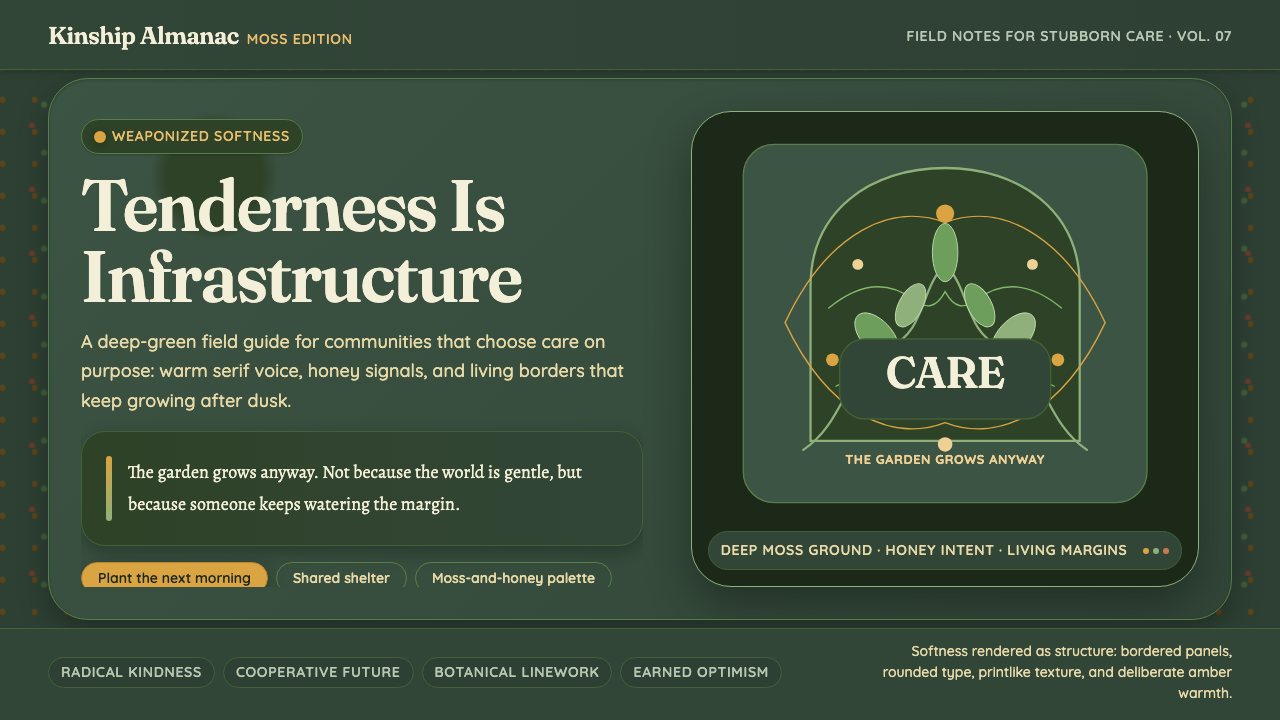 HopepunkSoftness becomes defiance. Deep moss, honey amber, and vine borders make care…
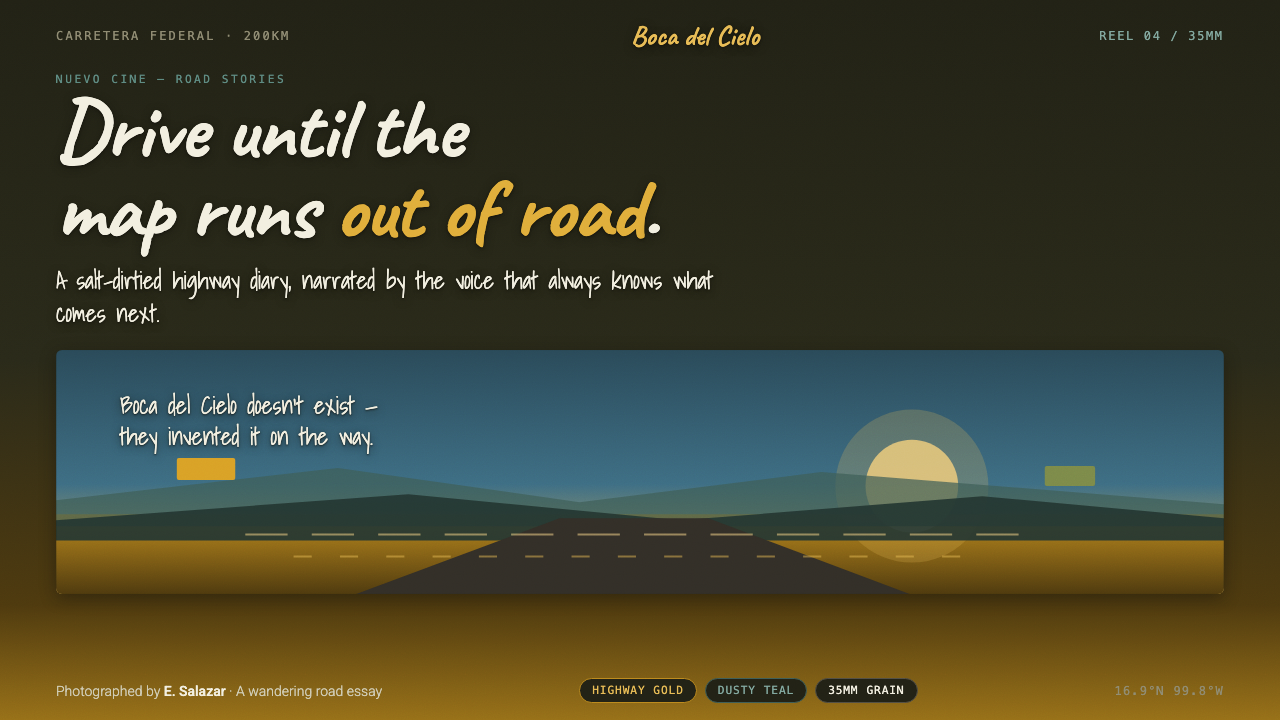 Y Tu Mamá TambiénSun-bleached road-movie warmth. Highway gold and dusty teal on dusky film, ha…
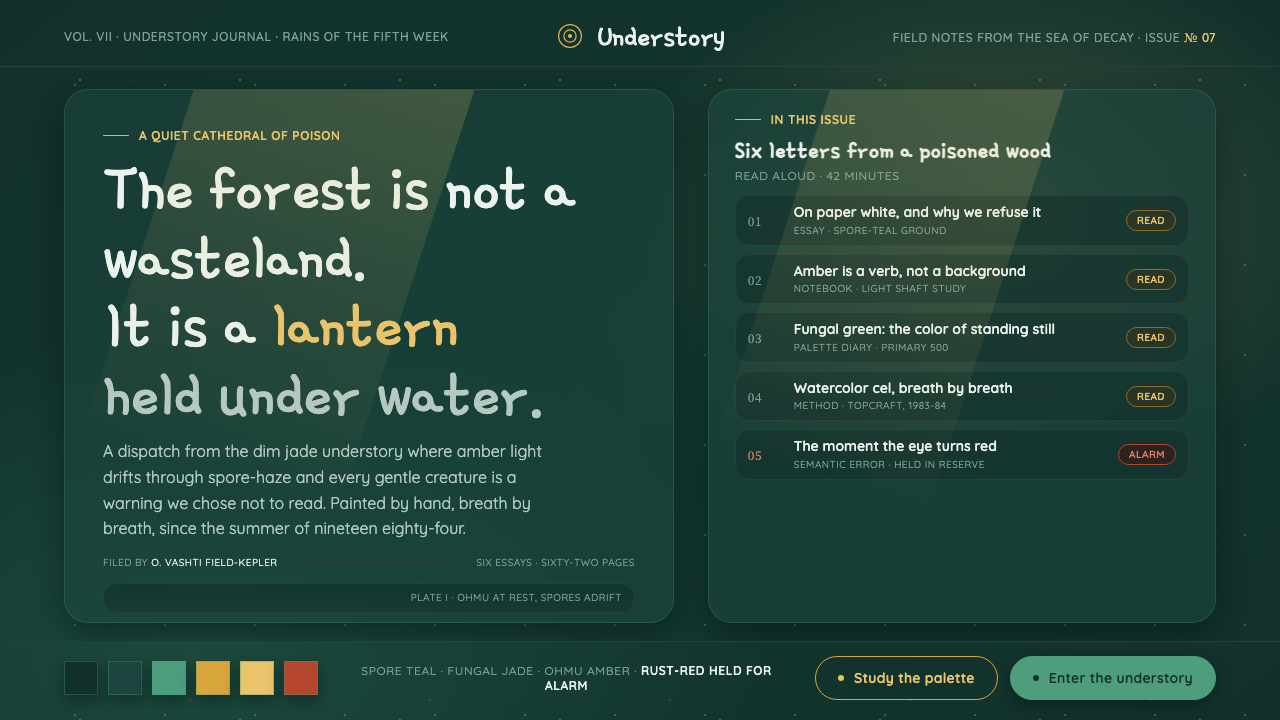 Nausicaä Toxic JungleRefuses paper-white. Jade-teal understory lit by drifting amber spores, rust-…
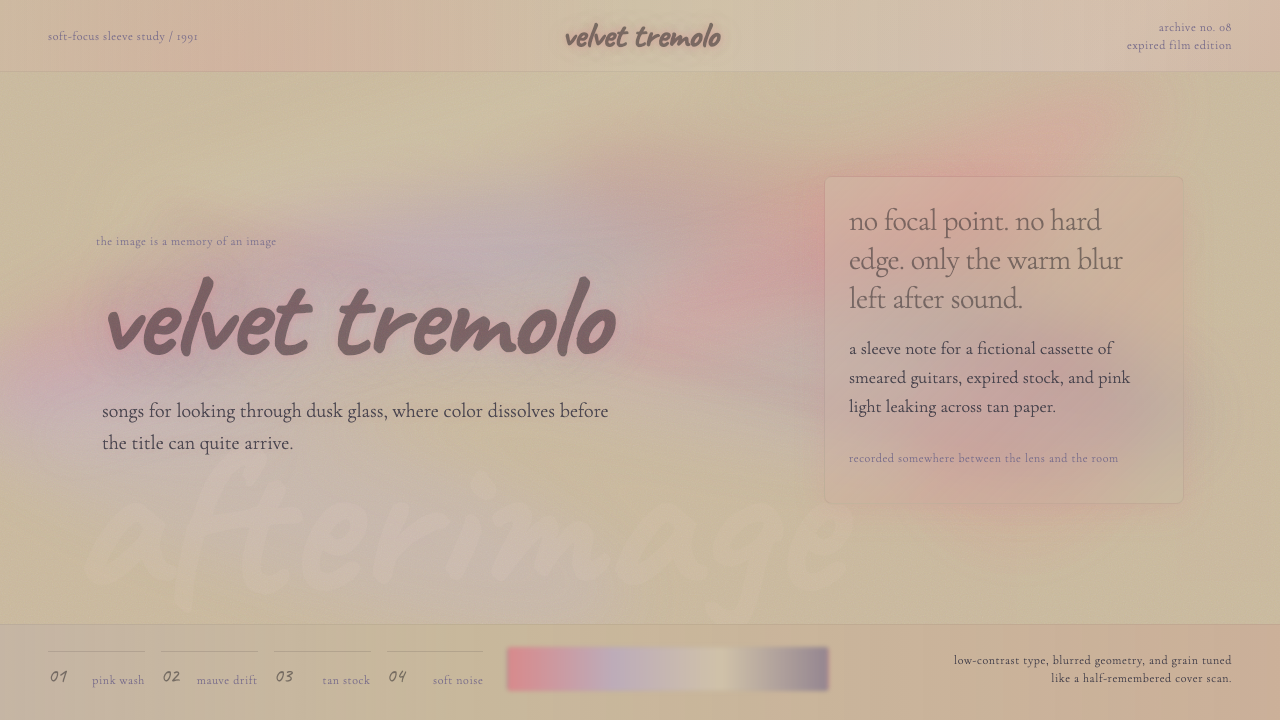 Shoegaze MBV (1991)Sound becomes fog. Hot-pink bleach, mauve blur, and whispered serif type diss…
 Studio Ghibli (Miyazaki)Hand-painted wonder breathes. Cumulus blue, meadow green, and Cormorant type…
 Amores Perros New WaveRaw street cinema. Crushed black, sodium amber, Oswald credits, heavy 35mm gr…