What is Frank Ocean — Blonde?
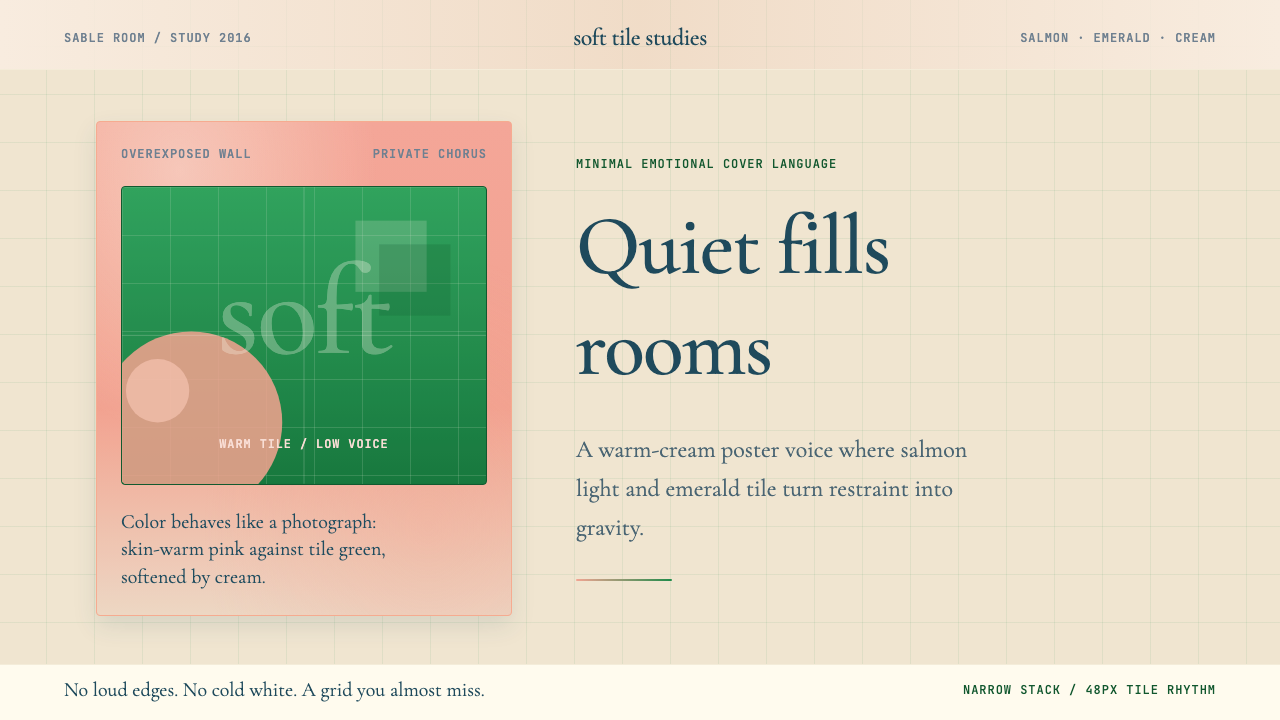
Blonde turns intimacy into visual grammar — warm cream, saturated salmon-pink, and a quiet tilt of the head that somehow fills the whole room.
Frank Ocean — Blonde in brief
Frank Ocean's Blonde (2016) established a visual identity so precise and so restrained that it became the defining aesthetic reference for an entire era of indie R&B and alternative soul. The cover — Wolfgang Tillmans' soft-focus photograph of Ocean covering his face with both hands, his hair dyed a warm salmon-pink — was paired with art direction by Tom Sachs to produce something that looked nothing like a conventional music release. It looked handmade, intimate, and completely unhurried.
The aesthetic operates through a small number of deliberate choices. A warm cream ground — not stark white, but the color of old paper or morning light on a bare wall — carries the central image. Against that ground, the saturated salmon-pink of Ocean's hair and the deep emerald of bathroom tile geometry create a palette that is simultaneously warm and cool, indulgent and austere. Spacing is generous throughout: the cover breathes. Nothing crowds anything else. Text, when it appears, is rendered in wide-set serif letterforms that feel like handwritten notes rather than designed labels.
What distinguishes Blonde's visual language from ordinary minimalism is emotional weight. The restraint is not emptiness — it is the restraint of a person who has chosen very carefully what to say and what to leave out. The bathroom tile motif, the hand covering the face, the muted personal-photograph quality of the image: all of these carry the feeling of something private made briefly visible. The aesthetic asks the viewer to slow down, to look, to be in the same room.

Where does Frank Ocean — Blonde come from?
Frank Ocean came up through New Orleans, then Los Angeles, where he wrote songs for other artists before signing to Def Jam and releasing the mixtape Nostalgia, Ultra in 2011. That release used sampled beats and free distribution to build an audience entirely outside the conventional label pipeline, establishing an independence of method that would carry forward. His debut studio album Channel Orange followed in 2012 — critically celebrated, Grammy-winning — and its visual language was already reaching toward the personal and the understated. But it was four years of silence, legal disputes with Def Jam, and deliberate self-exile from the industry that made Blonde possible.
Blonde was released in August 2016 simultaneously as a visual album and as a streaming exclusive, bypassing traditional retail entirely. This act of structural independence shaped the aesthetic: there was no label art department to satisfy, no standard template to conform to. Ocean worked with Wolfgang Tillmans — the German-British photographer known for his intimate, unposed, technically imperfect images of queer life, domestic spaces, and bodies in private moments — and Tom Sachs, the New York sculptor and artist known for his handmade, lo-fi reinterpretations of consumer culture. The combination was not accidental. Tillmans brought documentary intimacy; Sachs brought an insistence on the visible hand, the human mark, the thing that looks made rather than manufactured.
The salmon-pink-and-emerald palette had a specific photographic origin: the cover image captures Ocean's dyed hair and the green tiles of a bathroom, photographed under the ambient light of that interior space. The palette was not chosen from a mood board — it was found. This is an important distinction for understanding the aesthetic: the design does not impose a system on the image; the image generates the system. Tillmans' practice of finding rather than constructing images means the visual language of Blonde has an authenticity that purely art-directed covers rarely achieve.
The cultural moment mattered too. 2016 was the height of the streaming-era fragmentation of the music industry, and the year that saw an extraordinary wave of artistically ambitious Black American music — Beyoncé's Lemonade, Solange's A Seat at the Table, Kendrick Lamar's untitled unmastered. In this context, Blonde's quietness was itself a statement. Where those releases were grand and political, Ocean's was whispered and private. The visual language — intimate, handmade, unhurried — mirrored that posture exactly. The aesthetic became influential not because it was loud, but because it offered a counterpoint to loudness at exactly the moment loudness was everywhere.
What defines the Frank Ocean — Blonde look?
Salmon-Pink and Cream Ground
The dominant palette is built on two warm tones that sit adjacent rather than in contrast: a saturated salmon-pink carrying the emotional charge, and a warm cream background that softens everything it touches. Neither tone is aggressive — the salmon reads as skin-adjacent, fleshy, personal. The cream prevents the whole from feeling clinical or museum-like. Together they create an atmosphere of warmth-at-a-distance: close, but not crowding.
Emerald Tile Geometry
The deep emerald green of bathroom tiles introduces the only cool note in the palette, and it arrives as geometry rather than field color. The grid of tile seams creates a quiet structural underpinning — repetitive, domestic, slightly institutional. This geometric pattern grounds the soft photograph in something more concrete, preventing the overall mood from dissolving into pure sentiment. The tiled surface is architectural memory: it recalls specific rooms, specific intimacies.
Intimate Photographic Light
The light in Blonde's visual world is ambient and interior — not studio-controlled, not dramatically directional, but the kind of light that exists in rooms where people actually live. Tillmans' photographic practice rejects the manufactured quality of commercial portraiture; his images feel found rather than constructed. This quality of light gives the aesthetic an air of documentary truth: something was captured here, not staged.
Serif Type with Generous Spacing
Where text appears in Blonde's extended visual identity, it does so in serif letterforms set with wide letter-spacing and generous surrounding whitespace. This typographic posture is the opposite of corporate or authoritative — it reads as contemplative, almost handwritten in feel. The choice of serifs over sans-serifs signals warmth and literary tradition rather than rationality and system. The wide tracking prevents crowding and allows each word to breathe as an individual object.
Visible Hand — Handmade Quality
Tom Sachs' art direction brings a deliberate imperfection to the overall visual language — an insistence that the thing looks made by a person, not produced by a machine. This does not mean sloppiness; it means that the traces of human decision-making remain visible in the final object. Slight asymmetries, textures that feel physical rather than digital, an overall looseness that resists the smooth finish of corporate design. The aesthetic explicitly positions itself against the polish of mainstream commercial visual culture.
Restraint as Emotional Language
Perhaps the most important characteristic of the Blonde aesthetic is what it does not do. It does not explain itself. It does not fill silence with decoration. It does not reach for the viewer's attention; it waits for the viewer to arrive. This restraint is not emptiness — it is the fullness of withheld feeling. Every decision to leave space, to not add another element, to let a quiet image carry its own weight without supporting graphics or explanatory text, constitutes a form of emotional expression.
Domestic and Private Scale
Unlike aesthetics built for spectacle — the stadium-scale grandeur of arena rock, the maximalist visual noise of commercial pop — Blonde operates at the scale of the domestic interior. The bathroom, the bedroom, the quiet afternoon. The visual elements are not monumental; they are personal-scale. This choice of register is itself meaningful: the aesthetic is not performing for a crowd, it is speaking to one person at a time.

Who shaped Frank Ocean — Blonde?
Born Christopher Edwin Breaux in Long Beach, California, and raised in New Orleans, Ocean moved to Los Angeles as a teenager and quietly established himself as a songwriter before anyone knew his name. His 2011 mixtape Nostalgia, Ultra — released for free, bypassing Def Jam entirely — demonstrated the structural independence that would define his career. The 2012 album Channel Orange made him a critical darling and introduced a visual sensibility already moving toward intimacy and understatement. Blonde, released in 2016 after four years of deliberate silence, is widely regarded as one of the defining artistic statements of the 2010s: not just musically but as a total aesthetic object whose visual language, distribution strategy, and emotional register all cohere into a singular and unrepeatable act.
Wolfgang Tillmans was born in Remscheid, Germany in 1968 and is among the most influential photographers of the last four decades. His work — intimate, unposed, technically imperfect in ways that feel purposeful — established a visual language for queer life, youth culture, and domestic space that became enormously influential on editorial photography, fashion, and album art. His photographs feel found rather than made: a detail of fabric, a body in an unguarded moment, the interior of a room at a specific time of day. Tillmans won the Turner Prize in 2000 — the first photographer to do so — and has exhibited widely at institutions including Tate Modern and MoMA. His collaboration with Frank Ocean on Blonde brought his documentary intimacy to bear on popular music at a moment when popular music rarely looked to fine art photography for its visual language.
Tom Sachs is a New York-based sculptor and artist born in 1966, known for handmade, lo-fi reinterpretations of consumer culture and institutional authority. His studio practice involves meticulous craft applied to unexpected materials — he has built functional space stations out of plywood and domestic hardware, recreated luxury brand packaging in foam core, and constructed elaborate ceremonial systems with deliberate DIY aesthetics. The thread connecting Sachs' art practice to his art direction on Blonde is his insistence on visible process: the thing should look like someone made it, and the marks of making should remain. This quality — what critics sometimes call 'bricolage' — translates in Blonde's visual language as the handmade imperfection and anti-corporate warmth that distinguishes the album's aesthetic from the polished visual production of mainstream music releases.
Homer — the zine published by Frank Ocean accompanying the Blonde release — extended the album's visual language into print. Distributed to select Apple Music subscribers and later circulated widely online, the zine features photography by Tillmans alongside other images, fragments of text, and graphic elements consistent with the album's restrained, personal aesthetic. Homer established the precedent for Ocean's subsequent creative ventures (including the Homer jewelry brand launched in 2021) and demonstrated that the Blonde visual system was not a one-off album cover but a coherent, expandable aesthetic world. The zine format itself — small, limited, physical — reinforced the intimate and anti-mass-market character of the release.
While Wolfgang Tillmans shot the canonical Blonde cover, the photographer and director Nabil Elderkin had been a key visual collaborator with Frank Ocean since Channel Orange, and his work shaped the evolving visual language that culminated in Blonde. Elderkin, who has also worked extensively with Kanye West, Bon Iver, and other artists associated with thoughtful visual practice, brings a similar preference for natural light, documentary texture, and emotional restraint. His contribution to Ocean's extended visual world illustrates that the Blonde aesthetic was not the product of a single moment of inspiration but emerged from sustained, consistent creative partnerships in which visual values were held to and refined across multiple projects and years.
How do you use Frank Ocean — Blonde today?
The Blonde aesthetic transfers most naturally to contexts that share its fundamental posture: quiet, personal, unhurried. It is the wrong tool for work that needs to project authority, urgency, or systemic rationality. Applying it correctly requires internalizing the emotional register first — ask what kind of experience the design is supposed to create for the person looking at it, and whether that experience is compatible with warmth, intimacy, and restraint. If the answer is yes, the visual toolkit is available. If the answer is no, a different reference is needed.
For presentation slides, the Blonde aesthetic works exceptionally well on title and section-break pages but requires discipline on content pages. A title slide should use the cream-ground approach: a single photographic or illustrative image with generous surrounding space, the title in wide-set serif type, no supporting graphics or decorative borders. Section breaks can carry the salmon-pink or emerald as a field color behind minimal text. Content slides require restraint: one idea per slide, body text in a weight and size that feels readable rather than bold, generous margins, and no decorative elements. Data visualizations should be kept visually quiet — use the palette's warm and cool tones to distinguish data series, but do not crowd the chart. The overall rhythm of the deck should feel like turning pages in a book rather than advancing through a presentation.
For web interfaces and dashboards, the Blonde visual language adapts well to products whose primary relationship with the user is personal rather than transactional. A wellness application, a personal finance tool, a reading or journaling app — these contexts invite the warm cream ground, the restrained typography, and the generous whitespace. Navigation should be typographic and minimal: no icon-heavy sidebars, no color-coded badges fighting for attention. Interactive states — hover, active, focus — can use the salmon-pink as an accent without saturating the whole interface. Pricing pages work with the style if tiers are distinguished through typography and spacing rather than competing color blocks.
For editorial and marketing contexts, the aesthetic supports long-form and brand-building work better than it supports short-form conversion-focused content. A brand story page, an about-us section, a feature article about a founder or product philosophy — these formats reward the slow, accumulative quality of the Blonde approach. Full-width imagery in a warm, documentary style alternates with text blocks set in wide-measure serif, and the overall page rhythm breathes. Marketing headlines work in wide-set serif at a scale that commands attention without shouting. One consistent accent color — the salmon-pink — used only for primary calls to action, with all other interactive elements handled typographically.
A common mistake is treating the Blonde palette as an invitation to softness everywhere. The aesthetic is not pastel — the salmon-pink is saturated, the emerald is deep, the cream is warm but not sugary. Desaturating the palette to achieve a gentle or soothing effect produces something that looks more like generic wellness branding than like Blonde. Another frequent error is over-applying the photographic quality: Blonde's intimacy works because it is selective. One or two images carrying the full documentary weight of the aesthetic is more powerful than a page saturated with soft-focus personal photography. And the generous spacing that defines the aesthetic requires actual restraint in the number of elements — generous spacing around too many elements does not read as Blonde, it reads as clutter with wide margins.
Finally, the handmade quality that Tom Sachs brings to the art direction is easy to misread as an invitation to visible imperfection everywhere. In practice, the handmade quality is precise: it is not messiness, it is the decision to leave certain marks visible that a more corporate aesthetic would sand away. Applied to digital design, this translates as a slight looseness in layout — not a rigid grid, but not chaos — and a willingness to let asymmetries stand when they feel right. The discipline is knowing the difference between an intentional mark and a mistake.

Frank Ocean — Blonde — FAQ
How does the Blonde aesthetic differ from general minimalism?
General minimalism tends toward coldness, precision, and the systematic removal of the personal. The Blonde aesthetic is restrained but not cold — its restraint is emotional rather than rational, expressive of feeling rather than expressive of order. The warm cream ground, the salmon-pink of skin and hair, the domestic bathroom setting: these are choices that invite personal association rather than pure formal appreciation. Minimalism says 'nothing unnecessary exists here.' The Blonde aesthetic says something quieter: 'I chose not to say more.'
Can the Blonde style work in a dark-mode or dark-background context?
The Blonde palette is fundamentally warm-ground: the cream is structural, not decorative. A dark inversion is possible but requires significant adaptation. On a deep background, the salmon-pink reads differently — it becomes more fragile, almost translucent — and the warm intimacy that makes the palette effective can break down. If a dark mode is required, the most faithful approach is to use a very dark warm brown rather than a neutral dark or pure black, and to reduce the palette to the salmon-pink as a single accent. The emerald geometry can survive on dark grounds but should be used even more sparingly. The handmade, photographic quality is harder to preserve in dark mode and may require custom photography with compatible lighting.
What kinds of photography pair well with the Blonde aesthetic?
Photography that pairs well with the Blonde aesthetic shares three qualities: it is shot under ambient rather than artificial light, it captures unguarded moments rather than posed subjects, and it is technically imperfect in ways that feel considered rather than careless — slight softness, grain, an unconventional angle. The subject matter should be domestic or personal rather than grand or spectacular. Portraits work well when the subject is not looking directly at the camera. Still lifes work when the objects have personal rather than commercial significance. Fashion or editorial photography becomes compatible when it abandons the studio and moves into real spaces with real light.
Is the Blonde aesthetic appropriate for brand identity work, or only for one-off creative projects?
The aesthetic is absolutely applicable to brand identity, but the brands it suits are specific. It is appropriate for brands whose value proposition centers on authenticity, craft, personal connection, or emotional depth — independent publishers, artisan product brands, personal creative practices, certain hospitality or lifestyle concepts. It is not appropriate for brands that need to project scale, authority, or rational credibility — financial services, enterprise software, institutional organizations. The critical test is whether the brand's core promise involves the kind of intimate, personal relationship with its audience that the aesthetic implies.
How do you avoid the aesthetic feeling dated rather than timeless?
The risk of Blonde-inspired work feeling dated lies primarily in over-reliance on surface markers that were specific to a cultural moment — the warm filter tones of 2016 Instagram, certain low-fi lo-fi tropes that became ubiquitous by 2020. The deeper principles of the aesthetic — warmth without sweetness, restraint without coldness, human presence without performance — do not date in the same way. Work that applies those principles through contemporary materials and contexts, rather than mimicking the specific visual gestures of 2016, tends to hold up. The reference point should be the emotional intention, not the surface style.
Related design styles
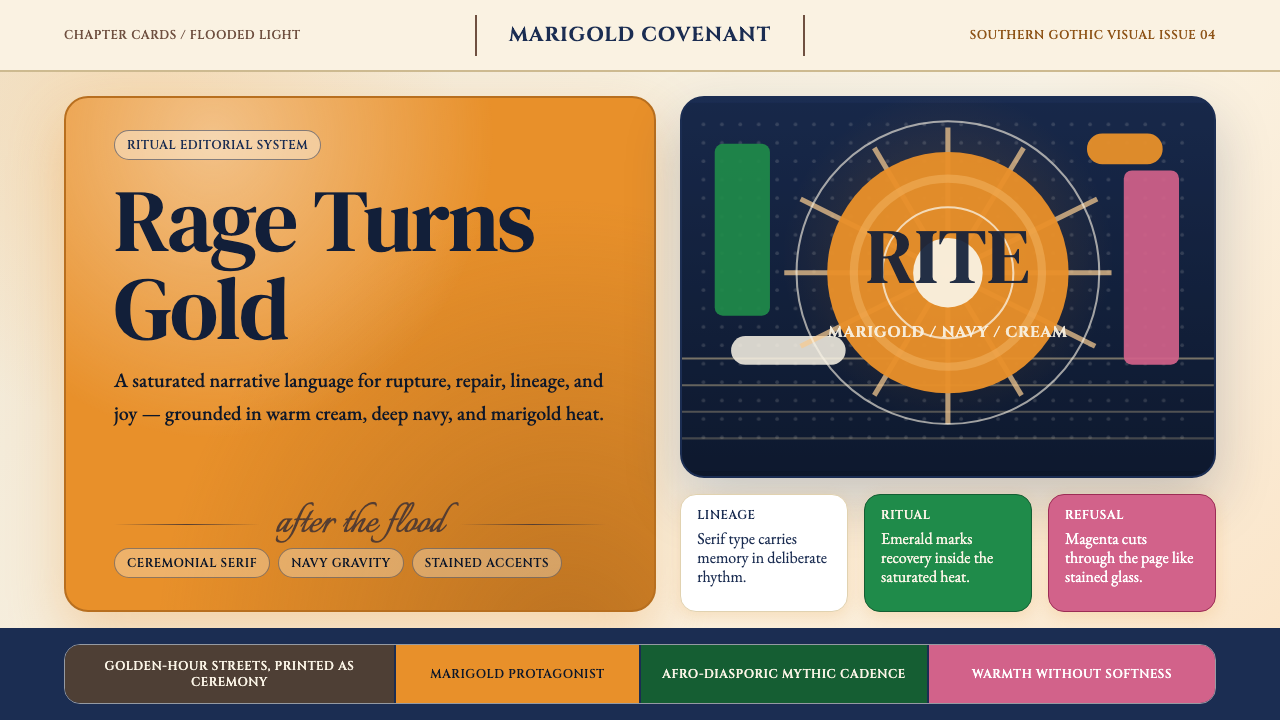 Beyoncé — LemonadeMythic heat refuses restraint. Marigold blocks, navy gravity, serif ceremony.
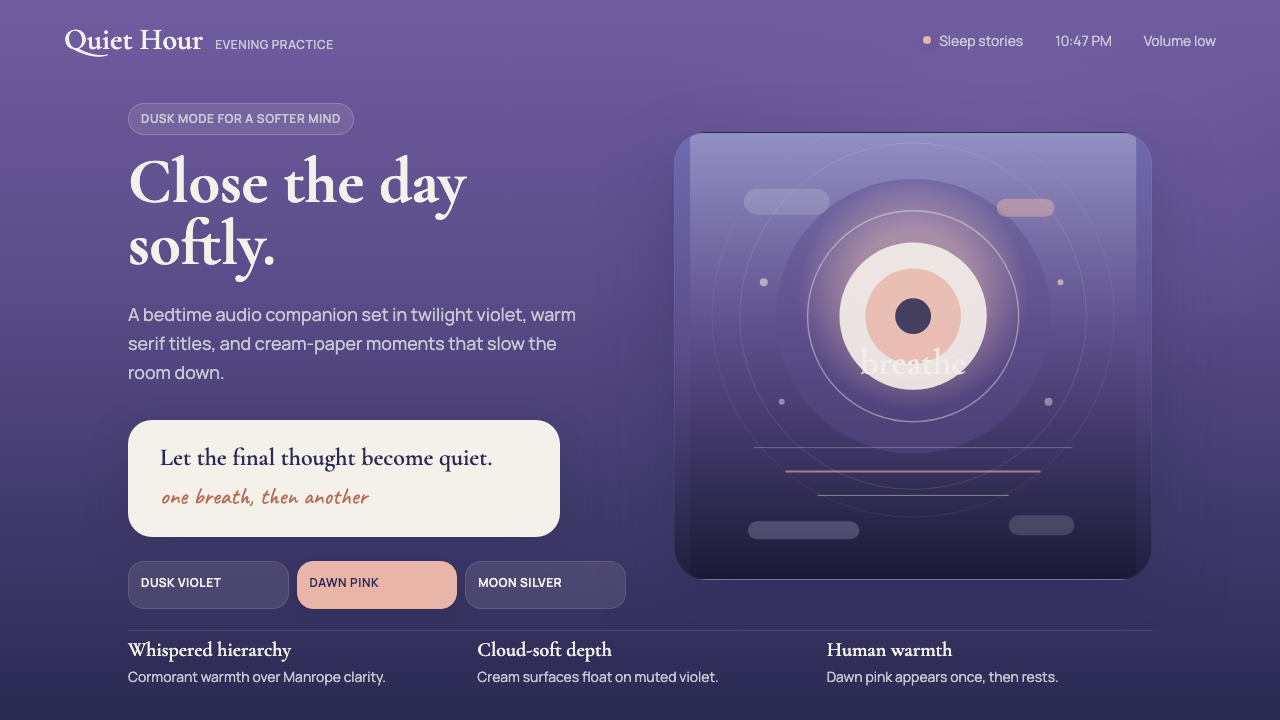 Calm App Purple MeditationWhispers at bedtime. Dusk-purple gradients, cream serif type, and dawn-pink w…
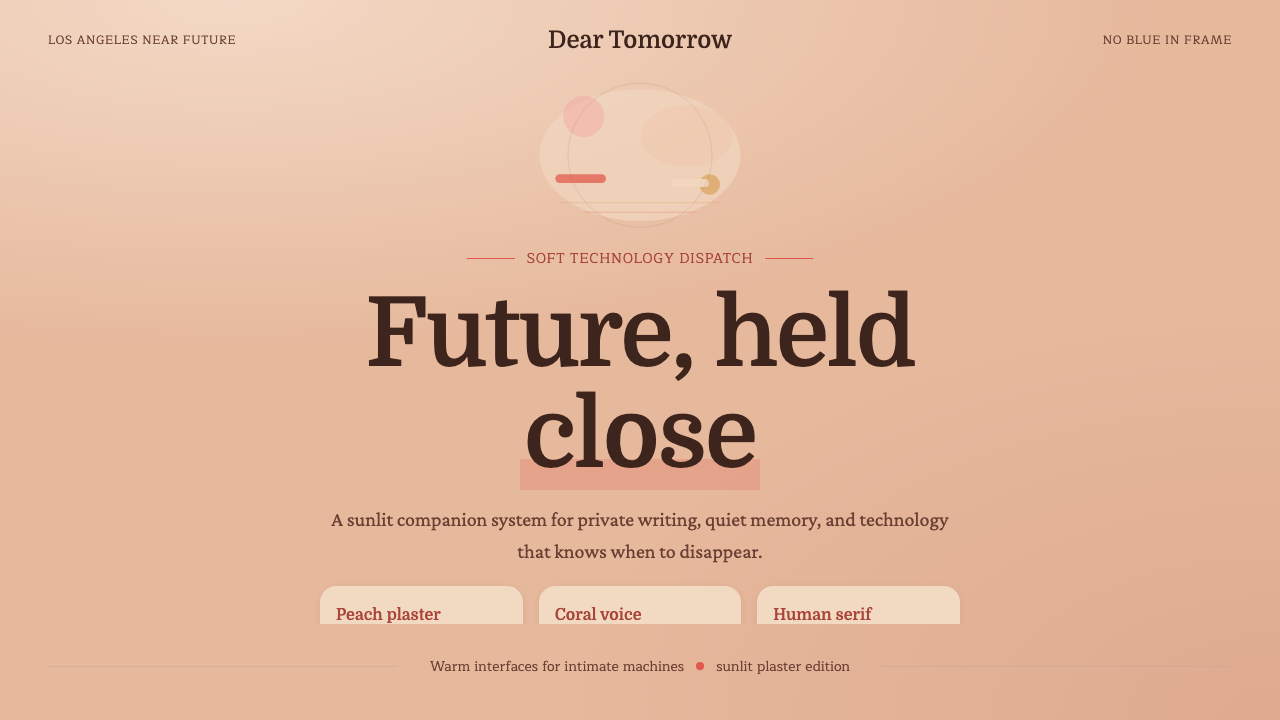 Her — Soft FutureTender future, no chill. Peach plaster, coral serif type, and soft stacked sp…
 Kanye — 808s & HeartbreakGrief in restraint. Cream paper, one red heart, yellow heat, and a black hair…
 Belizean Garifuna PuntaNight rhythm burns. Indigo fields, flame-orange serif type, and flag stripes…
 Coquette Aesthetic Pink Bow (2023)Softness is deliberate. Dusty pink, cream silk, and strawberry red frame ever…