What is Pixar Luxo?
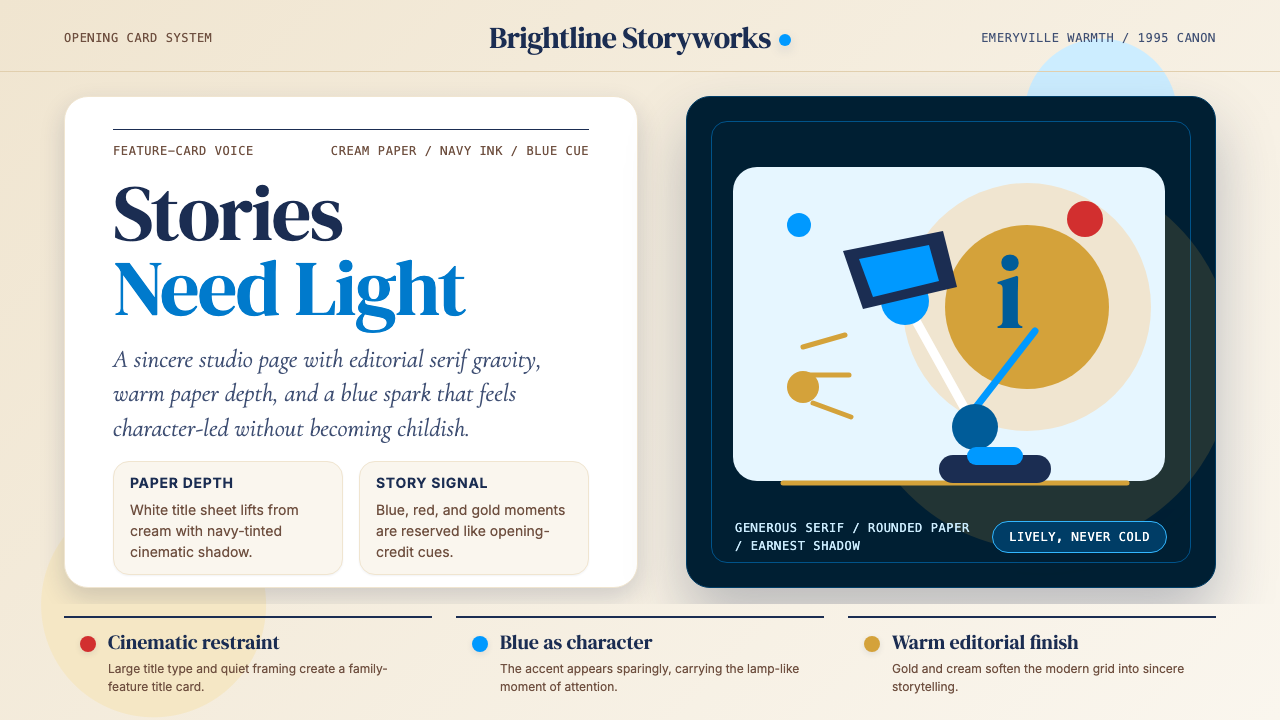
Pixar's Luxo Jr. lamp taught the world that a circle of warm light and a bouncing silhouette could carry more emotional weight than any photorealistic blockbuster.
Pixar Luxo in brief
Pixar Luxo is the design language built around the studio's most recognizable symbol: the hopping desk lamp that has introduced every Pixar film since 1986. The visual system translates the warmth, sincerity, and narrative weight of that lamp into a communicable aesthetic — cream paper grounds, deep navy serif headlines, saturated brand reds and golds, soft-rounded shapes, and a cinematic shadow vocabulary that makes any surface feel like a film's end-credit card.
At its core, the style is a marriage of editorial gravitas and animated storytelling. It borrows the unhurried confidence of classic American book and poster design — generous leading, wide margins, ink-dark type — and fuses it with the rounded, approachable geometry of computer-generated character animation. The result sits at an unusual cultural intersection: it feels both institutional enough for a Fortune 500 annual report and warm enough for a children's bedtime story.
The palette is built around restraint and contrast. A cream or warm-white field anchors everything. Deep navy — not pure black — carries the typographic weight. Pixar's signature blue, a clear saturated mid-blue, appears as a directional accent. Brand reds and warm golds punctuate sparingly, carrying the emotional temperature of a lit stage rather than the aggression of a marketing color. The overall effect is cinematic warmth with editorial precision.

Where does Pixar Luxo come from?
Pixar Animation Studios was born in 1986 as a spinoff from Lucasfilm's Computer Division, when Steve Jobs purchased the unit for ten million dollars. The company's first public creation was not a feature film but a short: Luxo Jr., directed by John Lasseter and released the same year. Running less than two minutes, it depicted two desk lamps — a large one and a small one — playing with a ball. The short was the first computer-animated film ever nominated for an Academy Award. It also established, in a single piece of work, the entire emotional vocabulary that would define Pixar for the next four decades: simple geometry, expressive motion, and the conviction that audiences will project full humanity onto any object that moves with intention.
The Luxo lamp became the studio's logo almost by accident — Lasseter's short had used the Luxo brand of adjustable desk lamps as its subject, and the resulting character was so beloved that the studio adopted it as its mark. From 1995's Toy Story onward, a computer-animated Luxo Jr. lamp would hop across the screen and squash the letter 'i' in 'Pixar' at the start of every theatrical release. This opening ritual gave the studio its most consistent visual asset: a piece of animated brand identity that communicated warmth, playfulness, and technical ambition simultaneously — long before the feature had shown a single frame.
The visual language of Pixar's corporate and marketing materials grew in dialogue with the films themselves. The studio's Emeryville, California campus — designed with input from Steve Jobs, who served as chairman after the acquisition by Disney in 2006 — emphasized open collaboration, natural light, and warm materials. The design systems that accompanied early Pixar home-video releases, theatrical one-sheets, and press materials drew on classic American editorial traditions: the deep navy and cream of vintage book jacket design, the broad-shouldered serif type of golden-era Hollywood title cards, and the saturated but never garish color sense of mid-century American illustration.
Toy Story (1995) was the watershed moment not just for Pixar but for the entire animation industry. As the first fully computer-animated feature film, it demonstrated that 3D rendering could achieve emotional resonance rather than merely technical spectacle. The film's visual warmth — soft volumetric light, rounded character forms, a palette that referenced both the plastic of actual toys and the warm grain of childhood memory — established the aesthetic benchmark that subsequent Pixar films would iterate on. The Pixar Story Brain Trust, a creative feedback group established by Ed Catmull and John Lasseter in the late 1990s, became the institutional guardian of this aesthetic consistency, ensuring that visual warmth and narrative sincerity remained inseparable across dozens of productions.
What defines the Pixar Luxo look?
Warm Ground Palette
The foundational ground is cream or warm white — never a stark, blue-tinted white. This warmth is not accidental; it evokes the physical texture of paper, the glow of a practical lamp, and the grain of film stock. Against this ground, deep navy and warm black carry typographic mass, while the signature Pixar blue and occasional warm gold function as accents. The overall temperature reads as dusk-lit rather than daylight-clinical.
Generous Serif Headlines
Headline type is set in broad, confident serif letterforms — the kind associated with classic editorial publishing and theatrical title cards rather than corporate sans-serifs. Letters are given room to breathe: wide tracking, comfortable leading, and generous scale differentials between heading levels. The effect communicates authority without coldness — the same tone as a hardcover book jacket or a film's opening title sequence.
Soft-Rounded Geometry
Shapes in this system carry visible corner rounding — not as a UI trend but as a direct echo of the Luxo lamp's own silhouette and of the rounded, volumetric characters that define Pixar's 3D aesthetic. Cards, containers, and illustrative shapes avoid sharp ninety-degree corners. This roundedness is calibrated: enough to read as friendly and approachable, not so extreme as to appear soft or unserious.
Cinematic Shadow Language
Shadows in this system simulate the warm, directional cast light of a practical lamp — soft-edged but with clear directionality, suggesting a single warm source above and slightly to one side. This is the opposite of the Bauhaus hard-offset drop shadow: rather than treating shadow as a geometric decision, Pixar Luxo treats it as a lighting narrative. The effect gives flat interface elements a gentle dimensionality, as though they exist under stage lighting rather than on an LCD panel.
Saturated Brand Accents
While the ground palette is warm and restrained, the accent colors are unapologetically saturated. Pixar's brand red and warm gold are used sparingly but at full saturation when they appear — never desaturated, never tinted toward pastels. This creates a clear emotional hierarchy: the cream ground is resting, the navy is working, and the saturated accents are performing. The analogy is theatrical: warm ambient light, dark stage, spotlit focal points.
Narrative Illustration Style
When illustration appears in this system, it echoes the character design principles of Pixar's films: clearly silhouetted forms, volumetric but not hyper-realistic shading, warm local color, and an emphasis on readable expression over anatomical detail. Figures and objects are designed to communicate at a glance — the same principle that makes a Pixar character readable from a cinema seat fifty rows back. Flat icon sets clash with this language; the appropriate illustration approach has weight and warmth.
Emotional Legibility
The deepest principle of the Pixar Luxo aesthetic is that every visual decision should reinforce emotional legibility — the sense that the audience immediately understands not just what they are looking at but how they are supposed to feel about it. This principle governs color temperature, type choice, illustration style, and shadow language simultaneously. A layout in this style should feel like a story about to begin, not a specification about to be executed.

Who shaped Pixar Luxo?
Lasseter directed Luxo Jr. in 1986, establishing both the lamp as a character and the principle — warmth through simple geometry — that would define Pixar's visual identity. He went on to direct Toy Story (1995) and A Bug's Life (1998), and served as Chief Creative Officer of Pixar and Walt Disney Animation Studios from 2006 until 2018. His insistence that every technical advance must serve an emotional story rather than display itself as spectacle is the philosophical root of the entire Pixar Luxo design language.
Catmull co-founded Pixar and served as its president until 2019. As the computer scientist who developed many of the foundational algorithms of 3D rendering, he represents the technical half of Pixar's identity — but his most significant contribution to the studio's design culture was organizational: the Story Brain Trust, which he and Lasseter established, became the mechanism through which aesthetic consistency was maintained across directors, productions, and decades. His book Creativity Inc. (2014) documents how the studio's culture of creative feedback protected visual and narrative quality.
Jobs purchased the Pixar computer division from Lucasfilm in 1986 and served as chairman through the Disney acquisition in 2006. His influence on the studio's visual culture was not primarily about film aesthetics but about brand presentation: the insistence on physical quality in packaging, the preference for warm materials and natural light in the Emeryville campus design, and the conviction — shared with his work at Apple — that a company's visual face should communicate values rather than merely announce products. The Pixar Luxo design language carries his fingerprints in its editorial restraint and its refusal of visual noise.
The Brain Trust is not a single individual but a standing creative council — a group of experienced Pixar directors and storytellers who provide candid, non-hierarchical feedback on films in production. Established by Catmull and Lasseter in the late 1990s, it operates on the principle that good notes improve the work without dictating solutions. As a design force, the Brain Trust is responsible for the consistent emotional register of Pixar's visual output: no film looks like its predecessor, but all of them share the same warmth of address, the same commitment to readable character, and the same resistance to visual coldness.
How do you use Pixar Luxo today?
Pixar Luxo translates most naturally into contexts that need to feel both authoritative and human — where the audience must trust the content and also feel welcomed by it. The core discipline is temperature management: every layout decision should either hold the warmth of the cream ground or punctuate it with the controlled fire of a saturated accent. Anything that reads as cold, clinical, or purely geometric will break the system's promise.
For presentation decks, the style excels on cover slides that need to stop a room. A full-bleed cream or warm-white field, a Luxo-blue or deep navy geometric mark in one corner, and a large serif headline in navy with a single gold or red word highlighted in the title — this composition has the weight of a theatrical one-sheet without any of a film poster's visual clutter. Content slides should be treated as editorial pages: generous margins, a clear typographic hierarchy built on size and weight rather than decorative rules, and any data visualizations rendered as warm, rounded chart forms rather than clinical sharp-edged graphs. The chart palette follows the brand sequence — navy for primary data, Pixar-blue for secondary, warm gold for emphasis — so the data reads as story rather than spreadsheet.
For web interfaces and dashboards, the Pixar Luxo approach requires resisting the temptation toward flat minimalism. The style works best when cards have visible but soft rounding, shadows carry the warmth of a lamp rather than the neutrality of a grey drop, and interactive states use the saturated brand accents at their full intensity. Pricing pages benefit from a deliberate narrative structure: each tier should feel like a chapter in a story, with the recommended option marked by a warm accent frame rather than a harsh contrast block. Navigation should be typographically led — wordmarks and labels in confident serif or complementary sans-serif — without icon-first visual pollution.
For editorial and marketing applications, the style supports strong feature storytelling. A Luxo-influenced article layout gives the body text room to breathe with wide margins and generous leading, uses pull-quote type set in the same confident serif at a much larger scale, and breaks sections with a warm-toned horizontal rule rather than a cold geometric line. Marketing pages work best when they honor the theatrical metaphor: alternating full-width sections between navy-on-cream and cream-on-navy, with the Pixar-blue or warm gold reserved exclusively for calls to action, creates the visual rhythm of a film's act structure — tension and release, dark and light.
The most common mistake when applying Pixar Luxo is importing the warmth as sentimentality rather than precision. Warm does not mean soft, loose, or decoratively busy. Authentic Pixar visual work is highly disciplined: the warmth is delivered through palette and shadow temperature, not through decorative flourishes, gradient washes, or illustrative excess. A layout that multiplies rounded shapes, fills every surface with warm texture, and stacks script typefaces on top of serif headlines is not Pixar Luxo — it is a pastiche of warmth with none of the system's structural intelligence. Keep the geometry clean, keep the type hierarchy rigorous, and let the color temperature do the emotional work.

Pixar Luxo — FAQ
Is Pixar Luxo appropriate for B2B SaaS products, or is it too playful?
The style is more versatile than the Pixar name suggests. When applied with editorial restraint — leading with the deep navy and cream rather than the brand red and gold, keeping type hierarchies rigorous, and limiting soft-rounded shapes to cards and containers rather than every element — Pixar Luxo reads as warm and trustworthy rather than playful. It is well-suited to products in categories where emotional connection and institutional credibility must coexist: HR platforms, education technology, family-facing financial products, and healthcare communications all benefit from a design language that communicates both authority and approachability. Where the style fails in B2B is when the warmth is overdone and the discipline collapses — the result reads as unserious.
How does Pixar Luxo differ from Disney's broader visual identity?
Disney's visual identity is rooted in hand-drawn animation, fairy-tale iconography, and a decorative warmth built on scrollwork, ornate type, and the castle silhouette. Pixar Luxo is built on 3D volumetric form, editorial typography, and a warmth that comes from light temperature and shadow direction rather than ornament. Disney is associative and nostalgic; Pixar Luxo is precise and cinematic. When Disney acquired Pixar in 2006, the studio was specifically allowed to maintain its own visual and creative culture — the distinction was considered a competitive asset. In practical design terms, Disney's palette trends toward richer purples, magentas, and fantasy blues, while Pixar Luxo anchors on navy, cream, and that specific mid-blue of the Luxo lamp.
Can this style work in dark mode or on dark-background layouts?
Dark mode is possible but requires careful rebalancing. The canonical Pixar Luxo palette is light-ground — removing the cream base removes the single element that unifies all the warmth signals. On a dark ground, the Pixar-blue accent can read as cold, and the warm gold can tip into garish. A successful dark variant commits to a very deep, slightly warm navy as the ground rather than pure black, and treats the cream as a foreground type color rather than a background. The saturated accents appear only at key moments — primary call-to-action, active navigation state, hero headline emphasis. The cinematic shadow language reverses: glows and inner light replace cast shadows, as though the source of illumination is within the content rather than above it.
What makes Pixar Luxo feel cinematic rather than just warm?
The cinematic quality comes from three specific decisions that most warm design systems do not make. First, the shadow direction is consistent and purposeful — all shadows in a layout point toward the same implied light source, creating a unified sense of space rather than elements floating independently. Second, the typographic scale differentials are theatrical rather than modest: a hero headline might be many times the size of body copy, creating the kind of visual drama that a film's title card achieves against an opening scene. Third, there is always a clear focal point — one element that the composition is organized to deliver the eye to, the way a film director stages a scene so the audience knows what to look at. Without these three elements, warmth is just coziness. With them, it becomes a designed experience with a beginning, a middle, and an end.
Does the style require character illustration, or can it work with photography?
Photography is compatible with Pixar Luxo but requires specific treatment. The canonical Pixar aesthetic is illustrated — volumetric character art with readable expression and warm local color — but photography that is color-graded toward the same warmth (golden hour light, shallow depth of field that softens backgrounds toward the cream palette ground) integrates well. The key constraint is that photography must carry the same light-temperature story as the rest of the layout. A cold, high-contrast, or editorial-documentary photograph will conflict directly with the warmth of the typographic and color system. When in doubt, apply a warm grade, crop to emphasize human expression over environment, and treat the photograph as a light source within the composition rather than a window to a separate visual world.
Related design styles
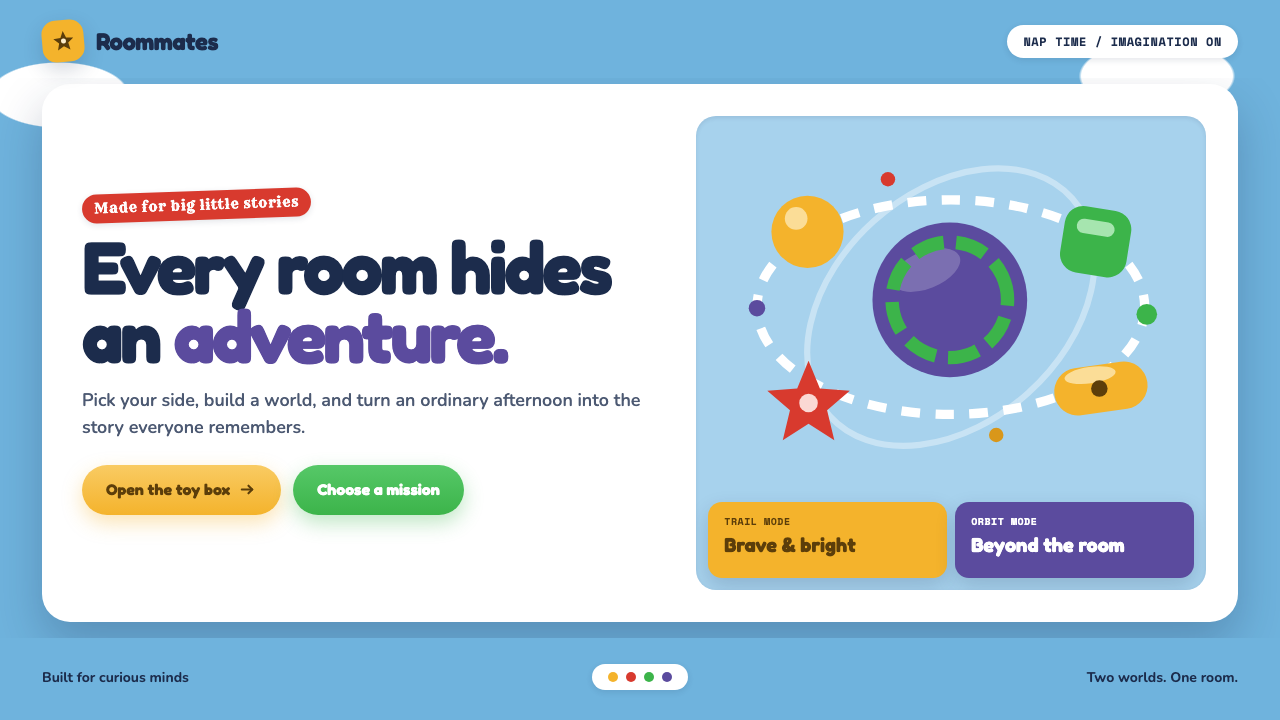 Toy Story (1995)Playtime becomes a whole world. Cloud blue, chunky type, and glossy two-tone…
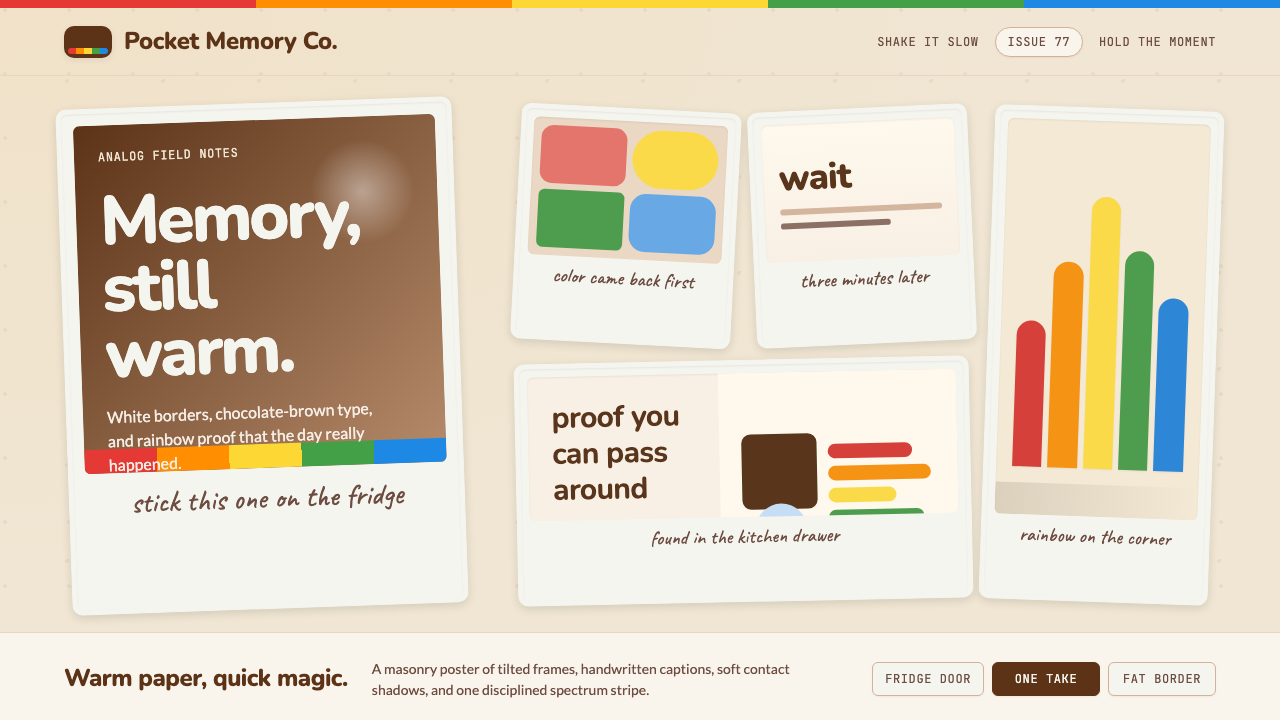 Polaroid InstantMemory made tangible. Photo-white frames tilt on aged paper with a warm rainb…
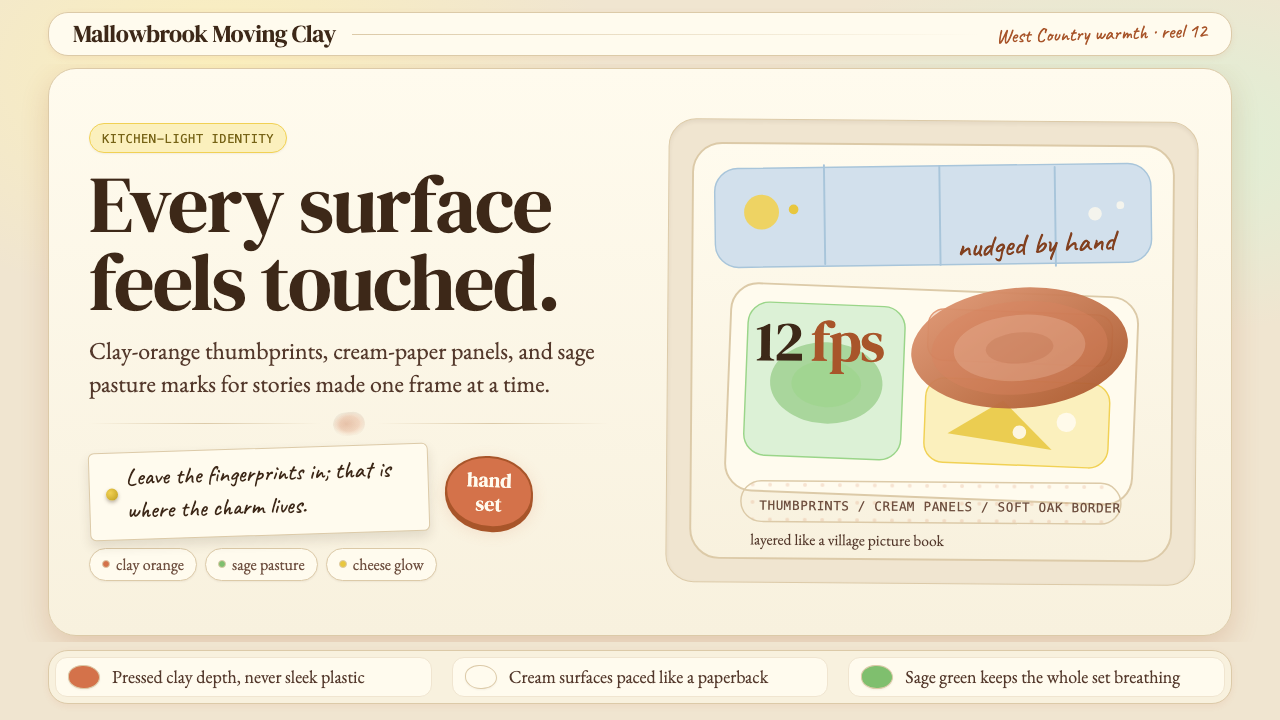 Aardman ClaymationHandmade warmth, visibly touched. Clay-orange panels, Caveat notes, thumbprin…
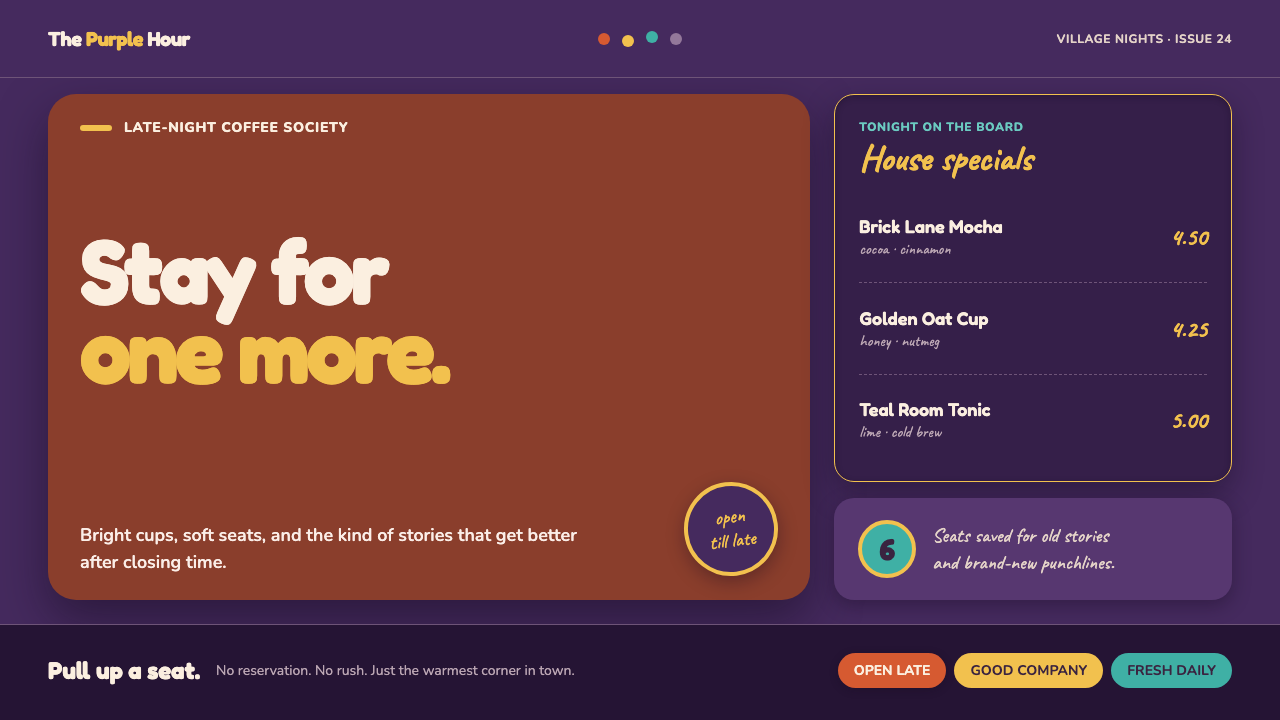 Friends Central Perk (1994)Sitcom warmth, turned TV-bright. Grape walls, couch orange, and bouncing colo…
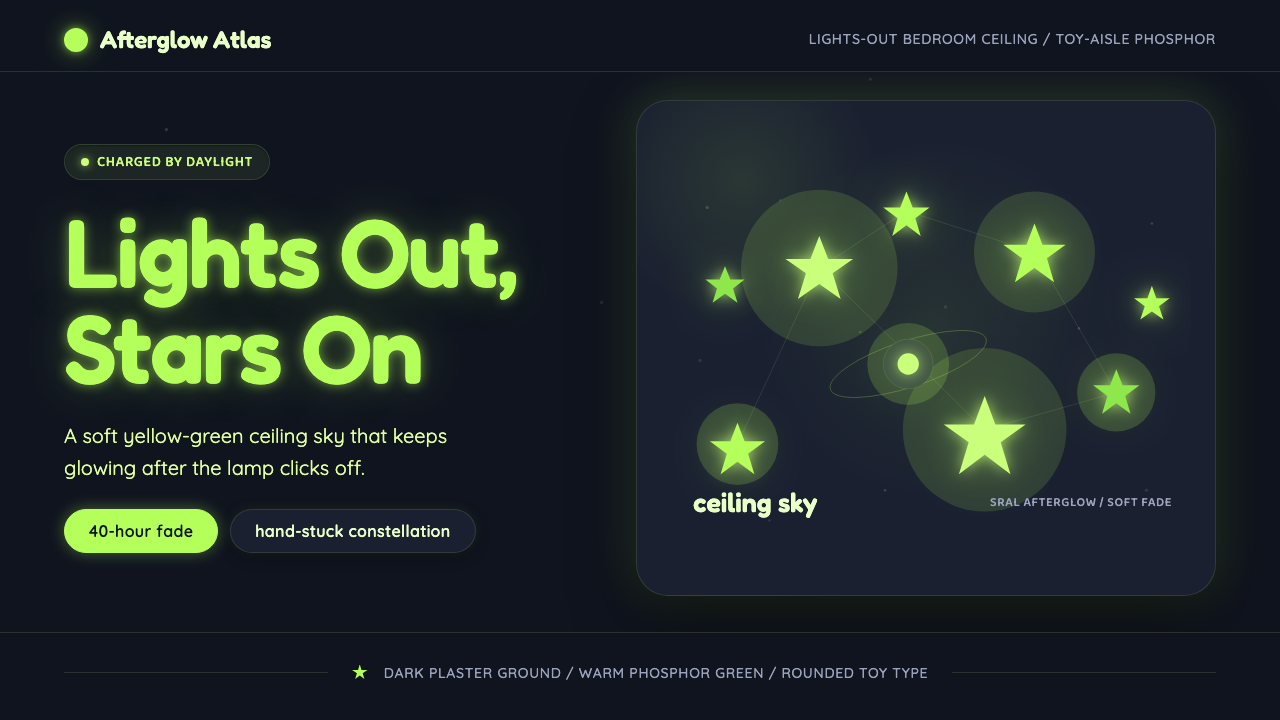 Glow-in-Dark Ceiling StarsTurns lights-out into wonder. Yellow-green stars glow across a dark blue-gray…
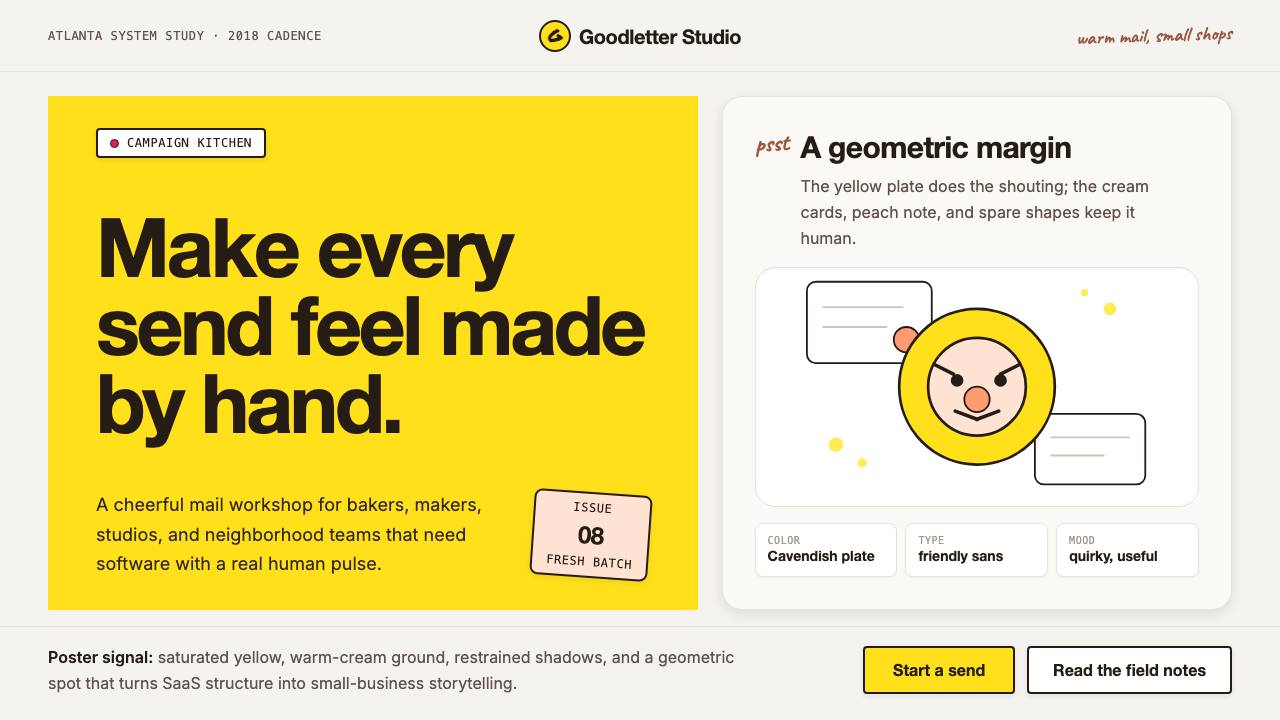 Mailchimp Freddie-YellowFriendly software, handmade. Cavendish yellow blocks and warm geometric masco…