What is Stripe 2024?
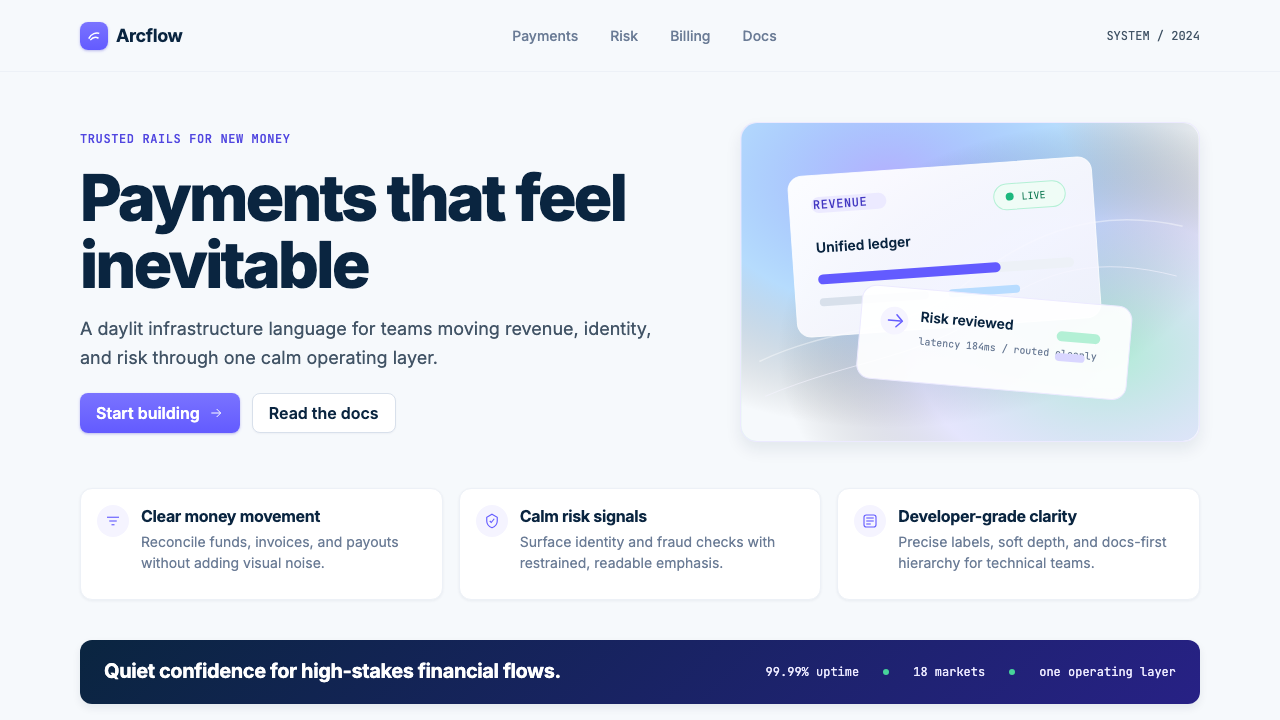
Stripe's design language turns the quiet confidence of financial infrastructure into something you can see — a near-white canvas, a deep saturated indigo, and gradient meshes that feel like light refracted through water.
Stripe 2024 in brief
Stripe 2024 is the mature visual identity of Stripe, the payments infrastructure company that quietly processes a significant share of the internet's commerce. More than a brand refresh, it is a coherent design system: a near-white foundation, a signature deep indigo-violet, luminous gradient mesh heroes, and a typographic discipline built around neutral-precision letterforms. Together these elements communicate trust, technical competence, and a warmth unusual for enterprise software.
Where most fintech brands lean on hard blues, rigid grids, and institutional austerity, Stripe's system earns its authority more subtly. The gradient meshes — swirling confluences of indigo, violet, and teal — introduce dimensionality and a sense of organic motion into an otherwise restrained layout. The overall effect is a company that feels engineered without feeling cold, and considered without feeling over-designed.
The system has become a reference point for modern B2B SaaS design, influencing how a generation of startups presents pricing pages, documentation, and product dashboards. Its signature moves — whisper-soft cards floating on near-white, generous breathing room between sections, and color used to guide rather than decorate — have been adapted so widely that the aesthetic now constitutes its own recognizable genre.

Where does Stripe 2024 come from?
Stripe was founded in 2010 by Irish brothers Patrick and John Collison in San Francisco. From its earliest days, the company treated design not as an afterthought but as a competitive advantage — the thesis being that if you could make developer infrastructure as visually compelling as consumer software, you would attract a different kind of customer. The original site was already notable for its directness and typographic care, but it was not yet the recognizable system the industry would later emulate.
The visual language that would become Stripe 2024 crystallized gradually between roughly 2017 and 2022, under the influence of Stripe's in-house design leadership — most notably Ludwig van der Pol, who led design efforts across that period. A deep indigo-violet moved to center stage as the brand anchor; whitespace became more deliberate; the gradient mesh emerged as the hero treatment of choice. By 2020 the system was coherent enough that 'Stripe-like' had entered the working vocabulary of product briefs across Silicon Valley — shorthand for premium, considered, and technically credible.
Two broader cultural movements shaped the style. The first is what might be called the Gradient Mesh Renaissance of the early 2020s: a reaction against the flat-design orthodoxy of the 2013–2018 period, in which designers rediscovered that subtle color gradients could add emotional warmth and dimension without reintroducing the skeuomorphic excess of the early mobile era. Stripe's gradient meshes were among the most studied examples of this approach. The second movement is Modern B2B SaaS Minimalism — the recognition, driven partly by companies like Linear, Vercel, and Stripe itself, that enterprise software did not have to look enterprise.
Stripe Press, the company's publishing imprint launched in 2018, also contributed subtly to the system's character. Its book covers — drawing on the mid-century typographic tradition of publishers like Penguin — featured bold type, limited color, and high-contrast compositions on solid grounds. The imprint signaled that Stripe conceived of itself as a cultural institution as much as a fintech platform. That ambition is legible in the restrained authority of the 2024 design system. The system does not shout; it publishes.
What defines the Stripe 2024 look?
Near-White Foundation
The canvas is not pure white but a subtly warmed near-white, giving the overall page a quality associated with premium print rather than clinical screen. This barely perceptible warmth prevents the starkness of pure white while keeping the layout airy and open. All other tonal decisions — card backgrounds, dividers, hover states — are calibrated as soft variations on this ground. The slightly off-white base is one of the system's quietest and most effective choices.
Indigo-Violet Signature
The brand's primary accent is a deep, saturated indigo that sits between blue and violet on the spectrum — authoritative enough to anchor a hero section, distinctive enough to be immediately recognizable. It carries associations of depth, technical precision, and a certain gravity without veering into the cold institutional blue common among financial competitors. This color does the heaviest identity work in the system, appearing as the primary interactive color, the call-to-action anchor, and the dominant hue in the gradient mesh.
Gradient Mesh Hero
The most visually distinctive element is the gradient mesh: a smooth, swirling blend of indigo, violet, and teal applied to large hero sections and occasionally to feature block backgrounds. Unlike flat gradients, a mesh gradient has no clear directionality — it suggests depth and motion without committing to either. Each gradient layer is applied at low opacity so the effect reads as atmospheric rather than decorative. Placed over the near-white canvas, it reads as light refracted through glass or water, warm and alive in a way that flat color cannot achieve.
Whisper-Soft Cards
Cards are a primary compositional unit in the system, and their treatment is deliberately understated. Borders are so faint they function more as shape definition than as visible lines. Shadows are extremely subtle — barely perceptible — lifting each card off the near-white page without creating strong contrast. Rounded corners reinforce the approachable quality. The cards feel like they float rather than sit; they occupy space gently, without demanding attention. This softness is calibrated to contrast with the boldness of the gradient mesh.
Typographic Precision
The type system pairs a neutral geometric sans-serif with disciplined scale and spacing. Display headings are large and confidently tracked — letterforms given generous room to breathe at dramatic sizes — creating an airy openness in section titles. Body text is set at a comfortable reading size with adequate line height for technical content. The absence of decorative typefaces is intentional: in a payments context, legibility and neutrality are trust signals. Type does not perform personality; it performs reliability.
Generous Whitespace
Sections are separated by far more breathing room than typical enterprise software affords. This generosity of space accomplishes several things at once: it prevents cognitive overload, it confers a sense of quality associated with luxury goods or editorial design, and it gives individual elements — particularly feature callouts and pricing cards — room to be considered on their own terms. Whitespace in Stripe's system is not empty; it is structural. The rhythm of space between elements is as carefully considered as the elements themselves.
Restrained Color Logic
Outside the gradient meshes, color is used with deliberate restraint. The deep indigo anchors all interactive elements. Secondary tones — soft teals, muted lavenders — appear as supporting accents in illustrations and icon backgrounds, never competing with the primary indigo for dominance. Functional colors carry semantic meaning: a clear green for success, a clear red for errors, an amber for warnings. The system never feels colorful in the way of a marketing-heavy brand; it feels considered, where every color placement has a reason.

Who shaped Stripe 2024?
Co-founder and CEO of Stripe, Patrick Collison established design as a first-class concern from the company's earliest days. His conviction that developer infrastructure could be as thoughtfully crafted as consumer software set the cultural conditions that allowed a distinctive visual identity to emerge and be maintained at scale. Stripe's design standards became an industry benchmark in part because its leadership created the organizational conditions for long-horizon design work rather than short-term visual fixes.
Co-founder and President of Stripe, John Collison shaped the company's developer-first ethos, which permeates the visual identity as much as the product. The decision to treat documentation as a design surface — to make reading technical references a genuinely pleasant experience — flows directly from his priorities. This integration of developer experience and brand experience gives Stripe's design language an unusual coherence across contexts, from a marketing homepage to a deeply nested API reference page.
Design leader at Stripe through the period when the 2020–2024 visual language crystallized. Van der Pol's leadership shaped the specific character of the indigo palette, the gradient mesh treatment, and the layered card system that made the Stripe look recognizable worldwide. His work demonstrated that a fintech company's marketing site could function as a portfolio of craft in its own right — a standard that propagated throughout the B2B SaaS industry.
Stripe's publishing imprint, launched in 2018, extended the company's design language into physical books with covers drawing on the mid-century typographic tradition of publishers like Penguin: bold type, limited color, geometric composition on solid-colored grounds. The imprint demonstrated that Stripe's design sensibility was not a marketing veneer but a coherent worldview extending from screen to paper. It introduced a restrained editorial gravity into the broader Stripe visual identity — the feeling that the company designs as a publishing house, not a startup.
Stripe did not invent B2B SaaS minimalism alone. A cohort of developer-focused companies — including Linear (project management), Vercel (deployment infrastructure), and Resend (email API) — developed parallel visual languages in the same period, all sharing the near-white palette, generous whitespace, neutral sans-serif typography, and soft-shadow cards. Together, they established a new standard for the category and created the context in which 'Stripe-like' became a meaningful shorthand for quality rather than a description of a single company's style.
How do you use Stripe 2024 today?
Stripe 2024 is among the most transferable contemporary styles for professional work, precisely because its principles are systematic rather than idiosyncratic. Applying it well requires understanding the underlying logic — whitespace as active composition, color as identity anchor, shadow as whisper — rather than copying surface-level visual cues. The gradient mesh is the most tempting element to borrow, but it is also the most easily misapplied.
For presentation slides, the style works exceptionally well on cover pages and feature-overview slides. A cover benefits from the gradient mesh treatment: a near-white background with swirling indigo-violet-teal color pooling in one corner or across the upper half, combined with a large neutral sans-serif heading at confident weight and tight spacing. Avoid placing the mesh on every slide — its power comes from being exceptional. Content slides should be treated as card layouts: one concept per card zone, generous margins, type at two or three size steps for hierarchy, and a single indigo accent for calls to action or key data points. Data slides use contained card areas to group charts and supporting labels, keeping the eye within a defined zone.
For web UI — dashboards, pricing pages, documentation portals — this is the style's native territory. Dashboards benefit from the card-centric layout: a near-white page background, white surface cards with barely visible borders and whisper-soft shadows, neutral sans-serif type in two weights for metric labels and body, and the deep indigo reserved exclusively for interactive states, focus indicators, and key action buttons. Pricing pages work well with the gradient mesh applied to the recommended plan's column header, drawing the eye without requiring a different background color. Navigation should be typographic and unobtrusive.
For editorial and marketing content, the style supports strong informational hierarchy and a tone of considered authority. Long-form articles or documentation pages use a comfortable reading measure for body text, generous paragraph spacing, and section breaks marked by subtle horizontal rules rather than decorative dividers. Marketing landing pages work well with alternating content sections using slightly different tonal backgrounds to create visual rhythm without heavy color blocks. Hero sections carry the gradient mesh as the primary visual anchor; all subsequent sections should be clean and unadorned.
A common mistake when applying this style is treating the gradient mesh as wallpaper rather than as a focal statement. Because it is the most visually memorable element, there is strong temptation to apply it everywhere — which destroys the contrast that makes it effective. The mesh works because it is the exception: deployed only at the top of the page or in key feature headers, it sets emotional tone and then steps back. A second frequent error is using the deep indigo at full saturation for body copy or secondary UI elements, which creates visual fatigue. Reserve full saturation for primary calls to action and the mesh itself; let the surrounding palette remain near-white, neutral, and restful.

Stripe 2024 — FAQ
Can Stripe 2024 work for a non-fintech product?
Yes — and it frequently does. The style has propagated far beyond payments into developer tools, project management software, marketing platforms, and documentation portals. What it communicates is technical credibility, considered restraint, and professional trust — not anything specific to finance. Any product that wants to signal it was built carefully by people who care about quality can adopt the style. It struggles in contexts requiring warmth, sensory richness, or cultural specificity — food, wellness, children's products, entertainment — where the near-white restraint reads as cold or sterile rather than considered.
What makes the Stripe gradient mesh different from a generic gradient?
The difference is in layering, opacity, and restraint. A generic gradient typically runs from one color to another in a linear or simple radial pattern at full saturation. The Stripe gradient mesh overlays multiple radial color pools — each at very low opacity — positioned at different focal points so they interact and blend organically rather than producing a clean color transition. The result looks like softly colored light pooling on a surface rather than a filled background. The second key difference is color discipline: constraining the hues to closely related indigo, violet, and teal keeps the mesh harmonious rather than disruptive.
Should I copy Stripe's exact colors or adapt them?
Adapt them. Stripe's signature deep indigo and near-white are brand identifiers — using them verbatim in a different product will make it look like a Stripe clone rather than a product with its own identity. The transferable principle is the color role: a restrained primary hue with high authority, deployed as the single interactive anchor on a near-white, generous-whitespace canvas with deep neutral body text. Shift the hue to teal, cobalt, warm purple, or forest green and the system remains coherent while acquiring a distinct identity.
How does Stripe 2024 differ from earlier flat design?
Flat design (roughly 2013–2018) rejected depth almost entirely — no shadows, no gradients, hard color fills, a certain visual rigidity. Stripe 2024 works in the same tradition of functional restraint but allows itself three things flat design refused: gradient mesh for atmospheric warmth, subtle diffuse shadows for surface hierarchy, and rounded corners throughout. It is best described as post-flat minimalism — inheriting the clarity and information density of flat design while reintroducing just enough depth cues to create a sense of material quality and approachability.
Is Stripe 2024 suitable for dark mode?
Not natively. Stripe's identity is explicitly daylit — the near-white background and warm palette depend on lightness for their character. A dark inversion is technically possible but requires significant rethinking rather than a simple color flip: the gradient mesh shifts from a warm-light-pooling quality to a neon-glow-on-dark look if applied unchanged; the whisper cards need to become subtly elevated dark surfaces; typography needs to be rebalanced for light-on-dark reading. If your product genuinely needs dark mode, treat it as a separate design problem rather than a color inversion of the light system. The light system should be the primary face of the product.
Related design styles
 Android Bugdroid GreenFriendly tech, reduced to geometry. Vivid green pops from Grey 900 and rounde…
 AsanaCalm productivity breathes. Cream canvas, lavender panels, coral-blue-yellow…
 GitLab 2023DevOps in daylight. Tanuki orange-to-purple gradient, Inter, warm enough for…
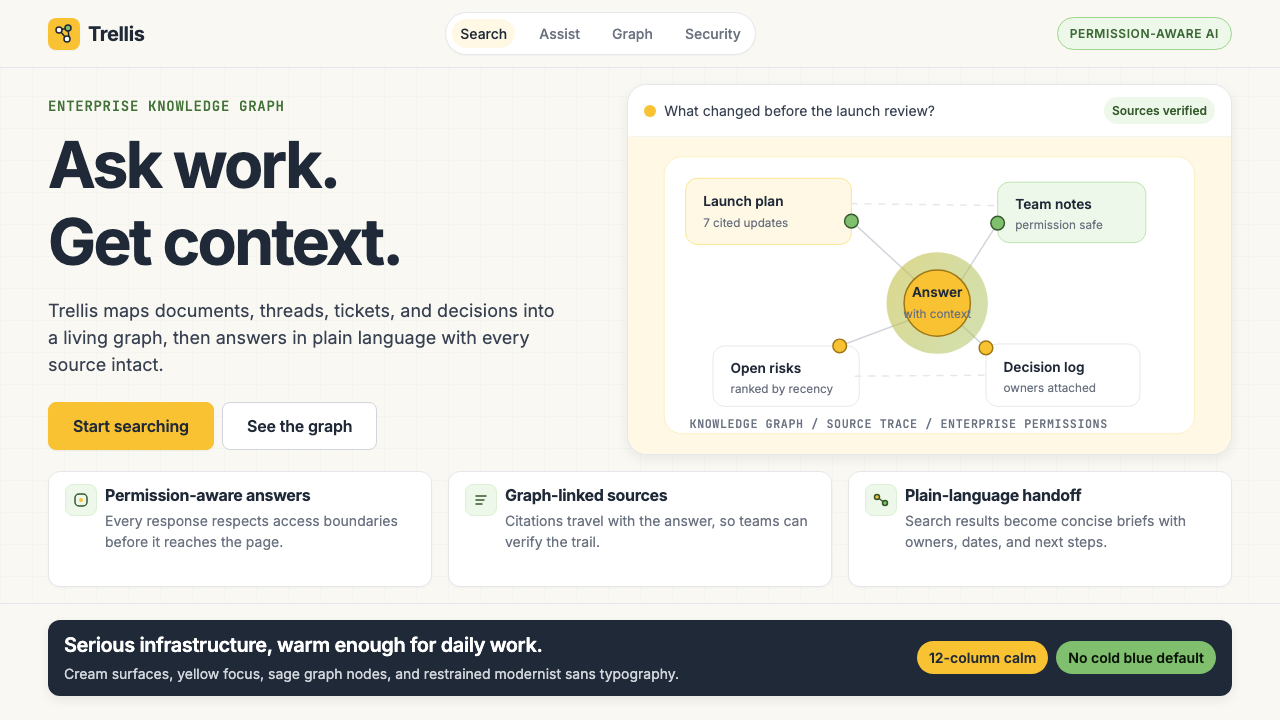 Glean Enterprise-SearchWarm enterprise AI. Cream ground, yellow focus, sage graph nodes, and sans ca…
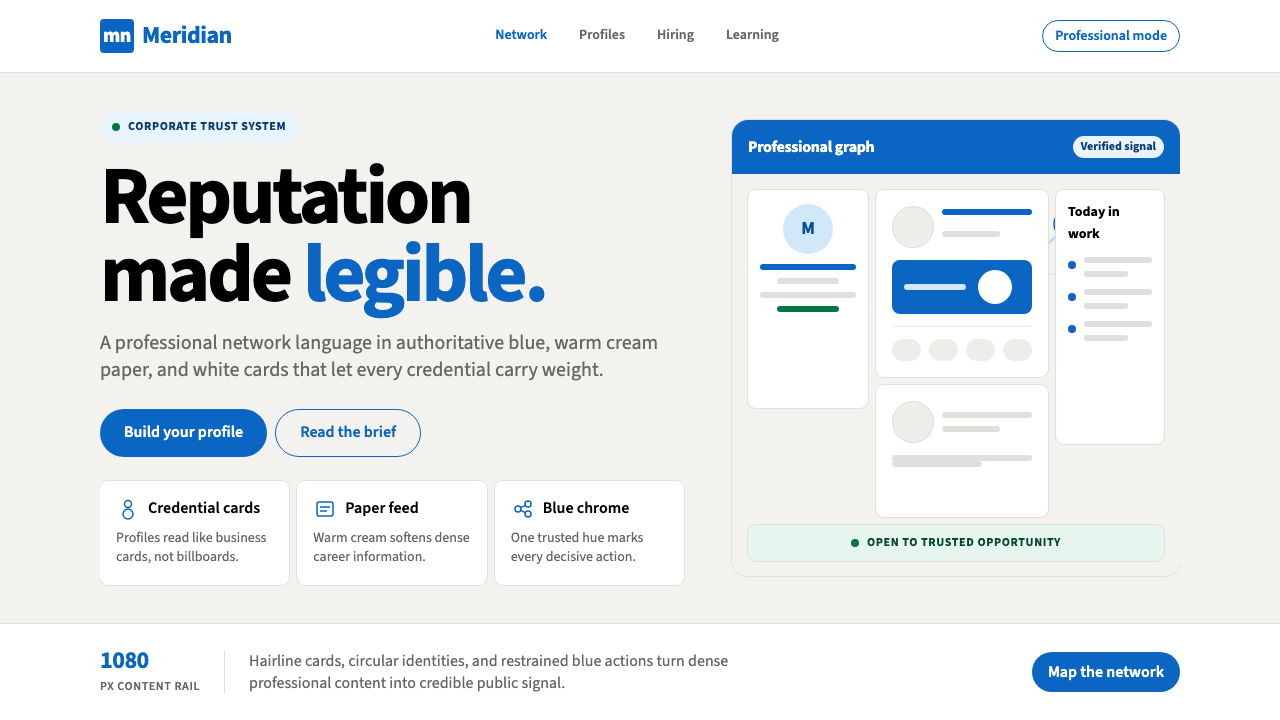 LinkedInCorporate trust, digitized. Authoritative blue frames white cards on warm cre…
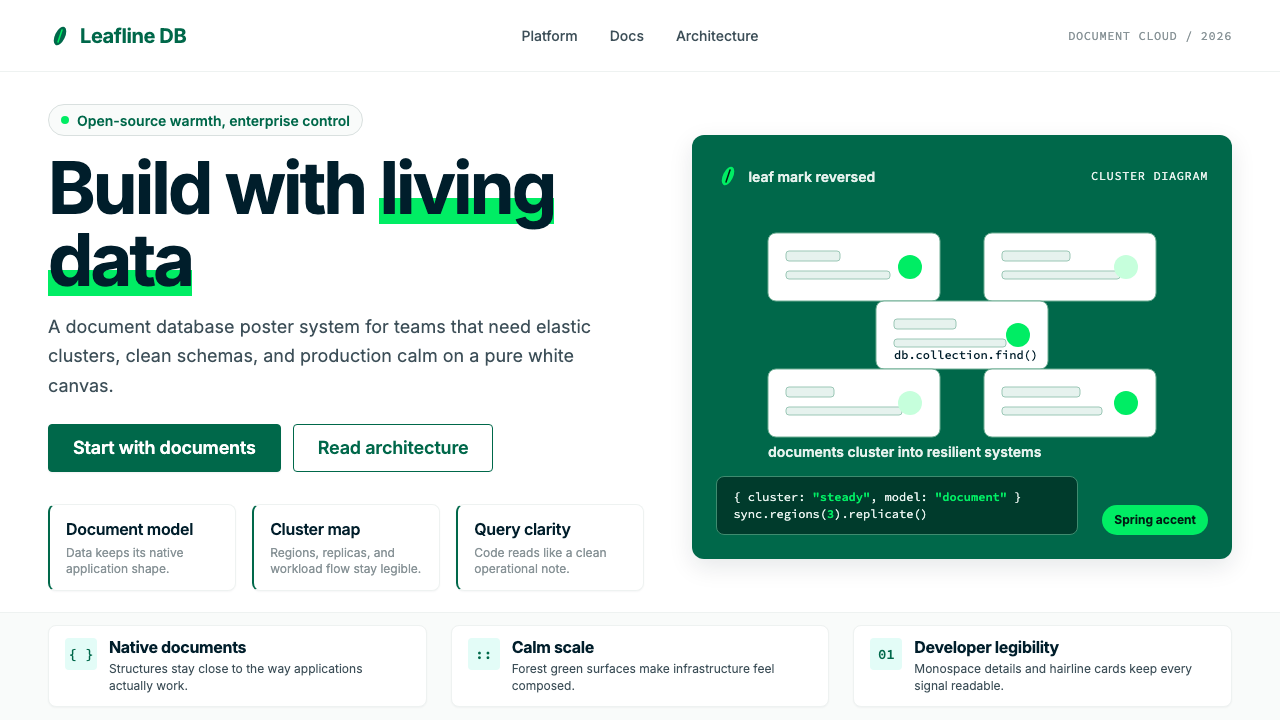 MongoDB Leaf GreenDisciplined green, open warmth. Forest leaf forms and Spring accents breathe…