What is Streetwear (Supreme red)?
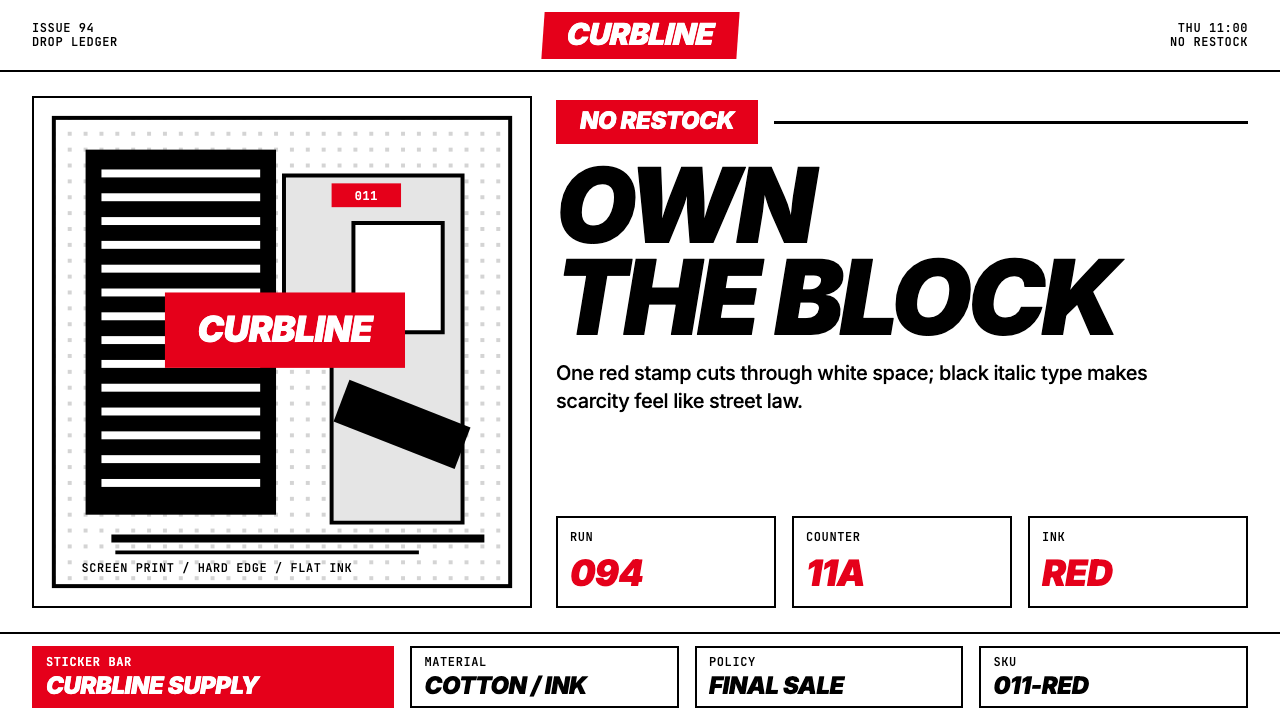
Supreme built an empire from a single red rectangle — proof that the most aggressive restraint is its own kind of maximalism.
Streetwear (Supreme red) in brief
Streetwear (Supreme red) is a visual design language distilled from one of the most influential brand identities in fashion history: Supreme's box logo, introduced in 1994 and never fundamentally altered. The system is defined by its refusal to expand — a single bold red field carries a white wordmark in heavy italic letterforms, and that combination alone performs every function a full design system would ordinarily require.
The aesthetic draws its power from constraint. Where most visual systems use a broad palette, multiple typefaces, and layered graphic elements to communicate hierarchy and mood, the Supreme system communicates everything through the contrast between one saturated red and white. The result is a language that reads instantly at any scale — on a postage-stamp sticker or a ten-story building wrap — and that borrows its authoritative tone from the visual rhetoric of advertising, protest signage, and institutional stamps of approval.
Applied beyond the brand itself, the design language defines a broader aesthetic family: black body type on white or off-white grounds, tight editorial grids inspired by skate and punk zines, full-bleed photography treated as documentary evidence rather than styled imagery, and the red rectangular stamp used as a device for ownership or emphasis. The system is uncompromisingly flat — no gradients, no rounded corners, no soft shadows — and its harshness is precisely the point.

Where does Streetwear (Supreme red) come from?
Supreme was founded in April 1994 by James Jebbia on Lafayette Street in Manhattan's SoHo neighborhood. The store was designed around the skating community — the floor space was deliberately generous, allowing skaters to ride inside and feel at home, and the product selection was tightly curated around the needs of downtown New York's skate and arts scenes. From its first day, Supreme positioned itself as a participant in a subculture rather than a retailer selling to one.
The box logo — the red rectangle containing the white wordmark in Futura Bold Italic — was adapted directly from the work of Barbara Kruger, the American conceptual artist whose signature style in the 1980s involved bold sans-serif text on red-and-white backgrounds to deliver blunt social and political commentary. Kruger's works appeared in galleries and on billboards; her visual grammar was drawn from the authoritative registers of advertising and propaganda. Jebbia and the early Supreme team borrowed this grammar wholesale, transplanting its confrontational energy into a commercial context and transforming its political urgency into brand identity. Kruger herself later acknowledged the appropriation with characteristic directness, calling the borrowing straightforward theft.
The cultural context that shaped Supreme's visual identity was the New York downtown scene of the early 1990s — a convergence of skateboarding, hip-hop, punk, and contemporary art that was largely invisible to mainstream culture. Lafayette Street sat at a node in this network: close to galleries, close to record shops, close to the spots where crews skated. The brand's early collaborators and customers included artists, musicians, and athletes who moved between these subcultures fluidly, and the visual identity needed to operate credibly across all of them.
The scarcity model that became central to Supreme's cultural dominance — releasing small quantities of product on a fixed weekly schedule, creating lines and resale markets — reinforced the visual identity rather than existing independently of it. The red box became a mark of authentication: a signal that the object bearing it had passed through a controlled channel and was genuinely scarce. This transformed the logo from a brand identifier into something closer to a hallmark or a government stamp, and that institutional weight is inseparable from the aesthetic. By the 2010s, Supreme had become a template for the hypebeast economy, with the drop model and the box logo imitated by brands across every category of consumer goods.
What defines the Streetwear (Supreme red) look?
The Red Field
The defining element of the system is a saturated, high-chroma red that carries maximum visual weight without mixing toward orange or crimson. It is not a warm red or a cool red — it reads as an absolute, as if red itself were being defined rather than approximated. This quality gives the color an institutional authority: it does not suggest warmth, playfulness, or nature, but rather officiousness, urgency, and the finality of a stamp.
Heavy Italic Wordmark
The wordmark sits in a condensed, heavy italic sans-serif that communicates velocity and force simultaneously. The italic angle is aggressive enough to read as motion, while the weight of the strokes keeps the letterforms from feeling light or playful. The effect is closer to a stencil or a brand burned into material than to conventional logo lettering — it looks imposed rather than designed. White on red inverts the normal figure-ground relationship of text on a light page, reinforcing the sense that the mark is being applied to surfaces from outside.
Zero Tolerance for Ornament
The system inherits from its Barbara Kruger lineage a complete absence of decorative elements. No borders, no rules that serve only visual interest, no gradients softening transitions, no rounded corners moderating the rectangularity of the mark. Even when Supreme has produced collaborations with artists, illustrators, and designers, the box logo itself remains unmodified — its authority depends on its refusal to be customized. The zero-ornament principle extends to typography in the broader visual system: body text is set with minimal leading variation and no decorative accents.
Editorial Grid Inherited from Zine Culture
Supreme's lookbooks, catalogs, and web presence draw on the visual conventions of skateboarding and punk zine publishing: tight multi-column grids, photographs cropped close and hard, text set in compact columns with minimal margins, and a general sense that the layout has been assembled with the efficiency of a newspaper rather than the luxury of a magazine. This connects the brand to a tradition of self-published, community-distributed media and keeps the aesthetic grounded in documentary credibility rather than aspirational lifestyle imagery.
Full-Bleed Photography as Document
When photography enters the system, it is treated as evidence rather than advertisement. Supreme's campaign imagery is typically shot in available light, on streets and in skate parks, with subjects behaving naturally rather than posed. The photographs are reproduced without elaborate color grading or retouching — or, when they are, the correction is invisible. Full-bleed treatment means the image extends to the edges of the page or screen, creating a sense of unmediated encounter. The red box then appears as an addition to reality, not a frame for it.
Scarcity as Visual Grammar
The drop model — releasing limited quantities on a fixed schedule — is inseparable from the visual identity because it determines how the logo is encountered in the world. The red box appears suddenly, on a specific Thursday, on a specific product, and then disappears. This temporal scarcity gives every appearance of the mark a heightened significance: the logo is not ambient brand presence but event. Visual applications of the system should understand this quality — the red field should never feel routine, overused, or decorative. Its power depends on restraint in deployment.
Flat Geometry and Hard Edges
Every element in the system is geometrically resolved and edge-defined. The rectangle of the box logo has no shadow, no glow, no border-radius modifying its corners. Typography sits on the baseline with no optical tricks. When the system extends to layout — whether on a garment tag, a web page, or a printed catalog — the geometry of the grid is maintained without softening. This creates a visual language that reads the same way in all media and at all scales, which is one reason the system has proved so extraordinarily durable over three decades.

Who shaped Streetwear (Supreme red)?
Jebbia founded Supreme in 1994 with a background in retail that included working at Parachute in SoHo and running Union, a downtown sneaker and streetwear store. His genius lay less in the design itself — which was adapted from existing visual sources — than in the operational and cultural logic that made the design meaningful: the store format that treated customers as community members, the product curation that connected skating, art, and music, and the drop model that transformed each release into a cultural event. Jebbia has remained notoriously private throughout Supreme's growth, rarely granting interviews, which has itself reinforced the brand's mystique.
Kruger is the American conceptual artist whose visual system — bold italic text in white on red bands, typically paired with confrontational statements about power, consumption, and identity — was the direct source for the Supreme box logo. Working from the early 1980s, Kruger developed a practice that deliberately recycled the visual grammar of mass media and advertising to critique those same systems. Her use of Futura Bold Italic set against saturated red and white became globally recognized through works installed in museums, on billboards, and on public buildings. The appropriation by Supreme is now one of the most discussed examples of corporate borrowing from fine art, and Kruger's own assessment of it has shifted over the decades from pointed criticism to a kind of weary acknowledgment.
Marcopoulos is the Amsterdam-born photographer who documented Supreme's early years and, more broadly, downtown New York skateboarding and youth culture in the 1990s. His photography — shot in available light with a directness that made subjects feel observed rather than photographed — shaped the visual language of Supreme's printed materials, defining the documentary aesthetic that continues to characterize the brand's imagery. The style Marcopoulos brought to the work established the principle that Supreme photography should look like it was taken because something was happening, not because a shoot was scheduled.
Although primarily associated with Off-White and Louis Vuitton rather than Supreme itself, Abloh was the figure who most systematically theorized and extended the visual language that Supreme pioneered. His use of quotation marks placed around found text, his treatment of brand graphics as readymades available for recontextualization, and his explicit engagement with the relationship between streetwear and institutional fashion brought the logic underlying the Supreme aesthetic into critical discourse. Abloh's career demonstrated both the cultural reach of the system Supreme had invented and the commercial possibilities of a design language rooted in subcultural authenticity.
Stussy preceded Supreme as the founder of the streetwear brand Stüssy, which he established in the early 1980s in Laguna Beach, California. His signature — a loose, spray-painted rendering of his surname used as a logo — established the precedent for a personal mark elevated to brand status through subcultural credibility rather than institutional investment. Stussy's model of limited distribution through select accounts, international travel to build scene-specific credibility, and a graphic identity rooted in surf, skate, and hip-hop culture created the template that Jebbia refined and systematized when founding Supreme a decade later.
How do you use Streetwear (Supreme red) today?
The Supreme red system is among the most culturally loaded visual languages available to a designer, which means it demands conscious deployment. Applying it effectively requires understanding the difference between referencing the aesthetic and merely imitating the logo. The goal is to capture the underlying logic — institutional authority delivered through extreme reduction — rather than to produce a replica of the box mark.
For presentation slides, the system works powerfully for cover pages and section dividers where a strong impression of authority and confidence is needed. A cover built in this language uses a single bold red rectangle — not necessarily centered — against a clean white or near-white ground, with a headline in heavy italic sans-serif. The red occupies enough of the page to register as a field, not an accent. Content slides shift to the secondary vocabulary: black type on white, tight column structures, photography used large and without styling. Data slides treat charts as geometric objects — bar charts with flat fills in the brand's primary red, minimal axis labels, no background fills. The system fails on slides that try to soften it with gradients, rounded cards, or multiple colors.
For web interfaces, the language is most effective in contexts that benefit from the authority register: checkout flows, pricing pages, product launch announcements, and developer-facing documentation. A pricing page built in this language uses a rigid typographic hierarchy — large numerals in heavy weight, category labels in compact uppercase, feature lists in a smaller monospaced or geometric sans — with the red reserved exclusively for the primary call-to-action element. Navigation is typographic and minimal; no icons unless they are purely geometric. Dashboard applications can use the system for header treatments and status indicators, but the full red-field treatment should be reserved for the most critical states or actions to preserve its urgency.
For editorial and marketing applications, the system's poster-logic makes it exceptionally suited to full-page or full-screen advertising, event announcements, and product launches where a single message needs to land with maximum force. A promotional piece in this language typically commits to a single dominant visual element — a full-bleed photograph or a large typographic statement — with the red box appearing as a stamp of emphasis rather than a decorative frame. Marketing email campaigns can use the system effectively with a single bold header treatment and minimal body copy, allowing the graphic logic of the red field to carry emotional weight the copy does not need to restate.
The most common mistake when applying this system is treating it as merely a color scheme — using a red that approximates the palette without understanding the institutional, confrontational quality that red is meant to convey. A second common error is rounding corners or adding subtle shadows to elements in an attempt to make the system feel friendlier; this directly contradicts its authority. A third failure mode is using the red too often: if every element or section uses the red field treatment, the mark loses its urgency and reads as decoration. The system only works when the red is used sparingly enough that its presence still registers as an event.

Streetwear (Supreme red) — FAQ
Is this system usable outside streetwear and fashion contexts?
Yes, but the cultural associations need to be factored into the decision. The Supreme red system carries connotations of urban subculture, countercultural authenticity, and a certain aggressive directness that will feel appropriate in some contexts and jarring in others. It works well for technology products that want to position themselves as serious and uncompromising, for cultural institutions communicating authority, and for editorial contexts where a strong editorial voice is valued. It is less suitable for healthcare, finance, or children's products, where the confrontational register conflicts with the relational values those sectors depend on. The key question is whether the institutional authority the system conveys aligns with the authority your product legitimately claims.
How should the red be used in a dark-mode interface?
Dark mode presents a genuine challenge for this system, which was built for light grounds. On a dark or black background, the same saturated red can read as aggressive or alarming in ways that are difficult to control. The most successful dark adaptations maintain the essential logic of the system — extreme reduction, geometric discipline, no gradients — while treating the red as a pure accent rather than a field. The wordmark or the critical call-to-action might retain the red treatment; everything else defaults to white type on dark ground. Full red-field blocks on dark ground should generally be avoided unless the alarming quality is intentional, as in error states or warnings.
What distinguishes authentic use of this system from imitation?
Authentic use understands that the system's power comes from institutional authority expressed through extreme constraint — not from the specific color or typeface. An imitation applies the red and italic text without understanding that every other element in the layout must be equally uncompromising. Authentic use maintains the zero-ornament principle consistently: no gradient fills, no soft shadows, no decorative borders anywhere in the composition. It also deploys the red with discipline — using it where maximum force is needed and withholding it everywhere else. An imitation typically softens the system in response to aesthetic discomfort, adding roundedness or warmth that drains the system of its force. The test is whether you could remove the red and still have a coherent, disciplined layout — or whether the red is doing all the work while the rest of the design is visually ordinary.
Can this system coexist with other brand colors?
Only with great care. The Supreme red system is designed to dominate — it asserts hierarchy rather than sharing space. Introducing a second strong color alongside it typically dilutes the authority of both. If an existing brand color must be accommodated, the most workable approach is to relegate the brand color to the secondary vocabulary (body type, backgrounds, structural elements) and reserve the red treatment for the highest-priority element in any given composition. A brand color in a muted or darkened variant can function as a neutral within the system. What the system cannot absorb without losing coherence is a second saturated, high-chroma hue operating at comparable visual weight — that creates competition rather than hierarchy.
Does the system work at small scale, such as mobile interfaces or app icons?
The system is unusually well-suited to small scale precisely because of its reduction. The red field and white wordmark logic of the box mark was designed for a sticker — perhaps the smallest commercial canvas — and it reads clearly at that size. The core principles (flat geometry, high contrast, no gradients, no soft shadows) are technically advantageous at small sizes where fine details would be lost anyway. A mobile interface built in this system should commit to the same reduction: minimal navigation elements, large bold type for primary actions, the red reserved for a single highest-priority control per screen. App icon design in this language is direct — a red field with a single bold element — and benefits from the same visual logic that has made the original mark readable on surfaces ranging from postage stamps to building facades.
Related design styles
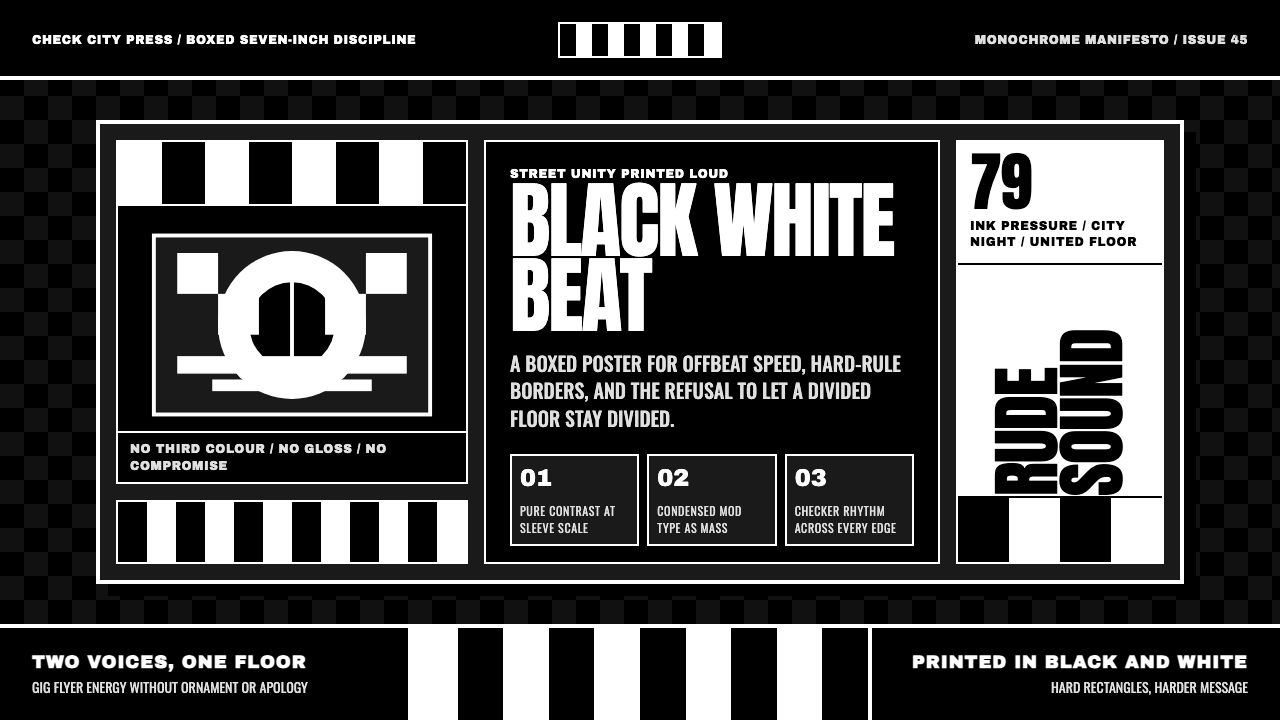 2 Tone SkaContrast as manifesto. White Anton type locks into a near-black checkerboard…
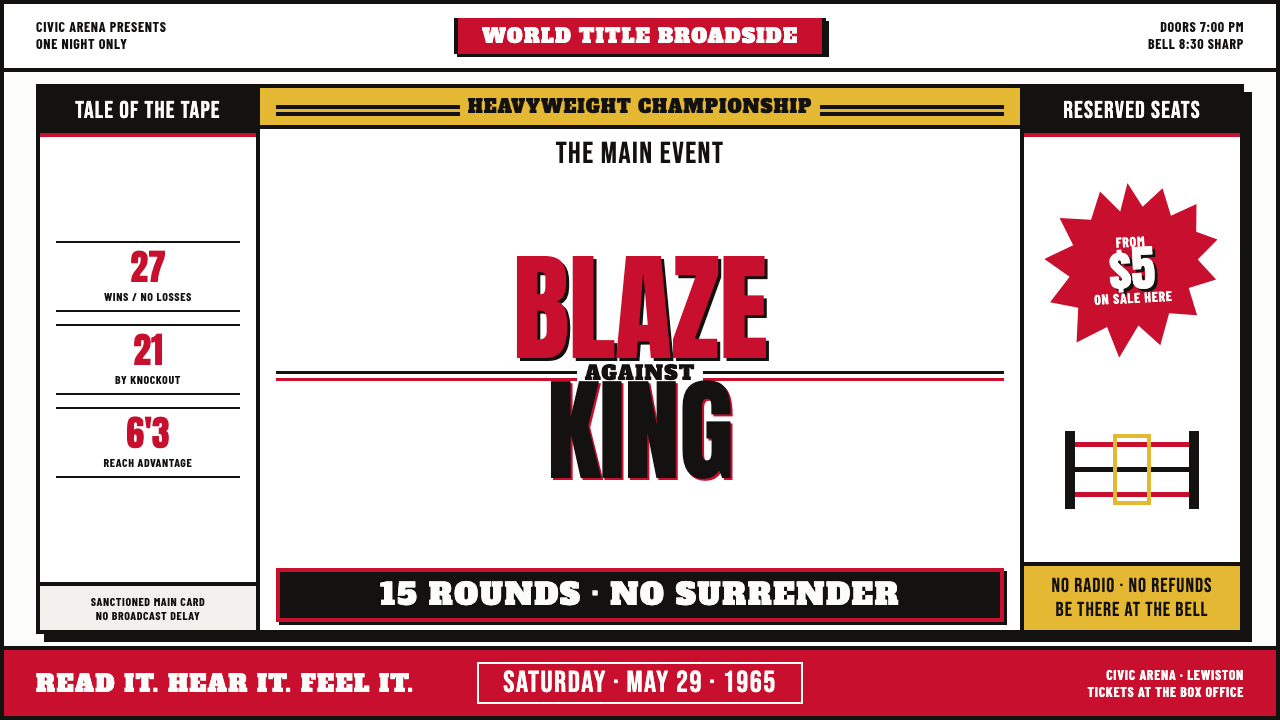 Muhammad Ali Fight Poster (1965)Type does the fighting. Blood red and dead black collide in a stacked letterp…
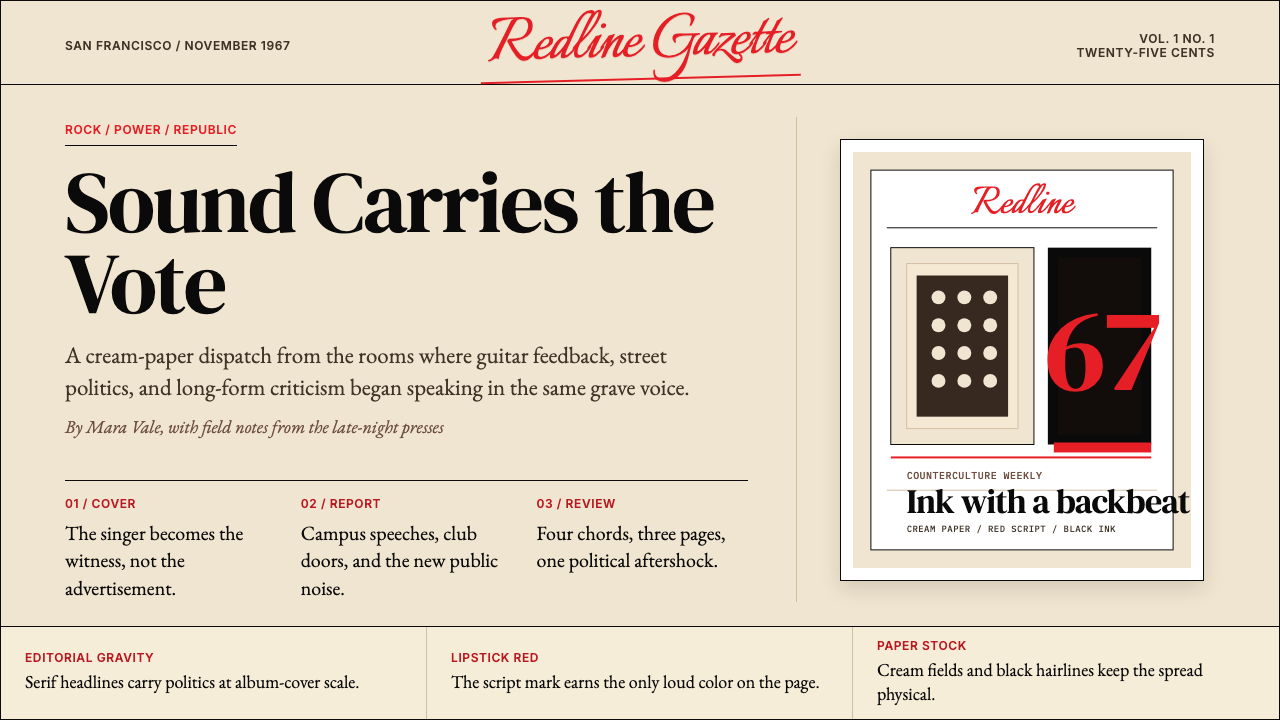 Rolling Stone MagazineCounterculture gets editorial weight. Cream paper, lipstick red script, serif…
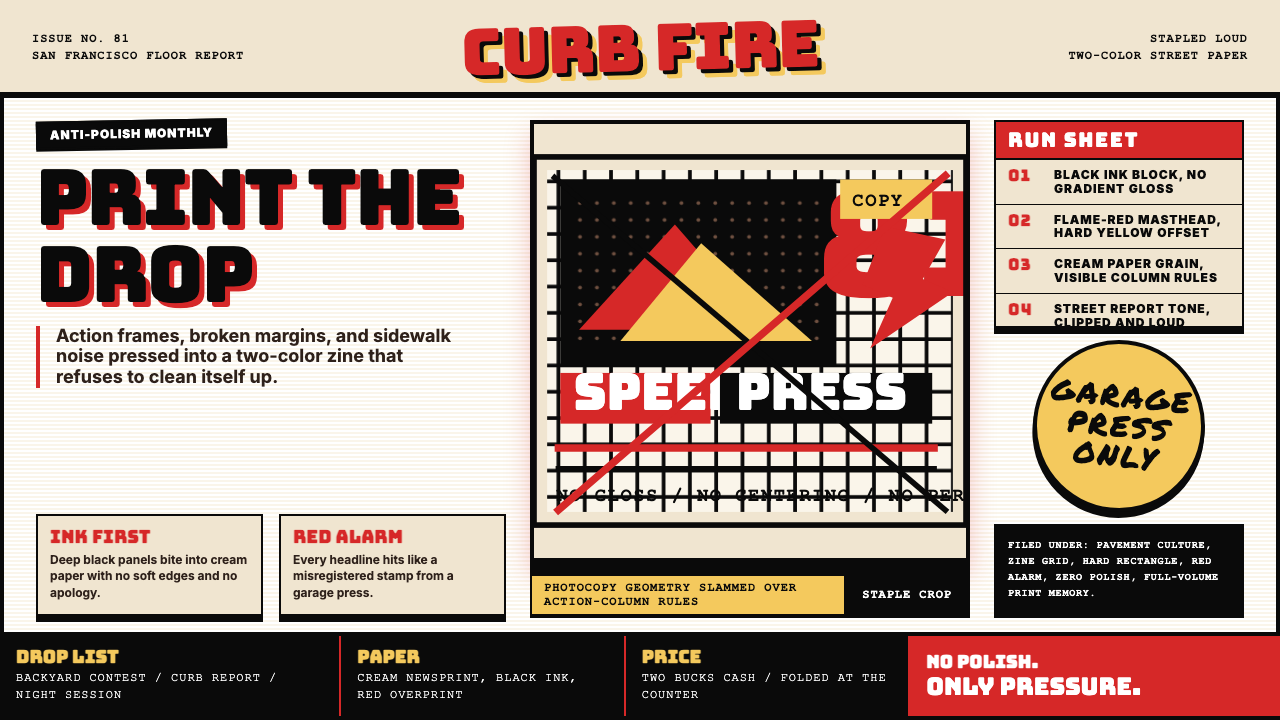 Thrasher Skate Zine (1981)Loud without polish. Flame red type, black ink blocks, and cream zine grids h…
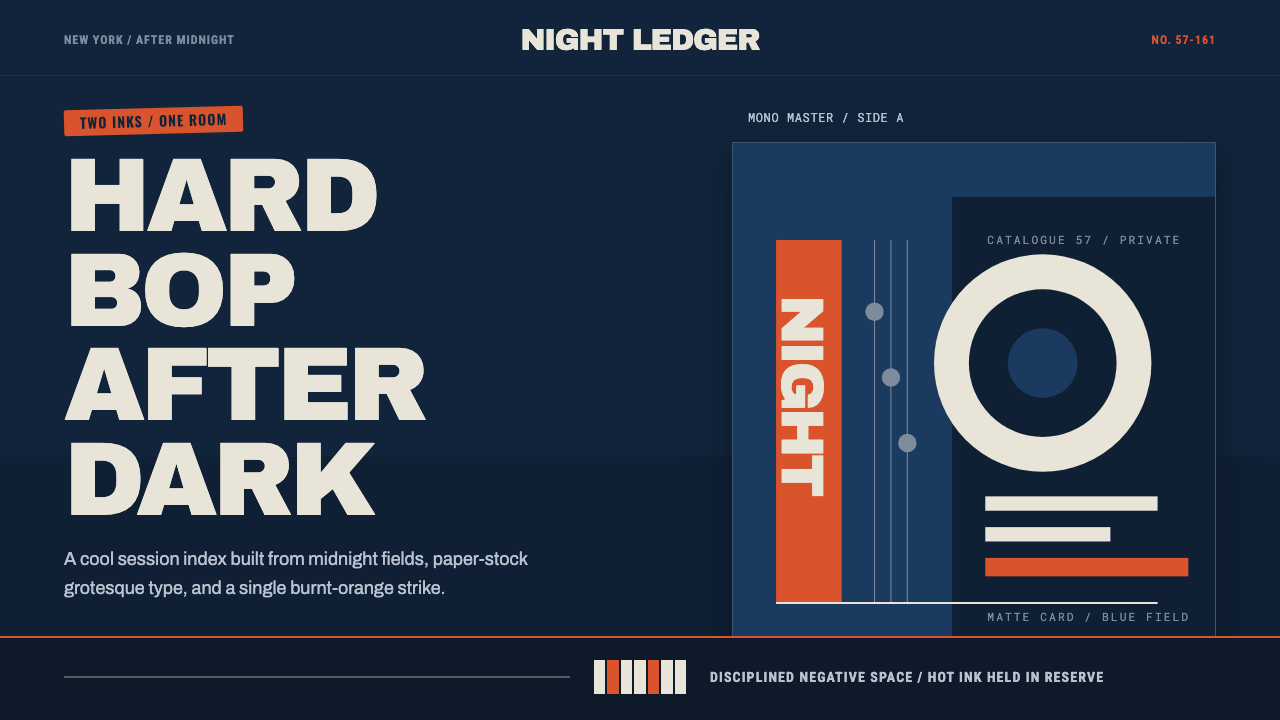 Blue Note JazzCool intelligence, printed flat. Midnight blue, paper type, and one burnt-ora…
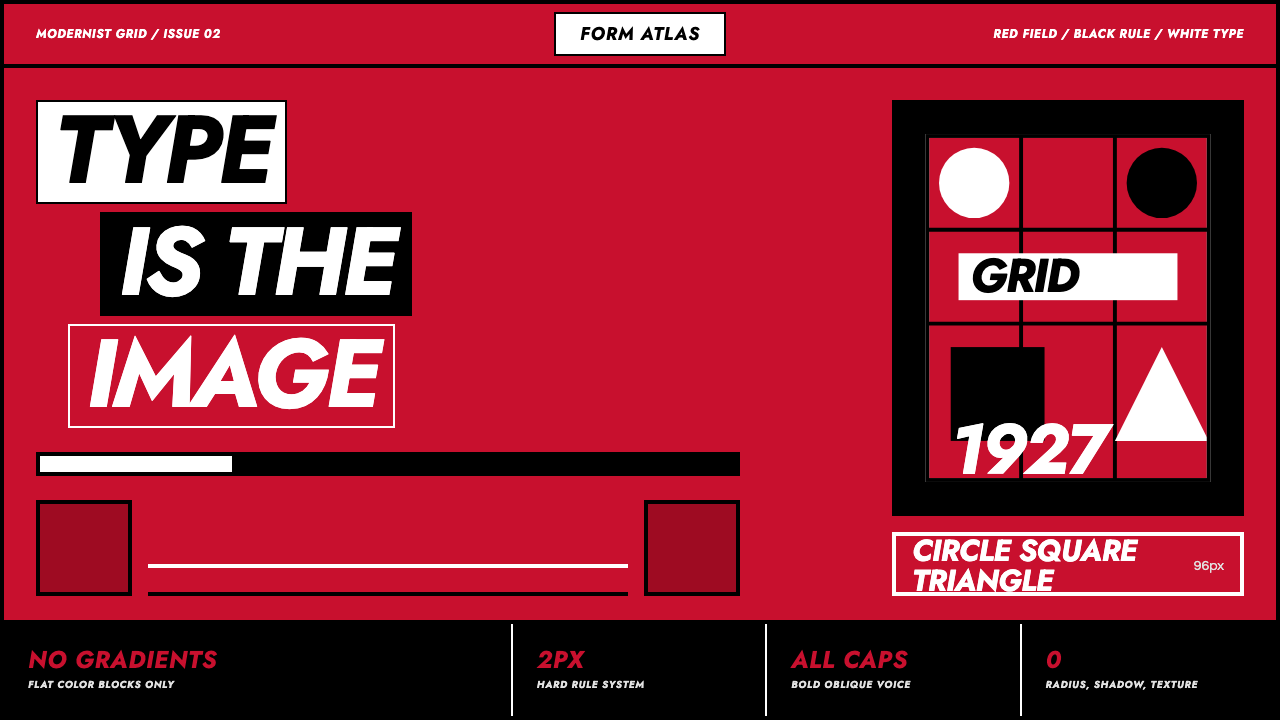 Futura Geometric PosterType becomes image. Red grid, white oblique Jost, black rules at poster scale.