What is Shepard Fairey OBEY?
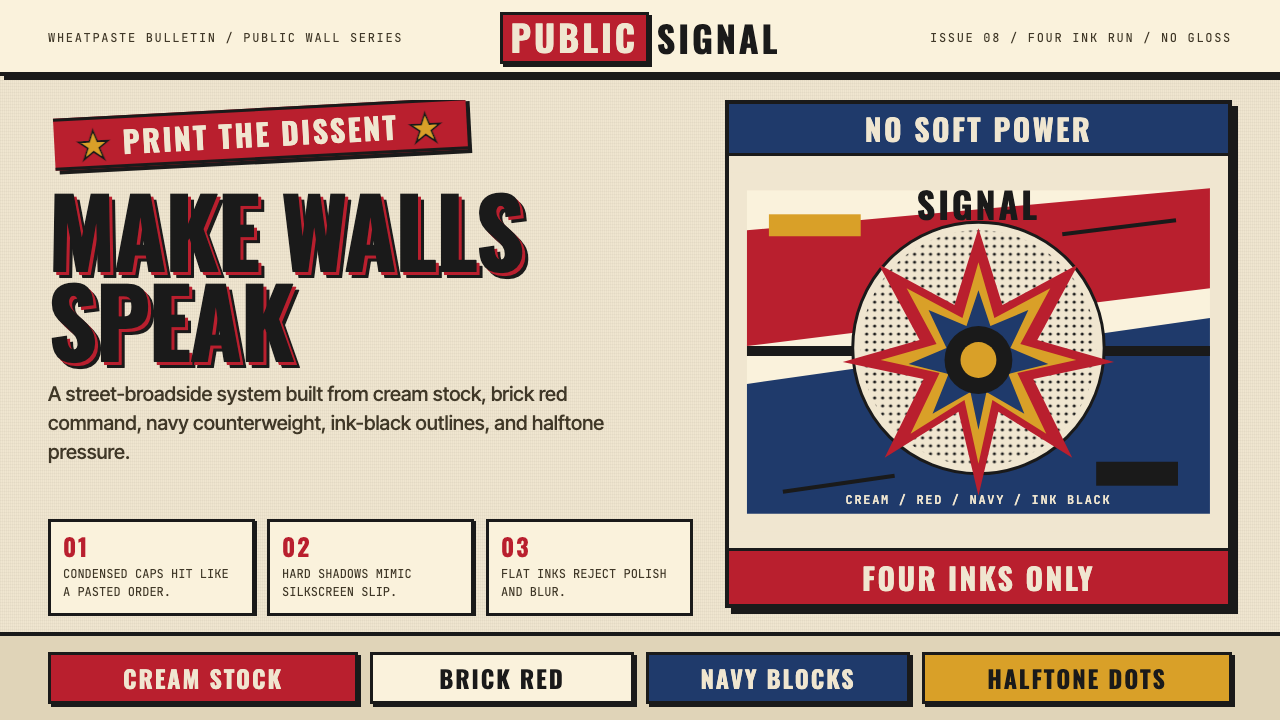
Shepard Fairey's OBEY campaign turned the four-ink constraints of street-poster silkscreen into the most recognized political visual language in twenty-first-century America.
Shepard Fairey OBEY in brief
Shepard Fairey's OBEY Giant visual system is a self-imposed discipline built around the physical constraints of low-budget silkscreen printing. The palette is restricted to four values — cream paper as ground, brick red, navy blue, and ink black — with no gradients and no photographic half-tones beyond the coarse dot screens inherited from Soviet and constructivist print tradition. Every image exists as flat fills separated by hard edges, giving each composition the graphic weight of a wall-pasted manifesto.
The typography is inseparable from the propaganda rhetoric the style deliberately invokes. ALL-CAPS letterforms in a condensed grotesque face dominate headline banners, which are rotated diagonally at a shallow angle to inject urgency and movement into otherwise static layouts. Hard offset drop shadows — shifted consistently in a single direction — make type appear to detach from the page surface, a technique borrowed from Soviet poster design of the 1920s. Star-rose and gear ornaments borrowed from Cold War iconography appear as recurring structural emblems rather than decorative flourishes.
What distinguishes authentic work in this system from imitation is constraint discipline. The visual power comes precisely from what is refused: no soft gradients, no photographic naturalism, no more than four ink colors, no decorative typeface mixing. The restriction is the message — it signals urgency, reproducibility, and the democratic directness of the photocopier and the paste-up table.

Where does Shepard Fairey OBEY come from?
The OBEY Giant campaign began in 1989 as an art class experiment at the Rhode Island School of Design. Fairey printed a sticker bearing the face of French wrestler André the Giant — whose likeness he found in a newspaper photo — with the caption 'André the Giant Has a Posse.' The sticker spread virally through Providence's skateboarding community, not because of any particular aesthetic ambition but because the act of stickering itself was already embedded in skate culture. Fairey began wheat-pasting larger versions on walls, telephone poles, and construction hoardings, and the project rapidly outgrew its origins as an inside joke.
The theoretical framework came later. Fairey codified his practice under the label 'phenomenology' — borrowed loosely from philosophy to describe the sensation of encountering an image that seems simultaneously familiar and out of place. The OBEY logo, derived from the wrestler's face and reduced to a high-contrast four-color stencil, was designed to provoke a dissonant double-take: its institutional graphic authority — the heavy condensed type, the bold color blocks, the official-looking star badges — conflicts with the absurdity of its content and the illegality of its placement. The friction between those two registers is the work's actual subject.
The style's visual vocabulary drew explicitly on identified predecessors. The Soviet Constructivists — especially Aleksandr Rodchenko's red-and-black poster compositions, his diagonal type treatments, and his use of the circle as a structural emblem — provided the essential grammar. The work of street artist and political printmaker Robbie Conal, who had been wheat-pasting grotesque caricature portraits of politicians in Los Angeles since the early 1980s, showed that the vernacular of street posting could carry genuine critical weight in a contemporary American context. Fairey synthesized these into a style legible to an audience that had never seen a Rodchenko original.
The campaign reached its widest cultural moment in 2008, when Fairey created the HOPE poster depicting Barack Obama in the red-cream-blue palette he had refined over two decades of street work. The poster circulated first as a wheat-paste and then as a downloadable file before it was adopted — without official authorization — by the Obama campaign's grassroots volunteers. It became the most reproduced political image of the election cycle and placed Fairey's visual language, and the street-poster idiom more broadly, into the center of mainstream American visual culture. The 2017 We the People series, created in response to the subsequent political climate, extended the system toward portrait-based advocacy, demonstrating that the style's grammar was robust enough to accommodate new subjects without revision.
What defines the Shepard Fairey OBEY look?
Restricted Four-Color Palette
The canonical palette mirrors a single silkscreen run: uncoated cream paper as the light ground, brick red as the dominant warm tone, navy blue as the dominant cool tone, and ink black for outlines and type. No fifth color is permitted. Gradients are structurally prohibited — every value transition must occur as a hard edge between two flat fills, or as a coarse halftone dot pattern that reads as a distinct tone rather than a blend. This restriction is both a production constraint and a philosophical position: the work must be reproducible by anyone with a photocopier and a can of wheatpaste.
Diagonal Banner Typography
Headline text is set in a condensed grotesque face in all capitals and enclosed in a filled banner that is rotated at a shallow diagonal — typically leaning upward from left to right. The diagonal is not a compositional flourish but a direct citation of Soviet Constructivist agitprop layouts, which used angled type to convey revolutionary urgency. The banner itself — a solid-color rectangle extending slightly beyond the letterforms — is derived from stencil and woodblock print conventions where color registration required simple rectangular masks.
Hard Offset Drop Shadow
All major typographic and illustrative elements carry a hard drop shadow offset at a consistent angle and rendered as a solid flat shape in a single contrasting value — typically black on the light palette, or cream on the dark one. The shadow is not a lighting simulation but a geometric doubling: it creates visual separation, adds a sense of stacked paper layers, and references the misregistration effects that occur in real silkscreen production when ink layers shift slightly during printing. The shadow thickness is perceptible and deliberate, never subtle.
High-Contrast Halftone Portraiture
Photographic source material — faces, figures, architectural landmarks — is reduced to a two- or three-tone silkscreen representation using coarse halftone dot screens. The reduction process eliminates midtone detail and collapses the image into flat areas of the four palette colors, giving subjects an iconic, poster-like quality that reads at distance. This technique descends directly from Warhol's silkscreen portraits and Constructivist photo-montage, but Fairey applies it with a commitment to street-readable legibility rather than fine art scale.
Constructivist Ornamental Emblems
Star-rose rosettes, interlocking gear rings, and symmetrical geometric borders appear as recurring structural emblems borrowed from Soviet, military, and Cold War institutional insignia. Unlike decorative flourishes, these ornaments serve a compositional function: they fill negative space, establish symmetry axes, and confer an air of official authority that ironizes the street-paste context. The star-rose in particular functions as a compositional anchor equivalent to the seal or stamp on a government document.
Flat Fills and Zero Gradients
Every area of color is a flat, uniform fill with no value transitions within it. Even areas that represent three-dimensional forms — a face in raking light, a raised fist, a figure in foreground — are rendered entirely through flat color shapes separated by hard contour lines. The visual depth in the system comes not from tonal modeling but from color contrast and the layering of flat shapes. This flatness is the clearest inheritance from Constructivist print practice and remains the most important single quality to maintain when applying the style digitally.
Bilateral Symmetry with Vertical Stacking
Portrait-format compositions follow a vertical stacking logic: a bottom block in one color holds a subject name or slogan in the diagonal banner; a large central field contains the halftone portrait; a top band carries an identifying label or the OBEY logo. The layout is bilaterally symmetrical along the vertical axis — a deliberate echo of propaganda posters, military insignia, and institutional seals. This symmetry conveys authority and permanence, qualities that the work simultaneously invokes and subverts by situating them in the ephemeral context of street posting.

Who shaped Shepard Fairey OBEY?
Fairey studied at the Rhode Island School of Design, where the OBEY Giant project began in 1989 as a sticker distributed through the Providence skateboarding scene. Over the following two decades he built Studio Number One in Los Angeles and developed the OBEY campaign into a globally recognized visual system spanning street interventions, commercial gallery work, brand collaborations, and political imagery. His 2008 HOPE poster became the defining image of that presidential election cycle and the most widely circulated American political poster since the Second World War. Fairey has also been a consistent advocate for street art's legitimacy as a critical practice, engaging directly with debates about public space, copyright, and the appropriation of imagery.
Rodchenko was a central figure in Russian Constructivism whose poster compositions, magazine covers, and typographic experiments of the 1920s provided the primary visual grammar that Fairey absorbed and transformed. His use of red and black at maximum contrast, his diagonal type placement, his integration of photomontage with bold geometric form, and his development of the circle as a structural emblem are all directly visible in Fairey's work. Rodchenko designed not for the gallery but for mass reproduction and public display — values that made his approach unusually compatible with the street-paste vernacular of four decades later.
Conal has been wheat-pasting large-format political portrait posters on the streets of Los Angeles and other American cities since the early 1980s, targeting politicians and public figures with grotesque, highly textured oil-painted caricatures paired with sardonic captions. He demonstrated before Fairey that the street-poster format could function as serious political art in a contemporary American context, and that unsanctioned public posting could generate media coverage and cultural conversation rather than simply constitute vandalism. Fairey has cited Conal as an important precedent for the OBEY campaign's combination of street practice and political intent.
Studio Number One is Fairey's Los Angeles-based design studio, which has been responsible for extending the OBEY visual system beyond street work into commercial brand identity, music packaging, apparel graphics, and large-scale public mural commissions. The studio's work demonstrates the degree to which Fairey's aesthetic — developed under the constraints of cheap reproduction and illegal posting — can scale to institutional and commercial contexts without losing its graphic identity. Studio Number One has also produced the design infrastructure that allows the OBEY brand to function as a commercial entity while maintaining its association with political street art.
André René Roussimoff — the French-born professional wrestler known as André the Giant — was the involuntary origin point of the entire OBEY visual system. Fairey encountered his photograph in a newspaper and was struck by the compositional qualities of his face: the scale of his features relative to the frame, the high contrast between light and shadow, and the way the image could be reduced to a simple stencil without losing recognizability. André never participated in or endorsed the campaign; the use of his likeness became one of several copyright controversies associated with Fairey's practice of appropriating existing imagery as visual raw material.
How do you use Shepard Fairey OBEY today?
The OBEY style translates into contemporary design contexts most successfully when the four-color constraint is observed as a structural rule rather than a loose aesthetic mood. The temptation in digital work is to expand the palette — adding a fifth accent color, softening the brick red toward coral, introducing gradient blends between the navy and the cream. Resisting these additions is not a stylistic purism but a functional decision: the graphic power of the system depends entirely on the high-contrast juxtaposition of a very small number of values. Every additional color dilutes that contrast.
For presentation slides, the style works with particular force on cover and section-divider pages. A cover benefits from the poster's vertical stacking logic: a navy or brick-red lower band anchors a subject name in the diagonal condensed banner treatment, a large halftone-style portrait or illustrated graphic occupies the central field, and an overline label or series title appears at the top in the same condensed all-caps treatment. Content slides should be treated as stripped-down manifestos: large section labels in the diagonal banner style, body content in a plain condensed face at generous size, and a tight two-column structure that keeps information density high without introducing clutter. Data slides work well when charts and graphs are rendered in the flat four-color palette — bar heights and pie segments become flat geometric forms with hard edges, avoiding any soft shadow or glow treatment that would break the print-production logic.
For web interfaces, the OBEY grammar is best suited to contexts where directness and authority are the primary communication goals — landing pages for political or advocacy organizations, editorial platforms with a strong point of view, and brand pages where the product's identity is built on cultural credibility rather than luxury or warmth. Dashboard and pricing page applications should use the cream or near-white ground as the default surface, with brick-red and navy reserved for primary calls to action, tier labels, and interactive state indicators. Card components should use the hard offset shadow treatment — a flat black shape shifted consistently in one direction — rather than any soft elevation or glow. Navigation should be typographic and direct, using the condensed all-caps treatment for primary labels.
For editorial and marketing work, the style's poster-like authority makes it particularly effective for feature covers, campaign headers, and advocacy materials. An editorial spread adapted from this system uses a wide-margin layout with section labels in the diagonal banner treatment and body text in a plain condensed face at a comfortable reading measure. Marketing campaign materials benefit from the alternating-band logic of the street poster: full-width cream bands alternate with brick-red or navy bands, each containing a large typographic statement or halftone graphic in the contrasting value. The star-rose and gear ornaments, used sparingly, can serve as section markers or emphasis points without reading as arbitrary decoration.
A common mistake when applying this style is conflating it with generic propaganda-pastiche by adding sepia tones, distressed textures, or aged-paper effects. The original system is not nostalgic — it is deliberately contemporary in its graphic execution, using flat digital fills and clean hard edges even when referencing the visual vocabulary of Soviet print. Adding texture or aging effects softens the contrast that drives the system's authority and imports a vintage aesthetic that is the opposite of what the style communicates. Similarly, introducing soft drop shadows, rounded corners, or any gradient fill — even a subtle one — immediately undermines the flat silkscreen logic that gives the system its identity.

Shepard Fairey OBEY — FAQ
How is the OBEY style different from generic Constructivism revival?
Constructivism revival in contemporary design tends to borrow the visual vocabulary — diagonal type, red and black palette, bold geometric forms — as historical quotation, often within an overall typographic refinement and grid precision that signals sophistication. The OBEY system preserves those elements but adds the coarse halftone portrait, the star-rose ornamental emblem, the cream paper ground, and — critically — the street-paste context that frames the work as political action rather than cultural reference. The difference is intention: Constructivism revival is retrospective, OBEY is operative.
Can the style work with full-color photography, or must imagery always be reduced to halftone?
Full-color photography is incompatible with the system's structural logic. The four-color palette constraint means that any photographic image used within the system must be reduced to a representation using only the four palette values — cream, brick red, navy, and black — whether through coarse halftone dot screens, posterization to flat fills, or a combination of both. Introducing a full-color photograph, even a single one, collapses the visual tension between the institutional graphic authority and the print-production constraint that makes the style coherent. If photographic naturalism is required, a different system is more appropriate.
Is the style appropriate for commercial or corporate branding, or is it too politically charged?
The style has been used successfully in commercial contexts — Fairey's own Studio Number One has produced brand work, apparel graphics, and music packaging using the system — but it carries associations that cannot be separated from its street art and political origin. Brands that benefit from cultural credibility, counterculture positioning, or a deliberate anti-corporate stance can use the style authentically. Brands in finance, enterprise software, healthcare, or luxury goods risk the irony of deploying an anti-establishment aesthetic to reinforce establishment power — an incoherence that informed audiences will notice. The style's best commercial applications are those where the brand's actual values align with the directness, irreverence, and democratic accessibility that the visual system embodies.
How does the style handle dark backgrounds, and when is a dark variant appropriate?
The canonical OBEY palette is light-ground — cream or off-white — because the original silkscreen runs used uncoated paper as the base value. A dark variant is possible but requires rebalancing. On a black or very dark ground, the brick red and navy collapse in contrast against each other, so the palette effectively reduces to two values: dark ground and light fills. Cream or near-white takes on the role that black plays in the light-ground version — it becomes the dominant structural color for outlines, type, and key illustrative elements. Dark variants work best for environmental contexts (large-format murals, stage backdrops, apparel on dark fabric) where the light-ground original would read as a framed object rather than an immersive surface.
What is the relationship between the OBEY style and the 2008 HOPE poster specifically?
The HOPE poster is the clearest and most widely seen application of the visual grammar Fairey had been developing since 1989, but it is not the origin of that grammar — it is its largest-scale public deployment. The poster applies every element of the established system: the four-color silkscreen palette in its cream-red-blue-black form, the halftone portrait reduction, the diagonal condensed banner at the base carrying the word HOPE, and the star-rose ornaments in the upper register. What distinguished it from earlier OBEY work was the substitution of a political candidate for the anonymous or ironic figures of the campaign's early years, and the speed and scale at which it propagated — first as a wheat-paste, then as a downloadable file, then as an officially printed campaign poster. The HOPE poster demonstrated that a visual system built for street reproduction at zero cost could scale, without fundamental revision, to the most public context in American political life.
Related design styles
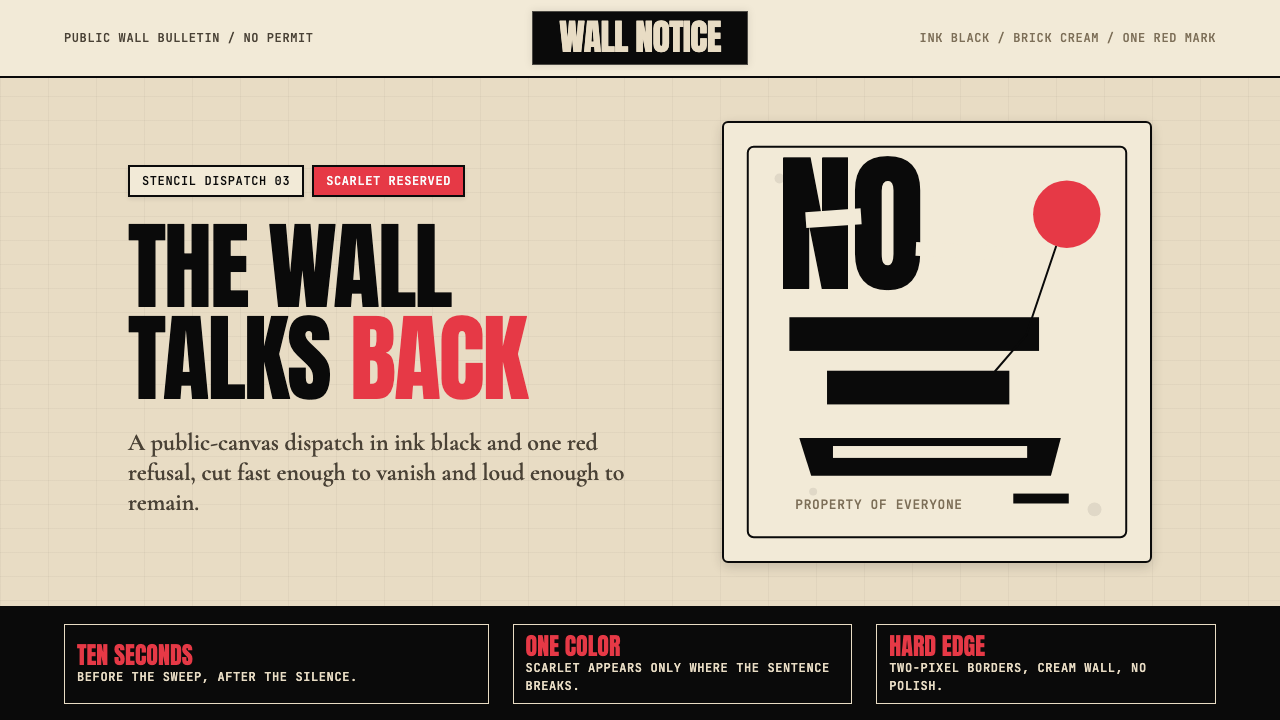 Banksy Stencil GraffitiProtest is reduced to a cut mark. Anton black on brick cream, one scarlet red…
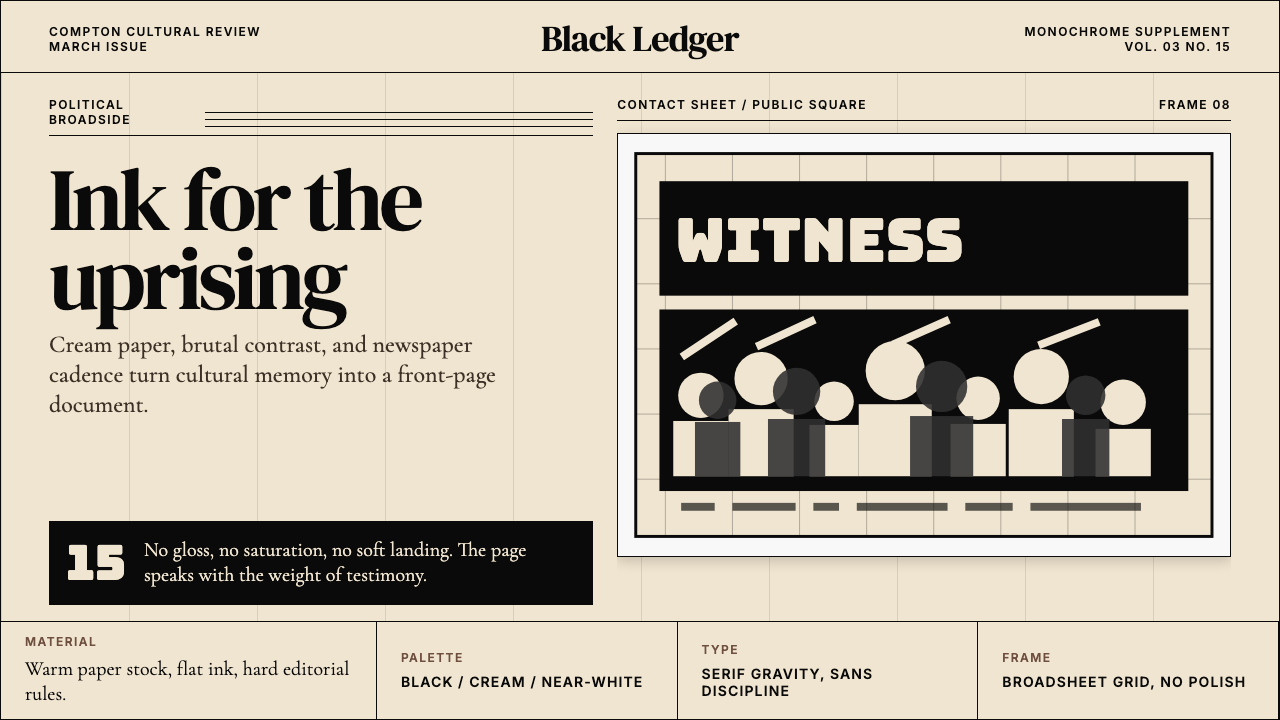 Kendrick — To Pimp a ButterflyPolitical weight, printed cold. Cream paper, hard serif type, monochrome crow…
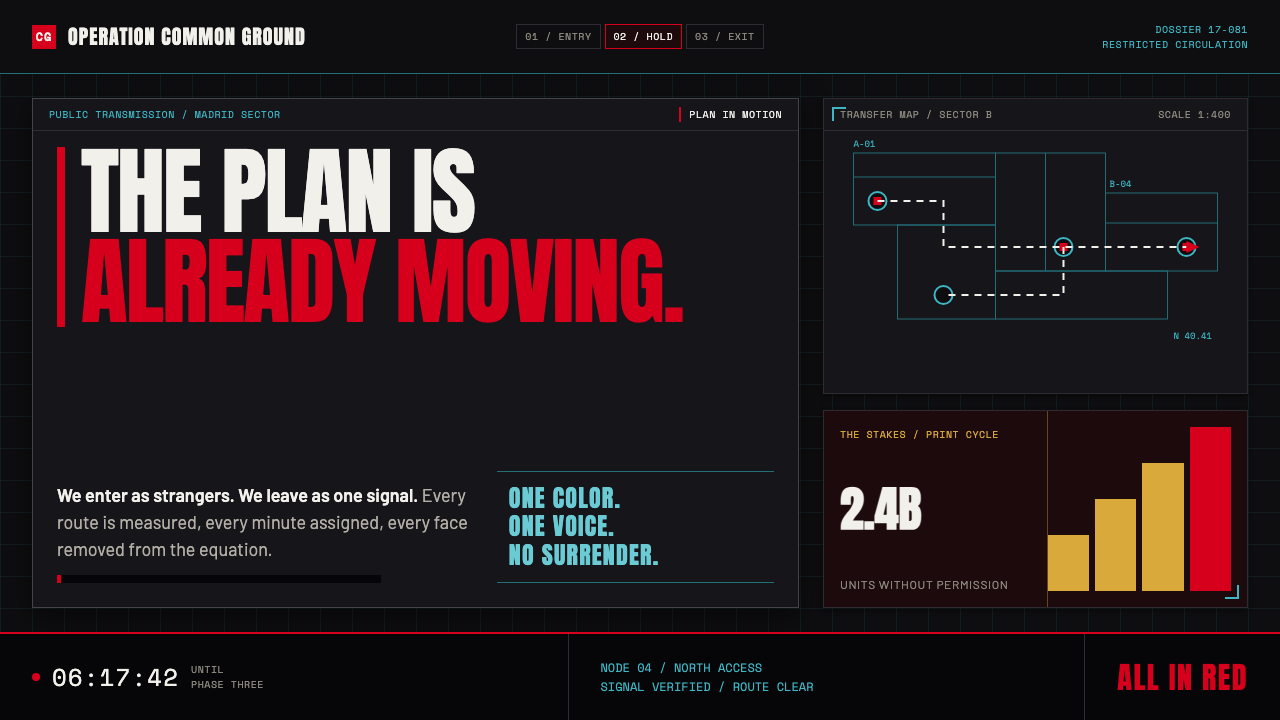 Money Heist (La Casa de Papel)Resistance becomes spectacle. Arterial red cuts through graphite grids and ta…
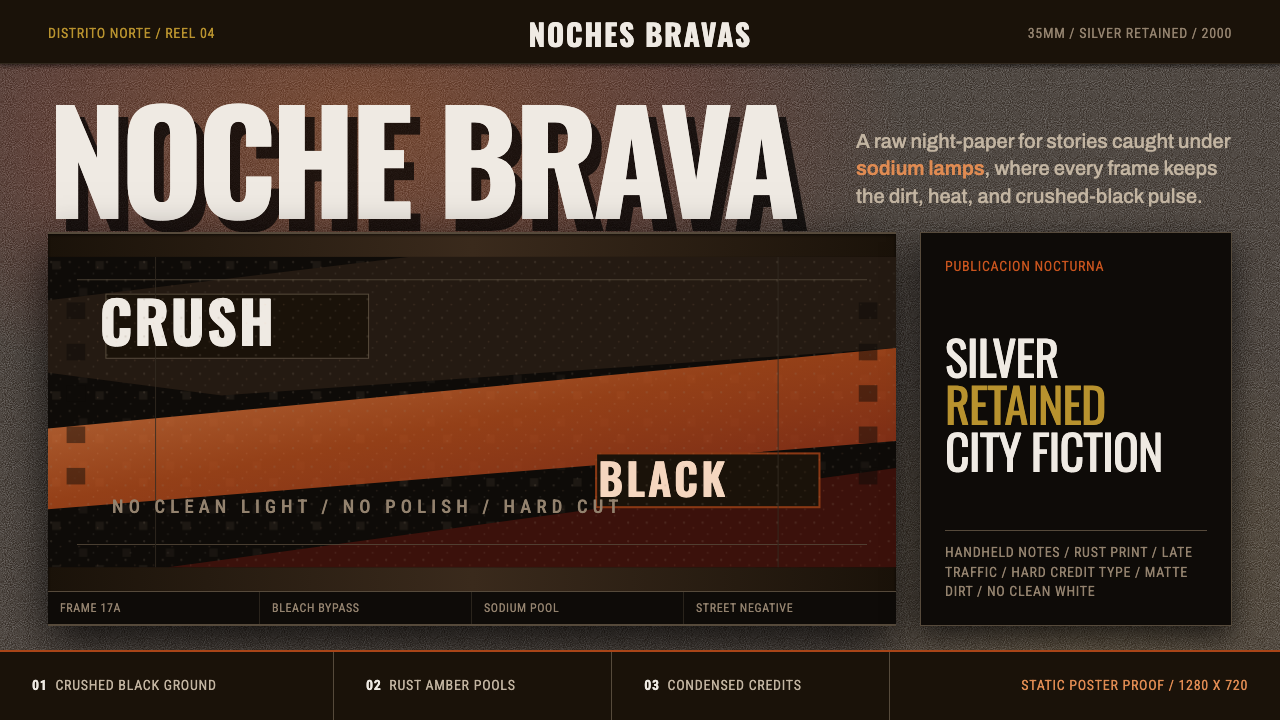 Amores Perros New WaveRaw street cinema. Crushed black, sodium amber, Oswald credits, heavy 35mm gr…
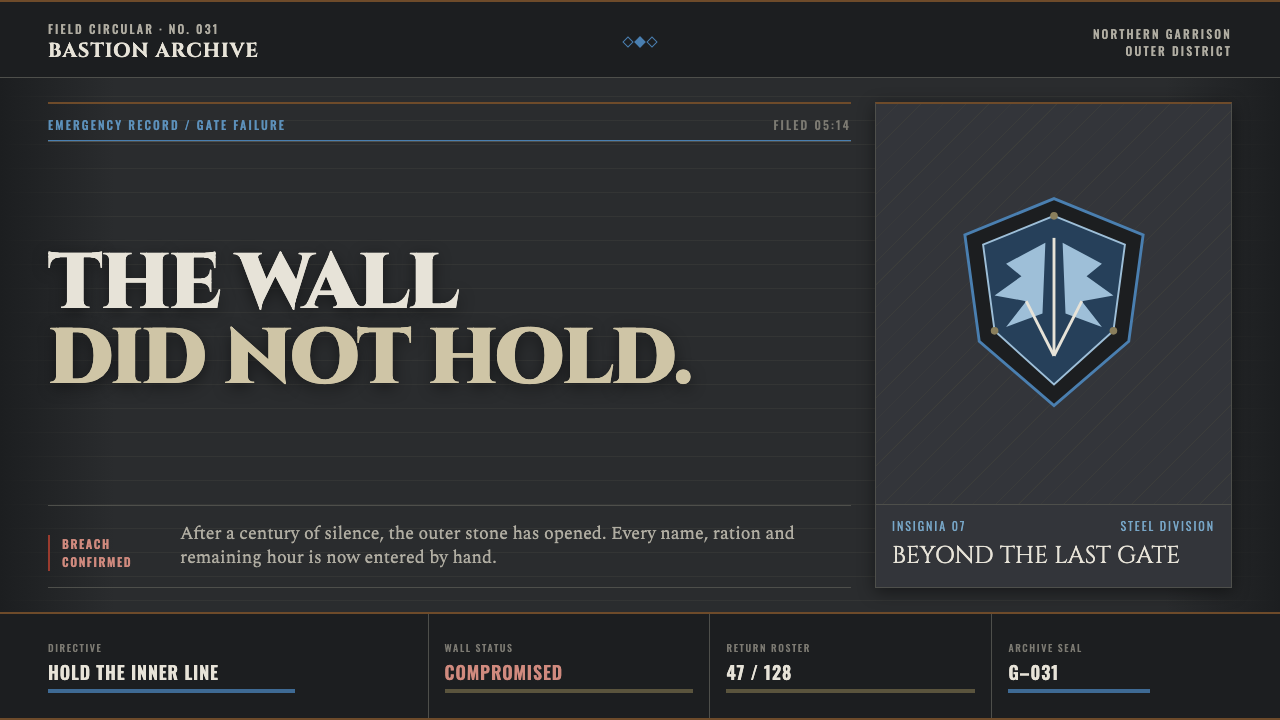 Attack on Titan (2013)Dread becomes duty. Stone-gray bands, engraved caps and one steel-blue crest…
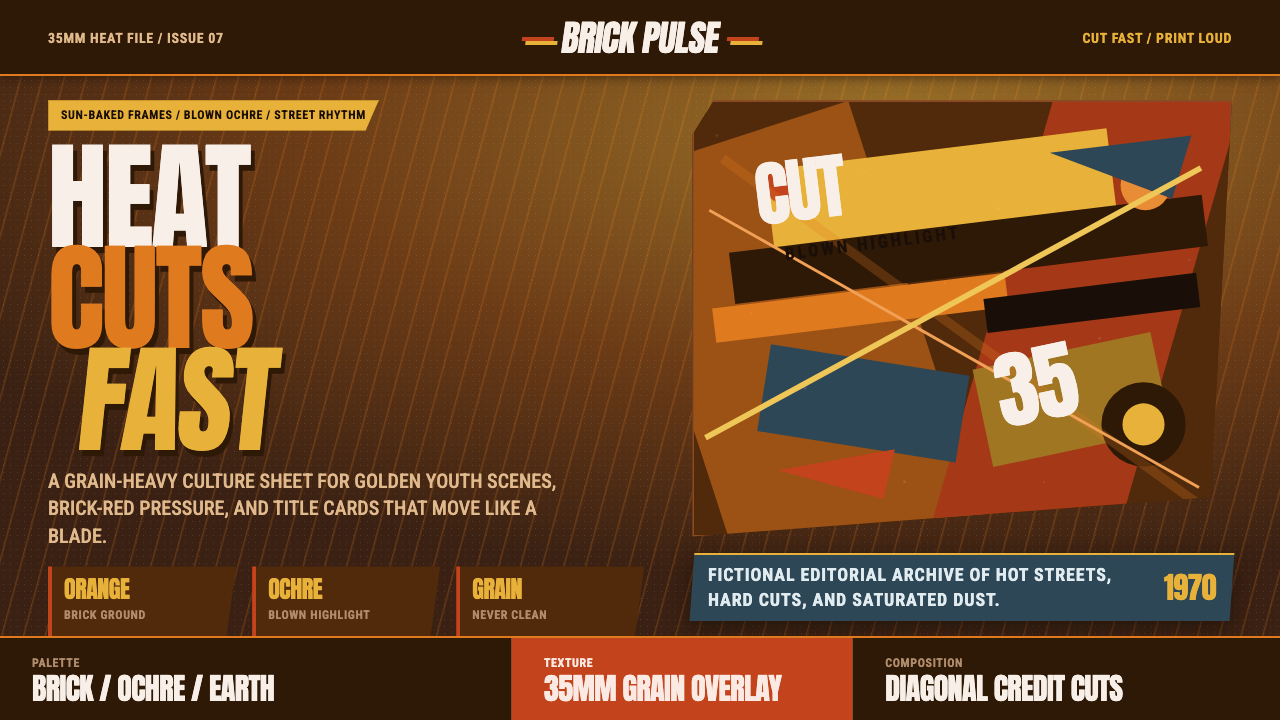 City of God FavelaHeat refuses polish. Orange brick, ochre glare, diagonal cuts, and grain do t…