What is Star Wars (1977)?
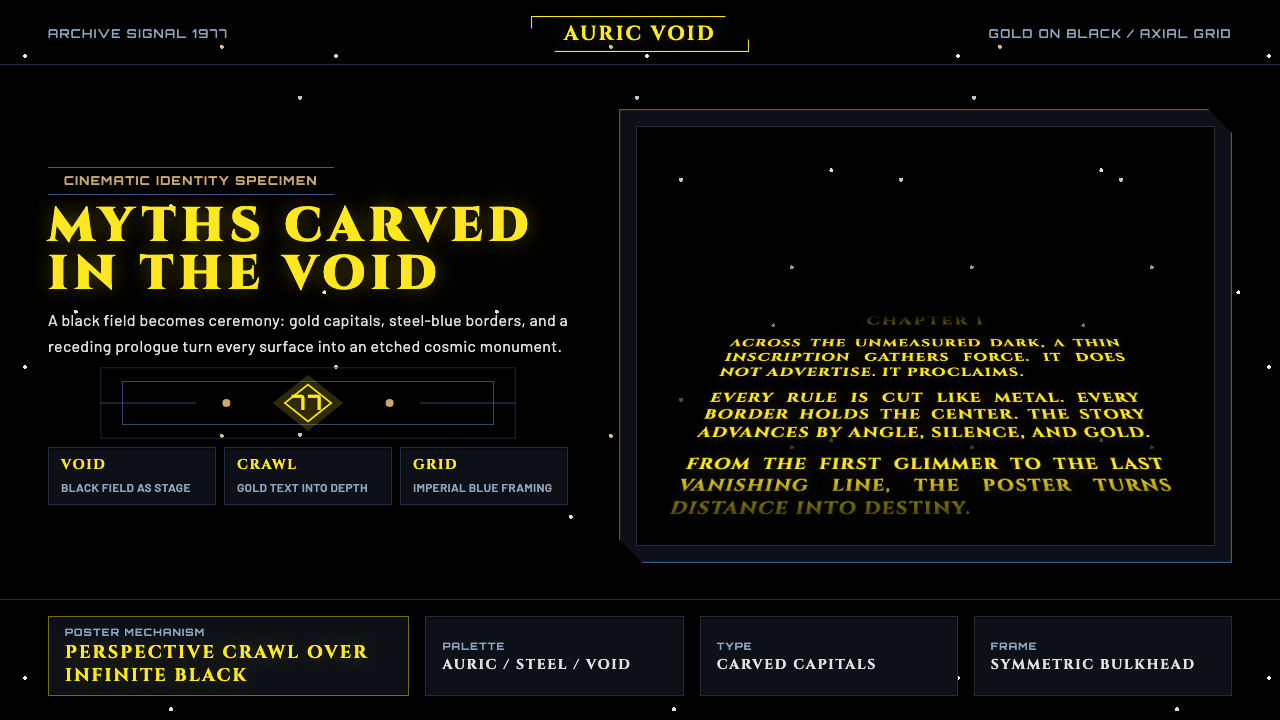
Star Wars (1977) didn't invent science fiction cinema — it invented the visual grammar of myth carved into space, etching gold against black void in a language that billions instantly recognized as epic.
Star Wars (1977) in brief
The Star Wars visual identity is not a graphic design system in the conventional sense — it is a mythology machine. The opening crawl's gold perspective type receding into a star field, the angular slab logo that Suzy Rice designed in 1976, Drew Struzan's painted theatrical posters, and Ralph McQuarrie's concept paintings collectively established a visual grammar that fused ancient myth with deep-space spectacle. The result is an aesthetic that feels simultaneously ancient and impossibly remote: carved rather than printed, etched rather than displayed.
The dominant tension in the system is the opposition between two visual registers. The Rebellion's palette is warm, organic, and weathered — desert sand, worn leather, the amber glow of twin suns on a horizon. The Empire's visual language is its direct inversion: cold, geometric, symmetrical, and steel-hard. Imperial surfaces feel machined; Rebel surfaces feel lived-in. Every poster, title card, and environment in the original trilogy is lit by this fundamental contrast.
What makes the style durable across decades is that its rules operate at the level of myth rather than trend. The compositional logic borrows from Renaissance triptychs and Japanese Akira Kurosawa films simultaneously. The typography recalls both Roman imperial inscriptions and American Western movie posters. This layering of cultural references — ancient, classical, and mid-century popular — gives the aesthetic a density that resists easy dating.

Where does Star Wars (1977) come from?
George Lucas began developing the project that would become Star Wars in 1971, initially as an homage to the Flash Gordon serials he had watched as a child. Early drafts borrowed heavily from Joseph Campbell's The Hero with a Thousand Faces — a comparative mythology study that traced the same narrative arc across cultures from ancient Greece to Polynesia. This choice of mythic rather than hard-science-fiction source material would directly determine the visual language. A story built on archetypes demanded an aesthetic built on archetypes.
Suzy Rice designed the Star Wars logotype in 1976 under tight constraints and an extremely short deadline — she has described having only a few days to develop the design. Working from Lucas's brief that the film should feel 'fascist' and 'totalitarian' in its visual scale and authority, Rice drew on the wide, compressed, angular letterforms associated with Nazi-era German graphic design — specifically the kind of blocky, serifed slab capitals that conveyed power through sheer mass. The backward-italic slant she applied gave the resulting logo its characteristic forward thrust, as though the words themselves were accelerating through space. The combination of weight and angle became one of the most imitated logotype structures in entertainment history.
Ralph McQuarrie was hired in 1975, before a single frame of film was in production, to produce concept paintings that would help Lucas pitch the project to 20th Century Fox executives. McQuarrie had trained as a technical illustrator and worked on NASA presentations — a background that gave his spacecraft and environments a plausible industrial density. His paintings established the tonal range of the entire trilogy: the warm sepia of Tatooine's desert, the fog-blue of Dagobah's swamp, the cold white corridors of the Death Star. When the film finally went into production, production designer John Barry and art director Norman Reynolds used McQuarrie's paintings as direct visual references, producing a rare case in which concept art and finished film occupied essentially the same aesthetic register.
Drew Struzan created many of the theatrical release posters that defined the public face of the franchise, and his painted illustration style — intense light sourcing, dramatic figure compositions arranged in vertical pyramids, and faces rendered with the emotional directness of nineteenth-century academic painting — became inseparable from the identity of the films. Struzan's technique drew on the tradition of American pulp science fiction cover art from the 1930s through the 1950s, filtered through the dramatic lighting of Howard Pyle and N.C. Wyeth. The result was a poster aesthetic that felt simultaneously heroic and intimate: epic in scale, but executed at a level of craft that rewarded close attention.
What defines the Star Wars (1977) look?
Gold on Black
The core chromatic relationship in the Star Wars visual system is metallic gold or warm yellow against a deep, absolute black. This pairing carries the visual weight of ancient inscription — coins, seals, monumental carvings — translated into the scale of cinema. Gold implies permanence, authority, and ceremonial weight; pure black implies the void, the infinite, and the absence of warmth. The opening crawl enacts this relationship literally: gold letterforms dissolving into starless space. When applied to design work, this pairing should feel weighty and formal rather than decorative.
Imperial Geometry vs. Organic Rebellion
The visual system maintains a consistent duality between two aesthetic modes. The Empire is expressed through hard right angles, precise symmetry, cold steel-grey surfaces, and a complete absence of organic curve or texture. The Rebellion is expressed through weathered surfaces, asymmetric compositions, warm earth tones, and materials that show wear and human use. These two registers function as design vocabulary: any Star Wars-derived work should pick a side and maintain it, using the opposing register only to signal friction, conflict, or transition.
Diagonal Thrust and Perspective Depth
Star Wars compositions consistently use strong diagonal movement and extreme perspective recession to generate a sense of scale and narrative velocity. The opening crawl is the defining example: text angled on a vanishing point that implies infinite depth. The Star Destroyer shot that opens the film — a massive hull passing overhead, shrinking to nothing — enacts the same principle spatially. In graphic work derived from this aesthetic, compositions should favor strong diagonals, foreshortened objects, and a vanishing point that pulls the viewer's eye into depth rather than across a flat surface.
Slab and Wedge Typography
The Star Wars logotype established a typographic vocabulary based on wide, compressed letterforms with heavy serifs — the visual equivalent of stone carving. This slab-serif sensibility implies permanence and monumental authority: these are not printed words but inscribed ones. The characteristic backward italic leans the forms into apparent forward motion, combining the weight of ancient inscription with the dynamic thrust of speed. Headline type in this aesthetic should feel hewn from solid material, with no delicate hairline strokes; every letterform carries equal weight throughout its strokes.
Starfield and Void Space
Unrelieved black — often populated with a fine scatter of small white dots suggesting distant stars — functions as the foundational ground of the aesthetic. This void is not empty negative space in the modernist sense: it is charged with scale and narrative implication. The starfield communicates that the stakes are cosmic and the distances are incomprehensible. In design applications, this translates to generous use of deep black grounds, with minimal elements allowed to float against them. Crowding the void defeats its purpose; the expanse must be felt.
Painted Light and Cinematic Glow
Unlike design systems built on flat color and hard edges, the Star Wars aesthetic embraces luminosity and atmospheric glow — effects visible in McQuarrie's concept paintings and Struzan's poster work. Light sabers bleed light into surrounding space. The sun over Tatooine casts warm atmospheric haze. Ship engines glow. This luminosity is not the soft diffuse glow of contemporary UI design; it is the intense, sourced, dramatically angled light of classical painting applied to science fiction. In graphic applications, selective use of bloom, atmospheric haze, or warm-to-dark gradients at light sources can invoke this quality — but only as dramatic accent, never as overall surface treatment.
Symmetrical Monumentalism
Imperial iconography in the Star Wars universe is rigorously symmetrical — the Death Star's spherical perfection, the TIE Fighter's paired hexagonal wings, the Imperial crest's bilateral exactness. This symmetry is used not as classical balance but as an expression of absolute authority and mechanical inevitability: nothing organic, nothing accidental, nothing that varies. When the aesthetic is applied to design work invoking authority, scale, or formality, bilateral symmetry becomes a key compositional tool. Heroic or Rebellion-coded work should break this symmetry deliberately to communicate humanity and improvisation.

Who shaped Star Wars (1977)?
Lucas conceived Star Wars as a conscious synthesis of Joseph Campbell's comparative mythology, Akira Kurosawa's samurai cinema, and the adventure serials of his own childhood. His decision to ground the film's visual identity in myth rather than hard science fiction determined every subsequent aesthetic choice. Lucas also made the historically unusual decision to retain merchandising rights to the film, which meant the visual system he had created would be applied to products, toys, and licensed goods at an unprecedented scale — a decision that transformed the film's graphic identity into one of the most widely reproduced design languages in commercial history.
McQuarrie's pre-production concept paintings are arguably the single most important visual document in the franchise's history. Painted before any casting, locations, or production decisions were finalized, they established the complete tonal and chromatic vocabulary of the universe: the warm amber of Tatooine, the cold steel of Imperial interiors, the worn texture of Rebel equipment. His background in technical illustration for NASA gave his work a credible industrial specificity — spaceships looked functional because McQuarrie understood how functional objects looked. His designs for Darth Vader, R2-D2, C-3PO, and the Death Star remain essentially unchanged from concept to screen.
Rice designed the Star Wars logotype under significant time pressure and with a deliberately provocative creative brief — Lucas wanted the title to carry the visual weight of totalitarian authority. Her solution drew on compressed, heavy slab-serif letterforms associated with mid-century German institutional typography, applying a backward italic that gave the mark its sense of kinetic forward motion. The resulting logotype has appeared on more merchandise, books, theatrical releases, and licensed products than arguably any other entertainment trademark in history. Rice has noted in interviews that the design's intended reference to fascist visual language was deliberate and functional — the Empire needed to look like an empire.
Struzan's theatrical posters for the Star Wars saga — including key art for the original trilogy, the Special Editions, and the prequel trilogy — defined the franchise's public face for three decades. Working in painted illustration at a time when film marketing was moving toward photographic compositing, Struzan maintained a craft-based approach that placed the Star Wars visual identity in a lineage of American pulp science fiction illustration stretching back to the Golden Age paperback covers of the 1940s and 1950s. His technique of intense directional light, dramatic figure pyramids, and emotionally direct portraiture gave even familiar characters an operatic grandeur that photography could not replicate.
Mollo served as costume designer on the original Star Wars and won the Academy Award for Costume Design for his work. His approach to dressing the film's universe was grounded in historical military tailoring: Imperial uniforms draw on Nazi SS dress uniforms, Soviet military overcoats, and British naval tradition; Rebel costumes reference peasant clothing, samurai armor, and American frontier dress. This historical layering gave every costume a subconscious familiarity — viewers recognized the Empire as evil and the Rebellion as scrappy not because of exposition but because the costumes activated existing cultural memories. Mollo's work demonstrates that the Star Wars aesthetic operates through historical quotation as much as through original invention.
How do you use Star Wars (1977) today?
The Star Wars visual language is among the most recognizable design systems in popular culture, and this recognition cuts both ways in applied design. Its vocabulary — gold on black, diagonal perspective, monumental slab type, star fields — arrives loaded with fifty years of franchise association. Used thoughtfully, this association becomes an asset: the aesthetic instantly signals epic scale, mythic stakes, and a certain cinematic grandeur. Used carelessly, it produces work that reads as licensed merchandise rather than original design. The key discipline is to invoke the aesthetic's underlying structural logic — the contrast between void and light, the tension between organic and geometric registers — rather than borrowing its most literal surface elements.
For presentation slides, this aesthetic works exceptionally well in contexts requiring gravitas, vision, or announcement quality. A cover slide benefits from the full chromatic contrast: deep black ground, gold or warm-yellow headline type, a single strong diagonal element — whether a graphic form, an image crop, or a perspective grid — that pulls the eye toward depth. Section dividers should feel like title cards: sparse, high-contrast, typographically led. Content slides should resist the temptation to fill every corner; generous dark negative space communicates confidence. Data visualizations in this register work best when the chart elements themselves are colored in the warm-to-cool contrast vocabulary — warm amber or gold for the primary series, steel blue or cool grey for comparative or secondary data.
For web interfaces, the aesthetic is well-suited to product launches, event landing pages, cinematic brand presences, and any context where the experience should feel immersive and large-scale. A dark ground with selective gold or amber accents, strong typographic hierarchy using display-weight condensed serifs, and careful use of atmospheric glow or light bleed around key interface elements can create the distinctive luminous quality associated with the films. Dashboards and functional interfaces are harder territory — the aesthetic's drama can undermine scannability. Use it for hero sections and marketing layers; default to a lighter, more neutral system for dense data environments, using the Star Wars vocabulary as selective accent only.
For editorial and marketing applications, the style is strongest when it owns its cinematic references directly rather than disguising them. A poster, event announcement, or editorial spread that fully commits to the gold-on-black compositional language, dramatic diagonal composition, and slab-serif display type will outperform a design that hedges — borrowing the palette but softening the geometry, or using the type treatment but switching to a light ground. Marketing campaigns using this vocabulary work best when they adopt the franchise's own device of opposition: warmth against cold, organic against mechanical, light against dark. Brand narratives that have a genuine antagonist or challenge to overcome find the most authentic resonance with this visual language.
A common mistake when applying this aesthetic is treating the star field as decoration. In the films, the star field is the void against which all action is measured — its scale is existential. Reproduced as a texture, a background pattern, or a subtle overlay, it becomes wallpaper. Another frequent error is applying the gold-on-black pairing at low contrast or in a muted, fashionable colorway — desaturating the gold to bronze, or using charcoal instead of true black. The aesthetic depends on absolute contrast; the void must be absolute and the gold must glow. Finally, the slab-serif typographic vocabulary works only when type is set at genuinely large, monumental scales. At body text sizes, the same letterforms lose their inscribed quality and read as generic period pastiche.

Star Wars (1977) — FAQ
Is this a science fiction style or a fantasy style?
Visually, Star Wars (1977) is better classified as mythic-epic than as either science fiction or fantasy in the conventional design sense. It deliberately borrows from fantasy's sense of ancient heroism and moral absolutes while using science fiction's spacecraft and technology as its setting. The visual references are less to the chrome-and-neon aesthetic of contemporary science fiction illustration and more to sources like Japanese samurai cinema, American Western mythology, and the compositional language of European academic historical painting. When applying the aesthetic, think 'legend carved in stone' rather than 'technology rendered in light'.
Can this aesthetic work on a light background?
The canonical Star Wars visual identity is built on dark grounds — the aesthetic's entire sense of scale and cosmic void depends on black functioning as an infinite backdrop. A light-background variant is possible but requires committing to different aspects of the visual system. Struzan's posters occasionally used warm mid-tone grounds rather than pure black; the effect is closer to classical illustration than to space opera. If a light ground is required, the compositional logic — strong diagonals, perspective recession, slab-serif display type — remains valid. What must be abandoned is the void-and-glow quality. Substitute high contrast between ground tone and type weight for the original light-against-dark drama.
How does this style differ from generic space or sci-fi aesthetics?
Generic space aesthetics typically emphasize technology, velocity, and the near-future: gradients, lens flares, glowing interfaces, clean sans-serif type, and a palette of electric blue, white, and silver. Star Wars (1977) runs almost opposite to this: it emphasizes antiquity, mythology, and the weight of the past. The typography is carved and heavy rather than light and technical. The palette is gold, warm amber, and absolute black rather than cool blue and silver. The surfaces feel weathered and ancient rather than sleek and contemporary. The key differentiator is the mythic register: when looking at a composition, ask whether it feels like a legend or a product launch. Star Wars should always feel like a legend.
Is it possible to use this aesthetic without it feeling like a parody or pastiche?
Yes, but it requires working at the level of principle rather than surface. The mistake that produces parody is treating the surface markers — the star field, the logo-style type, the specific gold-on-black palette — as the style itself. These are symptoms of the aesthetic, not its source. The source is mythic composition: large-scale contrast, diagonal thrust, monumental typography, the opposition of warmth and cold. Design work that applies these structural principles to a genuinely appropriate subject — an epic product launch, a film festival identity, a gaming brand with authentic narrative depth — can feel original and authoritative. The test is whether the aesthetic's mythic ambition is earned by the subject matter it serves.
What are the most common misapplications of the Star Wars aesthetic in design work?
Three patterns recur most frequently. First, using the star field as texture or wallpaper — distributing white dots evenly across a background as subtle atmosphere, rather than committing to the full cosmic void. The star field works only when the black ground is absolute and the scale is existential. Second, desaturating or warming the gold to a fashionable bronze or metallic tone that reads as contemporary rather than ancient — the original gold must be warm and saturated, not muted. Third, applying the slab-serif display typography at body text sizes, where it loses its inscribed, monumental quality entirely. The aesthetic requires generous scale and generous space; compressed into small formats or dense information environments, its fundamental virtues — weight, contrast, depth — cannot operate.
Related design styles
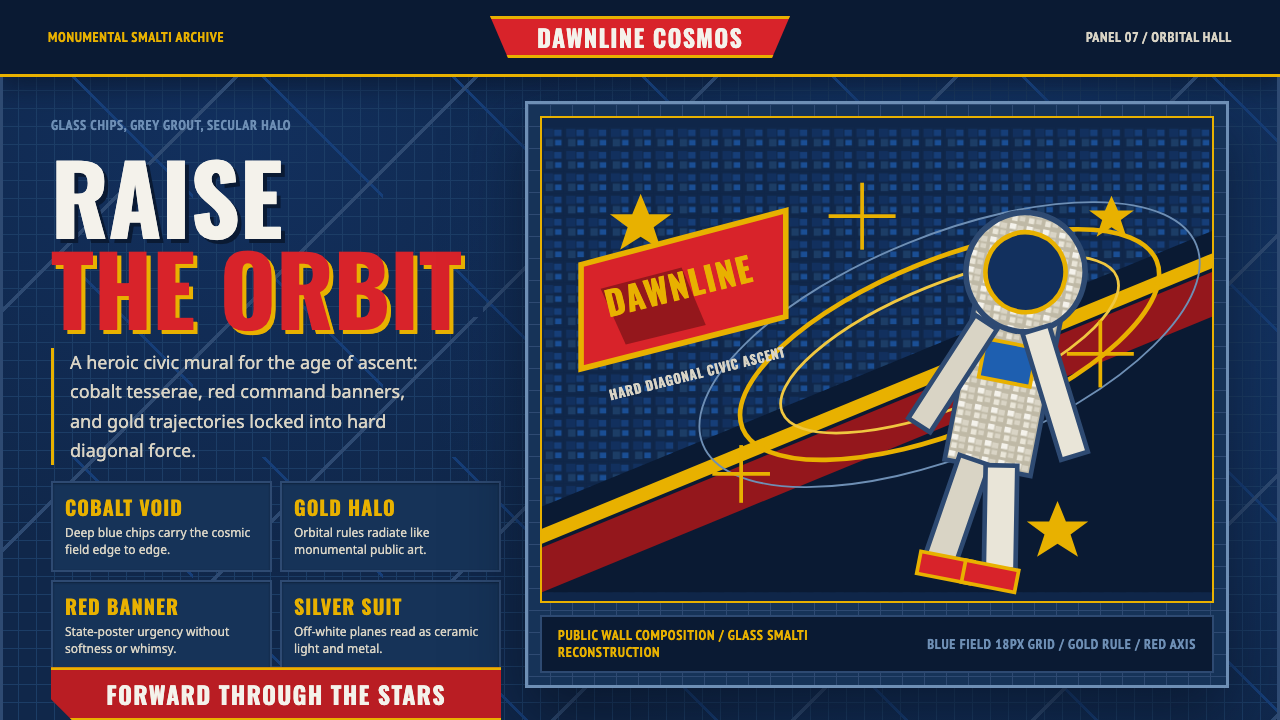 Soviet Cosmic MosaicMonumental and reverent. Cosmic-blue tesserae, red axis, gold orbital halo.
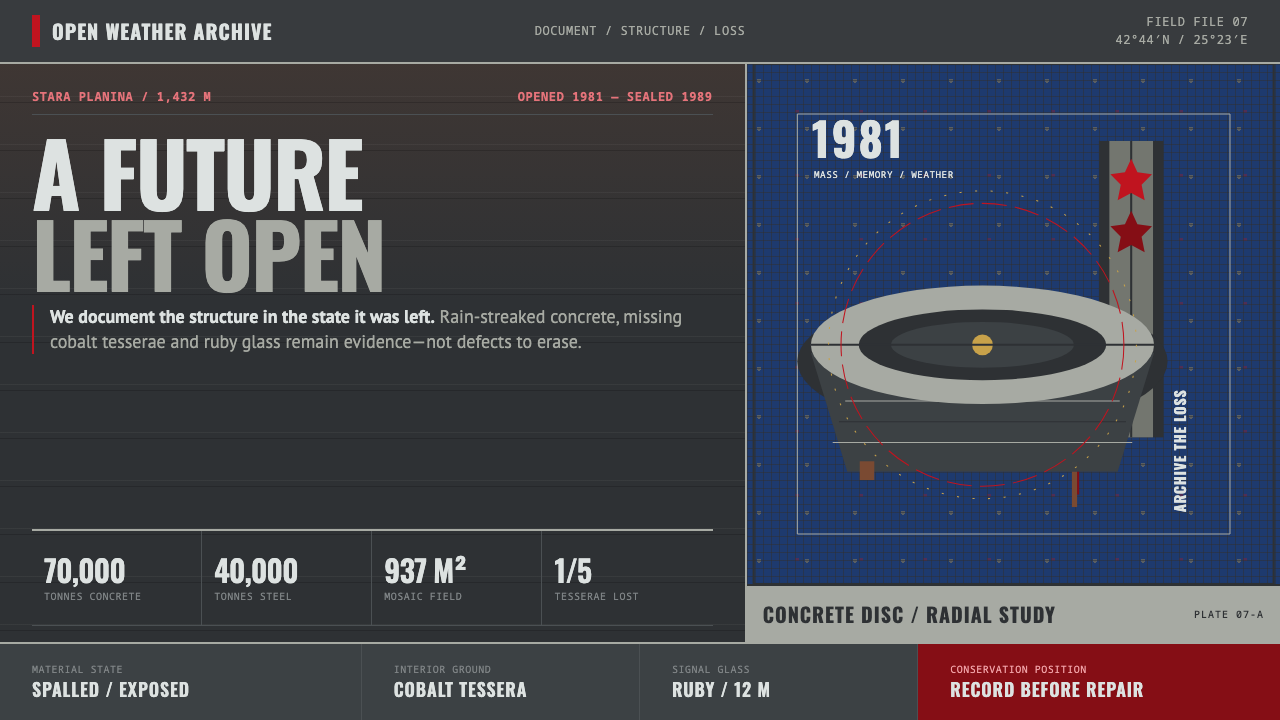 Buzludzha MonumentMonumentality without repair. Stained concrete frames cobalt tesserae, ruby g…
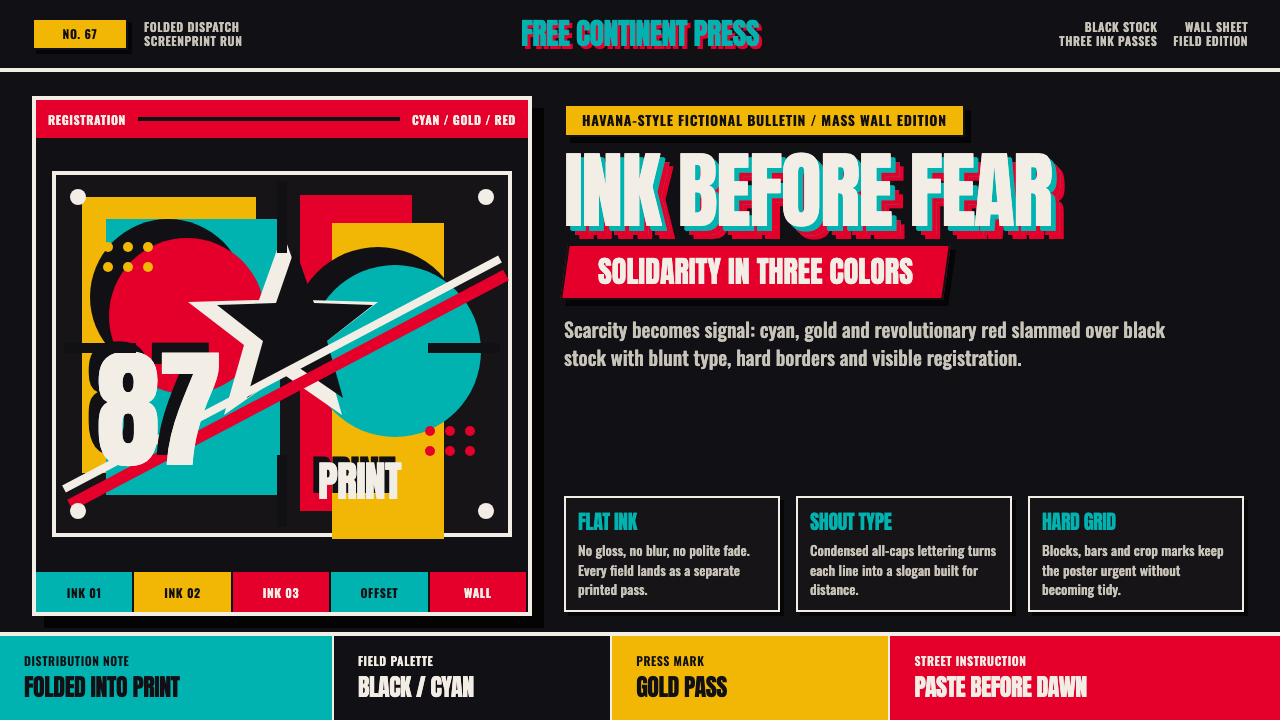 Cuban OSPAAAL Tricontinental PosterUrgency from scarcity. Cyan, gold and red slam over black in blunt silkscreen…
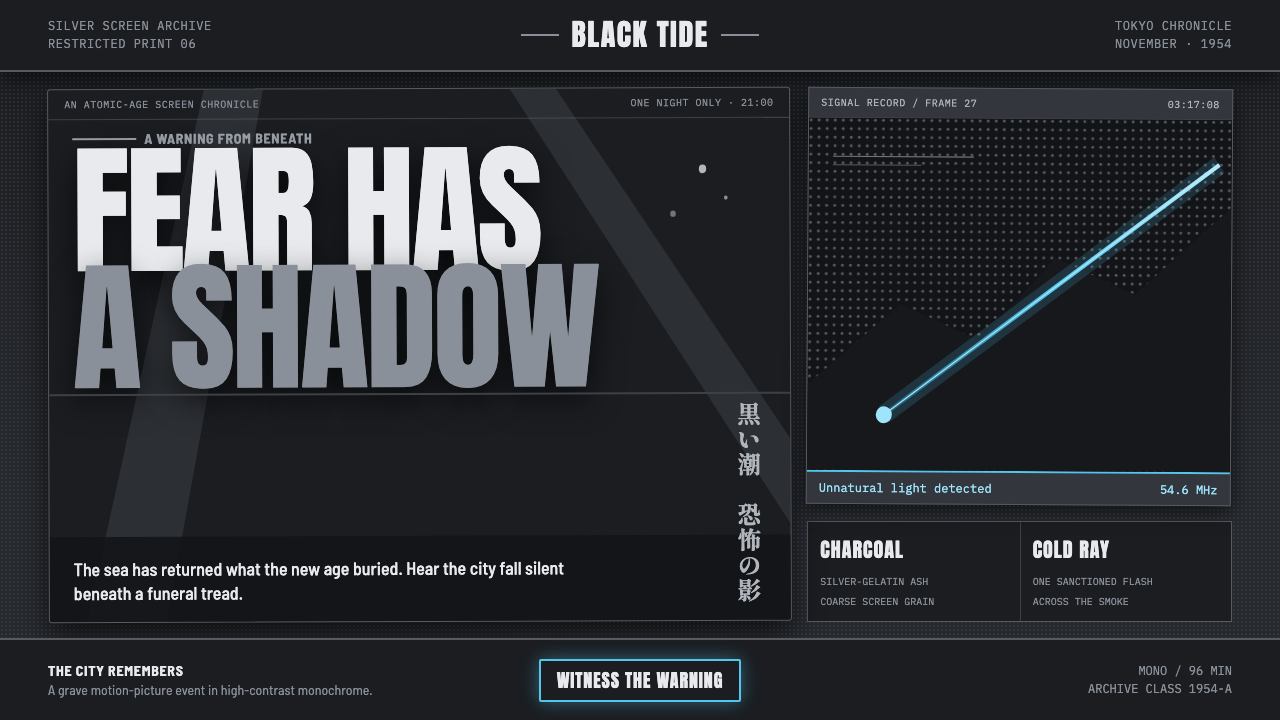 Godzilla (1954 Showa)Fear takes monumental form. Charcoal halftones split under one atomic-blue ra…
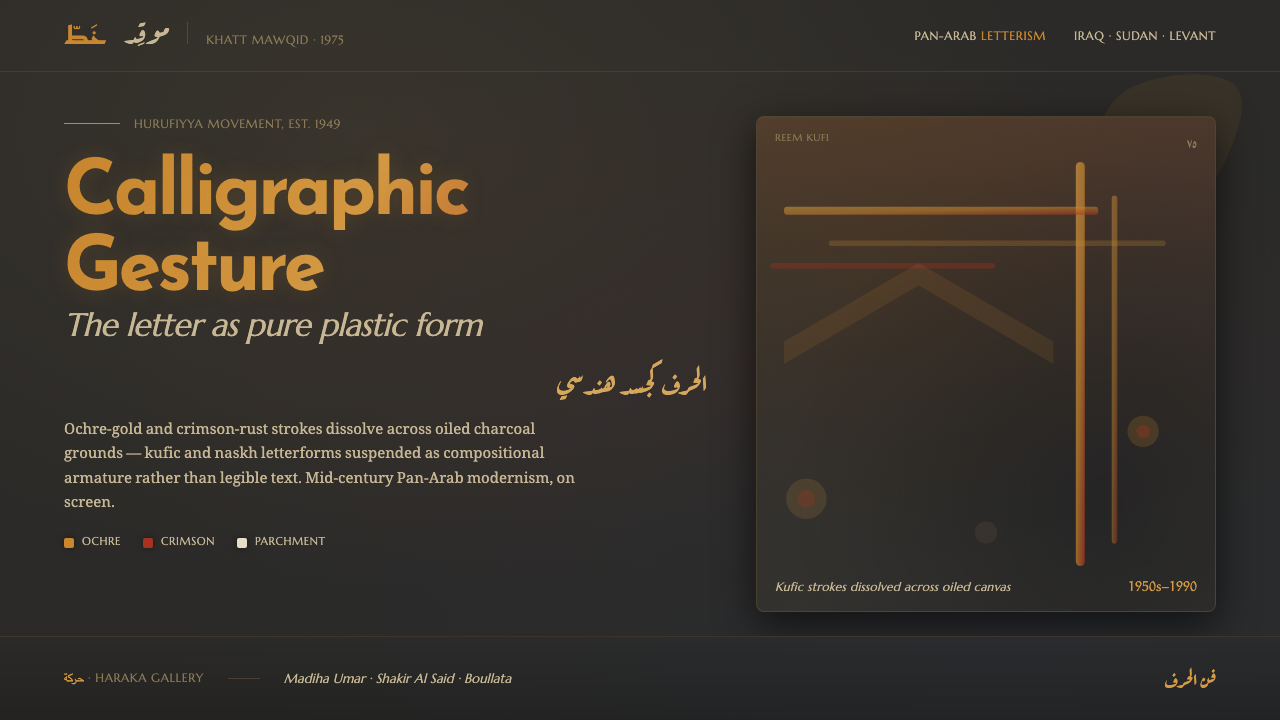 Hurufiyya Letter ArtArabic letters as pure gesture. Ochre and crimson strokes dissolve across oil…
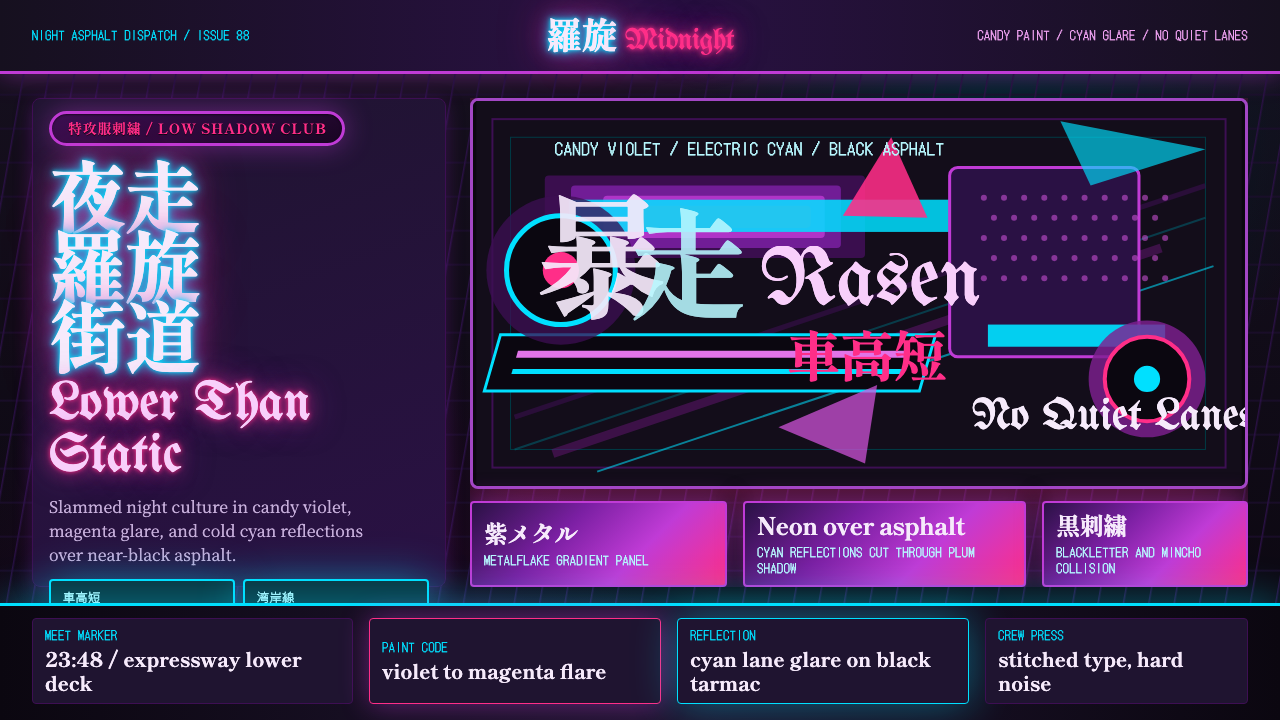 JDM BosozokuNight culture shouts. Candy violet, cyan neon, and stacked Mincho-blackletter…